Bitcoin ATMs: How They Work & Fees
Bitcoin ATMs (sometimes called BTMs or crypto kiosks) look like ordinary cash machines, but they do something quite different: they let you swap physical cash or a card payment for Bitcoin and other cryptocurrencies, and in many cases sell crypto back for cash. They have become one of the most visible on-ramps into digital assets precisely because they are familiar, fast, and require no bank account. That convenience comes at a price, though. Bitcoin ATMs carry some of the highest fees in the entire crypto industry, and they operate under a growing web of identity-verification and licensing rules. This guide explains how the machines actually work, what the costs and limits typically look like, and how regulation and ID checks differ between the United States, Europe, and elsewhere. It is general educational information only and is not financial, legal, or tax advice; rules change quickly, so always confirm specifics with the operator and with official regulators before you transact.
What is a Bitcoin ATM?
A Bitcoin ATM is a self-service kiosk that connects you to a cryptocurrency exchange service rather than to a traditional bank network. Despite the name, most machines are not linked to your checking account at all. Instead, they take cash (or sometimes a debit or credit card) and send the equivalent value in cryptocurrency to a digital wallet you control. The machine handles the trade with a back-end exchange operated by the kiosk company and charges you a fee for the service.
There are two broad types:
- One-way machines let you buy crypto with cash only. These are by far the most common because they are simpler to operate and carry lighter cash-handling and compliance burdens.
- Two-way machines let you both buy and sell, dispensing physical cash when you send crypto to the machine. These are less common and often have stricter verification.
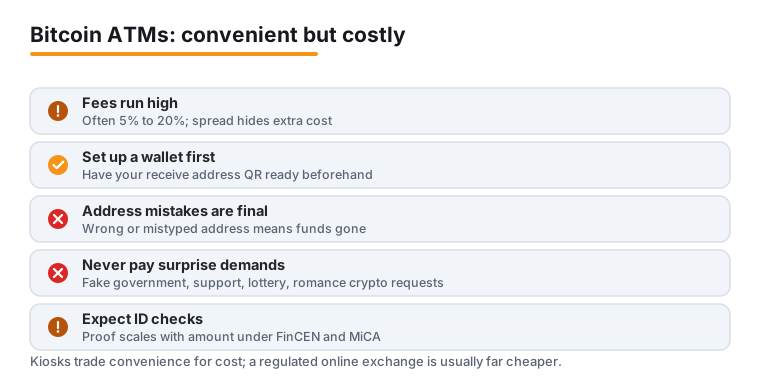
Although the original kiosks were Bitcoin-only, many modern machines also support other assets such as Ethereum, Litecoin, or popular stablecoins. The crucial point to understand is that a Bitcoin ATM is not a custodial account. Once the crypto lands in your wallet, you are responsible for it. If you do not already control a wallet and its private keys or recovery phrase, the coins effectively belong to whoever does. Before using a machine for the first time, set up a reputable self-custody wallet on your phone so you have a wallet address (and its QR code) ready.
How to use one
The exact screens vary by manufacturer and operator, but the buying flow is broadly the same everywhere:
- Find a machine and check the rate. Online maps and directories list nearby kiosks. It is worth comparing a few, because the price and fees can differ significantly between operators on the same street.
- Start a purchase and verify your identity. Most machines now require at least a mobile phone number for a verification code, and larger transactions typically require a government-issued photo ID and sometimes a selfie or palm scan. Verification thresholds depend on the operator and jurisdiction (see the regulation section below).
- Provide your wallet address. Open your crypto wallet app, display your receive address as a QR code, and scan it at the machine, or type the address manually. Double-check it: crypto transactions are irreversible, and sending to a wrong or mistyped address usually means the funds are gone for good.
- Insert cash or pay by card. The screen shows how much crypto you will receive after fees and the current exchange rate. Confirm only if you are comfortable with that net amount.
- Wait for the transfer and keep your receipt. The machine broadcasts the transaction to the blockchain. Depending on network conditions it may take from a few minutes to longer to confirm in your wallet. The printed receipt is your record if you need support.
Selling works in reverse on two-way machines: you tell the kiosk how much you want to sell, send crypto from your wallet to the address (or QR code) the machine displays, and once the network confirms, the machine dispenses cash. A common scam to be aware of: never use a Bitcoin ATM to pay someone who contacted you unexpectedly demanding payment in crypto, including fake government, tech-support, lottery, or romance contacts. Legitimate agencies and businesses do not ask to be paid this way, and these transfers cannot be reversed.
Fees & limits
Bitcoin ATMs are convenient, but they are an expensive way to buy crypto. The total cost usually comes from more than one place, and the headline number on the screen does not always make every charge obvious.
Where the cost comes from
- Operator service fee. A percentage (or sometimes a flat fee) the kiosk company charges for the transaction.
- Exchange-rate spread. The machine usually prices crypto above the open-market rate when you buy (and below it when you sell). This margin is built into the quoted price and can be larger than the stated service fee, so two machines advertising the same percentage fee can still give very different amounts of crypto.
- Blockchain network fee. The cost of recording the transaction on-chain. This varies with network congestion and may be passed on to you or absorbed by the operator.
As a rough guide for 2026, combined buy-side costs commonly fall somewhere in the range of about 5% to 20% of the transaction value, and in some low-competition or premium locations they can run higher. Selling fees are often lower than buying fees. These are general industry ranges only and not a quote: the rate on any given machine depends on the operator, the location, the asset, and current market conditions, so always read the fee disclosure on screen and compare nearby machines before confirming.
Limits
Most machines set minimum and maximum transaction amounts, often with tiered daily limits that rise as you complete higher levels of identity verification. A phone number alone might allow only a small purchase, while a full ID check unlocks larger amounts. Operators set these caps both to manage cash and to stay within regulatory reporting thresholds. To keep effective costs down, people often make fewer, larger transactions rather than many small ones, and compare several operators first. None of this is financial advice; if cost is your main concern, a regulated online exchange is usually far cheaper than a kiosk.
Regulation & ID
Bitcoin ATM operators are regulated businesses in most major markets, and that regulation is the main reason machines ask for identification. The rules differ sharply by country, and they have been tightening. What follows is a general overview, not legal advice, and it is not jurisdiction-specific guidance for operators or users; consult official regulators and a qualified professional for your situation.
United States
Regulation operates on two levels. Federally, Bitcoin ATM operators are generally treated as money services businesses (MSBs) and must register with FinCEN and comply with the Bank Secrecy Act. In practice that means maintaining a written anti-money-laundering (AML) program, appointing a compliance officer, performing Know Your Customer (KYC) checks, screening customers against sanctions lists, and filing reports such as Currency Transaction Reports for large cash transactions and Suspicious Activity Reports where warranted. On top of that, individual states impose their own rules. Many require a money transmitter license, and the bar varies enormously: New York's BitLicense regime is among the most demanding, while some states take a much lighter touch or exempt certain models. Several states have introduced or updated dedicated digital-asset and consumer-protection rules in recent years, and some have added BTM-specific measures such as transaction caps for new customers and mandatory fraud warnings.
Europe
The European Union has moved to a single harmonized framework, the Markets in Crypto-Assets Regulation (MiCA). Under MiCA, firms providing crypto-asset services (including operating crypto ATMs) generally need to be authorized as a Crypto-Asset Service Provider (CASP), with a transitional period for existing businesses that is set to end in mid-2026; a license obtained in one member state can be passported across the bloc. Alongside MiCA, the EU's Transfer of Funds Regulation applies the so-called Travel Rule to crypto transfers and requires identity information to accompany transactions, with full KYC typically required above modest thresholds. Outside the EU, approaches still vary widely, from relatively open regimes to strict licensing or outright restrictions on cash-for-crypto kiosks, so the picture genuinely differs country by country.
What this means for ID checks
For everyday users, the practical upshot is consistent across most regulated markets: expect to verify your identity, and expect the level of proof required to scale with the amount. Small transactions may need only a phone number; larger ones typically require a government photo ID, and sometimes a selfie, fingerprint, or palm scan. Anonymous, no-ID crypto kiosks are increasingly the exception rather than the rule. Because reporting thresholds and verification rules change, treat the requirements at any specific machine as the authoritative ones, and verify current law with official sources rather than relying on a general guide.
Frequently asked questions
Why are Bitcoin ATM fees so high?
Operators face real costs that online exchanges do not: buying and maintaining industrial kiosks, paying rent for retail placement, moving and insuring physical cash, and meeting registration and compliance obligations. Those costs, plus a profit margin, are recovered through a service fee and an exchange-rate spread, which together commonly push the total well above what you would pay trading online. The fee also reflects the convenience of instant, near-anonymous, no-bank-account access.
Do I need a bank account or an ID to use a Bitcoin ATM?
You generally do not need a bank account, since most machines take cash. You do, however, usually need some form of identity verification, and the requirement increases with the transaction size. A small purchase might need only a mobile number, while larger amounts typically require a government-issued photo ID and sometimes a selfie or biometric scan. The exact threshold depends on the operator and local law.
Are Bitcoin ATMs legal?
In most major markets they are legal but regulated. In the United States, operators must register federally with FinCEN and often hold state money transmitter licenses. In the European Union, they fall under the MiCA framework and the Travel Rule. Some jurisdictions impose strict conditions or restrictions, so legality and the precise rules vary by location. This is general information, not legal advice; check official regulators for your area.
Can I get my money back if I make a mistake at a Bitcoin ATM?
Usually no. Cryptocurrency transactions are irreversible once broadcast to the blockchain, so sending coins to the wrong wallet address typically means they are unrecoverable. Always verify the receiving address carefully before confirming. Keep your receipt and contact the operator promptly if a machine malfunctions, but do not assume a transfer can be reversed.
How long does a Bitcoin ATM transaction take?
The on-screen part takes only a few minutes, but the crypto itself arrives once the transaction is confirmed on the blockchain. That can range from a few minutes to longer depending on network congestion and the asset involved. Selling for cash at a two-way machine similarly requires the network to confirm your transfer before the kiosk dispenses money.
Last updated: 2026-06.