How to Swap One Crypto for Another Safely
Swapping one cryptocurrency for another, for example trading ETH for the stablecoin USDC, is one of the most common things people do with crypto. It is often the step before doing something else with a coin, such as staking it to earn rewards. It sounds simple, and on the easy route it almost is. The harder route gives you more control but also more ways to lose money or get tricked, so it is worth understanding both before you move any funds.
This guide walks through the two main ways to swap: a centralized exchange (the simple, custodial option) and a decentralized exchange, or DEX, run from your own wallet (non-custodial, with more steps). It explains the fees, the jargon like slippage and price impact, the scams to watch for, and the tax point most people miss. None of this is financial or tax advice; it is general education, and rules vary by country.
The two routes, compared
There are two practical ways to turn one coin into another. They differ in who holds your funds, what you pay, and how much can go wrong.
The centralized exchange (CEX) route uses a "Convert" button or a spot trade screen on an exchange. The exchange is custodial, meaning it holds the coins for you. The cost is bundled into a single trading fee, commonly 0.1% to 0.6% on the standard trade screen and more on the one-tap instant buttons, and there is no separate network or gas fee for the swap itself.
The decentralized exchange (DEX) route, using something like Uniswap, runs from your own wallet and is non-custodial: you keep control of your keys and your coins the whole time. In exchange for that control you pay a protocol fee, plus the network gas fee, plus any slippage. For obscure or low-liquidity tokens, the price impact and slippage can be far larger than on a deep centralized order book.
| Feature | Centralized exchange | Decentralized exchange (DEX) |
|---|---|---|
| Who holds the coins | The exchange (custodial) | You (non-custodial) |
| What you pay | One bundled trading fee (about 0.1% to 0.6%) | Protocol fee + gas + slippage |
| Gas fee | None for the swap itself | Yes, paid by you |
| Steps involved | Few | More |
| Ways to go wrong | Fewer | More (fake tokens, approvals, slippage) |
Neither route is universally "better." The CEX route is simpler and harder to ruin, while the DEX route keeps you in control and reaches tokens a centralized exchange may not list. If you want a refresher on how non-custodial protocols work in general, see our guide to DeFi.
Route A: the easy route on an exchange
If your coins already sit on a centralized exchange, the "Convert" or trade screen is the lowest-effort option. Because the exchange is custodial and matches the trade internally, you do not touch a wallet, sign a transaction, or pay gas.
- Open the Convert tool or the spot trade screen for the pair you want, for example ETH to USDC.
- Enter the amount and review the quoted rate and the fee.
- Confirm. The new coin appears in your exchange balance.
The cost is the trading fee, commonly 0.1% to 0.6% on the standard screen and higher on instant one-tap buttons, with no separate gas fee. Published fee schedules differ between exchanges; Coinbase is one example of an exchange that documents its fees openly. The trade-off for this simplicity is that the exchange holds your coins the whole time, so you are trusting it with custody.
Route B: swapping on a DEX, step by step
A DEX swap happens entirely from your own wallet. You stay in control, but you also take on every responsibility yourself. The core procedure looks like this:
- Confirm you are on the official site and the right network. Type the address yourself or use a trusted bookmark rather than clicking a search ad or a link from a message. Then check your wallet is set to the network you intend to trade on, because the same token can exist on several networks. If you are unsure, see how to choose the right network.
- Connect your wallet. The DEX will request a connection; approve it only on the site you trust.
- Pick the two tokens and verify the contract address of the one you are buying. Fake tokens that copy a real token's name are common on DEXs. Always confirm the official token contract address from a reliable source before selecting it, since the name and logo alone prove nothing.
- Review the quote, the price impact, and the fees. The interface shows the expected output, the estimated price impact, and the protocol fee. Add the gas fee on top.
- Set a sensible slippage tolerance. This is covered in detail in the next section.
- Approve the token allowance. Before a DEX can move a token out of your wallet, you grant it an approval (allowance). Approvals can be abused, so it is good practice to limit them and revoke ones you no longer need afterward.
- Confirm the swap and check it on a block explorer. Your wallet asks for a final signature. Once it confirms, look up the transaction on an explorer to see exactly what moved.
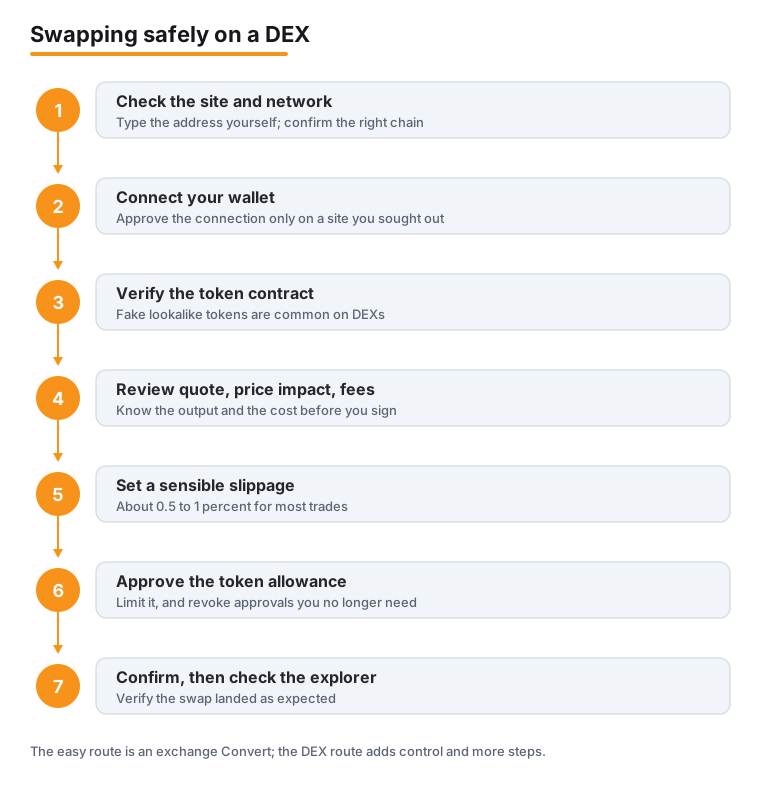
Every one of these steps is a place where a careless click can cost you, which is the price of self-custody. Every step rewards the same patience and double-checking that careful self-custody always demands.
Slippage and price impact explained
Two related ideas decide how good a price you actually get on a DEX.
Slippage is the difference between the price you expected and the price the swap actually executed at. Prices can move in the seconds between quoting and confirming, especially in busy or thin markets. Slippage tolerance is the maximum price movement you are willing to accept before the swap automatically fails.
Choosing that tolerance is a balance:
- For most trades, 0.5% to 1% is reasonable.
- Smaller or low-liquidity tokens may need 1% to 3% to go through.
- Setting it too low causes the swap to fail and still wastes the gas you spent trying.
- Setting it too high (5% and up) exposes you to front-running, where bots see your pending trade and manipulate the price to extract value from you.
Price impact is how much your own trade moves the price because of the size of your order relative to the pool. A large swap in a shallow pool suffers heavily: a 100,000 USD swap in a pool holding about 1,000,000 USD of liquidity might lose 5% to 10% to slippage, while a deep centralized order book could absorb the same size with little impact. For clear, vendor-written explainers of these mechanics, both MetaMask and Uniswap publish guides worth reading.
MEV, sandwich attacks, and how to reduce them
On public networks, your pending transaction is visible before it is finalized, and automated bots compete to profit from that information. This activity is broadly called MEV (maximal extractable value). The most common form that affects ordinary swappers is the sandwich attack: a bot places a buy right before your trade and a sell right after it, pushing the price against you and pocketing the difference.
A high slippage tolerance makes sandwich attacks easier, because it gives the bot more room to move the price while still letting your trade succeed. That is the practical reason to keep slippage only as high as you genuinely need. Several habits reduce the damage:
- Keep slippage tolerance tight rather than padding it "to be safe."
- Split a large trade into smaller parts so each one moves the price less.
- Use an aggregator such as 1inch, which routes a single trade across several pools to reduce price impact.
Aggregators help because liquidity for a given pair is often spread across many separate pools; routing through several at once can find a better overall price than any single pool offers. Reducing the number and size of transactions also tends to lower what you pay overall, which our note on lowering crypto fees goes into further.
Token approvals and staying safe
The approval step on a DEX deserves special attention because it is a frequent source of losses. When you grant an allowance, you are giving a smart contract permission to move a certain amount of one of your tokens. A malicious or excessive approval can later be used to drain those tokens, sometimes long after the trade you thought you were authorizing.
Two habits keep this in check. First, where the wallet lets you, limit an approval to the amount you are actually swapping rather than an unlimited allowance. Second, periodically revoke approvals you no longer need, so an old permission cannot be exploited later. Our walkthrough on revoking token approvals shows how to review and remove them.
Beyond approvals, the safety basics for a DEX swap are: verify the site address yourself, confirm the token contract before buying, read exactly what each signature authorizes, and never approve a transaction you do not understand. Self-custody means there is no support desk to reverse a mistake.
Taxes: the part people forget
Here is the detail that surprises many people: in most countries, swapping one coin for another is a taxable event, even though no cash ever reached your bank account. Trading ETH for USDC, for example, is generally treated as disposing of the ETH, which can create a reportable gain or loss based on its value at the time.
This applies to both routes. A "Convert" on a centralized exchange and a swap on a DEX are usually treated the same way for tax purposes; the convenience of the easy route does not make it tax-free. Keep a record of the date, the amounts, and the values of each swap so you can report accurately. Tax treatment varies widely by country and changes over time, so check official guidance for where you live. Our overview of crypto taxes is a starting point, not a substitute for advice from a qualified professional.
Frequently asked questions
Is it cheaper to swap on an exchange or on a DEX?
It depends on the trade. A centralized exchange bundles the cost into a single trading fee, commonly 0.1% to 0.6% on the standard screen, with no separate gas fee. A DEX charges a protocol fee plus network gas plus any slippage. For small or routine swaps the exchange is often simpler and predictable, while for tokens an exchange does not list, a DEX may be the only option. For low-liquidity tokens, DEX slippage and price impact can make the true cost much higher than the headline fee.
What is a safe slippage tolerance to set?
For most trades, 0.5% to 1% is a reasonable balance. Smaller or low-liquidity tokens may need 1% to 3% to go through. Setting it too low causes the swap to fail and wastes the gas you already spent trying. Setting it too high, around 5% and up, exposes you to front-running, where bots manipulate the price because your large tolerance gives them room to do so. Keep it only as high as the trade genuinely requires.
Why did my DEX swap fail but still cost gas?
A swap can fail if the price moves more than your slippage tolerance allows between the time you confirm and the time the transaction is processed. The network still does the work of attempting and reverting the transaction, so the gas you paid to try is not refunded. Raising slippage slightly can help thin-liquidity trades succeed, but raising it too far invites front-running, so adjust carefully rather than setting it very high.
How do I avoid buying a fake token?
Fake tokens that copy a real token's name and logo are common on DEXs, and the name alone proves nothing. Before swapping, verify the official token contract address from a reliable source and confirm it matches what the DEX has selected. Also make sure you are on the official site and the correct network. Taking these two checks seriously removes the most common way people end up holding a worthless lookalike token.
Do I have to pay tax when I swap one coin for another?
In most countries, yes. Swapping one coin for another is usually a taxable event even though no cash reached your bank, because it is generally treated as disposing of the first coin. This is true for both a centralized exchange "Convert" and a DEX swap. Keep records of dates, amounts, and values, and check the official tax guidance for your country, since rules vary and change. Consider a qualified professional for anything significant.
Should I revoke token approvals after swapping?
It is good practice. On a DEX you grant a token approval before swapping, and a malicious or excessive approval can later be used to move your tokens. Limiting approvals to the amount you need and revoking ones you no longer use reduces the risk that an old permission is exploited. Many wallets and dedicated tools let you review and remove existing approvals in a few clicks.
Last updated: 2026-06.
Related guides
- How to Accept Crypto Payments as a Business
- How to Choose the Right Network When Sending Crypto (ERC-20 vs TRC-20 vs BEP-20)
- Getting Paid in Crypto: How Stablecoin Salaries Actually Work
- How to Back Up Your Seed Phrase (and Test That It Works)
- How to Buy & Sell Crypto: Step-by-Step
- How to Set Up a Self-Custody Wallet
- Crypto Scams and Fraud: How to Stay Safe