How to Lower Crypto Transaction Fees
Crypto fees can feel random, but they are not. Most of what you pay comes down to three separate charges, and each one has a lever you can pull to make it smaller. None of these levers require special tools or insider access. They mostly require understanding what you are being charged for and slowing down enough to choose.
This guide explains the three fees you actually meet, then walks through the practical ways to lower each one and the trade-offs that come with them. The goal is not to chase the cheapest possible number at any cost. It is to stop overpaying for things you did not need to pay for. This is educational information, not financial advice.
The three fees you actually pay
When you move or trade crypto, you usually meet three different fees. They are charged by different parties for different reasons, and mixing them up is the most common reason people overpay.
The first is the blockchain network fee. This is paid to the people who run the network (validators or miners), not to your exchange or wallet. On Ethereum it is called gas. On Bitcoin it is measured in satoshis per virtual byte (sats/vB). It exists because block space is limited, so users effectively bid for it.
The second is the exchange trading fee, charged when you buy or sell on a platform. The third is the exchange withdrawal fee, charged when you move crypto off the platform to your own wallet. Each of these has its own way of being lowered, so it helps to treat them separately. To understand gas in more depth, see our explainer on Ethereum gas fees.
The main levers to cut your fees
Here are the practical ways to pay less, roughly in order of how much they tend to save. You will not use all of them every time. Pick the ones that fit what you are doing.
- Pick a cheaper network for the asset. For stablecoins, sending on a low-fee network instead of Ethereum mainnet can cut the network fee dramatically, but only if the receiver supports that network.
- Time it for low congestion. Network congestion tends to spike during US and European waking hours. Moving non-urgent transactions to quieter hours can lower the fee.
- Set a lower priority fee or fee rate when you are not in a rush. A higher rate confirms faster; a lower one waits longer but costs less.
- Use the standard trading screen, not the one-tap instant-buy button. The same coin can cost far more through the convenience button.
- Batch or consolidate. Combine small amounts into fewer, larger movements so you pay the network fee fewer times.
- Withdraw larger amounts less often. A flat withdrawal fee is a smaller percentage of a big withdrawal than a tiny one.
- Use your wallet's low, medium, and high setting wisely. Reach for low or medium when nothing is urgent.
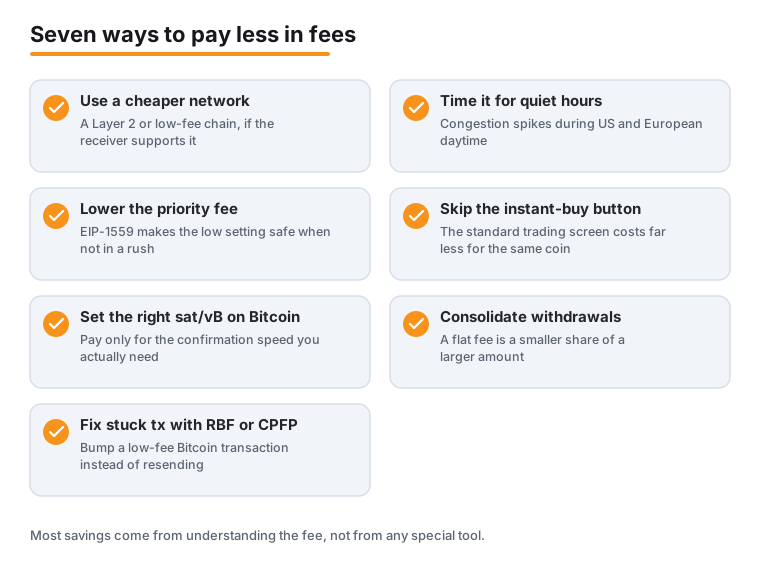
The rest of this guide explains each lever, plus how to rescue a transaction you already sent with too low a fee.
Choose a cheaper network, but check the receiver first
The single biggest saving is often choosing the right network for what you are moving. Ethereum mainnet is secure and widely supported, but it is not always the cheapest place to transact. Layer 2 networks such as Arbitrum, Base, and Optimism settle to Ethereum while reducing fees by roughly 100 to 1000 times versus Ethereum mainnet.
For stablecoins specifically, choosing a low-fee network such as Tron, Solana, or a Layer 2 instead of Ethereum mainnet can cut the network fee dramatically. The catch is non-negotiable: this only works if the receiver supports that network. The cheapest chain is worthless to you if the exchange or wallet on the other end cannot accept funds on it. Sending to an unsupported network can mean the funds are stuck or lost.
So before you save money on the network, confirm the destination supports it. If you are unsure how to do that, see how to choose the right network. The official Ethereum documentation also explains how gas works across the ecosystem at ethereum.org.
Time it, and use EIP-1559 to make low safe
Block space is auctioned, so the price moves with demand. Congestion tends to spike during US and European waking hours. If your transaction is not urgent, sending it during a quieter window can meaningfully lower the cost.
On Ethereum, understanding EIP-1559 makes timing easier. Under EIP-1559, an Ethereum fee splits into a base fee set by the protocol, which is burned and removed from supply, and a priority fee, which is a tip to the validator that you set. Because the base fee is predictable, your wallet's low setting is usually safe when you are not in a hurry. It may simply wait for a slight dip in traffic before confirming.
As of 2026, Ethereum base fees are often very low, a fraction of a gwei, and a simple ETH transfer can cost only cents, though busy periods cost more. You can read the original specification at EIP-1559. The practical takeaway: when you are not racing anyone, choosing low or medium rarely backfires.
Set the right fee rate on Bitcoin
Bitcoin works differently from Ethereum but the principle is the same. The fee is measured in satoshis per virtual byte (sats/vB), and a higher rate confirms faster. When the network is quiet you can set a low rate and still get confirmed in a reasonable time; when it is busy, a low rate may wait hours or longer.
The tool most people use to check current rates and estimated wait times is mempool.space. It shows the going rate for fast, medium, and slow confirmation so you can pick deliberately instead of guessing. Learning to read this kind of data is a useful skill in general; see how to read a blockchain explorer.
The honest trade-off is time. Underpaying does not lose your money, but it can leave the transaction waiting. The next section covers what to do when that happens.
Rescue a stuck low-fee Bitcoin transaction
If you set a fee too low and the transaction is stuck unconfirmed, you are not out of options. There are two standard fixes.
The first is Replace-By-Fee (RBF). This rebroadcasts the same transaction with a higher fee, replacing the original so miners have a reason to include it. Your wallet must have enabled RBF on the original transaction for this to work.
The second is Child-Pays-For-Parent (CPFP). Here the receiver spends the incoming funds in a new transaction that carries a high fee, so miners confirm both the parent and the child together to collect that fee. This is useful when RBF was not available or when you are on the receiving end.
| Method | Who does it | When to use |
|---|---|---|
| RBF | The sender | The original transaction had RBF enabled |
| CPFP | The receiver | RBF was not enabled, or you received the funds |
A similar concept exists on Ethereum, where you can resend a transaction with a higher fee. The Etherscan Information Center walks through that process.
Avoid the convenience markup when you trade
One of the easiest savings has nothing to do with networks. It is choosing where you click to buy. Standard trading-screen fees are typically 0.1% to 0.6%. The one-tap instant-buy buttons, the big friendly buy button on the home screen, can cost 0.5% to 3% or more in markup and spread, for the exact same coin.
The instant-buy button is built for speed and simplicity, and you pay for that convenience. If you take the extra few steps to use the standard trading screen, often labeled as a spot market or an order book, you frequently pay several times less. The coin is identical; only the price of the convenience differs.
If you are moving between assets rather than buying with cash, the same caution applies to swap interfaces. See how to swap one crypto for another for what to watch.
Consolidate and withdraw larger amounts less often
An exchange withdrawal network fee is usually a flat amount per withdrawal, not a percentage. That changes the math in an important way. If the fee is fixed, withdrawing a tiny amount can lose a large percentage of it to that single fee, while the same fee on a larger withdrawal is a small percentage.
The practical move is to consolidate: instead of many small withdrawals, make fewer, larger ones. You pay the flat fee fewer times, so it eats a smaller share of your total. The same logic applies on Bitcoin to combining small balances, though that itself costs a fee, so it is best done when network rates are low.
The trade-off is that holding a larger balance on an exchange before withdrawing carries its own custody risk, since you do not control those coins. Balance the fee saving against how comfortable you are leaving funds on a platform. For the broader safety checklist, see how to send crypto safely.
Frequently asked questions
Will choosing a lower fee make me lose my crypto?
No. Setting a lower fee does not put your funds at risk; it affects speed, not safety. A lower fee simply means your transaction may wait longer to confirm, especially when the network is busy. If it gets stuck, you can use tools like Replace-By-Fee or Child-Pays-For-Parent on Bitcoin, or resend with a higher fee on Ethereum, to move it along.
Is the wallet's low setting risky?
Usually not, when you are not in a hurry. Under EIP-1559 on Ethereum, the base fee is set by the protocol and is predictable, so the low setting is generally safe and just waits for a slight dip in traffic. The main downside is time. If you genuinely need a transaction confirmed quickly, choose medium or high instead.
Why is the same coin cheaper on the trading screen than the buy button?
Because you are paying for convenience. The one-tap instant-buy button bundles in markup and spread, often 0.5% to 3% or more, while the standard trading screen typically charges 0.1% to 0.6%. The coin is identical. The difference is the price of speed and simplicity, which you can avoid by taking a few extra steps.
Should I always use the cheapest possible network?
No. The cheapest network only helps if the receiver supports it. Sending stablecoins on a low-fee chain such as Tron, Solana, or a Layer 2 can cut the network fee dramatically, but if the destination exchange or wallet does not accept that network, the funds can be stuck or lost. Always confirm the receiver supports the network before you save on the fee.
How do I know what fee rate to set on Bitcoin?
Check current conditions before sending. Tools like mempool.space show the going rate in satoshis per virtual byte for fast, medium, and slow confirmation, along with estimated wait times. A higher rate confirms faster. When the network is quiet you can pick a low rate and still confirm reasonably; when it is busy, a low rate may wait a long time.
Does timing really matter for fees?
Yes, for non-urgent transactions. Congestion tends to spike during US and European waking hours, which pushes fees up. Moving a transaction that can wait to a quieter window can lower what you pay. This matters more on Ethereum mainnet and Bitcoin during busy periods than on Layer 2 networks, where fees are already much lower.
Last updated: 2026-06.
Related guides
- How to Move Crypto Between Exchanges (Without Losing It)
- How to Read a Blockchain Explorer and Track Your Transaction
- How to Read a Crypto Whitepaper Before You Buy
- How to Send Crypto Safely: A Step-by-Step Guide
- How to Set Up 2FA and Stop SIM-Swap Attacks
- How to Set Up a Self-Custody Wallet
- Crypto Scams and Fraud: How to Stay Safe