How to Read a Crypto Whitepaper Before You Buy
A whitepaper is the document a crypto project uses to explain what it does, how the token works, and who is behind it. Reading one properly is one of the cheapest things you can do before putting money in. It will not tell you whether a project succeeds, but it will catch a lot of the junk, and that alone is worth the hour it takes.
What a whitepaper is, and what it is not
The whitepaper started as a technical paper. Bitcoin's, published in 2008, is nine pages and reads like a research note. Ethereum's came a few years later and laid out the idea of programmable contracts. Both were written to explain a design, not to sell you anything.
That is not how most papers read now. A lot of them are marketing decks with a token attached. So the first thing to decide is which kind you are holding. Is this document trying to teach you how something works, or is it trying to get you to buy before a deadline? You can usually tell within the first two pages.
Here is the honest part up front. A clean, well-written whitepaper is a filter, not proof. Scammers can write good papers, and serious teams sometimes write clumsy ones. Reading the paper removes the obvious failures from your list. It does not promote what is left to a sure thing. Treat it as one check among several, alongside the team, the code, the on-chain data, and how the project actually behaves.
The problem it claims to solve
Start with the abstract and the introduction. In plain terms, what problem does this project say it fixes, and why does that problem need a blockchain at all?
That second part matters more than people think. Plenty of papers describe a real problem, then bolt a token onto a solution that would work fine without one. If you read the use case and a normal database or a normal app would do the same job, ask why the token exists. Sometimes the answer is fine. Often the token is there because selling a token was the actual goal.
Look for specifics. A good paper names the thing it is competing with and says how it differs. A weak one talks in generalities about disruption and the future of finance without ever explaining the mechanism. If you finish the problem section and still cannot say in one sentence what the thing does, that is a signal in itself.
Tokenomics: read this section twice
This is where money is won and lost, so slow down here. You are looking for four things: how many tokens exist, how that number changes over time, who holds them, and what the token is actually for.
Supply first. Is there a fixed cap, or can the team mint more whenever they want? Unlimited or open-ended minting is a real risk, because new tokens dilute the ones you hold. Then look at inflation and emissions. Many tokens pay out new supply as staking rewards or liquidity incentives. That is not automatically bad, but it means tokens are entering circulation constantly, and someone is selling them.
Now the part most people skip: distribution and vesting. Find the chart that shows who gets the tokens. A team and advisor slice under about 20% is generally considered healthy. When a large chunk, say over 30 to 40%, goes to the team and private investors, you are exposed to those people selling into you later. Vesting is the schedule that controls when their tokens unlock. The common standard is roughly a four-year vest for the team with a one-year cliff, and two to three year lockups for investors. Short vesting, like everything unlocking inside a year, sets up an insider dump.
You do not have to take the paper's word for any of this. Sites like CoinGecko, CoinMarketCap, CryptoRank, DefiLlama and Tokenomist publish token unlock and vesting calendars, and a block explorer like Etherscan shows you the actual top holders of a token. If the paper says distribution is fair and the explorer shows three wallets holding most of the supply, believe the explorer.
Last, fees and utility. What does the token do inside the system? Does it pay for gas, secure the network through staking, grant governance votes, or unlock a real service? If the honest answer is that the token does nothing except go up when more people buy it, that is the description of a greater-fool trade, not a use case.
Roadmap, and whether they hit past milestones
Any project can draw a roadmap. The useful question is not what they promise next quarter, it is what they promised last year and whether it shipped.
This is easy to check and almost nobody does it. Find an older version of the roadmap. Look at the project's GitHub, its blog, its old announcements. If the paper from two years ago promised a mainnet, a wallet, and partnerships, did those arrive, and roughly on time? A team with a track record of hitting dates earns some trust. A team that keeps pushing the same milestone back, or quietly drops things and replaces them with new buzzwords, is telling you something.
Be wary of roadmaps that are mostly price and listing events rather than product. "Listed on a major exchange" and "reach a target market cap" are not engineering milestones. They are sales targets dressed up as progress.
Can you actually verify the team?
A real team is usually willing to put their names and faces on the work. Look for full names, real LinkedIn profiles with history you can cross-check, past projects, and public talks or code commits. A fully named, traceable team is a good sign.
Anonymous teams are not automatically fraud. Bitcoin's creator was pseudonymous and that worked out. But anonymity plus a hard sell is a bad pairing. If the team hides behind handles like "CryptoWhale" while promising you life-changing returns and pushing you to buy before a deadline, the two things together are the warning, not either one alone.
Check the photos. Reverse-image search a few headshots. Stock photos or faces lifted from other sites mean the team probably does not exist as shown. And check that named advisors actually know they are advisors. It happens more than you would think that a project lists a well-known name who has never heard of them.
Red flags you can spot fast
Some warning signs take five minutes. These are the ones worth memorising, because they catch a large share of bad projects before you waste time on the details.
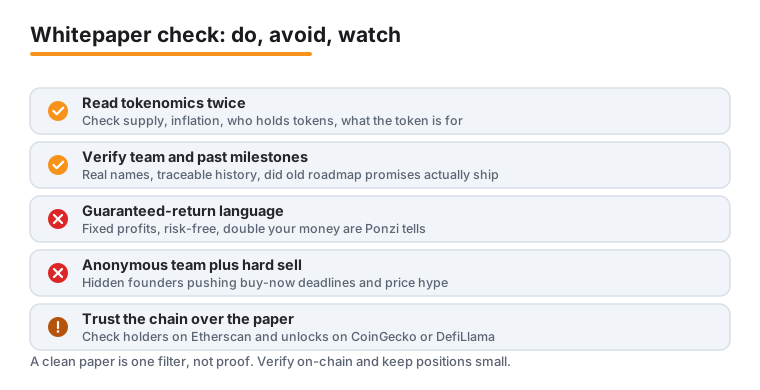
Guaranteed-return language is the big one. No real investment promises fixed profits, because markets move. Phrases like "guaranteed daily returns", "risk-free", or "double your money in 30 days" are the language of a Ponzi scheme. BitConnect promised steady daily returns and collapsed, taking billions with it. If a paper guarantees a number, stop reading and walk away.
Then the writing itself. A paper riddled with typos, broken formatting, or sections that read like they were copied from somewhere else suggests a team that either could not be bothered or is hiding a thin idea. Try pasting a distinctive paragraph into a search engine. If it turns up word-for-word in another project's paper, you have your answer.
Manufactured urgency is another tell. "Limited time", "get in before the explosion", countdown timers on the buy page. Real technology does not expire on Friday. Urgency is there to stop you thinking. And watch for the combination from earlier: anonymous team, hard sell, and a token with no clear job. Any one might be explainable. All three together rarely are.
Cross-check the paper against reality
The paper is a claim. Your job is to test it against things the team cannot edit.
If the token is live, open a block explorer and look at the holder list and the contract. Is supply concentrated in a few wallets? Has the contract been audited, and by whom? An unaudited or unverified contract handling your money is a real risk. If there is a smart contract, see whether reputable firms have reviewed it and whether the report is public, not just a logo on the website.
Look at where the token trades and how. A token only on small decentralised exchanges with thin liquidity, no listing on CoinGecko or CoinMarketCap, and liquidity that is unlocked or locked for only a few weeks, is easy to manipulate or pull. None of this is in the whitepaper, which is exactly why you check it. The paper tells you the story. The chain tells you the facts.
A simple order to read it in
If you want a routine, here is one that works and takes under an hour. Read the abstract and conclusion first to get the core promise. Then go straight to tokenomics and read it twice, checking supply, vesting and distribution against an unlock tracker and a block explorer. Then the problem section, asking whether the token is even needed. Then the team, verifying names and photos. Then the roadmap, comparing old promises to what shipped.
By the end you should be able to say, in plain words, what the project does, who holds the tokens and when they unlock, who built it, and what the token is for. If you cannot answer those after reading, the gap is the answer. And remember the limit: passing this review means the project is not obviously broken. It does not mean it is good. Keep your position small enough that being wrong does not hurt.
Frequently asked questions
Do I really need to read the whole whitepaper?
You should at least read the abstract, the tokenomics section, and the team section closely, and skim the rest. Tokenomics is where most of your money risk lives, so that part deserves a careful second read. The technical chapters you can skim unless you have the background to judge them.
Is an anonymous team always a scam?
No. Bitcoin itself came from a pseudonymous creator and turned out fine. The danger is anonymity combined with a hard sell and promises of returns. A quiet, anonymous team shipping working code is very different from anonymous founders pushing you to buy before a countdown ends.
What token distribution counts as a red flag?
Watch the share going to the team and private investors. Under about 20% to the team and advisors is generally seen as healthy. Once a large portion, say over 30 to 40%, sits with insiders on short vesting schedules, you are exposed to them selling into you when tokens unlock. Check the unlock schedule, not just the headline split.
How do I check if the team actually delivered past milestones?
Find an older version of the roadmap from the project's blog, old announcements, or web archive, then compare it to what exists today. Look at their GitHub for real activity. A team that consistently hits dates earns trust. One that keeps moving the same milestone or swaps it for new buzzwords is telling you to be careful.
Where can I verify tokenomics claims independently?
Token unlock and vesting calendars on CoinGecko, CoinMarketCap, CryptoRank, DefiLlama and Tokenomist let you check supply and unlock dates. A block explorer like Etherscan shows the real top holders of a token. If the paper and the on-chain data disagree, trust the chain.
If the whitepaper looks clean, is the project safe to buy?
No. A solid whitepaper only means the project is not obviously broken on paper. Scammers can write good documents, and the paper cannot tell you about future execution, market conditions, or a team that turns dishonest later. Treat it as one filter among several and keep any position small enough that being wrong is survivable.
Last updated: 2026-06-24.
Related guides
- How to Send Crypto Safely: A Step-by-Step Guide
- How to Set Up 2FA and Stop SIM-Swap Attacks
- How to Set Up a Hardware Wallet (Ledger or Trezor), Step by Step
- How to Stake Crypto: A Step-by-Step Beginner's Guide
- How to Swap One Crypto for Another Safely
- How to Set Up a Self-Custody Wallet
- Crypto Scams and Fraud: How to Stay Safe