Ethereum Gas Fees Explained: Why They Vary and How to Pay Less
If you have ever tried to send Ethereum, swap tokens, or mint something and watched the network ask you for an extra fee on top of the amount you wanted to move, you have met gas. Gas can feel random and frustrating: one minute a simple transfer costs a few cents, the next it costs more than the thing you are buying. The good news is that gas follows clear rules. Once you understand what you are paying for and when, you can routinely cut your fees by a large amount, sometimes by more than ninety percent, just by changing where and when you transact. This guide explains gas in plain language and walks through the practical settings that lower your costs.
This is educational information, not financial advice. Crypto is volatile and full of scams, so treat every link, app, and wallet prompt with care.
What gas actually is
Every action on Ethereum, sending coins, swapping tokens, approving a contract, takes computing work from thousands of computers (called nodes) that run the network. Gas is simply the unit that measures how much computing work your action requires. You pay for that work in Ethereum's own currency, ETH.
A plain ETH transfer to an ordinary wallet address costs a fixed amount of work: 21,000 gas. More complex actions cost more because they ask the network to do more. A token swap on a decentralized exchange might use 150,000 to 250,000 gas. Minting an NFT or interacting with a complicated smart contract can use even more.
Think of it like a taxi fare. The distance (gas units) is set by how far you are going, but the price per mile (the gas price) changes depending on how busy the roads are. Your total fee is the two multiplied together:
- Gas used (how much work) multiplied by
- Price per unit of gas (set by network demand)
You can see exactly how much gas any past transaction used by pasting its ID into a block explorer such as Etherscan.
Gwei: the unit you will actually see
Gas prices are quoted in gwei, not in whole ETH, because whole ETH would be an absurdly tiny number. One gwei is one billionth of an ETH (0.000000001 ETH). Quoting prices in gwei keeps the numbers human readable.
When a wallet tells you the network is running at "0.5 gwei," that is the price per unit of gas. To estimate a simple transfer:
- 21,000 gas multiplied by 0.5 gwei equals 10,500 gwei.
- 10,500 gwei is 0.0000105 ETH.
- At an ETH price of, say, 1,900 dollars, that is roughly 2 cents.
Notice what drives the dollar cost: the gwei price and the dollar price of ETH. When either rises, your fee rises, even if the action is identical. This is why the same swap can cost a few cents one week and several dollars another week.
Base fee vs priority fee (and why fees spike)
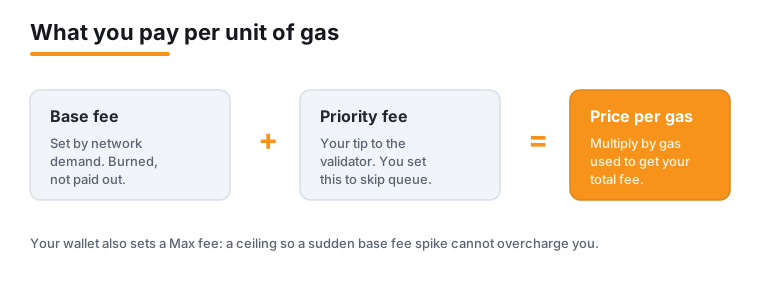
Since an upgrade called EIP-1559, the gwei you pay is split into two parts. Understanding the split is the single most useful thing for controlling costs.
Base fee
The base fee is set automatically by the network based on how full recent blocks have been. When blocks are crowded, the base fee rises block by block; when activity calms down, it falls. You do not set this number, and the base fee portion is burned (permanently removed from circulation) rather than paid to anyone. The base fee is the main reason fees spike: when a popular token launch, NFT drop, or market panic floods the network, blocks fill up and the base fee climbs fast.
Priority fee (the tip)
The priority fee, sometimes shown as "max priority fee" or simply the tip, is a small extra amount you offer the validator who processes your block, to encourage them to include your transaction sooner. During calm periods a tip of 0.01 to 0.1 gwei is plenty. During congestion you may need more to jump the queue.
Max fee
Your wallet also lets you set a max fee, the ceiling you are willing to pay per gas. You are charged the current base fee plus your tip, never more than your max. Setting a sensible max protects you from paying a fortune if the base fee suddenly spikes between the moment you click confirm and the moment your transaction lands.
The official write up of how this works lives in the Ethereum.org documentation, which is the most reliable plain language source.
Layer 2 networks: the biggest single saving
If you want to pay less, the most powerful lever is not a clever setting. It is using a Layer 2 network. Layer 2s (often called L2s or rollups) are separate networks that bundle thousands of transactions together, process them cheaply, and then post a compressed summary back to Ethereum's main chain (Layer 1). You get Ethereum level security, and fees that are typically 90 to 99 percent lower than the same action on Ethereum's main chain.
Well known L2s include Arbitrum, Optimism, Base, and zkSync. They have their own apps and their own versions of the same tokens.
How to use one
- Bridge your funds. Use the network's official bridge to move ETH or tokens from Ethereum mainnet to the L2. Always start from the network's official site, for example by finding the bridge linked from the project's verified channels, never from an ad or a direct message.
- Switch networks in your wallet. In MetaMask, click the network dropdown at the top left and select the L2 (you may need to add it once).
- Transact as normal. The same swaps and apps usually exist on the L2, at a fraction of the cost.
One caution: bridging takes time and the bridge itself charges a Layer 1 gas fee, so L2s pay off when you plan to do several transactions, not for a single tiny transfer. You can compare current gas across networks on tools linked from L2BEAT, an independent site that tracks rollups.
Timing your transactions
Because the base fee rises and falls with demand, when you transact matters as much as how. Gas tends to be cheapest when the United States and Europe are asleep, since a large share of activity comes from those time zones. Late night and early morning UTC, and weekends, are often calmer.
Practical habits that help:
- Check a gas tracker first. The Etherscan Gas Tracker shows the current gwei for low, average, and high priority. If it reads several gwei when recent days have been under one gwei, and you are not in a hurry, wait.
- Avoid known rush events. Big NFT mints, token launches, and sharp market moves all spike the base fee. If you can wait an hour, you often save most of the cost.
- Batch your actions. If you need to do several things, doing them in one sitting during a calm window beats spreading them across busy periods.
None of this requires guessing the market. You are only watching the gas tracker number and choosing a quiet moment.
Setting gas limits and speed in your wallet
Most wallets pick gas settings for you, but knowing where the controls live lets you save money and avoid mistakes. The steps below describe MetaMask, the most common wallet, but other wallets are similar.
Choosing speed
When a transaction confirmation pops up, MetaMask usually offers Low, Market (the default) and Aggressive presets, plus an Advanced option. If you are not in a hurry, the default or a slightly lower setting is fine. Click Edit or the gas estimate, then choose your preset or open advanced controls.
Understanding the gas limit
The gas limit is the maximum units of work you authorize for the transaction. For a plain transfer it is 21,000. For contract interactions the wallet estimates a higher number with a safety buffer.
- Do not set the limit too low. If the transaction needs more gas than the limit allows, it runs out partway, fails, and you still lose the gas it consumed (more on that below).
- You are not charged for unused limit. Setting a generous limit does not cost extra; you only pay for the gas actually used. The limit is a ceiling, not a price.
Setting max fee and priority fee manually
In the advanced view you can set Max base fee and Priority fee in gwei. A reasonable approach during normal conditions: set the priority fee to around 0.1 gwei, and set the max base fee a little above the current network base fee so your transaction still confirms if the fee ticks up. Setting the max too tight can leave your transaction stuck pending for a long time.
Why failed transactions still cost gas
This surprises almost everyone the first time. A failed transaction still charges you gas. The reason is fair once you see it: the network's computers had to start doing the work and get paid for the effort they spent, even if the action could not complete. There is no refund for the work already done.
Common reasons a transaction fails but still costs you:
- Gas limit too low. The work needed more gas than you authorized, so it stopped partway and reverted. You pay for the gas burned up to that point.
- Slippage or price moved. On a swap, if the price moves beyond your allowed slippage before your transaction lands, it reverts. You still pay gas.
- Insufficient token allowance. A contract was not approved to move your tokens, so the action failed.
- Front running or sold out. Someone bought the last item, or the mint sold out, before your transaction confirmed.
How to reduce wasted gas:
- Let the wallet estimate the gas limit rather than forcing a low number.
- Use a sensible slippage setting on swaps, not the tightest possible.
- Make sure any required token approval has already gone through before the main action.
- During chaotic events (hyped mints), accept that some failures are likely and do not pour money into repeated attempts.
You can always inspect a failed transaction on Etherscan; it will show a red "Fail" status and the exact gas you were charged.
A simple routine to pay less
Put it all together and a money saving routine looks like this:
- Ask if you even need mainnet. For most everyday activity, a Layer 2 like Arbitrum, Optimism, or Base will cost a fraction of Ethereum mainnet.
- Check the gas tracker. If gwei is high and you can wait, come back during a quieter window.
- Use the default speed when calm. Do not overpay for priority you do not need.
- Keep the gas limit at the wallet's estimate. Avoid both running out of gas and the false belief that a high limit costs more.
- Set a sensible max fee. High enough to confirm, capped enough to avoid a nasty surprise.
- Batch errands. Do related transactions together in one calm session.
These habits routinely cut a fee by 90 percent or more, with no special tools and no risk.
Frequently asked questions
Why is my gas fee so high for a small transfer?
The size of what you send does not affect gas; the network only charges for computing work and current demand. A plain transfer is always about 21,000 gas, so a high fee means the network is congested (a high base fee in gwei) or ETH's dollar price is high. Check a gas tracker, and if the gwei reading is high, wait for a calmer window or use a Layer 2 network.
Do I get a refund if my transaction fails?
No. A failed or reverted transaction still consumes the gas the network used while attempting it, and that gas is not refunded. The most common causes are a gas limit set too low, slippage being exceeded on a swap, or a missing token approval. Letting your wallet estimate the gas limit and using sensible slippage settings reduces wasted gas.
Are Layer 2 networks safe to use?
Established rollups such as Arbitrum, Optimism, and Base inherit security from Ethereum's main chain and are widely used, though they are newer technology and carry their own risks, including bridge risk. Always reach them through official channels rather than ads or links sent in messages, and never share your recovery phrase. Independent monitors like L2BEAT publish risk assessments worth reading before you commit large amounts.
What is the difference between gas limit and gas price?
The gas limit is the maximum amount of work you authorize, measured in gas units, for a single transaction. The gas price, quoted in gwei, is how much you pay per unit of that work. Your total fee is the gas actually used multiplied by the price. Raising the limit does not raise your cost on its own, because you only pay for gas consumed; it simply prevents the transaction from running out of gas and failing.
When is the cheapest time to transact on Ethereum?
Gas is usually cheapest when major markets are inactive, often late night and early morning UTC and on weekends, because demand and the base fee drop. There is no fixed schedule, so the reliable method is to watch a live gas tracker such as the one on Etherscan and transact when the gwei figure is low and you are not under time pressure.
Is gwei a separate coin I need to buy?
No. Gwei is just a small unit of ETH, equal to one billionth of one ETH, used to make gas prices readable. You pay all gas fees in ETH, so you only need enough ETH in your wallet to cover both the amount you are sending and the fee. On a Layer 2 you still pay fees in ETH, just much less of it.