Home › Crypto Regulation › Brazil
Bitcoin & Cryptocurrency Regulation in Brazil
Quick answer — Brazil, 2026
- Legal: Legal to own and use, not legal tender
- Tax: Progressive 15% to 22.5% on gains; monthly disposals at or below R$35,000 exempt; 15% on offshore holdings
- Buying: Via BCB-authorised providers, often funded by Pix, with KYC
Brazil is the largest cryptocurrency market in Latin America, with tens of millions of residents holding or trading digital assets. Owning, buying, selling and using crypto is legal. Over 2022 to 2026 the country moved from a light-touch environment to a formal, supervised regime: the central bank, Banco Central do Brasil (BCB), now authorises and supervises crypto firms under rules that begin taking effect on 2 February 2026, the securities regulator (Comissao de Valores Mobiliarios, or CVM) oversees tokens that qualify as securities, and the tax authority (Receita Federal do Brasil) taxes gains and requires reporting. This guide explains the legal status of crypto in Brazil, who regulates it, the key laws, how exchanges are licensed, how tax works, AML and KYC rules, practical buying and remittance considerations, mining, recent 2025 to 2026 developments, consumer risks, and how to verify everything against official sources.
This is general information current as of 2026 and is not legal, tax or financial advice. Crypto rules in Brazil are evolving quickly. Always confirm the current position with the Banco Central do Brasil, the CVM or the Receita Federal, or consult a qualified Brazilian professional, before acting. See also our overview of crypto regulation.
On this page: Legal status · Who regulates it · Taxes · How to buy · Mining
Legal status of crypto in Brazil
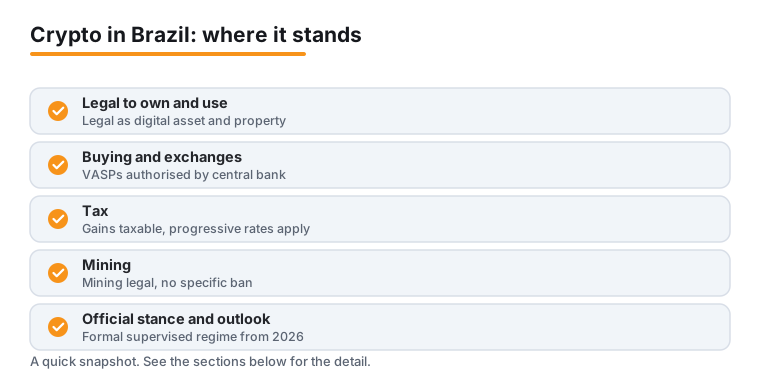
Buying, selling, holding and transferring Bitcoin and other cryptocurrencies is legal in Brazil. Crypto is treated as a tradeable digital asset and a form of property, not as legal tender. The only legal tender is the Brazilian real (BRL). Merchants may accept crypto voluntarily, but no person or business is required to accept it as payment.
The legal foundation is Law No. 14,478 of 21 December 2022, commonly called the Legal Framework for Virtual Assets (Marco Legal dos Ativos Virtuais), which took effect on 20 June 2023. It defines a virtual asset as a digital representation of value that can be traded or transferred electronically and used for payment or investment, while excluding national and electronic currencies, loyalty points, and instruments already governed by securities law. The law is not a ban; it brings crypto service providers into a supervised framework rather than restricting ordinary use.
Who regulates crypto: the BCB, CVM and Receita Federal
Brazil uses a split, function-based model. Knowing which authority does what matters:
- Banco Central do Brasil (BCB), the central bank, is the lead supervisor for virtual asset service providers (VASPs) such as exchanges, brokers and custodians, and runs the foreign-exchange and payments framework that cross-border crypto now partly falls under. A Presidential Decree (No. 11,563 of June 2023) designated the BCB as the competent authority under Law 14,478.
- Comissao de Valores Mobiliarios (CVM), the securities and exchange commission, regulates crypto-assets that qualify as securities (for example tokenised investments and certain token offerings) under the Securities Market Law (Law No. 6,385/1976).
- Receita Federal do Brasil (RFB), the federal tax authority, sets reporting obligations and taxes gains.
- COAF (Conselho de Controle de Atividades Financeiras), the financial intelligence unit, receives suspicious-activity and threshold reports for anti-money-laundering purposes.
This division means the same project can touch more than one regulator. Areas such as staking sit at the boundary of BCB and CVM jurisdiction and are still being defined.
Key laws and frameworks
The main pillars of Brazil's crypto regime are:
- Law 14,478/2022 (Legal Framework for Virtual Assets) sets the definitions and principles and designates a federal authority to supervise VASPs.
- Decree 11,563/2023 appointed the Banco Central do Brasil as that authority for non-securities virtual assets.
- BCB Resolutions 519, 520 and 521 of 2025, published on 10 November 2025, build out the detailed operating rules for VASPs (locally termed prestadoras de servicos de ativos virtuais, or PSAVs/SPSAVs). They begin taking effect on 2 February 2026.
- Law 6,385/1976 (Securities Market Law), applied by the CVM where a token is a security.
- Law 9,613/1998 (anti-money-laundering law), amended by Law 14,478 to bring VASPs under AML obligations.
- Law 14,754/2023, which sets the tax treatment of offshore financial investments, including crypto held abroad.
Unlike the European Union, Brazil is not subject to the EU MiCA regulation; it has its own domestic framework described above.
Licensing and registration of exchanges and VASPs
Under BCB Resolutions 519 to 521 of 2025, firms that intermediate, custody or broker virtual assets in Brazil must obtain prior authorisation from the central bank before operating. The framework recognises categories such as virtual-asset intermediaries (facilitating buying, selling and exchange), custodians (safeguarding assets and keys), and brokers that perform both functions. Key features reported for the regime include:
- Authorisation requirement: unauthorised operation is prohibited once the rules apply. Existing providers that were already offering virtual asset services before 2 February 2026 are given a transition window of about 270 days, reported to end on 30 October 2026, in which to notify the BCB or apply for authorisation. Firms that do not meet the requirements by the deadline must stop operating and, per reporting, give clients about 30 days to move their assets to an authorised provider.
- Minimum capital: capital requirements scaled by activity, reported in the range of roughly R$10.8 million to R$37.2 million depending on the services offered.
- Prudential and governance standards: governance, cybersecurity, operational-risk and consumer-protection requirements that align VASPs more closely with other regulated financial institutions.
- Asset segregation: client crypto and client fiat must be held separately from the firm's own funds.
- Foreign-exchange integration: Resolution 521 brings activities such as cross-border payments, stablecoin operations and certain self-hosted-wallet transfers within Brazil's FX framework.
Because these rules begin on 2 February 2026 with phased elements, exact obligations on any given platform may still be settling. Confirm whether a service is authorised by the BCB before relying on it. Specific figures above are drawn from reporting and should be checked against the BCB's own published resolutions.
Crypto taxation in Brazil
Crypto is taxable in Brazil. Gains from selling or disposing of crypto are subject to tax, residents must declare holdings on the annual income-tax return (IRPF), and certain transactions must be reported. Receiving crypto as income, for example from work or rewards, can also be taxable as ordinary income.
The tax rates did not change in 2026. A flat rate was proposed and then failed in Congress, so the pre-existing structure still applies. The position in August 2026 is:
- Flat rate: gains from disposals through Brazilian platforms are taxed on the progressive capital gains table in Article 21 of Law 8,981/1995, as amended by Law 13,259/2016: 15% on the slice of gains up to R$5,000,000, 17.5% on the slice between R$5,000,000 and R$10,000,000, 20% between R$10,000,000 and R$30,000,000, and 22.5% above R$30,000,000. Most individuals therefore pay 15%. Tax is assessed monthly through GCAP and paid by DARF by the last business day of the following month.
- End of the monthly sale exemption: under the earlier rules, disposals were exempt where total crypto sales in a month were at or below R$35,000. That exemption is still in force. Article 22 of Law 9,250/1995 exempts the capital gain on disposals of small-value assets and rights where the disposal price in the month is at or below R$35,000, or R$20,000 for shares traded over the counter. The Receita Federal applies the threshold to the total value of crypto disposals in the month across the portfolio, not to profit, and it applies to disposals through Brazilian platforms. The same R$35,000 figure separately triggers the monthly DeCripto reporting duty for individuals transacting through foreign providers, decentralised platforms or without an intermediary.
- Offshore and self-custody: Law 14,754/2023 expressly lists ativos virtuais and carteiras digitais among foreign financial investments, and treats variation of a cryptocurrency against the national currency as income from one. Income from those is taxed at 15% in the annual adjustment return, with no deductions from the base and no R$35,000 monthly exemption. The law leaves the detailed classification of virtual assets and digital wallets to Receita Federal regulation, so the treatment of a given holding is worth confirming with a Brazilian tax adviser.
- Reporting: IN RFB 1,888/2019 was revoked with effect from 1 July 2026 and replaced by the DeCripto return created by IN RFB 2,291/2025, which is aligned with the OECD Crypto-Asset Reporting Framework. Monthly filing is due by the last business day of the following month and annual filing by the last business day of January. Individuals resident in Brazil must file where they transact through foreign providers, decentralised platforms or without any intermediary and the monthly value of operations exceeds R$35,000.
Provisional Measure 1303, published on 11 June 2025, proposed a single flat crypto rate, raised to 18% in committee shortly before it fell, and the removal of the monthly exemption. On 8 October 2025 the Chamber of Deputies voted 251 to 193 to pull it from the agenda and it lost validity at midnight. It never took effect, and no replacement has been enacted, so the progressive regime and the monthly sale exemption both continue to apply. Because these changes are recent and were politically disputed, the exact rules and any further changes should be confirmed directly with the Receita Federal or a tax professional. Keep detailed records (dates, amounts, BRL values and counterparties). See our general guide to crypto taxes.
AML, KYC and the Travel Rule
Law 14,478/2022 amended Brazil's anti-money-laundering law (Law 9,613/1998) to include VASPs among the entities subject to AML and counter-terrorist-financing controls. In practice this means licensed and registered providers must perform know-your-customer (KYC) identity verification, monitor transactions, and register with and report relevant and suspicious transactions to COAF, Brazil's financial intelligence unit.
The 2025 BCB resolutions reinforce these duties for authorised VASPs and introduce a phased rollout of the Travel Rule, the requirement to transmit originator and beneficiary information alongside transfers between institutions. Under Article 89 of Resolution 520, the Travel Rule is implemented in two stages between 2026 and 2028, with full compliance mandatory from 2 February 2028. Resolution 521 also defines self-hosted wallets (carteiras autocustodiadas) as wallets where the user controls the private keys with no third-party intermediary, and requires authorised providers to identify the wallet owner when a transfer involves such a wallet. For ordinary users, the practical effect is more identity verification and documentation when opening accounts and moving funds.
Buying and using crypto in practice
Brazilians can buy crypto through domestic and international exchanges, brokers and peer-to-peer platforms. Funding is straightforward thanks to Pix, Brazil's instant-payment system, which most local exchanges support alongside bank transfers. Under the 2026 BCB regime, platforms operating in Brazil are expected to be authorised and to apply KYC and AML checks, so you will normally verify your identity when opening an account.
Practical pointers:
- Prefer providers that are authorised, or in the process of authorisation, by the Banco Central do Brasil.
- Check fees, supported assets, Pix and BRL deposit options, and withdrawal limits.
- Enable two-factor authentication and consider moving long-term holdings to a self-custody wallet, ideally a hardware wallet, and safeguard your recovery phrase.
- Keep records of every purchase and sale for tax reporting.
Bitcoin ATMs exist mainly in larger cities such as Sao Paulo and Rio de Janeiro but are fewer than in the United States; they tend to carry higher fees and are best for convenience rather than cost. Stablecoins are widely used in Brazil for dollar exposure and for cross-border transfers; note that cross-border crypto activity now sits within the FX framework described above.
Bitcoin mining in Brazil
Bitcoin mining is legal in Brazil. There is no specific ban, and the country's large, relatively clean electricity grid (a high share of hydropower, plus growing solar and wind) has made some regions attractive to miners seeking lower-cost, lower-carbon power.
Miners operate within ordinary law: they must comply with energy and environmental regulations, register and tax their business activity appropriately, and account for income earned. Mined coins generally have tax consequences when earned and again when later sold, so record-keeping matters. Profitability depends heavily on electricity tariffs, hardware efficiency and the Bitcoin price, so it varies by region and over time. There is no dedicated mining licence regime distinct from the general business, energy and tax rules.
Recent developments (2025 to 2026)
Several changes stand out for 2025 and 2026:
- BCB VASP framework: Resolutions 519, 520 and 521, published 10 November 2025, were the long-awaited operating rules under Law 14,478. They begin taking effect on 2 February 2026, with phased elements (including the Travel Rule) rolling out over the following years.
- Flat crypto tax: no flat rate exists. Provisional Measure 1303 was pulled from the Chamber agenda on 8 October 2025 by 251 votes to 193 and lost validity, so the progressive 15% to 22.5% table and the R$35,000 monthly exemption both remain in force. The genuine 2026 tax change is reporting, not rates: DeCripto replaced IN RFB 1,888/2019 from 1 July 2026.
- DeCripto reporting: reporting indicates a new monthly crypto reporting system, DeCripto, is being introduced from mid-2026, aligned with the OECD Crypto-Asset Reporting Framework.
- International reporting: Brazil has been aligning crypto reporting with the OECD Crypto-Asset Reporting Framework (CARF) to increase cross-border data-sharing.
- Drex: the BCB continues developing Drex, Brazil's central bank digital currency (a digital real), in phases. Drex is a state-issued digital currency and is separate from decentralised cryptocurrencies.
Because the VASP rules are new and partly phased, expect further clarifications and supplementary guidance from the BCB and CVM.
Consumer risks and protection
The main risks for Brazilian crypto users are market volatility, scams and fraud, platform failure or hacking, and the cost of getting tax and reporting wrong. Crypto is higher-risk than most traditional investments and can lose value quickly.
The 2026 BCB framework should improve protection by holding exchanges and custodians to capital, governance, cybersecurity and asset-segregation standards and by requiring authorisation, but it does not remove market risk. Sensible precautions: use authorised providers, enable strong security and self-custody for long-term holdings, keep clean records, be sceptical of guaranteed or unusually high returns, and invest only what you can afford to lose. Consumer-protection and disclosure questions can fall to the CVM (for securities-like tokens) and to general consumer law; for licensed-provider conduct, the BCB is the supervisor.
Official sources and how to verify
Because the rules are evolving, verify the current position directly with the authorities rather than relying on summaries. Useful starting points:
- Banco Central do Brasil (BCB) for VASP authorisation, the 2025 resolutions and the FX framework.
- Comissao de Valores Mobiliarios (CVM) for crypto-assets that qualify as securities.
- Receita Federal do Brasil for taxation and reporting obligations (including IN 1,888).
- Full text of Law 14,478/2022 (Planalto) for the Legal Framework for Virtual Assets.
For broader context see our regulation hub and crypto regulation guide. Remember this article is general information current as of 2026 and not legal advice; confirm details with the named regulators or a qualified Brazilian professional before acting.
What is changing: the Brazilian crypto timeline from August 2026 to 2028
Brazil is roughly halfway through a phased handover from a lightly supervised market to a fully authorised one. Every date below comes from a published instrument, not from an announcement. The two that matter most in the next three months are 1 October and 30 October 2026.
| Date | What happens | Instrument |
|---|---|---|
| 2 February 2026 | The VASP authorisation regime starts. Operating without authorisation or an authorisation process becomes irregular. | Article 92, Resolution BCB 520/2025 |
| 4 May 2026 | Monthly reporting of virtual asset service operations begins, due by the fifth day of the following month, along with purpose codes for international transfers. | Article 6, Resolution BCB 521/2025 |
| 1 July 2026 | DeCripto monthly reporting goes live and IN RFB 1,888/2019 is revoked. On the face of the rule the first monthly return, covering July 2026, is due by the last business day of August 2026. | Articles 12, 18 and 19, IN RFB 2,291/2025 |
| 1 October 2026 | eFX providers may no longer settle with their foreign counterparty using virtual assets. Settlement must be by FX operation or through a non-resident reais account held in Brazil. | Articles 1 and 4, Resolution BCB 561/2026 |
| 30 October 2026 | Deadline for providers already trading to instruct a phase 1 authorisation request. On the same date, Brazilian banks and payment institutions must stop dealing with providers that are neither authorised nor in the authorisation process. | Articles 88 and 91, Resolution BCB 520/2025; Article 9, IN BCB 704/2026 |
| About 29 November 2026 | Providers that did not file must have ceased virtual asset services, within 30 days after the filing deadline. | Article 88, paragraph 7, Resolution BCB 520/2025 |
| 31 December 2026 | Institutions already operating must hold 25% of the increase to the new minimum capital figure. | Article 12, Joint Resolution CMN/BCB 14/2025 |
| 1 January 2027 | The full prudential rulebook applies to providers: capital adequacy, risk management, liquidity and disclosure. Segment S5 institutions may no longer provide virtual asset services. | Articles 5 and 8, Resolution BCB 580/2026 |
| 2 February 2027 | Travel Rule stage I due: information transfer between providers established in Brazil, 365 days after entry into force. | Article 89, item I, Resolution BCB 520/2025 |
| 31 May 2027 | eFX providers outside the listed categories must have applied for payment institution authorisation. | Article 56-B, Resolution BCB 561/2026 |
| 1 January 2028 | Full minimum capital under the new methodology, after the 50% and 75% steps in mid and late 2027. | Article 12, Joint Resolution CMN/BCB 14/2025 |
| 2 February 2028 | Travel Rule compliance mandatory for all authorised providers, covering operations abroad. | Article 89, paragraph 3, Resolution BCB 520/2025 |
| 30 June 2028 | Providers stop being held in Segment 4 regardless of size and are segmented normally. | Article 6, Resolution BCB 580/2026 |
How crypto gains are actually taxed in Brazil in August 2026
There is no flat crypto tax rate in Brazil. Provisional Measure 1303/2025 proposed one, the Chamber of Deputies voted 251 to 193 to pull it from the agenda on 8 October 2025, and it lost validity at midnight. No replacement has been enacted. The rules that applied before it still apply, and they differ depending on where the asset is held.
| Situation | Rate | How it is assessed | Legal basis |
|---|---|---|---|
| Disposal through a Brazilian platform, on the slice of gains up to R$5m | 15% | Monthly, via GCAP, DARF paid by the last business day of the following month | Article 21, Law 8,981/1995, as amended by Law 13,259/2016 |
| On the slice above R$5m up to R$10m | 17.5% | Same | Article 21, item II |
| On the slice above R$10m up to R$30m | 20% | Same | Article 21, item III |
| On the slice above R$30m | 22.5% | Same | Article 21, item IV |
| Total monthly disposals at or below R$35,000 | Exempt | No tax on the gain. The Receita Federal applies the threshold to the total value of crypto disposals in the month across the portfolio, not to profit | Article 22, Law 9,250/1995 |
| Assets held on foreign platforms or in foreign digital wallets | 15% | Annually, in the annual adjustment return, with no deductions from the base and no R$35,000 exemption | Law 14,754/2023 |
Note the source of the confusion. 17.5% is a real Brazilian rate, but it is the second band of the progressive capital gains table and applies only to the slice of a gain between R$5m and R$10m. It is not a flat rate on all crypto gains, and most individuals pay 15%. Article 22 of Law 9,250/1995 sets the exemption by reference to the disposal price in the month, at R$35,000 in general and R$20,000 for shares traded over the counter.
Law 14,754/2023 expressly lists ativos virtuais and carteiras digitais among foreign financial investments, and treats variation of a cryptocurrency against the national currency as income from such an investment. It also leaves the detailed classification of virtual assets and digital wallets to Receita Federal regulation, so the treatment of a particular holding is worth confirming.
Separately, Law 15,270/2025 introduced a minimum personal income tax from calendar year 2026 for individuals with income above R$600,000 in the year, reaching 10% at R$1,200,000. Its Article 16-A, paragraph 1, item I deducts capital gains from that base except gains from exchange or organised over-the-counter operations taxed on a net-gain basis in Brazil. Confirm the effect on your own position with a Brazilian tax adviser.
The 30 October 2026 deadline and what it means if you use a foreign exchange
Two separate things happen on 30 October 2026, and the second is the one that touches ordinary users.
- Filing deadline. Article 88, item I of Resolution BCB 520/2025 gives firms that were already carrying on virtual asset activities 270 days from 2 February 2026 to request authorisation. Article 9 of IN BCB 704/2026 fixes that date as 30 October 2026 and lists what must accompany the filing, including financial statements for the last three financial years audited by an independent auditor registered with the CVM. Firms that file on time may keep operating until their process concludes, though they may not take on another modality meanwhile. Firms that do not file must cease within 30 days.
- Banking cut-off. Article 91 prohibits financial institutions, payment institutions and other BCB-authorised institutions, from 30 October 2026, from carrying out or enabling virtual asset market operations whose counterparties are providers that are neither authorised nor in the authorisation process. The article expressly reaches trading, intermediation and custody of virtual assets, the carrying out and intermediation of FX operations, the opening and maintenance of payment accounts, and the execution of payment transactions where these are done to enable such operations.
The practical reading for a holder is straightforward. If the platform you use has not filed with the BCB, the Brazilian side of your funding route can close from 30 October 2026, which includes Pix and bank transfers arranged through Brazilian institutions. Before that date, ask your provider directly whether it has filed a phase 1 request and keep the answer in writing. Holding your own coins in a self-hosted wallet remains legal throughout: Resolution BCB 521/2025 defines a carteira autocustodiada and regulates transfers made through providers, it does not restrict ownership.
Stablecoins and cross-border transfers: what is already restricted and what is only proposed
Stablecoins are the dominant use of crypto in Brazil and are where regulation has moved fastest during 2026. Nothing below bans owning or trading them.
- In force since February and May 2026. Resolution BCB 521/2025 pulls international payments and transfers with virtual assets, transfers to and from self-hosted wallets, and purchases and sales of fiat-referenced virtual assets into the FX framework. For a virtual asset service provider, an international payment or transfer with virtual assets where the counterparty is not an institution authorised to operate in the FX market is capped at the equivalent of US$100,000. Article 76-C treats the equivalent of US$50,000 as the reference limit for using the Annex III purpose codes, and Article 82-A requires reporting by the fifth day of the following month, in force since 4 May 2026.
- In force from 1 October 2026. Resolution BCB 561/2026, published on 5 May 2026, rewrites Article 50 of Resolution 277/2022 so that payment or receipt between an eFX provider and its counterparty abroad must be made exclusively through an FX operation or through a non-resident reais account held in Brazil, and states that the use of virtual assets is prohibited. This closes the stablecoin settlement rail behind remittance and payment firms. It does not stop you buying or holding USDT or USDC through an authorised provider. Contemporaneous reporting read the measure the same way.
- Proposed only, and not settled. In June 2026 the Banco Central put to industry a proposal for a hold of up to 24 hours on stablecoin operations destined for self-hosted wallets or for abroad from the equivalent of US$10,000, or from that amount summed across one client's operations in a day. Associations had until 2 July 2026 to comment. On 29 July 2026 the BCB said that no norm from the National Monetary Council or the Banco Central specifically addresses preventive retention of virtual asset operations and that the work is part of an ongoing process. Treat this as a proposal with no date until a numbered resolution appears.
Bills and consultations still in progress
Three things are moving in Brasilia that are not yet law, and one window has already closed. None of them changes what you may do today.
- Strategic bitcoin reserve, PL 4501/2024. Deputy Eros Biondini's bill would create a federal strategic bitcoin reserve as part of Brazil's international reserves. Rapporteur Luiz Gastão filed an opinion for approval with a substitute text on 9 February 2026, the amendment window closed on 3 March 2026 with no amendments filed, and the item was pulled from the Economic Development Committee agenda on 8 April 2026 because the rapporteur was absent. It remains pending in that committee and must still pass three more before any floor vote. The full history is on the Chamber's tramitation record. Brazil does not hold a bitcoin reserve.
- Crypto tax. Nothing has been adopted. After Provisional Measure 1303/2025 lost validity, no successor has been enacted. Any future flat rate requires new legislation.
- Tokenisation rules at the CVM. Public Consultation SDM 05/25 proposes replacing CVM Resolution 88 of 2022, the crowdfunding rule that in practice carries most Brazilian tokenisation offerings, widening eligible issuers and raising fundraising caps. Contributions closed on 23 January 2026 after an extension and the final rule has not been published. Until it lands, the classification principles in CVM Parecer de Orientação 40 of 11 October 2022 continue to determine when a token is a security.
The closed window was regularisation. Law 15,265/2025 created the Rearp regime, which expressly covered criptoativos e demais ativos virtuais as defined in Law 14,478/2022, taxed at 15% with a fine of 100% of the tax, an effective cost of about 30% of the 31 December 2024 value. The law allowed 90 days from publication on 21 November 2025 to join, so it closed in February 2026.
Frequently asked questions
Is cryptocurrency legal in Brazil in 2026?
Yes. Buying, holding, selling and transferring crypto is legal. Crypto is treated as a digital asset and property, not as legal tender (only the Brazilian real is legal tender). Under BCB rules taking effect on 2 February 2026, exchanges and other service providers must be authorised and supervised by the Banco Central do Brasil.
Who regulates crypto in Brazil?
The Banco Central do Brasil (BCB) is the lead regulator for virtual asset service providers such as exchanges and custodians, designated under Law 14,478/2022 and Decree 11,563/2023. The CVM regulates tokens that qualify as securities, and the Receita Federal handles tax and reporting. COAF receives anti-money-laundering reports.
What is the main crypto law in Brazil?
Law No. 14,478/2022, the Legal Framework for Virtual Assets, effective from 20 June 2023. It defines virtual assets, sets principles for service providers, and assigns supervision to a federal authority (the BCB). Detailed operating rules came in BCB Resolutions 519, 520 and 521 of 2025, which begin taking effect on 2 February 2026.
How is crypto taxed in Brazil?
Gains from disposing of crypto are taxable and holdings must be declared on the annual income-tax return. The rules changed in 2026: after a 2025 version of Provisional Measure 1303 was rejected by the Chamber of Deputies in October 2025, reporting indicates a flat 17.5% rate on crypto capital gains took effect on 12 June 2026, replacing the earlier progressive structure (15% to 22.5% by gain size) and the R$35,000 monthly sale exemption. The flat rate is reported to apply the same way to offshore and self-custody holdings. Because this is recent and was disputed, confirm the current rate, thresholds and reporting rules with the Receita Federal.
Do crypto exchanges need a licence in Brazil?
Yes. Under BCB Resolutions 519 to 521 of 2025, virtual asset service providers (intermediaries, custodians and brokers) must obtain prior authorisation from the Banco Central do Brasil, meet minimum capital and governance standards, segregate client assets, and follow KYC, AML and Travel Rule requirements. Existing providers were given a transition window (reported at around 270 days) to apply or wind down.
Is Bitcoin mining allowed in Brazil?
Yes, mining is legal. There is no specific ban and no dedicated mining licence; miners follow normal energy, environmental, business and tax rules. Brazil's largely hydro-based grid has attracted some miners seeking cheaper or lower-carbon power, but profitability depends on electricity costs, hardware and the Bitcoin price.
When do the new Brazilian crypto exchange rules take effect?
The BCB VASP rules under Resolutions 519, 520 and 521 (published 10 November 2025) begin taking effect on 2 February 2026. Providers that were already operating before that date have a transition window of about 270 days, reported to end on 30 October 2026, to notify the BCB or apply for authorisation. The Travel Rule is phased in two stages, with full compliance required from 2 February 2028.
Can I use a self-custody (self-hosted) wallet in Brazil?
Yes. Self-custody wallets, where you hold your own private keys with no third-party intermediary, remain legal. Resolution 521 of 2025 defines them (carteiras autocustodiadas) and brings transfers to or from such wallets through authorised providers within Brazil's foreign-exchange framework, so an authorised provider is generally required to identify the wallet owner for those transfers. Holding and using your own wallet is not banned.
Can I buy crypto with Pix in Brazil?
Yes. Most local exchanges support Pix, Brazil's instant-payment system, alongside bank transfers, so funding a crypto purchase in reais is common and fast. Under the 2026 BCB regime, platforms operating in Brazil are expected to be authorised and to apply KYC and AML checks, so you will normally verify your identity when opening an account.
Is there a flat 17.5% crypto tax in Brazil?
No. Provisional Measure 1303/2025 proposed a single flat rate for crypto, but the Chamber of Deputies voted 251 to 193 on 8 October 2025 to pull it from the agenda and it lost validity at midnight. No replacement has been enacted as of August 2026. Gains on disposals through Brazilian platforms are taxed on the progressive capital gains table in Article 21 of Law 8,981/1995: 15% on the slice up to R$5m, 17.5% from R$5m to R$10m, 20% from R$10m to R$30m and 22.5% above R$30m. Most individuals pay 15%. The 17.5% figure is real, but it is the second band of that table, not a flat rate.
Does the R$35,000 monthly exemption still apply in 2026?
Yes, for disposals through Brazilian platforms. Article 22 of Law 9,250/1995 exempts the capital gain where the disposal price in the month is at or below R$35,000. The Receita Federal applies the threshold to the total value of crypto disposals in the month across your whole portfolio, not to profit, so exceeding it in a month makes the whole gain for that month taxable. The exemption does not apply to crypto held on foreign platforms or in foreign wallets, which is taxed at 15% under Law 14,754/2023.
What happens on 30 October 2026?
Two things. It is the deadline for virtual asset service providers that were already trading to instruct a phase 1 authorisation request with the Banco Central, under Article 88 of Resolution BCB 520/2025 and Article 9 of IN BCB 704/2026. From the same date, Article 91 of Resolution BCB 520/2025 prohibits Brazilian banks, payment institutions and other BCB-authorised institutions from carrying out or enabling virtual asset operations with providers that are neither authorised nor in the authorisation process. That reaches payment accounts, payment transactions, FX and custody, so funding an unfiled platform from Brazil can stop working. Providers that do not file must cease within 30 days.
Has Brazil banned stablecoins?
No. Resolution BCB 561/2026 stops eFX providers settling with their foreign counterparty using virtual assets from 1 October 2026, which closes a settlement rail used by remittance and payment firms. You can still buy, hold and trade stablecoins through an authorised provider. A separate proposal for a hold of up to 24 hours on stablecoin transfers to self-hosted wallets or abroad above the equivalent of US$10,000 was put to industry in June 2026 with comments closing on 2 July 2026, but on 29 July 2026 the Banco Central said no norm on preventive retention has been issued. Nothing on that front is in force.
Does Brazil have a strategic bitcoin reserve?
No. PL 4501/2024 would create one, but it is still in the Chamber's Economic Development Committee. The rapporteur filed an opinion for approval with a substitute text on 9 February 2026, the amendment window closed on 3 March 2026 with no amendments, and the item was pulled from the agenda on 8 April 2026 because the rapporteur was absent. It must still clear three further committees before any floor vote, and no date is set.
What is DeCripto and do I have to file it?
DeCripto is the Receita Federal crypto reporting return created by IN RFB 2,291/2025 and aligned with the OECD Crypto-Asset Reporting Framework. It replaced IN RFB 1,888/2019, which was revoked from 1 July 2026. Crypto service providers with a Brazilian nexus must file, and so must individuals and entities resident in Brazil who transact through foreign providers, decentralised platforms or without any intermediary where the monthly value of operations exceeds R$35,000. Monthly returns are due by the last business day of the following month and the annual return by the last business day of January.
Facts reviewed: 3 August 2026. Page updated: 3 August 2026.