Home › Crypto Regulation › Bolivia
Bitcoin & Cryptocurrency Regulation in Bolivia
Quick answer — Bolivia, 2026
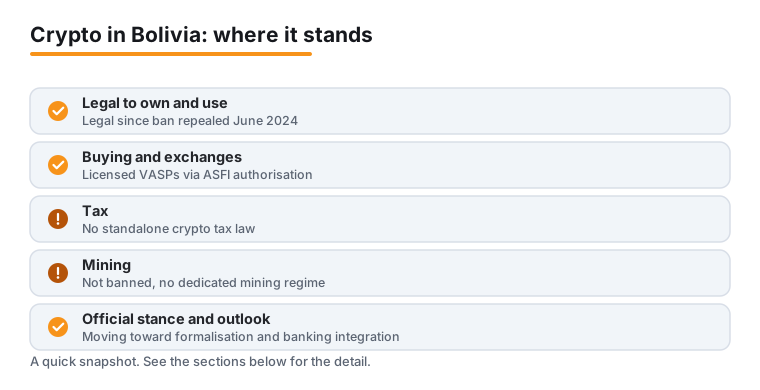
- Legal: Legal via authorised channels since 2024, not legal tender; providers must register
- Tax: No standalone crypto tax; business profits under IUE, transactions may face VAT
- Buying: Via international and licensed local providers, KYC standard, stablecoins dominant
Bolivia is one of the most striking recent reversals in global crypto policy. For roughly a decade the country maintained one of Latin America's strictest stances, with the central bank barring banks and payment firms from touching digital assets. That changed on 25 June 2024, when the Banco Central de Bolivia (BCB) issued Board Resolution N degrees 082/2024, repealing the prohibition and authorising the use of electronic payment channels to buy and sell virtual assets. Since then the framework has been built out quickly: Supreme Decree 5384 of May 2025 created a legal framework for financial technology firms and virtual asset service providers, the financial supervisor ASFI issued implementing rules, and in late 2025 the government announced plans to integrate crypto and dollar-pegged stablecoins into the formal banking system.
This guide explains where Bolivia's crypto regulation stands as of 2026: the legal status, the regulators involved, the key laws, the licensing regime for exchanges and providers, tax treatment, anti-money-laundering rules, how residents buy and use crypto in practice, mining, recent developments, and consumer risks. It is general information as of 2026 and is not legal, tax, or financial advice; rules in this area are changing quickly, so always verify the current position with the named official regulators (the BCB and ASFI) or a qualified Bolivian professional before acting. For broader context, see our overviews of crypto regulation and crypto rules by country.
On this page: Legal status · Who regulates it · Taxes · How to buy · Mining
Is Bitcoin and crypto legal in Bolivia?
Yes. Owning, buying, selling, and exchanging cryptocurrency through authorised electronic channels is legal in Bolivia following the central bank's decision on 25 June 2024 to repeal its long-standing prohibition. Before that, Bolivia stood out in the region for an outright ban: financial institutions were prohibited from using, holding, or intermediating in crypto, a position reaffirmed in BCB Resolution 144/2020, which Resolution N degrees 082/2024 expressly revoked.
Two caveats remain important. First, cryptocurrency is not legal tender in Bolivia. The boliviano (BOB) remains the only official currency, virtual assets do not constitute cash, and no person or business is obliged to accept Bitcoin or any token as payment. Second, "legal" means crypto activity is permitted within a defined, supervised framework rather than being fully unregulated: service providers must now register and, increasingly, obtain authorisation from the financial supervisor. For the exact current wording, consult the BCB and ASFI directly.
Who regulates crypto in Bolivia?
Several public bodies share responsibility for virtual assets in Bolivia, and the 2024 to 2025 reforms were issued in coordination among them:
- Banco Central de Bolivia (BCB) drove the policy shift through Board Resolution N degrees 082/2024 and remains responsible for the payment system and the boliviano. See Banco Central de Bolivia.
- Autoridad de Supervision del Sistema Financiero (ASFI) is the financial-system supervisor. It is the primary regulator for financial technology firms and virtual asset service providers under Supreme Decree 5384, issuing licensing and operational rules. See ASFI.
- Unidad de Investigaciones Financieras (UIF), Bolivia's financial intelligence unit, handles anti-money-laundering supervision and the registration of virtual asset service providers for AML purposes.
The reforms were also shaped by the 2023 to 2024 Mutual Evaluation of Bolivia carried out by GAFILAT, the Latin American Financial Action Task Force regional body, which pushed Bolivia toward bringing virtual asset activity inside its AML framework. Because several rules are recent and still being implemented, the division of duties is set instrument by instrument: the BCB authorised the activity in Resolucion de Directorio 082/2024 of 25 June 2024, ASFI licenses and supervises fintech firms and virtual asset service providers under Decreto Supremo 5384 of 7 May 2025 and Resolucion ASFI 540/2025 of 3 July 2025, and the UIF runs the virtual asset service provider anti money laundering register under Resolucion Administrativa 019/2025 of 16 April 2025.
Key crypto laws and frameworks in Bolivia
Bolivia's framework has been assembled in stages over a short period:
- BCB Board Resolution N degrees 082/2024 (25 June 2024): repealed Resolution 144/2020 and authorised the use of electronic payment channels and instruments to buy and sell virtual assets. The BCB stressed that the boliviano remains the only legal tender and that users assume the risks of using virtual assets.
- Supreme Decree N degrees 5384 (7 May 2025): created the legal framework for Empresas de Tecnologia Financiera (financial technology firms) and defined virtual assets, tokenised assets, blockchain, and Proveedores de Servicios de Activos Virtuales (PSAV, the local term for virtual asset service providers or VASPs). It instructed ASFI to issue implementing regulation. The official text is published at Decreto Supremo N degrees 5384 on LexiVox.
- ASFI implementing rules (2025): ASFI issued the regulation for financial technology firms (reported as Circular ASFI 885/2025 of 3 July 2025, approved by ASFI Resolution 540/2025), setting out constitution, functioning, licensing, cybersecurity, and consumer-protection requirements for fintech firms and PSAV.
- Circular ASFI/945/2026 (issued 29 April 2026): amended the financial-technology regulation, adding more detailed rules for virtual asset operations and alliances, clarifying the BCB's role in payments and settlement, strengthening the regulatory sandbox, and extending the period for existing firms to file a letter of intent to begin the adaptation process. Confirm the current deadline directly with ASFI.
The contrast with regions such as the EU, which applies the unified MiCA regulation, is that Bolivia has no single crypto statute. Instead it relies on a central-bank resolution plus a supreme decree and supervisory rules that are still bedding in. For background on how regimes differ, see our guide to crypto regulation.
Licensing and registration for exchanges and VASPs
Under Supreme Decree 5384 and ASFI's implementing rules, firms that provide virtual asset services for profit, the PSAV (VASPs), are brought into the supervised perimeter. The scope covers activities such as exchanging fiat for crypto, exchanging crypto for crypto, transferring virtual assets, custody and administration of virtual assets, and related financial services around asset offerings.
Two obligations stand out. First, PSAV must register with the UIF and adopt Know Your Customer, due diligence, and risk-management policies under Bolivia's anti-money-laundering and counter-terrorist-financing rules. Reporting indicated the obligation targets those operating for profit, with personal uses such as individual payments or personal investing excluded. Second, firms providing financial technology services must obtain authorisation from ASFI: under ASFI Resolution 540/2025 existing operators without an ASFI licence were first given until 31 December 2025 to begin the adequacy and authorisation process. A later amendment, Circular ASFI/945/2026 (issued 29 April 2026), extended this adaptation period, giving existing firms more time to submit a letter of intent to begin adapting to the framework. The original deadline under Resolucion ASFI 540/2025 of 3 July 2025 was 31 December 2025 for existing firms to begin the adaptation and authorisation process. It was then extended, with legal reporting in December 2025 placing the extended window in May 2026, and it has since moved again. ASFI does not publish an open register of authorised providers, so confirm the current deadline with ASFI directly and ask any platform to evidence its authorisation before you deposit.
If you use a platform that claims to be authorised in Bolivia, verify that it genuinely holds the relevant ASFI authorisation and UIF registration before trusting it with funds. Confirm current requirements directly with ASFI, as deadlines and conditions may have moved on.
Crypto and Bitcoin tax in Bolivia
Bolivia does not have a dedicated, standalone cryptocurrency tax law. Crypto activity is generally assessed under the country's existing tax rules, administered by the Servicio de Impuestos Nacionales (SIN), so the treatment depends on the nature of the activity and who carries it out.
- Businesses and professional operators may have profits assessed under Bolivia's corporate income tax, the Impuesto sobre las Utilidades de las Empresas (IUE), generally levied at 25 percent, and transactions or services may fall within the value-added tax (IVA) of 13 percent and other applicable levies.
- Individuals face a less clearly codified position for occasional gains, and SIN has not issued comprehensive crypto-specific guidance.
Because Bolivia's tax framework is still catching up with the 2024 to 2025 legalisation, Bolivia has no crypto specific tax rule, so a personal disposal falls back on Ley 843. There is no exclusive tax law for individual trading gains, while income from services paid in crypto must be declared to SIN under the general rules, and habitual or commercial activity is taxed as business income at 25 percent IUE, with 13 percent RC-IVA on individual income, 13 percent IVA and 3 percent IT where a taxable business activity exists and reporting duties may change. Keep clear records of purchases, sales, and transfers, and confirm your obligations with SIN or a qualified Bolivian accountant. See our general explainer on crypto taxes. This section is informational only and not tax advice.
AML and KYC rules
Anti-money-laundering (AML) and counter-terrorist-financing (CFT) compliance is a core part of Bolivia's new framework, and a direct response to the GAFILAT mutual evaluation. Virtual asset service providers (PSAV) operating for profit must register with the UIF and implement Know Your Customer identity verification, customer due diligence, and risk-management procedures aligned with GAFILAT standards.
In practice this means regulated platforms and bank services that handle crypto in Bolivia ask users to verify their identity, and that on and off-ramps tied to Bolivian banks operate within AML rules. The aim is to formalise flows that previously sat outside the system and to reduce the use of crypto for illicit purposes. Expect identity checks when you use compliant providers, and be cautious of any service that lets you transact large amounts with no verification, as that is a warning sign of an unregulated or illicit operator.
Buying and using crypto in practice
Since the ban was lifted, Bolivians can fund accounts and transact through authorised channels rather than working entirely around the banking system. Most residents access crypto through international exchanges that serve the region and, increasingly, through licensed local providers and banks. Banco Bisa, for example, launched a regulated USDT custody service in late 2024.
A few features shape day-to-day use:
- Stablecoins dominate. Amid US-dollar shortages and inflation pressure on the boliviano, dollar-pegged stablecoins such as USDT are widely used for saving, cross-border payments, and settling trade, often more than Bitcoin itself. The Banco Central de Bolivia reported that virtual asset transactions reached about USD 294 million in the first half of 2025, roughly 630 percent higher than the same period a year earlier.
- KYC is standard. Regulated platforms require identity verification, and bank-linked on and off-ramps operate within AML rules.
- Real-economy use is growing. Reporting in 2025 noted some merchants and vehicle distributors beginning to accept stablecoin payments, although crypto is not legal tender and acceptance is voluntary.
Stick to platforms that comply with Bolivian requirements, verify that any provider claiming local authorisation genuinely holds it, watch exchange-rate spreads and fees, and be wary of informal deals outside the regulated framework. This is general information, not financial advice.
Bitcoin mining in Bolivia
Bitcoin mining is not specifically prohibited in Bolivia, but there is no dedicated, mining-specific legal regime, so miners fall under general business, tax, energy, and import rules. Two factors particularly affect the activity here:
- Electricity supply and subsidies. Bolivia's power and fuel markets are heavily shaped by subsidies and, recently, by energy and foreign-currency strains. The cost and reliability of electricity, the single biggest factor in mining economics, is therefore a real consideration, and policy on subsidised energy could affect miners.
- Business and tax treatment. A mining operation run as a business would generally be subject to corporate income tax (IUE) and other applicable levies, plus standard company registration and reporting duties.
Anyone considering mining should map out grid access and tariffs, hardware import duties, and permitting and environmental implications, and should obtain local legal and tax advice. Claims that Bolivia offers a uniquely favourable mining environment should be checked carefully against current energy policy.
Recent developments (2025 to 2026)
The pace of change has been rapid:
- May 2025: Supreme Decree 5384 created the legal framework for financial technology firms and defined virtual assets, blockchain, tokenised assets, and PSAV.
- Mid-2025: ASFI issued the implementing regulation for financial technology firms, setting licensing, cybersecurity, and consumer-protection rules, with existing operators expected to begin the authorisation process by 31 December 2025.
- Late 2025: On 26 November 2025, Economy Minister Jose Gabriel Espinoza announced plans to integrate cryptocurrencies and stablecoins into the formal financial system, reportedly allowing regulated banks to custody crypto for clients and, over time, to offer digital-asset-linked savings, cards, and credit products.
- 2026: ASFI issued Circular ASFI/945/2026, which amended the regulation for financial technology firms. It clarified the Banco Central de Bolivia's role in payment systems, digital wallets, and settlement, set out more detailed rules for virtual asset operations and for alliances between licensed firms and other authorised entities, strengthened the regulatory sandbox, and extended the adaptation period, giving existing firms more time to submit their letter of intent to begin adapting to the framework. Confirm the current deadline with ASFI.
The direction of travel is toward greater formalisation, driven partly by strong grassroots demand amid currency stress. However, most of these are adopted and in force, namely Resolucion BCB 082/2024, UIF Resolucion Administrativa 019/2025, Decreto Supremo 5384 of 7 May 2025 and Resolucion ASFI 540/2025 of 3 July 2025. Only the USDT payments idea announced on 13 July 2026 is a proposal, and it has no bill, no draft text and no published timetable, so specific products and timelines may shift. Always confirm the current status with the BCB and ASFI before relying on it.
Consumer risks and protection
Bolivia has moved from a near-total ban to legalisation and plans for banking integration in a very short time, which means the local market, consumer protections, and dispute mechanisms are still maturing. Key risks include:
- Volatility. Crypto prices can swing sharply. The BCB has explicitly noted that the population assumes the risks of using and trading virtual assets, which are not legal tender and need not be accepted as payment.
- Unlicensed operators and scams. A young market attracts fraud, fake "authorised" platforms, and high-pressure schemes. Verify any provider's ASFI authorisation and UIF registration.
- Implementation risk. Licensing, banking integration, and tax guidance are still being rolled out, so the rules you rely on today may be clarified or changed.
- Macroeconomic backdrop. The same inflation and dollar-shortage pressures fuelling adoption also create instability that can affect on and off-ramps and prices.
The sensible approach is to use regulated providers, never invest money you cannot afford to lose, keep good records, and verify the current legal and tax position with official Bolivian sources before deciding. Nothing here is legal, tax, or financial advice.
Official sources and how to verify
Because this area is changing quickly, treat secondary news coverage as a starting point and confirm details against primary, official sources:
- Banco Central de Bolivia (BCB) for the central bank's resolutions and statements on virtual assets, including Board Resolution N degrees 082/2024.
- ASFI (Autoridad de Supervision del Sistema Financiero) for licensing rules, authorisation status of fintech firms and PSAV, and consumer guidance.
- Decreto Supremo N degrees 5384 (LexiVox) for the official text of the 2025 financial-technology and virtual-asset framework.
For tax questions, contact the Servicio de Impuestos Nacionales (SIN) or a qualified Bolivian accountant. To check whether a specific platform is authorised, contact ASFI directly rather than relying on the platform's own marketing. This guide is general information as of 2026 and is not legal advice; verify the current rules with the named official regulators. For more, see our hub on crypto regulation by country.
What is changing: Bolivia's crypto position in August 2026
No Bolivian crypto rule was repealed, replaced or newly adopted between the end of June 2026 and early August 2026. Two things moved around the rulebook instead, and both matter more to a Bolivian reader than another circular would have.
- 13 July 2026. The Minister of Economy and Public Finance, Jose Gabriel Espinoza, said the government is technically evaluating the possibility of including USDT in the Bolivian payments system so that it circulates as one more currency, alongside the dollar and the boliviano. Nothing was enacted. There is no bill, no draft text, no implementing rule and no legal tender status. CoinDesk reported the announcement the same day, as did CriptoNoticias.
- 26 June 2026. Bolivia ended its long standing dollar peg and let the boliviano float. The reference rate moved to roughly 9.73 to 9.83 bolivianos per dollar, against a fixed rate near 6.96. The exit from the peg is set out here.
Running alongside this, the central bank is unwinding the freeze on dollar deposits in phases. The first phase, in January 2026, covered balances up to 1,000 dollars. The tranche for balances between 1,001 and 3,000 dollars opened on 15 July 2026, with about 48 million dollars allocated to it. The BCB published the full schedule on 28 May 2026: about 1,028 million dollars to individuals through August 2027, and about 1,056 million dollars to legal entities through December 2028.
What has not changed: crypto is legal to own, buy and sell under Resolucion de Directorio BCB 082/2024, the boliviano is still the only legal tender, there is still no act of parliament governing crypto, and Bolivia is still on the FATF grey list, which is the main obstacle to the USDT idea moving quickly.
The currency changes are the ones to watch. The reason Bolivians moved into USDT was dollar scarcity at an artificial official rate. If the float holds and frozen dollar deposits are genuinely returned on schedule, the practical case for holding stablecoins purely as a dollar substitute weakens, even though the legal position is unchanged.
The USDT payments proposal: what is proposed, and what stage it is really at
This is the only live crypto proposal in Bolivia, and it is worth being precise about how early it is. Espinoza framed it as a technical evaluation, and said formal adoption still requires comprehensive regulation. Coverage of the announcement noted that eventual official recognition would not mean an immediate substitution of the boliviano.
| Question | Answer as at August 2026 |
|---|---|
| What is proposed | USDT recognised for use in the national payment system, circulating as one more currency alongside the boliviano and the dollar |
| Who is driving it | Ministry of Economy and Public Finance, under the Rodrigo Paz Pereira government |
| Legal stage | Technical evaluation only. No bill before the Asamblea Legislativa Plurinacional, no supreme decree, no ASFI circular published |
| Timing | None stated. No official calendar has been published |
| Would it be legal tender | No. Legal tender status has not been granted and was not what was announced |
| Main obstacle | Bolivia's FATF grey list status, which requires stronger anti money laundering and counter terrorist financing controls before any recognition |
What it would mean concretely if it were ever adopted. Holders would be able to pay and be paid in USDT through regulated rails. Exchanges would need payment system authorisation on top of their existing UIF registration and ASFI licence. Banks could offer USDT denominated accounts, cards and credit, which the same minister had already trailed in late November 2025 when he said banks would be allowed to offer crypto custody, trading, savings accounts and lending. Taxpayers would gain nothing automatically, because none of this changes Ley 843.
Treat this as a stated policy direction with institutional backing and no legal instrument behind it yet. It is a reason to check back, not a reason to plan around a date.
Why there is no crypto law, and what governs you instead
Bolivia has no crypto statute. That single fact explains the shape of everything else: the framework is executive and regulatory, built from a central bank board resolution, supreme decrees, ASFI circulars and UIF administrative resolutions. It can be changed without a parliamentary vote, and it has been, repeatedly.
A bill did reach the Chamber of Deputies. The Proyecto de Ley de Regulacion de Criptoactivos y Tecnologia Financiera was socialised from 4 July 2024 by Deputy Rosario Garcia of MAS-IPSP, partly in response to pyramid scheme fraud, with the chamber noting that over one billion dollars had moved through these technologies in Bolivia between 2023 and 2024. The Chamber of Deputies published the announcement itself, and the same chamber later ran an international forum on crypto regulation on 2 June 2025, organised by Deputy Mariela Baldivieso Castillo. The bill did not advance, and the Assembly that received it was replaced in November 2025. Reviewing the position in December 2025, LexLatin concluded that it still could not be said that crypto assets formed part of a fully consolidated public policy in Bolivia.
So what actually applies to you today, in order of how likely you are to meet it.
| Instrument | Date | Who it binds |
|---|---|---|
| Resolucion de Directorio BCB 082/2024 | 25 June 2024 | Everyone. It is the permission itself. Crypto is legal to hold and trade, and is not legal tender |
| Circular ASFI/10881/2024 | 24 July 2024 | Banks and supervised entities, which must report virtual asset transaction flows. In practice, your bank purchases are visible to the supervisor |
| UIF Resolucion Administrativa 019/2025 | 16 April 2025 | Anyone providing virtual asset services for commercial gain. This is the AML register and the reason for KYC |
| Decreto Supremo 5384 | 7 May 2025 | Exchanges, wallets, tokenisation and crypto payment firms, which need an ASFI Empresa de Tecnologia Financiera licence |
| Resolucion ASFI 540/2025, issued through Circular ASFI/885/2025 | 3 July 2025 | The 176 PSAVs and 33 payment platforms already operating, plus new entrants. Sets registry, cybersecurity and controlled test environment rules |
Decreto Supremo 5384 defines a virtual asset as a digital representation of value that can be traded or transferred digitally and used as an alternative means of payment or investment, expressly excluding digital representations of fiat currency. The controlled test environments under the ASFI rules let a firm operate for 12 months, extendable up to 36.
One consequence worth stating plainly. Because there is no statute, there is no statutory consumer protection specific to crypto and no deposit guarantee. The central bank's own framing is that the boliviano remains the only legal tender and the risks fall on the user.
Tax: no crypto rule, so Ley 843 applies by default
Bolivia has not enacted a crypto tax. There is no crypto specific chapter, no reporting form and no capital gains regime for occasional personal disposals. What exists is the ordinary tax code, Ley 843, administered by the Servicio de Impuestos Nacionales (SIN), applied to crypto by analogy.
| Tax | Rate | Base, as published |
|---|---|---|
| IUE, corporate profits tax | 25 percent | On net taxable profit. Reaches companies and habitual commercial activity, including mining and staking run as a business |
| RC-IVA, complementary VAT regime | 13 percent | On the total amount of income received by individuals, including services paid in crypto |
| IVA, value added tax | 13 percent | On the net sale price, where a taxable supply of goods or services exists |
| IT, transaction tax | 3 percent | On gross income accrued from business activity |
| ITF, financial transaction tax | 0.30 percent | On the gross amount of taxable financial transactions |
Rates and bases are as published in the Ecovis Bolivia tax guide. The practical position for a private holder is that there is no exclusive tax law for individual trading gains, while income from services paid in crypto must be declared to SIN under the general rules.
The gap is real and independently acknowledged. The Chambers Banking Regulation 2026 guide for Bolivia records that questions remain over the applicability of VAT, the transaction tax and other obligations to holding, selling and services related to cryptocurrencies, and that it is not yet clear which accounting standards should govern the recording of these assets. If you are trading at any scale, the risk is not that a crypto tax exists and you missed it. The risk is that SIN later characterises your activity as habitual and commercial, and assesses IUE and IT on it.
Where Bolivians actually buy crypto now, and what changed in 2026
Bolivian banking moved faster than Bolivian law during 2026. Several banks now offer some form of USDT service, which is the practical answer to where you buy this through a regulated channel.
| Provider | Service | Since |
|---|---|---|
| Banco Bisa | CriptoBisa, regulated USDT custody service | Late 2024 |
| Banco FIE | Cuenta Cripto, buying and selling USDT from its mobile app, for residents over 18, with a 2,000 USDT custody limit | 9 April 2026 |
| Banco Union, state controlled, via its Yasta wallet | USDT purchase through EFY Finance, for payments and purchases abroad | Announced 29 April 2026, live 30 April 2026 |
| Banco de Credito de Bolivia (BCP) | Converting bolivianos to USDT for same day international transfers, minimum equivalent of 200 US dollars | Currently live |
These routes are convenient and fully identified, but they are capped and priced by the bank. Banco Union's Yasta USDT purchases carry a daily limit of 8,250 bolivianos per person, roughly 1,200 US dollars, for regulatory reasons. Banco FIE's Cuenta Cripto operates Monday to Friday with a 2,000 USDT custody ceiling, and BCP restricts its USDT purchases to international transfers made the same day, within weekday operating hours.
Demand behind this is substantial. The Banco Central de Bolivia reported virtual asset transactions of about 294 million US dollars in the first half of 2025, roughly 630 percent higher than the same period a year earlier, a figure CoinDesk cited again in July 2026.
On costs and settlement, a July 2026 review of Bolivian stablecoin on and off ramps put stablecoin transaction fees at 5 to 15 US dollars, against international bank wires that still take two to five business days. Before depositing with any local platform, ask it to evidence its ASFI authorisation and its UIF registration. ASFI does not publish an open register of authorised providers, so the burden of checking sits with you.
Frequently asked questions
Is cryptocurrency legal in Bolivia in 2026?
Yes. The Banco Central de Bolivia lifted its ban with Board Resolution N degrees 082/2024 on 25 June 2024, and it is now legal to hold, buy, sell, and exchange crypto through authorised electronic channels. However, crypto is not legal tender, the boliviano remains the only official currency, and service providers are expected to operate within the framework overseen by the BCB, ASFI, and the UIF.
Who regulates cryptocurrency in Bolivia?
Responsibility is shared. The Banco Central de Bolivia (BCB) authorised electronic payment channels for virtual assets and oversees the payment system; ASFI (the financial-system supervisor) licenses and supervises financial technology firms and virtual asset service providers under Supreme Decree 5384; and the UIF (financial intelligence unit) handles anti-money-laundering registration. Verify details at the BCB and ASFI websites.
Do exchanges and VASPs need a licence in Bolivia?
Yes. Under Supreme Decree 5384 (May 2025) and ASFI's 2025 implementing rules, virtual asset service providers (PSAV) operating for profit must register with the UIF and adopt KYC and AML policies, and financial technology firms must obtain ASFI authorisation. Reporting indicated existing operators were given until 31 December 2025 to begin the authorisation process. Confirm the current requirements with ASFI.
Why are stablecoins so popular in Bolivia?
Bolivia has faced shortages of physical US dollars and inflation pressure on the boliviano. Dollar-pegged stablecoins such as USDT give residents and businesses a way to preserve value, send cross-border payments, and settle trade without relying on scarce cash dollars, which is why they are often used more than Bitcoin. According to the Banco Central de Bolivia, virtual asset transactions reached about USD 294 million in the first half of 2025, roughly 630 percent higher than a year earlier.
Do I have to pay tax on crypto in Bolivia?
Bolivia does not have a standalone crypto tax law. Crypto is generally assessed under existing rules administered by the Servicio de Impuestos Nacionales (SIN), with business profits potentially subject to corporate income tax (IUE, generally 25 percent) and transactions possibly within VAT (IVA, 13 percent). Guidance for individuals is still limited, so confirm your obligations with SIN or a qualified local accountant. This is not tax advice.
Is Bitcoin mining allowed in Bolivia?
Mining is not specifically banned, but there is no dedicated mining law, so it falls under general business, tax, energy, and import rules. Electricity cost and reliability, shaped by Bolivia's subsidy policies and recent energy strains, are the key practical factors, so anyone considering it should review grid access, tariffs, and import duties and obtain local legal and tax advice.
What is Circular ASFI 945/2026 in Bolivia?
Circular ASFI/945/2026 amended Bolivia's regulation for financial technology firms. It added more detailed rules for virtual asset operations and for alliances between licensed firms and other authorised entities, clarified the Banco Central de Bolivia's role in payments and settlement, strengthened the regulatory sandbox, and extended the adaptation period so existing firms have more time to submit a letter of intent to begin adapting. It was issued on 29 April 2026. Confirm the current deadline with ASFI.
Can banks in Bolivia hold crypto for customers?
Movement is in that direction. Banco Bisa launched a regulated USDT custody service in late 2024, and on 26 November 2025 Economy Minister Jose Gabriel Espinoza announced plans to let regulated banks custody crypto for clients and, over time, offer digital-asset-linked savings, cards, and credit products, with an initial focus on stablecoins. Several of these measures are recent announcements or rules still being implemented, so check the current status with the BCB and ASFI before relying on any specific product.
Is crypto legal in Bolivia in August 2026?
Yes. Residents may legally own, buy, sell and exchange crypto through authorised channels. The Banco Central de Bolivia repealed the prohibition through Resolucion de Directorio 082/2024 on 25 June 2024. Crypto is not legal tender: the boliviano is the only legal tender, acceptance by a merchant is voluntary, and the central bank has stressed that the risks fall on the user.
Does Bolivia have a cryptocurrency law?
No. Bolivia has no crypto statute passed by the Asamblea Legislativa Plurinacional. Everything binding comes from executive and regulatory instruments: a central bank board resolution, supreme decrees such as Decreto Supremo 5384 of 7 May 2025, ASFI rules such as Resolucion ASFI 540/2025 of 3 July 2025, and UIF administrative resolutions such as Resolucion Administrativa 019/2025. A crypto bill was socialised in the Chamber of Deputies from 4 July 2024 but did not advance, and the Assembly that received it was replaced in November 2025.
Is Bolivia about to make USDT official currency?
No, not on the current record. On 13 July 2026 the Minister of Economy and Public Finance, Jose Gabriel Espinoza, said the government is technically evaluating the possibility of including USDT in the Bolivian payments system so that it circulates as one more currency alongside the boliviano and the dollar. He said formal adoption still requires comprehensive regulation. There is no bill, no implementing rule, no legal tender status and no published timetable, and reporting noted this would not mean an immediate substitution of the boliviano.
Do I pay tax on crypto gains in Bolivia?
There is no crypto specific tax and no separate capital gains regime for an occasional personal sale. The general Ley 843 taxes apply where the activity fits them: IUE at 25 percent on company profits and habitual commercial activity, RC-IVA at 13 percent on individual income, IVA at 13 percent and IT at 3 percent on taxable business activity, and ITF at 0.30 percent on certain financial transactions. The Chambers Banking Regulation 2026 guide for Bolivia records that questions remain over how VAT and the transaction tax apply to crypto, and that the correct accounting treatment is still unclear.
Which Bolivian banks let me buy USDT?
As at August 2026, Banco Bisa through CriptoBisa, Banco FIE through its Cuenta Cripto launched 9 April 2026, Banco Union through its Yasta wallet in partnership with EFY Finance from 30 April 2026, and Banco de Credito de Bolivia, which lets customers convert bolivianos to USDT for same day international transfers. Limits apply: Yasta caps purchases at 8,250 bolivianos per person per day, roughly 1,200 US dollars, Banco FIE applies a 2,000 USDT custody ceiling, and BCP sets a minimum equivalent to 200 US dollars.
Why did the end of the currency peg in June 2026 matter for crypto in Bolivia?
Bolivian stablecoin demand was driven by dollar scarcity at an artificial official rate, which made USDT an informal reference for the parallel exchange rate. On 26 June 2026 Bolivia let the boliviano float, moving the reference rate to roughly 9.73 to 9.83 per dollar from about 6.96. Separately, the central bank is returning frozen dollar deposits in phases, with the tranche for balances between 1,001 and 3,000 dollars opening on 15 July 2026. If official dollar access is genuinely restored, the practical case for holding USDT purely as a dollar substitute weakens, even though the legal position is unchanged.
Do I need to use an ASFI authorised platform?
For local providers, yes in principle. Decreto Supremo 5384 and Resolucion ASFI 540/2025 require virtual asset service providers and payment platforms operating in Bolivia to be authorised by ASFI as financial technology companies, and UIF Resolucion Administrativa 019/2025 requires them to register and run customer identification. The original deadline to begin adapting was 31 December 2025 and has been extended more than once, so confirm the current position with ASFI. ASFI does not publish an open register, so ask the provider to evidence its authorisation before depositing funds.
Facts reviewed: 10 August 2026. Page updated: 10 August 2026.