Home › Crypto Regulation › Colombia
Bitcoin & Cryptocurrency Regulation in Colombia
Quick answer — Colombia, 2026
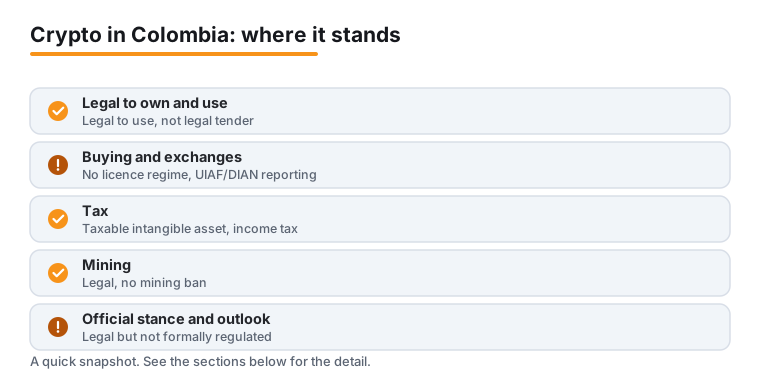
- Legal: Legal to use but not formally regulated, not legal tender
- Tax: Taxed as intangible asset; gains reported as income
- Buying: Via exchanges, P2P, fintech apps and ATMs with KYC
Colombia has one of the most active cryptocurrency communities in Latin America, with millions of users buying, holding, and sending digital assets. Yet as of 2026 the country still has no single, comprehensive crypto law. The approach is best summarized as legal to use but not formally regulated: owning and trading Bitcoin is permitted, crypto is not legal tender, and oversight is spread across several authorities applying existing financial, anti-money-laundering, and tax rules. One development defines the current period: DIAN Resolution 000240 of December 2025, which imposes crypto tax-reporting duties on platforms beginning with the 2026 tax year. The Virtual Asset Service Provider bill that had been advancing, Proyecto de Ley 510 de 2025, was archived by Congress on 20 June 2026 without ever being approved in plenary, so Colombia has no VASP statute and no PSAV registry. This guide explains what is legal today, who the regulators are, how crypto is taxed, and the practical rules around exchanges, AML/KYC, mining, and remittances. For background, see our overview of crypto regulation.
This article is general information as of 2026 and is not legal, tax, or financial advice. Crypto rules in Colombia are changing quickly; always confirm your situation with a qualified Colombian professional and verify against official sources such as the Superintendencia Financiera de Colombia (SFC), DIAN, the Unidad de Información y Análisis Financiero (UIAF), and Banco de la República.
On this page: Legal status · Who regulates it · Taxes · How to buy · Mining
Is Bitcoin and crypto legal in Colombia?
Yes. Buying, holding, selling, and using cryptocurrencies such as Bitcoin is legal for individuals and businesses in Colombia. There is no law prohibiting ownership or peer-to-peer trading, and a large domestic market has developed around exchanges, stablecoins, and remittances.
What crypto is not, however, is official money. Banco de la República (the central bank) and the Superintendencia Financiera de Colombia (SFC) have repeatedly clarified that cryptocurrencies are not legal tender, are not the Colombian peso, and are not securities under Colombian law. The practical consequences:
- No merchant or person is obliged to accept crypto as payment.
- Crypto is generally treated as an intangible asset rather than as currency.
- Holders bear the full risk of price volatility, fraud, and platform failure, with limited consumer-protection recourse compared with regulated bank products.
You can legally use crypto, but you do so largely outside the protections that apply to traditional regulated financial services.
Who regulates crypto in Colombia?
There is no single crypto regulator. Several authorities apply their existing mandates to digital assets:
- Superintendencia Financiera de Colombia (SFC): the financial regulator that supervises banks and securities markets. The SFC has publicly stated that it does not regulate, supervise, monitor, endorse, or authorize operations or business models based on so-called cryptocurrencies, and that crypto trading is not part of the financial system. It warns that any document claiming SFC authorization to trade crypto is fraudulent. Official site: superfinanciera.gov.co.
- Banco de la República (central bank): has stated that crypto is not legal tender and is not part of the national payment system. Official site: banrep.gov.co.
- DIAN (Dirección de Impuestos y Aduanas Nacionales): the national tax authority. It treats crypto as a taxable intangible asset and, through Resolution 000240 of 2025, has introduced platform reporting obligations. Official site: dian.gov.co.
- UIAF (Unidad de Información y Análisis Financiero): the financial intelligence unit, which oversees anti-money-laundering (AML) reporting for virtual asset service providers. Official site: uiaf.gov.co.
- Superintendencia de Sociedades: applies AML/CFT compliance duties (Chapter X of its Basic Legal Circular) to certain companies, including some operating with virtual assets.
Key laws and frameworks
Colombia does not yet have a comprehensive, crypto-specific statute. Instead, a patchwork of existing rules forms the de facto framework while dedicated legislation is debated:
- UIAF Resolution 314 of 2021: requires individuals and companies providing virtual asset services to report transactions to the UIAF, including suspicious-operation reports and threshold-based transaction reports, to combat money laundering and terrorist financing.
- Superintendencia de Sociedades, Chapter X of the Basic Legal Circular: sets self-control and AML/CFT risk-management duties for supervised companies.
- DIAN guidance: earlier DIAN concepts established that crypto is an intangible asset subject to income tax, later reinforced by Resolution 000240 of 2025 on platform reporting.
Because there is no single statute, you should treat any specific rule as something to verify against the issuing authority. The trend is toward tax and AML reporting, not licensing. Reporting duties keep arriving by resolution from DIAN and the UIAF, while every attempt to pass a licensing statute has failed in Congress, most recently on 20 June 2026. The national government said in March 2026 that it has a comprehensive bill ready to file, but no text has been published and no filing date has been announced.
The proposed VASP law (Bill 510 of 2025)
Lawmakers have tried for several years to pass dedicated crypto legislation; earlier attempts stalled. The most recent effort, Proyecto de Ley 510 de 2025 (also cited as PL 510C), was filed by Representative Julián López and Senator Gustavo Moreno and passed its first debate in the Chamber of Representatives on May 20, 2025. It aims to bring Colombia's crypto ecosystem out of its current grey area.
As reported, the proposal would establish a framework for Virtual Asset Service Providers (in Spanish, Proveedores de Servicios de Activos Virtuales, or PSAV) with a division of oversight: a mandatory public PSAV registry administered by the Superintendencia de Sociedades, which would supervise the providers; the Superintendencia Financiera de Colombia (SFC) supervising the activities and specialized entities; and Banco de la República keeping a role over stablecoins because of their impact on monetary policy. Domestic and foreign platforms serving Colombia would have to register, with a transition period reported at up to 12 months once the registry becomes operational. The bill draws on Financial Action Task Force (FATF) Recommendation 15 on virtual assets and would set consumer-protection, registration, and AML standards while leaving existing finance, data-protection, and competition rules in place. Stablecoins would be treated for tax purposes in the same way as the asset that backs them.
Important: as of this update the bill is proposed, not enacted. It is now dead. The Chamber of Representatives records PL 510 de 2025C with Estado "Archivado" and the observation "ARCHIVADO ARTICULO 190, LEY 5 DE 1992", and Congreso Visible dates the archive to 20 June 2026 as "Archivado por Tránsito de Legislatura". Article 190 of Ley 5 de 1992 provides that no bill may be considered in more than two legislatures, and this one ran out of time: it cleared first debate in the Comisión Sexta in May 2025 and a second debate report appeared in Gaceta 1070 de 2025 on 18 June 2025, but no plenary approval was ever recorded. Nothing described in this section is law and none of it takes effect on any date.
Crypto and Bitcoin tax in Colombia
Crypto is taxable in Colombia. DIAN regards digital assets as intangible property, which generally means:
- Income or profit on disposal: gains from selling or trading crypto are generally treated as taxable income and reported in your annual return.
- Asset declaration: holdings are generally declared at their value as assets (net worth) in the income-tax return where filing thresholds are met.
- Mining and crypto received as payment: typically treated as income at the time received.
Colombia uses progressive personal income-tax rates, and the exact rate, brackets, filing thresholds, and any deductions depend on your total income and circumstances and change with each tax reform. The two rates that matter are fixed in the Estatuto Tributario. Crypto held as a fixed asset for two years or more is taxed as ganancia ocasional at a flat 15 percent under article 314, as amended by Ley 2277 de 2022. Crypto sold before two years is ordinary income in the cédula general, taxed on the article 241 scale: 0 percent up to 1,090 UVT of taxable base, then 19, 28, 33, 35, 37 and 39 percent above 31,000 UVT. The UVT for 2026 is COP 52,374, set by DIAN Resolución 000238 of 15 December 2025. Deductions and your personal circumstances still change the final bill, so confirm your own position with DIAN or a Colombian tax adviser. For general context, see our explainer on crypto taxes.
None of the above is tax advice. Confirm filing obligations and rates with DIAN or a licensed accountant.
New 2026 reporting rules: DIAN Resolution 000240
The most consequential recent change is DIAN Resolution 000240, signed on December 24, 2025. It aligns Colombia with the OECD's Crypto-Asset Reporting Framework (CARF) and shifts crypto reporting from voluntary self-disclosure toward automatic platform reporting.
Key points as reported:
- Who must report: Crypto-Asset Service Providers (PSCAs / VASPs) operating with Colombian users, including foreign platforms that serve Colombian taxpayers.
- What is reported: reportable users and the types of cryptoasset transacted, including the fair value of the reported transactions and the number of transactions. The USD 50,000 figure is not a general exemption, and reading it as one is the most common mistake about this rule. It attaches to a single defined category, the Transacción de Pago Minorista Reportable, which the resolution defines as a transfer of relevant cryptoassets above US$50,000. Exchange transactions in which the provider acts as counterparty, as intermediary or through a trading platform are reportable in their own right.
- Deadline: the first full annual reports covering 2026 activity are due by the last business day of May 2027.
- Penalties: the general information-reporting penalty in article 651 of the Estatuto Tributario, as rewritten by Ley 2277 de 2022 article 80. It is a fine that may not exceed 7,500 UVT, COP 392,805,000 at the 2026 UVT, set using 1 percent of the sums not reported, 0.7 percent of sums reported in error and 0.5 percent of sums reported late. If the reporter fixes the failure voluntarily before DIAN issues a pliego de cargos, that fine is reduced to 10 percent of itself.
The practical effect for users is that crypto activity is becoming far more visible to the tax authority. Keep your own records, including dates, amounts, counterparties, and peso values, for every transaction. Confirm thresholds and obligations on the DIAN website, since figures can be updated.
Recent developments (2024 to 2026)
Two changes stand out in the current period:
- DIAN Resolution 000240 (December 24, 2025): Colombia adopted the OECD Crypto-Asset Reporting Framework (CARF) and moved from voluntary disclosure toward automatic platform reporting. Crypto-asset service providers serving Colombian users, including foreign platforms, must report reportable users and transfers above USD 50,000, with the first reports covering 2026 activity due by the last business day of May 2027. See the section above for detail.
- Bill 510 of 2025 (PL 510C): a dedicated VASP framework passed its first debate in the Chamber of Representatives on May 20, 2025. It would create a mandatory PSAV registry under the Superintendencia de Sociedades and align Colombia with FATF Recommendation 15. It was archived on 20 June 2026 under article 190 of Ley 5 de 1992, having never been approved in plenary, and it is not law.
The direction of travel is toward formalizing and reporting rather than banning. Both items above are drawn from Colombian tax, legal, and news sources; confirm current status directly with DIAN and Congress before relying on any specific figure or date.
Exchange and VASP registration in Colombia
There is currently no dedicated licensing regime that exchanges must hold to operate in Colombia. The SFC does not authorize or supervise crypto platforms, and there is no SFC license for crypto trading. However, providers are subject to existing obligations:
- AML reporting: under UIAF Resolution 314 of 2021, virtual asset service providers must register with and report to the UIAF.
- Tax reporting: under DIAN Resolution 000240 of 2025, platforms serving Colombian users face the new CARF-aligned reporting duties described above.
- Proposed registration: Bill 510 of 2025 would have created a formal VASP registry, but it was archived on 20 June 2026. No PSAV registry exists in Colombia and no authority operates one, so there is no register you can check a platform against.
Banking access can be uneven. Because the SFC keeps crypto outside the regulated perimeter, some banks have historically restricted or closed accounts linked to crypto activity, and users often rely on fintech rails for peso deposits and withdrawals. When choosing a platform, prioritize transparent fees, clear KYC, peso on and off ramps, a solid security track record, and compliance with UIAF and DIAN reporting.
AML and KYC rules
Anti-money-laundering and counter-terrorist-financing rules are the most developed part of Colombia's crypto framework. The core obligations come from the UIAF:
- UIAF Resolution 314 of 2021 requires virtual asset service providers to file Suspicious Operation Reports (ROS) and threshold-based transaction reports through the UIAF's reporting system, so that authorities can detect possible money laundering or terrorist financing.
- Covered activities include exchange between crypto and fiat, exchange between different cryptoassets, custody or administration of virtual assets, and related financial services.
- The Superintendencia de Sociedades (Chapter X) imposes AML/CFT self-control duties on certain supervised companies.
For users, the practical result is identity verification (KYC). Reputable platforms will ask for your national ID (cédula) and may request proof of address, particularly for larger transactions. Be wary of any service that lets you transact significant sums with no verification at all.
Buying and using crypto in practice
Colombians can buy crypto through global and regional exchanges, peer-to-peer marketplaces, fintech apps, and Bitcoin ATMs. A typical, compliant path looks like this:
- 1. Choose a reputable platform that supports Colombian pesos, applies proper KYC, and reports to the UIAF and DIAN.
- 2. Verify your identity with your cédula and, where required, proof of address.
- 3. Fund your account via bank transfer or supported fintech rails. Be aware some banks restrict crypto-linked transfers.
- 4. Place your order and review the spread and fees before confirming.
- 5. Secure your holdings; for larger amounts consider a self-custody hardware wallet and safeguard your recovery phrase.
- 6. Keep records of every transaction for tax reporting.
Colombia has historically hosted one of the largest fleets of Bitcoin ATMs in Latin America, concentrated in Bogotá and Medellín. ATMs are convenient but typically charge fees well above online-exchange rates, and AML rules still apply. Dollar-pegged stablecoins are widely used for remittances and as a hedge, because they avoid Bitcoin's short-term volatility; recipients should remember that converting and holding crypto can carry tax-reporting implications.
Bitcoin mining in Colombia
Bitcoin mining is legal in Colombia, and there is no dedicated mining ban or special mining licence. Miners operate under the same general business, electricity, tax, and environmental rules that apply to any energy-intensive activity.
Key considerations:
- Electricity cost and supply: profitability depends heavily on power prices, which vary by region and tariff. Colombia has a substantial share of hydropower, which appeals to operators seeking lower-carbon energy, though hydrology and grid conditions affect availability and price.
- Tax treatment: mined coins are generally treated as income when received, and equipment and operations carry the usual business-tax obligations.
- Compliance: larger operations should consider corporate registration, environmental permitting where relevant, and AML obligations if they also exchange the proceeds.
Claims that Colombia offers special crypto-specific mining subsidies should be treated cautiously; there is no broad, crypto-specific mining incentive. Confirm any incentive with official energy and tax authorities before relying on it.
Consumer risks and protection
Because crypto sits outside the regulated financial perimeter, consumer protection is limited. The SFC explicitly does not supervise or guarantee crypto platforms, so deposit-insurance and the recourse mechanisms that apply to banks generally do not apply to crypto holdings.
Main risks to keep in mind:
- Fraud and fake authorizations: the SFC warns that documents claiming SFC permission to trade crypto are fraudulent, and that promises of high guaranteed returns are a classic scam pattern. Verify any entity against the SFC's official list of authorized firms before investing.
- Platform and custody risk: losses from hacks, insolvency, or fraud may have little recourse. Consider self-custody for significant sums.
- Volatility: crypto prices can swing sharply; never invest funds you cannot afford to lose.
- Regulatory and tax change: a VASP law could reshape which platforms operate, and the new DIAN reporting rules make under-reporting riskier.
If something looks too good to be true, check the regulator first. See also the broader regulation hub for other countries.
Official sources and how to verify
Crypto rules in Colombia are evolving, so always confirm current details with the responsible authority rather than relying on summaries. The primary official sources are:
- Superintendencia Financiera de Colombia (SFC): superfinanciera.gov.co for its public statements on crypto and its list of authorized entities. See its notice that it does not regulate or endorse crypto operations.
- DIAN (tax authority): dian.gov.co for income-tax rules and Resolution 000240 of 2025 on crypto-platform reporting.
- UIAF (financial intelligence unit): Resolution 314 of 2021 on virtual-asset reporting.
- Banco de la República (central bank): banrep.gov.co on legal-tender status.
Reminder: this page is general information as of 2026 and is not legal, tax, or financial advice. Verify your situation with the named official regulators (especially the SFC and DIAN) or a qualified Colombian professional before acting.
August 2026 update: the VASP bill was archived
The bill this page described as advancing is no longer alive. The Chamber of Representatives' own record for Proyecto de Ley 510 de 2025 Cámara shows Estado "Archivado" with the observation "ARCHIVADO ARTICULO 190, LEY 5 DE 1992". Congreso Visible, the legislative tracker run by Universidad de los Andes, dates the archive to 20 June 2026 and records it as "Archivado por Tránsito de Legislatura".
The bill did not lose a vote. It ran out of time. Congreso Visible's timeline shows it filed on 25 February 2025, published in Gaceta 206 de 2025 on 3 March 2025, approved in first debate by the Chamber's Comisión Sexta Constitucional Permanente in May 2025, and a second debate report published in Gaceta 1070 de 2025 on 18 June 2025. No plenary approval is recorded after that. Article 190 of Ley 5 de 1992 provides that no bill may be considered in more than two legislatures, so it expired when the 2025 to 2026 legislature closed on 20 June 2026, having cleared only the first of the four debates a law requires.
Three things follow for anyone reading this in August 2026:
- There is no PSAV registry in Colombia and no authority operates one. Sources that say the Superintendencia Financiera or the Superintendencia de Sociedades runs a register of virtual asset service providers, or that a Colombian decree already created one, are describing a bill that died rather than a rule in force.
- There is no VASP licence, no registration deadline and no 12 month transition period. Those were features of the archived draft.
- The Banco de la República role over stablecoins, the consumer-protection duties and the FATF Recommendation 15 alignment set out in that draft all lapsed with it.
A new Congress for the 2026 to 2030 period was installed on 20 July 2026. At the time of this update, 3 August 2026, no successor PSAV bill had been published on the Chamber's register of proyectos de ley. Separately, the national government was reported in March 2026 to have a comprehensive digital-assets bill drafted with Banco de la República and ready to file, with no filing date announced and no published text. Any fresh attempt, from Congress or from the government, starts again at the first of four debates.
What is actually in the pipeline, and when
Colombia's crypto rules now arrive by administrative resolution, not by statute. Every attempt at a licensing law has died in Congress; every reporting duty that binds you today came from a regulator acting under existing powers. This is the state of play on 3 August 2026.
| Measure | Stage | Timing | Who it hits |
|---|---|---|---|
| DIAN Resolución 000240 de 2025, CARF platform reporting | In force since 24 December 2025 | Calendar year 2026 is the first reportable period and it is running now. First reports due by the last business day of May 2027 | Exchanges serving Colombian users, and through them every Colombian account holder |
| UIAF Resolución 314 de 2021, AML reporting | In force since 29 December 2021 | Monthly reporting through SIREL, running continuously since 1 April 2022, with UIAF calendars published for 2026 | Anyone providing virtual asset services in Colombia |
| Proyecto de Ley 510 de 2025 Cámara, PSAV framework | Archived 20 June 2026 | No effect on any date. Dead unless refiled and passed from zero | Nobody |
| Proyecto de Ley 283 de 2025 Cámara, Ley de Financiamiento | Archived, noted "ARCHIVADO ART. 184 LEY 5 DE 1992" | No effect. The 2026 financing bill filed on 1 September 2025 never reached the statute book | Taxpayers: ordinary Estatuto Tributario rules continue unchanged |
| Government digital-assets bill drafted with Banco de la República | Announced in March 2026, text unpublished, not filed | No filing date announced. Would need four debates once filed. The current legislature runs to 20 June 2027 | Unknown until a text exists |
The financing bill matters to crypto holders for what it did not do. CriptoNoticias reported on 3 September 2025 that the draft carried crypto-specific clauses, including a statutory definition of digital assets as "una representación digital e intangible de un derecho susceptible de valoración" and an exchange reporting threshold of 1,400 UVT. None of that survived. Colombian crypto tax is therefore still decided by general asset rules written long before crypto existed.
The actual crypto tax rates in Colombia
DIAN's compiled doctrine on cryptoassets, Oficio 915014 de 2022, treats cryptoassets as "bienes inmateriales o incorporales susceptibles de ser valorados" that form part of the taxpayer's patrimonio. That classification, not a crypto-specific rate, decides what you pay. Two paths exist, and the holding period chooses between them.
| Situation | Treatment | Rate | Basis |
|---|---|---|---|
| Sold after being held as a fixed asset for two years or more | Ganancia ocasional, computed as sale price minus fiscal cost | Flat 15 percent | Article 314 ET, as amended by Ley 2277 de 2022 article 33 |
| Sold before two years | Renta líquida, added to the cédula general alongside salary | 0 percent up to 1,090 UVT of taxable base, then 19, 28, 33, 35, 37 and 39 percent above 31,000 UVT | Article 300 ET and article 241 ET |
| Mined coins and crypto received as payment | Ordinary income when received | Same progressive scale | Article 241 ET |
| Holdings at 31 December | Declared at patrimonial value. Those not required to keep books use acquisition cost; foreign-currency purchases convert at the TRM in force at the time of the transaction | Not a separate tax, but it feeds the filing thresholds | Articles 271 and 288 ET |
One trap in the official doctrine: Oficio 915014 was issued on 14 October 2022 and still quotes the old 10 percent ganancia ocasional rate. Ley 2277 de 2022 raised it, and article 314 of the Estatuto Tributario now reads "quince por ciento (15%)". Use 15 percent.
The UVT that converts those bands into pesos is COP 52,374 for 2026, fixed by DIAN Resolución 000238 of 15 December 2025, up 5.17 percent from COP 49,799 in 2025. At the 2026 UVT the zero-rate band covers the first COP 57,087,660 of taxable base and the 39 percent band starts above COP 1,623,594,000.
One practical consequence is easy to miss. A sale inside two years does not get its own gentle rate. It goes into the cédula general on top of your salary, so an active trader on a good income can face a higher marginal rate on crypto profit than a long-term holder pays in total. Article 300 also excludes assets sold in the ordinary course of a business from fixed-asset treatment, so frequent trading can put you outside the 15 percent path regardless of how long any single position was held.
The AML thresholds that already apply
The UIAF, not the SFC, is where crypto compliance actually bites today. Resolución 314 de 2021 obliges anyone providing virtual asset services in Colombia to report through SIREL, the UIAF's online reporting system, and it sets numbers rather than principles:
- Suspicious operation reports, ROS, as soon as a suspicious operation is detected. No monetary threshold.
- Monthly reports of individual transactions that "igualen o superen los 150 dólares o su equivalente en otras monedas".
- Monthly reports of multiple transactions that "igualen o superen los 450 dólares o su equivalente".
- Covered activity: crypto to fiat exchange, crypto to crypto exchange, transfers, custody and administration of virtual assets, and related financial services.
The resolution took effect on publication, 29 December 2021, and reporting began on 1 April 2022. The UIAF's virtual assets page publishes the reporting annexes, the ROS report, the client report and the transaction report, along with a 2026 reporting calendar and a separate 2026 calendar for participants in the SFC's La Arenera pilot.
That USD 150 line is the reason a Colombian-facing exchange asks for your cédula at amounts most people assume are too small to matter. It is a reporting obligation on the platform, not a limit on you, and it has been in force for over four years.
If you hold crypto: the return you file between August and October 2026
The 2025 income tax return for individuals is being filed right now. The deadlines run from 12 August to 26 October 2026, ordered by the last two digits of the cédula, under Decreto 2229 de 2023. Crypto held at 31 December 2025 belongs in that return, valued using the 2025 UVT of COP 49,799.
You must file for tax year 2025 if any one of these applies:
- Gross patrimony at 31 December 2025 above 4,500 UVT, COP 224,096,000. Crypto holdings count toward this.
- Gross income for 2025 of 1,400 UVT or more, COP 69,719,000.
- Credit card consumption above 1,400 UVT, COP 69,719,000.
- Total purchases and consumption above 1,400 UVT, COP 69,719,000.
- Bank deposits, deposits or financial investments accumulating above 1,400 UVT, COP 69,719,000.
- You were a responsable de IVA at 31 December 2025.
Crypto reaches you twice here. It is an asset that can push you over the patrimony threshold even if you never sold, and a disposal is income that can push you over the income threshold. Note the timing gap that matters most: the first return DIAN will be able to cross-check against exchange data is the one for tax year 2026, filed in 2027, because Resolución 000240's first reportable period is calendar year 2026. The 2025 return you are filing now is the last one DIAN sees only from your side.
Frequently asked questions
Is cryptocurrency legal in Colombia?
Yes. Owning, buying, selling, and trading crypto is legal for individuals and businesses. However, crypto is not legal tender and is not classed as currency or a security, so no one is obliged to accept it, and it sits largely outside regulated financial protections. The SFC has confirmed it does not regulate or endorse crypto operations.
Which authorities regulate crypto in Colombia?
There is no single regulator. The SFC supervises the financial system but states it does not regulate crypto; Banco de la República addresses legal-tender status; DIAN handles taxation and platform reporting (Resolution 000240 of 2025); and the UIAF oversees AML reporting (Resolution 314 of 2021). A dedicated VASP bill, Proyecto de Ley 510 de 2025, was archived on 20 June 2026 without becoming law, so no crypto-specific statute exists and no regulator has been given a crypto mandate.
Do I have to pay tax on crypto in Colombia?
Generally yes. DIAN treats crypto as a taxable intangible asset, so profits are typically reported as income and holdings may need to be declared as assets. Rates and thresholds depend on your overall situation and change with tax reforms. From the 2026 tax year, DIAN Resolution 000240 also requires platforms to report user and transaction data. Confirm specifics with DIAN or a tax professional.
What is DIAN Resolution 000240 and how does it affect me?
Signed in December 2025 and aligned with the OECD's Crypto-Asset Reporting Framework (CARF), it requires crypto platforms serving Colombian users (including foreign ones) to report transactions over USD 50,000 plus general user information such as tax residence and net balances. The first reports covering 2026 activity are due by the last business day of May 2027. In practice, your crypto activity is now far more visible to the tax authority, so keep accurate records.
Do crypto exchanges need a licence in Colombia?
Not currently. There is no SFC licence for crypto trading, and the SFC does not supervise exchanges. Providers must, however, register and report to the UIAF for AML purposes (Resolution 314 of 2021) and comply with DIAN reporting (Resolution 000240 of 2025). Bill 510 of 2025 would have created a formal VASP registry, but Congress archived it on 20 June 2026, so no such registry exists and none is scheduled.
Who would run the VASP registry under Bill 510 of 2025?
Under the bill as reported, the mandatory registry for Virtual Asset Service Providers (PSAV) would be administered by the Superintendencia de Sociedades, which would supervise the providers, while the SFC would supervise activities and specialized entities and Banco de la República would keep a role over stablecoins. Domestic and foreign platforms serving Colombia would have to register, with a transition reported at up to 12 months once the registry is operational. This is a proposal that passed only its first debate on May 20, 2025, so the details can change and are not yet law.
Do foreign crypto exchanges have to report my transactions to DIAN?
Yes, if they serve Colombian users. DIAN Resolution 000240 of 2025 applies to crypto-asset service providers with Colombian users, including foreign platforms. They must report reportable users and transfers above USD 50,000, and general user data such as tax residence and net balances can be reported even below that threshold. The first reports cover 2026 activity and are due by the last business day of May 2027. Keep your own records regardless.
Is it safe to invest in crypto in Colombia?
Crypto is legal but high-risk and largely outside regulated consumer protections. The SFC does not guarantee crypto platforms and warns that any document claiming SFC authorization to trade crypto is fraudulent. Before investing, verify entities against the SFC's official list, never trust promises of high guaranteed returns, consider self-custody for large sums, and only invest what you can afford to lose. This is not investment advice.
Did Colombia pass a crypto law in 2026?
No. The Virtual Asset Service Provider bill, Proyecto de Ley 510 de 2025 Cámara, was archived on 20 June 2026 under article 190 of Ley 5 de 1992 after the Chamber plenary never approved it. Colombia still has no crypto-specific statute. The rules that actually bind you are DIAN Resolución 000240 de 2025 on platform reporting, UIAF Resolución 314 de 2021 on AML reporting, and the ordinary Estatuto Tributario for tax.
Does Colombia have a PSAV or VASP registry?
No. A mandatory PSAV registry under the Superintendencia de Sociedades was proposed in Bill 510 of 2025, but that bill was archived on 20 June 2026 and never became law. No Colombian authority operates a crypto register and none issues a crypto licence. If a source tells you the Superintendencia Financiera administers a PSAV registry, or that a decree already created one, it is describing a proposal that died, not a rule in force.
What rate do I pay on crypto profits in Colombia?
If you held the crypto as a fixed asset for two years or more, the gain is ganancia ocasional and taxed at a flat 15 percent under article 314 of the Estatuto Tributario, calculated as sale price minus fiscal cost. If you sold before two years, the profit is ordinary income in the cédula general and taxed on the article 241 scale: 0 percent up to 1,090 UVT of taxable base, then 19, 28, 33, 35, 37 and 39 percent above 31,000 UVT. The 2026 UVT is COP 52,374.
Is anything under USD 50,000 invisible to DIAN?
No. The USD 50,000 figure in Resolución 000240 defines one category, the Transacción de Pago Minorista Reportable, a transfer of relevant cryptoassets above that amount. Exchange transactions in which the provider acts as counterparty, as intermediary or through a trading platform are reportable in their own right, together with information on reportable users, the types of cryptoasset transacted, and the number and fair value of transactions.
When will Colombia regulate crypto exchanges?
There is no date. The only bill that would have licensed exchanges was archived on 20 June 2026, and no replacement had been published on the Chamber's register when this page was updated on 3 August 2026. The national government was reported in March 2026 to have a comprehensive digital-assets bill ready to file, prepared with Banco de la República, but no text has been published and the reporting says explicitly that no filing date has been set. A new Congress was installed on 20 July 2026 and any new bill must clear four debates.
What happens if my exchange does not report to DIAN?
The penalty falls on the platform under article 651 of the Estatuto Tributario, the general information-reporting sanction. It is a fine that may not exceed 7,500 UVT, COP 392,805,000 at the 2026 UVT, set using 1 percent of the sums not reported, 0.7 percent of sums reported in error and 0.5 percent of sums reported late. If the platform fixes the failure voluntarily before DIAN issues a pliego de cargos, that fine is reduced to 10 percent of itself. Your own duty to declare your holdings and your gains is unaffected by what the platform does.
At what amount does a Colombian platform report me to the UIAF?
Individual transactions of USD 150 or more, and multiple transactions of USD 450 or more, are reported monthly to the UIAF through the SIREL system under Resolución 314 de 2021. Suspicious operation reports have no threshold at all. This has applied since reporting began on 1 April 2022, which is why verification starts at amounts far lower than most users expect.
Do I need to file a Colombian tax return just because I hold crypto?
Possibly. For tax year 2025 you must file if your gross patrimony at 31 December 2025 was above 4,500 UVT, COP 224,096,000, and crypto holdings count toward that figure. You must also file if gross income, credit card consumption, total purchases, or bank deposits and financial investments reached 1,400 UVT, COP 69,719,000. The 2025 filing window runs from 12 August to 26 October 2026, ordered by the last two digits of your cédula.
Facts reviewed: 6 August 2026. Page updated: 6 August 2026.