Home › Crypto Regulation › Argentina
Bitcoin & Cryptocurrency Regulation in Argentina
Quick answer — Argentina, 2026
- Legal: Legal to own and trade, not legal tender
- Tax: Taxed as property under income and personal assets tax
- Buying: Via CNV-registered exchanges and peer-to-peer
Argentina is one of the most active cryptocurrency markets in Latin America. Years of high inflation, recurring currency crises and tight foreign-exchange controls pushed many Argentines toward Bitcoin and US-dollar stablecoins to protect savings and move money across borders. That grassroots adoption now sits alongside a formalising legal framework: crypto is legal to own and trade, exchanges and other Virtual Asset Service Providers must register with the securities regulator, and the tax authority increasingly expects holdings and gains to be declared.
This guide explains how crypto is treated in Argentina as of 2026: legal status, the regulators, the key laws, registration and tax rules, AML and KYC obligations, mining, recent developments and the practical risks. It is general information as of 2026 and is NOT legal, tax or financial advice. Rules here change quickly, so verify current specifics with the named official regulators, the Comisión Nacional de Valores (CNV) and the tax authority (ARCA), or a qualified Argentine professional, before acting. For broader context see our guide to crypto regulation.
On this page: Legal status · Who regulates it · Taxes · How to buy · Mining
Is Bitcoin and crypto legal in Argentina?
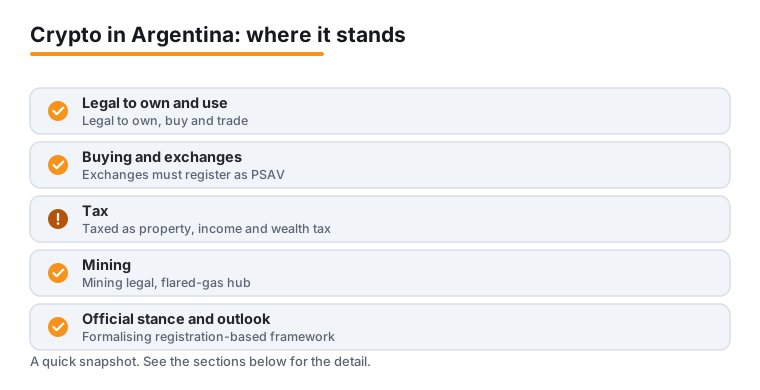
Yes. Owning, buying, selling and trading Bitcoin and other crypto assets is legal in Argentina. There is no ban on individuals holding digital assets, and using crypto in private agreements between consenting parties is generally permitted.
What crypto is NOT is legal tender. The Argentine peso, issued by the Central Bank (Banco Central de la Republica Argentina, BCRA), remains the only currency that must be accepted to settle debts. Bitcoin and other crypto assets are treated as property rather than money, so merchants are not obliged to accept them. Crypto is a legal, recognised asset class in Argentina, but one that now sits inside a registration, anti-money-laundering and tax framework rather than outside it.
Who regulates crypto in Argentina?
Several authorities share oversight of the crypto sector:
- Comisión Nacional de Valores (CNV) is the lead crypto regulator. The National Securities Commission was designated under Law 27.739 to run the public registry of Virtual Asset Service Providers (Proveedores de Servicios de Activos Virtuales, or PSAV) and to set their operating rules. See the official site: Comisión Nacional de Valores (cnv.gov.ar).
- Unidad de Información Financiera (UIF), Argentina's financial-intelligence unit, oversees anti-money-laundering (AML) rules and receives suspicious-activity reports. Registered PSAVs are designated reporting entities to the UIF.
- Banco Central de la Republica Argentina (BCRA), the Central Bank, governs banks and the peso and sets foreign-exchange rules. It has been preparing a framework that would let regulated banks offer crypto custody and trading.
- Agencia de Recaudación y Control Aduanero (ARCA), the national tax and customs authority that replaced AFIP, administers crypto-related taxes and receives data from local exchanges.
For background on how regulators work elsewhere, see our overview of crypto regulation.
Key crypto laws and frameworks
Argentina moved from a largely unregulated market to a registration-based regime in 2024 to 2025. The core instruments are:
- Law 27.739 (March 2024) reformed the anti-money-laundering law (Law 25.246) in line with Financial Action Task Force (FATF/GAFI) Recommendation 15. It introduced the legal definition of a PSAV and tasked the CNV with maintaining a mandatory PSAV registry. Unregistered providers may not operate in the country.
- CNV General Resolution 994/2024 created the PSAV registry and set initial registration requirements.
- CNV General Resolution 1058/2025, published in the Boletín Oficial on 14 March 2025 and effective from 26 May 2025, updated and tightened the rules, adding obligations on legal form (S.A. or S.R.L. only), minimum capital, segregation of client assets, cybersecurity, reporting and risk disclosure. It set staged registration deadlines during 2025 (with cut-off dates in July, August and September 2025 depending on the applicant), a minimum net-worth compliance date of 30 November 2025 for providers already enrolled under the earlier Resolution 994/2024, and most of the substantive Chapter III obligations becoming enforceable for registered providers from 31 December 2025. You can read the official text at the Boletín Oficial (Resolución General 1058/2025).
Because deadlines and thresholds have been revised more than once, check the current CNV rules and registry directly rather than relying on older summaries.
Licensing and registration of exchanges (PSAV)
Under Law 27.739 and the CNV resolutions, any natural or legal person that, as a business, exchanges crypto for fiat, swaps one crypto for another, transfers virtual assets, custodies or administers them, or provides related financial services must register as a PSAV with the CNV. The registry covers both Argentine and foreign providers that direct their offer to Argentine residents, regardless of transaction volume or technology, and foreign legal entities are generally expected to register through a local entity or branch.
Registration runs through the CNV's remote-procedures platform and requires identity and corporate documentation, AML/CFT policies, a described business structure, internal controls, cybersecurity measures and ongoing reporting (including periodic data on customers, transactions and assets) plus annual IT audits. Under Resolution 1058/2025 a corporate PSAV must be incorporated locally as an S.A. or S.R.L., the participation of offshore companies is barred, client assets must be kept separate from the provider's own, and a minimum net-worth (capital) requirement applies. The CNV Normas set the minimum net worth by category: US$150,000 for categories 1, 2 and 4, being exchange between virtual assets and legal tender, exchange between virtual assets, and custody or administration of virtual assets; US$75,000 for category 3, transfer of virtual assets; and US$35,000 for category 5, participation in and provision of financial services related to virtual asset offerings. The requirement drops to 50 percent for a provider with under US$2,500,000 of volume transacted in the last twelve months in categories 1, 2 and 3, or under US$2,500,000 of volume held in custody in the last twelve months for category 4. Natural persons may only carry out the activities in categories 1 and 2. Providers that fail to register are not permitted to operate. You can consult the live registry at the CNV PSAV registry. Verify a platform's status there before depositing funds; details and deadlines can change.
Crypto and Bitcoin tax in Argentina
Crypto is taxable in Argentina. Although digital assets are not legal tender, ARCA treats them as property, so both gains and holdings can trigger tax. The main taxes that may apply to individuals are:
- Income tax (Impuesto a las Ganancias) on profits from selling or disposing of crypto and on crypto received as income, such as salaries, staking rewards or mining proceeds. Gains on financial assets are generally taxed at a flat rate, while crypto earned as ordinary income can fall under the progressive scale; the exact treatment depends on your residency and circumstances.
- Personal assets tax (Bienes Personales), a wealth tax that can apply to crypto held at year-end if your total assets exceed the annual exemption, generally valued at market price on 31 December.
- Provincial gross-receipts tax (Ingresos Brutos) and other levies may apply to trading or business activity, depending on the jurisdiction.
The headline figures are a cedular income tax rate of 5 percent where the disposal is in pesos without an adjustment clause and 15 percent for foreign currency operations, with foreign-source results taxed at 15 percent in all cases, and a personal assets tax scale of 0.50, 0.75 and 1.00 percent for fiscal period 2025 above a general exempt minimum of ARS 384,728,044.57, reduced to 0, 0.25 and 0.50 percent for compliant taxpayers. Thresholds are indexed annually, so confirm the figures for the year you are filing. Confirm current figures with ARCA or a qualified Argentine tax advisor. Keep detailed records, including dates, amounts, fees and the peso value at the time, for every transaction. For general background see our guide to crypto taxes. This is general information, not tax advice.
AML, KYC and reporting obligations
Crypto in Argentina now operates inside the anti-money-laundering system. Law 27.739 brought PSAVs into the framework as obligated reporting entities supervised by the UIF, in line with FATF/GAFI standards. In practice this means a registered platform must:
- verify customer identity through Know-Your-Customer (KYC) checks, collecting ID and personal details before you can transact;
- apply risk-based due diligence and monitor transactions for suspicious patterns;
- file suspicious-activity reports to the UIF and retain records;
- share data with the authorities, including customer, transaction and asset information reported to the CNV, and provide data used by ARCA for tax purposes.
Argentina is also aligning with the OECD's Crypto-Asset Reporting Framework (CARF) for the automatic exchange of crypto account information between countries, with reporting expected to phase in over the coming years. The exact start date has shifted, so confirm the current position with ARCA.
Buying and using crypto in practice
Argentines can buy crypto through CNV-registered local exchanges, peer-to-peer (P2P) marketplaces and, increasingly, banks once they are authorised to offer digital-asset services. US-dollar stablecoins are especially popular as a savings tool. On a compliant platform, expect identity verification (registered PSAVs must run KYC), peso funding via bank transfer (CBU/CVU) and sometimes cash or card, and data-sharing with ARCA, so on-platform activity is visible to the tax authority.
The big shift here is the foreign-exchange backdrop. For years Argentina ran strict currency controls (the "cepo") that limited dollar purchases and opened a wide gap between the official rate and parallel rates such as the "blue dollar" and the MEP rate. From 2025, backed by an IMF agreement, the government lifted most of these controls for individuals and moved toward a managed float, and the various dollar rates have converged much closer together. That trims some of the arbitrage that once drove crypto demand, though stablecoins remain a fast way to hold and move dollars. FX rules can shift again, so verify the current regime with the BCRA before large conversions. A typical compliant buying path is: choose a CNV-registered platform, complete KYC, fund in pesos, place your order (often a stablecoin first for dollar exposure), then either keep funds with a regulated custodian or withdraw to a personal wallet and back up your recovery phrase offline. Keep records of every transaction for tax reporting.
Bitcoin mining in Argentina
Bitcoin mining is legal in Argentina, and the country has drawn attention as a potential mining hub thanks to its energy resources, especially abundant natural gas. A notable trend is using stranded and flared gas to power mining rigs: gas that would otherwise be burned off at remote oil-and-gas sites is converted into electricity to run miners. The most cited examples sit around the Vaca Muerta shale formation in Neuquén province, where energy and mining ventures have argued this monetises wasted energy and reduces emissions from open flaring.
For miners, the practical considerations include energy cost and access (the economics hinge on cheap or wasted power, and grid costs and subsidies have shifted under recent reforms), taxation (mined coins are generally taxable income at their value when received, and later disposals can trigger further tax), and hardware and setup (importing equipment and formalising a business entity carry customs and compliance requirements). There is no single settled mining-specific law covering every scenario, so larger operations typically seek local legal and tax guidance before deploying capital.
Recent developments (2025 to 2026)
The direction of travel is toward formalisation rather than prohibition:
- PSAV regime in force. CNV General Resolution 1058/2025 tightened the rules for crypto providers, who were required to register and adapt their operations, with the framework taking full effect from the end of 2025. More than one hundred providers had entered the registry in its first phase.
- Currency controls relaxed. The 2025 easing of foreign-exchange controls reshaped the market, narrowing the dollar gap that once supercharged crypto demand, while interest in dollar savings and fast cross-border transfers remains strong.
- Banks moving into crypto. The BCRA has been finalising a framework that would let regulated banks offer crypto custody, trading and related services through separate legal units subject to capital, security, liquidity and AML/KYC requirements. This would reverse a May 2022 rule that had barred banks from handling crypto. That April 2026 date passed with no rule published, and it never came from the BCRA: it was attributed to an unnamed exchange in a December 2025 press report that itself noted there was no official communication. As of 3 August 2026 the prohibition stands. The BCRA's own criptoactivos page still states that financial entities under its regulation may not participate, directly or indirectly, in offering crypto assets to clients, and the extension barring payment service providers from facilitating crypto operations also remains. The central bank has announced no date for a replacement framework. Banks wanting exposure today must work through a separately CNV-registered PSAV.
- International tax transparency. Argentina is preparing to adopt the OECD CARF standard for cross-border reporting of crypto accounts.
Because these reforms are still being implemented and timelines have moved, treat any specific date as provisional and confirm it with the official source.
Consumer risks and protection
Crypto in Argentina carries the usual hazards plus some country-specific ones. The general risks include price volatility, scams and fraudulent "investment" schemes, exchange or custodian failure, and the responsibility that comes with self-custody, where losing your keys means losing your funds. Argentina-specific factors include macroeconomic instability, the possibility that currency or capital rules tighten again, and a regulatory framework that is still being built out.
To reduce risk, use only CNV-registered platforms (check the official PSAV registry), be wary of guaranteed-return promises, secure your own keys carefully, and keep thorough records. The new PSAV rules add protections such as custody and cybersecurity standards and risk disclosure, but registration is not a guarantee against loss, and crypto holdings are not covered by bank-deposit guarantees. Never invest more than you can afford to lose. This page is informational only and is not legal, tax or financial advice.
Official sources and how to verify
Because Argentina's crypto landscape changes faster than most, always confirm current rules with primary official sources rather than secondary summaries. The most useful starting points are:
- Comisión Nacional de Valores (CNV), the lead crypto regulator, including its PSAV registry to check whether a platform is authorised.
- Banco Central de la Republica Argentina (BCRA) for monetary, banking and foreign-exchange rules.
- Boletín Oficial (CNV Resolución General 1058/2025) for the official text of the PSAV rules.
For tax questions, consult ARCA, the national tax authority, or a qualified Argentine accountant. You can also browse our wider crypto regulation hub for other countries. Remember: this guide is general information as of 2026 and is not legal advice, and you should verify your specific situation with the named official regulators.
August 2026 status: what changed in Argentina this year
Argentina did not pass a crypto law in 2026. What it did instead was change the rules around crypto repeatedly through decrees, tax resolutions and CNV general resolutions, mostly between December 2025 and July 2026. The registration regime described above is unchanged. What moved is tax cost, reporting, and what a registered provider is allowed to do.
| Instrument | In force from | What it changes |
|---|---|---|
| Decreto 475/2026 | 18 June 2026 | Article 6 repeals the second-to-last paragraph of article 10 of the annex to Decreto 380/2001, inserted in November 2021, which stripped exemptions from the bank credits and debits tax whenever a fund movement was linked to buying, selling, exchanging or intermediating crypto. Article 5 exempts accounts used exclusively by PSAVs registered with the CNV. |
| ARCA General Resolution 5869/2026 | Taxable events from 18 June 2026 | Sets the mechanics. A PSAV must enrol the specific accounts in ARCA's Registro de Beneficios Fiscales before the exemption applies, so it is not automatic. |
| CNV General Resolution 1150/2026 | 12 June 2026 | Widens the tokenisation regime to shares including dual-listed ones, negotiable obligations, CEDEARs and certain fund and debt certificates, while excluding Social, Green and Sustainable and Sustainability-Linked securities. Digitally represented securities may not be transferred or traded outside the intervening PSAVs or on decentralised protocols, an authorisation lapses if no digital representation happens within two years, and the sandbox runs to 31 December 2027. |
| CNV General Resolution 1139/2026 | 15 May 2026 | Extends beneficial-owner reporting to PSAVs through the Autopista de la Información Financiera, covering any natural person with at least 10 percent of capital or voting rights, with the initial filing due 31 July 2026. It also restricts cash in favour of bank transfer, cheque and electronic cheque, with a carve-out letting clients inside the simplified income tax regime still deposit cash. |
| CNV General Resolution 1125/2026 | 8 April 2026 | Lets holdings in Activos Virtuales count toward the 350,000 UVA test for Inversor Calificado status, alongside negotiable securities and deposits at financial institutions. |
| CNV General Resolution 1108/2026 | 21 February 2026 | Article 16, inciso 3 allows people in the simplified income tax return regime to move virtual assets in and out of accounts held in their own or joint name at CNV-registered PSAVs, provided the jurisdiction of origin is not on the non-cooperative list and is not high risk per GAFI. |
| Law 27.799 and Decreto 93/2026 | 2 January 2026 and 9 February 2026 | The inocencia fiscal law raises criminal tax thresholds sharply, replacing ARS 1,500,000 with ARS 100,000,000 for simple evasion, and creates a simplified income tax return. The decree sets the operating rules, including a 15 percent significant-discrepancy test, with ARCA as implementing authority. Neither text mentions crypto; Resolution 1108/2026 is what connects PSAV accounts to it. |
| ARCA General Resolution 5804/2025 | Filings due from May 2026 | Rebuilds the platform reporting regime around the person rather than the account. A user is reported for a month when total inflows, total outflows or the closing balance reaches ARS 50,000,000 for individuals or ARS 30,000,000 for companies. |
The practical effect for an ordinary holder is that a registered Argentine exchange is now cheaper to use, mostly cannot take your cash, reports you to ARCA above the thresholds above, and is the only route that lets crypto count inside the new simplified tax return.
What is still pending, and when it could move
Two things sit in the pipeline as of 3 August 2026, and neither is law.
- Banks are still barred, and the April 2026 date never came from the BCRA. The BCRA's own criptoactivos page still states that financial entities under its regulation may not participate, directly or indirectly, in offering crypto assets to clients. That May 2022 prohibition, and the May 2023 extension barring payment service providers from facilitating crypto operations, both remain the published position, and the page carries no reference to any replacement framework. The April 2026 date that circulated widely traces back to a December 2025 report quoting an unnamed exchange, and that report itself noted there was no official communication. More recently, reporting from 14 July 2026 records that the central bank made no official comment when the chief executive of Circle said publicly he expected rules for banks and blockchain before the end of 2026. That is an expectation from an interested party, not a timetable.
- A capital markets and deregulation bill that has not reached Congress. A draft prepared under the Ministry of Deregulation would amend Law 26.831 to bring tokenised assets, digital representations and virtual assets inside the definition of negotiable securities, make virtual assets eligible as pledge collateral, create a fully digital federal guarantee register, and split supervision so the BCRA covers virtual assets used for payment while the CNV covers securities issuance and trading. Government sources said they would give no detail until the text is closed. A parallel deregulation draft would let mutual funds invest in virtual assets where the fund's policy allows, with CNV review limited to legality and technical solvency. Neither had been introduced in either chamber as of 3 August 2026.
President Milei announced a capital markets liberalisation package on 30 July 2026, but the published account of it covers corporate bonds and collective financing and does not mention crypto. Do not assume the crypto provisions above are inside that package.
If those drafts pass, an Argentine saver would be able to hold crypto exposure through a regular mutual fund, pledge crypto against a loan in the regulated market, and eventually buy through a bank rather than only through an exchange. None of that is possible today.
Crypto tax in Argentina, in figures
Argentina has no crypto-specific tax. Crypto is taxed under the general rules, and these are the numbers that actually apply.
- Income tax on disposals. Gains fall under the cedular regime of article 98 of the income tax law, which covers monedas digitales. ARCA states the rate is 5 percent where the disposal is in pesos without an adjustment clause and 15 percent for foreign currency operations, and that foreign-source results are taxed at 15 percent in all cases. Because most positions are dollar or stablecoin denominated, 15 percent is the usual outcome, and acquisition cost and related expenses are deductible. Swapping one crypto asset for another is a disposal. For companies, crypto results fold into ordinary taxable income.
- Personal assets tax on year-end holdings. For fiscal period 2025, filed during 2026, ARCA set the general exempt minimum at ARS 384,728,044.57. On the excess, the general scale is 0.50 percent up to ARS 52,664,283.73, then 0.75 percent up to ARS 114,105,948.16, then 1.00 percent above that. Taxpayers who qualify as compliant pay 0, 0.25 and 0.50 percent on the same brackets. Thresholds are indexed annually, so check the year you are filing.
- Bank credits and debits tax. The general rate is 0.6 percent on each credit and each debit. Since 18 June 2026, crypto-linked movements no longer automatically lose access to exemptions and reduced rates, and accounts used exclusively by a CNV-registered PSAV are exempt once enrolled with ARCA.
- Gross receipts tax. Ingresos Brutos is provincial and reaches habitual trading and mining run as a business. The rate depends on the province and the activity code, so it has to be checked where you are registered.
There is no crypto-specific exemption and no reduced rate for long holding periods. Records of date, amount, fees and the peso value at the time are what make the cedular calculation defensible. This is general information, not tax advice.
Frequently asked questions
Is cryptocurrency legal in Argentina?
Yes. Buying, selling and holding crypto is legal in Argentina. However, it is not legal tender; only the peso, issued by the Central Bank (BCRA), has that status, so businesses are not required to accept crypto as payment.
Who regulates crypto in Argentina?
The Comisión Nacional de Valores (CNV) is the lead regulator and runs the registry of Virtual Asset Service Providers (PSAV) under Law 27.739. The financial-intelligence unit (UIF) handles anti-money-laundering oversight, the Central Bank (BCRA) governs banks and foreign exchange, and the tax authority ARCA administers crypto taxes.
Do crypto exchanges need a licence in Argentina?
They must register. Under Law 27.739 and CNV resolutions (including General Resolution 1058/2025), exchanges and other Virtual Asset Service Providers must enrol in the CNV's PSAV registry, run KYC, follow AML rules, meet cybersecurity and custody standards and report regularly. Unregistered providers are not permitted to operate. You can check a platform's status on the CNV PSAV registry.
Do I have to pay tax on crypto in Argentina?
In most cases, yes. Crypto is treated as property, so gains and certain year-end holdings can be subject to income tax (Ganancias) and the personal assets (wealth) tax (Bienes Personales), administered by ARCA. Rates and thresholds change and depend on your circumstances and residency, so confirm the current figures with ARCA or a qualified tax professional. This is general information, not tax advice.
Can banks in Argentina offer crypto services?
This is changing. The Central Bank (BCRA) has been preparing a framework that would let regulated banks offer crypto custody, trading and related services through separate legal units under strict capital, security, liquidity and AML/KYC requirements, reversing a May 2022 rule that had barred banks from crypto. The April 2026 date reported in the press came and went without a rule being published, and it was never a BCRA figure. As of 3 August 2026 no Argentine bank may offer crypto directly. The May 2022 prohibition is still the position published on the BCRA's own criptoactivos page, it was extended in May 2023 to payment service providers, and the central bank has not announced a new date. Any bank-branded crypto product currently has to run through a separately CNV-registered PSAV.
Why is crypto so popular in Argentina?
High inflation and a history of currency restrictions led many Argentines to use Bitcoin and especially US-dollar stablecoins to protect savings and to send or receive money across borders quickly. Demand stays strong even as the rules and the currency regime evolve, though the 2025 easing of currency controls narrowed some of the arbitrage that once drove it.
What does a company need to register as a PSAV in Argentina?
Under CNV Resolution 1058/2025 a corporate virtual-asset provider must be set up locally as an S.A. or S.R.L., cannot have offshore companies in its ownership, must keep client assets separate from its own, and must meet a minimum capital requirement scaled by category (reported in the range of about US$35,000 to US$150,000, with a possible reduction for lower-volume providers). It must also run KYC and AML controls, meet cybersecurity and reporting rules, and pass annual IT audits. Confirm the current figures on the CNV site, as they can change.
When did Argentina's crypto provider rules take effect?
The main rulebook, CNV General Resolution 1058/2025, was published on 14 March 2025 and became effective on 26 May 2025. It set staged registration deadlines through 2025 (with cut-off dates in July, August and September depending on the applicant), a minimum net-worth compliance date of 30 November 2025 for providers already enrolled under the earlier Resolution 994/2024, and most of the substantive obligations becoming enforceable for registered providers from 31 December 2025.
Can I buy crypto through my bank in Argentina in 2026?
No. As of 3 August 2026 the BCRA prohibition dating from May 2022 is still in force and the central bank has not published any replacement framework. The BCRA's criptoactivos page still states that financial entities under its regulation may not participate, directly or indirectly, in offering crypto assets to clients, and payment service providers have been barred from facilitating crypto operations since May 2023. The April 2026 date that circulated in press summaries was attributed to an unnamed exchange, not to the BCRA. Buying still runs through a CNV-registered PSAV or peer-to-peer.
What rate do I pay when I sell crypto in Argentina?
Gains fall under the cedular regime of article 98 of the income tax law, which covers monedas digitales. ARCA states the rate is 5 percent where the sale is in pesos without an adjustment clause and 15 percent for operations in foreign currency, and that foreign-source results are taxed at 15 percent in all cases. Because most crypto is dollar or stablecoin denominated, 15 percent is the usual result, and acquisition cost and related expenses are deductible. Swapping one coin for another counts as a disposal. This is general information, not tax advice.
When does my exchange report me to ARCA?
Under ARCA General Resolution 5804/2025, which applies to informative filings due from May 2026, a platform reports a user for a month when total inflows, total outflows or the closing balance reaches ARS 50,000,000 for an individual or ARS 30,000,000 for a company. The regime was rebuilt around the person rather than the individual account, so holding several accounts at the same platform does not keep you below the line.
Can I still fund my exchange account with cash?
Generally no. CNV General Resolution 1139/2026, in force from 15 May 2026, restricts cash as a means of receiving or paying out client funds in favour of bank transfer, cheque and electronic cheque. There is one carve-out: clients who have adhered to the Régimen de Declaración Jurada Simplificada para el Impuesto a las Ganancias may still make cash deposits into the obligated subject's bank accounts. Outside that case, expect a bank or CVU rail.
Is there a crypto bill in the Argentine Congress right now?
No crypto bill had been introduced as of 3 August 2026. A draft prepared under the Ministry of Deregulation would amend Law 26.831 to treat tokenised assets and virtual assets as negotiable securities, make virtual assets eligible as pledge collateral, and split supervision between the BCRA for crypto used as payment and the CNV for securities, while a parallel draft would let mutual funds invest in virtual assets. Reporting indicates the draft still awaits presidential signature before being sent to Congress, and the government has said it will not release the text until it is finalised.
Do I still pay the cheque tax when I buy crypto?
The penalty treatment is gone. Decreto 475/2026, in force from 18 June 2026, repealed the paragraph added in November 2021 that stripped exemptions from the bank credits and debits tax whenever the fund movement was linked to crypto operations, and it exempts accounts used exclusively by a PSAV registered with the CNV. The provider has to enrol those accounts in ARCA's Registro de Beneficios Fiscales first. The tax itself, at a general rate of 0.6 percent on each credit and each debit, still applies where no exemption is available.
Can I use crypto to join the new simplified income tax regime?
Yes, if it sits at a registered provider. CNV General Resolution 1108/2026, in force from 21 February 2026, permits transfers of virtual assets to and from accounts held in your own name or joint name at PSAVs registered with the CNV under the simplified income tax return regime created by Law 27.799 and regulated by Decreto 93/2026. The jurisdiction of origin must not be on the list of non-cooperative jurisdictions nor be classified as high risk by GAFI. Crypto held on an unregistered or offshore platform does not qualify.
Facts reviewed: 5 August 2026. Page updated: 5 August 2026.