Home › Crypto Regulation › Ecuador
Bitcoin & Cryptocurrency Regulation in Ecuador
Quick answer — Ecuador, 2026
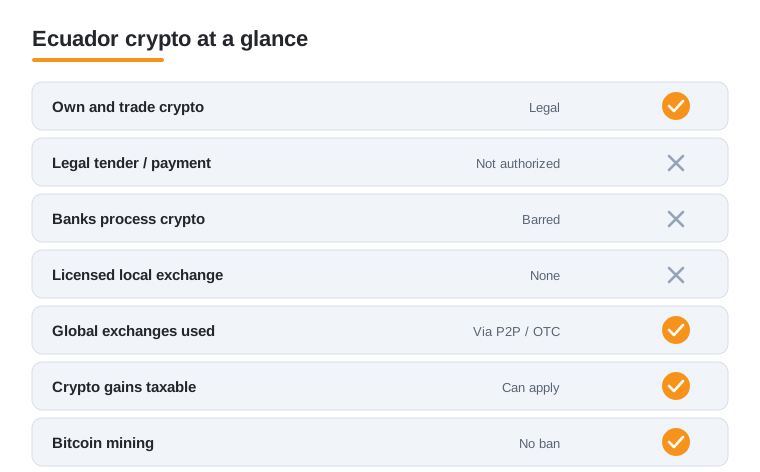
- Owning and trading crypto is legal in Ecuador, but it is not legal tender or an authorized means of payment.
- Crypto gains and income can be taxable; Ecuador has no dedicated crypto tax, so confirm rates with the SRI.
- Residents mainly buy via global exchanges (Binance, OKX), peer-to-peer trades, or Bitcoin ATMs, since banks are barred from crypto transactions.
Ecuador occupies an unusual position in the cryptocurrency world. The country has used the US dollar as its sole legal tender since 2000, and that single fact shapes almost everything about how Bitcoin and other digital assets are treated. Crypto is not illegal to own or trade, but it is also not recognized as money or an authorized means of payment. The Central Bank of Ecuador has been explicit that the restriction is on using crypto as payment and on banks processing crypto transactions, not on private ownership. The result is a legal grey area in which individuals can buy, hold and swap tokens while regulated banks and payment companies are barred from touching them.
This guide explains where Ecuador stands on crypto as of 2026: the legal status, the regulators involved, the laws that apply, how exchanges and virtual asset businesses are treated, taxation, anti-money-laundering rules, the practical realities of buying and using crypto, mining, recent developments, consumer risks, and how to verify the current position with official sources. It is general information as of 2026 and is NOT legal, tax or financial advice. Crypto rules in Ecuador are evolving, so always confirm the current position with the named official regulators or a qualified local professional before acting. For broader context, see our overviews of crypto regulation and regulation by country.
On this page: Legal status · Who regulates it · Taxes · How to buy · Mining
Is Bitcoin and crypto legal in Ecuador?
Short answer: owning and trading crypto is legal, but using it as money is not. There is no law in Ecuador that prohibits a private person from buying, holding or selling Bitcoin and other tokens over the internet or peer to peer. At the same time, no cryptocurrency is recognized as legal tender or as an authorized means of payment.
The Central Bank of Ecuador (Banco Central del Ecuador, BCE) states plainly that cryptocurrencies are not legal tender nor an authorized means of payment in Ecuador. The dollar is the only authorized monetary unit, and the regulatory board has classified authorized payment methods as physical cash, electronic transfers, and credit, debit and prepaid cards. Cryptocurrencies are deliberately excluded from that list.
In practice this creates a two-track reality:
- Permitted: private purchase, sale, holding and peer-to-peer exchange of crypto by individuals.
- Restricted: use of crypto as a formal payment method, and the involvement of regulated banks and payment processors in crypto transactions.
Importantly, the BCE has acknowledged that it does not have the power to ban the assets themselves; the prohibition targets crypto as a means of payment and the banking channels used to move it. Anyone trading crypto in Ecuador does so without state guarantees, deposit insurance or consumer-protection backstops, which is a key distinction from holding money in a regulated bank account.
Who regulates crypto in Ecuador?
Ecuador has no single crypto regulator. Several institutions touch digital assets, each within its own mandate:
- Banco Central del Ecuador (BCE) is the central bank. It defends dollarization and has repeatedly stated that cryptocurrencies are neither legal tender nor an authorized means of payment.
- Junta de Politica y Regulacion Monetaria (JPRM) is the monetary policy and regulation board. It issues the resolutions that reaffirm the dollar's exclusivity and list the authorized electronic payment instruments, none of which is crypto.
- Superintendencia de Bancos (SB) is the banking supervisor. It oversees financial institutions, enforces the rule that banks do not process crypto transactions, and is tasked with supervising new financial-technology entities.
- Servicio de Rentas Internas (SRI) is the tax authority, relevant whenever crypto activity generates taxable income.
- Unidad de Analisis Financiero y Economico (UAFE) is the financial intelligence unit, central to anti-money-laundering reporting.
Because responsibilities are split, the rules that affect crypto come from a patchwork of monetary resolutions, banking supervision, tax law and AML obligations rather than from one comprehensive crypto statute. You can confirm each body's current position on its official site, including the Central Bank of Ecuador.
Key laws and frameworks
No single statute governs cryptocurrency in Ecuador. The current treatment rests on a handful of laws and resolutions:
- Codigo Organico Monetario y Financiero (Organic Monetary and Financial Code). This establishes the US dollar as the sole legal tender and reserves to the state the power to authorize means of payment. The Central Bank has cited its provisions when warning that using unauthorized payment methods is prohibited and that misuse may be referred to the Attorney General's Office for investigation and sanction.
- JPRM resolutions. The monetary board issued Resolution No. JPRM-2022-005-M (11 February 2022) and Resolutions No. JPRM-2023-014-M (7 August 2023) and No. JPRM-2023-015-M (9 August 2023), which reaffirm the dollar as legal tender and define the authorized payment instruments.
- Ley Organica para el Desarrollo, Regulacion y Control de los Servicios Financieros Tecnologicos (the Fintech Law), in force since late 2022. It requires financial-technology services to be provided by locally incorporated corporations (sociedades anonimas) and brings them under supervision. By-laws and resolutions issued in 2025 tightened the conditions for fintech operators.
The most consequential practical rule is the banking restriction: banks, insurers and payment processors are expected to refuse crypto-related transactions unless a future law grants an explicit license. Treat any specific draft requirement as provisional until enacted, and verify the current state of the law before relying on it.
Licensing and registration of crypto exchanges and VASPs
As of 2026, Ecuador does not have a dedicated virtual asset service provider (VASP) license. There is no domestic licensing regime purpose-built for crypto exchanges, and no licensed domestic crypto exchange operates in the country. Global platforms such as Binance and OKX are not authorized by the Superintendency of Banks; Ecuadorian users typically reach them as individuals or through peer-to-peer and over-the-counter channels.
Two regimes are nonetheless relevant to anyone running a crypto-related business:
- Fintech Law requirements. Entities providing technology-based financial services must incorporate locally as corporations (sociedades anonimas). Rules formalized in 2025 set demanding conditions reported to include a minimum paid-in capital of around USD 200,000, an approved risk structure, liability insurance, and special registration, with oversight by the Superintendency of Banks.
- AML registration. Businesses that handle virtual assets can fall within the anti-money-laundering reporting framework supervised by the UAFE (see the next section).
There is no virtual-asset licensing regime in Ecuador, and the National Assembly archived the only crypto-specific bill on 13 October 2025. The only registration that exists is the codigo de registro that every obligated subject, virtual asset service providers included, must obtain from the UAFE under article 56 of the anti-money-laundering law. If you plan to operate a crypto business in Ecuador, obtain current legal advice and confirm requirements directly with the Superintendency of Banks and the UAFE before committing capital.
Crypto and Bitcoin tax in Ecuador
Ecuador does not have a dedicated cryptocurrency tax code, but that does not mean crypto activity is tax-free. The Servicio de Rentas Internas (SRI) generally treats profits and income sourced in Ecuador as taxable, and crypto gains can fall within that scope.
In broad terms, the following situations may create a tax obligation:
- Realized gains when you sell or exchange crypto for more than you paid.
- Crypto received as payment for goods, services or work, which can count as income.
- Business or professional activity involving crypto, which is taxed like other business income.
Ecuador applies a progressive income tax to individuals. For the 2025 tax year the annual tax-free threshold was about USD 12,081, and marginal rates rise across brackets to a top rate of 37 percent on the portion of annual income above roughly USD 108,810. The system is marginal, so only the amount inside each bracket is taxed at that bracket's rate, not your whole income. Companies pay a separate corporate income tax at a general rate of 25 percent, with a higher 28 percent rate in some cases involving tax-haven shareholders. Rather than rely on a single percentage here, because brackets and rates change with periodic tax reforms, confirm the current figures directly with the SRI or a local accountant. The rate that applies depends on your total income, residency status and how the activity is classified, and value-added tax or other levies may also apply.
Record-keeping matters. Keep clear records of acquisition dates, costs, disposal values and counterparties, which will make any future filing far easier and reduce the risk of disputes. You can review current income-tax rules at the Servicio de Rentas Internas (SRI), and see our general guide to crypto taxes. This section is general information, not tax advice; Ecuadorian tax treatment of crypto is unsettled and fact-specific, so professional guidance is strongly recommended.
AML and KYC rules
Anti-money-laundering rules are where crypto businesses in Ecuador face the clearest obligations. The Unidad de Analisis Financiero y Economico (UAFE) is the country's financial intelligence unit. It receives and analyzes reports of unusual or suspicious operations and forwards relevant findings to the Attorney General's Office.
There is no separate crypto-specific AML statute, but providers that handle virtual assets can fall under the general reporting framework. In practice this means:
- Registration with the UAFE as a reporting entity where the activity falls within scope.
- Know-your-customer (KYC) checks, including verifying customer identity.
- Transaction monitoring and risk management, with reports of unusual operations submitted to the UAFE.
Reporting duties have tightened in recent years. Ecuador has moved to link tax control and AML supervision, with the tax registry now flagging whether a taxpayer must report to the UAFE, and timelines for obtaining a UAFE registration code after opening or updating a tax record. Banks also run enhanced transaction monitoring that can flag and decline crypto-related flows. The underlying duties come from the Ley Organica de Prevencion, Deteccion y Combate del Delito de Lavado de Activos, published in Registro Oficial 610 of 29 July 2024, under which the UAFE requires threshold reports for transactions of USD 10,000 or more within 15 days after each month end and suspicious operation reports within four days. For the authoritative requirements, consult the Unidad de Analisis Financiero y Economico (UAFE).
Buying and using crypto in practice
Because dollarization makes the US dollar the everyday currency, Ecuadorians who buy crypto are effectively converting dollars into tokens, which removes the foreign-exchange friction seen in countries with volatile local currencies. The main obstacle is not price conversion but the banking restriction.
Common ways residents acquire crypto include:
- Global exchanges such as Binance and OKX, used directly by individuals, though these are not authorized domestically.
- Peer-to-peer (P2P) marketplaces and over-the-counter groups, where buyers and sellers match and settle between themselves, often the practical route given that banks may decline transfers flagged as crypto-related.
- Bitcoin ATMs in larger cities such as Quito, Guayaquil and Cuenca for cash purchases; availability changes frequently, so check a live locator before travelling to one.
The banking ban is the recurring complication. Funding an exchange account or cashing out to a local bank can be refused if the institution identifies the transaction as crypto-related, and enhanced monitoring makes such flags more likely. Many users work around this through P2P trades or cash, but each carries counterparty and fraud risk, and using methods designed to disguise the nature of a transaction can create legal exposure. Crypto also cannot be used to pay official obligations such as taxes, which must be settled in dollars. There is no Ecuadorian regulator standing behind any of these platforms, so due diligence falls entirely on the user: favour services with strong security and a track record, and enable two-factor authentication.
Bitcoin mining in Ecuador
There is no specific law that bans Bitcoin mining in Ecuador, and the country's substantial hydroelectric capacity makes low-cost, lower-carbon mining attractive in principle. In recent years, however, Ecuador has faced periods of serious electricity shortages and rationing, which is a critical consideration for any energy-intensive operation.
Anyone weighing mining in Ecuador should think through:
- Energy reliability and cost. Hydro power can be cheap, but drought-driven shortages and blackouts have disrupted supply; assess current grid conditions, not just headline rates.
- Electricity tariffs and connection terms. Industrial and residential rates differ significantly and can change.
- Business registration and tax. Mining income is generally treated as taxable business activity, so operating formally means registering the business and meeting tax and possibly AML obligations.
- Import and hardware logistics. Bringing in mining rigs involves customs duties and shipping costs.
- Cooling and climate. Location affects cooling needs and overall efficiency.
Because the regulatory treatment of mining is not spelled out in a dedicated framework, miners should obtain local legal and tax advice and confirm energy-supply commitments in writing before committing capital. Profitability is highly sensitive to power costs, hardware efficiency and network difficulty, none of which Ecuador controls.
Recent developments (2025 to 2026)
The Ecuadorian framework is in motion, though most change has come through monetary and fintech rule-making rather than a single crypto law.
- Reaffirmed warnings. The Central Bank has continued to warn the public that crypto is not legal tender or an authorized means of payment, that using unauthorized payment methods is prohibited, and that misuse can be referred to prosecutors. These warnings were repeated as adoption of various tokens grew.
- Worldcoin warning (August 2024). After the Worldcoin project (now called World) began signing up thousands of Ecuadorians who scanned their irises with its Orb devices in exchange for tokens, the Central Bank issued a public reminder in August 2024 that cryptoassets are not legal tender and that using crypto as a means of payment is prohibited. Around the same time the Superintendency of Companies, Securities and Insurance said it was concerned about reports of irregular activity linked to Worldcoin and the risk to citizens' data, security and privacy.
- Proposed exchange licensing bill. Bill 6538, sponsored by Shirley Rivera, is a cryptocurrency bill in the Congress of Guatemala, presented there in 2025 by a Guatemalan deputy. It is not before Ecuador's National Assembly and has no application in Ecuador. The only crypto-specific bill that reached the National Assembly, the Ley Organica sobre Uso y Regulacion de Tecnologias Blockchain en el Ecuador, was archived on 13 October 2025 with 145 affirmative votes.
- Tighter fintech rules in 2025. By-laws and resolutions issued in 2025 firmed up the conditions for financial-technology entities under the Fintech Law, including incorporation as corporations, a substantial minimum capital requirement, risk structures and registration, supervised by the Superintendency of Banks. These rules lay groundwork that could eventually support virtual-asset licensing.
- Tighter AML and tax linkage. Authorities moved to integrate tax control with AML supervision, tying tax registration to UAFE reporting obligations.
- Tokenized dollar study. The Central Bank has studied a tokenized dollar and, according to reporting, could test a limited pilot around 2026 if enabling rules are approved. This remains exploratory and is not a cryptocurrency in the decentralized sense.
Treat all of the above, especially any pilot or future licensing regime, as evolving. Proposals can change substantially before adoption, and timelines slip. Verify the current state with the official regulators named in this guide.
Consumer risks and protection
The defining risk in Ecuador is regulatory rather than purely financial. Crypto exists in a tolerated-but-not-endorsed space, and the Central Bank has been consistent in defending dollarization and warning the public against treating crypto as money. There is no local safety net if a platform fails or a counterparty defrauds you.
Key risks to weigh include:
- No deposit insurance or local consumer-protection regime for crypto holdings, unlike funds in a regulated bank.
- Liquidity and cash-out friction created by the banking restriction and enhanced transaction monitoring.
- High price volatility and the genuine possibility of significant loss.
- Fraud and scams, including guaranteed-return schemes and impostor platforms, with irreversible transactions that leave little recourse.
- An evolving legal environment that could tighten or change the rules.
Sensible principles apply: only commit money you can afford to lose, use reputable tools and self-custody for larger holdings, enable two-factor authentication, never share private keys or recovery phrases, double-check wallet addresses, and be sceptical of any guaranteed return. None of this is financial advice; consider speaking with a qualified adviser about your own situation.
Official sources and how to verify
Because Ecuador's crypto rules are spread across several institutions and continue to evolve, always confirm the current position with the primary official sources rather than third-party summaries. The most relevant bodies and their official websites are:
- Banco Central del Ecuador (BCE) for the legal-tender position, payment-method authorizations and public crypto warnings.
- Servicio de Rentas Internas (SRI) for income tax, brackets and rates, and registration obligations.
- Unidad de Analisis Financiero y Economico (UAFE) for anti-money-laundering registration and reporting duties.
For banking-sector and fintech supervision, also check the Superintendency of Banks (Superintendencia de Bancos). When you find a rule, note its date and reference number, because resolutions are amended over time. This article is general information as of 2026 and is NOT legal, tax or financial advice; verify the current rules with the named official regulators or a qualified Ecuadorian professional before making decisions. For more context, see our crypto regulation guide and country regulation hub.
What is changing: August 2026 status
Ecuador has no crypto ban and no crypto licensing regime, but it does have crypto-specific statutory law. Since 29 July 2024 the definitions of a virtual asset and of a virtual asset service provider have sat in primary legislation, inside the anti-money-laundering law rather than a standalone crypto act. That is the main correction to make to this page.
- Owning, buying and selling crypto remains lawful. No statute prohibits it, and the Banco Central del Ecuador's stated position is confined to payment and legal tender rather than to holding.
- Using crypto to pay is a different matter. The Banco Central notice of 12 August 2024, citing articles 94, 98 and 99 of the Codigo Organico Monetario y Financiero, states that the dollar is the legal tender currency, that the use of payment methods not authorised by the JPRM is expressly prohibited, and that the bank will notify the Fiscalia General del Estado where it identifies cryptoassets being used as a means of payment (Banco Central del Ecuador, English version).
- Crypto businesses are supervised, but only for money laundering. Article 26 of the anti-money-laundering law classifies obligated subjects into three groups, the third being proveedores de servicios de activos virtuales (Registro Oficial 610, 29 July 2024).
- There is still no licence, no authorised exchange and no consumer-protection regime. Registration with the financial intelligence unit is a reporting obligation, not permission to operate.
- The only crypto-specific bill was rejected. The National Assembly archived the Ley Organica sobre Uso y Regulacion de Tecnologias Blockchain en el Ecuador on 13 October 2025 with 145 affirmative votes (Asamblea Nacional).
Correction. Bill 6538, sponsored by Shirley Rivera, is a cryptocurrency bill presented in 2025 in the Congress of Guatemala by a Guatemalan deputy (Prensa Libre). It is not before Ecuador's National Assembly and has no effect in Ecuador.
Virtual asset service providers under the 2024 anti-money-laundering law
The Ley Organica de Prevencion, Deteccion y Combate del Delito de Lavado de Activos y de la Financiacion de Otros Delitos, published in the Cuarto Suplemento del Registro Oficial No. 610 of 29 July 2024, is the operative instrument. Its consolidated text records its status as vigente, with the most recent reform published at Edicion Constitucional del Registro Oficial 96 of 3 October 2025.
| Provision | What it requires |
|---|---|
| Article 4(a) | Defines activo virtual as a digital representation of value that can be traded or transferred digitally, expressly excluding digital representations of fiat currency, securities and other financial assets. |
| Article 4(z) | Defines a proveedor de servicios de activos virtuales by five activities carried out for or on behalf of another person: exchange between virtual assets and fiat currencies, exchange between one or more forms of virtual asset, transfer of virtual assets, custody or administration of virtual assets or of instruments allowing control over them, and participation in and provision of financial services related to an issuer's offer or sale of a virtual asset. |
| Article 26 | Classifies obligated subjects into financial, non-financial, and virtual asset service providers. |
| Article 56 | Requires every obligated subject to apply to the UAFE for a codigo de registro and to notify any change within 15 days. |
| Articles 79 to 81 | Grades infractions as leves (1 to 10 unified basic salaries), graves (11 to 20) and muy graves (21 to 40). Operating without a UAFE registration code, operating without required registration or licence, failing to keep records for ten years and failing to report suspicious operations are all muy graves. |
| Article 82 | Makes the UAFE the competent authority to sanction breaches of the registration code and reporting duties. |
Reporting mechanics are published by the financial intelligence unit itself: threshold reports (RESU) for transactions equal to or above USD 10,000, filed within 15 days after the end of each month; suspicious operation reports (ROS) within four days from when the obligated subject's compliance committee or officer becomes aware; and additional information reports (RIA) within five days of a UAFE request, extendable by three (UAFE). Virtual asset providers were first brought in by Resolucion UAFE-DG-2022-0131 of 8 April 2022, reformed by Resolucion UAFE-DG-2022-0577 of 11 October 2022, both recorded as vigente (UAFE resolutions register).
One caveat worth stating plainly. Articles 5, 22, 31 and 57 were repealed by the Second Repealing Provision of Decree Law 477, the Ley Organica para la Mejora Recaudatoria a traves del Combate al Lavado de Activos, published at Quinto Suplemento del Registro Oficial No. 700 on 10 December 2024. Article 31 was the one spelling out the virtual asset provider category. The Constitutional Court then accepted public unconstitutionality action 94-24-IN and, in Sentencia 94-24-IN/25 published at Edicion Constitucional del Registro Oficial 8 of 27 March 2025, declared that decree-law unconstitutional on formal grounds with retroactive effects. The definitions in article 4 and the classification in article 26 were never touched, so the obligation stands either way, but the consolidated text still carries the old repeal annotations alongside the Court's note.
What is in the pipeline, and what would move it
The one crypto-specific bill that reached Ecuador's National Assembly was rejected, not deferred, and no successor was found in the Assembly's published news or in any source consulted.
- Archived, 13 October 2025. The plenary voted 145 in favour of a motion by Cecilia Baltazar, president of the Comision de Educacion, Cultura, Ciencia, Tecnologia, Innovacion y Saberes Ancestrales, to archive the Proyecto de Ley Organica sobre Uso y Regulacion de Tecnologias Blockchain en el Ecuador. Baltazar said the project did not sit in harmony with the existing legal order and did not guarantee legal certainty, personal data protection or financial sustainability, and that regulating a constantly evolving technology could conflict with the competences of the Banco Central and the financial control bodies. Ana Maria Raffo said that after appearances by experts from the Banco Central, the Superintendencia de Bancos and the Superintendencia de Companias, the commission concluded the country did not yet have the technical or legal maturity to legislate on the technology, and that hasty rules could create economic and legal risks and undermine dollarisation (Asamblea Nacional).
- Annulled, 27 March 2025. The December 2024 decree-law that had repealed virtual-asset articles from the AML law was struck down retroactively by the Constitutional Court, as recorded in the consolidated text of the law itself (Registro Oficial 610 consolidated text). The Assembly had archived the same proposal before the President issued it by decree (Primicias).
The most concrete pressure for a future framework is international rather than domestic. In GAFILAT's fourth-round mutual evaluation of Ecuador, based on an on-site visit from 28 March to 8 April 2022 and adopted at GAFILAT's XLVI plenary in December 2022, Recommendation 15 on new technologies is rated Parcialmente Cumplida, or partially compliant. The report identifies specific gaps: Ecuador had not developed an analysis identifying and assessing the risks arising from new products and business practices, new delivery mechanisms and new or developing technologies; there were no legal measures preventing criminals or their associates from holding, being beneficial owners of, holding a significant or majority stake in, or occupying a management function in a virtual asset provider; and there was no sanctions framework allowing sanctions against providers operating without registration or licence. The report also notes the 2021 national risk assessment did not address virtual asset risks, and recommends outreach to the sectors recently brought into the AML system, naming lawyers, accountants and virtual asset providers, so they understand the scope of their obligations (GAFILAT mutual evaluation report, listed as the fourth-round IEM on the GAFILAT country page).
The 2024 anti-money-laundering law appears to close part of that last gap, since article 81 now makes operating without a UAFE registration code, or without required registration or licence, a muy grave infraction. Whether GAFILAT re-rates Recommendation 15 on that basis is not something any published follow-up report confirms; the GAFILAT country page lists no follow-up reports for Ecuador.
The currency-exit tax when you buy crypto from abroad
This is the tax most Ecuadorian buyers actually meet, and it applies whether or not any crypto-specific rule exists. The Impuesto a la Salida de Divisas (ISD) is charged on transfers, remittances and movements of currency abroad. The general rate is 5 percent in 2026 (Servicio de Rentas Internas).
- Credit and debit card consumption and withdrawals abroad carry an annual exempt amount of USD 5,188.26, the figure set for 2025, 2026 and 2027. Spending above that is taxed at 5 percent.
- Transfers and remittances abroad through the financial system are exempt up to three unified basic salaries, USD 1,446.00 in 2026, and that allowance applies per fortnightly period running from the 1st to the 15th and from the 16th to the last day of each month, not per transfer and not annually.
- Cash carried abroad by adults leaving the country is exempt up to the same three unified basic salaries, applied once on departure.
- Financial institutions act as withholding agents and courier companies as collection agents, so the tax is usually deducted at source rather than self-declared.
- Reduced rates of 0 percent for fuel and pharmaceutical imports and 2.5 percent for other productive-sector imports were set by Decreto Ejecutivo No. 272 of 30 December 2025. These are import reliefs and do not apply to individuals buying cryptoassets.
The practical consequence: funding an offshore exchange account by card or international transfer is a taxable currency exit once the applicable exemption is used up. That is separate from, and additional to, any income tax due when a position is later sold at a gain. Corporate income tax remains 25 percent, rising by three percentage points where a tax-haven resident sits in the ownership chain (Servicio de Rentas Internas).
Frequently asked questions
Is Bitcoin legal tender in Ecuador?
No. The US dollar is Ecuador's only legal tender, and the Central Bank of Ecuador states that no cryptocurrency is recognized as legal tender or an authorized means of payment. You can legally own and trade crypto, but merchants are not required to accept it and it cannot be used as official money or to pay taxes.
Can I buy and hold crypto legally in Ecuador?
Yes. There is no prohibition on private individuals buying, holding or selling cryptocurrencies through the internet or peer to peer. The Central Bank has acknowledged it does not have the power to ban the assets themselves. The main limitation is that regulated banks and payment processors are barred from handling crypto transactions, which can make funding accounts and cashing out difficult.
Do I have to pay tax on crypto gains in Ecuador?
Potentially, yes. Ecuador has no dedicated crypto tax law, but the tax authority (SRI) generally treats Ecuador-sourced profits and income as taxable, which can include realized crypto gains and crypto received as payment. Individuals face progressive income tax, which for 2025 ran up to a top marginal rate of 37 percent on income above about USD 108,810, with a tax-free threshold near USD 12,081; companies pay a separate corporate rate of 25 percent. Rates and brackets change, so confirm your specific obligations with the SRI at sri.gob.ec or a local accountant. This is general information, not tax advice.
Are crypto exchanges licensed in Ecuador?
No. As of 2026 there is no dedicated virtual asset service provider license and no licensed domestic crypto exchange. Global platforms such as Binance and OKX are not authorized by the Superintendency of Banks, and Ecuadorians typically use them as individuals or via peer-to-peer and OTC channels. Fintech businesses must incorporate locally and meet capital and supervision requirements, and crypto businesses may face anti-money-laundering registration with the UAFE.
What AML and KYC rules apply to crypto in Ecuador?
Ecuador has no crypto-specific AML statute, but providers handling virtual assets can fall under the general anti-money-laundering framework supervised by the Unidad de Analisis Financiero y Economico (UAFE). That can require registering as a reporting entity, performing know-your-customer identity checks, monitoring transactions, and reporting unusual operations. Banks also run enhanced monitoring that can flag and decline crypto-related transfers. Verify current duties at uafe.gob.ec.
Why does the central bank discourage crypto if it is not banned?
Ecuador is fully dollarized, and the Banco Central del Ecuador prioritizes protecting the dollar as the sole monetary instrument. It views crypto as a rival means of payment that could undermine monetary stability, so it has restricted banks from processing crypto transactions and warned the public, while acknowledging it cannot ban private ownership and trading. It has also studied a tokenized dollar, which is a separate, exploratory idea rather than an endorsement of decentralized crypto.
Was Worldcoin legal in Ecuador?
Worldcoin (now called World) operated in Ecuador in 2024, paying people tokens to scan their irises with its Orb devices, and thousands of residents took part. In August 2024 the Central Bank publicly reminded citizens that cryptoassets are not legal tender and that using crypto as payment is prohibited, and the Superintendency of Companies, Securities and Insurance said it was concerned about reports of irregular activity and risks to citizens' data and privacy. Signing up was not treated as a crime for participants, but authorities discouraged it and warned about privacy and payment risks.
Will Ecuador license crypto exchanges soon?
Possibly, but nothing is settled. Bill 6538 is a Guatemalan bill, not an Ecuadorian one. Ecuador's National Assembly archived its only crypto-specific bill, on blockchain technologies, on 13 October 2025 with 145 affirmative votes. As of mid-2026 it had not become law, and separate fintech rules issued in 2025 tightened conditions for technology-based financial firms. Treat any specific requirement as provisional until enacted, and confirm the current position with the Superintendency of Banks.
Why do Ecuadorian banks block or freeze crypto transfers?
Banks and payment processors in Ecuador are expected to refuse crypto-related transactions because crypto is not an authorized means of payment and the Superintendency of Banks enforces that rule. Institutions run enhanced transaction monitoring that can flag transfers to or from known crypto platforms, which may lead a bank to decline or hold a payment. This is why many residents fund purchases and cash out through peer-to-peer trades or cash rather than direct bank transfers. Using methods designed to disguise a transaction can create legal exposure, so weigh that risk.
Does Ecuador have a law that mentions cryptocurrency?
Yes. The Ley Organica de Prevencion, Deteccion y Combate del Delito de Lavado de Activos y de la Financiacion de Otros Delitos, published in the Cuarto Suplemento del Registro Oficial No. 610 on 29 July 2024, defines a virtual asset and a virtual asset service provider in article 4 and treats virtual asset service providers as one of three classes of obligated subject in article 26. It is an anti-money-laundering law, not a licensing or investor-protection law.
What happened to Ecuador's blockchain bill?
The National Assembly archived it on 13 October 2025 with 145 affirmative votes. The Education, Culture, Science, Technology, Innovation and Ancestral Knowledge Commission concluded the bill did not sit in harmony with the existing legal order and did not guarantee legal certainty, data protection or financial sustainability, and members warned that hasty regulation could create economic and legal risks and undermine dollarisation.
Do crypto exchanges need a licence in Ecuador?
There is no licence to obtain. Ecuador has no authorisation regime for crypto exchanges. What the law does require is that a virtual asset service provider register with the Unidad de Analisis Financiero y Economico and hold a codigo de registro under article 56 of the anti-money-laundering law. Operating without that code is a muy grave infraction punishable by a fine of 21 to 40 unified basic salaries under article 81.
Is there a tax when I send money abroad to buy crypto?
Yes, the Impuesto a la Salida de Divisas. The general rate is 5 percent in 2026. Credit and debit card consumption and withdrawals abroad have an annual exemption of USD 5,188.26, and transfers abroad through the financial system are exempt up to three unified basic salaries, USD 1,446.00 in 2026, per fortnightly period running from the 1st to the 15th and from the 16th to the end of each month. Banks withhold it at source. This is separate from any income tax due when you later sell at a gain.
Was the December 2024 anti-money-laundering decree-law repealed?
It was annulled. The Ley Organica para la Mejora Recaudatoria a traves del Combate al Lavado de Activos, issued as Decree Law 477 and published at Quinto Suplemento del Registro Oficial No. 700 on 10 December 2024, was declared unconstitutional on formal grounds with retroactive effects by the Constitutional Court in Sentencia 94-24-IN/25, published at Edicion Constitucional del Registro Oficial 8 on 27 March 2025. Commentary written in early 2025 describing its changes as being in force is out of date.
Facts reviewed: 13 August 2026. Page updated: 13 August 2026.