Crypto in Your 401(k): The New 2026 Rules Explained
For most of the last decade, the answer to "can I buy Bitcoin in my workplace retirement plan?" was a quiet no. That is changing. A short stack of federal actions in 2025 and 2026 has cleared the legal path for 401(k) plans to offer cryptocurrency and other so-called alternative assets, and in June 2026 the rule that ties it all together is fresh out of its public comment period. If you are one of the roughly 90 million Americans with an employer plan, it is a fair question to ask what this means for your savings. This guide walks through what actually changed, how you would get crypto into a retirement account if you wanted to, what it costs, and the honest risks. It is educational content, not financial advice.
What actually changed, in plain terms
Three things happened, in order, and each one removed a barrier.
First, on May 28, 2025, the Department of Labor (the federal agency that polices workplace retirement plans) threw out a 2022 warning. That older guidance had told employers to use "extreme care" before putting crypto in a 401(k), language that effectively scared most plans away. The 2025 release, Compliance Assistance Release No. 2025-01, pointed out that "extreme care" is not a standard found anywhere in the law, and returned to a neutral position: the government neither endorses nor discourages crypto in retirement plans. You can read the announcement straight from the U.S. Department of Labor.
Second, on August 7, 2025, President Trump signed Executive Order 14330, titled "Democratizing Access to Alternative Assets for 401(k) Investors." An alternative asset, in one phrase, is anything outside the usual stocks-and-bonds menu: private equity, real estate, commodities, and digital assets like Bitcoin. The order told the Department of Labor, the Securities and Exchange Commission and the Treasury to open employer plans to these assets, and gave the Labor Department 180 days to rewrite its rulebook. The full text sits on the White House site.
Third, on March 30, 2026, the Labor Department delivered the rule itself: a proposed "safe harbor" for the people who run 401(k) plans. The public comment window ran 60 days and closed on June 1, 2026, with more than 20,000 comments filed. That is the piece making news this month, and it is the one that decides how easily crypto can land in your plan.
What a 'safe harbor' is and why it matters to you
This is the part worth slowing down for, because the word sounds like jargon but the idea is simple and it controls everything downstream.
The person who chooses your plan's investment menu is called a fiduciary. By law they must act in your interest and pick options prudently. If they choose badly, they can be sued, and 401(k) lawsuits are expensive. For years that legal exposure was the real reason employers avoided crypto: not that it was banned, but that adding a volatile asset felt like inviting a lawsuit. As the U.S. Department of Labor describes it, the proposed rule reduces that risk.
A safe harbor is a checklist. If a fiduciary follows the listed steps, they are presumed to have done their job prudently, which makes them much harder to sue. The proposed rule lays out six things a fiduciary must weigh before adding an alternative investment:
- Performance compared with similar options.
- Fees and total cost, and whether they are clearly disclosed.
- Liquidity, meaning whether the money can actually be taken out when participants need it.
- Valuation, meaning whether the asset can be priced accurately and on time.
- Benchmarking against a fair reference point.
- Complexity, an honest judgment of whether ordinary savers can understand what they are buying.
What this means for you: the rule does not push crypto into anyone's plan. It lowers the legal fear that kept employers from offering it. The decision still sits with your employer.
The most important caveat: permitted is not the same as available
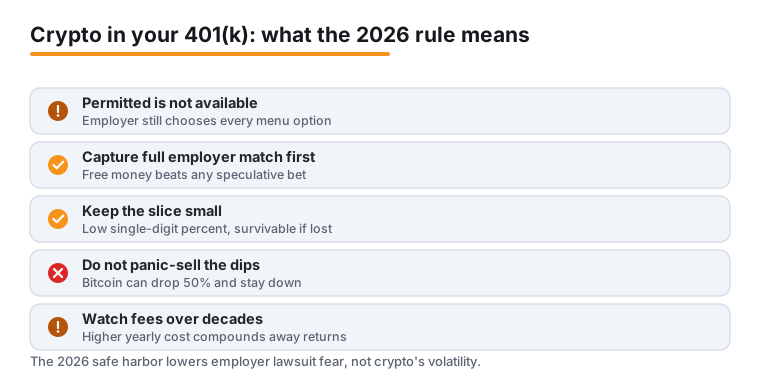
If you remember one thing from this page, make it this. Even if the rule is finalized exactly as written, crypto will not appear in your 401(k) automatically. Your employer and the plan's fiduciaries still choose every option on the menu, and most workplace plans have not added crypto. As CoinDesk reported when the rule dropped, opening the door is not the same as walking through it.
So the realistic near-term picture for most people is: nothing in your account changes this year. Some large employers, especially in tech, may add a crypto option. Many will wait to see whether the rule survives, whether litigation follows, and whether their plan provider builds the feature at all. A few plans, through Fidelity, have offered Bitcoin exposure since 2022 already.
How to check what your plan offers, without guessing:
- Log in to your plan provider's website (Fidelity NetBenefits, Empower, Vanguard, Principal, and so on).
- Open the investment menu, sometimes labeled "Investment options" or "Change investments."
- Scan for anything with "Bitcoin," "digital asset," or "crypto" in the name, or a brokerage window option (more on that below).
- If you see nothing, email your HR or benefits contact and ask directly whether the plan intends to add a digital asset option.
The three ways crypto can actually reach a 401(k)
"Crypto in a 401(k)" is not one thing. There are three different doors, and they carry very different levels of risk and control. Knowing which one your plan uses matters more than the headline.
1. A spot crypto ETF on the menu. An ETF is a fund that trades like a stock; a spot Bitcoin ETF simply holds Bitcoin and tracks its price. Funds such as IBIT or FBTC let a plan offer Bitcoin exposure as just another line item, with no wallets or private keys involved. This is the cleanest route and the one most W-2 employees would see, if their plan adds anything at all. You own shares of a fund, not the coins themselves.
2. A managed fund that holds some crypto. Some asset-allocation or target-date funds (the "set it and forget it" funds keyed to your retirement year) may hold a small slice of digital assets inside a professionally managed mix. Here the manager decides the size of the allocation and rebalances it. You get exposure without choosing it directly.
3. A self-directed brokerage window, or a self-directed 401(k). Some plans include a brokerage window: a door from your 401(k) into a regular brokerage account where you can buy a much wider range of investments, sometimes including crypto ETFs or, in a true self-directed plan, actual coins. This is the only route that gets you near holding real tokens. It also puts every decision and every risk on you. A spelled-out comparison of these routes is laid out by FinTech Weekly.
For nearly everyone with a standard employer plan, exposure will come through door one or two: a regulated fund, not a coin you hold yourself. If you want the bigger picture on owning Bitcoin as an investment, our guide to Bitcoin investing covers the basics.
Fidelity already did this in 2022, and it is a useful preview
This is not entirely uncharted territory. Back in 2022, Fidelity launched a workplace Digital Assets Account, the first time a major plan provider let workers put part of their 401(k) into Bitcoin through the core menu. The details are worth knowing because they show the guardrails employers tend to like.
Fidelity capped the default Bitcoin allocation at 20 percent of a participant's balance, and let each employer set that cap lower if they wished. The account held Bitcoin plus a sliver of cash-like assets to handle day-to-day transactions. Crucially, your own employer still had to switch the feature on; it was never automatic. The original announcement is on BusinessWire.
Two lessons carry over to 2026. First, expect caps. Even where crypto is offered, plans usually limit how much of your balance can go into it, precisely because of the volatility. Second, adoption was slow: the 2022 offering did not flood the market, and most employers stayed on the sidelines even when the option existed. The new rule changes the legal weather, not the basic caution of the people running these plans.
The risks nobody should gloss over
A retirement account is money you will not touch for years or decades, which cuts two ways. It gives volatility time to even out, but it also means a bad allocation can quietly damage the one pot of money you most need to protect. Here are the real concerns, including the ones critics have raised loudly.
Price swings. Bitcoin can fall 50 percent or more and stay down for a long stretch. Stocks do this too, but rarely as sharply. Our explainer on Bitcoin price volatility goes into why. If you are within a few years of retiring, a deep drop right before you start withdrawing is a serious problem, since you have little time to recover.
Thin track record. Bitcoin has existed since 2009. Compared with stocks and bonds, which have a century of data, there is far less history to judge how crypto behaves across full market cycles or recessions. Long-run retirement planning leans on that history, and for crypto it mostly is not there yet.
Political and legal uncertainty. The rules are new and contested. Senator Elizabeth Warren and other critics have pushed back hard; Warren warned that the administration had "decided now is the time to stick these risky assets into Americans' 401(k)s," pointing to volatility, limited performance data and shifting regulation. A future administration could tighten or reverse course. Our overview of crypto regulation tracks how quickly these things move.
Fees. Alternative assets often cost more to hold than a plain index fund. A crypto fund charging a higher yearly fee, compounded over thirty years, can eat a meaningful chunk of your return even if the price does well.
None of this means crypto is automatically wrong for a retirement account. It means a small, deliberate slice, sized so a total loss would not derail your plan, is a very different decision from betting a large share of your nest egg.
If your plan does not offer crypto: the IRA route
Plenty of people will check their plan, find nothing, and wonder what else they can do inside a tax-advantaged account. The main answer is a Crypto IRA, an Individual Retirement Account held at a specialist custodian that allows digital assets. It sits outside your employer entirely, so you can open one regardless of what your workplace offers.
The numbers for 2026, straight from Fidelity: you can contribute up to $7,500 across all your IRAs combined, or $8,600 if you are age 50 or older. "Combined" matters. If you put $5,000 into a Roth IRA, only $2,500 of room is left for a traditional or crypto IRA that year. The cap is per person, not per account.
A few practical notes before you go this way:
- Choose between Roth and traditional. A Roth IRA is funded with after-tax money and grows tax-free, which some people find attractive for a high-growth asset, since gains are not taxed on qualified withdrawal. A traditional IRA gives an upfront deduction but taxes withdrawals later.
- Watch the fees. Crypto IRA custodians often charge setup fees, yearly account fees and trading spreads that are wider than what a normal exchange charges. Read the full fee schedule before funding.
- Understand custody. In most Crypto IRAs the custodian holds the keys, not you. That is the trade-off for the tax benefit. If self-custody matters to you, read our note on holding Bitcoin for the long term.
Should you do it? A calm way to decide
There is no single right answer, but there is a sane way to think it through. Ask yourself these in order.
- Are the basics covered first? If you are not yet capturing your full employer match, that match is free money and beats almost any speculative bet. Fill that before anything else.
- How many years until you need the money? More time means more room to ride out volatility. Someone in their thirties can absorb a swing that would seriously hurt someone retiring in three years.
- What share would crypto be? Many cautious savers who want any exposure keep it to a small slice of the total, often in the low single-digit percentages, and never more than they could lose without changing their retirement plans. The old Fidelity 20 percent cap was a ceiling, not a recommendation.
- Can you leave it alone? The worst outcomes come from buying after a run-up and panic-selling after a drop. If watching a balance fall by half would make you sell at the bottom, this asset may not suit your temperament inside a retirement account.
A small worked example. Suppose you have $100,000 in your plan and decide a 3 percent crypto slice is your limit. That is $3,000. If it triples, you gain $6,000, a nice bonus but not life-changing. If it goes to zero, you lose $3,000, painful but survivable. That asymmetry, capped downside against meaningful upside on a small stake, is the logic behind keeping the position small. New to how any of this works under the hood? Start with crypto explained.
The tax angle, briefly
One genuine advantage of holding crypto inside a retirement account is the tax treatment, and it is easy to misunderstand. In a regular taxable account, every time you sell or swap crypto you create a taxable event and have to track gains and losses, which our crypto taxes guide explains in detail.
Inside a 401(k) or IRA, trades within the account are not taxed as they happen. In a traditional account you are taxed when you withdraw in retirement; in a Roth, qualified withdrawals come out tax-free. For an asset people tend to buy and sell often, sheltering that activity from year-by-year tax paperwork is a real benefit.
The catch is the same as for any retirement money. Pull it out early, generally before age 59 and a half, and you usually owe income tax plus a 10 percent penalty. So the tax break only pays off if you genuinely leave the money invested for the long haul, which loops back to the central point: this is retirement money, and the volatility has to be sized accordingly.
Frequently asked questions
Can I put Bitcoin in my 401(k) right now?
Only if your specific employer's plan offers it, and most still do not. The 2026 federal rule makes it legally easier for employers to add crypto, but it does not add it for you. Log in to your plan provider, look at the investment menu for anything labeled Bitcoin or digital asset, and if there is nothing, ask your HR or benefits team whether the plan intends to add one.
Did the new rule force crypto into everyone's retirement plan?
No. It creates a safe harbor that protects the people running 401(k) plans from lawsuits if they follow a six-point prudence checklist before adding an alternative investment. The choice to actually offer crypto stays with your employer and the plan's fiduciaries. Permitted is not the same as available, and many plans will wait or decline.
Would I own actual Bitcoin, or just a fund?
For most workplace plans, you would own shares of a regulated fund such as a spot Bitcoin ETF, or hold crypto indirectly inside a managed asset-allocation fund. You would not hold the coins or any private keys. Holding real tokens generally requires a self-directed brokerage window or a self-directed 401(k), which puts every decision and risk on you.
What if my plan never adds crypto?
The main alternative is a Crypto IRA, a retirement account at a specialist custodian that allows digital assets and is independent of your employer. For 2026 you can contribute up to $7,500 across all your IRAs, or $8,600 if you are 50 or older. Watch the custodian's setup and yearly fees, which are often higher than a normal exchange, and check who holds the keys.
Is putting crypto in a retirement account a good idea?
That depends on your timeline and how much you allocate. Cover your full employer match first, since that is free money. If you still want exposure, many cautious savers keep it to a small slice they could lose without derailing their plans, and commit to leaving it alone through the swings. A large bet on a volatile, short-history asset inside your nest egg is a very different and riskier choice.
Why are some lawmakers against this?
Critics including Senator Elizabeth Warren argue the change pushes risky, hard-to-value assets into the savings of ordinary workers. Their core concerns are crypto's sharp price swings, its limited long-term track record compared with stocks and bonds, the still-shifting regulatory rules, and fees that can be higher than plain index funds. Supporters counter that workers should have the same access institutions already enjoy, with proper guardrails.
Last updated: 2026-06.