Bitcoin Investing: Strategies & Risk
Bitcoin has moved from an internet curiosity to an asset held by individuals, public companies, and regulated funds. That maturity does not make it simple. It remains highly volatile, technically demanding to hold safely, and surrounded by marketing that ranges from optimistic to outright fraudulent. This guide explains how to think about Bitcoin as an investment in 2026: whether it belongs in your portfolio, the two strategies that suit most long-term holders, how to manage the risks that actually matter, and the mistakes that cost people money. It is written for the patient investor, not the day trader, and it avoids predictions about where the price is heading.
This article is educational and is not financial, legal, or tax advice. Bitcoin can lose a large share of its value, and you should consult a qualified professional and official sources before making decisions.
Is Bitcoin a good investment?
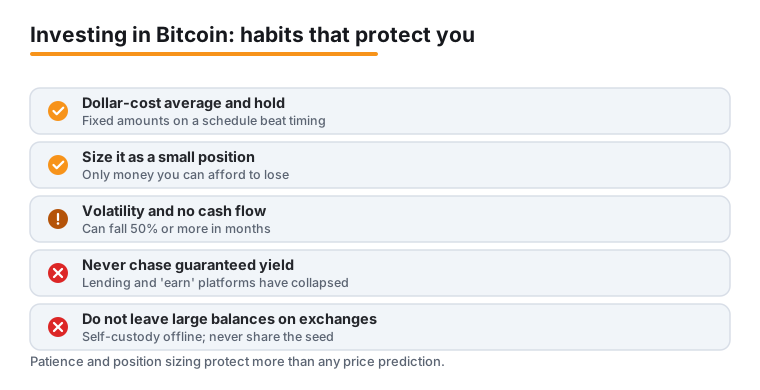
There is no honest universal answer. Whether Bitcoin is a good investment depends on your time horizon, your risk tolerance, and how much of your portfolio you are willing to expose to an asset that can fall 50% or more in a matter of months. What we can do is lay out the case on both sides so you can judge for yourself.
The case for owning some
- Fixed supply. Bitcoin's protocol caps the total supply at 21 million coins, and the great majority have already been mined. New issuance is cut roughly every four years (see the section on strategies and cycles). This predictable scarcity is the core of the "digital gold" thesis: an asset no central bank can print more of.
- Growing institutional access. In January 2024 U.S. regulators approved the first spot Bitcoin exchange-traded funds (ETFs), letting investors gain exposure through ordinary brokerage accounts. Several of these funds now hold tens of billions of dollars in assets. This has made Bitcoin easier to buy and, for some, more legitimate as a portfolio component.
- Asymmetric history. Over long multi-year periods Bitcoin has produced large returns, though always with severe drawdowns along the way. Past performance is not a promise of future results.
The case for caution
- Volatility. Sharp drawdowns are normal, not exceptional. Money you might need within a few years generally should not be in Bitcoin.
- No cash flow. Unlike a dividend stock or a bond, Bitcoin produces no income. Its return depends entirely on someone paying more for it later.
- Self-custody risk. If you hold your own keys and lose them, the coins are gone permanently. There is no help desk and no password reset.
- Regulatory and tax uncertainty. Rules differ by country and keep evolving, and in many places selling or spending Bitcoin is a taxable event.
A common framing among advisers is to treat Bitcoin as a small, high-risk satellite position, perhaps a low single-digit percentage of a portfolio, sized so that a total loss would be disappointing but not financially devastating. Never invest money you cannot afford to lose.
Strategies: DCA & HODL
Most people who do well with Bitcoin are not traders. They use two simple, well-worn strategies that remove emotion and guesswork from the process.
Dollar-cost averaging (DCA)
Dollar-cost averaging means buying a fixed dollar amount on a regular schedule, for example weekly or monthly, regardless of the price on that day. When the price is high your fixed amount buys less; when it is low it buys more. Over time this smooths out your average entry price and removes the impossible task of timing the market.
DCA is especially suited to a volatile asset like Bitcoin because it stops you from putting a large lump sum in at a single moment that might turn out to be a local peak. Many exchanges let you automate recurring buys. The discipline of sticking to the schedule through both rallies and crashes is what makes it work.
HODL (long-term holding)
"HODL" began as a misspelling of "hold" and has become shorthand for buying and holding through volatility rather than trading in and out. The thesis is that Bitcoin's long-term trajectory matters more than short-term swings, and that frequent trading tends to underperform after fees, taxes, and mistakes.
HODLing pairs naturally with DCA: you accumulate steadily and you do not sell into panic. It also forces you to think seriously about secure storage, because you may be holding for years.
Understanding market cycles
Bitcoin has historically moved in multi-year cycles of euphoria and deep pullbacks, often discussed alongside the roughly four-year halving schedule. A halving is a programmed event that cuts the reward miners receive for each block, reducing the rate of new supply. The April 2024 halving reduced the block reward from 6.25 to 3.125 BTC, and the next is expected around 2028. Some investors point to cycles around these events, but the relationship is not a reliable timing signal, and you should never make decisions on the assumption that a past pattern will repeat. The point of DCA and HODL is precisely that they do not require you to predict cycles correctly.
Managing risk
The biggest risks in Bitcoin are usually not the price chart. They are losing access to your coins, being scammed, and taking on more exposure than you can stomach. Managing those is where most of the protective work happens.
Position sizing
Decide in advance what share of your overall wealth Bitcoin will represent, and rebalance toward that target rather than letting a bull run quietly turn a small bet into your entire net worth. Size the position so that a severe drawdown would not force you to sell at the worst possible time or jeopardize essentials like rent, debt payments, or an emergency fund.
Custody and storage
How you store Bitcoin is a security decision in its own right.
- Exchange / custodial accounts are convenient and good for buying, but the platform controls the keys. If it fails, freezes withdrawals, or is hacked, your access is at risk. Leaving large balances on an exchange long term is a common and avoidable mistake.
- Hardware (cold) wallets keep your private keys offline on a dedicated device, greatly reducing exposure to online theft. They are the standard choice for meaningful long-term holdings.
- Software / hot wallets sit between the two: more control than an exchange, but connected to the internet.
Whatever you choose, the recovery phrase (seed words) is the master key. Back it up offline, never type it into a website or share it with anyone, and treat anyone who asks for it as a scammer.
Bitcoin lending platforms
Some services offer interest for depositing your Bitcoin, then lend it out. This is not free yield; it carries real risk, and several high-profile platforms have collapsed, freezing or wiping out customer funds. Before using any lending or "earn" product, treat it like a security checkpoint:
- Verify the company's registration, licensing, and track record through official regulators, not just its own website.
- Be deeply skeptical of guaranteed or unusually high returns. If a rate is far above the market norm, ask who is taking the risk to fund it; the answer is usually you.
- Check how custody works, whether funds are insured, and how easily you can withdraw. Difficulty getting your money out is a major red flag.
- Read independent reviews and community feedback for reports of withdrawal problems.
Note that lending rules and the legal status of these products vary widely by jurisdiction and continue to change. Confirm what is permitted where you live with official sources before committing funds.
Security hygiene
- Use a strong, unique password and enable two-factor authentication (preferably an authenticator app, not SMS) on every account.
- Assume unsolicited messages, "support" agents, and giveaway offers are phishing. No legitimate service will ask for your seed phrase or private keys.
- Double-check website addresses and app sources to avoid look-alike fakes.
Common mistakes
Most losses in Bitcoin come from a short, repetitive list of avoidable errors. Recognizing them in advance is one of the cheapest forms of risk management.
- Investing money you cannot afford to lose. Rent, debt payments, and emergency savings do not belong in a volatile asset.
- Trying to time the market. Jumping in at the top out of excitement and selling at the bottom out of fear is the classic way to lose money. DCA exists specifically to prevent this.
- Panic selling and FOMO buying. Reacting emotionally to headlines and price swings turns paper volatility into realized losses.
- Leaving everything on an exchange. Convenient, but you do not control the keys, and platforms can fail or freeze withdrawals.
- Mishandling the seed phrase. Losing it, photographing it to the cloud, or sharing it are all permanent, unrecoverable mistakes.
- Chasing yield. "Guaranteed" high returns from lending or staking schemes are a leading cause of catastrophic losses.
- Using leverage. Borrowing to amplify a position can wipe you out during ordinary volatility; it is not appropriate for most long-term investors.
- Ignoring taxes. In many jurisdictions selling, spending, or swapping Bitcoin triggers a taxable event. Keep records of your transactions and dates.
- Over-diversifying into low-quality altcoins. Spreading into dozens of speculative tokens in the name of "diversification" often adds risk rather than reducing it.
Frequently asked questions
How much should I invest in Bitcoin?
Only an amount you could afford to lose entirely. Many advisers suggest treating Bitcoin as a small satellite position, often a low single-digit percentage of a portfolio, sized so a steep drop would not derail your finances. There is no one-size-fits-all figure; consider speaking with a qualified financial professional about your situation.
Is it better to buy all at once or gradually?
For most people, buying gradually through dollar-cost averaging, fixed amounts on a regular schedule, reduces the risk of putting a lump sum in at an unlucky moment and removes the pressure to time the market. A lump sum can work if you have a long horizon and high risk tolerance, but it concentrates timing risk into a single day.
What is the safest way to store Bitcoin?
For meaningful long-term holdings, a hardware (cold) wallet that keeps your private keys offline is the standard choice. Whatever method you use, your recovery seed phrase is the master key: back it up offline, never enter it on a website, and never share it. Leaving large balances on an exchange long term exposes you to that platform's failure.
What is the Bitcoin halving and should I trade around it?
The halving is a programmed event roughly every four years that cuts the reward for mining a block, slowing new supply. The April 2024 halving reduced the reward from 6.25 to 3.125 BTC, with the next expected around 2028. While some investors discuss price cycles around halvings, past patterns are not a reliable predictor, and strategies like DCA and HODL are designed so you do not need to trade around it.
Do I owe taxes on Bitcoin?
In many jurisdictions, yes, selling, spending, or swapping Bitcoin can be a taxable event, and rules vary widely by country and continue to evolve. Keep detailed records of your purchases, sales, and dates, and verify your obligations with official tax authorities or a qualified tax professional. This article is not tax advice.
Last updated: 2026-06.