Crypto Trading & Exchanges for Beginners
Crypto trading is the buying and selling of digital assets such as Bitcoin and Ethereum, usually through an online exchange, either to build a position over time or to capture shorter-term price moves. For newcomers it can feel intimidating: the market runs 24 hours a day, prices swing sharply, and the jargon piles up fast. The good news is that the fundamentals are learnable, and a beginner who grasps a handful of core ideas, account security, how exchanges work, the main order types, and disciplined risk management, is far better positioned than one chasing tips on social media.
This guide covers those fundamentals in plain language. Nothing here is a recommendation to buy or sell any asset. It is educational material only and is not financial, legal, or tax advice; rules and product details change, so always confirm specifics with the exchange and a qualified professional in your jurisdiction.
Getting started
Before placing a single trade, separate two things people often blur together: investing (buying an asset to hold for a long time) and trading (actively entering and exiting positions to profit from price movement). Both are valid, but they demand different mindsets, time commitments, and risk controls. Decide which one you are actually doing, because it shapes every other decision.
Learn the language first
A few terms recur constantly: a wallet stores the keys that control your crypto; volatility is how sharply prices move; liquidity is how easily an asset trades without moving the price; market capitalization is the total value of a coin's circulating supply. Recognizing these words makes exchanges and charts far less confusing.
Set up an account and verify your identity
Reputable exchanges are regulated financial businesses. Expect to complete Know Your Customer (KYC) checks: typically submitting a government ID and sometimes a selfie or short video for a liveness check. This is normal and required by law in most regions. An exchange that lets you trade large amounts with no verification at all is a warning sign, not a convenience.
Start small
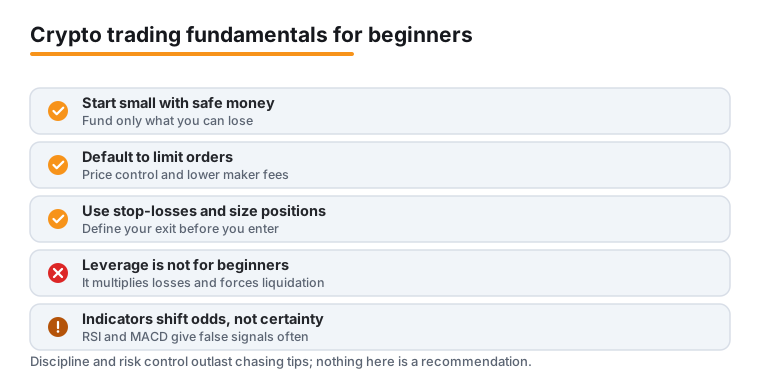
The most common beginner mistake is committing too much, too soon. Fund your account with an amount you could lose entirely without affecting your rent, savings, or peace of mind. Use your first weeks to learn the interface, practice the different order types, and watch how the asset behaves, not to get rich. Many platforms offer a demo or paper-trading mode; use it.
Custody: who holds your keys?
When your crypto sits on an exchange, the exchange controls the private keys, you hold an IOU. That is fine for funds you are actively trading, but for amounts you intend to keep, many users move coins to a self-custody wallet (software or a hardware device) where they alone control the keys. The phrase "not your keys, not your coins" captures this trade-off between convenience and control.
Choosing an exchange
The exchange is where you will spend most of your time, so choosing well matters more than picking any single coin. Treat it like opening a bank account: judge it on safety and reliability first, features second. The factors below are what experienced traders actually weigh.
- Regulation and licensing. Check the platform is authorized to operate in your country. Frameworks have tightened sharply: in the EU, the Markets in Crypto-Assets (MiCA) regime requires crypto-asset service providers to be authorized, with key compliance deadlines in 2026 and a new EU anti-money-laundering authority supervising large firms; in the US, oversight is shared across federal agencies. You need not master the rules, but confirm the exchange complies with them where you live.
- Security track record. Look for two-factor authentication (2FA), the option to whitelist withdrawal addresses, and a history of holding most customer assets in cold (offline) storage. Search whether the platform has been hacked and, if so, how it handled it.
- Fees. Compare the published fee schedule, not headline marketing. Most exchanges use a maker-taker model (see the next section) and charge separately for deposits and withdrawals. Small differences compound heavily if you trade often.
- Liquidity and supported assets. Higher liquidity means tighter spreads and faster fills. Confirm the exchange lists the assets you want with healthy volume in those pairs.
- Funding and payouts. Check which deposit options work in your region (bank transfer, card) and, just as importantly, how easily you can withdraw both crypto and cash.
- Usability and support. A clear interface reduces costly fat-finger errors, and responsive support matters most precisely when something has gone wrong.
Fee structures, supported regions, and features change frequently and vary by jurisdiction, so verify current details on the exchange's own site before committing funds.
Order types
An order is your instruction to the exchange about how to buy or sell. Knowing the main types, and when each fits, prevents avoidable losses and unnecessary fees.
The orders you will use most
| Order type | What it does | Best for |
|---|---|---|
| Market order | Buys or sells immediately at the best available price. | Speed when you accept whatever the current price is. |
| Limit order | Buys or sells only at a price you set, or better; it waits on the order book until filled. | Price control; it may not fill if the market never reaches your level. |
| Stop / stop-loss order | Triggers a market or limit order once price hits a level you choose. | Capping a loss or protecting a profit automatically. |
| Stop-limit order | Triggers a limit (not market) order at your stop level. | More control than a stop, but may not fill in a fast market. |
| Take-profit order | Closes a position automatically at a target price. | Locking in gains without watching the screen. |
Maker vs. taker, and why limit orders save money
A limit order that rests on the order book waiting to be matched adds liquidity and makes you a maker; a market order that fills instantly against existing orders removes liquidity and makes you a taker. On most exchanges takers pay a higher fee. The takeaway for beginners is powerful: defaulting to limit orders is often the simplest way to cut trading costs, and it forces you to decide your price in advance.
A note on leverage and margin
Many platforms offer leveraged or margin trading, which lets you control a position larger than your deposit. Leverage multiplies gains and losses and can trigger forced liquidation. It is genuinely high-risk and not appropriate for beginners; understand it, and your exchange's specific rules, thoroughly before going anywhere near it.
Risk management
Risk management separates traders who last from those who blow up an account in a few volatile weeks. You cannot control the market, only how much you expose to it and how you react. These principles apply whether you trade actively or simply hold.
Decide your trading style
Different styles carry different risks and time demands. Day trading opens and closes positions within a single day and demands constant attention. Swing trading holds for days or weeks to capture larger swings, a common starting point because it does not require watching charts all day. Position trading holds for months or longer, leaning on broad trends rather than short-term noise. Match the style to the time and temperament you actually have.
Core risk rules
- Risk only what you can lose. Never trade with rent money, emergency funds, or borrowed money.
- Size your positions. Many traders risk only a small, fixed percentage of their account on any single trade, so one bad outcome is survivable.
- Use stop-loss orders. Define your exit before you enter; a predetermined stop removes emotion from the decision to cut a loss.
- Diversify sensibly. Concentrating everything in one asset magnifies risk; spreading across assets reduces, though never eliminates, exposure to any single one.
- Control your emotions. Chasing a pumping coin (fear of missing out) and panic-selling a dip are two sides of the same costly mistake. A written plan you actually follow is the antidote.
- Mind security and taxes. Enable 2FA, beware phishing links and fake support accounts, and keep records, since in many jurisdictions crypto trades are taxable events. Confirm your obligations with the relevant tax authority or a professional.
The technical tools traders use
Technical analysis studies price charts to gauge probability, not certainty. A few widely used tools are worth recognizing:
- Candlestick charts show the open, high, low, and close for each period and form the visual basis of most analysis.
- Moving averages (MA) smooth price to reveal the trend. An SMA weights all periods equally; an EMA reacts faster by weighting recent prices more heavily. A shorter average crossing above a longer one is a golden cross (read as bullish); the reverse is a death cross (bearish).
- MACD (Moving Average Convergence Divergence) uses two EMAs plus a signal line and histogram to flag momentum shifts, commonly when the MACD line crosses its signal line.
- RSI (Relative Strength Index) measures the speed of recent moves on a 0 to 100 scale to flag potentially overbought or oversold conditions.
- Fibonacci retracement draws levels from a prior move to anticipate where a pullback might find support or resistance.
- Elliott Wave theory reads price as repeating waves of crowd psychology; it is subjective and best treated as one lens among many.
No indicator predicts the future. Experienced traders combine several signals with market context and treat every tool as a probability aid, never a guarantee.
Frequently asked questions
Is it safer to keep my crypto on an exchange or in my own wallet?
It depends on what the funds are for. Keeping crypto on a reputable exchange is convenient for assets you are actively trading, but the exchange controls the private keys, so you are trusting it with custody. For holdings you intend to keep long term, many users move coins to a self-custody wallet, ideally a hardware device, so they alone control the keys. The trade-off is that with self-custody, losing your recovery phrase means losing the funds permanently, with no support line to call. A common approach is to keep only active trading funds on the exchange and self-custody the rest.
Do I have to pay taxes on crypto trades?
In many countries, yes. Selling, swapping one crypto for another, or sometimes even spending crypto can be a taxable event, and rules differ widely between jurisdictions and change over time. Keep clear records of every transaction, dates, amounts, and prices, from the start, since reconstructing them later is painful. This guide is not tax advice; confirm your specific obligations with your national tax authority or a qualified professional.
What is the difference between a market order and a limit order?
A market order executes immediately at whatever the best available price is, prioritizing speed over price. A limit order executes only at a price you specify or better, prioritizing price over speed, which means it might not fill at all if the market never reaches your level. For beginners, limit orders are often the better default: they give you control over the price you pay and, on most exchanges, they qualify for lower maker fees than the taker fees charged on market orders.
Are technical indicators like MACD or RSI reliable for predicting price?
No indicator predicts price with certainty, and any source promising one is misleading you. Tools such as moving averages, MACD, RSI, and Fibonacci retracement describe past and current price behavior and, at best, shift probabilities slightly in your favor. They produce false signals regularly, especially in choppy markets. Experienced traders use several indicators together, weigh them against broader market context, and pair them with strict risk management rather than betting on any single signal.
Last updated: 2026-06.