Bitcoin Price & Volatility Explained
Few things in finance are discussed as obsessively, or understood as poorly, as the price of Bitcoin. It can climb thousands of dollars in a weekend and give it all back by Tuesday, and every move spawns a fresh round of headlines explaining exactly why it happened. This guide takes a calmer approach. Rather than chasing the latest swing, it explains the durable forces behind bitcoin price volatility: what actually sets the price, why those swings are so much larger than in traditional markets, how Bitcoin has historically moved through repeating cycles of greed and fear, and how to read all of it without losing your head. The goal is understanding, not forecasting. Nothing here is financial, investment, tax, or legal advice, and you will not find a single price prediction, because no one can reliably make one. Verify any specific figure, rule, or product mentioned with an official or primary source before acting on it.
What drives Bitcoin’s price
At its simplest, Bitcoin's price is set the same way as the price of anything traded on an open market: by supply and demand. At any given moment, the price is whatever a willing buyer and a willing seller agree on. What makes Bitcoin distinctive is the shape of both sides of that equation.
On the supply side, Bitcoin is unusually rigid. The total number of coins that will ever exist is capped at 21 million, and the rate at which new coins are created is fixed in software and cut roughly every four years at the halving. Unlike a company that can issue more shares or a central bank that can print more money, no one can create extra bitcoin to meet a surge in demand, so when buying interest spikes the price has to do the adjusting. That inflexibility is one reason moves can be so sharp.
Demand, by contrast, is volatile and driven by a shifting mix of forces:
- News and narrative. A favorable regulatory decision, a major company adding Bitcoin to its balance sheet, a new investment product, or conversely an exchange collapse or a government crackdown can move demand within hours. Markets often react to the story and the expectation as much as to the underlying fact.
- Macroeconomics. Interest rates, inflation, and the strength of the dollar all influence appetite for a risky, non-yielding asset. When central banks raise rates, riskier assets including Bitcoin have often come under pressure; when policy loosens, they have frequently been bid up. Bitcoin is also discussed as a potential inflation hedge, though its record on that is mixed and debated.
- Institutional and corporate flows. Regulated products such as US spot Bitcoin exchange-traded funds (ETFs), approved in January 2024, made it far easier for large investors to gain exposure. Inflows and outflows from these vehicles, and from companies holding Bitcoin in their treasuries, are now a meaningful and visible source of demand.
- Liquidity and "whales." A large share of bitcoin is held by a relatively small number of big holders, often called whales. A single large order, especially on a thin order book, can move the price noticeably and trigger follow-on reactions from other traders.
- Adoption and access. Easier on-ramps, payment integrations, and broader acceptance gradually widen the pool of potential buyers, while improvements to the underlying technology can support confidence over the long run.
Put together, an asset with a fixed, inelastic supply and a demand side that swings with sentiment, macro conditions, and large concentrated holders is almost built to move violently. That is the foundation for everything that follows.
Why Bitcoin is volatile
Volatility measures how much and how quickly a price moves. By that yardstick Bitcoin has historically been far more volatile than stocks, bonds, gold, or major currencies, with single-day moves of 5% to 10% being unremarkable and much larger swings during turbulent periods. Several structural reasons explain why.
- It is a young, still-evolving asset. Bitcoin only launched in 2009. Compared with centuries-old markets it is small and immature, and the market is still figuring out what Bitcoin is worth. Price discovery in a new asset is inherently bumpy.
- Inelastic supply meets shifting demand. Supply cannot flex to absorb demand shocks, so when a wave of buying or selling arrives the price must move further than it would in a market where new supply can be created to meet it.
- Sentiment-driven demand. Much buying and selling is based on expectation, momentum, and emotion rather than cash flows or earnings, because Bitcoin produces none. With no dividend or coupon to anchor a valuation, prices can detach from any obvious fundamental and run on narrative alone.
- Around-the-clock, fragmented trading. Crypto markets never close. They trade 24/7 across many global venues of varying quality and regulation. News can hit at any hour, liquidity varies between exchanges, and there are no exchange-wide circuit breakers of the kind that pause stock markets during extreme moves.
- Leverage and liquidations. Much crypto trading uses borrowed money. When the price moves against heavily leveraged positions they can be forcibly closed (liquidated), and cascades of liquidations can accelerate a move far beyond what the original news would justify, in either direction.
- Concentration. Because large holders control a significant share of supply, the actions of a few participants can have an outsized effect, particularly when liquidity is thin.
- Regulatory and event risk. A single announcement, a country restricting or embracing Bitcoin, a major platform failing, a security breach, can reprice the asset almost instantly, because so much of its value rests on expectations about an uncertain future.
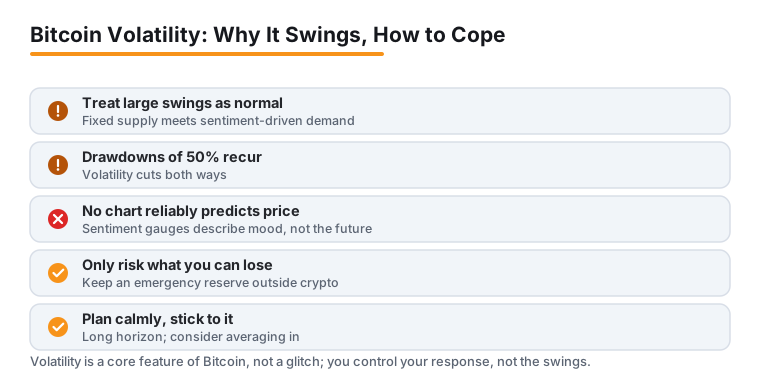
Crucially, volatility cuts both ways. The same conditions that produce dramatic rallies produce equally dramatic drawdowns, and Bitcoin has repeatedly fallen 50% or more from its highs before recovering. High volatility is not a flaw to be explained away; it is a core characteristic of the asset, and any approach to it should treat large swings as normal rather than exceptional.
Market cycles & sentiment
Zoom out from the daily noise and Bitcoin's history looks less like random chaos and more like a series of large boom-and-bust cycles: long climbs to a peak, sharp declines, extended quiet periods, and eventual recovery. These cycles are driven by the interaction of the supply schedule, macroeconomic conditions, and, above all, mass psychology.
The halving and the four-year rhythm. Roughly every four years (every 210,000 blocks), the reward for mining new bitcoin is cut in half, slowing the creation of new supply. The most recent halving was in April 2024, which reduced the block reward to 3.125 BTC, and the next is expected around 2028. In each of the cycles that followed the 2012, 2016, and 2020 halvings, Bitcoin reached new highs over the following twelve to eighteen months. That pattern is real and widely cited, but it deserves heavy caveats: there are only a handful of halvings on record, each happened under very different conditions, the supply impact shrinks with every cycle, and a widely anticipated event is at least partly reflected in the price before it arrives. A repeating pattern in a tiny sample is not a law you can bank on.
The role of sentiment. Within each cycle, the dominant driver is collective emotion, which tends to oscillate between two extremes:
- Greed and FOMO. As prices rise, fear of missing out pulls in new buyers, media coverage intensifies, and rising prices themselves become the main reason people buy. This feedback loop can push valuations to euphoric levels disconnected from any fundamental.
- Fear and capitulation. When the trend reverses, the same loop runs backwards. Falling prices trigger selling, negative headlines dominate, and discouraged holders give up near the lows. Pessimism can overshoot just as badly as optimism did.
This is why tools like the widely watched Fear and Greed Index exist, to gauge whether the crowd is euphoric or panicked. Such gauges describe the current mood; they do not predict the next move. A related dynamic is the ripple effect on the broader market: when Bitcoin trends strongly, attention and capital often spill into other cryptocurrencies, and a wave of corporate or institutional buying can act as a confidence signal that reinforces a cycle. None of this makes the timing or size of the next cycle knowable in advance. The practical lesson is to recognize that you are operating inside a cycle, and to be most cautious precisely when the crowd is most confident.
Reading the swings
Understanding why Bitcoin moves is one thing; deciding what to do about it is another. You cannot control the volatility, only how you respond to it. The following are general risk-management principles common in investor education, not personalized advice or a strategy to adopt without your own research.
- Only commit money you can afford to lose. Because drawdowns of 50% or more have happened repeatedly, never invest funds you need for living expenses, debt, or an emergency cushion. Keep a reserve well outside of crypto.
- Size positions for the volatility. Because the swings are large, even a modest allocation can have an outsized effect on your portfolio. Decide in advance how much exposure you are comfortable seeing cut in half.
- Think in long time horizons. Reacting to every move tends to mean buying high in excitement and selling low in fear. Many long-term holders deliberately ignore short-term swings, an approach the community shorthand calls HODL.
- Consider averaging in. Rather than timing a single entry, some investors spread purchases over time at regular intervals, an approach known as dollar-cost averaging, to soften the impact of buying at an unlucky moment. It does not guarantee a profit or protect against loss.
- Manage your information diet. Constant price-checking and a firehose of social-media hype amplify emotional decisions. Choose a few credible sources, check on a sensible schedule rather than compulsively, and be skeptical of anonymous tips, guaranteed-return promises, and influencer calls.
- Keep emotion out of the trigger. Deciding your plan when you are calm, and sticking to it when the market is euphoric or terrifying, is what separates a strategy from a series of panic reactions.
A note on charts and predictions. Many traders use technical analysis, the study of price charts, volume, and historical patterns, and real-time data is genuinely useful for reading current conditions and liquidity. But these are tools for managing uncertainty, not crystal balls. No chart pattern, indicator, sentiment gauge, or algorithm can reliably predict Bitcoin's future price, and anyone promising otherwise deserves deep suspicion. Past performance does not indicate future results.
Finally, the legal, tax, and regulatory treatment of Bitcoin varies widely by country and changes over time. Buying, selling, or holding it may have tax consequences and be subject to local rules. This guide is educational only and is not financial, investment, tax, or legal advice; consult official sources and a qualified professional for your own situation.
Frequently asked questions
Why is Bitcoin so volatile compared to stocks?
Bitcoin combines a fixed, inflexible supply with demand driven largely by sentiment and expectation rather than earnings or cash flow. It is also a relatively young, smaller market that trades 24/7 across many lightly regulated venues, often with heavy leverage and a concentration of holdings among large players. When demand shifts, supply cannot expand to absorb it, and leverage-driven liquidations can amplify moves, so prices swing far more than in mature markets like equities or major currencies.
What is the single biggest driver of Bitcoin's price?
There is no single driver, which is part of why it is hard to predict. The price reflects the balance of supply (fixed and slowing) against demand, and demand is pushed around by news and regulation, macroeconomic conditions such as interest rates and inflation, institutional flows through products like spot ETFs, the actions of large holders, and overall market sentiment. At any given moment one factor may dominate, but over time it is the interaction of all of them.
Does the four-year cycle mean I can time the market?
No. Bitcoin has historically moved in cycles linked loosely to the roughly four-year halving schedule, and prices rose in the periods after past halvings. But there are only a handful of halvings on record, each occurred under very different conditions, the supply effect shrinks each cycle, and markets tend to price in anticipated events ahead of time. A pattern in a tiny sample is not a reliable timing tool. This is not investment advice, and no one can tell you what the price will do next.
How can I reduce the risk of Bitcoin's volatility?
You cannot remove the volatility, only manage your exposure to it. Common educational principles include investing only money you can afford to lose, keeping position sizes modest relative to your overall finances, taking a long-term view rather than reacting to every swing, spreading purchases over time instead of trying to time a single entry, and limiting compulsive price-checking and hype. These are general ideas, not personalized advice; consider your own circumstances and consult a qualified professional.
Will Bitcoin ever become less volatile?
Possibly, but it is not guaranteed and there is no timeline. In theory, as the market grows larger, more liquid, more widely adopted, and more institutionally held, price swings could moderate, and some observers argue volatility has trended lower over very long horizons. For now, though, Bitcoin remains a high-volatility asset, and the prudent assumption is that large swings will continue rather than disappear.
Last updated: 2026-06.