Bitcoin Price Predictions & 2026 Outlook
Few questions in crypto attract as much attention as a Bitcoin price prediction. Search any forecast and you will find numbers ranging from a total collapse to seven-figure price targets, often for the same year. This guide does not add another number to that pile. Instead, it explains how serious forecasts are built, which forces actually move the market, why even well-reasoned predictions miss, and how to read 2026 commentary without being misled. The goal is to make you a smarter consumer of forecasts rather than a follower of them.
This article is educational and is not financial, investment, legal, or tax advice. Bitcoin is volatile and you can lose money. Always verify figures, rules, and dates with primary sources before acting.
How price forecasts are made
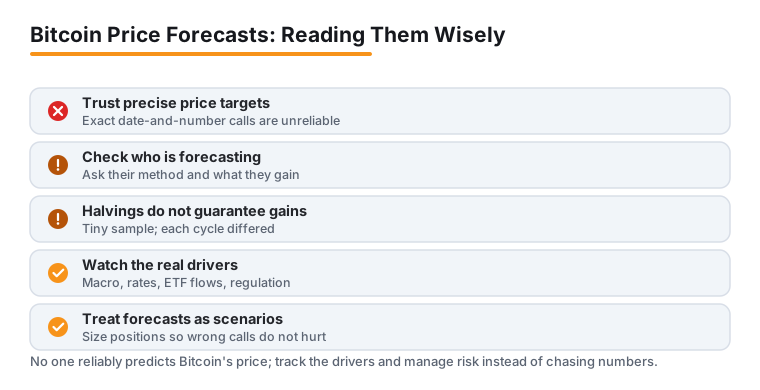
A Bitcoin price prediction is only as good as the method behind it. Most credible forecasts lean on one or more of four broad approaches, and each answers a different question.
Technical analysis
Technical analysis studies past price and volume to identify patterns, support and resistance levels, momentum, and trend direction. Analysts use moving averages, trading ranges, and indicators to estimate where price might go next. It is useful for framing probabilities over days and weeks, but it describes behavior rather than explaining causes, and patterns that worked in one cycle can fail in the next.
On-chain analysis
Because Bitcoin's ledger is public, analysts can measure things no traditional market reveals: how many coins have not moved in years, how much supply sits at a profit or loss, exchange inflows and outflows, and the behavior of long-term versus short-term holders. On-chain metrics can hint at whether coins are being accumulated or distributed, though they are signals, not certainties.
Fundamental and macro analysis
This approach treats Bitcoin like any asset with supply and demand. On the supply side, issuance is fixed by code and falls at each halving. On the demand side, analysts weigh adoption, institutional flows, and the macroeconomic backdrop. Some build long-horizon models around scarcity or total-addressable-market comparisons (for example, against gold). These models give context, not precision, and their assumptions deserve scrutiny.
Sentiment analysis
Sentiment tools scan social media, news, search trends, and survey data to gauge whether the crowd is greedy or fearful. Because crypto is heavily driven by narrative, sentiment can move price in the short term. It is worth noting that forecasts themselves feed sentiment: a widely shared target can nudge behavior in its own direction, at least temporarily. That reflexive loop is real but unreliable as a trading tool.
The most grounded analysts blend these methods and express results as ranges and probabilities, not single guaranteed numbers. Treat any forecast that promises a precise price on a precise date with heavy skepticism.
Key drivers to watch
Rather than memorizing price targets, it is far more useful to track the forces that actually shape demand and supply. These are the variables that turn up again and again in serious analysis.
- Macroeconomic conditions. Inflation, growth, and the strength of the US dollar set the backdrop. When currencies lose purchasing power, some investors look to scarce assets as a potential store of value; when conditions tighten, risk assets including Bitcoin often come under pressure.
- Central bank policy and interest rates. When borrowing is cheap and liquidity is abundant, risk assets tend to do better; when rates rise and liquidity drains, the opposite often holds. Bitcoin has frequently traded as a high-beta risk asset, reacting sharply to changes in monetary policy expectations.
- The halving and supply schedule. Roughly every four years, the rate of new Bitcoin issuance is cut in half. The most recent halving occurred in April 2024, reducing the block reward to 3.125 BTC, and the next is expected around 2028. Halvings tighten new supply, and historically each cycle has had its own character, but past patterns are not a promise of future ones.
- Institutional flows and ETFs. US spot Bitcoin ETFs launched in January 2024 and have since accumulated very large assets under management, giving traditional investors regulated exposure. Net inflows and outflows from these products are now a closely watched demand signal. Confirm current figures with issuers or regulatory filings, as they change daily.
- Regulation and policy. Approvals, tax treatment, and the legal status of crypto in major economies can shift demand quickly. Favorable clarity tends to broaden access; restrictive moves can shrink it.
- Adoption and infrastructure. Growth in wallets, payment rails, custody, and access in underbanked regions expands the potential user base over the long run.
- Correlations and commodities. Bitcoin sometimes moves with equities and sometimes diverges, and broad commodity or energy shocks can feed inflation expectations that indirectly affect demand. These relationships are unstable and can flip during stress.
No single driver dominates for long. The mix that matters most tends to rotate from one period to the next, which is exactly why static forecasts age badly.
Why predictions fail
Understanding the failure modes of forecasting is more valuable than any single prediction. Bitcoin is unusually hostile to confident point estimates, for several structural reasons.
Extreme volatility
Bitcoin's history is a series of large rallies and deep drawdowns. Major declines of roughly fifty to over eighty percent have occurred more than once, driven by events such as regulatory crackdowns, exchange failures, and broad market panics. A forecast that ignores the possibility of a sharp reversal is incomplete by design.
Black swans and reflexivity
The biggest moves are often triggered by events no model anticipated: a sudden policy ban, a large platform collapse, or a macro shock. Markets are also reflexive, meaning beliefs change behavior, which changes prices, which changes beliefs. That feedback makes the system hard to model with the tidy assumptions most forecasts rely on.
Leverage and liquidations
Much of crypto's short-term volatility is amplified by derivatives. Bitcoin futures let traders take long or short positions, often with leverage, without holding the asset itself. Leverage magnifies gains and losses alike, and when prices move against crowded positions, cascading liquidations can accelerate a move far beyond what fundamentals justify. This is one reason short-term price action so often defies forecasts. Futures trading carries a high risk of rapid loss and is not suitable for most beginners.
Incentives and survivorship
Many public forecasts come from people with something to sell or a position to defend, and wrong predictions are quietly forgotten while lucky ones are amplified. Round-number targets and dramatic headlines spread because they get clicks, not because they are accurate. Always ask who is making a forecast, what method they used, and what they gain if you believe it.
The practical takeaway is humility. Treat forecasts as scenarios with assumptions you can test, size any position so a wrong call does not harm you, and use basic risk controls rather than conviction in a number.
2026 outlook
Instead of a single Bitcoin price prediction for 2026, here is the landscape thoughtful observers are actually watching this year. None of this is a forecast; it is a checklist of what could matter.
- The institutional channel has matured. Spot Bitcoin ETFs are now an established route for traditional capital, with very large combined assets under management and a growing list of institutional holders. Sustained inflows would represent steady structural demand, while heavy outflows would signal the opposite. Watch the flow data rather than the headlines.
- Regulation is becoming clearer in major markets. The United States advanced crypto-specific legislation in recent years, including stablecoin rules, and the European Union's MiCA framework has moved the bloc toward harmonized standards. Clearer rules can lower the barrier to participation, but specifics differ widely by jurisdiction, so confirm what applies to you locally.
- The post-halving supply backdrop continues. With issuance reduced after the April 2024 halving and the next halving not expected until around 2028, new supply remains constrained. Historically, the period following a halving has been eventful, but each cycle has differed and there is no guarantee history repeats.
- Macro remains the wild card. The path of inflation, interest rates, and global growth will likely shape risk appetite across all assets, Bitcoin included. A shift in monetary policy expectations can override crypto-specific news in either direction.
- Volatility has not gone away. Even in a more institutional market, sharp swings remain normal. Plan for the possibility of a large drawdown in any given year, regardless of how constructive the longer-term narrative sounds.
If you take one thing from this section, let it be a process rather than a target: track the drivers above from primary sources, distinguish durable trends from noise, and never assume any single year will follow a script. Markets routinely surprise even informed participants.
This is general information, not advice, and nothing here is a recommendation to buy, sell, or hold any asset. Do your own research and consider speaking with a qualified, independent financial professional before making decisions.
Frequently asked questions
Can anyone accurately predict the price of Bitcoin?
No one can reliably predict Bitcoin's price with precision, especially over the short term. Analysts can map out scenarios and probabilities using technical, on-chain, fundamental, and sentiment methods, but Bitcoin's volatility, sensitivity to unexpected events, and reflexive crowd behavior make exact point-in-time forecasts unreliable. Treat confident single-number predictions with skepticism.
What factors most affect the Bitcoin price?
The main drivers include the macroeconomic backdrop (inflation, growth, the US dollar), central bank policy and interest rates, the halving-driven supply schedule, institutional flows such as ETF inflows and outflows, regulation in major economies, and broader adoption. The relative importance of each tends to rotate over time, which is why no single factor explains price for long.
Does the Bitcoin halving guarantee a price increase?
No. The halving reduces the rate of new supply roughly every four years (most recently in April 2024, with the next expected around 2028), which constrains issuance. Past cycles have varied in character, and historical patterns are not a promise of future results. Many other factors, especially demand and macro conditions, also shape price.
Why do so many Bitcoin forecasts turn out to be wrong?
Forecasts fail because Bitcoin is highly volatile, prone to large unexpected shocks, and amplified by leveraged derivatives that can trigger sharp liquidation cascades. Many public predictions also come from people with incentives to promote a target, and wrong calls are easily forgotten while lucky ones are amplified. Always check who made a forecast, what method they used, and what they gain.
Is trading Bitcoin futures a good way to profit from price predictions?
Bitcoin futures let traders take long or short positions, often with leverage, without owning the asset. Leverage magnifies both gains and losses, and many beginners lose money quickly. Futures are complex, risky, and regulated differently across jurisdictions. This is not advice; if you consider them, learn the mechanics thoroughly, use strict risk controls, and confirm the rules that apply where you live.
Last updated: 2026-06.