Form 1099-DA Explained: The New Crypto Tax Form and What to Do With It
If you sold or traded crypto on a US exchange during 2025, a new form landed in your tax documents this year: Form 1099-DA, Digital Asset Proceeds From Broker Transactions. This is the first filing season it exists, and every US custodial platform had to send one to you and to the IRS. The form is useful and dangerous at once: it reports what you sold, but usually not what you paid, and for coins moved in from a hardware wallet it may show a cost basis of zero. Copy it into your return unfixed and you overpay. Report less in proceeds than the IRS copy shows and you get an automated notice. Here is what the form contains, why the basis is missing, the per-wallet rule behind it, and how to reconcile before you file. For the general rules, start with our crypto taxes guide.
What Form 1099-DA is and who sends it
Form 1099-DA is the digital asset cousin of the 1099-B stockbrokers have issued for years. Under regulations finalized in 2024, US custodial brokers such as Coinbase, Kraken, Gemini and Robinhood must report your digital asset sales and exchanges to the IRS, starting with transactions dated January 1, 2025. Recipient copies for 2025 were due by February 17, 2026, so the form is in your exchange's tax documents section now, usually as a consolidated statement.
Two things to fix in your mental model. First, the form covers dispositions only: selling crypto for dollars, and trading one crypto for another. Income events like staking rewards show up on a 1099-MISC if anywhere. Second, each exchange reports only its own platform. Three exchanges means three forms, and the IRS gets all three.
How to read the form: the boxes that matter
Ignore the layout noise and find these fields on each line:
- Gross proceeds. The dollar value you received when you sold or traded. For a crypto-to-crypto trade, this is the fair market value of what you received, which surprises people who never touched dollars.
- Date acquired and date sold. Date acquired is often blank, because the broker does not know it.
- Box 1g, cost basis. Usually blank for 2025, and sometimes $0 for transferred-in coins. More on this below.
- Box 9, the noncovered checkbox. Checked when the broker is not reporting basis for that asset. Expect it a lot this year.
- Boxes 12a and 12b, transfer-in information. Units transferred into your account and the transfer date, the broker telling the IRS these coins arrived from somewhere else, which is exactly why the basis is missing.
The number IRS computers match against your return is gross proceeds. Everything else on the form is context.
Why the cost basis is missing or shows $0
For 2025 transactions, brokers were only required to report gross proceeds. Mandatory basis reporting starts with 2026 transactions, on the forms arriving in early 2027, and even then only for covered assets, meaning coins you bought and kept at that same broker. A blank box 1g this year is normal, not an error.
The $0 case is nastier. Say you bought BTC in 2021, held it on a hardware wallet, then moved it to an exchange in 2025 and sold. The exchange never saw your purchase, so its records contain an acquisition value of nothing. Some platforms print that as $0, and some tax software imports it as-is and computes a gain on the entire sale amount, a five figure phantom tax bill on a six figure sale.
The fix is manual but simple: your basis is what you actually paid, plus fees, and you report that on Form 8949 regardless of what the 1099-DA says. The IRS did not receive basis figures for 2025 anyway, so there is no mismatch to explain. Keep the purchase evidence, exchange confirmation, bank statement or on-chain record, in case anyone asks.
What is on the form and what is not
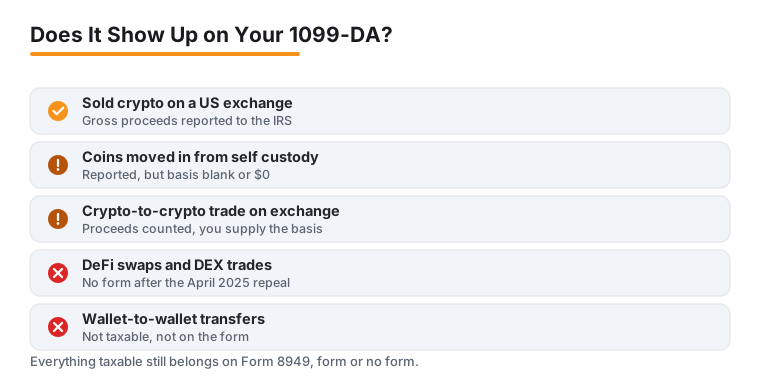
A 1099-DA covers sales and exchanges through a US custodial broker: selling for fiat, crypto-to-crypto trades, and, under optional aggregate methods, qualifying stablecoin and certain NFT sales. It does not cover most of what active crypto users actually do.
DeFi is the big gap. The regulation that would have forced DEX front-ends to issue 1099-DAs was repealed by Congress in April 2025 under the Congressional Review Act, which also blocks a substantially similar rule in the future. Swaps on Uniswap, lending on Aave, liquidity positions, none of it generates a form. Self-custody wallets like MetaMask report nothing either. Wallet-to-wallet transfers between your own addresses are not taxable and are not on the form, though boxes 12a and 12b flag when transferred coins later get sold. Our crypto regulation overview covers how this rule rose and fell.
None of this changes what you owe. Every taxable disposition belongs on your return whether or not a form exists; the gap only changes who has to remember it.
The per-wallet rule that replaced universal accounting
Behind the 1099-DA sits a quieter change that broke everyone's old spreadsheets. Through 2024, most people used the universal method: all your ETH across every wallet sat in one queue, and a sale anywhere could pull basis from anywhere. Revenue Procedure 2024-28 ended that. Since January 1, 2025, basis is tracked per wallet and per account: a coin sold on Coinbase must use basis from that Coinbase account, period.
The IRS offered a one-time safe harbor for the transition: allocate your leftover universal basis across your wallets as they stood on January 1, 2025, by specific unit or by a global formula. The allocation is irrevocable and had to be documented; crypto tax software mostly walked users through it in early 2025. If you never did one, talk to a crypto-literate tax professional before filing, because an undocumented mix of methods across years is what draws scrutiny in an exam.
Within each wallet, FIFO is the default. Specific identification is still allowed, and the regulations generally require identifying units with the broker at or before the sale. Notice 2025-7 let sellers keep the identification in their own books and records instead, and Notice 2026-20 extended that relief through December 31, 2026, because many brokers still cannot accept specific identification instructions.
How to reconcile gross proceeds, step by step
The goal: Form 8949 proceeds must cover the sum of every 1099-DA the IRS received, and your basis must be defensible. Working order:
- Collect every form. Check each US exchange you touched in 2025, including ones used once to cash out to your bank, exactly the event these forms capture.
- Export full transaction history as CSV from each exchange. The form summarizes; the CSV has the detail you need for basis.
- Add the gross proceeds across all forms. This is the floor your return has to clear.
- Rebuild basis with all wallets connected. Include every wallet and exchange, tag transfers between your own accounts as transfers rather than sales, and apply per-wallet tracking for 2025 onward.
- Add everything with no form: DeFi swaps, DEX trades, NFT sales outside brokers, P2P deals, spending crypto on goods.
- Fill Form 8949 and Schedule D, putting broker-reported sales in the sections for transactions reported on a 1099 and self-reported activity in the others. Answer yes to the digital asset question on Form 1040.
- Compare your 8949 proceeds total to the 1099-DA total. If your return shows less, find the missing transactions before the IRS does.
The matching program compares proceeds, not basis. Come up short and a CP2000 notice typically arrives 12 to 24 months later, computing tax as if your basis were zero and adding interest.
When the form is wrong, and what to do about it
First-year forms have first-year bugs. The common cases:
Wrong or zero basis. Covered above. No corrected form needed for 2025, because basis was not IRS-reported. Report the truth on Form 8949 and keep proof.
Wrong proceeds. This one matters, because the IRS has the bad number. Ask the exchange for a corrected 1099-DA. If they refuse or stall, report the correct amount on Form 8949 with an adjustment and a statement explaining the difference, backed by the trade-level export.
Your own transfer shown as a sale. A withdrawal to your own wallet is not a disposition. If it appears in the proceeds total, escalate it as a broker error, and check that your tax software has not copied the same mistake.
Duplicate counting across tools. If you both import the 1099-DA and sync the exchange API into tax software, the same sales can appear twice. Pick one source per exchange.
Whatever you fix, never silently report smaller proceeds than the forms show. Explained differences are routine; unexplained shortfalls are what the matching computers catch.
What changes next year, and what to do now
For 2026 transactions, brokers begin reporting cost basis on covered assets. That helps simple accounts and does nothing for anyone who self-custodies, because every coin transferred onto an exchange arrives as a noncovered asset with an unknown basis, permanently, from the broker's point of view.
So build the habit now: every time you move coins onto an exchange, log the date, amount, transaction hash, original acquisition date and original cost. Thirty seconds per transfer. When you sell those coins in two years and the 1099-DA shows a checked box 9 and an empty basis field, that log is the difference between a five minute fix and an archaeology dig across dead wallets.
Frequently asked questions
My 1099-DA shows $0 cost basis. Do I owe tax on the whole sale amount?
No. A $0 in box 1g means the broker does not know your basis, usually because you transferred the coins in. Report your actual purchase price plus fees on Form 8949. For 2025 the IRS did not receive broker basis figures, so correcting it creates no mismatch. Keep the purchase records that support your number.
I only traded on DEXs and self-custody wallets. Will I get a 1099-DA?
No. The rule that would have covered DeFi front-ends was repealed in April 2025, and self-custody wallet software was never a broker. You get no form, but every swap and sale is still a taxable disposition you must report on Form 8949 from your own records.
What happens if I just ignore the form?
The IRS matches total proceeds against your return automatically. Report less, or nothing, and expect a CP2000 notice roughly one to two years later proposing tax on the full proceeds with zero basis, plus interest and possible penalties. You then do the same reconciliation work anyway, under a deadline.
Does Form 1099-DA include my staking rewards?
Not as income. The form reports dispositions only. Staking rewards are ordinary income when received and may appear on a 1099-MISC, or on no form at all. When you later sell the rewarded coins, that sale does appear on a 1099-DA, and your basis is the value you already declared as income.
Do I still get to choose FIFO, HIFO or specific identification?
Within each wallet, yes, with conditions. FIFO is the default. Specific identification, which is how HIFO-style selection works in practice, generally requires identifying units at or before the sale; through December 31, 2026, IRS relief in Notices 2025-7 and 2026-20 lets you record that identification in your own books instead of with the broker. The universal method across all wallets is gone as of January 1, 2025.
I moved crypto between two exchanges. Will both report the sale?
No. Only the platform where the disposition happened reports it. The receiving exchange notes the transfer-in via boxes 12a and 12b and later reports the sale with basis missing. The real risk is double counting in your own software when you import both the form and the API history, so use one source per exchange.
Last updated: 2026-06-30.