Home › Crypto Regulation › Switzerland
Bitcoin & Cryptocurrency Regulation in Switzerland
Quick answer — Switzerland, 2026
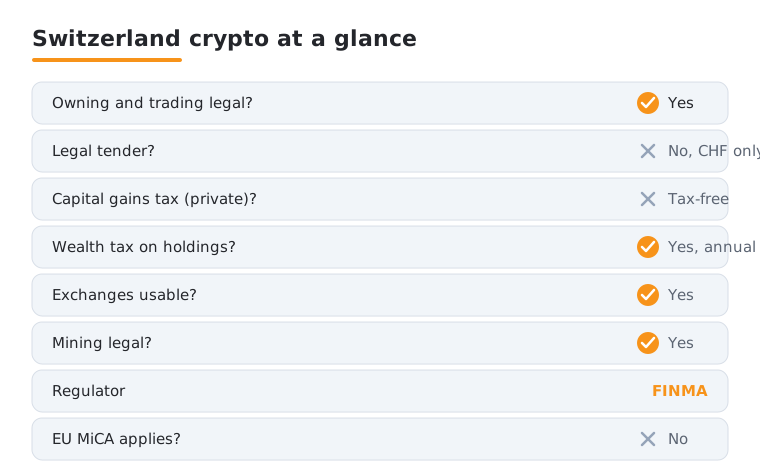
- Legal: owning, buying, selling and using Bitcoin and crypto is legal for individuals and businesses, though it is not legal tender.
- Tax: private investors' capital gains are generally tax-free, but year-end holdings face cantonal wealth tax, and mining or staking is taxed as income.
- Buying: residents use FINMA-authorised or SRO-affiliated exchanges, verify ID (KYC), and deposit Swiss francs.
Switzerland is one of the world's most established and welcoming homes for digital assets. Bitcoin and other cryptocurrencies are legal to own, buy, sell and use, and the country has spent the better part of a decade building clear, technology-neutral rules rather than blanket bans. The canton of Zug, nicknamed "Crypto Valley," hosts more than a thousand blockchain companies and foundations, and Swiss federal law has been deliberately adapted to accommodate tokenised assets.
There is no single "crypto law." Instead, crypto activity is governed by Switzerland's existing financial-market statutes, supervised mainly by the Swiss Financial Market Supervisory Authority (FINMA), and judged by what an activity actually does (taking deposits, trading securities, transmitting money, holding client assets) rather than by the technology used. This page explains, in plain terms, how Switzerland treats Bitcoin and crypto across legal status, the regulator, key laws, exchange licensing, tax, AML and KYC, everyday use, mining, recent 2025 and 2026 developments, and consumer risk, with links to the official sources you can use to verify everything. This is general information as of 2026, not legal, tax or financial advice; rules change and details vary by canton, so confirm anything important with FINMA, the named authorities, or a qualified Swiss adviser. See also our overview of crypto regulation.
On this page: Legal status · Who regulates it · Taxes · How to buy · Mining
Is Bitcoin and crypto legal in Switzerland?
Yes. Owning, buying, selling, holding and transacting in Bitcoin and other cryptocurrencies is legal in Switzerland for both individuals and businesses. There is no prohibition on private use, and crypto is not banned as a means of payment between willing parties.
That said, "legal" does not mean "unregulated," and it does not mean legal tender. The Swiss franc (CHF) remains the only official currency, and no one is obliged to accept Bitcoin in payment. The Federal Tax Administration classifies cryptocurrencies as assets, not as currency. Businesses that offer crypto services to the public, such as exchanges, custodians, brokers and ATM operators, operate inside a licensing and anti-money-laundering framework supervised by FINMA. In short, individuals enjoy broad freedom, while commercial crypto providers must be authorised and compliant.
Who regulates crypto in Switzerland?
The main supervisor is the Swiss Financial Market Supervisory Authority (FINMA), the country's independent financial regulator. FINMA oversees banks, securities firms, payment providers and crypto businesses, and applies a "same risk, same rule" principle. It classifies tokens broadly into payment tokens (such as Bitcoin), utility tokens, and asset or investment tokens (which can qualify as securities), then applies the relevant rules to each. FINMA also publishes practical guidance, maintains public registers of authorised institutions, and issues warnings about unauthorised providers.
Policy and legislation are led at federal level by the Federal Council and the State Secretariat for International Finance (SIF), part of the Federal Department of Finance. The Swiss National Bank (SNB) is the central bank and issuer of the franc but is not the day-to-day crypto regulator. Tax matters fall to the Federal Tax Administration (FTA) together with cantonal tax offices. You can confirm a provider's status on FINMA's site: FINMA (finma.ch).
Key laws and frameworks
Switzerland regulates crypto through several existing federal acts rather than one dedicated statute. The pillars commonly cited in 2026 are the Anti-Money Laundering Act (AMLA), the Banking Act, the Financial Market Infrastructure Act (FinMIA), the Collective Investment Schemes Act (CISA), and the DLT legislative package.
The DLT framework
The Federal Act on the Adaptation of Federal Law to Developments in Distributed Ledger Technology, known as the DLT Act, entered into force in stages in 2021. Rather than creating one new law, it amended around ten federal acts. Its key effects include recognising ledger-based (tokenised) securities in the Code of Obligations, creating a licence category for DLT trading systems under FinMIA, and improving the segregation and recovery of clients' crypto assets if a custodian becomes insolvent. It makes Swiss financial law compatible with blockchain; it does not regulate cryptocurrencies as such. You can read the government overview at the State Secretariat for International Finance (sif.admin.ch).
EU MiCA does not apply
Switzerland is not a member of the European Union, so the EU's Markets in Crypto-Assets Regulation (MiCA) does not apply here. Domestically the Swiss framework above governs. Swiss firms serving EU and EEA clients have dealt with MiCA by setting up authorised subsidiaries abroad: Bitcoin Suisse (Europe) AG and Sygnum Europe AG were authorised by the Liechtenstein FMA on 23 and 26 June 2026, RULEMATCH Europe AG on 3 June 2026, Swissquote Bank Europe SA by the CSSF in Luxembourg on 24 April 2026, and AMINA (Austria) AG by the Austrian FMA in October 2025.
Licensing and registration of exchanges and VASPs
Crypto exchanges, brokers, custodians and similar virtual-asset service providers (VASPs) serving Swiss customers are treated as financial intermediaries. To operate lawfully they must either hold a FINMA authorisation appropriate to their activity (for example a banking, securities-firm, fintech or DLT trading-system licence) or, for pure money-transmission and intermediary activity, be affiliated with a FINMA-recognised self-regulatory organisation (SRO) for AML supervision.
Under the Anti-Money Laundering Ordinance, an activity is generally deemed professional, and therefore subject to AML supervision, once it crosses thresholds such as gross revenue above CHF 50,000 per year, business relationships with more than 20 counterparties per year, control of third-party assets above CHF 5 million, or transaction volume above CHF 2 million per year. Before depositing significant funds with any platform, check its authorisation or SRO membership on FINMA's public register at finma.ch. See also the regulation hub for other jurisdictions.
Crypto and Bitcoin tax in Switzerland
Switzerland's tax treatment of crypto is often described as favourable for ordinary investors, but the details matter and vary by canton, since tax is assessed at federal, cantonal and communal levels. The Federal Tax Administration (FTA) publishes a working paper on crypto taxation and issues annual year-end reference market values for around 50 major cryptocurrencies. Its official page is Cryptocurrencies, Taxation (estv.admin.ch).
Private investors and capital gains
For a private individual who simply buys and holds, capital gains on the sale of crypto are generally tax-free, mirroring the treatment of private gains on other movable assets. This exemption is not automatic: it can be lost if the authorities consider you a professional trader. Factors pointing toward professional, taxable activity include very high transaction volume and frequency, short holding periods, use of borrowed money or leverage, and crypto being a main source of income.
Wealth tax
Crypto held at year-end forms part of your taxable wealth and must be declared at market value. Switzerland levies an annual wealth tax at cantonal and communal level, with rates and tax-free allowances that differ significantly between cantons.
Income from crypto activity
Rewards that look like income rather than a simple capital gain are typically taxable as income. This commonly includes mining and staking rewards, some airdrops, and lending or similar yield. Salaries paid in crypto are taxed as employment income. Because thresholds, rates and the line between private and professional depend on your canton and circumstances, keep detailed records and consult a Swiss tax professional. See our general guide to crypto taxes.
Staying a private investor: the FTA safe-harbour tests
The Federal Tax Administration's Circular No. 36 (from 27 July 2012, still in force) sets out five conditions. If a private holder meets all five, a sale of privately held crypto is treated as tax-free private wealth management and the authority will not, on a first review, class the person as a professional trader. All five must be met together:
- The assets sold were held for at least six months.
- Total yearly transaction volume (all purchase prices plus sale proceeds) is no more than five times the value of holdings at the start of the tax period.
- Capital gains are not needed to replace missing income for living costs (a rough practitioner guide is realised gains under about half of net income).
- Purchases are not debt-financed, meaning investment income exceeds the related debt interest.
- Derivatives, especially options, are used only to hedge your own positions.
This is a pre-screen, not an absolute guarantee: the circular is an administrative ordinance and does not bind the courts, so meeting all five is a strong safe harbour rather than a legal certainty.
Worked example: buy, hold, sell in Zurich
A Zurich resident buys 1 BTC in February 2025 with her own funds, no leverage, and sells it in May 2026 for a CHF 40,000 gain. Because she held it more than six months, did not borrow to buy, stayed within the volume limit and used no speculative derivatives, she satisfies Circular 36 and the CHF 40,000 gain is tax-free. Any crypto she still holds on 31 December is a separate matter: it is declared at the FTA year-end value and counts toward cantonal and communal wealth tax. In the City of Zurich for 2026 the first CHF 80,000 of net wealth is exempt for a single person, roughly double for a married couple, with effective wealth-tax rates of roughly 0.1 to 0.6 percent depending on total wealth and municipality, so an extra CHF 100,000 of taxable crypto wealth typically costs on the order of one to a few hundred francs a year while the sale gain itself stays untaxed.
AML and KYC rules
Anti-money-laundering compliance is the backbone of Swiss crypto regulation. Crypto service providers are financial intermediaries under the Anti-Money Laundering Act and must verify customer identity (KYC), identify beneficial owners, monitor transactions, and report suspicious activity. They must either hold a FINMA authorisation or belong to a recognised SRO.
Switzerland applies the international "Travel Rule" through FINMA's Anti-Money Laundering Ordinance (AMLO-FINMA). Originator and beneficiary information must accompany blockchain transfers above a threshold that Switzerland has set at CHF 1,000, notably lower than in many countries. Switzerland also applies stricter expectations to transfers involving external (self-custody) wallets: a provider must verify that the external wallet belongs to its client, or in the case of a third party, identify that third party and prove ownership of the wallet using suitable technical means. Expect identity checks, and for larger or cash-based activity, proof of address and source-of-funds questions.
Buying and using crypto in practice
Buying crypto in Switzerland is straightforward and legal. Residents can use both Swiss-based and international exchanges, brokers and apps, and several Swiss banks and the postal financial service have offered crypto access. A typical compliant path is: choose a FINMA-authorised or SRO-affiliated provider, open and verify an account (KYC), deposit Swiss francs by bank transfer or card, place an order after reviewing price, spread and fees, then secure your holdings.
- Security: enable two-factor authentication, and for long-term amounts consider self-custody in a hardware wallet, safeguarding the recovery phrase offline. Never share private keys or recovery phrases.
- Bitcoin ATMs: crypto kiosks are legal and present in cities such as Zurich and Geneva, but cash-to-crypto carries higher AML risk, so identification kicks in at low thresholds (the CHF 1,000 level applied across linked transactions) and fees are usually higher than online exchanges.
- Spending and remittances: some merchants and a few cantonal services voluntarily accept crypto, and stablecoins or prompt conversion can reduce volatility risk on cross-border transfers. Crypto transactions are irreversible, so verify addresses carefully and keep records for tax.
Crypto banks, SIX Digital Exchange and regulated products
A Swiss resident does not have to use an offshore exchange to get regulated crypto access. Switzerland has two fully licensed crypto banks, a regulated digital-securities venue, exchange-traded products on the main stock exchange, and long-established specialist custodians. Here is what each one is and what you can actually use.
Sygnum and AMINA: FINMA-licensed crypto banks
Sygnum Bank received a Swiss banking and securities dealer licence from FINMA on 26 August 2019, making it a regulated bank rather than an exchange. As a licensed bank it offers crypto custody, spot trading, staking and yield, lending and asset management, mainly to professional and institutional clients and to wealthier private clients. By 2026 it also runs regulated hubs in Singapore, Abu Dhabi and Luxembourg. A Swiss resident can bank with Sygnum directly if they qualify, or reach its infrastructure indirectly through partner banks. See sygnum.com.
AMINA Bank (headquartered in Zug) holds the same type of FINMA banking and securities dealer licence, also granted in August 2019. It was previously called SEBA Bank; the rebrand to AMINA was announced on 1 December 2023 and the new name has been in use since 2024. AMINA offers bank accounts, crypto and securities trading, hot and cold custody, staking, lending, margin trading and structured products. Clients typically need to meet professional-client thresholds to open an account. See aminagroup.com.
PostFinance: mainstream retail crypto through a state-linked bank
PostFinance, the systemically important state-linked Swiss postal bank, launched retail crypto trading and custody in 2024, with the custody and technical rails provided by FINMA-regulated Sygnum. As of early 2026 the service covers 22 cryptocurrencies, tradeable through e-finance and the PostFinance app, and in May 2026 it was extended to corporate clients. Any PostFinance customer in Switzerland can therefore buy, sell and hold mainstream cryptocurrencies through their normal bank account without opening a separate exchange account.
SIX Digital Exchange (SDX)
SIX Digital Exchange (SDX) is a FINMA-regulated market infrastructure for issuing, trading, settling and holding digital (DLT-based) securities. SDX Trading AG holds a stock-exchange licence and SIX Digital Exchange AG holds a central securities depository licence, both granted by FINMA in 2021. In 2026 FINMA approved merging SDX's DLT depository into the group's main securities depository, SIX SIS AG, and allowed SIX SIS to offer crypto custody. SDX is an institutional and bank-facing venue, so a retail resident does not trade on it directly, but benefits from tokenised bonds and products issued through it. See six-group.com.
Crypto ETPs on SIX any broker can buy
Issuers such as 21Shares list crypto exchange-traded products (ETPs) on the regulated SIX Swiss Exchange. They trade like ordinary shares and give exposure to Bitcoin, Ethereum, staking baskets and single-asset tokens without the investor managing wallets or private keys. Any Swiss resident with a normal bank or brokerage account that can reach SIX can buy them during trading hours, in CHF, USD or EUR share classes. One caution: these ETPs are debt securities, not funds, so they carry issuer and counterparty risk even when they are physically backed by the underlying coins.
Bitcoin Suisse: SRO-supervised broker and custodian
Bitcoin Suisse (founded 2013, Zug) is a member of the FINMA-recognised self-regulatory organisation VQF, which makes it a regulated financial intermediary under Swiss anti-money-laundering law but not a FINMA-licensed bank. It offers brokerage, custody, collateralised lending, staking and tokenisation to private, institutional and corporate clients, and is one of the larger crypto custodians in Switzerland. A resident can open an account to buy, sell, hold, stake and borrow against crypto, but Bitcoin Suisse does not take deposits as a bank. As of 2026 it remains SRO-supervised rather than bank-licensed. See bitcoinsuisse.com.
Note that the SRO-versus-bank distinction may shift after 2026: FINMA's Guidance 01/2026 sets custody expectations for all supervised institutions, and the proposed crypto-institution licence (see the developments section) would create a dedicated category for firms like these.
Paying taxes and spending crypto: Zug and Lugano
Paying a tax bill in crypto is different from how your crypto holdings are taxed, which is covered in the tax section above. A small number of Swiss cantons and municipalities let you settle public bills in crypto. In every case the government does not hold the crypto: it is converted to Swiss francs on receipt.
Canton of Zug: Bitcoin and Ether for taxes
Since February 2021 the Canton of Zug lets individuals and companies pay cantonal taxes in Bitcoin (BTC) or Ether (ETH), settled through partner Bitcoin Suisse, which converts the crypto to francs for the canton. In May 2023 the per-transaction limit was raised from the original CHF 100,000 to CHF 1.5 million, and taxpayers can trigger the payment by scanning the QR code on the payment slip. The scheme remains available in 2026, though uptake is modest. Separately, the city of Zug has accepted small crypto payments for government services since a 2016 Bitcoin pilot, capped at CHF 200 per payment; that city service is older and much smaller than the cantonal tax scheme.
Lugano Plan B: BTC and USDT for all city invoices
Under Plan B, launched in March 2022 with Tether, the City of Lugano accepts Bitcoin, Bitcoin over the Lightning Network, and Tether (USDt) for all invoices issued by city services, including income and corporate taxes, fees and fines, with no cap on the amount. From December 2023 this was extended to every city invoice by QR code, with crypto instantly converted to francs. The official city payment-methods page lists exactly these three options and warns residents to pay only through the city's official page. Plan B is confirmed active in 2026: on 3 March 2026 Tether and the city announced a Phase II covering 2026 to 2030.
Lugano also has a local town token, LVGA, used in the MyLugano app where more than 400 merchants accept BTC, USDT and LVGA and shoppers earn cashback in LVGA. Those LVGA tokens can be looped back into some municipal services such as parking and childcare fees through the app. But the official City of Lugano tax and invoice page lists only BTC, Lightning and USDT, so LVGA is best understood as an app-ecosystem convenience rather than a formal way to settle a tax bill.
Zermatt
Since 2020 the municipality of Zermatt in canton Valais has accepted Bitcoin for tax payments and government services, again in partnership with Bitcoin Suisse, which converts the received Bitcoin to francs. Zermatt accepts Bitcoin only, not Ether. It was introduced in 2020 with no confirmed closure, so treat it as long-running rather than freshly re-confirmed for 2026.
Bitcoin mining in Switzerland
Bitcoin mining is legal in Switzerland. There is no crypto-specific mining ban; the activity is shaped far more by energy economics and electricity rules than by any mining law. Switzerland's relatively high electricity prices make large-scale proof-of-work mining less competitive than in cheaper-power jurisdictions.
- Electricity and grid rules: power supply, tariffs and connection conditions are governed by Swiss energy regulation and by cantonal and municipal utilities. Large operations must manage cost, capacity and grid agreements carefully.
- Renewables and heat reuse: Switzerland's electricity mix is heavily hydro and low-carbon, and some operators explore surplus or renewable power and recovering waste heat for building or district heating.
- Permits and local rules: facilities may face zoning, building, noise and environmental requirements at cantonal and communal level.
- Tax: mining rewards are generally treated as taxable income, and a sufficiently large or systematic operation can be assessed as a business.
Small-scale or hobby mining is unproblematic legally; the main constraints are economic. Anyone planning a commercial operation should clarify electricity terms and local permitting before investing.
Recent developments in 2025 and 2026
Switzerland is refining its regime rather than overhauling it, with the direction of travel toward more clarity and stronger consumer and AML safeguards.
- First DLT trading facility authorised (March 2025): FINMA licensed BX Digital AG as Switzerland's first DLT trading facility, announced on 18 March 2025 (the licence decision was granted on 12 March 2025 and became legally effective on 14 May 2025). The licence lets BX Digital run a regulated venue for multilateral trading and settlement of tokenised securities, using the public Ethereum blockchain with delivery-versus-payment settled through a smart contract linked to Swiss Interbank Clearing. It is the first such authorisation under the DLT Act framework. See the announcement: FINMA (finma.ch).
- FINMA stablecoin guidance (July 2024): In Guidance 06/2024, FINMA confirmed that where a stablecoin issuer holds the backing assets for its own account, the coins can count as public deposits that need a banking licence. Many issuers instead rely on a bank default guarantee, for which FINMA set minimum conditions, including that each customer gets an individual claim in the issuer's bankruptcy. FINMA also stressed that a stablecoin issuer is a financial intermediary under anti-money-laundering law and must identify every coin holder.
- New licence categories proposed (October 2025): On 22 October 2025 the Federal Council launched a public consultation on amending the Financial Institutions Act. The proposal would abolish the 2018 "fintech licence" and create two new categories: a payment-instrument-institution licence (covering payment services and certain stablecoins) and a crypto-institution licence (covering custody, trading and related services for crypto-based assets). The consultation period ran until 6 February 2026. As of August 2026 the Federal Council has not published its dispatch to Parliament, so the bill has not yet been debated, and entry into force is not expected before 2027. Under the consultation draft, existing fintech institutions would have one year from entry into force to meet the new requirements, and previously unregulated providers twelve months to submit a licence application. See the official announcement: Federal Council consultation (admin.ch).
- FINMA Guidance 01/2026 on crypto custody (12 January 2026): FINMA set out its expectations on safekeeping crypto-based assets, covering private-key management, operational and cyber risks, bankruptcy-remote custody by Swiss banks, and the limited conditions for delegating custody abroad. Authorised institutions retain responsibility when using external providers.
- International tax reporting (CARF): Switzerland has already implemented the OECD Crypto-Asset Reporting Framework in domestic law: Parliament passed it in the final vote on 26 September 2025 and it entered into force on 1 January 2026. No data is being exchanged yet. The Federal Council decided on 26 November 2025 that the crypto provisions would not apply for 2026, and the federal decrees approving the 74 partner states, parliamentary business 25.052, are listed as still in the committee of the National Council. The first exchange is expected in 2027 at the earliest.
Because consultations can change before becoming law, always confirm the current position with the official source before relying on it.
Consumer risks and protection
Switzerland's clear rules reduce some risks but do not remove the fundamental ones. Bitcoin and other cryptocurrencies are highly volatile and can lose a large share of their value quickly. They are not bank deposits and are generally not covered by Switzerland's depositor-protection scheme, even when bought through a bank. The main practical risks for users are price volatility, scams and phishing, loss of access through forgotten keys or a failed custodian, and the chance of misjudging your tax status as a professional trader.
Protections include FINMA supervision and public registers (so you can check whether a provider is authorised), strong AML enforcement, and the DLT Act's improved segregation of client crypto assets in a custodian's insolvency. Sensible principles still apply: use FINMA-authorised or SRO-affiliated providers, invest only what you can afford to lose, be skeptical of guaranteed returns or pressure to act fast, and treat unsolicited offers and "can't-lose" predictions as red flags. Nothing on this page is investment advice.
Official sources and how to verify
Because Swiss rules differ by canton and are periodically updated, treat this page as a general guide and confirm details with the official sources below before acting. This content is general information as of 2026 and is not legal, tax or financial advice; verify your situation with FINMA, the relevant authority, or a qualified Swiss professional.
- Regulator: Swiss Financial Market Supervisory Authority (FINMA), including its public registers, warning list and guidance such as Guidance 01/2026 on crypto custody.
- Government policy: State Secretariat for International Finance (SIF), DLT and blockchain for the DLT Act and ongoing legislative work.
- Tax: Federal Tax Administration (FTA), Cryptocurrencies and taxation for the working paper and annual reference values, plus your cantonal tax office.
- Legislative announcements: the Federal Council (admin.ch) for consultations and new acts.
For wider context, see our crypto regulation explainer and the regulation hub.
Swiss crypto rules as of August 2026: what is in force and what is coming
Nothing about the legality of holding, buying, selling or spending crypto in Switzerland changed over the summer of 2026. What changed is the pipeline. Three dated items moved, and one of them closed a question readers often ask about the Swiss National Bank. The table below separates what already binds you from what is still a draft.
| Measure | Stage on 3 August 2026 | When it bites |
|---|---|---|
| Revised Anti-Money Laundering Act and the new Transparency Act, creating a central beneficial owners register | Adopted by Parliament on 26 September 2025. Entry into force fixed by the Federal Council on 12 June 2026 | 1 October 2026, with transition periods of three to six months for most entities |
| FinIA amendment creating payment institution and crypto institution licences | Consultation closed 6 February 2026. No Federal Council dispatch to Parliament published | Not expected before 2027, then a one year transition |
| OECD Crypto-Asset Reporting Framework in Swiss law | In force since 1 January 2026 | No crypto data exchanged for the 2026 tax year |
| Federal decrees approving 74 exchange partner states (business 25.052) | Listed as in the committee of the National Council | First actual exchange 2027 at the earliest |
| Popular initiative to put Bitcoin in Swiss National Bank reserves | Signature deadline of 30 June 2026 passed without the required 100,000 signatures | Never. No vote will be held |
| FINMA Guidance 01/2026 on crypto custody and Guidance 04/2026 on money laundering risk analysis | Applied as supervisory practice | Already applied to supervised institutions |
For a private holder, August 2026 looks the same as June 2026. For a Swiss crypto business, October 2026 brings a register filing obligation, and the licence regime that would move it from self regulatory supervision to direct FINMA supervision has not yet reached Parliament.
The Bitcoin reserve initiative lapsed at its 30 June 2026 deadline
From 31 December 2024 a Swiss popular initiative, officially titled "Für eine finanziell starke, souveräne und verantwortungsvolle Schweiz (Bitcoin-Initiative)", sought to amend Article 99 paragraph 3 of the Federal Constitution so that the Swiss National Bank would hold part of its currency reserves in Bitcoin alongside gold. Under Swiss law the organisers had eighteen months, to 30 June 2026, to collect 100,000 valid signatures.
They collected roughly 50,000. Founder Yves Bennaim said the campaign had always been a long shot and that organisers would let the initiative lapse, announced in early May 2026 with only weeks of collection time remaining.
The consequence is straightforward. There will be no national vote, the Constitution is unchanged, and the SNB holds no Bitcoin. The SNB had already rejected the idea on the grounds that Bitcoin's liquidity and volatility do not meet its currency reserve requirements. A fresh attempt would have to restart the whole popular initiative process, beginning with a new preliminary examination by the Federal Chancellery.
This matters because Switzerland is frequently listed alongside jurisdictions considering sovereign Bitcoin reserves. As of August 2026 it is not one of them.
New anti-money laundering rules and a beneficial owners register from 1 October 2026
On 12 June 2026 the Federal Council fixed 1 October 2026 as the date on which two acts adopted by Parliament on 26 September 2025 enter into force: the revised Anti-Money Laundering Act and the Federal Act on the Transparency of Legal Entities and the Identification of Beneficial Owners, usually called the Transparency Act. The State Secretariat for International Finance confirms both dates and states that the AMLA revision extends the Act to consultancy services, including those related to real estate transactions or the establishment and structure of legal entities.
The Transparency Act creates Switzerland's first central electronic register of beneficial owners, run by a new unit within the Federal Office of Justice. The reporting scope and deadlines are:
- Who must report: Swiss joint stock companies, limited liability companies, cooperatives and investment companies, foreign entities with a Swiss branch, Swiss effective management or Swiss real estate, and trustees domiciled or operating in Switzerland.
- Who is excluded: listed entities and entities at least 75 percent owned by listed entities or public authorities, pension funds, Swiss associations, Swiss foundations and Swiss sole proprietorships.
- Threshold: any natural person holding, directly or indirectly, at least 25 percent of the capital or votes, or controlling the entity by other means.
- Transition for existing entities: three months for joint stock companies subject to an ordinary audit and five months without one, four months for other entities subject to an ordinary audit and six months without one, with a maximum of two years where beneficial owners are already recorded in the commercial register.
- Access: not public. Only certain Swiss authorities, and financial intermediaries and advisors subject to the AMLA, may access it electronically.
The Federal Council chose this timing so the effectiveness of the measures can be assessed during the next Financial Action Task Force country evaluation of Switzerland, scheduled for 2027 to 2028.
For a private crypto holder none of this creates a new duty. For a Swiss crypto company set up as an AG or GmbH, including brokers, custodians and token issuers, it is a filing obligation with a hard date. Separately, FINMA Guidance 04/2026 of 4 June 2026 supplements the money laundering risk analysis required under Article 25 paragraph 2 of the FINMA Anti-Money Laundering Ordinance and classifies crypto services, complex structures and politically exposed persons as inherently high risk, which is why Swiss banks ask more questions about crypto source of funds than they did two years ago.
Where CARF crypto tax reporting actually stands
Switzerland's domestic legal basis for exchanging crypto tax data is already in force. Parliament passed the package in the final vote on 26 September 2025 and the law entered into force on 1 January 2026. What has not happened is any actual exchange of data. On 26 November 2025 the Federal Council decided that the crypto provisions would not apply for 2026, so no crypto data is exchanged with any partner state for the 2026 tax year.
The reason is a second, separate parliamentary item. The federal decrees approving the list of exchange partner states, registered as business 25.052 and based on a Federal Council dispatch of 6 June 2025, are listed as still in the committee of the National Council. Until those decrees pass, Swiss providers report to nobody abroad.
What the list contains, if approved: 74 partner states, including all EU member states, the United Kingdom and most G20 states, but not the United States, China or Saudi Arabia. A bilateral arrangement with the United States was flagged as a separate track. The first exchange is expected in 2027 at the earliest, and some Swiss tax specialists argue it slips to 2028 because the partner state decrees remain unapproved.
Two practical points. First, crypto asset service providers with a Swiss nexus already have to build registration, due diligence and reporting capability even though nothing is transmitted yet. Second, none of this changes what you owe. Swiss tax treatment is unchanged: private capital gains remain untaxed, holdings remain subject to cantonal wealth tax at the year end value, and the Federal Tax Administration continues to state that cryptocurrencies are subject to direct federal tax, withholding tax and stamp duty at federal level. CARF changes visibility, not liability.
Swiss providers now hold EU MiCA licences through EEA subsidiaries
MiCA still does not apply in Switzerland, and FINMA cannot issue a MiCA licence because Switzerland is not an EU or EEA member. What changed through 2025 and the first half of 2026 is that the largest Swiss crypto firms obtained MiCA authorisation anyway, through subsidiaries in EU and EEA states, then passported back across the bloc. As Crypto Valley Journal reported on 3 July 2026, eight Swiss crypto service providers now hold a crypto-asset service provider authorisation, which lets a firm offer custody, trading, order execution and portfolio management across the EU under a single passport.
The named authorisations, with the granting regulator and date:
- Crypto Finance (Deutschland) GmbH, granted by BaFin in Germany, 24 January 2025.
- AMINA (Austria) AG, granted by the Austrian FMA, October 2025.
- Relai EU SASU, granted by the AMF in France, 27 October 2025.
- Blocknodes SAS, the SwissBorg entity, granted by the AMF in France, 11 March 2026.
- Swissquote Bank Europe SA, granted by the CSSF in Luxembourg, 24 April 2026.
- RULEMATCH Europe AG, granted by the FMA in Liechtenstein, 3 June 2026.
- Bitcoin Suisse (Europe) AG, granted by the FMA in Liechtenstein, 23 June 2026.
- Sygnum Europe AG, granted by the FMA in Liechtenstein, 26 June 2026.
What this means in practice. If you are resident in Switzerland, you deal with the Swiss entity under Swiss rules and MiCA is irrelevant to you. If you are resident in the EU or EEA and want to use a Swiss provider, you are increasingly onboarded to its EU or EEA subsidiary and get MiCA protections rather than Swiss ones. The two regimes now sit side by side inside the same corporate groups.
Domestic distribution kept widening at the same time. On 23 July 2026 BancaStato launched Bitcoin, Ethereum, Litecoin and Solana trading through Sygnum's business to business infrastructure connected to its Avaloq core banking system, with Sygnum handling execution and custody. BancaStato joins more than 25 banks and financial institutions using that platform.
Frequently asked questions
Is Bitcoin legal tender in Switzerland?
No. Bitcoin and other cryptocurrencies are legal to own, buy, sell and use, but they are not legal tender. The Swiss franc is the only official currency, and no one is required to accept crypto as payment. Some merchants and a few cantonal services do voluntarily accept it, and the Federal Tax Administration treats crypto as an asset rather than a currency.
Who regulates cryptocurrency in Switzerland?
The Swiss Financial Market Supervisory Authority (FINMA) is the main regulator. It supervises crypto businesses under existing financial-market and anti-money-laundering laws using a "same risk, same rule" approach. Policy and legislation are led by the Federal Council and the State Secretariat for International Finance, while tax is handled by the Federal Tax Administration and cantonal offices. You can verify a provider at finma.ch.
Do I pay tax on crypto profits in Switzerland?
For a private investor, capital gains on crypto are generally tax-free, but this can be lost if the authorities treat you as a professional trader. Crypto held at year-end is subject to annual cantonal and communal wealth tax, and income such as mining or staking rewards is taxable as income. Rules vary by canton, so confirm your situation with the Federal Tax Administration or a Swiss tax adviser.
Do crypto exchanges need a licence in Switzerland?
Yes. Exchanges, custodians, brokers and ATM operators serving Swiss customers are financial intermediaries that must either hold an appropriate FINMA authorisation or be affiliated with a FINMA-recognised self-regulatory organisation for anti-money-laundering supervision. They must apply KYC identity checks and the Travel Rule. Always check a platform's status on FINMA's public register before depositing significant funds.
What is changing for Swiss crypto rules in 2025 and 2026?
In October 2025 the Federal Council opened a consultation, which ran until 6 February 2026, to replace the old fintech licence with two new categories: a payment-instrument-institution licence and a crypto-institution licence, expected to take effect toward 2027. FINMA also published Guidance 01/2026 on crypto custody in January 2026, and Switzerland is moving to implement the OECD Crypto-Asset Reporting Framework (CARF) for tax reporting around 2027.
Does EU MiCA apply in Switzerland?
No. Switzerland is not in the European Union, so the EU's Markets in Crypto-Assets Regulation (MiCA) does not apply domestically. Swiss crypto activity is governed by national law, mainly the Anti-Money Laundering Act, the Banking Act, the Financial Market Infrastructure Act, the Collective Investment Schemes Act and the DLT package, supervised by FINMA. Firms serving EU clients may still need to consider MiCA separately.
Which Swiss crypto banks and regulated providers can I use?
Switzerland has two FINMA-licensed crypto banks, Sygnum and AMINA (formerly SEBA), both holding a banking and securities dealer licence from 2019. PostFinance offers retail crypto on Sygnum's regulated custody, covering 22 coins as of early 2026. Bitcoin Suisse is a long-established broker and custodian supervised through the VQF self-regulatory organisation rather than as a bank. You can also buy crypto exchange-traded products on the SIX Swiss Exchange through a normal broker. Check any provider's status on FINMA's register first.
Can I pay my taxes in crypto in Switzerland?
In a few places, yes. The Canton of Zug accepts Bitcoin and Ether for cantonal taxes up to CHF 1.5 million per transaction, settled via Bitcoin Suisse. The City of Lugano accepts Bitcoin, Lightning and Tether (USDT) for all city invoices, including taxes, with no cap, under its Plan B programme confirmed active into 2026. Zermatt has accepted Bitcoin for taxes since 2020. In every case the crypto is converted to Swiss francs on receipt, so the government never holds it.
Can I buy a Bitcoin ETP through my Swiss bank?
Usually yes. Crypto exchange-traded products from issuers such as 21Shares are listed on the regulated SIX Swiss Exchange and trade like ordinary shares, so any Swiss bank or brokerage account that can reach SIX can buy them during trading hours, in CHF, USD or EUR. They give exposure to Bitcoin, Ethereum and other assets without managing wallets or private keys. Note that these ETPs are debt securities rather than funds, so they carry issuer and counterparty risk even when physically backed by the underlying coins.
How do I stay classed as a private crypto investor for tax?
The Federal Tax Administration's Circular 36 sets five conditions that, met together, keep you in tax-free private wealth management: hold assets at least six months; keep yearly transaction volume within five times your starting holdings; do not rely on the gains to cover living costs; do not buy with borrowed money; and use derivatives only to hedge your own positions. This is a first-review safe harbour, not an absolute legal guarantee, so keep records and ask a Swiss tax adviser if your activity is heavy.
Will the Swiss National Bank hold Bitcoin in its reserves?
No. The popular initiative that would have required it reached its signature deadline of 30 June 2026 having gathered roughly 50,000 of the 100,000 valid signatures needed. Organisers announced in early May 2026 that they would let it lapse. There will be no referendum and the Constitution is unchanged. The SNB had already rejected the idea, citing Bitcoin's volatility and insufficient liquidity for currency reserves. A new attempt would have to restart the popular initiative process from the beginning.
When will Switzerland start sharing my crypto data with foreign tax authorities?
Not for the 2026 tax year. The Swiss law implementing the OECD Crypto-Asset Reporting Framework entered into force on 1 January 2026, but the Federal Council decided on 26 November 2025 that the crypto provisions would not apply for 2026. The separate federal decrees approving the list of 74 partner states, parliamentary business 25.052, are listed as still in the committee of the National Council. The first exchange is expected in 2027 at the earliest. The proposed list covers all EU member states, the United Kingdom and most G20 states, but not the United States, China or Saudi Arabia.
What happens on 1 October 2026 for Swiss crypto companies?
The revised Anti-Money Laundering Act and the new Transparency Act enter into force, following the Federal Council's decision of 12 June 2026. A central electronic register of beneficial owners, run by a new unit within the Federal Office of Justice, starts operating. Swiss AGs, GmbHs, cooperatives and investment companies, plus foreign entities with a Swiss branch, Swiss effective management or Swiss real estate, must report any natural person holding at least 25 percent of the capital or votes or controlling the entity by other means. Transition periods run from three to six months depending on legal form and audit status. Private crypto holders have no new obligation, and the register is not public.
Do Swiss crypto exchanges need a FINMA licence yet under the new rules?
Not yet. Today most Swiss crypto brokers and custodians are supervised by a self regulatory organisation under anti-money laundering law rather than licensed by FINMA, unless they hold a banking or securities firm licence. The FinIA amendment that would create a dedicated crypto institution licence, covering custody including staking, client trading and short term proprietary trading including exchange services, closed consultation on 6 February 2026. As of August 2026 the Federal Council has not sent it to Parliament and it is not expected to be in force before 2027.
Can I use a Swiss crypto provider if I live in the EU?
Increasingly you are onboarded to its EU or EEA subsidiary instead. FINMA cannot grant a MiCA licence because Switzerland is not in the EU or EEA, so Swiss groups have obtained crypto-asset service provider authorisations abroad and passported them: Sygnum Europe AG and Bitcoin Suisse (Europe) AG were authorised in Liechtenstein in late June 2026, Swissquote Bank Europe SA in Luxembourg in April 2026, and AMINA (Austria) AG in Austria in October 2025. If you are resident in Switzerland, MiCA does not apply to you and the Swiss framework governs.
Facts reviewed: 5 August 2026. Page updated: 5 August 2026.