Home › Crypto Regulation › Germany
Bitcoin & Cryptocurrency Regulation in Germany
Quick answer — Germany, 2026
- Legal: Legal to own and use, not legal tender
- Tax: Private gains tax-free after one year, otherwise income-taxed
- Buying: Via MiCAR-authorised providers with KYC
Germany is one of Europe's most established and crypto-friendly jurisdictions. Bitcoin and other crypto-assets are legal to buy, hold, and sell, and the firms that provide crypto services are formally regulated. National oversight sits with the Federal Financial Supervisory Authority (BaFin), working alongside the Deutsche Bundesbank, while the EU-wide Markets in Crypto-Assets Regulation (MiCAR) now provides the single rulebook for the providers that serve German users. Tax matters fall to the Bundesministerium der Finanzen (Federal Ministry of Finance) and the local tax offices (Finanzamt).
This guide explains how digital assets are treated in Germany as of 2026: whether crypto is legal, who regulates it, the key laws, how exchanges are licensed, how private investors are taxed, the anti-money-laundering rules, and how to buy and use crypto in practice. It is general information as of 2026 and NOT legal, tax, or financial advice; rules are evolving, so verify any specifics with the named official regulators (BaFin and the Bundesministerium der Finanzen) or a qualified Steuerberater (tax advisor). See also our overviews of crypto regulation and crypto taxes.
On this page: Legal status · Who regulates it · Taxes · How to buy · Mining
Is Bitcoin and crypto legal in Germany?
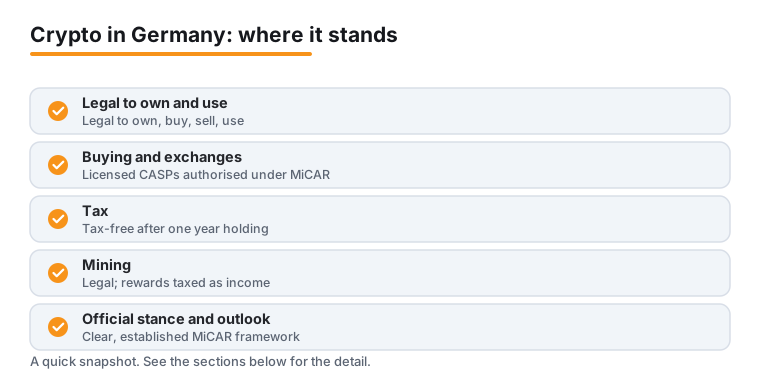
Yes. Owning, buying, selling, and using Bitcoin and other crypto-assets is legal in Germany. Crypto is not legal tender (only the euro is), but it is recognised as a private asset that can be held and traded, and individuals may use it freely. Merchants can accept it voluntarily.
What is regulated is the infrastructure around crypto rather than personal ownership. Exchanges, brokers, custodians, and similar providers must be authorised and must follow anti-money-laundering rules. Germany was an early mover in this area, having introduced a dedicated crypto-custody permission before the EU-wide framework arrived. For ordinary users, buying through an authorised platform is both legal and the safest route.
Who regulates crypto in Germany?
The lead national regulator is BaFin, the Federal Financial Supervisory Authority (Bundesanstalt fuer Finanzdienstleistungsaufsicht). BaFin authorises and supervises crypto-asset service providers, checks their capital, governance, and consumer-protection standards, and enforces compliance. It is the designated competent authority in Germany under the EU's MiCAR.
BaFin works with the Deutsche Bundesbank (the German central bank) on financial-stability questions. Tax treatment is set separately by the Bundesministerium der Finanzen (Federal Ministry of Finance, BMF) and administered by the regional tax offices (Finanzamt). On anti-money-laundering, BaFin coordinates with the Financial Intelligence Unit, and from 2025 onward the EU's new Anti-Money Laundering Authority (AMLA), which is headquartered in Frankfurt, is being built up to add a central supervisory layer.
You can confirm whether a provider is authorised, and read official guidance, directly on the BaFin MiCAR pages (see also the BaFin English-language site).
Key laws and frameworks
Germany's crypto rules combine EU regulation with national implementing law.
MiCAR: the EU rulebook
The Markets in Crypto-Assets Regulation, Regulation (EU) 2023/1114 (MiCAR), is the EU's harmonised regime for crypto-asset markets. Its rules for stablecoins (asset-referenced tokens and e-money tokens) began applying on 30 June 2024, and the rules for crypto-asset service providers (CASPs) and issuers became applicable across the EU on 30 December 2024. A key benefit is passporting: a CASP authorised in one member state can serve customers across the whole bloc.
National implementation: the KMAG
Germany implemented MiCAR domestically through the Kryptomaerkteaufsichtsgesetz (Crypto Markets Supervision Act, KMAG), published in the Federal Law Gazette on 27 December 2024. The KMAG gives BaFin the powers it needs to apply MiCAR, including the ability to issue public warnings. Notably, Germany used a shortened grandfathering window rather than the longer transition the EU regulation allowed. Under section 50(2) no. 3 KMAG, a permission treated as continuing under the old national regime expired at the latest at the end of 31 December 2025, so full MiCAR (CASP) authorisation has been required to serve German customers since 1 January 2026. Section 50(3) KMAG gave firms already licensed under section 32 of the Banking Act a simplified authorisation route.
AML and transfer rules
Anti-money-laundering duties stem from the German Money Laundering Act (Geldwaeschegesetz, GwG) and, at EU level, the Transfer of Funds Regulation, which extends the travel rule (sharing of sender and recipient data) to crypto transfers between regulated providers. This is general information, not legal advice; verify current requirements with BaFin.
Licensing and registration of exchanges (CASPs)
Under MiCAR, any business operating in Germany as a crypto-asset service provider must apply to BaFin for authorisation. CASPs include crypto custodians, operators of trading platforms, brokers and dealers, firms that transfer or exchange crypto-assets, and those that advise on or manage crypto portfolios. Once authorised, a provider can offer services throughout the EU using passporting rights.
To be authorised, firms must meet requirements on minimum capital, fit-and-proper management, governance, safeguarding of client assets, conflict-of-interest controls, disclosure, and operational resilience. They must also comply with AML obligations. BaFin has published interpretation and application guidance and held workshops to help firms apply the new rules, and Germany has been among the most active EU states in granting MiCAR authorisations during 2025. Germany is the largest CASP market in the EU by number of authorised providers. On 3 August 2026 an independent tracker mirroring the ESMA register listed 66 authorised providers in Germany out of 321 across the EU, ahead of France on 35. The count moves week to week as new authorisations are granted, and a large share of Germany's entries are established banks and brokerages taking narrow permissions rather than crypto-native firms.
For users, the practical takeaway is to favour a provider authorised to serve EU customers under MiCAR, because that authorisation carries consumer-protection, custody, and disclosure standards. You can check status via BaFin. This is general information, not legal advice.
Crypto and Bitcoin tax in Germany
Germany's tax treatment of crypto for private investors is unusually favourable. Crypto held privately is generally treated as a private sale asset under section 23 of the Income Tax Act (Einkommensteuergesetz, EStG). The Federal Ministry of Finance set out its current position in a detailed letter dated 6 March 2025.
The one-year holding rule
Gains on crypto held for more than one year are generally tax-free when sold. Dispose of it within one year and the gain is taxed at your personal income-tax rate. Short-term private-sale gains stay tax-free if your total profit from all private disposals in the calendar year is less than 1,000 euros. This figure is set in section 23(3) sentence 5 EStG. Because a Freigrenze works as a threshold rather than an allowance (exceeding it can make the whole amount taxable), reach 1,000 euros of total private-disposal profit in the year and the entire gain becomes taxable, not just the part above the limit. Gains inside the one-year period are then taxed at your personal rate, which for the 2026 assessment period runs to 42 percent from 69,879 euros of taxable income and 45 percent from 277,826 euros under section 32a EStG, plus the 5.5 percent solidarity surcharge where it is levied. Confirm your own position with a Steuerberater.
Mining, staking, and other crypto income
Income that is not a simple private sale is treated differently. Mining and staking rewards are generally taxable as income at their euro value when received; related costs may be deductible where the activity is commercial. The March 2025 BMF letter also addressed airdrops, hard forks, lending, and DeFi for the first time, and set out record-keeping and reporting expectations. Keep detailed records (dates, amounts, euro values, fees, and platform) to prove holding periods and calculate gains.
New reporting from 2026 (DAC8 and CARF)
Tax reporting is tightening across the EU. Under the EU directive known as DAC8, which is the EU version of the OECD Crypto-Asset Reporting Framework (CARF), crypto-asset service providers must start collecting reportable data on EU-resident users from 1 January 2026. Providers then report that data to tax authorities, with the first exchange of information between member states due by 30 September 2027. In practice this means German tax offices will increasingly receive account and transaction data directly from platforms, so keeping your own accurate records matters more than ever.
This is general information, not tax advice. The official source is the BMF crypto-tax letter: BMF letter of 6 March 2025 (English). For a broader overview, see our guide to crypto taxes.
AML and KYC rules
Anti-money-laundering (AML) and know-your-customer (KYC) requirements are central to how crypto is regulated in Germany. Authorised providers are obliged entities under the German Money Laundering Act (Geldwaeschegesetz, GwG) and must verify customer identity, monitor transactions, and report suspicious activity.
- Identity verification (KYC): regulated platforms must verify who you are before you can trade or withdraw, typically requiring a government ID and proof of address. This is a legal requirement, not an optional step.
- The travel rule: under the EU Transfer of Funds Regulation, providers must collect and share originator and beneficiary information on crypto transfers between regulated firms. In the EU this applies to crypto transfers regardless of amount, which is stricter than the threshold-based rule for traditional wire transfers.
- Coming changes: a new EU AML package introduces a single AML Regulation (AMLR) that applies directly from 10 July 2027, expands obligations for crypto providers, and brings an EU-wide cash-payment limit. The new EU Anti-Money Laundering Authority (AMLA), based in Frankfurt, became operational in 2025 and will add central supervision over time.
This is general information; for current AML duties consult BaFin and the relevant EU authorities.
Buying and using crypto in practice
Germans can buy crypto through exchanges, brokers, and regulated banks and fintech apps. The rule of thumb is to use a provider authorised to serve EU customers under MiCAR. A typical path looks like this:
- Choose an authorised provider: an exchange, broker, or app authorised under MiCAR. Compare fees, supported assets, and how it custodies funds.
- Complete KYC: verify your identity with a government ID and usually proof of address, as required by AML law.
- Fund your account: deposit euros, most cheaply by SEPA transfer; cards are often supported but cost more.
- Buy and decide on custody: place an order, then either leave assets on the platform for convenience or withdraw to a personal wallet (a hardware wallet for larger amounts). Self-custody is legal and cuts counterparty risk, but security then rests entirely with you, so back up your recovery phrase and never share it.
- Keep records: note purchase dates, amounts, and euro values for tax and holding-period tracking.
Bitcoin ATMs exist in Germany but are tightly regulated: operating one is a financial service, so operators must be authorised and meet AML obligations. BaFin has acted against unlicensed machines, the network is small, fees are high, and identity checks usually apply. For most people a regulated online exchange is cheaper and more reliable.
Bitcoin mining in Germany
Mining cryptocurrency is legal in Germany, but it is rarely competitive at scale because of high electricity costs. Proof-of-work mining is energy-intensive, so margins are thin against regions with cheaper power, and the energy footprint attracts scrutiny given Germany's strong climate and renewables agenda. There is no outright ban, but large operations face the same grid, permitting, and sustainability considerations as any energy-intensive business.
For tax, mining rewards are generally treated as income at their euro value when received, in line with the BMF's guidance, and commercial miners may deduct legitimate costs such as electricity and hardware. Anyone mining beyond a hobby scale should get tax advice, since the activity can be classified as commercial (gewerblich) with additional obligations.
Recent developments (2025 to 2026)
The direction of travel is toward clearer, harmonised rules. The most significant recent changes include:
- MiCAR fully applicable: the CASP and issuer rules took effect across the EU on 30 December 2024, and Germany implemented them through the KMAG (in force from 27 December 2024).
- German transition closed: Germany used a shortened grandfathering period that ended on 31 December 2025, after which firms needed full MiCAR authorisation to keep serving German customers. BaFin has been among the most active EU regulators in granting these authorisations.
- Updated crypto-tax guidance: the BMF's letter of 6 March 2025 refreshed the income-tax treatment of crypto, adding detail on staking, lending, DeFi, airdrops, hard forks, and record-keeping.
- Germany leads the EU CASP market: on 3 August 2026 an independent tracker mirroring the ESMA register listed 66 authorised providers in Germany out of 321 across the EU, ahead of France on 35, making Germany the largest CASP market in the bloc by provider count.
- New crypto tax reporting from 2026: the EU DAC8 directive, the EU version of the OECD Crypto-Asset Reporting Framework (CARF), requires providers to collect reportable user data from 1 January 2026, with the first cross-border exchange of that data due by 30 September 2027.
- AML overhaul ahead: the EU AMLA opened in Frankfurt in 2025, and the new EU AML Regulation applies directly from 10 July 2027, expanding obligations for crypto providers.
The one-year exemption is now the subject of a concrete government plan to abolish it. On 6 July 2026 the federal cabinet adopted the 2027 budget government draft, which assumes revenue from taxing private crypto gains as investment income regardless of holding period from 1 January 2027, and the Federal Ministry of Finance confirmed that intention on 9 July 2026. That would mean the 25 percent rate in section 32d(1) EStG, or 26.375 percent with the solidarity surcharge, plus church tax where applicable. It is not law: as of 24 July 2026 the published ministry working draft of the Annual Tax Act 2026 contained no amendment to section 23 EStG, whether existing holdings would be grandfathered is undecided, and the CDU/CSU has publicly defended the current rule. The exemption remains in force in the meantime.
Consumer risks and protection
Crypto in Germany is well-regulated, but not risk-free. The two biggest user risks are market volatility and fraud.
Market risk
Crypto prices are highly volatile and can fall substantially. The market is still maturing and individual projects can fail. A common conservative principle is to commit only money you can afford to lose, diversify, and ignore anything promising guaranteed profits.
Scams to watch for
Common schemes include fake or cloned platforms that mimic real exchanges; investment scams promising guaranteed or unusually high returns, including Ponzi structures and fraudulent token offerings; phishing messages and sites that capture your login or recovery phrase; and romance or pig-butchering scams that build trust before pushing a fake investment.
Protect yourself: use only authorised providers, verify URLs, enable two-factor authentication, never share your seed phrase, and treat any unsolicited opportunity with suspicion. BaFin publishes warnings about unauthorised firms, and suspected fraud can be reported to the police. MiCAR adds consumer-protection, disclosure, and custody safeguards when you use an authorised provider, which is the strongest reason to stick to one.
Official sources and how to verify
Because crypto rules are evolving, always confirm specifics with the primary official sources rather than third-party summaries. The most relevant are:
- BaFin for regulation, CASP authorisation status, and warnings: BaFin MiCAR pages and the BaFin English-language site.
- Bundesministerium der Finanzen (BMF) for crypto taxation: BMF crypto income-tax letter, 6 March 2025 (English PDF).
- EU Anti-Money Laundering Authority (AMLA) for the incoming AML regime: amla.europa.eu.
This page is general information as of 2026 and is NOT legal, tax, or financial advice. Laws and thresholds change; verify your situation with BaFin, the Bundesministerium der Finanzen, or a qualified Steuerberater before acting. For related reading, see our regulation hub and our guide to crypto regulation.
What is changing: the plan to end tax-free long-term holding
Nothing has changed yet for people who already hold crypto. As of 3 August 2026 section 23 of the Income Tax Act is unchanged and crypto held privately for more than one year is still tax-free on disposal. What has changed is that a concrete government plan to end that rule now exists, with a target date attached.
On 6 July 2026 the federal cabinet adopted the government draft of the 2027 federal budget. Its accompanying documents assume additional revenue in 2027 from a combined line covering the fight against financial and tax crime together with the introduction of crypto taxation, and Finance Minister Lars Klingbeil named 1 January 2027 as the target start date (cabinet decision, 6 July 2026). On 9 July 2026 the Federal Ministry of Finance confirmed the intention publicly, its spokesperson saying that people who make gains on crypto-assets should in future contribute to public finances in the same way as those who pay tax on wages or share income (ministry statement, 9 July 2026).
The plan is not law and is not yet even a draft law. As of 24 July 2026 the published ministry working draft of the Annual Tax Act 2026 contained no amendment to section 23 EStG, and the tax bill was not on the preliminary cabinet schedule for August or September, so the change could still be added before cabinet approval, inserted during parliamentary proceedings, or carried in separate legislation (status of the draft, 24 July 2026).
Two questions matter more than the headline rate and neither is settled: whether coins bought before the change would be grandfathered, and how losses could be offset. The CDU/CSU, the larger coalition partner, has publicly defended the one-year rule as a proven part of German tax law, while the Greens and Die Linke want it removed on different terms, so the outcome depends on coalition negotiation rather than on the budget line alone (party positions compared). A Bundestag petition to keep the rule was submitted on 30 May 2026 (petition).
| Measure | Stage | Timing |
|---|---|---|
| Kryptowerte-Steuertransparenz-Gesetz (KStTG), BGBl. 2025 I Nr. 352 | In force | In force since 24 December 2025. Duties apply first for calendar year 2026, first reports due 31 July 2027 |
| Kryptomaerkteanzeigenverordnung (KMAnzV), BGBl. 2026 I Nr. 153 | In force | In force since 1 July 2026 |
| End of the one-year exemption (section 23 EStG) | Announced, no draft text | Government target 1 January 2027. Absent from the published Annual Tax Act 2026 working draft as at 24 July 2026 |
| European Commission review of MiCA | Consultation open | Launched 20 May 2026, closes 30 September 2026 |
| Digital euro Regulation | In the EU legislative process | ECB pilot due to start in the second half of 2027, possible first issuance during 2029 |
Germany's own crypto reporting law: the KStTG
DAC8 is the EU directive. The German law that implements it, and the one that actually makes a platform hand your data to the tax administration, is the Kryptowerte-Steuertransparenz-Gesetz (KStTG) of 22 December 2025, published as BGBl. 2025 I Nr. 352 and in force since 24 December 2025 (full text of the KStTG).
- Who receives the data: the Bundeszentralamt fuer Steuern, the Federal Central Tax Office. Under section 16 KStTG it receives and stores the reports, passes information on users resident in Germany to the competent Land tax authority, and checks compliance with the reporting and due diligence duties. Section 15 names the Federal Ministry of Finance as the competent authority except where the BZSt is competent under the Finanzverwaltungsgesetz. Either way the data arrives at a federal body, not at your local Finanzamt.
- Deadline: providers must report by 31 July each year for the preceding reporting period (section 9(1) KStTG). The duties apply for the first time to calendar year 2026 (section 21 KStTG), so the first reports fall due by 31 July 2027.
- Record keeping: providers must keep the underlying records for ten years (section 14(2) KStTG).
- Registration: crypto-asset operators, the Kryptowerte-Betreiber category defined by a German nexus rather than by holding a MiCAR licence, must register once with the BZSt before the first reporting deadline falls due (section 17 KStTG).
- Penalties: fines of up to 50,000 euros for the breaches listed in section 18(1) nos. 1 to 8, 12 and 13, which include failures of self-disclosure, due diligence, reporting and registration, and up to 10,000 euros for the remaining cases, which are the record-keeping breaches (section 18(2) KStTG). Where the BZSt fines the same provider a second time, it informs BaFin (section 18(4) KStTG).
The practical consequence for a private holder is simple. From the 2026 tax year onward, assume the tax administration can see your activity on any regulated platform. Accurate personal records of acquisition dates, amounts and euro values are what allow you to prove a holding period, rather than argue with a data feed.
The actual numbers behind the one-year rule
Two provisions do the work. Section 23(1) sentence 1 no. 2 EStG sets a one-year period for disposals of other assets, and the Federal Fiscal Court confirmed in its judgment IX R 3/22 of 14 February 2023 that currency tokens such as Bitcoin, Ether and Monero are such assets and can be the subject of a private disposal transaction (judgment IX R 3/22). Section 23(3) sentence 5 EStG sets the exemption limit.
- Exemption limit: gains stay tax-free if your total profit from all private disposals in the calendar year is less than 1,000 euros (section 23(3) sentence 5 EStG). This is a Freigrenze, not an allowance. Reach 1,000 euros and the entire gain becomes taxable, not just the part above the limit.
- Rate inside the year: your personal income tax rate. For the 2026 assessment period, section 32a EStG sets a tax-free basic amount of 12,348 euros, a 42 percent rate from 69,879 euros of taxable income, and 45 percent from 277,826 euros. The 5.5 percent solidarity surcharge applies on the tax where it is still levied.
- Rate if the reform passes: crypto would move to the separate rate for investment income in section 32d(1) EStG, which is 25 percent. With the solidarity surcharge that is 26.375 percent, plus church tax where applicable, and it would apply whatever the holding period.
- Staking and lending: the Ministry of Finance letter of 6 March 2025 introduced a deemed-receipt rule for staking rewards, under which rewards not actively claimed count as received by the end of the business or calendar year at the latest and are taxable then. On the holding period, the tax administration does not apply the extension to currency and payment tokens (analysis of the 6 March 2025 letter). Confirm your own position with a Steuerberater.
Buying through a German bank
Both large German retail banking networks are moving crypto trading into their own apps, which changes the practical answer to how a German resident buys crypto.
- Sparkassen: crypto trading inside the Sparkassen app, provided by DekaBank, reported for a step by step rollout from mid-October 2026 after friends and family testing in September 2026, covering Bitcoin, Ether, Solana, Polygon and XRP, with a fixed order fee of 99 cents plus DekaBank's spread (report, 23 July 2026).
- Volksbanken and Raiffeisenbanken: meinKrypto, a wallet built into the VR Banking app by the cooperative IT provider Atruvia together with DZ Bank, offering Bitcoin, Ether, Litecoin and Cardano and rolling out through cooperative banks during 2026 (report, 24 March 2026).
Part of the reason Germany's authorised provider count is high is that cooperative banks and established brokerages appear in the EU register in their own right, often with narrow permissions, rather than the register being made up mainly of crypto-native firms. Only a small minority of authorised firms across the EU hold permission to operate a crypto trading platform at all (register analysis, 22 July 2026). A bank app is convenient and is covered by MiCAR conduct and custody standards, but it is still platform custody. The trade-off against self-custody described above is unchanged.
Frequently asked questions
Is Bitcoin legal in Germany?
Yes. Buying, holding, selling, and using Bitcoin and other crypto-assets is legal in Germany. It is not legal tender like the euro, but it is recognised as a private asset. The businesses that provide crypto services are regulated by BaFin and must be authorised under the EU's MiCAR framework. This is general information, not legal advice.
Which regulator oversees crypto in Germany?
BaFin, the Federal Financial Supervisory Authority, is the lead national regulator and the designated competent authority under MiCAR. It works with the Deutsche Bundesbank on financial stability, while the Bundesministerium der Finanzen sets tax rules. Across the EU, MiCAR provides harmonised rules and firms need MiCAR (CASP) authorisation to operate. You can verify a provider on the BaFin website.
Do I pay tax on Bitcoin profits in Germany?
For private investors, gains on crypto held more than one year are generally tax-free under section 23 EStG. Sell within a year and the gain is taxed at your personal income-tax rate, unless your total profit from all private disposals in that calendar year stays below 1,000 euros (section 23(3) sentence 5 EStG). That is a threshold, not an allowance: reach it and the whole gain is taxable. Mining and staking rewards are usually taxed as income when received. The official position is set out in the BMF letter of 6 March 2025. Confirm thresholds with a Steuerberater; this is not tax advice.
Do German crypto exchanges need a licence?
Yes. Under MiCAR, any firm operating in Germany as a crypto-asset service provider (exchange, broker, custodian, transfer or advisory service) must be authorised by BaFin. Germany's national KMAG implemented MiCAR, and a shortened transition period for older permissions ended on 31 December 2025. An authorised provider can passport its services across the EU. Favour providers you can verify as authorised.
What KYC and AML rules apply when buying crypto in Germany?
Authorised providers are obliged entities under the German Money Laundering Act (Geldwaeschegesetz) and must verify your identity (KYC) before you trade or withdraw, monitor transactions, and report suspicious activity. The EU travel rule requires sharing sender and recipient data on crypto transfers between regulated firms. A new EU AML Regulation applies directly from 10 July 2027 and expands these duties, with the Frankfurt-based AMLA adding central supervision.
Is crypto mining allowed in Germany?
Yes, mining is legal, but high electricity prices make it largely uncompetitive at scale, and Germany's climate focus puts the energy use of proof-of-work mining under scrutiny. There is no outright ban. Mining rewards are generally taxable as income at their euro value when received, and larger operations may be treated as commercial activity with extra obligations. Get tax advice if mining beyond a hobby scale.
Will German tax authorities receive my crypto data from 2026?
Increasingly, yes. Under the EU DAC8 directive, which mirrors the OECD Crypto-Asset Reporting Framework (CARF), crypto-asset service providers must collect reportable data on EU-resident users from 1 January 2026 and report it to tax authorities, with the first exchange of information between member states due by 30 September 2027. German tax offices will therefore receive account and transaction data directly from platforms, so keep your own records accurate. This is general information, not tax advice.
How many licensed crypto providers does Germany have?
By early May 2026 Germany was the largest crypto-asset service provider (CASP) market in the EU by number of authorised firms, well ahead of the next-placed member state. That reflects the size of its market and how quickly BaFin processed MiCAR applications after the national transition period closed on 31 December 2025. You can check whether a specific provider is authorised on the BaFin website.
Is Germany abolishing the tax-free one-year holding period for crypto?
Not yet, and as of 3 August 2026 it is still in force. The federal cabinet adopted the 2027 budget government draft on 6 July 2026, which assumes revenue from taxing private crypto gains as investment income regardless of holding period from 1 January 2027, and the Federal Ministry of Finance confirmed that intention on 9 July 2026. But as of 24 July 2026 there was no draft legal text: the published ministry working draft of the Annual Tax Act 2026 contained no amendment to section 23 EStG. The change also needs the CDU/CSU, which has publicly defended the existing rule. Until a law is passed, the one-year rule applies. This is general information, not tax advice.
If the one-year rule is abolished, what rate would I pay?
The plan is to treat crypto as investment income, which carries the separate rate of 25 percent in section 32d(1) EStG. With the 5.5 percent solidarity surcharge that comes to 26.375 percent, plus church tax where applicable, and it would apply regardless of how long you held. No draft legal text exists yet, so the final shape is not fixed, including how losses could be offset and which allowances would apply in place of the current 1,000 euro exemption limit for private disposals.
Would coins I already own be protected if the rule changes?
That is the most important open question and it has not been answered. The 2027 budget draft says nothing about grandfathering existing holdings, and reporting on the plan notes there has been no clear statement from the federal government on the treatment of existing holdings. The CDU/CSU has publicly defended the current rule, but nothing has been decided. Do not assume either outcome, and take advice before acting on speculation.
Which German law makes exchanges report my crypto to the tax office?
The Kryptowerte-Steuertransparenz-Gesetz (KStTG) of 22 December 2025, published as BGBl. 2025 I Nr. 352 and in force since 24 December 2025. It implements the EU DAC8 directive and the OECD Crypto-Asset Reporting Framework. Providers report to the Bundeszentralamt fuer Steuern by 31 July each year for the preceding period (section 9(1)), and the duties apply for the first time to calendar year 2026 (section 21), so the first reports are due by 31 July 2027. Providers face fines of up to 50,000 euros for reporting and registration breaches and must keep records for ten years.
Does staking or lending my crypto extend the holding period?
For currency and payment tokens such as Bitcoin and Ether, the tax administration does not apply the extended holding period. The Ministry of Finance letter of 6 March 2025 also set out a deemed-receipt rule for staking rewards: rewards not actively claimed count as received by the end of the business or calendar year at the latest and are taxable at that point. Because this area turns on how your specific activity is characterised, confirm your position with a Steuerberater.
Can I buy crypto through my German bank?
Increasingly yes. DekaBank is providing crypto trading inside the Sparkassen app, reported for a step by step rollout from mid-October 2026 covering Bitcoin, Ether, Solana, Polygon and XRP, with a fixed order fee of 99 cents plus a spread. On the cooperative side, meinKrypto is a wallet built into the VR Banking app by Atruvia and DZ Bank, offering Bitcoin, Ether, Litecoin and Cardano as Volksbanken and Raiffeisenbanken adopt it. These are MiCAR-regulated offerings, but they are still platform custody rather than self-custody.
Facts reviewed: 5 August 2026. Page updated: 5 August 2026.