Home › Crypto Regulation › Luxembourg
Bitcoin & Cryptocurrency Regulation in Luxembourg
Quick answer — Luxembourg, 2026
- Legal: Legal to own and trade, not legal tender; euro only
- Tax: No standalone crypto tax; speculative gains under six months taxed
- Buying: Via MiCA-authorised exchanges, funded in euro after KYC
Luxembourg is one of Europe's most established financial centres and has positioned itself as a deliberately crypto- and blockchain-friendly jurisdiction within a clear legal framework. Owning, buying, selling and using Bitcoin and other cryptocurrencies is legal for residents and businesses, and the sector now operates almost entirely under the European Union's Markets in Crypto-Assets Regulation (MiCA), supervised domestically by the Commission de Surveillance du Secteur Financier (CSSF). This page explains, in plain terms, the current legal status of crypto in Luxembourg, the regulators involved, the key laws, how exchanges are licensed, how crypto is taxed, the AML and KYC rules, and how to buy and use crypto in practice.
This guide is general information as of 2026 and is not legal, tax or financial advice. Crypto rules in Luxembourg and across the EU are still being phased in and individual circumstances differ, so always verify the current position with the named official regulator, the CSSF, and with the Luxembourg tax authorities or a qualified professional before acting. For wider context see our guide to crypto regulation and our overview of crypto rules by country.
On this page: Legal status · Who regulates it · Taxes · How to buy · Mining
Is Bitcoin and crypto legal in Luxembourg?
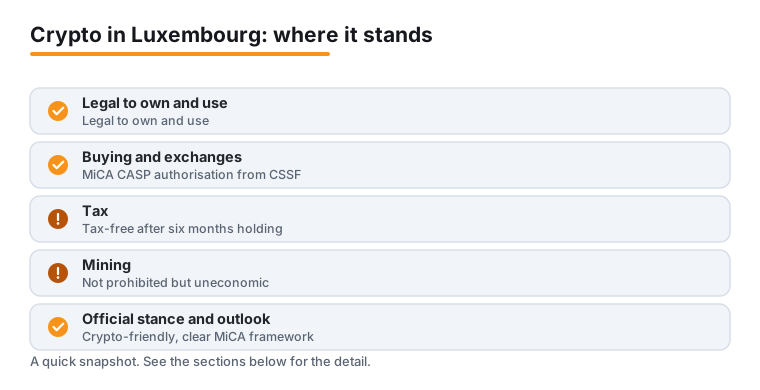
Yes. Bitcoin and other cryptocurrencies are legal to buy, hold, sell and use in Luxembourg. There is no ban on private ownership or trading, and the country has actively encouraged blockchain innovation as part of its broader financial-sector strategy.
It is important to understand what legal does and does not mean here. Crypto-assets are not legal tender in Luxembourg. The euro is the only legal tender, so no merchant is obliged to accept Bitcoin as payment. The Luxembourg tax authorities have treated virtual currencies as intangible assets rather than as a currency since the 2018 direct-tax circular. What is legal is the freedom to own and transact in crypto, and to operate a crypto business provided you meet the applicable authorisation and anti-money-laundering (AML) requirements. Activities that would be illegal with traditional money, such as fraud, tax evasion or money laundering, remain illegal when crypto is involved.
Who regulates crypto in Luxembourg?
The main regulator is the Commission de Surveillance du Secteur Financier (CSSF), Luxembourg's financial-sector supervisor. By the national law of 6 February 2025, the CSSF was designated as the competent authority responsible for carrying out the functions and duties provided for under MiCA. The CSSF authorises and supervises crypto-asset service providers (CASPs), holds the relevant investigative and sanctioning powers, and publishes dedicated guidance, circulars, forms and FAQs for the sector.
Other bodies have defined roles. The Banque centrale du Luxembourg is part of the Eurosystem and is concerned with monetary policy and the euro rather than with licensing crypto firms; it does not make Bitcoin legal tender. Tax matters fall to the Administration des contributions directes (direct taxes) and the Administration de l'enregistrement, des domaines et de la TVA (VAT and registration duties). At EU level, the European Securities and Markets Authority (ESMA) and the European Banking Authority (EBA) issue technical standards and guidance that the CSSF applies. You can confirm the CSSF's current remit on its official crypto pages at cssf.lu.
Key laws and frameworks
The central pillar of crypto regulation in Luxembourg is MiCA, formally Regulation (EU) 2023/1114 on markets in crypto-assets. MiCA is a directly applicable EU regulation that harmonises rules for issuing crypto-assets and providing crypto services across all member states. Its rules for issuers of asset-referenced tokens and e-money tokens (stablecoins) applied from 30 June 2024, and the remaining provisions, including the regime for CASPs, applied from 30 December 2024.
Luxembourg added the national law of 6 February 2025, which designates the CSSF as the MiCA competent authority and sets out its supervisory and sanctioning powers. The same reform integrated CASPs into the AML framework by amending the law of 12 November 2004, and it ended the older Virtual Asset Service Provider (VASP) registration regime for new entrants.
Separately, Luxembourg has modernised its securities and fund laws to recognise distributed-ledger technology (DLT) through a series of measures often called the Blockchain Laws: Blockchain I (law of 1 March 2019), Blockchain II (law of 22 January 2021), Blockchain III (law of 15 March 2023) and Blockchain IV (adopted in December 2024). These support tokenised and dematerialised securities and blockchain-based issuance and settlement within the regulated financial sector. They are distinct from the consumer-facing crypto rules under MiCA. You can review the framework on the CSSF's MiCA/MiCAR page.
Licensing and registration of exchanges and CASPs
Firms that want to offer crypto services in or from Luxembourg generally need a MiCA authorisation as a crypto-asset service provider (CASP), granted by the CSSF. Regulated services include operating a trading platform, exchanging crypto for fiat or for other crypto, executing orders, providing custody and administration of crypto-assets, transferring crypto on behalf of clients, placement, reception and transmission of orders, and giving crypto advice or portfolio management.
A CASP authorisation carries substantive obligations: a detailed programme of operations, fit-and-proper management and sound governance, minimum capital requirements that vary by the services offered, custody safeguards for client assets, conflict-of-interest management, cyber and operational resilience (including under the EU Digital Operational Resilience Act, DORA), and clear consumer disclosures. The CSSF encourages firms to open a preliminary dialogue before submitting an application.
A transitional regime applies to firms that were registered with the CSSF as VASPs before 30 December 2024. Under this grandfathering arrangement they may continue providing the services for which they were registered until 1 July 2026, or until their MiCA authorisation is granted or refused, whichever is sooner. New market entrants can no longer register as VASPs and must seek full CASP authorisation. After the transition closes, providing crypto services in the EU without proper authorisation breaches EU law. You can check authorised firms and the registration framework on the CSSF's CASP pages.
Crypto and Bitcoin tax in Luxembourg
Luxembourg does not have a single, separate crypto tax. There is no specific crypto-tax legislation; instead, gains and income from crypto are slotted into existing tax categories under the income-tax framework, guided by the direct-tax circular of 26 July 2018 (Circular L.I.R. n 14/5 - 99/3 - 99bis/3), which characterises virtual currencies as intangible assets. The treatment depends heavily on whether you hold privately or act in a business or professional capacity. The outline below is general only; tax positions are fact-specific, and you should confirm the current treatment with a Luxembourg tax adviser or the tax authorities. See also our general guide to crypto taxes.
Individuals (private wealth). The key distinction is between speculative and non-speculative disposals, which generally turns on the holding period. The circular of 26 July 2018 provides that gains on crypto sold within six months of acquisition are speculative gains under article 99bis L.I.R. and taxed as ordinary income at progressive rates (a top rate of 42 percent applies to income above about 234,870 euros, and a solidarity surcharge of 7 or 9 percent lifts the effective top marginal rate to roughly 45.78 percent), while gains on crypto held longer than six months fall outside article 99bis L.I.R. and are not taxable for private investors managing their own wealth when the activity is genuine passive investment. The 2018 circular sets a de minimis rule under which total annual speculative gains below 500 euros are exempt. Because these thresholds and rates can change and are easy to misstate, verify the exact holding period, the minimum-gain exemption and the applicable rate before filing.
Income. Crypto received as payment for goods or services, or as employment remuneration, is generally taxable as income at its value when received. Mining or staking carried out as a business is typically treated as business or miscellaneous income.
Businesses and professional traders. Companies and individuals trading on a professional basis are taxed on crypto profits like other business income, with normal corporate or business taxation, accounting and record-keeping obligations. The tax authorities can reclassify frequent, organised trading as a business activity.
VAT. Following EU case law and Luxembourg's 2018 VAT circular, the exchange of traditional currency for Bitcoin and vice versa is generally exempt from VAT, while other crypto services such as advisory or custody can remain taxable. VAT can still apply to the underlying goods or services bought with crypto.
AML, KYC and the travel rule
Anti-money-laundering and counter-terrorist-financing (AML/CFT) rules apply in full to crypto businesses in Luxembourg. CASPs are integrated into the amended law of 12 November 2004 on AML/CFT, and the CSSF supervises their compliance. In practice this means regulated exchanges and custodians must verify customer identity (KYC) before you can trade, monitor transactions on an ongoing basis, keep records, and report suspicious activity to the Cellule de Renseignement Financier (the financial intelligence unit).
For users, the visible effect is onboarding checks: you will normally submit an official identity document and proof of address, and sometimes information on the source of your funds. The EU travel rule requires originator and beneficiary information to accompany crypto transfers between regulated providers, similar to the rules for ordinary bank transfers. Luxembourg authorities have signalled that they continue to treat crypto providers as a higher money-laundering risk category despite the new harmonised EU rules, so expect full identity verification and source of funds questions, and expect your platform to report your account and transaction data to the Administration des contributions directes for calendar years from 1 January 2026.
Buying and using crypto in practice
Buying Bitcoin in Luxembourg is straightforward and usually done through online exchanges and broker apps. Many large international and European platforms serve Luxembourg residents, and several already hold or are pursuing MiCA authorisation in the EU. Funding is typically by SEPA bank transfer (often cheapest) or card, with the euro as the base currency.
Whatever platform you choose, expect serious onboarding standards. Under AML rules, regulated providers must verify your identity before you can trade. MiCA-authorised CASPs must also provide clear disclosures and handle client assets under defined safeguards. Practical tips:
- Favour platforms that are MiCA-authorised in the EU or clearly transitioning toward authorisation, especially as the 1 July 2026 deadline approaches.
- Compare the all-in cost: trading fees, deposit and withdrawal fees, and the spread baked into the quoted price, not just the headline rate.
- Check supported payment methods and limits, and confirm how and where client crypto and cash are held.
- Enable strong account security (a unique password and app-based two-factor authentication) and be alert to phishing.
- For meaningful holdings, consider a wallet you control, such as a hardware (cold) wallet, and back up your recovery phrase offline.
Physical Bitcoin ATMs are scarce in Luxembourg given its small size and strong online banking, and they generally charge higher fees and offer worse rates than online exchanges. They are still regulated cash-to-crypto services that apply identity checks. Keep transaction confirmations and euro values to support your tax reporting.
Bitcoin mining in Luxembourg
There is no general prohibition on cryptocurrency mining in Luxembourg, so mining itself is not illegal. In practice the country is not a natural home for large-scale proof-of-work mining: Luxembourg is a high-cost electricity market with no surplus of cheap power, and energy-intensive mining at scale is hard to operate profitably compared with regions that have abundant low-cost or renewable energy.
Anyone considering mining should weigh the tax and regulatory angles. Mining rewards are taxable. The circular of 26 July 2018 states that the conditions of article 14 L.I.R. are regularly met by mining a virtual currency, and it lists premises or an organisation dedicated to the operations, use of borrowed capital, frequent turnover of the virtual currency inventory, and trading on behalf of third parties as indicators of a commercial activity. Mining that falls short of that test can still produce miscellaneous income under article 99 number 3 L.I.R., and electricity costs are deductible only where they are caused exclusively by the business under article 45 L.I.R. Operators should also consider electricity contracts, equipment, heat and noise management, and any local rules on running such equipment from a home or commercial site. Confirm the current treatment with a professional before starting.
Recent developments (2025-2026)
The defining development is the bedding-in of MiCA. The national law of 6 February 2025 formally designated the CSSF as Luxembourg's MiCA competent authority, and the CSSF has since been receiving and processing CASP authorisation applications. The transitional window for firms previously registered as VASPs runs until 1 July 2026, after which only properly authorised CASPs may offer crypto services. Some major international platforms have already secured full MiCA CASP authorisation through the CSSF.
On the institutional side, Luxembourg adopted Blockchain Law IV in December 2024, extending the use of DLT for issuing and settling dematerialised securities and introducing a control-agent role, reinforcing the country's position as a hub for tokenised funds and securities. On taxation, Luxembourg adopted the law of 27 March 2026 transposing the EU's DAC8 directive, which brings crypto-asset service providers into the automatic exchange of information framework. Under it, reporting CASPs must identify their users, collect transaction data and report annually to the Luxembourg tax authorities, with the first reporting covering calendar year 2026 and due by 30 June 2027. That data is then exchanged with the tax authorities of users' countries of residence. The MiCA transition period for virtual asset service providers ended on 1 July 2026, and the DAC8 reporting law of 27 March 2026 applies from 1 January 2026, with the first provider filings due by 30 June 2027. You can confirm both with the CSSF and the Administration des contributions directes.
Consumer risks and protection
The main risks for crypto users in Luxembourg are the universal ones: price volatility, the irreversibility of on-chain transactions, hacking and phishing, scams promising guaranteed or outsized returns, and the loss of access if private keys or recovery phrases are mishandled. Crypto-assets are speculative and are not covered by deposit-guarantee or investor-compensation schemes the way bank deposits and many traditional investments are.
MiCA improves provider-level protections: authorised CASPs face governance, custody, disclosure and complaint-handling requirements, and the CSSF supervises them. That reduces some operational and counterparty risk, but it does not reduce market risk or protect you from your own security mistakes. Sensible practices include using regulated providers, investing only what you can afford to lose, diversifying, understanding the tax consequences of your trades, and being wary of unsolicited offers. The CSSF periodically publishes warnings about unauthorised entities and scams; check those before dealing with any platform you do not recognise.
Official sources and how to verify
Because crypto rules are still being phased in, always confirm the current position with primary official sources rather than relying on summaries. The most useful starting points are:
- The CSSF, Luxembourg's financial regulator and MiCA competent authority, including its dedicated crypto pages at CSSF crypto-assets and CSSF MiCA/MiCAR, where you can check authorised CASPs, circulars, forms and warnings.
- The Banque centrale du Luxembourg at bcl.lu for the euro and monetary matters.
- The European Securities and Markets Authority (ESMA) at esma.europa.eu for EU-level MiCA technical standards and guidance.
For tax questions, consult the Administration des contributions directes and the VAT authority (AED), or a qualified Luxembourg tax adviser. This page is general information as of 2026 and is not legal, tax or financial advice; verify your specific situation with the CSSF and the relevant tax authority before acting. You may also find our crypto regulation overview helpful for context.
What changed on 1 July 2026
Crypto remains legal to own, buy and sell in Luxembourg. What changed is who is allowed to sell it to you. The MiCA transition period for virtual asset service providers ended on 1 July 2026. Under the law of 6 February 2025, firms registered with the CSSF as VASPs before 30 December 2024 under the amended law of 12 November 2004 stayed on the CSSF VASP register only until 1 July 2026, or until they were granted or refused authorisation under Article 63 MiCAR, whichever came first. That window has now closed.
The CSSF set out the consequences in a communique published on 2 July 2026. A firm without MiCA authorisation as a crypto-asset service provider can no longer operate in the EU and must wind down in an orderly manner. Concretely, it may not:
- onboard new customers in the EU, or open new accounts or wallets
- advertise or distribute its products
It may only allow existing customers to exchange crypto-assets for legal tender, transfer holdings to an authorised platform, or move them to a wallet the customer controls.
The CSSF tells customers to check whether their provider is still allowed to offer services. Two registers are the reference points:
- the CSSF register of supervised entities, which the CSSF describes as listing the entities it supervises under MiCAR, meaning issuers of e-money tokens, issuers of asset-referenced tokens and CASPs
- the ESMA MiCA registers, published under Articles 109 and 110 MiCA as weekly CSV files covering notified white papers, issuers of asset-referenced and e-money tokens, authorised CASPs, and a separate list of non-compliant entities
A provider based outside the EU can still deal with a Luxembourg resident only under reverse solicitation, meaning you approached it entirely on your own initiative. The CSSF states that a third-country firm which solicits EU customers, for example through online advertising, brochures, telephone calls, emails, advertising banners or pop-ups, cannot rely on that exemption. It warns that such firms may be prohibited from providing services and that accounts may be closed at short notice.
Crypto tax reporting: the DAC8 law and what it means for you
Luxembourg transposed DAC8 through the loi du 27 mars 2026 on the automatic and mandatory exchange of information reported by crypto-asset service providers, published in Memorial A No. 144 of 27 March 2026. It transposes Council Directive (EU) 2023/2226 of 17 October 2023, which amends Directive 2011/16/EU on administrative cooperation in the field of taxation.
- It applies from 1 January 2026.
- Reporting crypto-asset service providers must register with the Administration des contributions directes.
- Reports are due no later than 30 June of the year following the year the information relates to.
- The first information covers calendar years from 1 January 2026, so the first filings fall due by 30 June 2027.
- The law sets a flat fine of 5,000 euros for failing to register or to report changes, a further flat fine of 5,000 euros for filing late, and a fine of up to 250,000 euros for failures of the required due diligence and reporting procedures.
The reglement grand-ducal du 18 mai 2026, published in Memorial A No. 245 of 20 May 2026, sets the mechanics: registration and the required declarations are filed by electronic deposit on the secure state platform, following the procedures set by the Administration des contributions directes. It takes effect from 1 January 2026. Both texts are listed on the tax administration's 2026 legislation page.
For a holder in Luxembourg the practical consequence is straightforward. Your platform reports your account and transaction data, so gains are no longer invisible to the tax office. The law does not change what is taxable. Whether you owe anything is still decided by the six-month speculative period and the 500 euro annual threshold.
How a taxable crypto gain is actually calculated
The rules come from circular L.I.R. n 14/5 - 99/3 - 99bis/3 of 26 July 2018, titled Monnaies virtuelles, which is still listed as applicable in the tax administration's collection of circulars in August 2026. Its main points:
- A virtual currency is not a currency. Unlike a currency it has no legal tender status. For income tax, municipal business tax and net wealth tax, virtual currencies such as bitcoin are intangible assets, biens incorporels.
- You may neither draw up your annual accounts nor declare your taxable income in a virtual currency. Amounts must be determined in euros, or in a currency for which the ECB publishes an exchange rate, based notably on the daily rate published by an exchange platform authorised by the CSSF.
- Exchanging one virtual currency for another, exchanging it for euros, and settling a transaction such as buying a good or a service with it are all treated as a disposal for consideration under article 102(1a) L.I.R. A crypto-to-crypto swap is a taxable event, not a neutral one.
- Any gain or loss on such an exchange is a speculative gain or loss under article 99bis L.I.R. where the interval between acquisition and realisation does not exceed six months.
- Speculative gains are not taxable where the total gain realised during the calendar year is below 500 euros.
- Where individual identification of the coins disposed of proves difficult or impossible in the circumstances, the acquisition price must be determined using the weighted average price method, to the exclusion of the methods known as first in first out and last in first out.
- Under paragraph 171 of the amended general tax law of 22 May 1931 you must hold coherent and continuous documentation covering the date of acquisition or creation of the virtual currency and the related costs. On a disposal, the burden of proving the holding period falls on you.
On the business side, the circular says the conditions of article 14 L.I.R. are regularly met by mining a virtual currency, by operating an online exchange for virtual currencies, and by operating a virtual currency ATM. It adds that the line between commercial activity and the management of private wealth must be assessed on all the circumstances of the case, and lists these indicators of a commercial activity: premises or an organisation dedicated to the virtual currency operations, use of borrowed capital, frequent turnover of the virtual currency inventory, and trading on behalf of third parties. Mining that does not meet the article 14 test can still generate miscellaneous income under article 99 number 3 L.I.R. Operating expenses such as electricity costs linked to mining and conversion fees charged by exchange platforms are deductible only where they are caused exclusively by the business, under article 45 L.I.R., and the same applies to depreciation of the computing infrastructure.
Which providers are actually authorised in Luxembourg
Since 1 July 2026 the question of whether a platform may serve you is a register lookup rather than a judgement call. ESMA publishes its MiCA registers as CSV files that are refreshed weekly. In the register of authorised crypto-asset service providers checked for this update in August 2026, 13 entities had Luxembourg as their home member state, with the CSSF as competent authority. They included Bitstamp Europe S.A., Coinbase Luxembourg S.A., Zodia Custody (Europe) S.A., Swissquote Bank Europe S.A., bitFlyer EUROPE S.A. and Standard Chartered Luxembourg S.A.
Two cautions on reading that register. First, it records the services each entity may provide, listed by letter, so an entity authorised only for custody is not thereby authorised to run a trading platform. Second, not every row is a CASP authorisation: the Clearstream Banking S.A. entry, for example, records a notification made to the CSSF by an already regulated institution rather than an authorisation under Article 63 MiCAR.
The register changes week to week, so check the current file, or the CSSF register of supervised entities, rather than relying on a list published on any website including this one.
What is coming next, and when
| What | Stage in August 2026 | Timing |
|---|---|---|
| MiCA authorisation of providers serving Luxembourg | In force, transitional relief exhausted | Transition ended 1 July 2026. Firms are now either authorised or winding down. Check the CSSF and ESMA registers before depositing funds. |
| First DAC8 filings by crypto-asset service providers | Law in force, first reporting cycle not yet run | Data for calendar year 2026 must be filed by 30 June 2027. |
| Digital euro | EU enabling regulation still in the legislative process; ECB in preparation | The ECB Governing Council decided in October 2025 to move to the next phase. Rulebook version 0.91 was published in July 2026. The Eurosystem is preparing a pilot in 2027. The ECB aims to be ready for a potential first issuance during 2029, assuming the necessary EU legislation is adopted in the course of 2026. |
The digital euro would be central bank money and is a separate thing from Bitcoin or other crypto-assets. It would not restrict or replace them. Source for the digital euro timing: the ECB digital euro page.
On tax, nothing identified in this review changes the treatment of a private holder. The six-month speculative period, the 500 euro annual threshold and the 2018 circular are the rules that apply in August 2026.
Frequently asked questions
Is cryptocurrency legal in Luxembourg?
Yes. Buying, holding, selling and using crypto is legal in Luxembourg. Crypto is not legal tender, so merchants are not required to accept it, but private ownership and trading are permitted, and crypto businesses can operate provided they hold the required MiCA authorisation and meet anti-money-laundering rules.
Who regulates crypto in Luxembourg?
The Commission de Surveillance du Secteur Financier (CSSF) is the competent authority for crypto-asset service providers under the EU's MiCA framework, a role set by the national law of 6 February 2025. Tax matters fall to the Luxembourg tax authorities, and the CSSF also supervises AML compliance. Confirm the latest guidance directly at cssf.lu.
Do I have to pay tax on crypto gains in Luxembourg?
It depends on your circumstances. For private individuals, gains on crypto sold within about six months of acquisition are generally taxed as speculative income at progressive rates, while gains on assets held longer are often not taxable when the activity is genuine passive investment. A small annual speculative gain may be exempt. Crypto received as income, and trading done as a business, are taxable. Thresholds and rates can change, so confirm the current rules with a tax professional before filing.
Do crypto exchanges need a licence in Luxembourg?
Yes. Firms providing crypto services generally need a MiCA crypto-asset service provider (CASP) authorisation from the CSSF. Firms previously registered as VASPs can continue under a transitional regime until 1 July 2026, or until their MiCA authorisation is granted or refused, after which only authorised CASPs may operate. New entrants must seek full CASP authorisation.
Where can I buy Bitcoin in Luxembourg?
Most people use online exchanges and broker apps that serve Luxembourg, funding accounts by SEPA bank transfer or card in euros. Favour platforms that are MiCA-authorised in the EU, complete the required identity verification (KYC), and compare the all-in cost of fees and spreads. Physical Bitcoin ATMs are scarce and usually more expensive.
Will MiCA change anything for crypto users in Luxembourg in 2026?
Yes. MiCA is being phased in, and the transitional period for providers previously registered with the CSSF as VASPs is set to end on 1 July 2026. After that, only properly authorised CASPs may offer crypto services in the EU, so users should expect to deal with licensed, supervised platforms and stronger consumer protections and disclosures.
Is there a tax-free amount for crypto gains in Luxembourg?
For private individuals, the 2018 direct-tax circular provides a de minimis rule: total annual speculative gains (from crypto sold within six months of acquisition) below 500 euros are exempt from tax. Above that, speculative gains are taxed at progressive income-tax rates, with a top rate of 42 percent that rises to roughly 45.78 percent once the solidarity surcharge is added. Gains on crypto held longer than six months are generally not taxable for genuine private investors. Confirm the current figures with a tax adviser before filing.
Will my crypto holdings be reported to the tax authorities under DAC8?
Yes, over time. Luxembourg adopted the law of 27 March 2026 transposing the EU's DAC8 directive. Under it, crypto-asset service providers must identify their users, collect transaction data and report annually to the Luxembourg tax authorities, who then exchange that information with the tax authorities of users' countries of residence. The first reporting covers calendar year 2026 and is due by 30 June 2027. This is similar to how banks already exchange account information under the Common Reporting Standard.
Can my crypto exchange still serve me in Luxembourg after 1 July 2026?
Only if it holds a MiCA authorisation as a crypto-asset service provider. The transition period for virtual asset service providers ended on 1 July 2026 and there is no further relief. The CSSF says customers should check, using the CSSF register of supervised entities and the ESMA MiCA register. A provider without authorisation may not onboard new customers in the EU, open new accounts or wallets, or advertise. It may only let you convert to legal tender, move your assets to an authorised platform, or withdraw them to a wallet you control.
What happens to my funds if my provider was not authorised in time?
It has to wind down its EU activity in an orderly manner. In practice you should still be able to exchange your holdings for legal tender, transfer them to an authorised platform, or withdraw them to a wallet you control. Do not assume the account stays open indefinitely. The CSSF has warned that where a provider wrongly relies on the reverse solicitation exemption it may be prohibited from providing services and accounts may be closed at short notice.
When will the Luxembourg tax office start receiving data about my crypto?
Under the law of 27 March 2026, which applies from 1 January 2026, reporting crypto-asset service providers must register with the Administration des contributions directes and file information no later than 30 June of the following year. The first information covers calendar years from 1 January 2026, so the first reports are due by 30 June 2027.
Is swapping one crypto for another taxable in Luxembourg?
It counts as a disposal. The circular of 26 July 2018 treats exchanging one virtual currency for another, exchanging it for euros, and settling a purchase of a good or service with it as disposals for consideration under article 102(1a) L.I.R. Whether it produces a taxable gain then depends on the six-month speculative period under article 99bis L.I.R. and the 500 euro annual threshold.
Which cost basis method do I have to use for crypto in Luxembourg?
Where individual identification of the coins disposed of proves difficult or impossible in the circumstances, the 2018 circular requires the weighted average price method, to the exclusion of first in first out and last in first out. You must also keep coherent and continuous records of the acquisition or creation date and related costs under paragraph 171 of the amended general tax law of 22 May 1931, and the burden of proving your holding period rests on you.
Is the digital euro going to replace or restrict Bitcoin in Luxembourg?
No. The digital euro would be central bank money issued by the Eurosystem, of which the Banque centrale du Luxembourg is a member. It is a separate thing from crypto-assets and does not restrict them. The ECB Governing Council decided in October 2025 to move to the next phase, the Eurosystem is preparing a pilot in 2027, and the ECB aims to be ready for a potential first issuance during 2029, assuming the necessary EU legislation is adopted in the course of 2026.
Facts reviewed: 13 August 2026. Page updated: 13 August 2026.