Home › Crypto Regulation › Austria
Bitcoin & Cryptocurrency Regulation in Austria
Quick answer — Austria, 2026
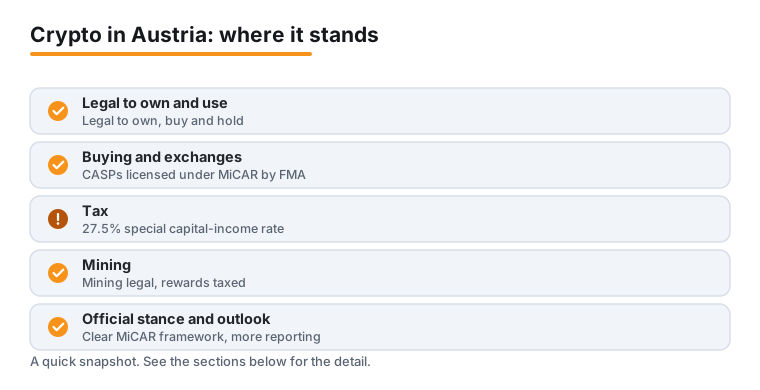
- Legal: Legal to own and use, not legal tender; providers licensed under EU MiCA
- Tax: Crypto income and gains taxed at the 27.5 percent capital rate
- Buying: Via MiCA-authorised exchanges, brokers and apps after KYC
Austria treats Bitcoin and other crypto-assets as legal to own, buy, sell and use, while regulating the businesses that provide crypto services to the public. As a member of the European Union, Austria applies the EU's Markets in Crypto-Assets Regulation (MiCAR) on top of its own financial-market, tax and reporting rules. The Financial Market Authority (FMA / Finanzmarktaufsicht) is the national supervisor for crypto-asset service providers, and crypto income is taxed under a dedicated capital-income regime administered by the Federal Ministry of Finance (BMF). The two headline developments for 2025-2026 are the end of the transition period for older virtual-asset providers and the entry into force of a new crypto tax-reporting law. This guide explains the current legal status, the regulators, how crypto is taxed, and the practicalities of buying, mining, sending and holding crypto in Austria.
This is general information as of 2026 and is not legal, tax or financial advice. Crypto rules change frequently; verify the details with the named official regulator, the FMA, and with the BMF and a qualified Austrian adviser before acting. See also our overview of crypto regulation.
On this page: Legal status · Who regulates it · Taxes · How to buy · Mining
Is Bitcoin and crypto legal in Austria?
Yes. Owning, buying, selling, holding and transferring Bitcoin and other crypto-assets is legal in Austria. There is no ban on individuals using cryptocurrency, and residents can freely hold crypto in self-custody wallets or with authorised providers.
What Bitcoin is not is legal tender. The euro is Austria's official currency, and no business is obliged to accept crypto as payment, though merchants may choose to do so voluntarily. For tax and regulatory purposes crypto-assets are generally treated as private capital assets rather than as money.
While ownership is unrestricted, the provision of crypto services to the public is regulated. Companies that exchange, custody, transfer or otherwise deal in crypto-assets for customers must be authorised, which is where MiCAR and the FMA come in.
Who regulates crypto in Austria?
Two bodies matter most. The Financial Market Authority (FMA / Finanzmarktaufsicht) is the national competent authority that supervises crypto-asset service providers and issuers under MiCAR. The Federal Ministry of Finance (BMF / Bundesministerium fuer Finanzen) sets and administers crypto taxation and reporting.
The Oesterreichische Nationalbank (OeNB), Austria's central bank, contributes to financial-stability monitoring and EU/eurozone policy but is not the day-to-day licensing authority for crypto firms; that role sits with the FMA. You can read about the regulator's mandate and the rules it applies on its official MiCAR page: FMA - Markets in Crypto-Assets Regulation (MiCAR). The BMF's tax guidance is published here: BMF - Tax treatment of crypto-assets.
Key laws and frameworks
Austria's crypto framework now rests primarily on the EU's Markets in Crypto-Assets Regulation (MiCAR, Regulation (EU) 2023/1114), which is directly applicable across member states and creates a single rulebook for issuing crypto-assets and for licensing and supervising crypto-asset service providers (CASPs) such as exchanges, brokers and custodians.
Austria added the national enforcement law, the MiCA-Vollzugsgesetz (MiCA-VVG / MiCA-Verordnung-Vollzugsgesetz), which was passed by the National Council (Nationalrat) on 3 July 2024 and entered into force on 20 July 2024. It designates the FMA as the competent authority and sets out national supervisory and enforcement powers.
On the tax side, the Krypto-Meldepflichtgesetz (Krypto-MPfG, Crypto Reporting Act) took effect on 1 January 2026, implementing the OECD Crypto-Asset Reporting Framework (CARF) and the EU's DAC8 directive. Together these instruments cover licensing, conduct, stablecoin rules, anti-money-laundering obligations, market-abuse rules and cross-border tax reporting. Because exact transition lists and deadlines evolve, confirm current status on the FMA MiCAR page.
Licensing and registration of exchanges and providers
Under MiCAR, any firm that provides crypto-asset services to Austrian customers needs authorisation as a CASP from the FMA (or from another EU regulator, with passporting across the European Economic Area). Applications are made to the FMA under Article 62 of MiCAR, and a single authorisation can be passported to serve customers across the EEA.
Austria did not extend grandfathering for providers registered under its older virtual-asset regime. Virtual-asset service providers that were registered with the FMA for AML purposes before 30 December 2024 could keep operating during a transition that ran until the end of 31 December 2025, or until they were granted or refused a CASP authorisation. After that date, providers serving Austrian customers must hold a MiCAR CASP authorisation rather than relying on the previous registration. Not all of the previously registered firms obtained a licence in time; those without one had to stop providing regulated services.
Key elements of the regime include:
- CASP authorisation: Exchanges, custodians, brokers and transfer services need FMA (or another EU regulator's) licence to serve Austrian customers.
- Stablecoins: Asset-referenced tokens and e-money tokens face stricter reserve, disclosure and approval requirements.
- Issuer disclosures: Public offerings of crypto-assets generally require a published white paper.
- Conduct and market integrity: Governance standards plus rules against market abuse.
Always cross-check a provider's current authorisation in the FMA's official company register before depositing funds. The FMA explains its role in FMA takes over supervision of crypto-asset service providers in Austria.
Crypto and Bitcoin taxation in Austria
Crypto taxation in Austria was overhauled by a tax reform that took effect on 1 March 2022, moving crypto into the country's capital-income tax regime. The BMF publishes the official guidance, summarised below; confirm current figures with the BMF or a tax adviser, and see our general guide to crypto taxes.
- Special capital-income rate: Income from crypto-asset holdings, including both current income and gains on disposal, is generally taxed at the special rate of 27.5%, the same rate that applies to many securities.
- New vs old assets: The regime applies to crypto-assets acquired after 28 February 2021 ("new assets"). Holdings acquired on or before that date ("old assets") are not covered by the new crypto-asset tax arrangements, so the acquisition date matters.
- Crypto-to-crypto swaps: Under BMF guidance, exchanging one crypto-asset for another is not a taxable disposal. Tax typically arises when you sell crypto for fiat (euros) or use it to pay for goods and services.
- Mining: Coins received through mining are treated as current income, taxed at the special rate when received.
- Staking: Where rewards arise primarily from staking existing crypto, they are not taxed at inflow but are deemed acquired at a cost of zero, so tax can arise on later disposal.
- Lending: Interest earned from lending crypto is current income subject to the 27.5% rate.
- Withholding at source: Since 1 January 2024, Austrian-based providers must deduct the 27.5% KESt (Kapitalertragsteuer) directly and remit it to the tax office. Where this happens correctly, the gain has a final-taxation effect and does not need to be declared separately. Providers that operate this deduction include Bitpanda, Coinfinity, 21bitcoin and Kurant. Foreign exchanges such as Binance, Kraken, Coinbase, Revolut and Bybit do not withhold Austrian KESt, so gains made there must be self-assessed in your tax return.
For the deduction to work, you must give the provider your acquisition cost. If the stated cost is not plausible, the BMF rules allow 50% of the disposal proceeds to be treated as the acquisition cost. Keep detailed records of dates, amounts, euro values and counterparties. Source: BMF - Tax treatment of crypto-assets.
AML, KYC and the new reporting rules
Authorised crypto providers in Austria must apply anti-money-laundering (AML) and counter-terrorist-financing controls in line with EU rules. In practice that means customer due diligence (KYC identity verification), transaction monitoring, and compliance with the EU's transfer-of-funds rules (the so-called "travel rule"), which require sender and recipient information to accompany crypto transfers above set thresholds.
From 1 January 2026, Austria also applies the Krypto-Meldepflichtgesetz (Crypto Reporting Act), implementing the OECD's Crypto-Asset Reporting Framework (CARF) and the EU's DAC8 directive. Reporting crypto-asset service providers must identify reportable users and collect and report data such as names, tax identification numbers, wallet addresses and transaction volumes. The first reports for 2026 activity are due by 31 July 2027, and the information is exchanged automatically with tax authorities in other participating countries. The practical effect is that crypto activity is becoming far more visible to tax authorities, so accurate personal record-keeping is essential.
Buying and using crypto in practice
Austrians have a wide choice of ways to buy crypto. Domestic and EU-based exchanges, brokers and apps serve the market, and Austria is home to one of Europe's better-known platforms, Bitpanda. International exchanges also operate in Austria, typically under a MiCAR CASP licence held with the FMA or another EU regulator.
A typical path for a resident looks like this:
- 1. Choose a provider. Pick a MiCAR-authorised exchange, broker or app and cross-check its authorisation in the FMA's official register.
- 2. Verify your identity. Complete KYC by providing identity documents, as required by AML rules.
- 3. Fund your account. Deposit euros via SEPA bank transfer, card or another supported method.
- 4. Place an order. Buy your chosen asset; compare fees and spreads first.
- 5. Decide on custody. Leave assets with the provider or withdraw to your own wallet (a hardware wallet for larger amounts) and safeguard your recovery phrase.
- 6. Keep records. Save transaction details, dates and euro values for tax reporting.
Cash buyers can also use Bitcoin ATMs, found mainly in larger cities such as Vienna and Graz, or voucher services that let people buy crypto with cash at retail outlets. These options are subject to AML checks for larger amounts and usually carry higher fees than online exchanges. Using crypto for cross-border remittances is possible and can be fast, but prices are volatile unless a stablecoin is used, transfers through regulated providers are subject to AML and travel-rule requirements, and converting crypto to fiat can trigger Austrian tax.
Bitcoin mining in Austria
Bitcoin mining is legal in Austria. There is no specific prohibition on running mining hardware, but miners operate within the country's general legal, tax and energy frameworks.
The main practical constraint is electricity. Austria's power prices are relatively high by global standards, which makes large-scale proof-of-work mining economically challenging compared with low-cost-energy jurisdictions. On the other hand, Austria generates a large share of its electricity from renewables, particularly hydropower, so mining using surplus or renewable power can have a lower carbon footprint.
From a tax perspective, mining rewards are treated as current income at the 27.5% special rate, valued in euros when received (see the taxation section). Anyone mining at scale should also consider business registration, VAT and energy compliance, and consult a professional. Hobby miners should still record the euro value of rewards for tax purposes.
Recent developments (2025-2026)
Two changes define the current period. First, the MiCAR transition is complete: Austria let its pre-MiCA virtual-asset registration regime lapse at the end of 2025 without extended grandfathering. The transition for previously registered virtual-asset providers ended at the end of 2025, and only some of those firms secured a CASP authorisation in time; the rest had to stop offering regulated services. Supervision by the FMA is now the norm rather than the exception. A separate but related change took effect on 1 January 2024, when Austrian-based providers began deducting the 27.5% KESt at source for resident customers.
Second, the Krypto-Meldepflichtgesetz (Crypto Reporting Act) entered into force on 1 January 2026, bringing CARF and DAC8 into Austrian law. Providers must record transaction data from the start of 2026, with the first reporting cycle due by 31 July 2027 and automatic exchange of that data with dozens of other countries. The broad direction of travel is more regulation, more consumer protection and more reporting, rather than prohibition.
Consumer risks and protection
MiCAR brings a more standardised, supervised market, including governance standards, disclosure rules and protections around stablecoins. But regulation does not remove the underlying risks of crypto:
- Volatility: Prices can swing sharply and you can lose part or all of your capital.
- Platform and counterparty risk: Exchanges or stablecoin issuers can fail; authorisation reduces but does not eliminate this risk.
- Security: Hacks, phishing and lost private keys can mean permanent loss of funds.
- Scams: Be sceptical of guaranteed returns, unsolicited offers and "get rich quick" promises.
Sensible precautions include using only MiCAR-authorised providers, verifying authorisation in the FMA register, securing your recovery phrase offline, and investing only money you can afford to lose. None of this is financial advice; consider speaking to a licensed Austrian adviser. For more context, see our regulation hub.
Official sources and how to verify
Because crypto rules and authorised-provider lists change, always confirm specifics against primary official sources rather than relying on summaries:
- FMA - Markets in Crypto-Assets Regulation (MiCAR): the regulator's overview of the rules, CASP licensing and the company register.
- FMA - takes over supervision of crypto-asset service providers: explains the FMA's role under the MiCA-VVG.
- BMF - Tax treatment of crypto-assets: the official guidance on the 27.5% rate, new vs old assets, swaps, mining, staking and lending.
To check whether a specific exchange or broker is allowed to serve Austrian customers, look it up in the FMA's official company database before depositing money. This article is general information as of 2026 and is not legal, tax or financial advice; verify your situation with the FMA, the BMF and a qualified adviser.
Status update: what changed on 1 July 2026
Austria closed its own MiCAR transition at the end of 2025 using a national option, so Austrian-registered providers had already passed their deadline. The date that matters now is the European one, and it fell after this page was last reviewed. In a statement dated 17 April 2026, reference ESMA75-113276571-1679, ESMA confirmed that the MiCA transitional period "will officially expire across the EU on 1 July 2026" and that after that date "any entity providing crypto-asset services to EU clients without a MiCA licence will be in breach of EU law and must cease offering such services" (ESMA, Statement on the End of Transitional Periods under MiCA).
Three points in that statement affect Austrian account holders directly.
- Any crypto-asset service provider still unauthorised had to have implemented its wind-down plan by 1 July 2026, including offboarding clients by transferring their crypto-assets to an authorised CASP or to a self-hosted wallet, with prior notice to clients.
- Entities established outside the EU may not provide MiCA services to EU investors or solicit EU clients, apart from the narrow reverse solicitation exception. ESMA states that this applies in a business to business context too, because MiCA prohibits CASPs from outsourcing or delegating custody to entities not authorised as CASPs themselves.
- National regulators, which in Austria means the FMA, are expected to take action against the unauthorised provision of crypto-asset services and to scrutinise client migration strategies, so that unauthorised firms do not continue business as usual beyond the transitional period.
On the Austrian supply side, the Austrian finance site broker-test.at reported on 1 July 2026 that the FMA had authorised ten crypto-asset service providers by the end of June 2026, and that more than one hundred European providers could offer services in Austria according to the FMA database (broker-test.at, 1 July 2026). These figures are that publication's, not a figure read from the FMA itself.
Austrian crypto tax did not change in 2026. The 27.5% special rate applies under Section 27a para 1 of the Einkommensteuergesetz to income from crypto-asset holdings as defined in Section 27b, the rules have applied since 1 March 2022, Austrian debtors and service providers have deducted KESt from capital yields accrued after 31 December 2023, and for income accruing from calendar year 2025 onwards those obliged to withhold must prepare a tax report, the Steuerreporting (BMF).
Crypto legislation in Austria: adopted and in progress
Austria has no standalone national crypto statute in the way some countries do. What applies is a stack of directly applicable EU regulations, one Austrian enforcement act, one Austrian tax reporting act and the general income tax rules. The table below sets out what is in force, what is adopted but not yet applicable, and the dates attached to each.
| Law | Status | What it does | Key dates |
|---|---|---|---|
| Regulation (EU) 2023/1114 (MiCA) | In force; transition over | EU rulebook for crypto-asset services, stablecoin issuance, white papers and market abuse | EU-wide transitional period expired 1 July 2026 |
| MiCA-Verordnung-Vollzugsgesetz (Austria's MiCAR enforcement act) | In force | Austria's national enforcement act for MiCAR, enacted alongside amendments to the Alternative Investmentfonds Manager-Gesetz, the Bankwesengesetz and other financial statutes; the FMA authorises and supervises Austrian CASPs | Nationalrat 3 July 2024, Bundesrat 10 July 2024; Austria's national grandfathering ended at the end of 2025 |
| Sections 27a and 27b Einkommensteuergesetz (EStG) | In force | 27.5% special rate under Section 27a para 1 on crypto income and gains; crypto-to-crypto swaps are not a disposal and acquisition costs carry over; the Section 27b para 4 definition does not cover NFTs or asset tokens | Applies since 1 March 2022 to assets acquired after 28 February 2021; KESt deducted from yields accrued after 31 December 2023 |
| Krypto-Meldepflichtgesetz (Krypto-MPfG), enacted by the Betrugsbekaempfungsgesetz 2025 Teil Daten, BGBl. I Nr. 96/2025 | In force | Implements DAC8 (Directive (EU) 2023/2226) and the OECD Crypto-Asset Reporting Framework; providers verify tax residence and report customer and transaction data for automatic exchange | Nationalrat 10 December 2025, Bundesrat 18 December 2025; applies from 1 January 2026; existing-customer due diligence by 1 January 2027; first reports for 2026 due 31 July 2027 |
| Regulation (EU) 2024/1624 (AMLR) | Adopted, applies later | Single EU AML rulebook; Article 79(1) bans banks, financial institutions and CASPs from keeping anonymous accounts or accounts allowing anonymisation or increased obfuscation of transactions, including through anonymity-enhancing coins | In force 9 July 2024; applies from 10 July 2027 (the 10 July 2029 date covers only football agents and football clubs) |
| Directive (EU) 2024/1640 (AMLD6) | Adopted, Austria must transpose | Requires Austria to update national AML supervision, which means amending the Finanzmarkt-Geldwaeschegesetz | In force 9 July 2024; staged transposition deadlines of 10 July 2025, 10 July 2026, 10 July 2027 and 10 July 2029 |
| AMLA, the EU anti-money-laundering authority | Established | EU authority in Frankfurt am Main working with national AML authorities | Begins direct supervision of certain cross-border financial institutions from 2028 |
| Digital euro regulation | Not adopted; under EU negotiation | Would create the legal basis for a euro-area central bank digital currency, which is central bank money rather than a crypto-asset | ECB moved to the next phase in October 2025 and published draft rulebook 0.91 in July 2026; pilot referenced for 2027; potential first issuance during 2029, assuming EU legislation is adopted in the course of 2026 |
The practical reading for an Austrian holder is that the near-term pipeline is about reporting and anti-money-laundering, not about restricting ownership. The two firm dates ahead are 1 January 2027, by which providers must have completed due diligence on customers who opened accounts before 2026, and 10 July 2027, when the EU Anti-Money Laundering Regulation starts to apply and regulated providers may no longer keep accounts allowing anonymisation or increased obfuscation of transactions (Regulation (EU) 2024/1624 on EUR-Lex, Directive (EU) 2024/1640 on EUR-Lex).
Checking that your provider may still serve you
Since 1 July 2026 the check is a two-step one, because a firm may be authorised in another EEA state and passport into Austria rather than hold an Austrian licence.
- Check the FMA company database for firms authorised or notified in Austria. This is the register the FMA itself maintains.
- Check the EU-level register ESMA publishes under Articles 109 and 110 of MiCA, which ESMA calls the Interim MiCA Register. It covers authorised crypto-asset service providers, issuers of asset-referenced and e-money tokens, published white papers and, importantly, non-compliant entities providing crypto-asset services. ESMA publishes it as downloadable files at weekly intervals, and the version current at the time of writing was last updated on 31 July 2026 (ESMA MiCA register).
- Confirm which legal entity you actually contract with. ESMA warns that MiCA protections apply only to the specific authorised legal entity in the EU, not to other companies of the same group and not to non-EU entities, and that providers may operate under the same brand across multiple companies or countries. Review your contract to confirm which entity is actually providing your service.
- If your provider is not authorised, ESMA's advice is to act promptly: transfer your crypto-assets to an authorised provider or a self-hosted wallet, or consider closing your positions. Staying with an unauthorised provider may mean less legal protection and a greater risk of losing access to your assets.
ESMA also states that the crypto-asset white papers listed in its register have not been reviewed or approved by any competent authority in any Member State of the European Union. A white paper on file is a disclosure document, not a seal of approval.
Frequently asked questions
Is Bitcoin legal in Austria?
Yes. Buying, holding, selling and transferring Bitcoin and other crypto-assets is legal in Austria. However, crypto is not legal tender (the euro is), so no one is required to accept it as payment, and businesses that provide crypto services to the public must be authorised under the EU's MiCAR rules.
Who regulates crypto in Austria?
The Financial Market Authority (FMA / Finanzmarktaufsicht) is the national competent authority supervising crypto-asset service providers under MiCAR, following Austria's MiCA-Vollzugsgesetz (MiCA-VVG), which took effect on 20 July 2024. Tax matters are handled by the Federal Ministry of Finance (BMF). Always check a provider's current authorisation in the FMA's official register.
How is crypto taxed in Austria?
Since the reform that took effect on 1 March 2022, income from crypto-assets, including current income and gains on disposal, is generally taxed under the capital-income regime at a special rate of 27.5%. The rules apply to assets acquired after 28 February 2021. Crypto-to-crypto swaps are not treated as a taxable disposal, while selling crypto for euros or spending it can trigger tax, and mining and lending income are taxable. Confirm the current treatment with the BMF or a tax adviser.
Do crypto exchanges need a licence in Austria?
Yes. Exchanges, custodians, brokers and transfer services must be authorised as crypto-asset service providers (CASPs) under MiCAR, either by the FMA or by another EU regulator with passporting across the EEA. Austria's older virtual-asset registration regime ended on 31 December 2025 without extended grandfathering, so providers serving Austrian customers are expected to hold a MiCAR CASP licence.
What changes for crypto users in Austria in 2026?
From 1 January 2026 Austria applies the Krypto-Meldepflichtgesetz (Crypto Reporting Act), implementing the OECD CARF framework and the EU DAC8 directive. Crypto-asset service providers must identify reportable users and report data such as names, tax IDs, wallet addresses and transaction volumes, with the first reporting due by 31 July 2027 and automatic exchange with other countries. In practice, crypto activity is becoming far more transparent to tax authorities, so accurate record-keeping is essential.
How can I check whether a crypto provider is authorised in Austria?
Use the FMA's official company database to confirm a provider holds a MiCAR CASP authorisation before depositing funds. You can start from the FMA's MiCAR page at fma.gv.at. This is general information as of 2026 and not legal advice; verify details with the FMA, the BMF and a qualified Austrian adviser.
Does my Austrian exchange deduct crypto tax automatically?
If you use an Austrian-based provider, usually yes. Since 1 January 2024, domestic providers such as Bitpanda, Coinfinity, 21bitcoin and Kurant deduct the 27.5% KESt (Kapitalertragsteuer) at source and pass it to the tax office, which generally means the gain does not need to be declared again. Foreign exchanges like Binance, Kraken, Coinbase, Revolut and Bybit do not withhold Austrian KESt, so gains made there must be self-assessed. Confirm your situation with the BMF or a tax adviser.
What happened to older crypto providers in Austria under MiCAR?
Virtual-asset providers that were registered with the FMA for anti-money-laundering purposes before 30 December 2024 could keep operating during a transition that ran until the end of 31 December 2025, or until they were granted or refused a CASP authorisation. Austria did not extend grandfathering, so providers that did not obtain a MiCAR CASP licence in time had to stop offering regulated services to Austrian customers.
Can I still use Binance, Kraken, Coinbase or Bybit from Austria in 2026?
Only through an EU-authorised entity. The EU-wide MiCA transitional period expired on 1 July 2026. ESMA states that after that date any entity providing crypto-asset services to EU clients without a MiCA licence is in breach of EU law and must cease offering such services, and that entities established outside the EU may not provide MiCA services to EU investors or solicit EU clients apart from the narrow reverse solicitation exception. MiCA protection applies only to the specific authorised legal entity in the EU, not to other companies of the same group and not to non-EU entities, and providers may operate under the same brand across several companies. Check which company your contract is with, then look that entity up in the FMA company database and in ESMA's Interim MiCA Register.
What happened on 1 July 2026?
The MiCA transitional period expired across the whole EU. Austria had already closed its own national transition at the end of 2025 using a national option, so this changed little for Austrian-licensed firms, but it removed the last legal basis for any EU firm still operating on a legacy national registration. ESMA expected any unauthorised crypto-asset service provider to have implemented an orderly wind-down plan by that date, including offboarding clients by transferring their crypto-assets to an authorised provider or a self-hosted wallet, with prior notice.
Will Monero and other privacy coins be banned in Austria?
Not for individuals, and the regulation does not use the phrase privacy coin. Regulation (EU) 2024/1624, the EU Anti-Money Laundering Regulation, applies from 10 July 2027. Article 79(1) prohibits credit institutions, financial institutions and crypto-asset service providers from keeping anonymous accounts, including anonymous crypto-asset accounts, and any account otherwise allowing the anonymisation of the account holder or the anonymisation or increased obfuscation of transactions, including through anonymity-enhancing coins. The prohibition binds the regulated provider, not the holder, and recital 160 records that it does not apply to providers of hardware and software or of self-hosted wallets where they do not have access to or control over the wallet. How individual exchanges respond in their listings is a commercial decision that the regulation does not spell out.
Is a new Austrian crypto law coming?
One national step is required. Austria has to transpose Directive (EU) 2024/1640, the sixth anti-money-laundering directive, which entered into force on 9 July 2024 and carries staged transposition deadlines of 10 July 2025, 10 July 2026, 10 July 2027 and 10 July 2029. That will mean amendments to Austrian AML law and supervision. No Austrian transposition bill could be identified in the parliamentary records checked for this update, so no bill number is given here. No change to the 27.5% crypto tax rate was found to have been enacted or proposed for 2026.
Does the digital euro change anything for Bitcoin holders in Austria?
No. The digital euro would be central bank money, not a crypto-asset, and the enabling EU legislation has not been adopted. The ECB says its Governing Council decided in October 2025 that the Eurosystem will move to the next phase of the project, that it published draft rulebook version 0.91 in July 2026, and that it aims to be ready for a potential first issuance of the digital euro during 2029, assuming the necessary EU legislation is adopted in the course of 2026.
Facts reviewed: 4 August 2026. Page updated: 4 August 2026.