Home › Crypto Regulation › South Africa
Bitcoin & Cryptocurrency Regulation in South Africa
Quick answer — South Africa, 2026
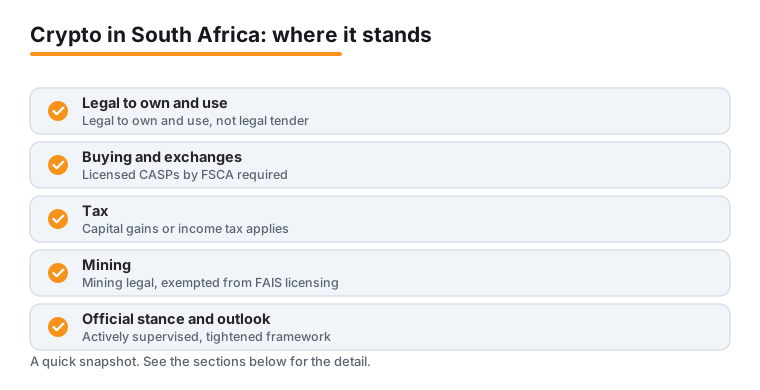
- Legal: Legal to own and trade, not legal tender
- Tax: Gains taxed as capital gains or income depending on activity
- Buying: Via FSCA-licensed exchanges with KYC
South Africa is one of the most active cryptocurrency markets on the African continent, with high retail adoption and a regulatory framework that has tightened sharply since 2022. Owning, buying, selling and using Bitcoin and other crypto assets is legal, but the space is now actively supervised: crypto is a regulated financial product, service providers must be licensed by the Financial Sector Conduct Authority (FSCA), anti money laundering rules apply, and the South African Revenue Service (SARS) expects gains and income to be declared.
This guide explains the current legal status of crypto in South Africa, who the regulators are, the key laws, how exchanges are licensed, how crypto is taxed, the AML and KYC rules, and the practical realities of buying, mining and using crypto. It is general information as of 2026 and is not legal, tax or financial advice; the rules are evolving, so always confirm your situation with the named official regulator or a qualified professional before acting. For background concepts see our crypto regulation explainer.
On this page: Legal status · Who regulates it · Taxes · How to buy · Mining
Is Bitcoin and crypto legal in South Africa?
Yes. Buying, holding, selling and transacting in Bitcoin and other crypto assets is legal in South Africa. There is no ban on individuals owning cryptocurrency, and merchants may choose to accept it by private agreement.
What crypto is not is legal tender. The South African Reserve Bank (SARB) and the FSCA have repeatedly stated that crypto assets, including stablecoins, are neither money as defined in the National Payment System (NPS) Act nor funds, and are therefore not legal tender. In practice the rand remains the only legal tender and no business is obliged to accept crypto.
The legal classification of crypto is contested because two judges in Gauteng have reached opposite conclusions. In Standard Bank of South Africa v South African Reserve Bank and Others (047643/2023) [2025] ZAGPPHC 481; 2025 (5) SA 289 (GP) of 15 May 2025, Motha J held that cryptocurrency falls outside the meaning of capital in regulation 10(1)(c) of the Exchange Control Regulations. In Mangundhla and Another v South African Reserve Bank and Others (2022/029979) [2026] ZAGPJHC 579, handed down on 1 June 2026, Wilson J held that Bitcoin is both money and capital and expressly rejected that reasoning. Neither judgment binds the other, and the Standard Bank decision remains subject to appeal before the Supreme Court of Appeal. South African courts have generally treated Bitcoin as an asset (property) rather than as currency, and in 2025 to 2026 several judgments wrestled with whether crypto falls within older laws such as the 1961 exchange control regime. The broad takeaway: holding and using crypto is lawful, but you do so as the owner of a volatile, regulated asset rather than as a holder of state backed money.
Who regulates crypto in South Africa
Several bodies share responsibility, and it helps to know which one does what:
- Financial Sector Conduct Authority (FSCA) is the lead conduct regulator. It declared crypto assets a financial product in 2022 and licenses and supervises crypto asset service providers. Official site: www.fsca.co.za.
- Financial Intelligence Centre (FIC) administers the anti money laundering regime and issues directives such as the crypto Travel Rule. Official site: www.fic.gov.za.
- South African Reserve Bank (SARB) oversees the payment system, monetary policy and exchange control through its Financial Surveillance Department, and monitors financial stability risks from crypto and stablecoins. Official site: www.resbank.co.za.
- South African Revenue Service (SARS) handles taxation of crypto gains and income.
This split matters: a provider can be FSCA licensed for conduct, an accountable institution under the FIC for AML, and still have SARB exchange control and SARS tax obligations layered on top.
Key laws and frameworks
South Africa does not have a single standalone crypto act. Instead, crypto is brought under existing financial laws:
- FAIS Act declaration (2022). On 19 October 2022 the FSCA declared crypto assets a financial product under the Financial Advisory and Intermediary Services Act, 2002 (FAIS), via Government Notice 1350 in Government Gazette 47334. A crypto asset is defined as a digital representation of value that is not issued by a central bank but can be traded, transferred or stored electronically for payment, investment or other utility. See the FSCA for the declaration and current licensing requirements.
- Financial Intelligence Centre Act (FICA). From 19 December 2022, crypto asset service providers were added as accountable institutions, imposing customer due diligence, record keeping and reporting duties.
- Exchange control regulations. The SARB and National Treasury are working to bring crypto into South Africa's capital flow management framework, partly in response to 2025 court findings that the 1961 rules did not clearly cover crypto.
Three consultations ran in 2026, all of them on cross border movement, payments and tax rather than on the legality of holding crypto: the draft Capital Flow Management Regulations, 2026 published on 17 April 2026, with comments closed on 30 June 2026; the draft Crypto Assets Manual for cross border activities published on 3 August 2026, with comments closing 30 September 2026; and the SARS Draft Guide to the Taxation of Crypto Assets published on 1 July 2026, with comments closing 31 August 2026. The direction of travel is clearer than the detail. Crypto stays legal to own and trade, cross border movement is being brought inside the capital flow management regime under the Currency and Exchanges Act 9 of 1933, and the FAIS licence that crypto firms hold today would be replaced by an activity based licence under the Conduct of Financial Institutions Bill, introduced in Parliament on 17 April 2026. None of that is in force yet.
Licensing and registration of crypto exchanges (CASPs)
Businesses that provide crypto related financial services, including exchanges, brokers, wallet providers and advisers, must be authorised by the FSCA as Crypto Asset Service Providers (CASPs) under the FAIS Act. The window to apply ran from 1 June 2023 to 30 November 2023; firms that applied in time could keep operating while under review.
The regulator has worked through the backlog. According to FSCA updates, by around 31 March 2026 it had received roughly 533 CASP licence applications, of which about 310 were approved, around 17 declined, and about 124 voluntarily withdrawn after engagement with the FSCA on unsuitable business models. Declines were driven mainly by failure to meet fit and proper requirements, in particular weak operational ability, thin business plans and a lack of practical crypto knowledge. On the enforcement side, the FSCA reported around 81 investigations into suspected unlicensed CASP activity, of which about 56 were ongoing, and said it would act against any entity conducting CASP activities without a licence. It also carried out on site supervisory inspections, completing about 21 of roughly 30 planned for the April 2025 to March 2026 year and planning around 35 more AML and CFT focused inspections for 2026 to 2027.
Important: the FSCA licenses these firms only for the financial services they render in relation to crypto (advice, intermediary and investment management services). A licence is not a guarantee against loss. Crypto asset miners, node operators and persons dealing only in non fungible tokens (NFTs) were exempted from the FAIS licensing requirement. Always verify a provider's status on the official FSCA website before depositing funds.
Crypto taxation in South Africa
SARS treats crypto assets as assets of an intangible nature, not as currency or legal tender, and expects all crypto activity to be declared. There are no crypto specific tax rules, so whether a disposal is taxed as a capital gain or as ordinary revenue is decided case by case, looking mainly at your intention and trading pattern.
- Capital gains tax (CGT). If you hold crypto as a long term investment, gains on disposal fall under CGT. Individuals have an annual capital gains exclusion (raised to about R50,000 from the 2026 Budget, up from R40,000), and only a portion of the gain is included in taxable income. SARS puts the maximum effective rate at 18 percent for individuals and special trusts, 21.6 percent for companies and 36 percent for other trusts, after an annual exclusion of R50,000 for individuals and special trusts.
- Income tax. If your activity looks like trading, profits are taxed as ordinary income at marginal rates of roughly 18 to 45 percent. Crypto earned from mining, staking or as payment is generally income when received.
- Reporting. SARS has increased its visibility of crypto, and South African exchanges are increasingly required to share trade data with SARS automatically. Disposals include selling for rand, swapping one coin for another, and spending crypto.
Keep detailed records of dates, rand values, amounts and counterparties. See the official SARS guidance on Crypto Assets and Tax and our general crypto taxes guide. This is not tax advice; confirm your position with SARS or a tax practitioner.
CARF: automatic reporting of crypto data to SARS
The biggest 2026 tax change is data sharing. South Africa adopted the Crypto Asset Reporting Framework (CARF), an OECD standard for tax transparency on crypto, which took effect on 1 March 2026. Under CARF, crypto asset service providers report customer identification details, wallet counts and aggregated transaction information to SARS in prescribed categories, and that data can be exchanged with other participating jurisdictions.
- First period. The first CARF reporting period runs from 1 March 2026 to 28 February 2027, with the first CARF return due to SARS by 31 May 2027 and the first international exchange of information expected around September 2027.
- Who reports. The reporting duty sits with the providers, not with you directly. Individual taxpayers do not file a separate CARF return but must keep declaring their crypto activity in the normal income tax return.
- What it means in practice. SARS gains a clearer view of who holds and trades crypto, including through offshore platforms in participating countries, so undeclared gains are easier to detect.
See the official SARS page on the Crypto Asset Reporting Framework (CARF). This is not tax advice; confirm your position with SARS or a tax practitioner.
AML, KYC and the Travel Rule
Because CASPs are accountable institutions under FICA, anti money laundering and know your customer rules are now central to using crypto in South Africa. Expect to verify your identity with an ID document and proof of address before funding, trading or withdrawing, and expect providers to monitor transactions and report suspicious activity to the FIC.
A major 2025 development was the crypto Travel Rule. The FIC issued Directive 9 on the implementation of the travel rule for crypto asset transfers, which took effect on 30 April 2025, in line with Financial Action Task Force (FATF) recommendations. It requires CASPs to collect and share originator and beneficiary information for crypto asset transfers, with reduced information gathering for smaller transfers reported around ZAR 5,000. The official advisory is available from the Financial Intelligence Centre.
In practice this means transfers between regulated providers can carry identifying data about both sender and recipient, and large or unusual transactions may attract additional checks.
Buying and using crypto in practice
You can buy crypto through FSCA authorised local exchanges, international platforms serving South African users, peer to peer marketplaces and a small number of Bitcoin ATMs in major cities. The most important rule for users is to deal with a licensed provider where possible. A typical compliant route:
- Choose a licensed provider that is FSCA authorised as a CASP and supports rand deposits.
- Verify your identity (KYC) with ID and proof of address, as required under FICA.
- Fund in rand by bank transfer (EFT) or card; check fees and the spread, which are wider at Bitcoin ATMs.
- Place your order and start small while you learn the platform.
- Decide on custody. Leave assets on the exchange for convenience, or withdraw to a personal wallet (a hardware wallet for larger holdings) for control. Self custody means you alone are responsible for your keys.
- Keep records of purchases, dates, amounts and rand values for tax.
Crypto can also be used for regional remittances because of its speed and reach, but remember that cross border value transfers are subject to exchange control rules that are being extended to crypto, and that price volatility, conversion costs and platform risk all apply. Using crypto does not exempt you from exchange control.
Crypto mining in South Africa
Bitcoin and crypto mining is legal in South Africa and was expressly exempted from FAIS licensing, so there is no dedicated mining licence regime for individuals. In practice mining is shaped less by crypto law than by the country's electricity supply.
- Electricity cost and reliability. Grid power can be expensive and historically subject to load shedding (scheduled outages), which directly affects profitability for any sizeable operation.
- Renewable interest. South Africa's strong solar potential has driven interest in solar powered mining to cut costs and emissions, though upfront capital is significant.
- Tax on rewards. SARS generally treats mined coins as income when earned, and a later disposal can trigger a further capital or income tax event. Keep records of coins mined, dates and rand values.
Miners still face general tax and, where relevant, business obligations. Confirm the current treatment of mining rewards with SARS or a tax practitioner.
Recent developments (2025 to 2026)
The pace of change has been rapid:
- CASP licensing matured. Through 2025 and into 2026 the FSCA approved the bulk of qualifying applicants, declined a small number, and shifted toward supervision and enforcement, including inspections and investigations into unlicensed operators.
- Travel Rule live. FIC Directive 9 took effect on 30 April 2025, bringing South Africa closer to FATF standards on crypto transfers.
- Regulatory examinations. An exemption from the required regulatory exams for CASPs and their key individuals was extended to 30 June 2025, with no further extension, tightening competency requirements.
- Exchange control and the courts. 2025 to 2026 court judgments, including matters involving the SARB and large Bitcoin transfers, questioned whether the 1961 exchange control rules applied to crypto, prompting work on a clearer cross border framework rather than blanket exemptions.
- CARF took effect. The OECD Crypto Asset Reporting Framework started in South Africa on 1 March 2026, with providers reporting customer and transaction data to SARS and the first return due by 31 May 2027, sharply increasing crypto tax visibility.
Because these threads are still developing, verify any specific point against the regulators' own publications before relying on it.
Consumer risks and protection
The main risks for South African crypto users are price volatility, scams and unlicensed operators, platform or custody failure, and regulatory change. Crypto is not protected like a bank deposit, and losses from fraud or your own mistakes are usually irreversible. South Africa has seen several high profile crypto related collapses and fraud cases, which is part of why supervision has tightened.
Protective steps:
- Verify the licence. Check that a provider appears on the FSCA's published list of authorised CASPs before depositing.
- Be sceptical of guaranteed returns. Promises of fixed or unusually high returns are a classic red flag.
- Protect your keys. Never share your recovery phrase, and double check wallet addresses before sending.
- Keep records and use FSCA authorised advisers if you want personalised guidance.
FSCA licensing improves conduct standards and recourse, but it does not insure you against market losses or remove the need for your own due diligence.
Official sources and how to verify
The facts on this page were checked against the following primary sources in August 2026, and the position can still change, so confirm anything you rely on:
- FSCA for licensing, the list of authorised CASPs and conduct rules: www.fsca.co.za.
- Financial Intelligence Centre (FIC) for AML obligations and the Travel Rule directive: www.fic.gov.za.
- SARS for the tax treatment of crypto assets: SARS Crypto Assets and Tax.
- SARB for the payment system and exchange control: www.resbank.co.za.
For more background, see our crypto regulation explainer and the wikicrypto.news regulation hub for other countries.
This article is general information as of 2026 and is not legal, tax or financial advice. Verify any specific obligation with the named official regulator, such as the FSCA, or a qualified professional before acting.
What is changing: three crypto consultations in 2026
As at 3 August 2026 nothing has changed about the legality of owning or trading crypto in South Africa. What is moving is cross border transfer, payments and tax. Three consultation documents are open or have just closed, and all three come from the state rather than from industry.
| Document | Issued by | Published | Comment deadline |
|---|---|---|---|
| Draft Capital Flow Management Regulations, 2026, under the Currency and Exchanges Act 9 of 1933 | National Treasury and the SARB | 17 April 2026 | Closed 30 June 2026, extended from 18 May 2026 |
| Draft Crypto Assets Manual for cross border activities | National Treasury and the SARB | 3 August 2026 | 30 September 2026 |
| Draft Guide to the Taxation of Crypto Assets | SARS | 1 July 2026 | 31 August 2026 |
Two things sit behind this. South Africa was removed from the Financial Action Task Force grey list on 24 October 2025 and is protecting that status. And at the SARB's 105th annual general meeting on 31 July 2026, Governor Lesetja Kganyago said crypto assets should face regulatory standards equivalent to those applied to banks, and that crypto and stablecoins must not be allowed to create loopholes for capital controls or financial crime.
Primary sources: the SARB and National Treasury joint statement on the draft Capital Flow Management Regulations, SAnews on the extended comment deadline and SAnews on the draft Crypto Assets Manual.
Cross border crypto is being pulled into exchange control
South Africa's exchange control regime still runs on the Exchange Control Regulations of 1961. The draft Capital Flow Management Regulations, 2026 would replace them and bring crypto assets into the capital flow management regime. The Minister of Finance announced the plan in the Budget Speech on 25 February 2026 and the draft followed on 17 April 2026.
The draft Crypto Assets Manual published on 3 August 2026 supplies the operating detail. On its current wording:
- A CASP would have to go through a SARB application and adjudication process to conduct the business of an Authorised CASP, in addition to its existing FSCA licence.
- Reporting is triggered when crypto moves between a domestic Authorised CASP and an offshore CASP, or from a domestic Authorised CASP to a non custodial wallet.
- Only individuals, at this stage, would be allowed to externalise crypto assets via Authorised CASPs, and only in terms of their single discretionary allowance or foreign capital allowance. Companies are not accommodated in this draft.
Two points matter for ordinary holders. Government has stated that the draft regulations do not intend to criminalise the possession of crypto assets or apply the regulations retrospectively. And the SARB has said the proposed approach neither distinguishes between different types of crypto assets, nor declares crypto assets an official currency in South Africa. Further reporting from Eyewitness News.
Comments on the manual close at close of business on 30 September 2026. No commencement date has been published for either document.
Two High Court judgments now contradict each other on whether crypto is capital
The reason the National Treasury is rewriting the exchange control rules is that two judges of the High Court in Gauteng have reached opposite conclusions on the same question.
- In Standard Bank of South Africa v South African Reserve Bank and Others (047643/2023) [2025] ZAGPPHC 481; 2025 (5) SA 289 (GP), handed down on 15 May 2025 in the Gauteng Division, Pretoria, Motha J held that cryptocurrency falls outside the ambit of capital under regulation 10(1)(c) of the Exchange Control Regulations, and set aside SARB forfeiture orders. The judge observed that a regulatory framework addressing cryptocurrency was long overdue. See the ENSafrica analysis.
- In Mangundhla and Another v South African Reserve Bank and Others (2022/029979) [2026] ZAGPJHC 579, handed down on 1 June 2026 in the Gauteng Local Division, Johannesburg, Wilson J held that Bitcoin is both money and capital for exchange control purposes and expressly rejected the reasoning in Standard Bank. The case concerned just under 1,680 Bitcoin, worth just under R182 million, moved to wallets accessible only through exchanges registered outside South Africa. Wilson J dismissed the review application and the forfeiture orders stood.
Neither judgment binds the other. As Werksmans sets out, Wilson J found Motha J's reasoning flawed for weighing crypto's technological characteristics over the real world consequences of its use. Clyde and Co confirms the Standard Bank decision remains subject to appeal before the Supreme Court of Appeal, which may give the definitive answer unless the new Capital Flow Management Regulations settle it first.
Stablecoins: foreign currency pegs are out, rand pegs are still open
Joint Communication 1 of 2026, issued on 28 May 2026 by the SARB, the FSCA, the Prudential Authority and the Financial Intelligence Centre, confirms that crypto assets including stablecoins used for payment are not considered payments in terms of the National Payment System Act, 1998, currently fall outside that Act, and are neither money as defined in it nor funds, and so are not legal tender. It also confirms that an FSCA licence under FAIS does not cover crypto assets used for payments, and that licensed CASPs must communicate clearly with customers about the limited scope of what they are licensed for. Summary via the Financial Regulation Journal.
The two categories of stablecoin are being treated differently:
- Foreign currency pegged stablecoins will not be approved for domestic payments. The stated reason is that they may result in the risk of currency substitution, or dollarisation, which would weaken monetary policy transmission. Reported by Bitcoin.com News.
- Rand pegged stablecoins are under active review. The Intergovernmental Fintech Working Group published a discussion paper on rand pegged stablecoin arrangements on 24 March 2026, with comments closing 18 May 2026, testing whether the Banks Act 94 of 1990, the Collective Investment Schemes Control Act 45 of 2002 or the Financial Markets Act 19 of 2012 could regulate them. The conclusion was that no existing framework is adequate without amendment and that a risk based, bespoke framework is needed. Analysis via Mondaq.
The IFWG is still analysing the use cases for rand pegged stablecoins to inform a policy and regulatory response. No deadline for that response has been published.
The COFI Bill will eventually replace the licence crypto firms hold today
Crypto asset service providers are currently licensed by the FSCA under the Financial Advisory and Intermediary Services Act 37 of 2002, in the category created when crypto was declared a financial product in October 2022. That Act is being replaced.
The Conduct of Financial Institutions Bill, 2026 was introduced in Parliament on 17 April 2026. It consolidates and replaces various industry specific conduct laws, including FAIS, and moves to an activity based licensing model. Webber Wentzel confirms that crypto asset custodial services fall within the financial services it covers.
It is not law yet. As at May 2026 only an explanatory summary had been published and the full Bill was not yet publicly available. Promulgation was anticipated during 2026, followed by a transitional period of approximately three years while existing licences convert. Practically, a CASP licensed under FAIS today keeps that licence for now and would be relicensed later.
What SARS is actually doing about crypto tax
The tax rules themselves are not new, but SARS's published guidance and its visibility both changed in 2026.
- The exact numbers. For capital gains, the annual exclusion for individuals and special trusts is R50,000, and the maximum effective rate is 18 percent for individuals and special trusts, 21.6 percent for companies and 36 percent for other trusts. Ordinary income, which is where trading profits, mining, staking and crypto received as payment usually land, is taxed at marginal rates running from 18 percent to a top rate of 45 percent. Confirmed on the SARS capital gains tax rates page and the SARS rates of tax for individuals.
- The draft guide. Published 1 July 2026, with comments to [email protected] by 31 August 2026. It treats crypto assets as intangible assets, confirms that swapping one crypto asset for another is a barter transaction and therefore subject to tax, and covers mining, staking, airdrops, hard forks, record keeping and disclosure. It is not an official publication as defined in the Tax Administration Act and is not a binding general ruling. Moneyweb reports that it leaves the revenue versus capital line to a library of case law and gives limited guidance on tokenised shares, wrapped assets, decentralised finance and crypto backed lending.
- Enforcement. Tax Consulting South Africa reports that SARS has established a dedicated Crypto Revenue Augmentation Unit to track and audit digital asset transactions.
- Data. The Crypto Asset Reporting Framework took effect on 1 March 2026. Reporting providers must collect and report customer and transaction information to SARS, which can be exchanged with other participating jurisdictions, and reportable retail payment transactions exceeding EUR or USD 50,000 are in scope. The first reporting period runs 1 March 2026 to 28 February 2027 and the first return is due by 31 May 2027. Individuals do not report directly under CARF and must continue declaring crypto in their normal returns. See the SARS CARF page and its notice that CARF has taken effect.
Frequently asked questions
Is Bitcoin legal in South Africa?
Yes. Owning, buying, selling and transacting in Bitcoin and other crypto assets is legal in South Africa. However, crypto is not legal tender, so no one is obliged to accept it as payment and the rand remains the only legal tender. Crypto related financial service providers must be licensed by the FSCA.
Who regulates crypto in South Africa?
The FSCA is the lead conduct regulator and licenses crypto asset service providers under the FAIS Act after declaring crypto a financial product in October 2022. The Financial Intelligence Centre (FIC) oversees anti money laundering under FICA, the South African Reserve Bank (SARB) handles the payment system and exchange control, and SARS handles taxation.
Do crypto exchanges in South Africa need a licence?
Yes. Exchanges, brokers, wallet providers and advisers offering crypto related financial services must be authorised by the FSCA as Crypto Asset Service Providers (CASPs) under the FAIS Act. By around early 2026 the FSCA had approved roughly 310 of about 533 applications. Verify a provider's status on the FSCA website before depositing funds.
How is crypto taxed in South Africa?
SARS treats crypto as an intangible asset and expects all activity to be declared. Long term investment gains generally fall under capital gains tax (with an annual exclusion raised to about R50,000 for the 2026 Budget), while trading style profits and mining, staking or payment income are taxed as ordinary income at marginal rates running from 18 percent to a top rate of 45 percent. SARS's draft guide of 1 July 2026 confirms that swapping one crypto asset for another is a barter transaction and therefore subject to tax. This is not tax advice; confirm with SARS.
What is the crypto Travel Rule in South Africa?
FIC Directive 9 introduced a Travel Rule for crypto asset transfers, effective 30 April 2025 and aligned with FATF recommendations. It requires CASPs to collect and share originator and beneficiary information for crypto asset transfers, with reduced information gathering for smaller transfers reported around ZAR 5,000. Check the Financial Intelligence Centre for the exact current requirements.
Is crypto legal tender in South Africa?
No. The SARB and FSCA have confirmed that crypto assets, including stablecoins, are not money under the National Payment System Act and are not legal tender. You can legally own and use crypto by agreement, but only the rand is legal tender, and merchants are not obliged to accept crypto.
Does SARS receive my crypto trade data automatically?
Increasingly, yes. Under the OECD Crypto Asset Reporting Framework (CARF), which took effect in South Africa on 1 March 2026, crypto asset service providers report customer identification, wallet and aggregated transaction data to SARS, and that data can be shared with other participating countries. The first reporting period runs to 28 February 2027, with the first return due by 31 May 2027. You do not file a CARF return yourself, but you must still declare your crypto activity in your normal income tax return.
What happens to crypto providers operating without an FSCA licence?
The FSCA treats unlicensed crypto asset service provision as a breach and has opened investigations into suspected unlicensed operators, reporting around 81 investigations with many still ongoing. It has said it will take enforcement action against any entity conducting CASP activities without authorisation, alongside on site inspections of licensed firms. Before using any platform, check that it appears on the FSCA list of authorised CASPs.
Can I send crypto offshore from South Africa right now?
The legal position is genuinely unsettled and this is the one area where you should take advice. Two High Court judgments in Gauteng contradict each other. Standard Bank of South Africa v SARB, decided 15 May 2025 in the Gauteng Division, Pretoria, held that cryptocurrency falls outside the meaning of capital in the Exchange Control Regulations. Mangundhla v SARB, handed down on 1 June 2026 in the Gauteng Local Division, Johannesburg, held that Bitcoin is both money and capital, dismissed the review and left the forfeiture orders standing. Neither binds the other and the Standard Bank decision is subject to appeal to the Supreme Court of Appeal. Separately, the draft Crypto Assets Manual published on 3 August 2026 proposes that in future only individuals may externalise crypto through an Authorised CASP, and only within their single discretionary allowance or foreign capital allowance. That draft is not law and comments close on 30 September 2026.
Do I pay tax if I swap one cryptocurrency for another?
Yes. SARS's Draft Guide to the Taxation of Crypto Assets, published 1 July 2026 for comment by 31 August 2026, treats swapping one crypto asset for another as a barter transaction and therefore a taxable event. You need a rand value at the point of each swap. Whether the result is taxed as ordinary income at marginal rates up to 45 percent or as a capital gain at a maximum effective 18 percent depends on the facts, and commentators have criticised the draft guide for leaving that line to case law. The guide is not a binding general ruling.
Are rand-backed stablecoins allowed in South Africa?
They are not prohibited, but there is no dedicated framework for them yet. The Intergovernmental Fintech Working Group published a discussion paper on rand pegged stablecoin arrangements on 24 March 2026, with comments closing 18 May 2026, and concluded that neither the Banks Act 94 of 1990, the Collective Investment Schemes Control Act 45 of 2002 nor the Financial Markets Act 19 of 2012 can regulate them adequately without amendment. The IFWG is still analysing use cases and no deadline for a regulatory response has been published. Foreign currency pegged stablecoins have already been ruled out for domestic payments because of currency substitution and monetary policy concerns.
Is there a minimum transfer size for the crypto travel rule?
No. A zero threshold applies to each crypto asset transfer conducted in the course of a business relationship, so every transfer carries the obligation regardless of amount. Section 20A of the Financial Intelligence Centre Act also prohibits transacting for anonymous clients even below ZAR 5,000. The FIC published Public Compliance Communication 61 on 30 March 2026 with the practical detail on implementing Directive 9 of 2024, including that information must be verified and transmitted before or at the time of the transfer, and that enhanced due diligence applies to higher risk transfers such as those involving unhosted wallets or high risk jurisdictions.
Facts reviewed: 5 August 2026. Page updated: 12 August 2026.