Home › Crypto Regulation › Botswana
Bitcoin & Cryptocurrency Regulation in Botswana
Quick answer — Botswana, 2026
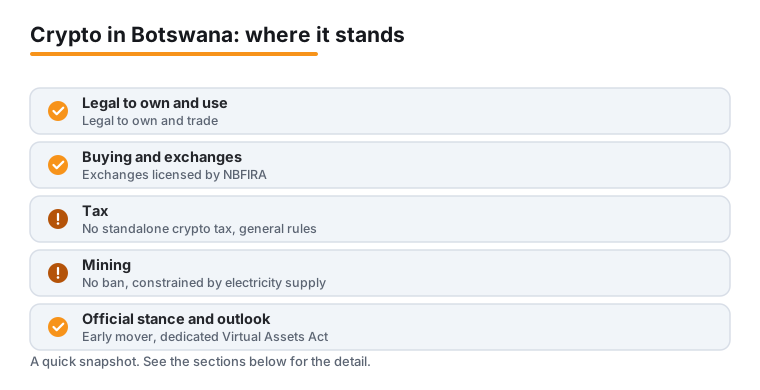
- Legal: Legal to own and trade, not legal tender
- Tax: No separate crypto tax, general rules apply
- Buying: Via NBFIRA-licensed VASPs, P2P or international platforms
Botswana was one of the first countries in Africa to put a dedicated licensing regime for crypto businesses on its statute books. Owning, buying, selling and trading Bitcoin and other cryptocurrencies is legal for residents and businesses, but the sector is supervised rather than left to its own devices: firms that offer exchange, custody or related services must be licensed by the financial regulator, and the pula remains the only legal tender. This guide explains the legal status, the regulators, the key laws, licensing of exchanges, tax, anti-money-laundering rules, buying and using crypto in practice, mining, recent developments, the risks involved, and how to verify everything against official sources, as of 2026.
This article is general information as of 2026 and is not legal, tax or financial advice. Crypto rules and tax treatment change and individual circumstances differ, so always verify the current position with the named official regulators, such as the Non-Bank Financial Institutions Regulatory Authority (NBFIRA), or a qualified Botswana professional, before acting. See our overview of how crypto regulation works for wider context.
On this page: Legal status · Who regulates it · Taxes · How to buy · Mining
Legal status: is Bitcoin and crypto legal in Botswana?
Yes. Buying, holding, selling and using Bitcoin and other cryptocurrencies is legal in Botswana for individuals and businesses. There is no general prohibition on owning or trading virtual assets, and the country has gone beyond mere tolerance by enacting a purpose-built law that regulates crypto-related businesses.
An important distinction is between being legal to use and being legal tender. Bitcoin is not legal tender in Botswana. The pula, issued by the Bank of Botswana, is the only currency that must be accepted to settle debts. Merchants are not obliged to accept crypto, and any that do take on price volatility and compliance considerations. The Bank of Botswana has repeatedly reminded the public that cryptocurrencies are not issued or guaranteed by the central bank and that users carry the risk of loss themselves.
The result is a two-tier picture: individuals are free to participate, while the businesses that serve them must operate inside the licensing framework described below.
Who regulates crypto in Botswana?
The primary regulator for crypto activity is the Non-Bank Financial Institutions Regulatory Authority (NBFIRA). NBFIRA licenses and supervises Virtual Asset Service Providers (VASPs) and issuers of token offerings under the Virtual Assets Act. Several bodies share responsibility around the edges:
- NBFIRA is the dedicated supervisor for virtual asset businesses: licensing, conduct, prudential oversight and enforcement against unlicensed operators.
- The Bank of Botswana, the central bank, is responsible for monetary policy, the pula and broader financial-stability concerns, and has published public statements on crypto risk. It does not license crypto firms but watches the sector for systemic risk.
- The Financial Intelligence Agency (FIA) oversees anti-money-laundering and counter-terrorist-financing reporting under the Financial Intelligence Act, and receives suspicious-transaction reports through the goAML system.
- The Botswana Unified Revenue Service (BURS) administers tax, including amounts arising from crypto activity.
For anything involving licensing or the current legal status of a provider, NBFIRA is the authoritative point of contact.
Key crypto laws and frameworks in Botswana
The cornerstone of Botswana's framework is the Virtual Assets Act, which made the country an early mover on the continent in creating a dedicated regime for digital assets. The original Act commenced on 22 February 2022. Parliament later repealed and re-enacted the framework, and the current principal law is the Virtual Assets Act No 4 of 2025. The 2025 re-enactment was introduced to fix drafting gaps flagged by regional reviewers, in particular a definition of VASP that did not fully match Financial Action Task Force (FATF) standards, and to strengthen anti-money-laundering, market-abuse and client-asset provisions. Its main features are:
- Licensing requirement. Anyone carrying on a virtual asset business, such as running an exchange, providing custody (wallet services), transferring virtual assets, processing crypto payments or running an initial token offering, generally needs an NBFIRA licence.
- Extraterritorial reach. The Act is drafted to apply to a person carrying on a virtual asset business regardless of the physical location from which the activity is carried out, so foreign-based providers serving Botswana residents fall within scope.
- AML/CFT integration. Licensed providers must meet obligations under the Financial Intelligence Act, including customer due diligence and suspicious-activity reporting.
- Enforcement. Operating without the required licence is an offence. Under the Act, an unlicensed operator can face a fine of up to P250,000 or imprisonment for a term not exceeding five years, or both.
NBFIRA has since supported the regime with supervisory tools, including a 2025 Guidance Note for VASPs on implementing AML/CFT programmes. NBFIRA's operative guidance for the sector is Implementing AML/CFT Programmes: A Guidance Note for non-bank financial institutions conducting virtual assets business, issued on 10 March 2025 under section 49(1)(c) of the Financial Intelligence Act, 2022 as amended in 2025 and section 4(1)(c) of the Virtual Assets Act, 2025. Note that NBFIRA's published FAQs still describe the repealed 2022 Act, so use the 2025 guidance note for current section references. For a general primer, see our guide to crypto regulation.
Licensing and registration of exchanges and VASPs
Crypto exchanges and other virtual asset service providers cannot lawfully serve the Botswana market without an NBFIRA licence. Under NBFIRA's published requirements, a licence applicant must typically satisfy:
- Company requirements. An appropriate corporate structure and local operational presence.
- Controller and personnel (fit-and-proper) requirements. Owners, directors and key staff must meet integrity and competence standards.
- Financial Intelligence Act requirements. Documented AML/CFT policies, procedures and controls.
- Application fees and other conditions specified by the regulator.
Licensable activities include exchanging virtual assets for fiat currency, exchanging between virtual assets, transferring virtual assets, providing custody or wallet services, and participating in or providing services for token offerings. Yellow Card was the first company to receive a VASP licence from NBFIRA, with its licence issued in late September 2022, reported as the first such licence granted by an African regulator, and the licensed population has stayed small: in February 2026 the Bank of Botswana was reported as saying Botswana had two fully licensed VASPs operating legally, and in August 2026 Xago announced a further NBFIRA VASP licence for digital asset and cross-border payment services. NBFIRA's Virtual Assets Service Provider regulated entities page carried no published list of licensees when checked in August 2026, so verifying a provider means contacting NBFIRA directly on +267 3102595 or [email protected] rather than relying on a web page or on a company's own marketing. The transitional window for operators active before the Act commenced closed on 31 May 2022, and NBFIRA's notice states that those who failed to apply are operating illegally and must cease operations. The official list and the latest licensing rules should always be checked before you transact.
Crypto and Bitcoin tax in Botswana
Botswana has no separate, standalone crypto tax. Instead, existing tax principles administered by the Botswana Unified Revenue Service (BURS) are applied to digital-asset activity under the country's general tax law. The practical expectation is that gains and income connected to cryptocurrency are not automatically tax-free.
How a transaction is treated typically depends on the activity:
- Disposals. Selling crypto for pula or another currency, swapping one token for another, or spending crypto can be a disposal that may give rise to a taxable amount, depending on the circumstances.
- Trading versus investing. Frequent, high-volume buying and selling with a profit motive may be characterised as a business and taxed as income; occasional holding may be treated differently. Frequency, volume and intention all matter.
- Businesses accepting crypto. Companies that accept crypto as payment or deal in it generally need to bring those amounts into taxable income.
There is no crypto-specific rate. In practice, crypto amounts fall under Botswana's ordinary tax rates, and those rates changed on 1 July 2026 under the Income Tax Act, 2026 (Act 13 of 2026). The general corporate income tax rate rose from 22 percent to 24.5 percent, the non-resident company rate fell from 30 percent to 24.5 percent, and a new top personal marginal rate of 27.5 percent now applies to taxable income above P400,000 a year, with the lower brackets unchanged. Which of these applies, and whether an amount is taxed as income or as a capital gain, depends on how your activity is characterised rather than on a separate crypto schedule. BURS has published no crypto-specific guidance, and the Income Tax Act does not name virtual assets. Botswana's capital gains charge attaches to immovable property and to marketable securities including shares in private companies, and since 1 July 2026 an individual disposing of land or shares must pay the capital gains tax within 28 days of the disposal. For crypto the deciding question is therefore not which schedule applies but whether your activity amounts to a business, in which case the profit is ordinary taxable income. Keep detailed records of every transaction (dates, pula values, counterparties and purpose) and confirm your obligations with BURS or a qualified Botswana tax adviser. See our general guide to crypto taxes for the principles, then verify the local detail.
AML, KYC and reporting obligations
Anti-money-laundering and counter-terrorist-financing (AML/CFT) rules are central to Botswana's crypto framework. Virtual asset service providers are subject to the Financial Intelligence Act, supervised in practice by the Financial Intelligence Agency (FIA) and reinforced by NBFIRA guidance for the sector.
- Customer due diligence (KYC). Licensed providers must verify the identity of customers before transacting and keep records, which is why you will normally complete identity checks when you open an account or trade.
- Transaction monitoring and reporting. VASPs must monitor activity and file suspicious-transaction reports, with licensed providers registering on the goAML system used by the FIA.
- Travel Rule and recordkeeping. NBFIRA's 2025 guidance note records that the Virtual Assets Act has legislated the FATF travel rule standard, citing section 26, and sets the information threshold at BWP 10,000. For transfers equal to or more than BWP 10,000 the provider must hold fuller originator details, including the account number or a unique transaction reference number where no account exists, and an identification number or date and place of birth, together with the beneficiary's name and account or reference number. A transfer that does not meet the required information criteria must not be executed and the amount must be returned to the originator. Customer due diligence information and transaction records must be kept for 20 years.
- Risk-based programmes. NBFIRA's 2025 guidance expects VASPs to run governance, training, customer due diligence, monitoring and recordkeeping controls proportionate to their risk.
For ordinary users this means licensed platforms will ask for identity documents and may query unusual activity. Refusing identity verification or using anonymous services pushes you outside the protected, regulated channel.
Buying and using crypto in practice
Residents can buy crypto through licensed virtual asset service providers, peer-to-peer arrangements and international exchanges that accept Botswana customers. Practical points:
- Use licensed or reputable platforms. Prefer providers that are NBFIRA-licensed or well established, with clear custody, security and complaints processes.
- Expect identity checks. AML/CFT rules mean you will normally complete KYC verification before transacting.
- Funding methods. Bank transfers, cards and mobile money are common; availability and limits vary by platform.
- Foreign-exchange considerations. The Bank of Botswana records that all remaining exchange controls were abolished in 1999, so there is no exchange-control approval to obtain before converting pula or funding an offshore platform. What applies instead is AML reporting: your provider must report cash and cross-border transactions equal to or more than P10,000 to the Financial Intelligence Agency through goAML. Separately, from 1 October 2026 non-resident suppliers of remote services must charge Botswana VAT once their supplies to Botswana residents exceed P500,000, which reaches fees charged by offshore crypto platforms.
- Spending crypto. Crypto is not legal tender, so day-to-day acceptance by merchants is limited; most use is for investment, savings or cross-border transfers rather than retail payments.
As always, compare fees and rates, double-check wallet addresses before sending, keep your recovery phrase private, and enable strong security such as two-factor authentication.
Bitcoin mining in Botswana
No specific law in Botswana bans Bitcoin mining, but anyone considering it should weigh practical and regulatory realities rather than assume it is unrestricted.
- Electricity supply and cost. Mining is energy-intensive, and Botswana has historically faced supply constraints and relied on imported power. Availability, tariffs and reliability are the dominant factors in whether mining is viable, and large consumers can expect scrutiny of their load.
- Energy and environmental rules. Significant operations may need to consider connection arrangements, environmental standards and local approvals under the country's electricity and environmental frameworks.
- Business and tax obligations. Mining commercially brings ordinary business obligations, including registration and the tax treatment of mined coins and profits.
Before buying equipment, confirm current rules with the relevant electricity and environmental authorities and model volatile power and crypto prices, because thin margins are easily wiped out.
Recent developments (2024 to 2026)
Botswana's framework has continued to mature since the Virtual Assets Act came into force:
- Law re-enacted in 2025. Parliament repealed and re-enacted the Virtual Assets Act as Act No 4 of 2025 to close drafting gaps, including a VASP definition that did not fully align with FATF standards, and to strengthen anti-money-laundering, market-abuse and client-asset rules. This 2025 Act is now the principal law.
- First VASP licences issued. NBFIRA granted Yellow Card a VASP licence, reported as the first such licence issued by an African regulator, and has authorised a small number of providers since.
- Action against unlicensed operators. NBFIRA has publicly directed unregistered firms to cease and desist. In one case it named FS Global Properties and warned the public not to deal with it, stressing that the company was not licensed to provide virtual asset business services in Botswana.
- Updated AML/CFT guidance. In 2025 NBFIRA issued a Guidance Note for VASPs on implementing AML/CFT programmes, setting clearer expectations for governance, customer due diligence and reporting.
- Central-bank stance. In its Financial Stability Report of May 2026, the Financial Stability Council notes that virtual assets further elevate monitoring challenges, and points to legislative reform that has strengthened FATF compliance as part of the mitigation. The same report records that a comprehensive sector-wide money-laundering and terrorist-financing risk assessment has been initiated in partnership with international experts, that ESAAMLG upgraded six of seven outstanding FATF Recommendations, and that the Bank's own Regulatory Sandbox became operational in March 2026.
- Enforcement focus. Authorities have publicly warned the public against dealing with unregistered or unlicensed operators and have emphasised action against those operating without a licence.
The position on the statute book is settled. The Virtual Assets Act is Act No. 4 of 2025 and it commenced on 24 January 2025 under Statutory Instrument No. 9 of 2025, with section 40 headed Repeal of Act No. 3 of 2022. The subsidiary legislation recorded under the Act is the Virtual Assets Regulations, Statutory Instrument No. 18 of 2022, which commenced on 25 February 2022 and comprises eighteen regulations and a Schedule. No amending Act or replacement instrument was recorded as at August 2026.
Consumer risks and protection
Botswana's early move to license crypto businesses gives it a clearer framework than many markets, but real risks remain for users:
- Scams and fraud. Investment scams, fake platforms, pyramid schemes and social-engineering attacks target crypto users. The Bank of Botswana has warned that some crypto-linked schemes may amount to fraud. Stick to licensed or well-known providers and verify before sending funds.
- Limited recourse. Consumer protections for crypto are weaker than for regulated bank products. The central bank has cautioned that those who lose money in crypto may have no legal recourse, and losses from theft, error or platform failure may be unrecoverable.
- Volatility and concentration. Prices are unpredictable, and over-concentration in a single asset amplifies risk. Only consider money you can afford to lose, and avoid borrowing to invest.
- Regulatory and tax change. Rules, licensing requirements and tax treatment can change, sometimes at short notice, so build that uncertainty into your plans.
Using NBFIRA-licensed providers, keeping good records, securing your own keys and treating guaranteed-return offers as red flags are the most effective protections available to ordinary users.
Official sources and how to verify
For YMYL legal and financial topics, always confirm the position against primary official sources rather than secondary commentary. The most useful starting points for Botswana are:
- NBFIRA: Virtual Assets Act and VASP regulation for the law, licensing requirements and supervisory guidance.
- NBFIRA FAQs on the regulation and supervision of virtual assets for plain-language answers and public warnings.
- Bank of Botswana for central-bank statements on crypto risk, legal tender and exchange-control matters.
- Botswana Unified Revenue Service (BURS) for tax guidance and the Income Tax Act.
To check whether a provider is genuinely licensed, look it up through NBFIRA directly. For background reading, see our overviews of crypto regulation by country and how crypto regulation works. Remember that this article is general information as of 2026, not legal advice, and the named regulators are the authoritative source for the current rules.
What is changing: Botswana crypto rules in August 2026
Two dated changes landed after this page was last reviewed on 30 June 2026, and one thing pointedly did not change.
- 1 July 2026: the tax law that governs crypto profits was replaced outright. The Income Tax Act, 2026 (Act 13 of 2026), the Tax Administration Act, 2026 (Act 14 of 2026) and the Value Added Tax Act, 2026 (Act 15 of 2026) were gazetted on 30 June 2026 and took effect on 1 July 2026 (Africa Tax in Brief, 14 July 2026). The Income Tax and Tax Administration Acts were assented to on 29 June 2026 (CRS news flash, 17 July 2026). General company tax went from 22 percent to 24.5 percent and a new 27.5 percent top personal rate now applies above P400,000 (KPMG TaxNewsFlash). BURS publishes the new statutes under Tax Laws 2026.
- 11 August 2026: another VASP licence. Digital asset infrastructure firm Xago announced that NBFIRA had granted it a Virtual Asset Service Provider licence, allowing it to offer digital asset and cross-border payment services to businesses and institutions in Botswana (The Patriot on Sunday, 11 August 2026). In February 2026 the Bank of Botswana was reported as saying the country had two fully licensed VASPs operating legally (Mmegi, 23 February 2026).
- The crypto statute book itself did not move. The Virtual Assets Act is still Act No. 4 of 2025, in force since 24 January 2025 under Statutory Instrument No. 9 of 2025, and no amending Act or replacement instrument is recorded since (Botswana Laws consolidated statutes).
So the honest headline for anyone arriving with the question is: crypto is legal to own and trade, the licensing regime is stable, and the thing that actually changed this year is what you owe on the profit.
The 1 July 2026 tax overhaul and what it means for crypto
Botswana still has no crypto-specific tax. That makes the general Income Tax Act the operative law, and the general Income Tax Act was replaced on 1 July 2026. These are the figures that now apply.
| What changed | Figure | From | Why it matters for crypto |
|---|---|---|---|
| General corporate income tax | 22 percent to 24.5 percent | 1 July 2026 | A company that trades crypto, runs a VASP or accepts crypto as payment is taxed on those amounts at 24.5 percent |
| Top personal income tax rate | New 27.5 percent rate on taxable income above P400,000. Lower brackets unchanged | 1 July 2026 | An individual whose crypto trading is characterised as a business adds the profit to taxable income and can reach 27.5 percent |
| Non-resident company rate | 30 percent to 24.5 percent | 1 July 2026 | Offshore-incorporated crypto businesses with Botswana-source income |
| Withholding tax on repatriated profits | 10 percent for non-residents | 1 July 2026 | Applies to profits taken out of Botswana by a non-resident operator |
| Capital gains payment deadline for individuals | Payable within 28 days of the disposal of land or shares | 1 July 2026 | The capital gains charge attaches to immovable property and marketable securities, not to virtual assets by name |
| VAT on remote services from non-resident suppliers | Registration threshold P500,000. Registration opened 1 June 2026 | Charging starts 1 October 2026 | An offshore exchange or wallet provider charging fees to Botswana customers must add Botswana VAT once it crosses the threshold |
| Domestic minimum top-up tax (BEPS Pillar Two) | Introduced | 1 July 2026 | Large multinational groups only, not individual holders |
| Record keeping | Harmonised to eight years across all tax types | 1 July 2026 | Keep eight years of trade history, pula values and counterparties |
The practical point is narrower than it looks. Botswana's capital gains rules bite on immovable property and on marketable securities including shares in private companies, and for gains outside the inflation-allowance rules the taxable gain is set at 75 percent of the total gain (PwC Worldwide Tax Summaries). Virtual assets are not named, and BURS has published no crypto guidance, so the question that decides your bill is whether your activity amounts to a business taxable as ordinary income. Frequency, volume and profit motive are what a revenue officer looks at.
Sources for the rates and dates: KPMG TaxNewsFlash, July 2026, RSM Botswana, Africa Tax in Brief. The measures were announced in the budget speech of 9 February 2026 (Andersen Botswana).
What is in the pipeline, and when it moves
No crypto-specific bill could be found before Parliament. What is moving is the surrounding financial law, and the Bank of Botswana sets out the stage each item is at in its Financial Stability Report of May 2026.
| Measure | Stage as at August 2026 | What it would do | Timing |
|---|---|---|---|
| National Payment Services Bill, 2026 | Layperson's draft submitted to the Attorney General's Chambers in February 2026, formal drafting underway | Consolidates payment law and widens Bank of Botswana supervision across clearing, settlement and digital payment platforms | No introduction or enactment date published |
| Non-Bank Lenders Bill, 2026 | Reviewed by the Cabinet Business Committee in January 2026, returned to the Attorney General's Chambers on 9 February 2026 | Brings micro-lenders, digital credit platforms and other non-bank lenders under a consistent licensing and oversight regime | No enactment date published |
| Bank of Botswana Regulatory Sandbox | Operational since March 2026, guidelines published November 2025 | Lets innovators test products under supervision before full market entry or licensing | First call opened 4 March 2026 and closed 31 March 2026. Applications under assessment. No second call announced |
| Sector-wide ML/TF risk assessment | Initiated with international experts | Supplies the virtual asset risk assessment reviewers found missing, enabling risk-based VASP supervision | No publication date announced |
| VAT on non-resident remote services | Enacted, obligation not yet live | Botswana VAT on fees charged by offshore platforms | Charging begins 1 October 2026 |
On the AML side, the same report records that ESAAMLG re-rated Botswana, upgrading six of seven outstanding FATF Recommendations to compliant or largely compliant, and that the updated National Money Laundering and Terrorist Financing Risk Assessment of October 2025 is complete. The gap that remains is specific to crypto: reporting in February 2026 found no evidence that NBFIRA had commenced risk-based supervision or monitoring of VASP compliance with national AML/CFT requirements, and questioned whether the sector's high-risk classification was supported by evidence (Mmegi, 23 February 2026). The sector-wide risk assessment now underway is the answer to that finding.
Travel Rule, reporting and verifying a provider
The page says a licence is needed. These are the operating rules behind it, which matter both to firms and to users judging whether a platform is credible. They come from NBFIRA's Guidance Note on Implementing AML/CFT Programmes, issued 10 March 2025 under section 49(1)(c) of the Financial Intelligence Act, 2022 as amended in 2025 and section 4(1)(c) of the Virtual Assets Act, 2025.
- Travel Rule, P10,000. The guidance note records that the Virtual Assets Act has legislated the FATF travel rule standard, citing section 26. For transfers equal to or more than BWP 10,000 the provider must hold fuller originator details, including the account number or, where no account exists, a unique transaction reference number, and an identification number or date and place of birth. Below BWP 10,000 a reduced set applies. Beneficiary information is the name plus the account number or unique transaction reference number.
- Transfers that fail the check are returned. A transaction that does not meet the required information criteria must not be executed, and the transaction amount must be returned to the originator.
- Linked transfers are aggregated when determining the value of a transfer, and transfers to or from self-hosted wallets above BWP 10,000 attract additional risk-based measures.
- Reporting deadlines. Suspicious transaction reports within 5 working days, plus reports of cash and cross-border transactions equal to or more than BWP 10,000, filed through goAML. NBFIRA has directed entities to register on goAML and failure to do so may lead to regulatory sanction.
- Records for 20 years. Customer due diligence information and transaction records must be kept for 20 years after the establishment of the business relationship and the transaction.
One practical caveat on verification. NBFIRA's Virtual Assets Service Provider regulated entities page carried no published list of licensees when checked in August 2026, so confirming a provider means contacting NBFIRA directly on +267 3102595 or [email protected]. The transitional window for operators active before the Act commenced closed on 31 May 2022, and NBFIRA's notice states that those who failed to apply are operating illegally and must cease operations (NBFIRA licensing notice). Note also that NBFIRA's own FAQs still describe the repealed 2022 Act, so use the 2025 guidance note for current section references (NBFIRA FAQs).
Frequently asked questions
Is cryptocurrency legal in Botswana?
Yes. Owning, buying, selling and trading Bitcoin and other cryptocurrencies is legal in Botswana, and the country regulates crypto businesses under the Virtual Assets Act, 2022. However, crypto is not legal tender; only the pula, issued by the Bank of Botswana, has that status, and merchants are not required to accept crypto.
Who regulates crypto in Botswana?
The Non-Bank Financial Institutions Regulatory Authority (NBFIRA) is the primary regulator, licensing and supervising Virtual Asset Service Providers (VASPs) such as exchanges and custodians under the Virtual Assets Act. AML/CFT reporting is overseen by the Financial Intelligence Agency under the Financial Intelligence Act, the Bank of Botswana handles monetary and financial-stability matters, and BURS administers tax.
Do crypto exchanges need a licence in Botswana?
Yes. Exchanges and other virtual asset service providers must hold an NBFIRA licence to serve the Botswana market, and the law reaches foreign providers serving local residents. Applicants must meet company, fit-and-proper, AML/CFT and fee requirements. Operating without a licence is an offence. Yellow Card was the first company to receive an NBFIRA VASP licence; always confirm a provider's current status with NBFIRA.
Do I have to pay tax on crypto in Botswana?
Crypto activity is generally not tax-free. There is no separate crypto tax law; instead, BURS applies existing tax principles, so gains on disposals or profits from trading can be taxable, with treatment depending on whether your activity looks like investing or a business. Rates and rules can change and depend on your circumstances, so keep full records and confirm your obligations with BURS or a qualified Botswana tax professional. This is not tax advice.
What AML and KYC rules apply to crypto in Botswana?
Licensed VASPs must comply with the Financial Intelligence Act, which means verifying customer identity (KYC), monitoring transactions, keeping records, applying the FATF Travel Rule to transfers, and filing suspicious-transaction reports through the goAML system overseen by the Financial Intelligence Agency. NBFIRA issued updated AML/CFT guidance for VASPs in 2025. Expect identity verification when using any licensed platform.
Is Bitcoin mining allowed in Botswana?
There is no specific ban on Bitcoin mining, but it is constrained in practice by electricity availability and cost and interacts with the country's energy and environmental rules as well as ordinary business and tax obligations. Anyone planning to mine commercially should confirm current requirements with the relevant electricity and environmental authorities and carefully model power and crypto-price risk before investing.
What is the current crypto law in Botswana?
The principal law is the Virtual Assets Act No 4 of 2025. It repealed and re-enacted earlier versions (the original Act commenced in February 2022) to close drafting gaps flagged against FATF standards and to strengthen anti-money-laundering, market-abuse and client-asset rules. It requires NBFIRA licensing for virtual asset businesses. Because Act numbers and dates are reported inconsistently elsewhere, confirm the current text with NBFIRA.
What is the penalty for running an unlicensed crypto business in Botswana?
Operating a virtual asset business without an NBFIRA licence is an offence. Under the Virtual Assets Act, an unlicensed operator can face a fine of up to P250,000 or imprisonment for up to five years, or both. NBFIRA has also issued cease-and-desist directions to unregistered firms, in one case naming FS Global Properties and warning the public not to deal with it.
What tax rate applies to crypto in Botswana?
There is no separate crypto tax rate. Crypto amounts fall under Botswana's ordinary rates administered by BURS: company tax of 23.5 percent and personal income tax rising to 26.5 percent on higher earnings for the 2025/2026 tax year, with treatment depending on whether your activity is characterised as investing or as a business. Rules and circumstances vary, so keep full records and confirm with BURS or a qualified Botswana tax adviser. This is not tax advice.
Did Botswana's crypto tax change in 2026?
There is still no crypto-specific tax, but the general tax law that governs crypto profits was replaced on 1 July 2026. The Income Tax Act, 2026 (Act 13 of 2026), the Tax Administration Act, 2026 (Act 14 of 2026) and the Value Added Tax Act, 2026 (Act 15 of 2026) were gazetted on 30 June 2026 and took effect on 1 July 2026, with the Income Tax and Tax Administration Acts assented to on 29 June 2026. General company tax rose from 22 percent to 24.5 percent, and a new top personal marginal rate of 27.5 percent applies to taxable income above P400,000. This is not tax advice; confirm your position with BURS or a qualified Botswana adviser.
Is there a new crypto law or crypto bill in Botswana right now?
No. The Virtual Assets Act, Act No. 4 of 2025, commenced on 24 January 2025 under Statutory Instrument No. 9 of 2025 and remains the principal crypto law, with the Virtual Assets Regulations, Statutory Instrument No. 18 of 2022, as the subsidiary legislation. As at August 2026 no crypto-specific bill could be found before Parliament, and none is recorded in the Bank of Botswana's May 2026 Financial Stability Report. What is in drafting is adjacent: the National Payment Services Bill 2026 and the Non-Bank Lenders Bill 2026 were both with the Attorney General's Chambers in February 2026, and neither has a published enactment date.
What is the Travel Rule threshold for crypto transfers in Botswana?
BWP 10,000. NBFIRA's guidance note of 10 March 2025 records that the Virtual Assets Act has legislated the FATF travel rule standard, citing section 26, and sets the information threshold at BWP 10,000. At or above it, the provider must hold fuller sender details, including the account number or a unique transaction reference number where no account exists, and an identification number or date and place of birth, plus the beneficiary's name and account or reference number. A transfer that does not meet the required information criteria must not be executed and the amount must be returned to the sender. Linked transfers are aggregated when determining the value of a transfer.
Do I need exchange-control approval to use an offshore crypto exchange from Botswana?
No. The Bank of Botswana records that all remaining exchange controls were abolished in 1999, so there is no approval to obtain before converting pula or funding an offshore account. Two other rules apply instead. Your provider must report cash and cross-border transactions equal to or more than P10,000 to the Financial Intelligence Agency through goAML. And from 1 October 2026, non-resident suppliers of remote services must charge Botswana VAT once their supplies to Botswana residents exceed P500,000, which can reach the fees an offshore platform charges you. Separately, NBFIRA states the regime applies to a virtual asset business irrespective of the physical location from which the activity is carried out, so an offshore platform serving Botswana residents needs a licence.
How many crypto exchanges are licensed in Botswana?
Very few. In February 2026 the Bank of Botswana was reported as saying Botswana had two fully licensed Virtual Asset Service Providers operating legally, and in August 2026 digital asset infrastructure firm Xago announced a further NBFIRA VASP licence. NBFIRA's Virtual Assets Service Provider regulated entities page carried no published list of licensees when checked in August 2026, so the only reliable way to verify a provider is to contact NBFIRA on +267 3102595 or [email protected].
How long must a Botswana crypto platform keep my records?
Twenty years. NBFIRA's guidance note of 10 March 2025 states that the Financial Intelligence Act requires customer due diligence information and transaction records to be kept for 20 years after the establishment of the business relationship and the transaction. Separately, for tax purposes the Tax Administration Act, 2026 harmonised record keeping to eight years across all tax types from 1 July 2026, which is the period a taxpayer should plan around for their own trade history.
Facts reviewed: 12 August 2026. Page updated: 12 August 2026.