Home › Crypto Regulation › Lesotho
Bitcoin & Cryptocurrency Regulation in Lesotho
Quick answer — Lesotho, 2026
- Legal: Not banned but unregulated, not legal tender, no recourse
- Tax: No dedicated crypto tax, general income rules may apply
- Buying: No licensed local exchange, use international or regional platforms
Lesotho, a small mountain kingdom landlocked within South Africa, has no dedicated cryptocurrency law. Bitcoin and other digital assets sit in a legal grey area: owning, buying or trading them is not specifically prohibited, but they enjoy no formal recognition, no licensing regime and no consumer protection. The Central Bank of Lesotho (CBL) has stated publicly that cryptocurrencies are not legal tender, that they fall outside its regulatory scope, and that there is no recourse to the Bank if you lose money. For Basotho who want to invest, mine, or receive remittances in crypto, the practical question is less "is it legal?" and more "which existing laws still apply to me?" Tax, exchange-control and anti-money-laundering rules do not disappear simply because an activity involves crypto. This guide explains the current 2026 picture and points you to the official sources you should always check before acting. For background concepts, see our guide to crypto regulation.
This article is general information as of 2026 and is NOT legal, tax or financial advice. Crypto rules in Lesotho are unsettled and can change. Verify any specific point with the Central Bank of Lesotho, Revenue Services Lesotho, the Financial Intelligence Unit, or a qualified local professional before you act.
On this page: Legal status · Who regulates it · Taxes · How to buy · Mining
Is Bitcoin and crypto legal in Lesotho?
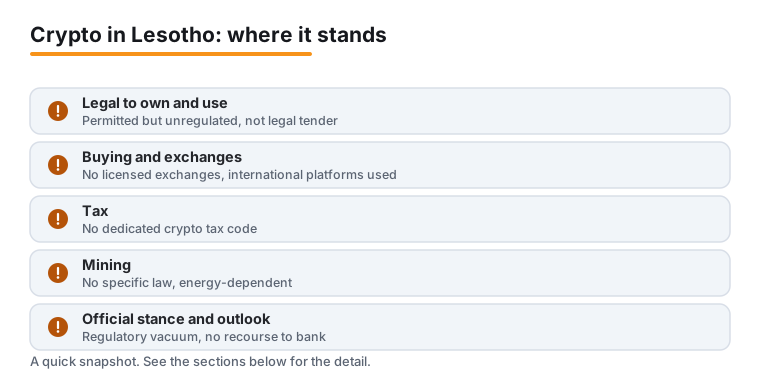
There is no statute that makes buying, holding or selling Bitcoin a criminal offence in Lesotho, so for individuals the activity is generally treated as permitted but unregulated. At the same time, cryptocurrencies are not legal tender. The Central Bank of Lesotho is the legislated sole issuer and redeemer of national currency (the loti), and digital tokens carry no equivalent legal status. Merchants are not obliged to accept Bitcoin, and any party that does accepts it at their own commercial risk.
The important nuance is that "not banned" does not mean "safe" or "protected." The CBL has stated that cryptocurrencies do not fall under the purview of its regulatory scope, which means there is no licensed exchange framework, no statutory consumer-protection backstop, and no recourse to the central bank if a platform fails or a scam occurs. In practice, Lesotho is best described as a permissive but unregulated jurisdiction, closer to a regulatory vacuum than to a clear pro-crypto or anti-crypto stance. You may also see headlines saying crypto is "illegal" in Lesotho; what the CBL has actually said is that crypto is unregulated, is not legal tender, and that promoting it as an investment can breach existing licensing laws (see below).
Who regulates crypto in Lesotho?
No authority in Lesotho currently regulates cryptocurrency as a distinct asset class, because there is no law that creates such a mandate. The bodies whose existing powers can still touch crypto activity are:
- Central Bank of Lesotho (CBL): the monetary authority and the country's financial-sector regulator. It issues the loti, supervises licensed financial institutions and capital-market activity, and has issued public warnings about crypto. It is the first place to check for any change in the official position.
- Revenue Services Lesotho (RSL): the tax and customs authority (formerly the Lesotho Revenue Authority). It administers income tax and other taxes that can apply to crypto gains and income.
- Financial Intelligence Unit (FIU): the national agency for anti-money-laundering and counter-terrorist-financing, established under the Money Laundering and Proceeds of Crime Act 2008. It receives and analyses suspicious-transaction reports and supervises accountable institutions.
None of these has published a stand-alone crypto rulebook. They regulate the surrounding obligations (currency, tax, AML) that crypto users still have to respect.
Crypto laws and frameworks in Lesotho
Lesotho has not enacted a stand-alone virtual-asset or crypto licensing law as of 2026. Instead, several existing frameworks can apply to crypto activity:
- CBL press statement on cryptocurrencies: originally issued on 9 November 2017 and reiterated in an updated press statement on 20 May 2024. The CBL warned that cryptocurrencies are not legal tender, do not fall under its regulatory purview, and that there shall be no recourse to the Bank in the event of losses.
- Capital Markets Regulations 2014: the CBL has cautioned that offering cryptocurrencies to the public as financial-investment opportunities exposes promoters to Sections 27 and 28 of these regulations, which require investment advisers to be licensed by the CBL. In other words, marketing crypto investments without authorisation may breach existing securities-style rules.
- Money Laundering and Proceeds of Crime Act 2008, as amended by the Money Laundering and Proceeds of Crime (Amendment) Act No. 7 of 2016 and supplemented by the Money Laundering Regulations No. 29 of 2019 and the Money Laundering (Amendment of Schedule) Notice No. 86 of 2023: the basis for Lesotho's AML/CFT regime and the FIU. Crypto participation may lead to violations of these laws, which the CBL describes as prosecutable transgressions.
- Exchange-control law: as a member of the Common Monetary Area with South Africa, Lesotho applies exchange controls. Moving value cross-border via crypto can intersect with these rules.
Because no single "crypto act" exists, compliance means looking across all of the above rather than to one rulebook. The nearest thing to a stated government intention on virtual assets is paragraph 126 of the 2026/27 Budget Speech, delivered on 18 February 2026, in which the Minister of Finance and Development Planning said Lesotho will embark on a National Risk Assessment to comply with FATF standards and that gaps in the registration and monitoring of legal persons, virtual assets and corruption will be identified. No completion date, draft law or timetable was announced.
Licensing and registration of exchanges and VASPs
There is no CBL-licensed domestic crypto exchange regime in Lesotho and no register of approved local platforms or virtual-asset service providers (VASPs). As of 2026, an exchange cannot obtain a Lesotho "crypto licence" because no such category exists in law. The Eastern and Southern African Anti-Money Laundering Group (ESAAMLG), in the mutual-evaluation report on Lesotho that its Council of Ministers approved in September 2023, has noted that authorities were unable to confirm whether virtual-asset transactions were occurring or whether any VASPs were operating locally, underscoring how undeveloped formal oversight is. That evaluation was carried out against the 2012 FATF Recommendations, one of which (Recommendation 15) asks countries to license or register VASPs and apply AML/CFT rules to them, a standard Lesotho does not yet meet.
Two practical consequences follow. First, Basotho who buy crypto generally use international or regional platforms rather than a locally licensed venue. Second, businesses that want to offer crypto services should not assume the activity is freely permitted: depending on how a product is structured, it could engage the Capital Markets Regulations 2014 (investment-adviser licensing), AML registration obligations with the FIU, or exchange-control rules. Anyone planning a crypto business in Lesotho should seek a formal view from the CBL and qualified local counsel before launching.
Crypto and Bitcoin tax in Lesotho
Lesotho does not publish a dedicated cryptocurrency tax code, but "no special rules" is not the same as "tax-free." Revenue Services Lesotho administers income tax and related taxes, and general principles can apply to crypto gains and income depending on the facts:
- Profits from frequent trading may be treated as ordinary income, while gains on longer-held holdings may be treated differently; the trading-versus-investment distinction is fact-dependent.
- Crypto received as payment for goods, services or work, and mining or staking rewards, can be taxable as income at the point received, valued in loti. For resident individuals the rates are 20 percent on the first M77,760 of chargeable income a year (M6,480 a month) and 30 percent above that, with a non-refundable tax credit of M12,240 a year (M1,020 a month). Those figures were set by the Income Tax (Amendment of Monetary Amounts) Regulations, Legal Notice No. 24, published on 27 March 2026, which amended section 73 and the Second Schedule of the Income Tax Act No. 9 of 1993 with effect from 1 April 2026. The tax year runs from 1 April to 31 March, and annual returns and reconciliations are generally due by 30 June following the end of the tax year, but how any specific crypto receipt is taxed depends on your circumstances.
- Good record-keeping matters: keep dates, amounts, counterparties and the loti value of each transaction so any liability can be calculated and substantiated.
We have seen third-party guides cite specific crypto tax rates and a "mandatory 2026 crypto reporting" rule with automatic penalties for Lesotho. We could not confirm those figures or that reporting rule against any official Lesotho source, so we do not state them as fact here. Tax treatment is one of the easiest things to get wrong with crypto. Confirm your obligations directly with Revenue Services Lesotho or a qualified local tax adviser, and see our general crypto taxes guide for context.
AML and KYC rules
Lesotho has an anti-money-laundering and counter-terrorist-financing (AML/CFT) framework built on the Money Laundering and Proceeds of Crime Act 2008, administered by the Financial Intelligence Unit. The FIU receives, analyses and disseminates information on suspected proceeds of crime, money laundering and terrorist financing, and accountable institutions listed in the Act must register with it and meet compliance obligations.
Although the Act predates crypto and does not name virtual assets explicitly, the CBL has warned that crypto activity may lead to AML/CFT violations, which are prosecutable. In practice, this means two things for ordinary users. First, reputable exchanges will apply their own know-your-customer (KYC) checks and ask for identity documents; you should expect this and treat platforms that ask for none with suspicion. Second, using crypto to obscure the source of funds, evade exchange controls, or move illicit value can expose you to criminal liability under Lesotho law regardless of the absence of crypto-specific rules. ESAAMLG's 2023 mutual evaluation flagged gaps in how virtual assets are supervised, and that finding has not since been retested: ESAAMLG's follow-up reports register lists no follow-up report for Lesotho as of August 2026, while other members have reports dated March and April 2026. The re-rating that would measure Lesotho against FATF Recommendation 15 on virtual assets has not happened yet, so AML pressure remains a plausible driver of future regulation rather than a current obligation.
Buying and using crypto in practice
Because there is no licensed domestic exchange, Basotho who buy crypto typically use international exchanges, peer-to-peer (P2P) marketplaces, or regional platforms that serve Southern Africa, often funding accounts via cards or bank transfers and trading in loti or South African rand pairs where supported. A typical, cautious approach looks like this:
- Choose a reputable platform with a solid security record, transparent fees and clear withdrawal terms, ideally one that supports users in Lesotho.
- Complete KYC with the identity documents requested; avoid platforms that ask for none.
- Fund your account via a supported method, mindful that funding an offshore account or sending value abroad can engage Lesotho's exchange-control rules; check before moving larger sums cross-border.
- Secure your holdings. For anything beyond small amounts, withdraw to a personal wallet (a hardware wallet for larger sums) rather than leaving funds on an exchange, and keep your seed phrase offline. If an exchange is hacked, freezes withdrawals or collapses, the CBL has made clear there is no recourse to the Bank.
- Keep records of dates, amounts and loti values for tax purposes.
On crypto ATMs: dedicated Bitcoin ATMs are not an established feature of Lesotho's market, so do not rely on finding one. Online platforms and P2P trades are the realistic options. Remittances are a common use case: crypto can in theory be faster and cheaper on some corridors and reach the unbanked, but the recipient still needs a reliable way to cash out into loti or rand, prices can be volatile, and cross-border transfers can engage exchange-control and AML rules. Weigh it against established licensed money-transfer operators.
Bitcoin mining in Lesotho
There is no law in Lesotho that specifically prohibits or licenses Bitcoin mining. The more relevant constraints are practical and economic. Mining is energy-intensive, and grid capacity, electricity tariffs and reliability are the decisive factors for anyone considering it.
Lesotho is notable for its hydropower potential. The Lesotho Highlands Water Project and the country's mountainous terrain give it meaningful renewable-energy resources, and there is ongoing interest in solar and wind. In principle, surplus renewable generation could make sustainably powered mining attractive, and commentators often highlight this as an opportunity. In reality, Lesotho still imports a share of its electricity and faces domestic demand pressures, so cheap, abundant surplus power for large-scale mining should not be assumed.
Anyone exploring mining should treat it as an energy and business-licensing question first: secure a lawful, cost-effective power supply, confirm any business-registration and tax obligations with Revenue Services Lesotho, factor in equipment, cooling and import costs, and remember that mining rewards may be taxable as income. Small-scale or hobby mining of Bitcoin with general-purpose hardware is generally not economically viable today.
Recent developments (2024 to 2026)
The most significant recent official action is the CBL's updated press statement of 20 May 2024, which restated and modernised the Bank's 2017 warning: cryptocurrencies are not legal tender, fall outside the CBL's regulatory scope, expose promoters to the Capital Markets Regulations 2014, and offer no recourse to the Bank for losses. As of 2026 there is no public indication that Lesotho has issued or piloted a central bank digital currency (CBDC), nor that a dedicated virtual-asset law has been enacted. On the AML/CFT side, ESAAMLG's mutual-evaluation report on Lesotho was approved in September 2023 and flagged supervisory gaps, including around virtual assets; as of early 2026 Lesotho is not on the FATF list of jurisdictions under increased monitoring (the "grey list"). Separately, a draft Computer Crime and Cyber Security Bill has been discussed locally, but it is not a crypto law and had not been enacted at the time of writing, so it does not change the position above.
The most likely direction of travel is toward more regulation, not less. The only financial-sector bill actually before Parliament is the Payment Systems Bill 2025, which the Minister of Finance and Development Planning presented on 2 May 2025 and moved for second reading on 5 May 2026, and which the Portfolio Committee on the Economic and Development Cluster recommended for adoption in a report published on 1 June 2026. It repeals the Payment Systems Act 2014 and would require every non-bank payment service provider to hold a Central Bank licence and be incorporated in Lesotho, but its text does not use the words cryptocurrency, virtual asset, crypto-asset, stablecoin or token anywhere. As of 3 August 2026 no draft crypto or virtual-asset bill has been published by the Central Bank of Lesotho, the Ministry of Finance and Development Planning or Parliament, and no regulator has announced a target date for one. The two dated commitments that could eventually lead to one are the National Risk Assessment announced in the February 2026 Budget Speech, which will look at virtual assets, and the regulatory sandbox for digital financial services listed as an immediate Central Bank priority in the Financial Sector Development Strategy II 2025 to 2030. Treat any claim of brand-new crypto-specific rules with caution and verify it against an official source before relying on it.
Consumer risks and protection
The central risk in Lesotho is the absence of a regulatory framework. With no licensing regime and no statutory consumer protection, users carry the full burden of platform risk, fraud risk and price volatility, and the CBL has confirmed there is no recourse to the Bank for losses. Layered on top are tax uncertainty, exchange-control exposure on cross-border transfers, and AML/CFT obligations that still apply.
Because the market is unregulated, fraud is a particular hazard. Be sceptical of "guaranteed returns," social-media promoters and unsolicited investment offers; promoting such schemes can itself breach the Capital Markets Regulations 2014. To protect yourself: only commit money you can afford to lose, use well-established platforms with strong security and genuine KYC, withdraw larger holdings to your own wallet, keep detailed records, and confirm tax obligations in advance. If you encounter a suspected scam or money-laundering activity, the Financial Intelligence Unit is the relevant national contact point. For more on investor safeguards generally, see our regulation hub.
Official sources and how to verify
Crypto rules in Lesotho are evolving, and third-party websites (including SEO-driven "guides") sometimes state rates, deadlines or rules that cannot be confirmed officially. Always check the primary sources yourself before acting:
- Central Bank of Lesotho for the official position on legal-tender status, regulation and capital-markets licensing: centralbank.org.ls. The cryptocurrency press statement is published at centralbank.org.ls.
- Revenue Services Lesotho for income-tax rules, filing deadlines and any tax treatment of crypto: rsl.org.ls.
- Financial Intelligence Unit for AML/CFT obligations, registration and suspicious-activity reporting: fiu.org.ls.
If you cannot find a rule on one of these official sites, treat it as unconfirmed. This article is general information as of 2026 and is not legal, tax or financial advice; verify your specific situation with the named regulators or a qualified local professional.
What is changing in 2026: the legislative pipeline
Between the last review of this page on 30 June 2026 and 3 August 2026, Lesotho's crypto position itself did not change. There is still no virtual-asset law, no register of virtual asset service providers and no Central Bank of Lesotho licence a crypto business can apply for. What has moved is the machinery around crypto, and four items tell a reader what is actually coming and roughly when.
- Payment Systems Bill, 2025. The Minister of Finance and Development Planning presented it to the National Assembly on 2 May 2025, after which it was referred to the Portfolio Committee on the Economic and Development Cluster. The Minister moved the second reading on 5 May 2026 and members supported that the Bill be read a second time. The committee report, which recommends the Bill for adoption, was published on the parliament website on 1 June 2026. The Bill repeals the Payment Systems Act 2014 and the Bills of Exchange Proclamation 1912, requires every non-bank payment service provider to hold a Central Bank licence and to be a company incorporated in Lesotho, and creates a National Payment Systems Council to advise the Central Bank. Clause 1 says the Act comes into operation on the date of publication in the Gazette, and section 45 then gives existing operators and payment services providers one year from that date to bring their activities into line with the Act. Read against a crypto question, the important fact is negative: the Bill's text never uses the words cryptocurrency, crypto-asset, virtual asset, digital currency, stablecoin or token. It does define payment services to include "any other service that Central Bank may prescribe as a payment service", which is the one clause that could later be used to pull new services in by regulation. Sources: the Bill as amended, the portfolio committee report and the Lesotho News Agency report of the second reading.
- A National Risk Assessment that names virtual assets. In the 2026/27 Budget Speech delivered on 18 February 2026, the Minister of Finance and Development Planning said that to comply with FATF standards Lesotho will embark on a National Risk Assessment, and that "Gaps in systems, including those in the registration and monitoring operations of legal persons, virtual assets, and corruption will also be identified". This is currently the only statement of government intent that names virtual assets. No completion date, publication date or follow-on legislation was announced. See the Budget Speech, paragraph 126.
- A regulatory sandbox. The Financial Sector Development Strategy II 2025 to 2030, published by the Ministry of Finance and the Central Bank of Lesotho, lists a regulatory sandbox for digital financial services in its implementation matrix under the cross-cutting initiative on enhancing access to digital financial services. The row for an enabling legal framework names the Central Bank as lead institution with priority marked "Immediate", and a further row covers enrolment of sandbox participants. No sandbox rules, eligibility criteria or application window have been published. See the strategy document.
- Three tax bills. Paragraph 52 of the same Budget Speech states that "the Tax Administration Bill Amendments, Income Tax Amendments, and VAT Administration Bill will be tabled in the 2026/27 financial year", meaning by 31 March 2027. None of the three has been announced as containing a crypto measure, but an Income Tax Act amendment is the only realistic vehicle through which crypto would ever be taxed differently in Lesotho.
Two things are still absent and worth stating plainly. No draft crypto or virtual-asset bill has been published by the Central Bank of Lesotho, the Ministry of Finance and Development Planning or Parliament, and no regulator has announced a target date for one. And the Eastern and Southern African Anti-Money Laundering Group has not published any follow-up report on Lesotho since its 2023 mutual evaluation: as of August 2026 its follow-up reports register lists none for Lesotho, while other members have reports dated March and April 2026. The re-rating that would normally test Lesotho against FATF Recommendation 15 on virtual assets has therefore not yet happened.
What tax rate would apply to crypto income in 2026/27
Lesotho has no crypto tax code, so any crypto amount that is chargeable income for a resident individual falls into the ordinary personal income tax structure. That structure changed on 1 April 2026. The Income Tax (Amendment of Monetary Amounts) Regulations, Legal Notice No. 24, published on Friday 27 March 2026, amended section 73 and the Second Schedule of the Income Tax Act No. 9 of 1993, raising the lower bracket from M6,170.00 to M6,480.00 a month and the non-refundable tax credit from M970.00 to M1,020.00 a month.
| Chargeable income, resident individual | Rate or amount |
|---|---|
| First M77,760 a year (M6,480 a month) | 20 percent |
| Above M77,760 a year (M6,480 a month) | 30 percent |
| Non-refundable tax credit | M12,240 a year (M1,020 a month) |
| Effective from | 1 April 2026, for the tax year 1 April 2026 to 31 March 2027 |
Revenue Services Lesotho states the calculation as follows: where chargeable income is between M1.00 and M77,760.00 the tax is 20 percent of the amount; where it exceeds M77,760.00 the tax is M15,552.00 plus 30 percent of the excess over M77,760.00; and the M12,240.00 credit is then applied to each resident individual. RSL's own worked table shows the practical effect: at M61,200 a year the calculated tax is exactly M12,240 and equals the credit, so no tax is payable, and the table notes that income above that level results in some tax payable. Source: Revenue Services Lesotho, Income Tax Structure for the Period Starting 1 April 2026 Onwards.
Two cautions. These are the general rates, not a ruling that crypto is taxed: whether a particular disposal is chargeable income at all depends on the facts, and Revenue Services Lesotho has published no crypto-specific guidance, rate, threshold or reporting rule. Anyone relying on this should confirm their position with Revenue Services Lesotho or a local tax adviser.
The Central Bank's June 2026 warning on unlicensed schemes
The most concrete regulator action of 2026 is not about crypto specifically, but it is what most Basotho losing money to online "investment platforms" will actually run into. Lesotho outlets and a Maseru law firm report that the Central Bank of Lesotho issued a public warning on 25 June 2026, reference 25062026/1, naming four entities that hold no valid Central Bank licence: the SGK Investment Scheme, also trading as SGK Platform or SGK Elite, Prestige Wealth Investments, Lengau People's Society and the Prime Aura Platform. The reports say the Bank cautioned the public against operators promising unusually high returns or soliciting deposits without a licence, and noted that some had falsely claimed to be Central Bank licensed.
The legal hooks cited in commentary on the warning are the Financial Institutions Act No. 3 of 2012 on deposit taking and on agents of financial institutions, the Money Laundering and Proceeds of Crime Act No. 4 of 2008 as amended by Act No. 7 of 2016, and the Penal Code Act No. 6 of 2010 on fraud and theft by false pretences. That is the practical answer to the question of what protects you in an unregulated market: not crypto rules, but the deposit-taking, fraud and money laundering offences that already exist.
We could not locate the notice itself on the Central Bank's own website: it does not appear in the Bank's post sitemap or on its press releases page. Treat the scheme names and the reference number as reported rather than as verified from the primary document, and check the Central Bank of Lesotho list of licensed institutions before sending money to any platform. Reporting: Lesotho.co.ls, Lesotho Tribune and ZM Ayet Law.
One crypto link is worth flagging with care. The Lesotho Tribune reported on 19 July 2026 that a Financial Intelligence Unit typology report from May 2026 described the SGK scheme moving funds in cycles and converting large sums into cryptocurrency. The FIU has not published that report: its reports page lists only an August 2025 strategic report on identity theft and fraud. So this is one outlet's account of a document we could not read, not a verified official finding.
On the anti money laundering side, nothing has changed for virtual assets. The Financial Intelligence Unit's legislation page lists the Money Laundering and Proceeds of Crime Act 2008, the Amendment Act No. 7 of 2016, the Money Laundering Regulations No. 29 of 2019, the Money Laundering (Amendment of Schedule) Notice No. 86 of 2023 and a series of guidelines and notices. None of the listed titles refers to virtual assets or virtual asset service providers. Accountable institutions must still register with the FIU.
Frequently asked questions
Is Bitcoin legal in Lesotho?
There is no law that bans buying, holding or trading Bitcoin in Lesotho, so for individuals it is generally treated as permitted. However, it is not legal tender and it is not regulated, and the Central Bank of Lesotho has warned that there is no recourse to the Bank if you lose money. "Not banned" is not the same as "protected."
Who regulates cryptocurrency in Lesotho?
No authority currently regulates cryptocurrency as a distinct asset class. The Central Bank of Lesotho is the monetary authority and has stated that crypto falls outside its regulatory scope. Existing laws still apply, though: the Capital Markets Regulations 2014 (administered by the CBL), tax rules under Revenue Services Lesotho, and the Money Laundering and Proceeds of Crime Act 2008 (overseen by the Financial Intelligence Unit).
Do I have to pay tax on crypto in Lesotho?
Possibly. Lesotho has no dedicated crypto tax code, but general income and capital principles administered by Revenue Services Lesotho can apply to gains, trading profits, and crypto received as payment or as mining and staking rewards, depending on the facts. We could not verify any crypto-specific rate, threshold or "2026 reporting rule" from an official source, so confirm your obligations with Revenue Services Lesotho or a local tax adviser.
Can a crypto exchange get a licence in Lesotho?
No. As of 2026 there is no virtual-asset licensing regime, so an exchange cannot obtain a Lesotho "crypto licence" because no such category exists in law. A crypto business should still take advice, because depending on its design it may engage the Capital Markets Regulations 2014, AML registration with the Financial Intelligence Unit, or exchange-control rules. Seek a formal view from the Central Bank of Lesotho and local counsel before launching.
Are there Bitcoin ATMs in Lesotho?
Dedicated crypto ATMs are not an established part of Lesotho's market, so you should not rely on finding one. Most people buy and sell using international or regional online exchanges and peer-to-peer marketplaces, often trading in loti or South African rand pairs where supported.
Can I use Bitcoin for remittances to Lesotho?
Some people do, because it can be faster and cheaper on certain corridors and accessible to the unbanked. But the recipient needs a reliable way to convert to loti or rand, prices are volatile, cross-border transfers can engage exchange-control and AML rules, and there is no regulatory safety net if a service fails. Compare it carefully against licensed money-transfer operators.
Is Lesotho on the FATF grey list?
As of early 2026, Lesotho is not on the FATF list of jurisdictions under increased monitoring (the "grey list"). ESAAMLG, the regional FATF-style body, approved a mutual-evaluation report on Lesotho in September 2023 that identified AML/CFT gaps, including limited oversight of virtual assets, but that is a supervisory finding rather than a grey-listing. Check the FATF and ESAAMLG websites for the current status before relying on this.
Has Lesotho passed a crypto or virtual-asset law?
No. As of 2026 Lesotho has not enacted a dedicated cryptocurrency or virtual-asset law, and there is no CBDC. The most recent official action is the Central Bank of Lesotho's press statement of 20 May 2024, which restated that crypto is not legal tender, is outside the Bank's regulatory scope, and offers no recourse for losses. A draft Computer Crime and Cyber Security Bill has been discussed, but it is not a crypto law and had not been enacted at the time of writing.
Is a crypto law coming in Lesotho, and when?
No crypto or virtual-asset bill has been published, and no regulator has given a date for one. The two dated commitments that touch virtual assets are the National Risk Assessment announced in the 2026/27 Budget Speech on 18 February 2026, which says gaps in the registration and monitoring of legal persons, virtual assets and corruption will be identified, and the regulatory sandbox for digital financial services listed as an immediate Central Bank priority in the Financial Sector Development Strategy II 2025 to 2030. Both are diagnostics or strategy commitments, not draft laws, and neither carries a published deadline.
Does the Payment Systems Bill 2025 regulate crypto in Lesotho?
No. The Bill repeals the Payment Systems Act 2014 and would require every non-bank payment service provider to hold a Central Bank of Lesotho licence and to be a company incorporated in Lesotho, with a National Payment Systems Council advising the Bank. Its text does not use the words cryptocurrency, crypto-asset, virtual asset, digital currency, stablecoin or token. It does define payment services to include any other service the Central Bank may prescribe as a payment service, which is the clause that could later be used to bring new services in by regulation. It was debated and supported at second reading in the National Assembly on 5 May 2026 and the portfolio committee recommended adoption in a report published on 1 June 2026. The Act would come into operation on the date it is published in the Gazette, and existing operators would then have one year to bring their activities into line with it.
What income tax rate applies to crypto profits in Lesotho in 2026/27?
There is no crypto-specific rate. If a crypto amount is chargeable income for a resident individual it falls into the ordinary structure that took effect on 1 April 2026 under Legal Notice No. 24 of 27 March 2026, which amended section 73 and the Second Schedule of the Income Tax Act No. 9 of 1993: 20 percent on the first M77,760 a year (M6,480 a month), 30 percent above that, and a non-refundable tax credit of M12,240 a year (M1,020 a month). Revenue Services Lesotho states the rule as M15,552 plus 30 percent of the excess over M77,760, with the credit then applied, which means no tax is payable until chargeable income exceeds M61,200 a year. Whether a specific disposal is chargeable income at all depends on the facts, and RSL has published no crypto guidance.
Has ESAAMLG re-assessed Lesotho on virtual assets since the 2023 mutual evaluation?
Not yet. ESAAMLG's follow-up reports register lists no follow-up report for Lesotho as of August 2026, although it lists reports for other members dated March and April 2026. That means the technical re-rating that would test Lesotho against FATF Recommendation 15, which asks countries to license or register virtual asset service providers, has not been carried out since the mutual evaluation approved in September 2023.
Facts reviewed: 13 August 2026. Page updated: 13 August 2026.