Home › Crypto Regulation › Namibia
Bitcoin & Cryptocurrency Regulation in Namibia
Quick answer — Namibia, 2026
- Legal: Legal to hold, not legal tender; VASPs need a licence, none fully live yet
- Tax: No settled crypto-specific tax, general income tax rules may apply
- Buying: No fully licensed local platform yet, use offshore or P2P
Namibia has shifted from one of Africa's most restrictive stances on digital assets to a structured licensing regime built around a dedicated law. The Virtual Assets Act, Act No. 10 of 2023, became operational on 25 July 2023 and replaced the central bank's earlier prohibitive position with a "regulate, do not ban" approach. It is administered by the Bank of Namibia, which the Minister of Finance designated as the regulatory authority for virtual assets. In practice, however, the market in 2026 remains cautious: crypto is not legal tender, no virtual asset service provider has yet received a full operational licence, and Namibian banks frequently restrict or freeze crypto-linked accounts.
This guide explains the current legal status, who regulates the sector, the key laws and frameworks, licensing of exchanges, taxation, anti-money-laundering rules, mining, recent developments, consumer risks, and how to verify everything against official sources. This is general information as of 2026 and is not legal, tax, or financial advice. Crypto rules in Namibia are still evolving, so always confirm the current position directly with the Bank of Namibia, the Financial Intelligence Centre, NAMFISA, the Namibia Revenue Agency (NamRA), or a qualified Namibian professional before acting. See our general crypto regulation overview for wider context.
On this page: Legal status · Who regulates it · Taxes · How to buy · Mining
Is Bitcoin and crypto legal in Namibia?
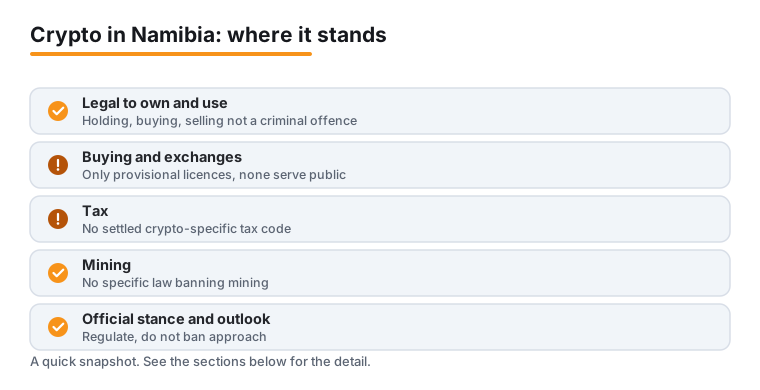
Holding, buying, and selling cryptocurrency is not a criminal offence for private individuals in Namibia. There is no outright ban on owning Bitcoin or other crypto assets. Two distinctions shape the legal picture, though:
- Not legal tender. The Bank of Namibia has repeatedly confirmed that cryptocurrencies are not legal tender and are not legally recognised as a means of payment. Merchants are not obliged to accept crypto, and it cannot be used to settle debts the way the Namibian dollar can.
- Regulated business activity. Running a crypto business, such as an exchange, custody service, or token offering, now falls under a dedicated legal regime. Doing so without the required authorisation from the Bank of Namibia is an offence.
The practical catch in 2026 is that, while individuals are not banned, the legal infrastructure for trading is still incomplete. The Bank of Namibia Annual Report 2025 records that in the 2025 reporting year the Bank granted full authorisation to two payment service providers, and that extensions were granted to the two entities previously provisionally authorised to operate as virtual asset service providers, rather than full licences. There is still no fully licensed local platform on which to trade. The Bank of Namibia has also warned that people who transact in crypto have no recourse to the central bank if they suffer losses.
Who regulates crypto in Namibia?
The Bank of Namibia (BoN) is the designated regulatory authority for virtual assets. Under the Virtual Assets Act, the Minister of Finance designated the central bank to license and supervise virtual asset service providers (VASPs), and the Bank confirms that it is "tasked with evaluating all individuals and entities intending to provide payment services and virtual asset services within Namibia."
Other bodies play supporting roles:
- NAMFISA (the Namibia Financial Institutions Supervisory Authority) assists the Bank of Namibia by helping evaluate applications that involve non-banking elements, such as virtual asset marketplaces. Note that some commentary incorrectly states that VASPs license through NAMFISA; the lead licensing authority under the Act is the Bank of Namibia.
- The Financial Intelligence Centre (FIC) is Namibia's anti-money-laundering and counter-terrorist-financing supervisor and the financial intelligence unit, operating under the Financial Intelligence Act.
The two lead bodies have now formalised how they divide that work. On 24 March 2026 the Bank of Namibia and NAMFISA signed an updated Memorandum of Agreement covering supervisory information sharing, joint investigations and inspections where concurrent jurisdiction exists, collaboration on financial stability monitoring, consultation on emerging risks, and coordination on fintech and innovation matters, together with terms of reference for a joint technical working group. See the official Bank of Namibia Virtual Assets Act 2023 page.
Crypto laws and frameworks in Namibia
The cornerstone of Namibian crypto law is the Virtual Assets Act, Act No. 10 of 2023, which was signed into law in July 2023 and became operational on 25 July 2023. The Act provides for the licensing and supervision of VASPs and for issuers of initial token offerings. Its stated aims are consumer protection, prevention of market abuse, and mitigation of money-laundering, terrorist-financing, and proliferation-financing risks, in line with Financial Action Task Force (FATF) standards.
The Act gives the Bank of Namibia power to make rules, to set the information that must accompany a virtual asset transfer under section 18(5), and to specify minimum unimpaired capital by Gazette notice under section 19. As at August 2026 the Bank of Namibia regulations index lists the Virtual Assets Act itself and no rules, determinations or standards issued under it, so the Act and its schedules remain the operative text. Anti-money-laundering obligations connect to the broader Financial Intelligence Act, Act No. 13 of 2012, which the FIC administers. Because the Act and its rules are detailed and still being implemented, the authoritative text is the Act itself, available from the Bank of Namibia.
Licensing and registration of exchanges and VASPs
Anyone wishing to provide virtual asset services to the public must be authorised by the Bank of Namibia. The Bank uses a two-stage process:
- Provisional authorisation, valid for six months, lets an applicant establish operations, hire staff, and build the required compliance infrastructure. Importantly, during this provisional period the holder is not allowed to conduct any business or engage with individuals or entities in Namibia.
- Full operational licence, granted only once the provisional holder satisfies all pre-authorisation conditions and passes inspection. Approval can come earlier than six months if the conditions are met sooner.
In its media release of 13 January 2025, the Bank of Namibia announced provisional authorisation for virtual asset services to Mindex Virtual Asset Exchange (Pty) Ltd and Landifa Bitcoin Trade CC (alongside payment-service authorisations for other entities). As reported through 2025, these remained provisional, meaning that no provider had yet been cleared to deal with the Namibian public. Operating a crypto business without authorisation is an offence, so anyone planning to provide services should treat licensing as mandatory and seek legal advice early. The official notice is the Bank of Namibia provisional-authorisation media release.
Crypto and Bitcoin tax in Namibia
Tax is administered by the Namibia Revenue Agency (NamRA), and Namibia operates a self-assessment system in which taxpayers calculate their own taxable income and file by the relevant deadlines. The Virtual Assets Act itself is silent on taxation, and NamRA has published no crypto-specific guidance, so the ordinary income tax rates apply to whatever part of your crypto activity is taxable income. NamRA's published bands begin above N$100,000 and run through 18, 25, 28, 30 and 32 per cent to 37 per cent on taxable amounts above N$1,550,000. Profits or income connected to crypto activity can nonetheless fall within Namibia's existing income-tax rules, and the pseudonymous nature of crypto has been publicly noted as a tax-administration challenge.
Because treatment depends on the facts, for example whether you are a casual holder, an active trader, a miner, or a business accepting crypto, we deliberately do not quote one rate as if it covered every scenario; the income tax bands above are the starting point. Practical steps:
- Keep detailed records of every acquisition and disposal and the Namibian-dollar value at the time of each transaction.
- Treat trading profits, mining rewards, and crypto received for goods or services as potentially taxable until you confirm otherwise.
- Speak with a Namibian tax adviser or contact NamRA directly to determine how income tax applies to your situation.
This section is general information, not tax advice. For broader context see our guide to crypto taxes.
AML, KYC, and the Travel Rule
Anti-money-laundering and know-your-customer obligations are central to Namibia's regime. The Financial Intelligence Act, Act No. 13 of 2012, administered by the Financial Intelligence Centre (FIC), requires accountable and reporting institutions to identify and verify customers, understand the source of funds, monitor transactions, keep records, and report suspicious activity. The FIC acts as the AML, CFT, and counter-proliferation-financing supervisor, and virtual asset service providers fall within this framework.
Under the rules issued for virtual assets, VASPs are also expected to apply the FATF Travel Rule, sharing originator and beneficiary information for qualifying transfers (section 18 of the Act sets no monetary threshold at all: it requires the originating provider to obtain, hold and pass on originator and beneficiary information on a transfer, and section 18(5) leaves the required information to rules the Bank of Namibia has not yet published). The gazetted number that does bite today is the Financial Intelligence Centre client identification threshold of N$10,000 for a single transaction, set by Determination FICD 1 of 2024 and effective from 1 October 2024, with related transactions treated as one where they appear separated or structured to circumvent client identification. For everyday users this means licensed platforms will require identity documents and proof of address, and banks may ask you to prove the source of funds on crypto-linked transactions. The authoritative AML source is the Financial Intelligence Centre.
Buying and using crypto in practice
Namibians can and do buy crypto, but the day-to-day experience is shaped by the licensing regime and the banking environment:
- Licensed local providers are not yet live. Because authorised firms were still provisional and barred from dealing with the public, many residents use offshore exchanges or peer-to-peer (P2P) platforms.
- Banks are cautious. Major banks have flagged, restricted, or frozen accounts linked to crypto activity, sometimes asking customers to prove the source of funds and freezing accounts when they cannot.
Foreign-exchange rules matter
The Namibian dollar is pegged one-to-one to the South African rand, and Namibia belongs to the Common Monetary Area. As a result, exchange-control regulations apply to moving funds offshore. Sending money abroad to fund a foreign crypto purchase can intersect with these controls, so larger or cross-border transfers may require documentation or fall under reporting requirements. Using crypto does not automatically exempt you from exchange-control rules, so confirm them with your bank before moving significant sums. When choosing any platform, prioritise strong security, transparent fees, clear compliance, and reliable support, and remember Bitcoin ATMs are scarce to non-existent in Namibia, so most activity is online or P2P.
Bitcoin mining in Namibia
Mining is not merely unbanned, it sits outside the licensing regime by construction. The Act defines virtual asset services as the activities listed in Part 1 of Schedule 2, and mining, validation and node operation are not among them, while Schedule 2 Part 2 separately names "validation, nodes operation and virtual mining services" among excluded ancillary services. Either way, no Bank of Namibia licence is needed to mine or to run a node. The country is also often cited as a potential location for sustainable mining because of genuine natural advantages:
- Exceptional solar potential. Namibia has some of the clearest skies and highest solar-irradiance levels in the world, which suits solar-powered operations.
- Renewable-energy ambitions. The government actively promotes renewable energy and green-hydrogen projects, which could in principle provide low-cost clean power for energy-intensive computing.
- Strategic location. As a stable Southern African economy with regional infrastructure links, Namibia appeals to international energy and technology investors.
The practical hurdles are real, however. Grid capacity is constrained, electricity is not universally cheap, and connecting large mining loads requires negotiation with utilities. Importing specialised hardware involves customs and cost considerations, and mining income may be taxable. The "renewable mining hub" narrative is potential rather than an established, large-scale industry. Anyone considering mining should model power costs carefully and confirm energy, import, and tax obligations before investing.
Recent developments (2025-2026)
The most significant recent steps are about implementation rather than new primary law:
- First provisional authorisations. On 13 January 2025, the Bank of Namibia granted provisional authorisation for virtual asset services to Mindex Virtual Asset Exchange (Pty) Ltd and Landifa Bitcoin Trade CC. In the same announcement it granted payment-service authorisations to Finatic Technologies (Pty) Ltd and United PayPoint (Pty) Ltd.
- Time-limited, conditions attached. Provisional authorisation runs for up to six months and carries pre-authorisation conditions that the applicant must satisfy, such as demonstrating systems for transaction monitoring, identity verification, and anti-money-laundering controls, before any full licence can follow. During this period the holder cannot deal with the Namibian public.
- Still no full operational licence. As reported through 2025, no VASP had progressed to a full licence permitting public dealings, so the regulated retail market was not yet operational.
- Banking friction and enforcement. Namibian banks continued to restrict or freeze crypto-linked accounts, and courts have heard disputes over frozen accounts tied to crypto schemes, underscoring the gap between what the law permits and what is practically easy.
- Open question for individuals. Through 2026 the authorities have published nothing that changes the position of an individual holder: holding and trading remain lawful, and the one confirmed 2026 development was Namibia's removal from the FATF list of jurisdictions under increased monitoring on 19 June 2026, confirmed the same day by the Financial Intelligence Centre in General Compliance Circular 02 of 2026.
Because the picture is changing, treat any specific claim here as a starting point and verify the latest position with the Bank of Namibia.
Consumer risks and protection
Namibia's framework aims to protect consumers, but several risks remain in 2026:
- No central-bank recourse. The Bank of Namibia has stated that people transacting in crypto have no recourse to the central bank if they lose money.
- Implementation lag. With licensing still provisional, the regulated market is immature, and users relying on offshore or P2P channels carry extra counterparty risk.
- Banking access. Account freezes and source-of-funds checks can disrupt cashing in or out.
- Foreign-exchange constraints. The rand peg and exchange-control regime add complexity to cross-border crypto activity.
- General crypto risks. Volatility, scams promising guaranteed returns, exchange failures, and self-custody mistakes apply everywhere.
Protect yourself by using providers with strong security and clear compliance, enabling two-factor authentication, double-checking wallet addresses, never sharing your private keys or recovery phrase, and keeping records for tax. Treat crypto as a high-risk part of a diversified approach and never invest more than you can afford to lose. This is general information, not financial advice.
Official sources and how to verify
Because Namibian crypto rules are evolving, always confirm the current position with primary official sources rather than secondary commentary:
- Bank of Namibia: Virtual Assets Act 2023, the regulator's page hosting the Act and its rules.
- Financial Intelligence Centre (FIC), the AML, CFT, and CPF supervisor under the Financial Intelligence Act.
- Namibia Revenue Agency (NamRA), for tax registration, filing, and guidance.
- NAMFISA, which supports the Bank of Namibia on non-banking elements and broader financial supervision.
To verify a specific provider, check whether it actually holds a full operational licence from the Bank of Namibia rather than only a provisional authorisation. For our wider coverage, see the regulation hub and the crypto regulation guide. This article is informational only and is not legal, tax, or financial advice; confirm details with the named official regulators.
What changed in 2026
Two things moved in 2026, and neither of them is a new crypto law.
- Namibia left the FATF grey list. At its plenary in Paris on 19 June 2026 the Financial Action Task Force removed Namibia from the list of jurisdictions under increased monitoring. The Financial Intelligence Centre circulated the change the same day in General Compliance Circular 02 of 2026, which lists Algeria and Namibia under the heading "Jurisdictions no longer subject to increased monitoring by the FATF". Namibia had been grey listed in February 2024 and worked through 13 strategic deficiencies (The Namibian, 19 June 2026).
- The two virtual asset authorisations were extended, not upgraded. The Bank of Namibia Annual Report 2025 records that in the reporting year the Bank granted full authorisation to two payment service providers, and that "Extensions were also granted to two entities previously provisionally authorised to operate as virtual asset service providers". No virtual asset service provider has been announced as fully licensed.
The extensions matter because the original grant was short and restrictive. The Bank's media release of 13 January 2025 states that provisional authorisation "is valid for a period of six months", and that during that period the entities "are not allowed to conduct any business or engage with individuals or entities in Namibia". More than a year later, the position has not advanced to a full licence.
What did not happen matters as much. The Bank's Financial Stability Report of April 2026, published jointly with NAMFISA, mentions virtual asset service providers in one place only, describing public education on fraud risk, and does not use the word crypto at all.
The laws that actually apply, and the numbers inside them
Namibia has no crypto-specific tax law and no rules yet published under its crypto statute. What it does have is a short stack of instruments that are in force and enforceable today.
| Instrument | Status | What it does |
|---|---|---|
| Virtual Assets Act 10 of 2023, promulgated by Government Notice 215 in Government Gazette 8143 of 21 July 2023 | In force | Section 7(2) makes operating as a virtual asset service provider without a licence an offence carrying a fine not exceeding N$10 000 000 or imprisonment not exceeding 10 years, or both. An applicant must be incorporated or registered in Namibia and keep a registered office or place of business there. Schedule 1 sets five licence classes: M broker-dealer, S market place, O wallet services, R custodian and I advisory, alongside token issuer. |
| Financial Intelligence Amendment Act 6 of 2023, Government Gazette 8139 | In force from 21 July 2023 | Inserted the definitions of virtual asset and virtual asset service provider into the Financial Intelligence Act 13 of 2012. Paragraph 18 of Schedule 1 makes "a person that carries on the business of a virtual asset service provider" an accountable institution, with full customer due diligence, record keeping and suspicious transaction reporting duties. |
| FIC Determination FICD 1 of 2024, General Notice 560 in Government Gazette 8456 of 27 September 2024 | In force from 1 October 2024 | Raised the client identification threshold for a single transaction from Five Thousand to Ten Thousand Namibia Dollars for all accountable and reporting institutions, held casinos and gambling institutions at Twenty-Five Thousand, and requires related transactions to be treated as one where they appear separated or structured to circumvent client identification. |
| Financial Institutions and Markets Act 2 of 2021 (FIMA) | Operative | NAMFISA held the official launch of FIMA on 13 May 2026 and applied its sections in a public notice dated 6 August 2026 that describes the Pension Funds Act 24 of 1956 as repealed. It matters here because the Virtual Assets Act excludes securities and other financial assets regulated under Namibian securities or financial assets law from the definition of virtual asset. |
One provision lets you verify any claim of a licence yourself. Section 9(4) of the Virtual Assets Act requires the Bank of Namibia to give notice in the Gazette of the names of licence holders including the type of licences issued. A Gazette notice, not a firm's own marketing, is the proof. Section 9(5) adds that a licence remains in force from the date of issue until it is cancelled, suspended or amended, so there is no annual renewal date to look for.
Crypto tax in Namibia: the rates that actually apply
NamRA has published no crypto-specific guidance. Its published site index lists 274 pages and none of them concerns cryptocurrency, virtual assets, digital assets, blockchain or tokens. So where crypto activity produces taxable income, the ordinary individual income tax rates apply on self assessment. These are the bands NamRA publishes:
| Taxable amount | Tax payable |
|---|---|
| Up to N$100,000 | Nil. NamRA's published bands begin above N$100,000. |
| Exceeds N$100,000 but does not exceed N$150,000 | 18 per cent of the amount by which the taxable amount exceeds N$100,000 |
| Exceeds N$150,000 but does not exceed N$350,000 | N$9,000 plus 25 per cent of the amount above N$150,000 |
| Exceeds N$350,000 but does not exceed N$550,000 | N$59,000 plus 28 per cent of the amount above N$350,000 |
| Exceeds N$550,000 but does not exceed N$850,000 | N$115,000 plus 30 per cent of the amount above N$550,000 |
| Exceeds N$850,000 but does not exceed N$1,550,000 | N$205,000 plus 32 per cent of the amount above N$850,000 |
| Exceeds N$1,550,000 | N$429,000 plus 37 per cent of the amount above N$1,550,000 |
VAT is levied at a standard rate of 15 per cent on the supply of most goods and services and on the importation of goods. Whether a given crypto gain is taxable income at all still turns on the facts of your activity, which is the part no rate table can settle for you.
There is one date worth working back from. Namibia's tax amnesty was extended in October 2024 by then Finance Minister Iipumbu Shiimi, who called it the final extension: "interest and penalties will be fully written off if outstanding capital is fully settled before 31 October 2026". NamRA published a further notice headed "Public Notice- Tax Amnesty Period" on 13 July 2026 whose terms we could not read, so confirm the current position with NamRA before relying on that date.
Mining, nodes and non-custodial wallets sit outside the licence
The mining question is settled by the statute rather than left open, and it is worth being precise about which part does the work.
- Mining is not a licensable activity. The Act defines "virtual asset services" as the activities specified in Part 1 of Schedule 2. That list has eight items: initial token offering, exchanging one virtual asset for another, exchanging virtual assets for fiat, transfer of virtual assets, operating a virtual asset exchange, safekeeping, administration, and participation in financial services related to a token issuer's offer. Mining, validation and node operation appear nowhere in it.
- Schedule 2 Part 2 says the same thing from the other direction. Under the heading "The following are not virtual asset services", item (c) covers provision of ancillary services or products to a virtual asset service provider, and expressly names "validation, nodes operation and virtual mining services" and "services to hardware wallet manufacturers or non-custodial wallets", alongside logistics and technical assistance, manufacture of hardware and engineering of software, network and telecommunication services, and information technology services for the creation, encryption or digital transfer of virtual assets.
The second list is drafted as a carve out for services supplied to a licensed provider, so the cleaner ground for an ordinary miner is the first: mining is simply not one of the licensable activities. Either way, no Bank of Namibia licence is required to mine or to run a node.
The carve out is from licensing only. It says nothing about tax, customs duty on imported hardware, or electricity supply agreements, all of which still apply.
What is in the pipeline, and what is not
Read plainly, the Namibian pipeline is thin, and saying so is more useful than implying movement that is not there.
- No rules or determinations under the Virtual Assets Act. The Bank of Namibia regulations index lists the Act itself with no subordinate instruments beneath it, three years after promulgation. Other statutes on the same index, such as the Banking Institutions Act, do list circulars, determinations, guidelines and regulations, so the absence is visible rather than presentational. Section 18(5) leaves the information that must accompany a virtual asset transfer to those rules, and section 19 leaves minimum unimpaired capital to a Gazette notice. Both remain unpublished.
- No crypto bill before Parliament. The National Assembly bills page lists no virtual asset, digital asset or crypto bill as at August 2026.
- Beware one document that looks like a bill and is not. The Financial Intelligence Centre's legislation library hosts a "Draft Virtual Asset and Initial Token Offering Services Bill". It is not pending legislation. Its definitions refer to the Banking Institutions Act 1998 and to "the Securities Act", its imprisonment terms are five years where the enacted Act uses ten, and it sits in the same archive as consultation papers dated January to March 2023. It is the pre-enactment draft of what became Act 10 of 2023.
- Central bank digital currency work is exploratory. The Bank of Namibia Annual Report 2025 describes collaboration with the South African Reserve Bank and the central banks of Lesotho and Eswatini on the role of CBDCs in Common Monetary Area cross-border payments. During 2025 that work "concluded a diagnostic assessment of the CMA cross-border payment landscape", and the focus moved from retail to wholesale use cases. No legislation, pilot date or launch date has been published, and a CBDC would be central bank money rather than a crypto asset in any event.
The realistic next milestone is administrative rather than legislative: one of the two provisionally authorised firms converting its authorisation into a full licence. On the statute that would appear as a Gazette notice under section 9(4), and on past practice as a Bank of Namibia media release. Until one of those appears, nothing has changed.
Frequently asked questions
Is cryptocurrency legal in Namibia?
Holding, buying, and selling crypto is not a criminal offence for individuals in Namibia, and the Virtual Assets Act 10 of 2023 created a licensing framework for crypto businesses. However, crypto is not legal tender, operating a crypto business without authorisation is an offence, and as of 2025 no provider had a full operational licence permitting it to deal with the public. The Bank of Namibia also warns that users have no recourse to the central bank if they lose money.
Who regulates crypto in Namibia?
The Bank of Namibia is the designated regulatory authority for virtual assets under the Virtual Assets Act 10 of 2023, handling licensing and supervision of virtual asset service providers. NAMFISA assists with non-banking elements such as marketplaces, and the Financial Intelligence Centre is the anti-money-laundering supervisor under the Financial Intelligence Act 13 of 2012. Confirm the current allocation of duties directly with these regulators.
Can I legally trade crypto on a Namibian exchange?
Not yet through a fully licensed local platform. In January 2025 the Bank of Namibia granted only provisional authorisations to firms such as Mindex Virtual Asset Exchange and Landifa Bitcoin Trade CC, and during the provisional period those firms are barred from dealing with the Namibian public. As reported through 2025, none had progressed to a full operational licence, so many residents use offshore or peer-to-peer platforms while exchange-control and banking rules still apply.
Do I have to pay tax on crypto in Namibia?
Crypto-related profits and income can fall within Namibia's existing tax rules, administered by the Namibia Revenue Agency (NamRA) under a self-assessment system. The Virtual Assets Act is largely silent on tax, and there is no single published crypto tax rate covering every scenario, so treatment depends on your activity. Keep detailed records and confirm your obligations with NamRA or a Namibian tax adviser. This is not tax advice.
Why might my bank freeze a crypto-related account in Namibia?
Namibian banks apply anti-money-laundering and know-your-customer obligations under the Financial Intelligence Act, supervised by the Financial Intelligence Centre. Because the regulated crypto market is still immature, banks have flagged, restricted, or frozen accounts tied to crypto activity and may ask you to prove the source of funds. If you cannot satisfy these checks, an account can be frozen. Keep clear records and use providers with strong compliance practices.
Can I send money abroad using Bitcoin from Namibia?
It is technically possible and can be fast, but Namibia's foreign-exchange controls, linked to the Namibian dollar's peg to the South African rand and Common Monetary Area membership, still apply to moving value offshore. Using crypto does not automatically exempt you from these rules. Many people use stablecoins to limit volatility, but you should confirm exchange-control compliance with your bank before sending larger amounts.
Are initial coin offerings covered by Namibian law?
Yes. The Virtual Assets Act 10 of 2023 provides for the regulation of issuers of initial token offerings alongside virtual asset service providers, so token sales to the public fall within the licensing and consumer-protection framework overseen by the Bank of Namibia. Anyone planning a token offering in Namibia should treat authorisation as mandatory and seek legal advice before launching. This is not legal advice.
Can I use an offshore crypto exchange from Namibia?
Many residents do use offshore or peer-to-peer platforms, because no locally licensed provider was yet cleared to deal with the Namibian public through 2025. The Virtual Assets Act is built around providers authorised by the Bank of Namibia, so using an unauthorised offshore service carries extra counterparty risk and no local recourse. Namibia's exchange-control rules, tied to the Namibian dollar's peg to the South African rand, also apply when you move funds offshore. Confirm the current position with the Bank of Namibia and your bank before using any platform.
Is Namibia still on the FATF grey list?
No. The FATF removed Namibia from its list of jurisdictions under increased monitoring at its Paris plenary on 19 June 2026. Namibia had been grey listed in February 2024 and worked through 13 strategic deficiencies. The Financial Intelligence Centre confirmed the removal the same day in General Compliance Circular 02 of 2026, which lists Algeria and Namibia under the heading Jurisdictions no longer subject to increased monitoring by the FATF. The exit does not change any crypto licensing or tax rule in Namibia, and Namibian institutions must still apply enhanced due diligence to counterparties in jurisdictions that remain listed.
How can I check whether a Namibian crypto firm is really licensed?
Section 9(4) of the Virtual Assets Act 10 of 2023 requires the Bank of Namibia to give notice in the Gazette of the names of licence holders including the type of licences issued. That Gazette notice is the proof, not a firm's own claim. Provisional authorisation is not a licence. The Bank's media release of 13 January 2025 states that provisional authorisation is valid for six months and that during that period the entities are not allowed to conduct any business or engage with individuals or entities in Namibia. As at August 2026 no virtual asset service provider has been publicly announced as fully licensed, and the Bank of Namibia Annual Report 2025 records that the two provisionally authorised entities received extensions rather than full licences.
What tax rate applies to crypto profits in Namibia?
There is no crypto-specific rate, and NamRA has published no crypto guidance. Where crypto activity produces taxable income, Namibia's ordinary individual income tax bands apply on self assessment. NamRA's published table starts above N$100,000: 18 per cent on the amount above N$100,000 up to N$150,000, then N$9,000 plus 25 per cent up to N$350,000, N$59,000 plus 28 per cent up to N$550,000, N$115,000 plus 30 per cent up to N$850,000, N$205,000 plus 32 per cent up to N$1,550,000, and N$429,000 plus 37 per cent above that. VAT is 15 per cent on most supplies. Whether a particular gain is taxable income at all depends on your facts, so confirm with NamRA or a Namibian tax adviser. This is not tax advice.
Do I need a licence to mine Bitcoin or run a node in Namibia?
No. The Virtual Assets Act 10 of 2023 defines virtual asset services as the activities listed in Part 1 of Schedule 2, and mining, validation and node operation are not among them. Schedule 2 Part 2 also names validation, nodes operation and virtual mining services, and services to hardware wallet manufacturers or non-custodial wallets, among services that are not virtual asset services. So no Bank of Namibia licence is required. The exclusion covers licensing only. Tax, customs duty on imported equipment and electricity supply arrangements still apply.
Is there a new Namibian crypto bill on the way?
Not on the public record as at August 2026. The National Assembly bills page lists no virtual asset, digital asset or crypto bill. One document causes confusion: the Financial Intelligence Centre's legislation library hosts a Draft Virtual Asset and Initial Token Offering Services Bill. It is the pre-enactment consultation draft of what became the Virtual Assets Act 10 of 2023, not a live proposal. Its definitions still refer to the Banking Institutions Act 1998 and to the Securities Act, its imprisonment terms are five years where the enacted Act uses ten, and it sits alongside consultation papers dated January to March 2023.
Facts reviewed: 13 August 2026. Page updated: 13 August 2026.