Home › Crypto Regulation › Eswatini
Bitcoin & Cryptocurrency Regulation in Eswatini
Quick answer — Eswatini, 2026
- Legal: Not illegal to own or trade, not legal tender, virtually unregulated
- Tax: No crypto-specific tax, income-nature gains taxed, top rate 33 percent
- Buying: No local licensed exchange, use international and regional platforms, P2P
Eswatini, the small landlocked kingdom in Southern Africa formerly known as Swaziland, takes a cautious, warning-based approach to cryptocurrency. As of 2026 there is no dedicated statute that legalises, bans, or comprehensively regulates Bitcoin and other digital assets. Crypto is not prohibited, but it is also not recognised as legal tender or money, and it sits outside most of the consumer protections that apply to licensed financial products. The Central Bank of Eswatini has publicly stated that crypto is not legal tender, is virtually unregulated, and that anyone who trades it does so at their own risk.
This page explains where crypto stands in Eswatini today, the authorities involved, how tax, anti-money-laundering, and exchange-control rules may apply, and the practical realities of buying, using, and sending Bitcoin. It is general information as of 2026 for residents, travellers, and investors, and is not legal, tax, or financial advice. Because the framework is still evolving, always confirm the current position with the named official regulator, the Central Bank of Eswatini, before acting. For wider context see our guide to crypto regulation and the main regulation hub.
On this page: Legal status · Who regulates it · Taxes · How to buy · Mining
Is Bitcoin and crypto legal in Eswatini?
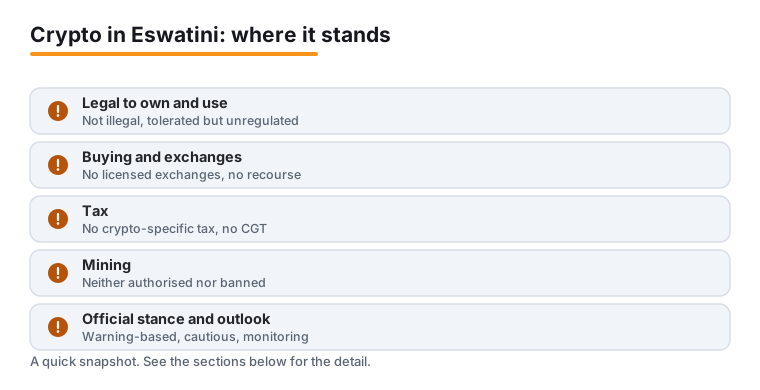
Owning, buying, and trading Bitcoin and other cryptocurrencies is not illegal in Eswatini. No statute prohibits residents from holding digital assets or transacting on exchanges. At the same time, no law grants crypto the status of legal tender or recognises it as official money. The only legal tender in the kingdom is the Eswatini lilangeni (plural: emalangeni), which is pegged one-to-one with, and circulates alongside, the South African rand under the Common Monetary Area arrangement.
The practical position is that crypto exists in a tolerated but unregulated space. The Central Bank of Eswatini has cautioned that cryptocurrencies are virtually unregulated and that there is no protection or legal recourse available from any institution, including the Central Bank, if something goes wrong. In short, holding crypto is permitted, but you do so largely at your own risk and without a dedicated consumer-protection regime behind you. That position did not change in 2026. Crypto is not mentioned anywhere in the 2026/27 Budget Speech delivered on 27 February 2026, in which the Minister for Finance stated that in the 2026/27 financial year Government does not intend to increase taxes other than the excise duties that were announced by South Africa.
Who regulates crypto in Eswatini?
No single authority comprehensively regulates cryptocurrency in Eswatini, but two institutions are central:
- Central Bank of Eswatini (CBE) is the monetary authority. It issues public guidance and warnings on cryptocurrencies, manages the national currency, administers exchange-control rules, and holds anti-money-laundering powers under the Money Laundering and Financing of Terrorism (Prevention) Act. The CBE has stated plainly that crypto is not legal tender and is not regulated as a payment instrument.
- Financial Services Regulatory Authority (FSRA) is the integrated regulator for non-bank financial services, established under the FSRA Act, 2010. It supervises insurance, retirement funds, capital markets, and credit and savings institutions. There is no FSRA licence category for crypto, but the FSRA already uses its general powers against unlicensed investment schemes promoted locally. It quoted section 35(1) of the Financial Services Regulatory Authority Act, 2010, which bars anyone from providing or holding themselves out as able to provide financial services without authorisation, in its public warning against QZ Asset Management dated 22 December 2022, and it cited section 35(1) together with section 38(1)(a) and (b) of the Securities Act, 2010 on unlicensed collective investment schemes in its notice against Pulse Glide, adding that breach constitutes criminal offences under section 35(2) of the FSRA Act and section 38(2) of the Securities Act. Neither case concerned crypto, but the same sections would reach a crypto investment scheme promoted in Eswatini.
- Eswatini Financial Intelligence Unit (EFIU), also referred to as the Eswatini Financial Intelligence Centre, is the national agency that receives, analyses, and disseminates financial intelligence to counter money laundering and terrorism financing. It supervises the AML/CFT compliance of accountable institutions and operates a registration system for them. The Central Bank's own cryptocurrency survey states that the Money Laundering and Financing of Terrorism (Prevention) Act designates virtual asset service providers as accountable institutions, expressly covering virtual currency exchanges that provide exchange or custodial services and entities that issue cryptocurrencies, regardless of whether those are pegged to reserve assets, cryptocurrencies, fiat money or exchange traded commodities. Those firms must register with the financial intelligence body. The correctly titled 2024 law, the Anti-Money Laundering, Counter Financing of Terrorism and Proliferation Financing (Miscellaneous Amendments) Act, 2024, went further: a regional legal review reports that it requires supervisory authorities to establish a framework to regulate virtual asset service providers. No such framework has been published.
Both the CBE and the FSRA have said they are closely monitoring regional and African developments in crypto regulation. You can verify the status of any firm claiming to offer financial services with the Central Bank of Eswatini or the Financial Services Regulatory Authority.
Key laws and frameworks
Eswatini does not yet have a standalone virtual-asset or crypto law. Several existing frameworks nonetheless shape how digital assets are treated:
- Money Laundering and Financing of Terrorism (Prevention) Act, 2011 (amended over time) is the cornerstone AML/CFT law, complemented by the Anti-Money Laundering, Counter Financing of Terrorism and Proliferation Financing (Miscellaneous Amendments) Act, 2024, which a regional legal review reports requires supervisory authorities, meaning any authority having oversight over an accountable institution, to establish a framework to regulate virtual asset service providers. As at August 2026 no such framework has been published. It imposes customer-identification, due-diligence, record-keeping, and suspicious-transaction-reporting duties on a wide range of "accountable institutions." The CBE derives anti-money-laundering powers from this Act.
- FSRA Act, 2010 establishes the non-bank financial-services regulator and its supervisory mandate.
- Exchange Control Order, 1974 and related regulations, administered through the Central Bank, govern cross-border movement of funds and foreign-currency transactions, which can be engaged when money moves offshore to buy crypto or when proceeds are repatriated.
- The Income Tax Order and related tax law, administered by the Eswatini Revenue Service, provide the general tax framework that can apply to crypto gains even without crypto-specific rules.
Until dedicated legislation is enacted, anyone running a crypto-related business in Eswatini should assume that general financial, company, consumer, tax, and AML laws can still apply, and should seek local legal advice. Eswatini is also part of the regional AML/CFT process led by the Eastern and Southern Africa Anti-Money Laundering Group (ESAAMLG) and assessed against the FATF standards, which increasingly push jurisdictions to bring virtual-asset service providers within reporting obligations.
Licensing and registration of exchanges and VASPs
There is currently no dedicated licensing or registration regime for crypto exchanges or virtual-asset service providers (VASPs) in Eswatini. Because no bespoke crypto licence exists, there is also no locally licensed, domestically domiciled exchange ecosystem comparable to larger markets.
That absence of a crypto-specific licence does not mean a free pass. A business dealing in crypto can still fall within the definition of an accountable institution under the Money Laundering and Financing of Terrorism (Prevention) Act, which would bring know-your-customer, record-keeping, and suspicious-transaction-reporting obligations. Legal analysis of the Southern African region reports that, under the Anti-Money Laundering and Counter-Terrorism Act, 2024, virtual-asset service providers in Eswatini are treated as accountable institutions and are expected to register with the Eswatini Financial Intelligence Unit and comply with fit-and-proper and AML/CFT requirements, even though no single dedicated crypto statute has been enacted. In the ESAAMLG FinTech follow up report of September 2025, Eswatini answered No to having specific regulation for virtual assets and VASPs, its approach to managing those risks was recorded as Not specified, and the measures it listed were public awareness initiatives, monitoring transactions, intercepting illegal deposits and law enforcement capacitation. It did confirm that existing AML/CFT/CPF measures apply to VASPs. Eswatini's rating on FATF Recommendation 15, which covers virtual assets, was Non-Compliant in its June 2022 mutual evaluation and remained Non-Compliant in the ESAAMLG technical compliance re-rating of August 2025, which did not re-assess R.15. Eswatini stays in enhanced follow up. Depending on the activity, general company registration, consumer-protection, and financial-services rules may also apply. The CBE has urged consumers to deal only with licensed firms and to verify any firm's registration with the Central Bank or the FSRA before engaging. Anyone planning to set up a crypto venture locally should obtain specific legal advice on how these overlapping rules apply, because the regulatory perimeter for VASPs is evolving and not yet codified in a single instrument.
Crypto and Bitcoin tax in Eswatini
Eswatini does not have tax rules written specifically for cryptocurrency, and it does not levy a separate, standalone capital gains tax. That does not make crypto gains automatically tax-free. General principles administered by the Eswatini Revenue Service (ERS) can still apply, and treatment typically depends on the nature of the transaction, for example whether a gain looks like income from a trade or business, payment for work, or an occasional disposal of a long-held holding. Gains that are income in nature can be brought into taxable income, which for individuals is assessed on a graduated scale that reaches a top marginal rate of 33 percent. If crypto activity is carried on through a company, company income is taxed at the standard corporate rate, which was reduced from 27.5 percent to 25 percent for financial years ending after 31 December 2024.
There is no crypto tax rate to state, because Eswatini taxes income rather than capital gains. PwC's Eswatini tax summary, last reviewed 30 March 2026, puts the rule plainly: capital gains are not subject to income tax, provided it can be demonstrated that the gains are of a capital and not an income nature, that is, not recurring transactions. Individuals whose gains are income in nature pay E47,500 plus 33 percent of the excess above E200,000 at the top band, with a rebate not exceeding E8,200 per tax year and a further E2,700 for those over 60, and the rates apply on the amount exceeding E41,000. Third-party sites that quote a flat crypto capital gains percentage for Eswatini are not describing any Eswatini rule. Practical points worth understanding:
- Crypto received as payment for work or services may be treated like other income.
- Frequent trading can be viewed differently from a one-off disposal.
- Keeping detailed records of dates, amounts, lilangeni values, counterparties, and fees makes correct reporting far easier.
Tax interpretation can change. Before filing, confirm your obligations directly with the Eswatini Revenue Service or a qualified local tax adviser, and see our general crypto taxes guide. This section is informational only and is not tax advice.
AML and KYC rules
Eswatini's anti-money-laundering and counter-financing-of-terrorism regime is set out in the Money Laundering and Financing of Terrorism (Prevention) Act, 2011, which has been amended over time, alongside the Anti-Money Laundering and Counter-Terrorism Act, 2024. Accountable institutions must identify and verify customers, conduct customer due diligence, keep records, and file suspicious-transaction reports, and these duties apply regardless of other laws.
While there is no crypto-specific licensing regime, a business dealing in virtual assets can be treated as an accountable institution and therefore subject to these KYC and reporting duties. Supervision of accountable institutions and the receipt of suspicious-transaction reports run through the Eswatini Financial Intelligence Unit, and legal reviews report that virtual-asset service providers are expected to register with it following the Anti-Money Laundering and Counter-Terrorism Act, 2024. In practice this means reputable exchanges serving Eswatini residents will ask for identity documents and proof of address. From a user's perspective, expect to complete identity verification on any legitimate platform, and treat any service that requires no verification at all as a red flag for fraud or sanctions risk. The CBE has specifically warned that the unregulated nature of crypto can facilitate money laundering and that some actors exploit it to run pyramid and scam schemes.
Buying and using crypto in practice
There is no licensed, locally domiciled crypto exchange in Eswatini, so most residents who buy crypto use international exchanges, regional platforms serving Southern Africa, or peer-to-peer (P2P) marketplaces. Because the lilangeni is pegged to and circulates with the South African rand, many users access rails oriented towards the South African market.
Two practical constraints stand out. First, banking access: local banks can be cautious about crypto-linked transactions, which may make funding an exchange account or converting back to emalangeni less straightforward. Second, exchange control: Eswatini operates exchange-control rules under the Exchange Control Order, 1974, administered through the Central Bank, which govern cross-border flows and foreign-currency transactions. Moving money offshore to buy crypto, or repatriating proceeds, can intersect with these controls, so larger or cross-border flows deserve particular care.
A sensible sequence is to choose a reputable platform that accepts Eswatini users, complete identity verification, fund the account mindful of bank scrutiny and exchange-control rules, move purchased crypto to a wallet you control rather than leaving large balances on an exchange, and keep records of prices in lilangeni and fees for tax purposes. Remember that if an overseas exchange fails or behaves dishonestly, your ability to seek redress from Eswatini's authorities is limited, precisely because the sector is not locally regulated. There is also no established network of Bitcoin ATMs in the kingdom, so online exchanges and P2P trades are the realistic routes to acquire Bitcoin.
Bitcoin mining in Eswatini
No law in Eswatini specifically authorises or bans cryptocurrency mining, and the country is not a significant Bitcoin-mining centre. Mining is therefore best understood as a general business and energy activity rather than a specially regulated one.
The main practical considerations are electricity and infrastructure. Eswatini imports a large share of its power and has a relatively small grid, so the cheap, abundant, reliable electricity that industrial mining depends on is not a given. Anyone contemplating mining should weigh energy cost and supply reliability (and whether on-site renewable generation such as solar is feasible), the cost of importing and cooling hardware, and standard business, customs, and tax compliance. We could not verify any dedicated government crypto-mining incentive scheme, so treat promotional claims of mining-specific grants or tax breaks with caution and confirm them directly with the relevant Eswatini authority before relying on them.
Recent developments (2024 to 2026)
Several developments shape the current picture. The Central Bank of Eswatini conducted a baseline cryptocurrency survey that found growing local interest in crypto, including among consumers with limited financial-markets knowledge, and identified three pivotal risks: the absence of consumer protection, the unauthorised provision of financial services, and money laundering. The survey also noted that a notable share of respondents had fallen victim to crypto-related scams.
Separately, the CBE researched a central bank digital currency, the Digital Lilangeni, completing diagnostic, proof-of-concept, and pilot phases and publishing a 2024 Digital Lilangeni Design Paper. The Bank has decided not to issue a CBDC at this time, prioritising other payment-infrastructure work such as a national payment switch, while stating it may revisit the question if conditions become more favourable. The AML framework was also strengthened through the Anti-Money Laundering and Counter-Terrorism Act, 2024, and legal reviews of the region report that this law extends to treating virtual-asset service providers as accountable institutions that should register with the Eswatini Financial Intelligence Unit and meet fit-and-proper and AML/CFT requirements. Eswatini also took part in the Eastern and Southern Africa Anti-Money Laundering Group (ESAAMLG) work on virtual assets, including a regional FinTech report and a follow-up report published in 2025 that track how member states without standalone crypto statutes are bringing VASPs within AML/CFT reporting. On the corporate-tax side, the standard company rate was reduced from 27.5 percent to 25 percent for financial years ending after 31 December 2024. The nearest thing to a timetable is payments law, not crypto law. Paragraph 44 of the 2026/27 Budget Speech records that the Central Bank, working with Government and supported by the World Bank, drafted National Payment System Regulations to operationalise the National Payment Systems Act of 2023, and that these regulations will enable the licensing of a broader range of payment service providers than what prevails at present. No commencement date has been published and the regulations do not create a virtual asset licence. Separately, the IMF Article IV mission that ran from 23 July to 5 August 2026 named updating the Central Bank of Eswatini Act and the Financial Services Regulatory Authority Act as priority financial sector reforms, without mentioning crypto or virtual assets.
Consumer risks and protection
The central risk in Eswatini is the absence of a tailored legal and consumer-protection framework. The Central Bank has expressly warned that crypto is virtually unregulated, that there is no protection or legal recourse from any institution including the Central Bank if an investment fails, and that consumers risk losing all their money with no compensation. It has also flagged that some actors exploit crypto platforms to run pyramid schemes and that citizens are frequently targeted by scammers.
On top of these, users face the price volatility inherent to crypto, reliance on overseas platforms with limited local recourse, cautious local banking, exchange-control friction, and uncertain tax treatment. Prudent practice is to risk only money you can afford to lose, use reputable platforms with strong security and proper KYC, verify any firm's registration with the CBE or FSRA before engaging, secure your own keys, beware of guaranteed-return and pyramid-style schemes, and keep records for tax purposes. Nothing on this page is a recommendation to buy or sell any asset.
Official sources and how to verify
Because Eswatini's crypto position is evolving and largely set by guidance rather than a single statute, always confirm the current rules with primary official sources rather than third-party summaries. The most authoritative starting points are:
- Central Bank of Eswatini for monetary policy, exchange control, the Digital Lilangeni, and its public guidance on dealing in cryptocurrencies.
- Financial Services Regulatory Authority (FSRA) for non-bank financial-services regulation, public warnings, and AML guidelines.
- Eswatini Revenue Service for income-tax obligations that may apply to crypto.
- Eswatini Financial Intelligence Unit (EFIU) for AML/CFT supervision of accountable institutions and registration information.
- EswatiniLII: Money Laundering and Financing of Terrorism (Prevention) Act, 2011 for the primary AML/CFT legislation.
This article is general information as of 2026 and is not legal, tax, or financial advice; verify your specific situation with the named official regulator, the Central Bank of Eswatini, or a qualified local professional. For broader background, see our crypto regulation guide and the regulation hub.
What is changing in 2026, and what is not
Eswatini's own law on crypto has not changed. No crypto bill has been tabled, no virtual asset licensing framework has been published, and no Central Bank or FSRA crypto statement dated 2025 or 2026 could be located. Crypto is not mentioned anywhere in the 2026/27 Budget Speech delivered on 27 February 2026, in which the Minister for Finance stated that in the 2026/27 financial year Government does not intend to increase taxes other than the excise duties that were announced by South Africa. Four things around it are moving.
| Item | Stage as at August 2026 | What it would mean in practice |
|---|---|---|
| Framework to regulate virtual asset service providers, required by the Anti-Money Laundering, Counter Financing of Terrorism and Proliferation Financing (Miscellaneous Amendments) Act, 2024 | Statutory duty recorded, no framework published, no draft, no timetable. In the ESAAMLG FinTech follow up report of September 2025 Eswatini answered No to having specific regulation for VAs and VASPs, and its approach to managing virtual asset risks was recorded as Not specified | The legal hook for a future crypto licence exists. A published licensing framework does not. Until it is built there is no locally authorised exchange and no local compensation or redress route |
| FATF Recommendation 15, the standard covering virtual assets | Rated Non-Compliant in Eswatini's June 2022 mutual evaluation and still Non-Compliant in the ESAAMLG technical compliance re-rating of August 2025. R.15 was not among the Recommendations Eswatini applied to have re-rated, and the report states that Eswatini will remain in enhanced follow up | Regional peer pressure to build a VASP regime continues, but no deadline is attached to it and no sanction is driving a date |
| National Payment System Regulations under the National Payments System Act, 2023 | Drafted by the Central Bank with Government and World Bank support, reported at paragraph 44 of the 2026/27 Budget Speech. No commencement date published | The Budget Speech says these regulations will enable the licensing of a broader range of payment service providers than what prevails at present. Not a crypto licence, but the most likely route by which a fiat on ramp serving Eswatini becomes a licensed activity |
| South Africa's draft Capital Flow Management Regulations, 2026, published for comment on 17 April 2026 in Government Gazette No. 7375 | Draft. They would replace South Africa's Exchange Control Regulations of 1961. The Reserve Bank joint statement says the amendments address gaps including in relation to cross-border crypto asset transactions | Not Eswatini law. It matters because many Eswatini residents buy crypto through South African oriented rails. Njogu Associates argues that South Africa, Lesotho, Namibia and Eswatini operate as a single exchange control territory under the Multilateral Monetary Agreement, so promulgation would carry across it. That is a law firm's view. No Eswatini authority has published a position |
The one place a formal crypto mandate could plausibly appear is the two statutes the IMF has flagged. The IMF Article IV mission that ran from 23 July to 5 August 2026 named updating the Central Bank of Eswatini Act and the Financial Services Regulatory Authority Act as priority financial sector reforms. Neither crypto nor virtual assets appear in the staff statement.
Which laws actually bite today, by name and section
There is no crypto statute. These are the instruments that apply anyway, with the authority that administers each.
- Money Laundering and Financing of Terrorism (Prevention) Act, 2011, as amended. The Central Bank's Eswatini Baseline Cryptocurrency Survey states that the Act designates virtual asset service providers as accountable institutions, covering virtual currency exchanges offering exchange or custodial services and entities issuing cryptocurrencies, regardless of whether they are pegged to reserve assets, cryptocurrencies, fiat money or exchange traded commodities. Registration with the financial intelligence body and full customer due diligence follow. The Central Bank's Financial Integrity Division is its dedicated AML and CFT supervisor.
- Financial Services Regulatory Authority Act, 2010, section 35(1). In its public warning against QZ Asset Management dated 22 December 2022 the FSRA quoted the section: a person shall not provide, purport to provide or hold himself or herself out as being able or authorised to provide financial services in Swaziland unless that person is an authorised financial services provider under this Part, or as otherwise permitted in this Act. In its notice against Pulse Glide the FSRA cited section 35(1) together with section 38(1)(a) and (b) of the Securities Act, 2010 on unlicensed collective investment schemes, and stated that breach constitutes criminal offences under section 35(2) of the FSRA Act and section 38(2) of the Securities Act. Neither case concerned crypto: QZ was promoted as an asset manager and Pulse Glide as an e-scooter rental investment scheme. They show the powers the FSRA uses against unlicensed schemes promoted locally.
- Financial Institutions Act, 2005, section 9(2). The Central Bank's cryptocurrency survey quotes it directly: no person shall engage in deposit-taking business in Swaziland without prior written authorisation from the Bank. The survey cites this when addressing crypto operators who take in public funds.
- Exchange Control Order, 1974 and Regulations under Legal Notice No. 2 of 1975. Administered by the Central Bank's Financial Surveillance Division, which the Bank describes as acting under section 48 of the Central Bank Order, 1974 and as responsible for licensing Authorised Dealers with Limited Authority.
- National Payments System Act, 2023. Section 9 covers licensing of payment system categories, sections 16 and 29 cover money or value transfer service providers and their agents, and section 31 subjects them to AML/CFT/PF requirements.
- CBE FinTech Regulatory Sandbox. The only live testing route for an innovative financial product, open to financial institutions, fintechs and professional service firms supporting them, testing products and business models regulated by the Central Bank. The published sandbox material does not mention crypto or virtual assets, and approved applicants are expected to enter the sandbox within 21 working days of approval.
On tax, the default is the general income tax system administered by the Eswatini Revenue Service. Individuals pay a graduated rate reaching E47,500 plus 33 percent of the excess above E200,000, with a rebate not exceeding E8,200 per tax year and a further E2,700 for those over 60, and the rates apply on the amount exceeding E41,000, per the ERS rates and thresholds page and PwC's Eswatini summary last reviewed 30 March 2026. Companies pay 25 percent for year-ends after 31 December 2024. There is no separate capital gains tax: capital gains are not subject to income tax, provided it can be demonstrated that the gains are of a capital and not an income nature (i.e. not recurring transactions).
How large is crypto in Eswatini, in official numbers
The Eswatini Baseline Cryptocurrency Survey, which the Central Bank commissioned from the Eswatini Economic Policy Analysis and Research Centre and published in December 2023, reached 4,561 individual respondents and 34 financial service providers. Its headline findings:
- Awareness of cryptocurrency stood at 88.1 percent, but only 8.5 percent owned crypto at the time of the survey and a further 12.4 percent had held it previously. Among crypto-aware respondents, 79.0 percent had never owned any.
- Bitcoin was held by 43.5 percent of owners and Ethereum by 10.9 percent. Named acquisition platforms included LUNO, Altcoin Trader, Dashtrader, Timetrade, Okex, Coinbase, StashCentral and Binance.
- 48.4 percent reported a limited understanding of cryptocurrency, while 49.4 percent said they intend to hold crypto in future. The main motives given were fear of missing out, 62 percent, and making quick money, 59 percent.
- Among respondents who possessed cryptocurrencies, 45 percent had encountered scams. The largest single scam type was group investment or Ponzi schemes at 57.3 percent, followed by fraudulent links to counterfeit websites at 13.6 percent and unsolicited phone calls or text messages at 11.4 percent.
- Only two of the 34 financial service providers surveyed held cryptocurrencies on their balance sheets.
For scale, Eswatini reported estimated 2024 virtual asset transaction values of US$36,498.52 in inflows and US$175,749.25 in outflows to the ESAAMLG FinTech follow up report published in September 2025, one of only five member jurisdictions out of 17 able to supply an estimate. Eswatini's 2023 National Risk Assessment rated Virtual Assets High for money laundering risk, alongside the securities sector, real estate, legal practitioners and dealers in motor vehicles, according to the ESAAMLG follow up report of August 2025.
Frequently asked questions
Is Bitcoin legal in Eswatini?
Yes, owning and trading Bitcoin is not prohibited in Eswatini. However, crypto is not legal tender and is not formally regulated, so it sits in a legal grey area without dedicated consumer protections. Only the lilangeni and the South African rand are legal tender. The Central Bank of Eswatini has warned that crypto is virtually unregulated and that you trade it at your own risk.
Who regulates cryptocurrency in Eswatini?
No single authority comprehensively regulates crypto. The Central Bank of Eswatini issues warnings, manages the currency and exchange control, and holds anti-money-laundering powers under the Money Laundering and Financing of Terrorism (Prevention) Act, 2011. The Financial Services Regulatory Authority (FSRA) supervises non-bank financial services but, based on available official information, not cryptocurrencies specifically. Crypto businesses may still fall under AML obligations.
Do I have to pay tax on crypto in Eswatini?
Eswatini has no crypto-specific tax law and no separate capital gains tax, but general principles administered by the Eswatini Revenue Service can still apply, especially where a gain looks like income from a trade or payment. Because the position is uncertain, keep detailed records and confirm your obligations with the Eswatini Revenue Service or a qualified tax adviser. This is not tax advice.
Is there a licence to run a crypto exchange in Eswatini?
There is currently no dedicated crypto or VASP licensing regime in Eswatini, and no locally domiciled licensed exchange. A crypto business can still be treated as an accountable institution under the 2011 AML Act, triggering KYC, record-keeping, and reporting duties, and general company and financial laws may also apply. Anyone setting up locally should obtain specific legal advice and check current requirements with the Central Bank and FSRA.
Has Eswatini launched a digital lilangeni (CBDC)?
No. The Central Bank of Eswatini researched a central bank digital currency, completed diagnostic, proof-of-concept, and pilot phases, and published a 2024 Digital Lilangeni Design Paper, but it decided not to issue a CBDC at this time. It has said it may revisit the question if conditions become more favourable. This is separate from private cryptocurrencies like Bitcoin, which remain unregulated.
Can I send Bitcoin abroad from Eswatini for remittances?
There is no specific ban on using Bitcoin for cross-border transfers, and some people use crypto to move value internationally. However, Eswatini's exchange-control rules under the Exchange Control Order, 1974 govern cross-border flows of funds and foreign currency, and converting to or from emalangeni can be a friction point. Larger or regular cross-border activity should be reviewed against current exchange-control requirements with the Central Bank of Eswatini.
Do crypto exchanges in Eswatini have to register with the Financial Intelligence Unit?
Eswatini has no standalone crypto licence, but legal reviews of the region report that, under the Anti-Money Laundering and Counter-Terrorism Act, 2024, a virtual-asset service provider is treated as an accountable institution and is expected to register with the Eswatini Financial Intelligence Unit (also called the Eswatini Financial Intelligence Centre) and meet AML/CFT and fit-and-proper requirements. Regional bodies have noted the exact perimeter is still settling, so confirm the current position with the EFIU, the Central Bank of Eswatini, and the FSRA before operating.
What tax rate applies to crypto gains in Eswatini?
There is no crypto-specific tax and no separate capital gains tax, so treatment depends on the nature of the transaction under general rules administered by the Eswatini Revenue Service. Where a gain is income in nature, individuals are assessed on a graduated scale reaching a top marginal rate of 33 percent, while company income is taxed at the standard corporate rate, which was reduced from 27.5 percent to 25 percent for financial years ending after 31 December 2024. Because the position is uncertain for occasional disposals, keep records and confirm with the Eswatini Revenue Service or a qualified adviser. This is not tax advice.
Is there a crypto law in Eswatini in 2026?
No. There is no crypto statute and no published virtual asset licensing framework. What does apply is the Money Laundering and Financing of Terrorism (Prevention) Act, 2011 as amended, which the Central Bank's own cryptocurrency survey says designates virtual asset service providers as accountable institutions that must register with the financial intelligence body, and the Anti-Money Laundering, Counter Financing of Terrorism and Proliferation Financing (Miscellaneous Amendments) Act, 2024, which a regional legal review reports requires supervisory authorities to establish a framework to regulate VASPs. No such framework had been published as at August 2026.
When will Eswatini regulate crypto exchanges?
No date has been published anywhere that could be verified. There is no bill, no draft framework and no consultation. In the ESAAMLG FinTech follow up report of September 2025, Eswatini reported that it has no specific regulation for virtual assets or VASPs and did not specify an approach to managing the risks. Its rating on FATF Recommendation 15 was still Non-Compliant in the August 2025 re-rating, which did not re-assess that Recommendation, and it remains in enhanced follow up, which creates peer pressure but no deadline.
Did the 2026/27 Eswatini budget change anything for crypto?
No. Crypto is not mentioned in the Budget Speech delivered on 27 February 2026, and the Minister for Finance stated that in the 2026/27 financial year Government does not intend to increase taxes other than the excise duties that were announced by South Africa. The one financial sector item with a bearing on crypto adjacent businesses is that the Central Bank, with Government and World Bank support, has drafted National Payment System Regulations to operationalise the National Payment Systems Act of 2023, which would widen the range of payment service providers requiring a licence.
Will South Africa's new exchange control rules affect crypto users in Eswatini?
Possibly, indirectly. South Africa's draft Capital Flow Management Regulations, 2026 were published for comment on 17 April 2026 in Government Gazette No. 7375 and would replace the Exchange Control Regulations of 1961. The Reserve Bank joint statement says they address gaps including in relation to cross-border crypto asset transactions. They are South African law, not Eswatini law, but many Eswatini residents buy crypto through South African oriented rails so the rules would be felt in practice. Njogu Associates argues the Common Monetary Area operates as a single exchange control territory under the Multilateral Monetary Agreement, but that is a law firm's view, no Eswatini authority has published a position, and Eswatini's own instrument remains the Exchange Control Order, 1974 with regulations under Legal Notice No. 2 of 1975.
How many people in Eswatini actually own crypto?
The Central Bank's Eswatini Baseline Cryptocurrency Survey, published December 2023 and based on 4,561 individual respondents, found awareness of 88.1 percent but current ownership of only 8.5 percent, with a further 12.4 percent having held crypto previously. Bitcoin was held by 43.5 percent of owners and Ethereum by 10.9 percent. 49.4 percent said they intend to hold crypto in future, and among those who possessed cryptocurrencies 45 percent had encountered scams, most often group investment or Ponzi schemes.
Facts reviewed: 13 August 2026. Page updated: 13 August 2026.