Home › Crypto Regulation › Nicaragua
Bitcoin & Cryptocurrency Regulation in Nicaragua
Quick answer — Nicaragua, 2026
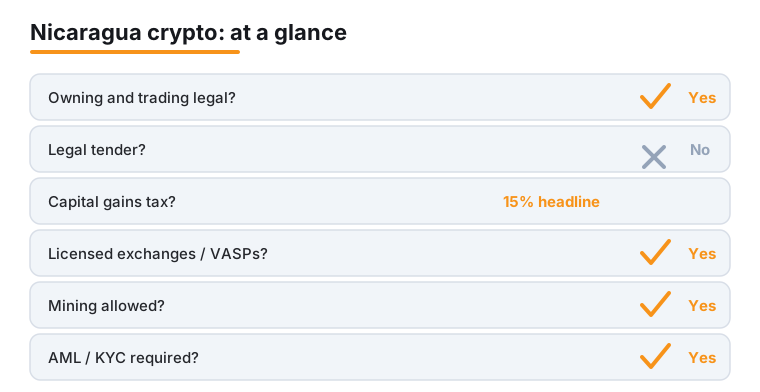
- Owning, buying and trading crypto is legal, but it is not legal tender; only the cordoba is.
- No crypto-specific tax law, but general rules can apply: capital gains at 15 percent, or income tax for trading, mining or a crypto business.
- Residents mostly buy via international exchanges, P2P or BCN-authorised providers, funding in cordobas or US dollars.
Nicaragua does not treat cryptocurrency the way its neighbour El Salvador once did. Bitcoin is not legal tender, and there is no headline crypto law making it official money. Instead, Nicaragua has folded virtual assets into its existing financial-supervision and anti-money-laundering system. The Banco Central de Nicaragua (BCN) authorises and supervises the firms that provide payment-technology and virtual-asset services, and the Unidad de Analisis Financiero (UAF) polices those firms for money laundering and terrorist financing. Owning and trading crypto is not banned, but the framework is supervisory and cautious rather than promotional.
This guide explains how Bitcoin and other digital assets are treated in Nicaragua as of 2026, including legal status, the regulators, the 2025 rules, taxation, buying and using crypto, mining, remittances and the real-world risks. It is general information as of 2026 and is not legal, tax or financial advice; readers should verify any specific question with the official regulators named here, in particular the Banco Central de Nicaragua and the Unidad de Analisis Financiero, or a qualified Nicaraguan professional. See also our overview of how crypto regulation works.
On this page: Legal status · Who regulates it · Taxes · How to buy · Mining
Is Bitcoin and crypto legal in Nicaragua?
Yes, in the sense that no law prohibits individuals from owning, buying, selling or holding Bitcoin and other crypto assets. Nicaragua has not banned cryptocurrency, and private use between consenting parties is generally permitted.
What crypto is not is legal tender. The Nicaraguan cordoba, issued by the Banco Central de Nicaragua (BCN), remains the official currency, and the US dollar circulates widely alongside it in everyday commerce. No merchant is required to accept Bitcoin, and unlike El Salvador, Nicaragua has shown no sign of granting crypto official-money status. In short, crypto sits in a tolerated-but-supervised middle ground: it is a defined category of digital asset that licensed businesses can handle, not an outlawed activity and not endorsed money. As of 2026 the framework is still maturing, so treat the environment as evolving rather than fully settled.
Who regulates crypto in Nicaragua?
Two bodies share responsibility, and a crypto business typically has to satisfy both:
- Banco Central de Nicaragua (BCN) is the authorising and supervising body for payment-technology providers (proveedores de servicios de pago, PSP) and virtual-asset service providers (proveedores de servicios de activos virtuales, PSAV). A firm wanting to exchange, transfer, custody or administer virtual assets must be authorised and registered by the BCN before operating. The BCN's official site is bcn.gob.ni, and its financial-surveillance section publishes the governing norms.
- Unidad de Analisis Financiero (UAF) is Nicaragua's financial-intelligence unit, created by Law No. 793 and now governed by Law No. 976. It supervises virtual-asset service providers as obligated subjects (sujetos obligados) for the prevention of money laundering, terrorist financing and proliferation financing. PSAV firms must also register with the UAF, whose official site is uaf.gob.ni.
Tax matters fall to a third body, the Direccion General de Ingresos (DGI), Nicaragua's tax authority. There is no single consumer-facing crypto law; instead these institutions apply financial-services, AML and general tax rules to crypto activity.
Key laws and frameworks (2025 norm)
Nicaragua regulates crypto through its financial-services and anti-money-laundering framework rather than a dedicated digital-asset statute. The current building blocks are:
- The 2025 norm. On 23 April 2025 the Consejo Directivo de Politica Monetaria y Financiera approved Resolution CDMF-XIII-2-25, the Norma de los proveedores de tecnologia financiera de servicios de pago y de los proveedores de servicios de activos virtuales. It is accompanied by an application regulation, Administrative Resolution GG-08-MAYO-2025-LASMF-DO. Together these replaced the earlier 2022 fintech regulation (Resolution CD-BCN-XXV-1-22) and strengthened licensing, governance, minimum-capital and technology requirements.
- Definition of virtual asset. The framework defines a virtual asset as a digital representation of value that can be commercially traded or transferred digitally and used for payments or investment, while expressly excluding digital representations of fiat currency, securities and other financial assets. The rules cover crypto-type assets, not central-bank money.
- AML laws. The anti-money-laundering regime rests on Law No. 977 (Ley contra el Lavado de Activos) and Law No. 976 (the UAF law), under which virtual-asset providers are obligated subjects.
- UAF crypto-specific AML rule. In 2025 the UAF issued Normativa UAF-N-026-2025, a prevention, detection and reporting standard aimed specifically at virtual-asset service providers (see the AML section below).
Specific thresholds, capital levels and reporting duties can be revised, so any business should consult the current BCN and UAF texts directly rather than relying on summaries.
Licensing and registration of exchanges and VASPs
Nicaragua operates an authorisation-and-registration regime for virtual-asset service providers. Under the 2025 norm, a PSAV is an entity authorised by the BCN to carry out one or more of the following: exchange between virtual assets and fiat currency; exchange between different forms of virtual assets; transfer of virtual assets; custody or administration of virtual assets (or instruments giving control over them); and participation in or provision of financial services related to the offer or sale of a virtual asset.
Key obligations introduced or reinforced by the 2025 framework include:
- Prior authorisation from the BCN before operating, plus registration with the UAF as an obligated subject.
- Minimum capital set on a differentiated basis according to the scope of services offered. Reported figures put the minimum share capital in the range of about 4 million to 11 million cordobas depending on the services provided.
- Governance requirements, including appointing a general manager or principal executive who must obtain background clearances and a BCN non-objection.
- Strengthened technology and operational standards, covering cybersecurity, customer authentication, operational traceability, data backup and business continuity, including compliance with the Travel Rule so that originator and beneficiary information travels with a virtual-asset transfer across platforms.
Existing licensed entities were given staged transition periods to adapt. Reported deadlines gave already-licensed providers until 29 May 2026 to adapt their technology platform and to meet risk-management, internal-control and operational obligations, and until 18 December 2026 to adjust their minimum share capital. Anyone planning to operate, or relying on a platform that claims to be licensed, should confirm its current status directly with the BCN and UAF.
Crypto and Bitcoin tax in Nicaragua
Nicaragua has no crypto-specific tax law, but that does not mean crypto activity is automatically tax-free. The general tax framework, set out in the Ley de Concertacion Tributaria (the Tax Concertation Law) and administered by the Direccion General de Ingresos (DGI), can apply to crypto gains and income depending on the nature of the activity.
Two general features of the system are relevant:
- Capital gains. Nicaragua's general rule taxes capital gains, defined as variations in the value of a taxpayer's assets arising from a sale, transfer or assignment of rights, at a headline rate of 15 percent on the difference between transfer value and acquisition cost, usually collected by definitive withholding. Whether a particular crypto disposal is treated this way, and by whom the tax must be withheld and declared, can depend on the facts.
- Ordinary or business income. Frequent trading, mining, accepting crypto in a business or running crypto-related services is more likely to be treated as ordinary or business income under the progressive income-tax rules rather than as a one-off capital gain.
Because there is no published, crypto-tailored guidance, this guide deliberately does not assign a single fixed rate to every crypto scenario. Practical steps that apply regardless: keep detailed records (dates, amounts, counterparties, fees and the cordoba or dollar value at the time); distinguish casual personal use from regular trading or a crypto business; and confirm your obligations with the DGI or a qualified Nicaraguan tax adviser. See our general guide to crypto taxes. This is general information, not tax advice.
AML and KYC rules for crypto
Anti-money-laundering compliance is the most developed part of Nicaragua's crypto framework. Virtual-asset service providers are obligated subjects supervised by the UAF and must implement prevention measures under Law No. 977, Law No. 976 and the UAF's standards.
In 2025 the UAF issued Normativa UAF-N-026-2025, published in La Gaceta, the official gazette, in January 2025, setting out prevention, detection and reporting duties specifically for virtual-asset service providers. Reported measures include:
- Reporting of unusual or suspicious virtual transactions of US$1,000 or more, with reports channelled through the supervisory system.
- Know-Your-Customer identification of both the sender and the beneficiary of a transfer.
- Technical monitoring, including reviewing the internet IP addresses used in transactions.
- Coverage of a broad range of activity, including cryptocurrencies, asset transfers, smart contracts, virtual wallets and non-custodial wallets.
- Travel Rule. Reporting on the 2025 rule indicates providers must apply the Travel Rule, obtaining and passing on accurate information about the originator and beneficiary of each virtual-asset transfer.
- Personal responsibility for managers and directors, and the ability to terminate relationships with parties suspected of illicit activity.
In practice this means a compliant Nicaraguan provider will run identity checks and monitor transactions, and customers should expect to verify their identity. International platforms apply their own KYC and may restrict some services for Nicaraguan users.
Buying and using crypto in practice
There is no large domestic exchange ecosystem in Nicaragua. Most people who buy crypto do so through international exchanges that accept Nicaraguan users, through peer-to-peer (P2P) marketplaces, or via locally authorised providers where they exist. Funding typically happens in cordobas or US dollars by bank transfer or card, or with cash on P2P platforms.
Things to understand before buying:
- Compliance and KYC. Any provider operating legally in Nicaragua should be authorised by the BCN and registered with the UAF and will run identity checks. Verify a platform's status rather than taking marketing claims at face value.
- Banking access. Nicaragua's banking sector has limited international connectivity, and US sanctions affecting parts of the government and economy can complicate cross-border payments, which may affect funding and withdrawals on some platforms.
- Stablecoins. Dollar-pegged stablecoins are widely used across the region for holding value and moving money, but they remain crypto assets subject to the same compliance and counterparty considerations.
- ATMs. Physical Bitcoin-ATM coverage is very limited and fluctuates, sometimes with none in service, so it is rarely the cheapest or most reliable option.
A typical compliant path is: choose a platform that genuinely serves Nicaragua; complete KYC; fund the account; place the order (some users buy a stablecoin first for steadier dollar exposure); withdraw to a wallet you control and back up your recovery phrase offline; and keep records of every transaction for possible tax reporting.
Sending remittances with crypto
This is where crypto is most relevant to Nicaragua. Remittances are central to the economy: money sent home by Nicaraguans abroad, the large majority from the United States, runs into billions of dollars a year and represents a very large share of national income. According to an Inter-American Development Bank estimate reported in early 2026, remittances to Nicaragua reached about 6.2 billion US dollars in 2025, a rise of roughly 18 percent on 2024 and equal to a large share of gross domestic product, commonly estimated at somewhere around a quarter, which places Nicaragua among the most remittance-dependent countries in Latin America and the Caribbean.
Against that backdrop, Bitcoin and, more often in practice, dollar-pegged stablecoins offer an alternative to traditional money-transfer operators and banks:
- Speed and cost. Crypto transfers can settle quickly and around the clock, and in some corridors can undercut conventional remittance fees.
- Volatility. Bitcoin's price can swing sharply, so many people prefer stablecoins for the transfer leg and convert promptly to dollars or cordobas.
- Cash-out friction. The real cost and convenience depend on how easily the recipient can convert crypto to local money, typically via a P2P trade, an exchange or an authorised provider.
- Compliance. Using providers authorised by the BCN and registered with the UAF keeps funds in the formal system, but note the AML monitoring of larger or unusual transactions described above.
Crypto remittances are a growing but still niche channel; traditional operators and dollar cash remain dominant, and the practical bottleneck is usually cashing out rather than sending.
Bitcoin mining in Nicaragua
There is no specific law banning or specially promoting Bitcoin mining in Nicaragua, so it falls under general rules on business activity, electricity use and the import of equipment. The country is not a recognised mining hub, and several practical factors weigh on the activity:
- Electricity supply and cost. Mining is highly sensitive to power prices and grid reliability. Nicaragua has invested in renewable generation (including geothermal, hydro, wind and solar), which in principle offers cleaner energy, but tariffs, supply stability and grid access are the deciding factors.
- Regulatory uncertainty. Without a dedicated mining framework, operators rely on general energy and commercial regulation, which can leave the rules for large-scale mining ambiguous.
- Hardware and setup. Importing rigs carries customs costs, and running a mining business means formalising an entity and meeting tax and registration requirements.
- Income treatment. Coins earned from mining may be treated as income under general tax rules; confirm with the DGI or an adviser.
Anyone considering a sizeable operation should seek local legal, tax and energy advice first, because the economics hinge on cheap, dependable power and clear rules, neither of which is guaranteed.
Recent developments (2025-2026)
The most important recent change is the overhaul of the fintech and virtual-asset framework in 2025:
- New core norm. Resolution CDMF-XIII-2-25 of 23 April 2025 replaced the 2022 regulation, with the application regulation GG-08-MAYO-2025-LASMF-DO setting out detailed requirements for PSP and PSAV providers, including stronger capital, governance, cybersecurity and operational standards.
- Dedicated crypto AML rule. The UAF's Normativa UAF-N-026-2025, published in La Gaceta in January 2025, established prevention, detection and reporting obligations for virtual-asset service providers, including reporting of unusual or suspicious transactions from US$1,000 and identification of both senders and beneficiaries.
- Transition periods. Existing licensed providers were given staged deadlines: reporting points to 29 May 2026 for technology, risk-management and operational adjustments and 18 December 2026 for minimum-capital adjustments. Reported minimum share capital runs from about 4 million to 11 million cordobas by service type, and providers must apply the Travel Rule to virtual-asset transfers.
- Remittance backdrop. An Inter-American Development Bank estimate reported in early 2026 put 2025 remittances to Nicaragua at about 6.2 billion US dollars, up roughly 18 percent on 2024 and equal to a large share of GDP, which keeps the pressure on faster, cheaper transfer channels including stablecoins.
- Direction of travel. The trend is toward formal supervision and AML alignment, not prohibition and not legal-tender status. The everyday ecosystem of exchanges, ATMs and merchant acceptance remains underdeveloped.
Because rules and deadlines in this area are being implemented and may be amended, confirm the current text and timelines directly with the BCN and UAF.
Consumer risks and protection
Crypto in Nicaragua carries the usual hazards plus some country-specific ones, and consumer-protection structures for crypto are limited:
- Volatility. Bitcoin can rise or fall dramatically and is not a reliable short-term store of value; stablecoins reduce price swings but add issuer, regulatory and de-peg risk.
- Scams and fraud. Fake investment schemes and platforms offering guaranteed returns are common across the region; ignore anyone promising fixed profits or price predictions.
- Platform and custody risk. Exchanges and custodians can fail or freeze funds; self-custody puts you in control but makes you solely responsible for your keys and recovery phrase.
- Thin infrastructure and banking constraints. Limited and partly sanctioned banking links can complicate funding and, crucially, cashing out.
- Limited recourse. Because the framework is supervisory rather than consumer-facing, there is no dedicated crypto compensation scheme; the main protections come from using authorised, AML-compliant providers and from general consumer and fraud law.
Practical takeaways: use registered, compliant channels; never invest more than you can afford to lose; plan your exit route before you buy; and keep thorough records. This page is informational only and is not legal, tax or financial advice.
Official sources and how to verify
Because Nicaragua's crypto rules are evolving, always confirm specifics with the primary sources rather than relying on third-party summaries (including this one):
- Banco Central de Nicaragua (BCN) for licensing of PSP and PSAV providers and the governing norms: bcn.gob.ni.
- Unidad de Analisis Financiero (UAF) for AML obligations, the register of obligated subjects and the 2025 crypto AML standard: uaf.gob.ni.
- Direccion General de Ingresos (DGI) for tax questions, including how capital gains and income rules apply: dgi.gob.ni.
For wider context, see our regulation hub and our explainer on how crypto regulation works. This guide is general information as of 2026 and is not legal, tax or financial advice; verify any specific question with the named official regulators, in particular the Banco Central de Nicaragua and the Unidad de Analisis Financiero, or a qualified Nicaraguan professional before acting.
Frequently asked questions
Is cryptocurrency legal in Nicaragua?
Yes, in the sense that no law bans owning, buying, selling or holding Bitcoin and other crypto assets for individuals. However, crypto is not legal tender. Only the cordoba, issued by the Banco Central de Nicaragua, has that status, and the US dollar also circulates widely, so no business is required to accept crypto.
Who regulates crypto in Nicaragua?
The Banco Central de Nicaragua (BCN) authorises and supervises payment-technology providers and virtual-asset service providers (PSAV) under the 2025 norm (Resolution CDMF-XIII-2-25 and Administrative Resolution GG-08-MAYO-2025-LASMF-DO), which replaced the 2022 regulation. The Unidad de Analisis Financiero (UAF) supervises those providers for anti-money-laundering purposes. The Direccion General de Ingresos (DGI) handles tax. There is no standalone consumer crypto law.
Do I have to pay tax on crypto in Nicaragua?
There is no crypto-specific tax law, but the general framework under the Ley de Concertacion Tributaria, administered by the DGI, can apply. As a general rule capital gains are taxed at a headline rate of 15 percent on the difference between transfer value and acquisition cost, while frequent trading, mining or a crypto business may be taxed as ordinary or business income. Because crypto treatment is not separately codified, confirm your situation with the DGI or a qualified Nicaraguan tax adviser. This is general information, not tax advice.
What changed in 2025?
Nicaragua overhauled its fintech and virtual-asset framework. Resolution CDMF-XIII-2-25 (23 April 2025) and its application regulation GG-08-MAYO-2025-LASMF-DO replaced the 2022 rules, strengthening licensing, capital, governance and technology requirements for providers. Separately, the UAF issued Normativa UAF-N-026-2025, a dedicated anti-money-laundering standard for virtual-asset service providers, including reporting of unusual or suspicious transactions from US$1,000 and identification of senders and beneficiaries.
Can I use crypto to send remittances to Nicaragua?
Yes. Bitcoin and especially dollar-pegged stablecoins can be used to send money to Nicaragua quickly and around the clock, potentially cheaper than some traditional services. The main practical challenge is cashing out into cordobas or dollars locally, typically via a P2P trade, exchange or authorised provider, and larger or unusual transactions may be subject to UAF reporting. Traditional remittance operators still dominate.
Does Nicaragua monitor my crypto transactions?
Yes, for transactions handled by regulated providers. Under the UAF's 2025 standard (Normativa UAF-N-026-2025), virtual-asset service providers must treat virtual transfers and payments of 1,000 US dollars or more as potentially unusual or suspicious and report them, identify both the sender and the beneficiary, and monitor details such as the internet IP address used. Providers must also apply the Travel Rule, passing originator and beneficiary information with a transfer. Individual holders are not registered directly, but activity that runs through a compliant provider is subject to this monitoring.
What is the minimum capital for a crypto provider in Nicaragua?
Under the 2025 norm, virtual-asset service providers must hold a minimum share capital set by the type of services they offer. Reported figures put this in the range of about 4 million to 11 million cordobas. Existing providers were given until 18 December 2026 to adjust their capital and until 29 May 2026 to meet technology, risk-management and operational requirements. Confirm the exact figure and current deadlines with the Banco Central de Nicaragua before relying on them.
How do I verify the current rules?
Check the primary sources directly: the Banco Central de Nicaragua (bcn.gob.ni) for licensing and the governing norms, the Unidad de Analisis Financiero (uaf.gob.ni) for anti-money-laundering obligations, and the Direccion General de Ingresos (dgi.gob.ni) for tax. Rules and deadlines are still being implemented and may be amended, so always confirm with these official regulators or a qualified Nicaraguan professional before acting.
Facts reviewed: 30 June 2026. Page updated: 3 August 2026.
Related guides
More countries in the region
Practical guides