Home › Crypto Regulation › Honduras
Bitcoin & Cryptocurrency Regulation in Honduras
Quick answer — Honduras, 2026
- Legal: Legal for individuals, not legal tender; banks barred from crypto
- Tax: No crypto-specific tax; general income rules via SAR may apply
- Buying: Via global exchanges, P2P and limited ATMs; no licensed local exchange
Honduras sits in a cautious middle ground in Latin America's crypto landscape. Unlike neighbouring El Salvador, which made Bitcoin legal tender, Honduras has never granted crypto legal-tender status, and in February 2024 its banking regulator barred supervised banks and insurers from dealing in virtual assets. At the same time, no law prohibits private individuals from owning or trading cryptocurrency, so personal use continues in a tolerated but unregulated grey area. This guide explains where things stand for residents and visitors as of 2026: the legal status of crypto, who regulates it, how tax and anti-money-laundering rules may apply, how to buy and use crypto in practice, and how to verify the current position with the official authorities. For broader background, see our overview of crypto regulation.
This article is general information as of 2026 and is not legal, tax or financial advice. Crypto rules in Honduras are limited and evolving, so you should verify your situation with the named official regulators (the CNBS and the Banco Central de Honduras) and a qualified Honduran professional before acting.
On this page: Legal status · Who regulates it · Taxes · How to buy · Mining
Is Bitcoin and crypto legal in Honduras?
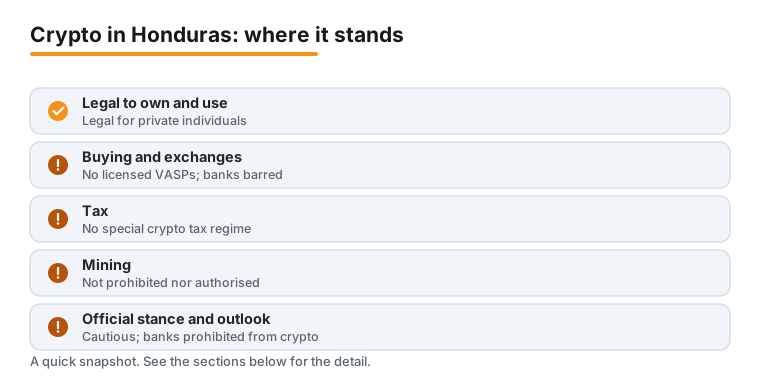
Owning, buying, selling and using cryptocurrency such as Bitcoin is not illegal for private individuals in Honduras. No law prohibits a resident from holding crypto in a personal wallet or trading peer-to-peer. The Banco Central de Honduras (BCH) has stressed, however, that cryptocurrencies have no legal backing in the country, are not regulated, and are used entirely at the holder's own risk.
Crypto is not legal tender. Under Article 342 of the Honduran Constitution, the BCH is the sole issuer of coins and banknotes of legal tender, so only the lempira (and currencies the central bank authorises) must be accepted to settle debts. No merchant or creditor is obliged to accept Bitcoin or any token.
The key distinction is between private use and the regulated financial system. Individuals operate in a tolerated but unprotected grey area, while supervised banks and insurers are explicitly prohibited from dealing in crypto (see the next section). In short: you may hold Bitcoin, but a Honduran bank cannot custody it, buy it for you, or knowingly process crypto transactions on your behalf.
Who regulates crypto in Honduras?
There is no single dedicated crypto regulator. Oversight is shared among the existing financial authorities:
- Comision Nacional de Bancos y Seguros (CNBS) - the National Banking and Insurance Commission, which supervises banks, insurers and the formal financial sector. The CNBS issued the February 2024 prohibition on crypto activity by supervised institutions and operates a Financial Innovation Hub.
- Banco Central de Honduras (BCH) - the central bank, responsible for the lempira and the only authority permitted to issue legal-tender currency. The BCH decides whether any virtual asset is authorised and is studying a possible central bank digital currency.
- Servicio de Administracion de Rentas (SAR) - the tax administration, which applies general income-tax rules that can capture crypto-related gains and business revenue.
- Anti-money-laundering authorities - obliged entities and reporting rules under Honduras's AML framework can reach crypto-related flows.
You can confirm any of this directly with the CNBS and the Banco Central de Honduras.
Key laws and frameworks
Honduras does not yet have a comprehensive, standalone cryptocurrency law. The framework is shaped by existing financial, monetary and anti-money-laundering rules, plus one decisive regulatory action.
The most significant measure is CNBS Circular No. 003/2024, adopted via Resolution 069/09-02-2024 at CNBS session No. 1779 on 9 February 2024 and published on 12 February 2024. It instructs all institutions under CNBS supervision (commercial and state banks, financial companies, insurers, reinsurers and similar entities) to abstain from maintaining, investing in, intermediating, brokering or operating with cryptocurrencies, virtual currencies, tokens or any similar virtual asset not issued or authorised by the BCH. It also bars them from holding assets or liabilities whose returns depend on crypto-price movements. The CNBS cited risks of fraud, money laundering, terrorist financing and high volatility, and noted that many platforms are domiciled across multiple jurisdictions beyond Honduran supervision.
Constitutionally, Article 342 reserves legal-tender issuance to the BCH, and the Monetary Law and Central Bank Law reinforce that monopoly, which is why non-authorised digital assets carry no legal recognition. You can read the official measure in the CNBS Circular No. 003/2024.
Some templated articles online claim Honduras has enacted detailed personal crypto-holding disclosure laws with asset seizure for non-disclosure. There is no widely documented statute of that kind; treat such claims with caution and verify any specific requirement directly with the authorities.
Licensing and registration of exchanges (VASPs)
As of 2026 Honduras has no licensing or registration regime specifically for cryptocurrency exchanges or virtual-asset service providers (VASPs). There is no crypto exchange licensed or supervised inside the country, and because CNBS-regulated banks are barred from crypto activity, you generally cannot buy Bitcoin through a Honduran bank product.
This means crypto businesses are neither authorised nor formally overseen domestically. A business that wanted to operate as a regulated exchange has no clear pathway to a Honduran licence today, and consumers using offshore platforms do so without local supervision or recourse.
That is now changing. On 25 July 2026 Honduran outlets reported that the CNBS had sent the Congreso Nacional a package of reforms to the anti-money-laundering law covering firms offering crypto services. Jose Rolando Vega, head of the CNBS Department of Financial Competition and Innovation, said the reform gives the CNBS powers to define the regulation and supervision regime for entities providing the public with custody, exchange or trading of cryptocurrencies. No bill text or decree number is public, and on 8 August 2026 CNBS commissioner Julieta Suazo said the three anti-money-laundering bills sent to Congress were still pending. There is still no Honduran crypto licence to hold, so treat any claim of one sceptically and verify directly with the CNBS before relying on it.
Crypto and Bitcoin tax in Honduras
Honduras has no special crypto tax regime. The relevant questions fall under the general income rules administered by the Servicio de Administracion de Rentas (SAR). Where crypto is sold or converted to fiat at a profit, that gain may be treated as taxable income, and a business that accepts crypto may need to account for it as revenue.
For context, the published personal income tax bands for individuals are: exempt on taxable income up to L 228,324.32, 15% from L 228,324.33 to L 348,154.10, 20% from L 348,154.11 to L 809,660.75, and 25% above L 809,660.75. Annual returns are generally due by 30 April of the following year. There is still no crypto-specific tax statute and the SAR has published no crypto guidance, so the open question is which published regime catches a given disposal. Honduras taxes capital gains at a flat 10%, while ordinary and business income falls under the progressive bands. A one-off sale by a private holder points towards capital gains treatment; frequent trading, or a business accepting crypto as revenue, points towards income. Note too that Honduras does not require every individual to file an annual return: the obligation falls on the self-employed who receive commissions, fees, royalties or other service income, and on those with interest or rental income, so a crypto disposal can be the first thing that raises a filing question for someone used to payroll withholding. No official source states which treatment applies to crypto, so confirm with the SAR or a Honduran tax adviser. Practical points:
- Keep detailed records of every purchase, sale and conversion, including dates, amounts and the lempira value at the time.
- A taxable event typically arises when you realise a gain, for example converting crypto to fiat, not simply from holding.
- Remittances received from family abroad are generally treated differently from trading profits.
Confirm your obligations with the SAR or a qualified Honduran tax adviser, and see our general guide to crypto taxes. Nothing here is tax advice.
AML, KYC and reporting rules
Honduras has an anti-money-laundering and counter-terrorist-financing framework that applies across the financial system, and combating money laundering was a central justification for the 2024 CNBS prohibition. While there is no crypto-specific AML statute aimed at private holders, general obligations matter in two ways.
First, regulated institutions must apply customer due diligence and suspicious-transaction reporting, which is part of why banks may scrutinise or decline transfers they identify as crypto-related. Second, reputable global exchanges that accept Honduran users impose their own know-your-customer (KYC) checks, typically requiring identity verification before trading or withdrawal. This is standard and aids both compliance and account security.
If you trade meaningful amounts, expect identity verification on regulated platforms, keep clear records of the source of funds, and be aware that large or unusual transfers through the banking system can trigger reporting. Where you are unsure whether an activity creates an AML obligation, confirm with the CNBS or a qualified compliance professional rather than assuming.
Buying and using crypto in practice
Because no exchange is licensed inside Honduras and banks are barred from crypto, residents typically buy and use crypto through external channels:
- Global centralised exchanges that accept Honduran users, funded through cards or international transfer methods that work for local accounts.
- Peer-to-peer (P2P) marketplaces, where buyers and sellers match directly and settle through local payment methods or cash, ideally with platform escrow.
- Over-the-counter and community groups, including local Bitcoin communities that facilitate in-person trades; small grassroots projects such as the Santa Lucia 'Bitcoin Valley' initiative have promoted merchant acceptance in limited areas.
A small number of Bitcoin ATMs have operated, mainly around Tegucigalpa and tourist areas, but the footprint is very limited and changes quickly, so do not assume nationwide availability. Because none of these channels is domestically regulated, consumer protection is minimal, bank-to-exchange transfers may be flagged or rejected, and P2P deals are a common scam vector. Use reputable platforms, enable two-factor authentication, verify counterparties, use escrow where offered, and for anything beyond small sums move funds into a wallet you control. Never share your seed phrase or private keys.
Remittances deserve a special note: money sent home by Hondurans abroad is a large share of national income, and Bitcoin or stablecoins are sometimes used as a faster, cheaper alternative. The practical catch is the off-ramp - the recipient usually needs to convert back into lempiras, which without a regulated local exchange often relies on P2P or informal cash conversion.
Bitcoin mining in Honduras
No specific national law authorises or prohibits Bitcoin mining in Honduras, so it sits in the same tolerated-but-unregulated space as private ownership. The constraints are economic and infrastructural rather than legal.
- Electricity cost and reliability - mining is energy-intensive, and grid stability and tariffs decide profitability. Honduras has notable renewable capacity, including hydro and solar, which could in principle support cleaner mining, but securing cheap, reliable industrial power is the real challenge.
- Energy and permitting - large operations can attract scrutiny on grid impact and sustainability, and permitting rules apply to substantial power users.
- Hardware and import costs - rigs must be imported, adding cost and logistical friction.
Small-scale mining is feasible where power is affordable, but Honduras is not a major mining hub and there are no special incentives for the sector. Anyone planning a commercial operation should evaluate energy contracts and confirm local permitting requirements before committing capital.
Recent developments (2024-2026)
Several developments define the current landscape:
- The 2024 institutional prohibition remains the defining rule. The public CNBS circular register lists nothing later than Circular No. 007/2026 of 7 July 2026, and no circular amending or lifting Circular No. 003/2024, so supervised banks and insurers stay closed to crypto.
- A digital lempira (CBDC) - the BCH has been studying the technical, operational, economic and legal feasibility of issuing a central bank digital currency and ran a public consultation seeking views from financial, social and academic stakeholders. Any such project would be a state-controlled digital currency, not an endorsement of decentralised crypto, and no launch date is confirmed.
- The Prospera ZEDE situation - the private special economic zone on Roatan announced recognition of Bitcoin (as legal tender in 2022 and as a unit of account in 2024). However, on 20 September 2024 the Honduran Supreme Court declared the 2013 ZEDE framework unconstitutional, reportedly with retroactive (ex tunc) effect. The dispute is now in international arbitration: Prospera brought a claim against Honduras at the World Bank's ICSID under the CAFTA-DR trade agreement, and in February 2025 the tribunal rejected Honduras's preliminary objection and let the case proceed, with no final ruling in the near term. Honduras moved to withdraw from the ICSID Convention in 2024, then reversed course: President Nasry Juan Asfura signed the Convention on 6 March 2026, making Honduras the 166th signatory state, with ratification still to follow. The arbitration itself remains live, with Honduras filing a counter-memorial on the merits and memorial on jurisdiction on 12 July 2026. As a result, the legal standing of ZEDE-based crypto arrangements is contested and should not be read as the law of Honduras as a whole.
- A VASP supervision bill now before Congress - in July 2026 the CNBS sent the Congreso Nacional a package of anti-money-laundering reforms that would let it regulate and supervise firms offering crypto custody, exchange or trading. The CNBS ties it to Financial Action Task Force requirements ahead of the GAFILAT fifth round mutual evaluation, which opened with a high-level visit on 4 August 2026. No bill text or decree number is public, the bills were still pending on 8 August 2026, and no commencement date has been published.
Because the space is moving and official guidance is thin, treat any single news report as provisional and confirm the current position with the CNBS and the BCH.
Consumer risks and protection
The defining risks in Honduras are regulatory uncertainty and the near-total absence of local consumer protection. Because exchanges are not domestically licensed and banks are barred from crypto, you have little or no recourse if a platform fails, freezes funds, or a P2P deal goes wrong. Off-ramps can be awkward, and rules could tighten with limited notice.
Scams are a recurring danger in a low-oversight environment, especially fake investment schemes promising guaranteed returns and fraudulent P2P counterparties. To protect yourself:
- Treat any 'guaranteed' or unusually high return as a likely scam.
- Keep deals on reputable, escrow-backed platforms and never move funds off-platform under pressure.
- Double-check wallet addresses, use two-factor authentication, and self-custody anything you are not actively trading.
- Only commit amounts you can afford to lose, given the lack of a safety net.
Crypto assets are also highly volatile and can lose substantial value quickly; this guide makes no price predictions and cannot tell you whether to invest. See our regulation hub for how other countries approach consumer protection. None of this is financial advice.
Official sources and how to verify
Because crypto guidance in Honduras is limited and evolving, always confirm the current position against primary official sources rather than secondary summaries. The most authoritative references are:
- Comision Nacional de Bancos y Seguros (CNBS) - the banking and insurance regulator, and author of the 2024 crypto prohibition.
- CNBS Circular No. 003/2024 (PDF) - the official text of the prohibition on virtual assets.
- Banco Central de Honduras (BCH) - the central bank, for legal-tender and CBDC matters.
- Servicio de Administracion de Rentas (SAR) - the tax authority, for income-tax questions.
To verify a specific point, check whether the rule comes from a primary regulator publication, note its date (rules change), and where the position is unclear, contact the CNBS, the BCH or the SAR directly or consult a licensed Honduran lawyer or accountant. This article is general information as of 2026 and is not legal, tax or financial advice; you should verify your situation with the named official regulators before acting.
What is changing: the position in August 2026
The page's core answer has not changed: no crypto-specific law is in force in Honduras, and CNBS Circular No. 003/2024 still shuts supervised institutions out. What is new is that a bill now exists. On 25 July 2026 Honduran outlets reported that the Comision Nacional de Bancos y Seguros (CNBS) had sent the Congreso Nacional a package of reforms to the anti-money-laundering law covering firms that offer crypto services. Jose Rolando Vega, head of the CNBS Department of Financial Competition and Innovation, said the reform gives the CNBS powers to define the regulation and supervision regime for all entities providing the public with cryptocurrency services, whether custody, exchange or trading (Tu Nota, STN, Honduras al Instante).
The stated driver is external. Tu Nota reports the measure is meant to meet the requirements of the Financial Action Task Force, whose evaluation of Honduras began in August. The GAFILAT fifth round mutual evaluation opened with a high-level visit on 4 August 2026, which CNBS president commissioner Nicolas J. Garcia Pineda called the start of a strategic process for Honduras (CNBS). Nothing has been voted. On 8 August 2026 CNBS commissioner Julieta Suazo said the three anti-money-laundering bills sent to Congress were still pending (Infobae). No bill text or decree number is public.
| Measure | Stage in August 2026 | Timing |
|---|---|---|
| Reform of the anti-money-laundering law covering virtual asset service providers | Reported on 25 July 2026 as sent to the Congreso Nacional, not voted | No vote date announced. Three anti-money-laundering bills still pending on 8 August 2026. |
| Ley de Transparencia y Registro Centralizado de Beneficiario Final, Decreto No. 127-2026 | In force since publication in La Gaceta No. 37,184 on 3 July 2026 | CNBS has six months to build the registry and 60 business days to issue regulations, then obliged entities have four months to file. Annual updates by 30 May. |
| GAFILAT fifth round mutual evaluation of Honduras | Opened with a high-level visit on 4 August 2026 | No report publication date announced |
| CNBS Circular No. 003/2024, the prohibition on supervised institutions | In force, unamended | Circular register lists nothing later than Circular No. 007/2026 of 7 July 2026 |
What the pending bill would mean for you
The bill has not been published as a numbered decree and its text is not public, so what follows is what the CNBS has said it is for, not a reading of enacted wording. If Congress approves it as described:
- Private holders. Nothing becomes illegal. Holding, buying and selling crypto is legal today and the described reform does not change that. The practical effect is that any Honduran-supervised venue would have to verify your identity.
- Exchanges and custody firms. For the first time there would be a route to a Honduran authorisation, which does not exist today. Firms serving Honduran users from offshore would stay outside CNBS supervision unless they came inside the regime.
- Banks and insurers. The reform does not repeal Circular No. 003/2024. That prohibition is a separate CNBS instrument, so approval would not by itself let a Honduran bank sell, custody or route crypto.
- Taxpayers. This is an anti-money-laundering measure, not a tax measure. It creates no crypto tax and changes no rate.
- Companies. Separately and already in force, Decreto No. 127-2026 requires companies in the Registro Mercantil to disclose their ultimate beneficial owners to a CNBS-run registry, and requires bearer shares to be registered as nominative shares within six months (Decreto 127-2026).
The anti-money-laundering perimeter, and one clause worth knowing
| Instrument | What it does | Who it binds |
|---|---|---|
| Ley Especial contra el Lavado de Activos, Decreto No. 144-2014 | The general anti-money-laundering statute, and the law the CNBS is now proposing to amend to reach firms offering crypto services | Obliged entities in the financial system. It does not currently name crypto firms. |
| Ley de Transparencia y Registro Centralizado de Beneficiario Final, Decreto No. 127-2026 | CNBS-run beneficial ownership registry, in force since 3 July 2026 | Commercial companies and legal structures, not individual holders |
Circular No. 003/2024 also reaches further than a simple investment ban. Alongside prohibiting supervised institutions from holding, investing in, intermediating or operating with virtual assets not issued or authorised by the Banco Central de Honduras, it prohibits them from allowing their own financial users to use their platforms to carry out operations with those instruments. That clause is the reason a transfer identified as crypto-related can be refused by a Honduran bank. The circular's recitals also cite Recommendation 15 of GAFILAT on virtual asset risks, the same standard now being invoked for the pending reform (Circular No. 003/2024).
On the central bank side, nothing is new. The CNBS document library on virtual assets holds Banco Central de Honduras statements from January 2018, January 2020, June 2021, March 2022 and July 2022, and nothing later (CNBS regulatory position on virtual assets).
Frequently asked questions
Is Bitcoin legal tender in Honduras like in El Salvador?
No. Unlike El Salvador, Honduras has not made Bitcoin legal tender. Under Article 342 of the Constitution, only the Banco Central de Honduras may issue legal-tender currency, so the lempira is the national currency and no business is obliged to accept crypto. The private Prospera zone on Roatan announced recognition of Bitcoin, but that is a contested, zone-specific arrangement, especially after the Supreme Court ruled the ZEDE law unconstitutional in 2024, and is not the law of Honduras nationally.
Did Honduras ban cryptocurrency?
Not for individuals. In February 2024 the banking regulator, the CNBS, issued Circular No. 003/2024 (Resolution 069/09-02-2024) prohibiting supervised banks and insurers from holding, investing in, intermediating or operating with crypto not authorised by the central bank. That restriction targets regulated financial institutions, not private citizens. Owning, buying and trading crypto personally remains legal but unregulated, so you do so without consumer protection.
Can I buy Bitcoin through a Honduran bank?
Generally no. Because CNBS-supervised institutions are barred from crypto activity, banks do not offer crypto products and may decline transfers they identify as crypto-related. Most Hondurans buy through global exchanges that accept local users or via peer-to-peer marketplaces, and should confirm a working funding method in advance.
Are crypto exchanges licensed in Honduras?
No. As of 2026 there is no licensing or registration regime for crypto exchanges or virtual-asset service providers in Honduras, and no exchange is supervised domestically. Officials have been reported to be studying a future fintech or virtual-asset bill, but no such law is in force. Treat any claim of a Honduran crypto licence sceptically and verify with the CNBS.
How is crypto taxed in Honduras?
There is no dedicated crypto tax law. Profits realised when converting crypto to fiat may fall under general income rules administered by the SAR, but the specific treatment, rates and thresholds for crypto are uncertain and depend on your circumstances. Keep full records and confirm your obligations with the SAR or a qualified Honduran tax adviser. This is not tax advice.
What is the status of Prospera's Bitcoin recognition after the 2024 ruling?
It is contested. The private Prospera zone on Roatan announced recognition of Bitcoin, but on 20 September 2024 the Honduran Supreme Court declared the 2013 ZEDE framework unconstitutional, reportedly with retroactive effect. Prospera has taken a claim against Honduras to the World Bank's ICSID under the CAFTA-DR trade agreement, and in February 2025 the tribunal let that case proceed. Because the matter is unresolved and specific to the zone, it does not create crypto rights across Honduras as a whole.
Is Honduras planning a central bank digital currency?
The Banco Central de Honduras has been studying the feasibility of a central bank digital currency, sometimes described as a digital lempira, and ran a public consultation on the idea. Reports suggest a limited pilot could be explored, with remittances a possible use case, but no launch date is confirmed and any such currency would be state-issued and centralised, not an endorsement of decentralised crypto. Check the BCH directly for the current position.
Where can I verify the current rules?
Use the primary official sources: the CNBS (cnbs.gob.hn) for the banking and insurance prohibition, the Banco Central de Honduras (bch.hn) for legal-tender and digital-currency matters, and the SAR (sar.gob.hn) for tax. Always check the date of any rule, since the position is evolving, and consult a licensed Honduran professional for advice specific to your situation.
Is Honduras about to regulate crypto exchanges?
A reform has been sent to Congress but has not passed. In July 2026 the CNBS sent the Congreso Nacional a package of anti-money-laundering reforms, reported as giving it power to define the regulation and supervision regime for firms offering custody, exchange or trading of cryptocurrencies. On 8 August 2026 CNBS commissioner Julieta Suazo said the three anti-money-laundering bills sent to Congress were still pending. No bill text or decree number is public and no vote date has been announced, so no Honduran crypto licence exists today.
Why is Honduras moving on crypto rules now?
Because of an international evaluation. The CNBS says the reform is aimed at meeting Financial Action Task Force requirements, and the GAFILAT fifth round mutual evaluation of Honduras opened with a high-level visit on 4 August 2026. Recommendation 15, the standard covering virtual assets, is the same one the CNBS already cited in the recitals of Circular No. 003/2024 back in 2024.
What tax rate applies if I sell Bitcoin in Honduras?
There is no crypto-specific rate, so the question is which published regime applies. Honduras taxes capital gains at a flat 10%. If instead your activity counts as trading or business income, the progressive bands apply: exempt up to L 228,324.32, then 15%, 20%, and 25% above L 809,660.75. The SAR has published no guidance on which applies to crypto, so confirm with the SAR or a Honduran tax adviser.
Would the new bill let Honduran banks offer crypto?
Not by itself. The prohibition on supervised institutions comes from CNBS Circular No. 003/2024, a separate instrument that the anti-money-laundering reform does not repeal. The CNBS circular register lists nothing later than Circular No. 007/2026 of 7 July 2026 and no amendment to it, so banks remain closed to crypto regardless of how the bill fares.
Facts reviewed: 13 August 2026. Page updated: 13 August 2026.
Related guides
More countries in the region
Practical guides