Bitcoin for Remittances & Sending Money Abroad
Every year, hundreds of billions of dollars cross borders as remittances: money sent home by workers to support families, pay school fees, cover medical bills, or handle emergencies. For decades this flow has run through banks and money-transfer operators such as Western Union and MoneyGram, and for decades it has been slow and expensive. According to the World Bank, the global average cost of sending money still sits above 6 percent of the amount transferred, far higher than the United Nations target of 3 percent. On a tight budget, those fees add up to real money lost.
Bitcoin and the wider crypto ecosystem are often pitched as a fix. The honest picture is more mixed than the marketing suggests: Bitcoin can make some corridors dramatically cheaper and faster, but it also adds volatility, technical friction, and regulatory questions that traditional services do not have. This guide explains where Bitcoin genuinely helps, how the real costs compare, the practical steps to send money abroad, and the risks to weigh first. Nothing here is financial, legal, or tax advice; verify the rules and fees for your situation with official and licensed sources before sending anything.
Why use Bitcoin for remittances
The case for using Bitcoin to send money abroad rests on a few structural differences from the banking system rather than on hype about the price of the coin.
It does not stop for borders, banks, or weekends
Traditional cross-border transfers pass through a chain of intermediaries: the sender's bank, one or more correspondent banks, a payment network, and the recipient's bank or a cash-pickup agent. Each link adds time and cost, and the whole system largely runs on business hours. A transfer started on a Friday can sit idle until Monday. The Bitcoin network settles transactions 24 hours a day, every day of the year, without asking permission from any institution. A confirmed payment is final whether it is a holiday in New York or midnight in Manila.
It can reach people without bank accounts
Many remittance recipients live where banking is patchy or expensive but smartphone ownership is widespread. To receive Bitcoin, a person needs only a wallet app and an internet connection, not a bank account, a credit history, or a nearby branch. In economies with weak local currencies or limited banking, this accessibility is often the biggest practical advantage, and it is why crypto remittances have grown fastest in emerging markets and among diaspora communities supporting relatives at home.
It removes some middlemen
Because Bitcoin can move value directly between two parties, it cuts out several of the intermediaries that each take a margin in the traditional model. Fewer middlemen can mean more of the money arriving, which matters most when sums are small and sent often. In practice, though, most people still rely on an on-ramp to buy Bitcoin and an off-ramp to convert it back to cash, so the savings depend heavily on which services and corridor you use.
Cost vs banks & Western Union
Cost is where Bitcoin remittances are most often oversold, so it is worth being precise. The comparison has two parts: the network fee to move Bitcoin, and the conversion fees to get into and out of it.
What the traditional route costs
The World Bank's Remittance Prices Worldwide data puts the global average for sending the equivalent of $200 at roughly 5 to 6 percent, with the all-in average across providers above 6 percent. Corridors vary widely: many US-to-Latin-America routes run lower, while some routes into parts of Africa exceed 8 to 10 percent. A meaningful slice of that cost is often hidden in an unfavourable exchange rate rather than shown as an explicit fee.
What the Bitcoin route costs
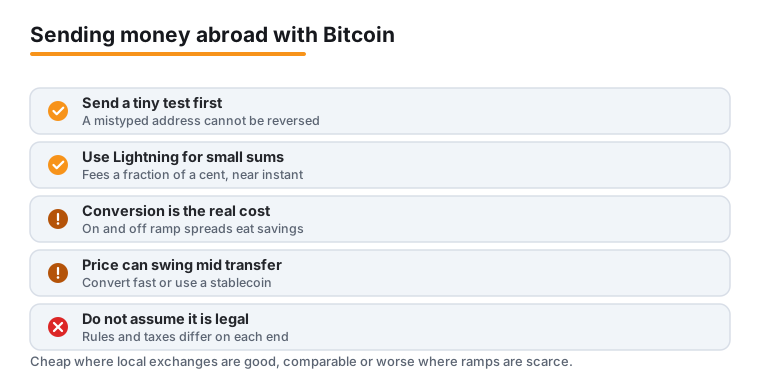
Sending Bitcoin itself is cheap relative to the amount: an on-chain fee is a flat dollar amount that does not scale with the payment size, so it is negligible on a large transfer and noticeable on a tiny one, and it rises when the network is congested. The Lightning Network, a layer built on top of Bitcoin for small, fast payments, cuts typical transfer fees to a fraction of a cent and settles in seconds, making Bitcoin competitive for everyday-sized remittances rather than just large transfers.
The part people forget: conversion
The headline "send for pennies" only holds if both sides already use Bitcoin. If you buy Bitcoin with dollars and the recipient cashes out to local currency, you pay a spread or fee on each conversion at an exchange or a Bitcoin ATM. Those on- and off-ramp costs are where most of the real expense lives, and a poorly chosen ramp can erase the savings entirely. The table below is illustrative only; always check live, all-in quotes for your exact corridor.
| Method | Typical all-in cost on a small transfer | Speed |
|---|---|---|
| Bank wire | High; often 5%+ plus FX margin | 1-5 business days |
| Money-transfer operator (e.g. Western Union, MoneyGram) | Moderate to high; varies by corridor | Minutes to a few days |
| Bitcoin on-chain + exchange conversion | Low network fee, but conversion spreads can add up | Roughly 10-60 minutes on-chain |
| Bitcoin over Lightning + local cash-out | Network fee is a fraction of a cent; cash-out spread still applies | Seconds to minutes |
The realistic takeaway: Bitcoin can be much cheaper where local exchange options are good, and comparable or worse where on- and off-ramps are scarce or charge high spreads.
How to send money abroad
There are two broad ways to use Bitcoin for a remittance. The right one depends on the technical comfort of both people and whether the recipient wants to hold Bitcoin or needs local cash.
Option 1: the do-it-yourself route
- Buy Bitcoin. Use a licensed exchange or a reputable Bitcoin ATM in your country, completing any required identity verification. Compare the all-in price, not just the advertised fee, because the exchange rate spread is part of the cost.
- Get the recipient's address. The recipient sets up a wallet and shares their receiving address or QR code. Decide together whether to send on-chain (for larger amounts) or over the Lightning Network (for small, fast transfers), and confirm both wallets support the method.
- Send a tiny test first. Before moving the full amount, send a small test and confirm it arrives. A mistyped address cannot be reversed.
- Send the full amount and confirm. Double-check the address, send, and wait for confirmation. On-chain payments typically settle within roughly ten to sixty minutes; Lightning is near-instant.
- Cash out as needed. The recipient either keeps the Bitcoin or converts it to local currency through a local exchange, peer-to-peer marketplace, or Bitcoin ATM.
Option 2: a crypto-powered remittance app
A growing number of services handle the crypto in the background. You pay in your local currency, the provider moves value over Bitcoin or another network, and the recipient gets local cash or a mobile-money deposit, sometimes without either side touching a wallet directly. These apps trade some do-it-yourself savings for convenience and support, and they vary a lot in fees, coverage, and reliability. Compare quotes and check the provider is properly registered in both countries before sending.
Whichever route you choose, back up recovery details for any wallet you control, and never share your private keys or recovery phrase.
Risks & safety
Bitcoin removes some problems and adds others. Going in with clear eyes is the difference between a cheaper transfer and an expensive mistake.
Price volatility
This is the biggest difference from sending dollars or euros. Bitcoin's value against local currency can move sharply within hours, so the amount a recipient cashes out may be worth more or less than you intended. The practical defences are to move and convert money quickly rather than holding it in Bitcoin, to use the fast Lightning Network for small transfers, or to consider a regulated stablecoin (a crypto token designed to track a currency like the US dollar) where it is legally available, which sidesteps most of the volatility while keeping much of the speed and low cost.
Irreversibility, scams, and custody
Bitcoin transactions cannot be undone. If you send to the wrong address, fall for a scam, or lose access to your wallet, there is no bank or support line to claw the money back. The same openness that makes Bitcoin accessible also attracts fraud: fake exchanges, impostor support staff, and "too good to be true" rates. Verify addresses carefully, send a test amount first, store recovery phrases offline, stick to well-established licensed services, and be skeptical of anyone who contacts you first. Holding your own keys means you alone are responsible for security.
Regulation, tax, and reporting
The legal treatment of buying, sending, and cashing out Bitcoin differs by country and changes over time. Some places embrace it, some restrict on- and off-ramps, and many treat crypto disposals as taxable events with reporting obligations. Do not assume the rules are the same on both ends of the transfer. Check the current position with the relevant tax authority, financial regulator, and a qualified professional before relying on Bitcoin for regular remittances. This guide is general information, not financial, legal, or tax advice.
Frequently asked questions
Is sending money with Bitcoin actually cheaper than Western Union or a bank?
It can be, but not automatically. Moving Bitcoin itself is very cheap, especially over the Lightning Network, and that beats traditional fees in corridors with good local exchange options. The catch is converting between Bitcoin and local cash on each end, where spreads and ramp fees live. Where on- and off-ramps are scarce or expensive, the total cost can match or exceed a money-transfer operator. Always compare live, all-in quotes for your exact route.
How long does a Bitcoin remittance take to arrive?
An on-chain Bitcoin transaction typically confirms within roughly ten to sixty minutes, depending on network congestion and the fee paid. Payments over the Lightning Network settle in seconds. Converting the received Bitcoin into local cash can add time depending on the recipient's exchange, peer-to-peer marketplace, or Bitcoin ATM.
What happens if Bitcoin's price drops while I'm sending it?
Because Bitcoin's value can swing quickly, the amount the recipient cashes out may be worth more or less than you intended. To limit this, move and convert the money promptly rather than holding it, use fast transfer methods, or consider a regulated stablecoin (designed to track a currency like the US dollar) where it is legally available in both countries.
Does the recipient need a bank account to receive Bitcoin?
No. To receive Bitcoin, a person needs a wallet app and an internet connection, not a bank account. This is a major reason crypto remittances appeal to families in regions with limited banking. To turn the Bitcoin into local cash, however, the recipient will usually need access to a local exchange, a peer-to-peer marketplace, or a Bitcoin ATM.
Is it legal to send remittances with Bitcoin?
It depends entirely on the countries involved. Rules on buying, transferring, and cashing out crypto vary widely and change over time, and many jurisdictions treat crypto transactions as taxable events with reporting requirements. Do not assume both ends are treated the same. Check the current position with the relevant financial regulator and tax authority, and consult a qualified professional before using Bitcoin for regular transfers.
Last updated: 2026-06.