Crypto & Financial Inclusion
Financial inclusion means reliable access to useful, affordable financial tools: a place to store money, a way to send and receive it, credit when needed, and a path to save. By the World Bank's 2025 Global Findex, roughly 1.3 billion adults still sit outside the formal financial system. The reasons are familiar: no nearby branch, too little money to clear minimum balances, missing identity documents, distrust of institutions, or fees that make small accounts uneconomical. Women, the rural poor, and people with little formal education are over-represented among the unbanked.
Crypto enters this picture as a set of open, internet-native rails. A smartphone, an internet connection, and a self-custodial wallet can let someone hold value and transact across borders without a bank account or a bank's permission. That is a genuine capability, and in some corridors it already helps real people. But crypto is not a finished product for the poor, nor a substitute for stable money, consumer protection, or local infrastructure. This guide explains where digital assets meaningfully expand access, where they fall short, and how to read the hype critically.
This article is educational and is not financial, legal, or tax advice. Crypto regulations and tax rules vary widely by country and change often. Verify the rules and risks that apply to you with qualified local professionals and official government sources before acting.
Banking the unbanked
"Unbanked" describes adults with no account at a bank or regulated provider; "underbanked" describes people who have an account but still lean on cash or informal services because formal options are too costly or limited. Both groups face the same core problem: the tools most of us take for granted are out of reach or not worth the friction.
What crypto can actually provide
The central promise is account-like functionality without an account. With a self-custodial wallet, a person can:
- Store value outside a bank, including in stablecoins designed to track a currency such as the US dollar.
- Send and receive payments to anyone with a wallet, at any hour, without branch hours or paperwork.
- Hold assets they control directly, rather than balances a third party can freeze or close.
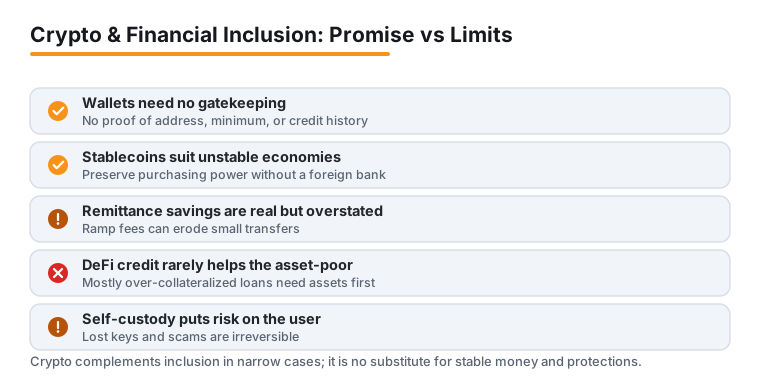
Crucially, opening a wallet typically requires no proof of address, no minimum deposit, and no credit history. For someone excluded precisely because they lack those things, removing that gatekeeping is the most concrete benefit on offer.
Why "just download a wallet" is not enough
Access to software is not access to money you can use. Several practical layers sit between a wallet and real-world spending:
- On- and off-ramps. People need a trusted way to convert local cash to crypto and back, often through peer-to-peer markets, local agents, or exchanges, each with its own fees and risks.
- Connectivity and devices. A smartphone and reliable data are prerequisites. Where coverage is patchy or data is expensive, the barrier simply moves.
- Literacy and security. Self-custody means you alone hold the keys. Lose your recovery phrase and the funds are gone; get tricked into revealing it and they are stolen. There is no bank hotline to reverse a mistaken or fraudulent transfer.
This is why education matters as much as technology. Good onboarding teaches not just which buttons to tap but the "why": what a private key is, why nobody legitimate will ever ask for your seed phrase, how to verify an address before sending, and how to start with tiny amounts while learning. Community groups, local-language tutorials, and step-by-step guides do more for real inclusion than any single app feature.
It is also worth being honest about the alternatives. In many places the fastest route to inclusion has been mobile-money services run on phone networks, not crypto. Crypto's distinct edge shows up most clearly where money must cross borders, where the local currency is unstable, or where access to the banking system itself is restricted.
Remittances & microloans
Cross-border remittances are the use case where crypto's value is easiest to see. Migrant workers send money home to families who often depend on it for food, school fees, and rent. The problem is cost: by World Bank data, the global average cost of sending a remittance was still around 6.5% in early 2025, far above the United Nations Sustainable Development Goal target of 3% by 2030. Costs are highest for cash-based transfers and in regions like Sub-Saharan Africa, where the average has hovered near 8-9%, and transfers can take days to clear.
How crypto can lower the cost of sending money
Because crypto networks move value directly between wallets, a transfer can bypass several intermediaries that each add a markup. In practice, people often send a stablecoin to avoid price swings, and the recipient cashes out locally. Done well, this can be cheaper and faster than a traditional money-transfer operator, settling in minutes rather than days.
The savings are real but easy to overstate. Honest accounting includes every step: the fee to buy crypto on the sending side, the network (transaction) fee, which varies by blockchain and congestion, and the spread and fee to convert back to local cash on the receiving side. On small amounts, those combined costs can erase much of the headline advantage, especially on high-fee networks or in markets with thin liquidity. The benefit is largest in corridors with competitive local exchange options and smallest where off-ramps are scarce. Treat any single "X% vs Y%" comparison as illustrative, not a guarantee.
Microloans, microfinance, and DeFi
Beyond payments, decentralized finance (DeFi) lets people lend and borrow through software-based protocols rather than banks. In principle this could widen access to credit and yield for people a traditional lender would never serve. In practice, today's mainstream DeFi lending is mostly over-collateralized: to borrow, you must lock up assets worth more than the loan. That manages risk without credit checks, but it does little for someone whose problem is having no assets to pledge in the first place.
More promising for inclusion are blockchain-based savings groups, community lending pools, and stablecoin-denominated microfinance experiments that give participants a hard-currency unit of account and transparent, low-overhead records. These are early and uneven, and carry their own risks (covered below). The realistic near-term win is not "DeFi replaces the village lender" but "stable, programmable money makes small-scale saving and sending cheaper and more transparent."
Developing economies
Adoption of crypto for everyday use has been strongest in emerging and developing economies, and the reasons are economic rather than speculative. Where a use case solves a pressing local problem, people adopt the tool; where it does not, they ignore it.
Why demand is highest here
- Currency instability and inflation. When a local currency loses value quickly, holding savings in it is a slow loss. Dollar-pegged stablecoins offer a way to preserve purchasing power without a foreign bank account. This "digital dollarization" is one of the clearest real drivers of crypto demand.
- Large diaspora populations. Countries that receive heavy remittance flows have a built-in incentive to find cheaper transfer methods.
- Young, mobile-first populations. Many developing economies skipped desktop banking entirely. A generation comfortable doing everything on a phone can adopt new financial apps quickly, the same "leapfrog" pattern seen earlier with mobile phones and mobile money.
- Restricted access to the formal system. Where opening or keeping a bank account is hard, an open network that requires no permission has obvious appeal.
National experiments and a course correction
El Salvador drew global attention by making Bitcoin legal tender in 2021. The experiment proved instructive: everyday adoption for payments remained limited, and the policy attracted significant criticism over volatility and macroeconomic risk. Under an agreement with the International Monetary Fund, El Salvador removed Bitcoin's mandatory legal-tender status in 2025, while still allowing voluntary private use. The episode is a useful real-world data point: state mandates do not automatically create adoption, and crypto sits uneasily alongside obligations like paying taxes in a stable national currency.
Two cautions follow for anyone generalizing about "developing-world adoption." First, headline adoption rankings often blend trading and speculation with genuine payment and savings use; high rankings do not necessarily mean broad, productive inclusion. Second, government stances differ sharply, from outright bans to active encouragement, and they change. The status of crypto in any specific country should be checked against current official sources rather than assumed.
The limits
An honest case for crypto and financial inclusion takes the downsides as seriously as the upside. For low-income, first-time users the risks are not abstract; they can wipe out money these households cannot afford to lose.
Volatility
Most crypto assets swing widely in price, so a tool meant to protect savings can instead destroy them if the unit of account is volatile. This is why, for inclusion specifically, stablecoins are usually more relevant than volatile assets. Even stablecoins are not risk-free: they depend on the quality and transparency of their reserves and the soundness of the issuer, and some have failed to hold their peg.
Custody, fraud, and irreversibility
Self-custody puts full responsibility on the user. Transactions are generally irreversible, with no deposit insurance or chargebacks. Lost keys, phishing, fake "support" agents, romance and investment scams, and malicious apps all target newcomers, who are often least equipped to spot them. Centralized exchanges add counterparty risk: balances on a platform can be lost if it fails or is fraudulent.
Connectivity, ramps, and usability
The infrastructure gaps from the first section persist: no internet means no access, and the cash-to-crypto-to-cash journey adds fees and friction at both ends. Seed phrases, addresses, and gas fees remain confusing for non-technical users.
Regulation, legality, and tax
Legal treatment is inconsistent and shifting. Some countries embrace crypto, others restrict or ban it, and rules on disclosure, consumer protection, and especially taxation vary widely. Using crypto can create reporting and tax obligations users may not anticipate. None of this is legal or tax advice; confirm what applies to you with qualified local professionals and official government sources.
Putting the limits in perspective
| Need | Where crypto helps | Where it falls short |
|---|---|---|
| Holding value | Account-free storage; stablecoins to resist local inflation | Volatility (non-stable assets); reserve/issuer risk; lost-key risk |
| Sending money abroad | Faster, often cheaper cross-border transfers | Ramp fees and thin liquidity can erode savings on small sums |
| Access to credit | Permissionless protocols; transparent records | Mostly over-collateralized; little help for the asset-poor |
| Everyday spending | Works where merchants and ramps exist | Limited acceptance; fees; taxes payable in local currency |
The balanced takeaway: crypto is a powerful complement to financial inclusion in specific situations, unstable currencies, costly remittance corridors, and restricted banking, but it is not a guaranteed or risk-free path. Pair any use of it with education, small amounts while learning, sound key management, and verification of local law.
Frequently asked questions
Can crypto really help people without a bank account?
Yes, in specific ways. A self-custodial wallet lets someone store and move value without a bank account, minimum balance, or credit history, which directly removes barriers that exclude many people. The catch is that they still need internet access, a device, a trusted way to convert local cash to crypto and back, and the knowledge to keep their funds safe. Crypto expands access where those pieces are in place; it does not by itself replace the need for stable money and consumer protections.
Is sending money abroad with crypto always cheaper?
Not always. Crypto can cut costs by removing intermediaries, and well-chosen corridors can beat traditional money-transfer fees while settling far faster. But the true cost includes buying the crypto, the network fee, and converting back to local cash on the other side. On small transfers, or in markets with limited or expensive off-ramps, those combined costs can erase much of the advantage. Compare the all-in cost for your specific route before assuming savings.
Should the unbanked use stablecoins or Bitcoin?
For inclusion focused on storing value and sending money, stablecoins that track a major currency are usually more practical because their price is steadier. Bitcoin and similar assets carry significant price volatility, which makes them risky as a place to keep savings you cannot afford to lose. Stablecoins are not risk-free either: they depend on the issuer's reserves and transparency, and some have broken their peg. Understand what backs any stablecoin before relying on it.
What are the biggest risks for first-time users?
The top risks are losing access to your own funds (a lost or stolen recovery phrase cannot be recovered), scams and phishing aimed at newcomers, price volatility if you hold non-stable assets, the failure of an exchange where you keep balances, and unexpected legal or tax obligations. Transactions are generally irreversible and there is no deposit insurance. Start with small amounts, never share your seed phrase, verify addresses, and use reputable services.
Is crypto legal everywhere, and do I owe tax on it?
No. Legal status ranges from full acceptance to outright bans and changes frequently; one country even rolled back Bitcoin's legal-tender status in 2025. Tax treatment also varies widely, and using or converting crypto can create reporting and tax obligations. This article is not legal or tax advice. Check the current rules for your country with official government sources and a qualified local professional before you act.
Last updated: 2026-06.