Home › Crypto Regulation › India
Bitcoin & Cryptocurrency Regulation in India
Quick answer — India, 2026
- Legal: Legal to own and trade, not legal tender, no comprehensive law
- Tax: Flat 30% on gains, no loss offset, plus 1% TDS
- Buying: Via FIU-IND-registered exchanges with PAN and Aadhaar KYC
Cryptocurrency sits in an unusual middle ground in India: it is legal to own and trade, very heavily taxed, increasingly monitored, but still not governed by a single comprehensive law. As of 2026, Indians can buy, sell, and hold digital assets such as Bitcoin and Ether through registered platforms, yet these assets are not legal tender and carry no formal investor-protection guarantee. This page explains how India treats crypto today: its legal status, who regulates it, the strict tax regime, the registration rules for exchanges, anti-money-laundering obligations, and the practical realities of buying, mining, and using crypto. For wider context see our overview of crypto regulation and the main regulation hub.
This is general information as of 2026 and is not legal, tax, or financial advice. India's crypto rules are evolving, key proposals remain unfinished, and detail can change with each Union Budget and regulatory notification. Always verify current obligations with the named official regulators, such as the Reserve Bank of India, the Securities and Exchange Board of India (SEBI), the Financial Intelligence Unit (FIU-IND), and the Income Tax Department, or with a qualified professional, before acting.
On this page: Legal status · Who regulates it · Taxes · How to buy · Mining
Is Bitcoin and crypto legal in India?
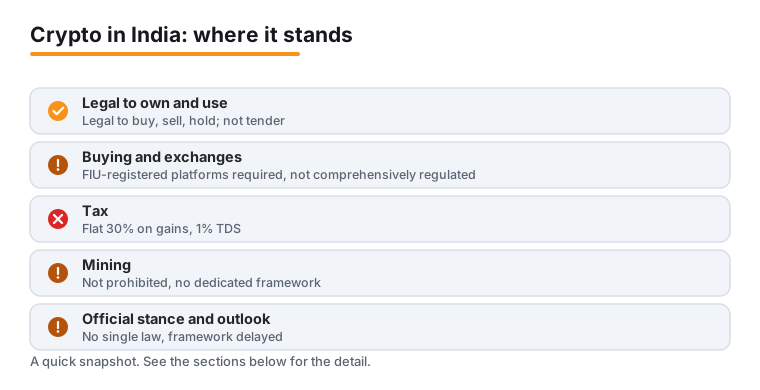
Yes. Buying, selling, holding, and transferring cryptocurrencies is legal in India for individuals and businesses. There is no blanket ban on private crypto activity, and tens of millions of Indians use domestic exchanges to trade.
Two distinctions matter:
- Not legal tender. The Indian rupee, including the Reserve Bank of India's central bank digital currency (the Digital Rupee, or e-Rupee, launched for retail use in December 2022), is the only legal tender. No one is obliged to accept Bitcoin or other crypto as payment.
- Legal but not comprehensively regulated as an asset class. Crypto is recognised in tax law as a Virtual Digital Asset (VDA) and platforms must follow anti-money-laundering rules, but there is no dedicated consumer-protection statute. If a platform fails or you are defrauded, your recourse is limited compared with regulated securities or bank deposits.
History matters here. In 2018 the RBI barred banks from servicing crypto businesses, effectively cutting off rupee on-ramps. The Supreme Court of India struck down that circular in 2020, restoring banking access. Since then the policy direction has shifted from prohibition toward taxation and supervision rather than an outright ban.
Who regulates crypto in India?
India has no single crypto regulator. Oversight is shared across several authorities:
- Reserve Bank of India (RBI) is the central bank. It oversees monetary policy, the Digital Rupee, and foreign-exchange and financial-stability matters that touch crypto. The RBI has historically been the most cautious voice, viewing private crypto as a potential macroeconomic risk. Its official site is rbi.org.in.
- Financial Intelligence Unit, India (FIU-IND) registers crypto service providers as reporting entities under the Prevention of Money Laundering Act (PMLA) and enforces anti-money-laundering and reporting obligations. Its official site is fiuindia.gov.in.
- Income Tax Department / CBDT administers the VDA tax regime introduced by the Finance Act 2022 and the newer mandatory reporting rules.
- Securities and Exchange Board of India (SEBI) regulates securities markets. A multi-regulator model has been reported but not adopted. In its Thirty-Sixth Report presented on 23 July 2026, the Parliamentary Standing Committee on Finance recommended that an interim framework for virtual digital assets run through recognised Self-Regulatory Organisations operating under the oversight of the designated regulator. The report does not say which regulator that would be. It is a recommendation, not law, and no regulator has been designated. Its official site is sebi.gov.in.
This split is a live source of disagreement. Through 2025 and into 2026, SEBI and the Finance Ministry have been more open to structured regulation while the RBI has resisted steps that could be read as legitimising the sector. Treat any specific division of duties as provisional and verify the current position with the official sources above.
Key laws and frameworks
India does not have a single comprehensive crypto statute. Instead, crypto is governed by a patchwork of existing laws and rules:
- Income-tax law (VDA regime). The Finance Act 2022 introduced the definition of a Virtual Digital Asset and the flat-tax and TDS rules described below (Sections 115BBH and 194S of the Income-tax Act).
- Prevention of Money Laundering Act (PMLA). In March 2023 the Ministry of Finance brought VDA service providers within the PMLA, making them reporting entities supervised by FIU-IND.
- Mandatory tax reporting. The Union Budget 2025 introduced a dedicated reporting obligation (widely referred to as Section 285BAA, re-codified under the new Income-tax Act, 2025) requiring crypto platforms to furnish user-level transaction data to the tax authority, from 1 April 2026, now Section 509 of the Income-tax Act, 2025, with the operating detail in Rules 241 to 244 and Form 167 of the Income-tax Rules, 2026.
- OECD Crypto-Asset Reporting Framework (CARF). India has built the domestic half of CARF and Indian platforms report now, but the OECD Global Forum's commitment list, last updated 23 June 2026, still records India among five jurisdictions relevant to CARF that have not yet made the political commitment to implement it, so the 2027 start for international exchange is intended rather than confirmed, which is intended to bring offshore crypto holdings of Indian residents into the tax net through automatic information exchange.
A long-discussed comprehensive crypto bill has not been enacted as a single law. A government discussion or consultation paper, led by the Department of Economic Affairs, has been expected and repeatedly delayed across 2025 and 2026 amid disagreement between the RBI and other agencies. Because these proposals are still in flux, do not treat any draft framework as settled law. Verify the latest position before relying on it.
Exchange and VASP registration
Crypto service providers serving Indian users, including exchanges, must register with FIU-IND as reporting entities under the PMLA. Operating without registration is not permitted, and FIU-IND has previously ordered the blocking of offshore exchanges that served Indian users without registering.
- FIU-IND registration. Registered providers are sometimes called Virtual Digital Asset Service Providers (VDA SPs). As of 9 March 2026, 54 VDA SPs were registered with FIU-IND, of which three had ceased operating, according to the Minister of State for Finance answering Lok Sabha Unstarred Question No. 5805 on 30 March 2026. FIU-IND had separately directed the takedown of 53 unregistered providers. The Ministry of Finance has stressed that registration is not an endorsement or a licence.
- AML and KYC duties. Registered entities must run customer due diligence, monitor and report suspicious transactions, maintain records, and meet ongoing compliance obligations under the PMLA.
- SEBI overlap. Tokens that resemble securities (for example, those promising returns based on the efforts of others) may fall under SEBI's remit, adding a further layer of potential oversight.
There is no broad, crypto-specific operating licence equivalent to a banking or securities licence today. FIU-IND registration plus tax and AML compliance is the baseline. You can check a provider's status against FIU-IND's official notifications at fiuindia.gov.in.
Crypto and Bitcoin taxation
India has one of the world's strictest crypto tax regimes. The headline rules, in place since the Finance Act 2022 and maintained through the 2025 and 2026 budgets, are:
- Flat 30% tax on gains from the transfer of Virtual Digital Assets (Section 115BBH), plus applicable health and education cess and any surcharge. The rate does not change with holding period.
- No deductions except cost of acquisition. You generally cannot deduct expenses, trading fees, or infrastructure costs against crypto gains.
- No loss offset or carry-forward. A loss on one crypto asset cannot be set against gains on another, nor against any other income.
- 1% Tax Deducted at Source (TDS) on transfers above prescribed thresholds (Section 194S), typically collected by the exchange or buyer. The threshold is 50,000 rupees in a financial year for specified persons, broadly individuals and Hindu Undivided Families with business turnover up to 1 crore rupees or professional receipts up to 50 lakh rupees, and 10,000 rupees in a financial year for everyone else. Where the seller has not furnished a PAN, the deduction is 20% rather than 1%. Since 1 April 2026 this sits at Section 393(1) of the Income-tax Act, 2025.
Other receipts, such as crypto received as a gift, airdrops, or staking and mining rewards, can also be taxable, and Goods and Services Tax can apply to certain platform services. The thresholds, forms, and treatment of specific events change over time, and the high tax burden has reportedly pushed a large share of Indian trading volume to offshore platforms. For more on the mechanics see our guide to crypto taxes, and confirm figures with the Income Tax Department or a chartered accountant for your situation.
When filing, crypto is reported in a dedicated Schedule VDA in the income-tax return. For financial year 2025 to 2026 (assessment year 2026 to 2027), individuals generally use ITR-2 if they treat gains as capital gains, or ITR-3 if they report crypto as business income. The Union Budget 2025 to 2026 made no change to the 30% rate or the 1% TDS. Industry bodies have continued to press for relief, such as a lower TDS or the ability to set off crypto losses against future crypto gains, but as of mid-2026 no such change had been enacted.
AML, KYC, and reporting
Anti-money-laundering controls are central to India's current approach to crypto.
- Reporting entities. Under the PMLA, VDA service providers are reporting entities supervised by FIU-IND and must perform KYC, monitor transactions, and report suspicious activity.
- Full KYC for users. Expect to verify identity with PAN and Aadhaar-linked details before trading or withdrawing on a registered Indian platform.
- Tax-data reporting. From around 1 April 2026, platforms are required to furnish user-level transaction information to the Income Tax Department under the reporting obligation introduced by the Union Budget 2025.
- International exchange. India's planned adoption of the OECD Crypto-Asset Reporting Framework (CARF), with reporting reported to begin from 1 April 2027, is designed to surface Indian residents' offshore crypto activity through automatic cross-border data sharing.
The practical effect is that the tax authority's visibility into crypto trades is rising sharply, and low-identification or cash-based channels sit uncomfortably with regulators.
Buying and using crypto in practice
Most Indians buy crypto through domestic exchanges that accept rupee deposits via bank transfer, UPI, or other local methods. A typical compliant path looks like this:
- Choose an FIU-registered platform. Prefer providers registered with FIU-IND that publish clear security, KYC, and tax-handling practices.
- Complete KYC. Verify your identity, usually with PAN and Aadhaar-linked details.
- Deposit rupees and buy. Fund the account and place your order, noting trading fees plus the 1% TDS deducted on eligible transactions.
- Secure your holdings. For larger or longer-term amounts, consider moving coins to a personal wallet (hardware wallets offer strong protection) and safeguard your recovery phrase. Never share private keys or seed phrases.
- Keep records. Retain full transaction history for accurate tax filing.
On using crypto to pay or to send money: no merchant is obliged to accept crypto because it is not legal tender, and cross-border flows are governed by the Foreign Exchange Management Act (FEMA) and RBI rules, which crypto does not fit neatly. Treat payments and remittances as compliance-heavy and get advice on FEMA, tax, and reporting first. Note too that Bitcoin ATMs have never been an established or clearly sanctioned channel in India, so the realistic route remains a registered online exchange.
Mining in India
Mining cryptocurrency is not specifically prohibited in India, and individuals and businesses can mine, but there is no dedicated mining licence or framework. Several considerations apply:
- Taxation of rewards. Mined coins are generally treated as income, and any later disposal falls under the 30% VDA gains regime. The strict rules on deductions mean electricity and hardware costs may not be deductible against gains in the way miners might expect. Confirm treatment with a tax professional.
- Electricity economics. Power costs vary widely by state and India's grid relies significantly on fossil fuels, which affects profitability and raises energy-use concerns.
- Regulatory uncertainty. With no mining-specific statute, miners operate under general tax, AML, and electricity rules, which can shift.
India is not a major global mining hub, and high taxation plus power costs limit large-scale commercial mining. Anyone considering it should model electricity costs carefully and confirm the tax position before buying equipment.
Recent developments (2025 to 2026)
The policy picture has been active but unresolved:
- SEBI steps forward. Reporting through 2025 and 2026 indicates SEBI has proposed a multi-regulator model, under which it would supervise crypto exchanges and security-like tokens while the RBI handles cross-border flows and the Finance Ministry retains policy and taxation control.
- Discussion paper delayed. The Department of Economic Affairs consultation paper expected across 2025 had still not been published as of 3 August 2026, and no publication date has been announced. The RBI told the Parliamentary Standing Committee on Finance on 2 July 2026 that virtual digital assets should not be legalised at this stage.
- Tighter reporting. The Union Budget 2025 introduced mandatory platform reporting of user transactions under Section 285BAA (from around April 2026), and India has aligned its domestic rules to the OECD CARF, though the Global Forum's commitment list of 23 June 2026 records India as not yet having made the political commitment.
- Parliamentary study. The Parliamentary Standing Committee on Finance continued its "Study on Virtual Digital Assets (VDAs) and Way Forward", taking evidence from exchanges, FIU-IND, the CBDT, the RBI and the ICAI through late 2025 and into July 2026.
- Tax debate. The punitive 30% rate and 1% TDS have drawn criticism for pushing a large share of trading volume offshore, prompting parliamentary and industry questions, though the headline rates were retained in the 2025 and 2026 budgets.
Because the central framework is still being negotiated, expect further change. The prudent stance is to use registered platforms, keep meticulous tax records, custody assets securely, and check official sources regularly.
Parliamentary review of virtual digital assets
Alongside the executive-branch discussion paper, India's Parliamentary Standing Committee on Finance has been running its own examination of the sector, titled "A Study on Virtual Digital Assets (VDAs) and Way Forward". The committee is chaired by Bhartruhari Mahtab, and the study was listed as a subject for detailed examination during the 2024 to 2025 period.
The committee has taken oral evidence from a range of stakeholders. Reporting indicates it heard from domestic exchanges including CoinDCX, CoinSwitch, ZebPay, WazirX and Binance across late 2025 and 2026, and from FIU-IND and the Central Board of Direct Taxes (CBDT) in January 2026. Representatives of the Reserve Bank of India and the Institute of Chartered Accountants of India (ICAI) were called to appear on 2 July 2026, with the ICAI session focused on crypto taxation and accounting questions.
The review is a study and consultation exercise rather than a law, and any recommendations it produces would still need to be taken up by the government. It is worth watching because it brings the tax authority, the central bank, the accounting profession and industry into a single formal process. Treat its outcome as pending until officially published.
Consumer risks and protection
The main risks for Indian users are concentrated and real:
- Limited protection. There is no dedicated crypto consumer-protection statute, so you bear more risk from platform failure, hacks, and fraud than with regulated securities or bank deposits. India has experienced large exchange security incidents.
- Heavy tax drag. A flat 30% on gains with no loss offset, plus a 1% TDS, materially reduces net returns and complicates active trading.
- Volatility. Crypto prices can swing sharply. Only consider money you can afford to lose entirely.
- Scams. Schemes promising guaranteed returns are common. No legitimate crypto investment guarantees profit.
- Regulatory uncertainty. Future rules could change how crypto is taxed, traded, or accessed.
Sensible habits help regardless of your view on the asset: use FIU-registered, security-conscious platforms, diversify and size positions carefully, custody long-term holdings yourself, and keep records. For tailored advice consider a SEBI-registered investment adviser. This is not investment advice.
Official sources and how to verify
Because India's crypto rules are evolving, verify any specific rule, rate, or registration directly with the relevant authority rather than relying on secondary summaries:
- Reserve Bank of India for the central bank's stance, the Digital Rupee, and FEMA/foreign-exchange matters: rbi.org.in.
- Financial Intelligence Unit, India (FIU-IND) for VDA service-provider registration and AML notifications: fiuindia.gov.in.
- Securities and Exchange Board of India (SEBI) for securities-related and investor-protection matters and any future crypto remit: sebi.gov.in.
For tax specifics, consult the Income Tax Department and a qualified chartered accountant. This page is general information as of 2026 and is not legal, tax, or financial advice. Confirm your obligations with the named official regulators before acting. You can also explore our broader coverage at the regulation hub.
What is changing: India's crypto rules in August 2026
Nothing about the legal status of crypto in India changed between 30 June and 3 August 2026. It is still legal to own and trade, still not legal tender, and still has no dedicated statute. What moved is the machinery underneath. The statute carrying the tax rules was replaced on 1 April 2026, the platform reporting rules acquired their forms and deadlines in July 2026, and a parliamentary committee put the first concrete official proposal for interim crypto regulation on the record.
These are the moving pieces and where each one actually stands:
| Item | Stage | Timing |
|---|---|---|
| Income-tax Act, 2025, replacing the Income-tax Act, 1961 and carrying the VDA tax rules | In force | Commenced 1 April 2026 |
| Platform reporting of user crypto transactions under Section 509, with Rules 241 to 244 and Form 167, plus the CBDT guidance note | In force, guidance issued 24 July 2026 | Obligation runs from 1 April 2026; due diligence on pre-existing users due within 12 months on and from 1 January 2026 |
| Union Budget 2026 to 2027 penalties for reporting failures | Adopted | Effective 1 April 2026; rate and TDS left unchanged |
| The Securities Markets Code, 2025, which excludes ordinary VDAs from the definition of securities | In Parliament, not passed | Introduced 18 December 2025, referred to committee 19 December 2025; committee report presented 23 July 2026; no passage date announced |
| Interim Self-Regulatory Organisation framework for VDAs, recommended by the Standing Committee on Finance | Committee recommendation only, not adopted | Recommended 23 July 2026; no government response, no regulator designated |
| Department of Economic Affairs discussion paper and a comprehensive VDA law | Not published | Repeatedly deferred; no announced date |
One further process is still open. The Standing Committee on Finance has a separate dedicated study titled "A Study on Virtual Digital Assets (VDAs) and Way Forward", under which it has taken evidence from the RBI, the ICAI, FIU-IND, the CBDT, the International Financial Services Centres Authority, the Ministry of Corporate Affairs, the Ministry of Finance and industry participants including the Bharat Web3 Association. That report had not been presented to Parliament as of 3 August 2026. The Monsoon Session runs from 20 July to 13 August 2026, so it may still be tabled in this session.
What Parliament recommended in July 2026
On 23 July 2026 the Standing Committee on Finance, chaired by Bhartruhari Mahtab, presented its Thirty-Sixth Report to Lok Sabha and laid it in Rajya Sabha. The report examines the Securities Markets Code, 2025, a bill of 157 clauses that would consolidate the SEBI Act 1992, the Securities Contracts (Regulation) Act 1956 and the Depositories Act 1996. The Code does not bring crypto inside securities law, and the committee used the report to say what it thinks should happen instead.
At paragraph 20.15 the committee found that leaving virtual digital assets outside the definition of securities creates a "regulatory grey area", exposing investors to heightened risks of fraud, market manipulation, misrepresentation and inadequate grievance redressal while also creating opportunities for regulatory arbitrage. At paragraph 20.16 it recommended that the government comprehensively examine the need for an appropriate statutory and regulatory framework for VDAs, and that pending such a framework it consider an interim mechanism through recognised Self-Regulatory Organisations operating under the oversight of the designated regulator. That interim mechanism, the committee said, should prescribe minimum standards of governance, transparency, disclosure, investor protection, grievance redressal, compliance with prescribed codes of conduct and appropriate regulatory oversight.
Three things follow for readers:
- This is a recommendation, not a law. A parliamentary committee cannot create a regulator or bind the government. No response has been published, no regulator has been designated, and no SRO has been recognised.
- The report does not say which regulator would be designated. Several news reports have added the gloss "such as the RBI or SEBI", but that phrasing does not appear in paragraph 20.16, which refers only to "the designated regulator".
- The report puts the government's own position on the record in writing. The Ministry of Finance told the committee that crypto-assets, including virtual digital assets, are presently unregulated in India except for the limited purposes of taxation, prevention of money laundering and reporting, and that any regulatory framework would require significant international and domestic coordination. That is the clearest official statement of the status quo currently available.
The Reserve Bank's position has not softened. Appearing before the same committee on 2 July 2026 under its separate VDA study, the RBI argued that virtual digital assets should not be legalised at this stage, citing risks to the financial system, potential use in terror funding and narcotics, and the difficulty of supervising offshore platforms. This is the disagreement that has kept the Department of Economic Affairs discussion paper unpublished.
Where the crypto tax provisions moved on 1 April 2026
The Income-tax Act, 2025 replaced the Income-tax Act, 1961 with effect from 1 April 2026. The crypto rules did not change in substance, but the section numbers did. This matters when reading older guidance, since almost every article written before 2026 cites the superseded numbering.
| Rule | Old section (Income-tax Act, 1961) | Current section (Income-tax Act, 2025) |
|---|---|---|
| Flat 30% on income from transfer of a VDA, cost of acquisition the only deduction, no loss set off or carry forward | Section 115BBH | Carried forward unchanged in substance. Tax commentary maps it to Clause 194, Table Sl. No. 4 of the bill that became the Act |
| 1% TDS on payment for transfer of a VDA | Section 194S | Section 393(1), Table Sl. No. 8(vi) |
| Obligation on platforms to furnish crypto-asset transaction statements | Section 285BAA | Section 509 |
| Penalty for reporting failures | Not applicable | Section 446 |
| Crypto-asset limb of the virtual digital asset definition | Not applicable | Section 2(111)(d) |
The TDS thresholds are specific rather than approximate. The 1% deduction applies once payments cross 50,000 rupees in a financial year for specified persons, broadly individuals and Hindu Undivided Families with business turnover up to 1 crore rupees or professional receipts up to 50 lakh rupees, and 10,000 rupees in a financial year for everyone else. Where the seller has not furnished a PAN, the deduction is 20% rather than 1%.
The Union Budget 2026 to 2027, presented on 1 February 2026, left the 30% rate and the 1% TDS untouched. Instead it added penalties for reporting failures from 1 April 2026: 200 rupees per day for each day a required crypto-asset statement is not furnished, and a flat 50,000 rupees where inaccurate information is filed and not corrected after being flagged. These fall on the reporting platform, not on the individual investor. Industry bodies had asked for TDS to be cut to 0.01% and the threshold raised to 5 lakh rupees, and got neither.
India and the OECD CARF: domestic rules first, formal commitment still pending
India has built the domestic half of the OECD Crypto-Asset Reporting Framework. Section 509 of the Income-tax Act, 2025, together with Rules 241 to 244 and Form 167 of the Income-tax Rules, 2026, requires Reporting Crypto-Asset Service Providers to identify users, establish tax residence and report transactions. The CBDT issued a 198 page guidance note on 24 July 2026 setting out the due diligence and reporting steps, including completing due diligence on pre-existing users within 12 months on and from 1 January 2026. The CBDT was explicit that the note does not determine the legality, legitimacy or regulatory permissibility of transactions in crypto-assets, and that its scope is limited to reporting and exchange of information for the administration of taxes. Individual filers get no new form from this; the burden sits on the platform.
The international half is not finished, and this is where most summaries overstate the position. The OECD Global Forum's published list of jurisdictions committed to implement CARF, last updated 23 June 2026, places India among five jurisdictions identified as relevant to CARF that have not yet committed to implement it, alongside Argentina, El Salvador, Georgia and Viet Nam. The footnote attached to India records that it is in the process of making a political commitment and expects to make it in due course. India appears on none of the first-exchange lists, which cover 46 jurisdictions by 2027, 29 by 2028 and the United States by 2029.
So the accurate statement in August 2026 is this. Indian platforms must collect and report CARF-style data now, and the Indian tax authority receives it. Automatic cross-border exchange, which is what would surface an Indian resident's holdings on a foreign exchange, depends on a formal commitment and activated exchange agreements that had not been recorded on the OECD's list at the time of writing. Treat 2027 as the intended start for international exchange rather than a confirmed one, and check the OECD list, which is updated periodically.
Frequently asked questions
Is cryptocurrency legal in India in 2026?
Yes. As of 2026 it is legal to buy, sell, and hold crypto in India through registered platforms. It is not banned, but it is also not legal tender, and there is no single comprehensive law dedicated to it. Rules can change, so check current official guidance from the RBI, SEBI, FIU-IND, and the Income Tax Department.
Who regulates crypto in India?
Oversight is shared rather than held by one regulator. The Reserve Bank of India (rbi.org.in) handles central-bank, financial-stability, and foreign-exchange matters; FIU-IND (fiuindia.gov.in) enforces anti-money-laundering rules and registers crypto service providers; the Income Tax Department handles taxation; and SEBI (sebi.gov.in) covers securities-like tokens and has proposed a broader multi-regulator model. That model is still under discussion and not yet finalised.
How is crypto taxed in India?
Gains from transferring Virtual Digital Assets are taxed at a flat 30% (plus applicable cess and surcharge), with no deductions beyond the cost of acquisition and no loss offset against other income. A 1% Tax Deducted at Source (TDS) applies to transfers above set thresholds. The headline rates were retained in the 2025 and 2026 budgets. Confirm exact thresholds and treatment with the Income Tax Department or a chartered accountant.
Do crypto exchanges need to register in India?
Yes. Crypto service providers serving Indian users must register with FIU-IND as reporting entities under the Prevention of Money Laundering Act and follow AML and KYC rules. Operating without registration is not permitted, and FIU-IND has blocked offshore platforms that served Indian users without registering. 54 providers were registered as of 9 March 2026, three of which had stopped operating, and FIU-IND had directed the takedown of 53 unregistered providers. You can check status at fiuindia.gov.in.
Can I use Bitcoin to pay for things or send money in India?
You can hold and trade crypto, but no merchant is obliged to accept it because it is not legal tender. Using crypto for payments or cross-border remittances raises tax, TDS, and foreign-exchange (FEMA) compliance questions, so seek advice before doing so. Bitcoin ATMs are not an established or clearly sanctioned channel in India.
Is India about to ban or fully regulate crypto?
Neither is settled. A government discussion paper and a comprehensive framework have been expected and repeatedly delayed across 2025 and 2026, amid disagreement between the RBI and other agencies. Meanwhile, reporting obligations are tightening (mandatory platform reporting from around April 2026 and OECD CARF adoption reported from 1 April 2027). Treat the framework as evolving and verify the current position with the official regulators.
How do I report crypto in my Indian income-tax return?
Crypto is reported in a dedicated Schedule VDA in the income-tax return. For financial year 2025 to 2026 (assessment year 2026 to 2027), individuals generally use ITR-2 if they treat gains as capital gains, or ITR-3 if they report crypto as business income. Gains are taxed at a flat 30% with no loss offset, and 1% TDS applies to eligible transfers. Confirm the correct form and treatment for your situation with the Income Tax Department or a chartered accountant.
What is the OECD CARF and how will it affect Indian crypto holders?
The OECD Crypto-Asset Reporting Framework (CARF) is a global standard for the automatic exchange of crypto-account information between tax authorities. India has built the matching domestic rules, but the Global Forum's commitment list of 23 June 2026 places India among five relevant jurisdictions that have not yet committed, and India appears on none of the 2027, 2028 or 2029 first-exchange lists. In practice it is intended to give the Indian tax authority visibility into residents' crypto held on foreign exchanges and wallets, so offshore holdings become harder to keep outside the tax net.
Is Parliament reviewing crypto rules in India?
Yes. The Parliamentary Standing Committee on Finance has been running a study titled "A Study on Virtual Digital Assets (VDAs) and Way Forward", hearing from exchanges, FIU-IND, the CBDT, the RBI and the ICAI across late 2025 and into July 2026. It is a consultation and study exercise, not a law, so any recommendations would still need to be adopted by the government.
Did anything change for Indian crypto holders on 1 April 2026?
Yes, but not the rates. The Income-tax Act, 2025 replaced the Income-tax Act, 1961 from that date. The flat 30% on gains, the cost-of-acquisition-only deduction and the ban on loss set off all continue unchanged. What changed is the section numbering: the 1% TDS moved from Section 194S to Section 393(1), and the platform reporting obligation moved from Section 285BAA to Section 509. Registered platforms also began furnishing user-level transaction data to the Income Tax Department from 1 April 2026.
Does Section 509 crypto reporting mean I have to file something new?
No. The obligation falls on Reporting Crypto-Asset Service Providers, meaning exchanges, brokers and other businesses that effect exchange transactions for customers or make a trading platform available. They report in Form 167 under Rules 241 to 244 of the Income-tax Rules, 2026. Individual taxpayers get no new form from this. You still report your own crypto in your income-tax return. The practical effect is that the tax authority now receives your trading data from the platform directly, so your return needs to match.
Has India passed a crypto law yet, as of August 2026?
No. There is still no dedicated crypto statute. The Securities Markets Code, 2025 is before Parliament but excludes virtual digital assets that do not independently satisfy the legal characteristics of a security or derivative. The Department of Economic Affairs discussion paper has been deferred repeatedly and remains unpublished with no announced date. What actually applies is tax law, the Prevention of Money Laundering Act with FIU-IND registration, and the new reporting rules.
What did the parliamentary committee recommend about crypto in July 2026?
In its Thirty-Sixth Report, presented on 23 July 2026, the Standing Committee on Finance said excluding virtual digital assets from the definition of securities creates a regulatory grey area. It recommended the government examine the need for a proper statutory framework and, in the meantime, consider an interim mechanism through recognised Self-Regulatory Organisations operating under the oversight of the designated regulator, covering governance, transparency, disclosure, investor protection and grievance redressal. The report does not say which regulator would be designated, despite press coverage that added the words "such as the RBI or SEBI". It is a recommendation with no legal force, and no government response had been published as of 3 August 2026.
Will foreign exchanges report my crypto to the Indian tax authority from 2027?
Not confirmed. India has built the domestic CARF machinery and Indian platforms must report now. But the OECD Global Forum's commitment list, last updated 23 June 2026, still records India among five jurisdictions that have not yet made the political commitment to implement CARF, alongside Argentina, El Salvador, Georgia and Viet Nam. India appears on none of the 2027, 2028 or 2029 first-exchange lists. Automatic exchange with other countries depends on that commitment and on activated exchange agreements. Treat 2027 as the intended start, not a confirmed one.
Facts reviewed: 5 August 2026. Page updated: 5 August 2026.