Home › Crypto Regulation › Bhutan
Bitcoin & Cryptocurrency Regulation in Bhutan
Quick answer — Bhutan, 2026
- Legal: Not legal tender and access restricted; licensed activity funnelled into Gelephu city
- Tax: No dedicated crypto tax; income may fall under existing tax categories
- Buying: No open retail exchanges; bank on-ramping restricted, tourist payments via Binance Pay
Bhutan occupies an unusual place on the global crypto map. The small Himalayan kingdom is one of the largest sovereign holders of Bitcoin in the world, having accumulated coins through state-run, hydropower-powered mining rather than market purchases. At the same time, ordinary residents face a restrictive environment: cryptocurrency is not legal tender, public trading through local banks is curtailed, and most permitted commercial crypto activity is funnelled into a dedicated special administrative region. This page explains Bhutan's approach to Bitcoin and crypto regulation as of 2026, covering the legal status, the regulator, the key laws and frameworks, exchange and mining licensing, taxation, anti-money-laundering rules, recent developments, and how to verify everything with official sources. This is general information as of 2026 and is not legal, tax, or financial advice; rules in Bhutan are evolving quickly, so always confirm the current position with the Royal Monetary Authority and a qualified local professional before acting. For broader background see our guide to crypto regulation.
On this page: Legal status · Who regulates it · Taxes · How to buy · Mining
Is Bitcoin and crypto legal in Bhutan?
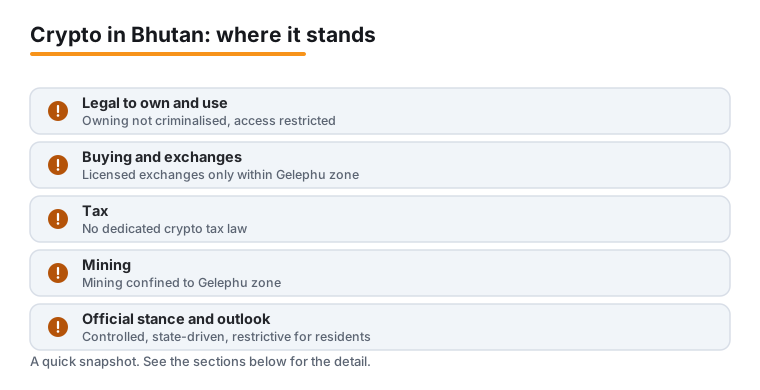
Crypto sits in a controlled middle ground in Bhutan: it is neither banned outright nor treated as ordinary legal money. Bitcoin and other cryptocurrencies are not recognised as legal tender, and the central bank does not require anyone to accept them. Owning crypto is not criminalised, but everyday access for residents is deliberately limited. The Royal Monetary Authority has stated that converting local currency into crypto assets (on-ramping) through Bhutanese banks or RMA-regulated financial institutions remains restricted, and domestic banks are not permitted to facilitate crypto trading for the public.
What makes Bhutan distinctive is that the state itself has engaged with Bitcoin far more directly than its citizens are permitted to. The government, through its sovereign investment arm, mined and held a substantial Bitcoin treasury, and in 2025 it launched a national crypto payment system aimed at international tourists. So crypto is effectively embraced for specific, government-sanctioned purposes while remaining off-limits as a free, open retail market for the general public. Treat the legal position as nuanced and check the latest official guidance rather than assume crypto is freely usable.
Who regulates crypto in Bhutan?
The primary financial regulator and central bank is the Royal Monetary Authority of Bhutan (RMA). The RMA was established in 1982, began operations in 1983, and was granted full central-bank powers under the Royal Monetary Authority Act of Bhutan 2010. It is responsible for monetary policy, currency issuance, foreign exchange, and the licensing and supervision of banks and other financial institutions, and it sets the tone for crypto policy in the country. You can reach it at its official site, Royal Monetary Authority of Bhutan.
A second, newer regulatory layer applies inside Gelephu Mindfulness City (GMC), a special administrative region in southern Bhutan that runs its own financial-services framework. Within GMC, the Gelephu financial-services office (sometimes referred to as the GMC financial authority) issues licences for crypto and fintech firms. So the regulatory picture has two parts: the RMA governs the national banking system, while GMC supervises the permitted crypto exchange, custody, and mining activity inside its zone. For Bhutan-specific obligations elsewhere, such as taxation, the Ministry of Finance and its Department of Revenue and Customs are the relevant authorities.
Key laws and frameworks
Bhutan has not passed a single comprehensive "crypto act." Instead, the regime is assembled from central-bank notices, an emerging special-zone framework, and general financial and tax laws. The most important elements as of 2026 are:
- RMA regulatory stance on cryptocurrency (April 2025): the RMA issued a formal notice in April 2025 setting out a phased, focused approach built around three priorities it described as protecting citizens, maintaining financial stability, and supporting responsible innovation. The notice restated that on-ramping through domestic banks is restricted and that crypto mining and exchange activity are permitted only for entities registered within Gelephu Mindfulness City.
- Gelephu Mindfulness City framework: GMC operates under its own special administrative region rules and has introduced a licensing regime for crypto and fintech firms (see the exchange-licensing section below).
- AML/CFT Regulations 2025: issued by the RMA, these superseded the 2022 AML/CFT rules and set customer due diligence, enhanced due diligence, and record-keeping obligations for reporting entities. See rma.org.bt.
- Income Tax Act of Bhutan 2025 and GST framework: the Income Tax Act of Bhutan 2025 has applied since 1 January 2026 and sets corporate income tax at 22 percent. Bhutan's Goods and Services Tax took effect on the same date at 5 percent, reduced from the 7 percent originally proposed, with non-resident businesses required to register above Nu 5,000,000 of annual taxable supply. Neither instrument contains a crypto-specific provision.
Because the framework is being built incrementally, requirements can change. Verify the latest RMA and GMC notices before relying on any specific rule. Our overview of how different countries approach the topic is in our crypto regulation guide.
Exchange and VASP licensing in Bhutan
There is no open, nationally licensed retail exchange market for the general public. Licensed crypto exchange, trading, and custody activity is channelled into the Gelephu Mindfulness City framework rather than the national banking system. In 2026, GMC launched a fast-track licensing route designed to attract crypto and fintech firms that are already regulated in established financial centres such as Singapore, Hong Kong, and Abu Dhabi. The framework bundles three steps that are usually sequential, incorporation in GMC, local regulatory approval, and corporate banking access, into a single coordinated application, with DK Bank as the official banking partner.
Licensing in GMC is not automatic. Applicants must meet GMC's own regulatory standards and ongoing supervision, and the banking partner still performs standard know-your-customer and anti-money-laundering checks. BTSE received in-principle approval from the Gelephu Financial Services Office on 14 May 2026 for a Financial Services Licence covering two activities: operating a multilateral trading facility for virtual assets and providing institutional-grade custody. The announcement stated at the time that the in-principle approval was not the issuance of a licence and did not permit regulated activity to begin. It has since converted. The GFSO's public Financial Institutions Directory lists BTSE Exchange Pte. Ltd as Active with effect from 24 July 2026, permitted to operate a multilateral trading facility and to provide custody. That was reported as the first exchange-level approval to emerge from GMC's licensing pipeline. Outside GMC, residents do not have access to a broad network of locally licensed exchanges, and using offshore platforms raises foreign-exchange and compliance questions that should be checked with the RMA first.
Crypto and Bitcoin tax in Bhutan
Bhutan does not, as of 2026, have a dedicated cryptocurrency tax law that sets specific crypto rates or thresholds for individuals. That absence does not make crypto activity automatically tax-free. The Income Tax Act of Bhutan 2025 has applied since 1 January 2026. Reporting on the Act states that corporate income tax is now 22 percent for all companies, down from a 25 to 30 percent range, that surcharge taxes have been removed, and that there is no capital gains tax for individuals selling personal assets outside business use. So a Bhutanese company that mines or trades crypto is taxed as an ordinary company at 22 percent, while an individual disposing of crypto held personally has no capital gains charge to report. The Ministry of Finance's Rules on the Income Tax Act of Bhutan 2025 came into force on the same date and contain no reference to crypto, virtual assets or digital assets, and the ministry has published no crypto tax ruling, so classification still rests on general principles rather than an explicit crypto rule. The Ministry of Finance publishes the relevant rules; see Bhutan Ministry of Finance.
A few points worth noting. The Income Tax Act 2025 reduced the corporate tax rate to 22 percent, and the 15 percent figure quoted for commercial Bitcoin mining profits comes from pre-2026 reporting and cannot be matched to any rate published for 2026. Companies incorporated in Bhutan proper now fall under the single 22 percent corporate rate, while companies established inside Gelephu Mindfulness City are taxed at 15 percent under section 43(1)(a) of the separate GMC Income Tax Act 2025 (Law No. 6 of 2025). Separately, Gelephu Mindfulness City has its own Income Tax Act 2025 (Law No. 6 of 2025). Section 43(1)(a) taxes every company or body of persons at 15 percent, not zero, although the Act also provides concessionary rates for particular categories such as strategic and development companies. A 0 percent rate applies under section 43(1)(b) and (ba) to individuals, specifically Bhutanese citizens who are not resident in the zone and non-citizens whether resident or not, on chargeable income derived on or before 31 December 2030. The Act contains no crypto-specific charging provision, but it does define an OECD Crypto-Asset Reporting Framework agreement and allows the zone's authority to enter into one for automatic exchange of crypto account information. Because specific guidance for individual digital-asset transactions is limited and evolving, do not assume a particular rate applies to you. Keep detailed records of acquisition dates, local-currency values, and disposals, and confirm your obligations with the Department of Revenue and Customs and a qualified Bhutanese tax adviser. For general concepts see our crypto taxes guide. This is general information, not tax advice.
AML and KYC rules
Anti-money-laundering and counter-terrorist-financing obligations in Bhutan are set out in the AML/CFT Regulations 2025, issued by the Royal Monetary Authority, which replaced the previous 2022 rules. These regulations require reporting entities to perform customer due diligence (the core of know-your-customer checks), apply enhanced due diligence to higher-risk customers, and keep records, consistent with international standards promoted by bodies such as the Financial Action Task Force.
For crypto specifically, AML and KYC discipline applies most clearly inside the Gelephu Mindfulness City framework, where licensed firms and the banking partner, DK Bank, carry out identity verification and AML screening as a condition of operating. Practically, this means anyone interacting with a licensed Bhutanese crypto or payments service should expect to provide identity documentation and be subject to monitoring. The official text and updates are published by the RMA at rma.org.bt.
Buying and using crypto in practice
Buying and using crypto inside Bhutan is constrained rather than freely available. Because crypto activity through ordinary regulated banks is restricted and licensed exchange activity is associated with the Gelephu Mindfulness City framework, residents do not have the kind of open, locally licensed retail exchange environment found in many other countries.
The most visible consumer-facing development is the tourist payment system launched on 7 May 2025 through a partnership between Bhutan and Binance Pay, with settlement handled by DK Bank, a digital bank licensed by the RMA. According to the launch announcement, tourists can pay with more than 100 cryptocurrencies, including Bitcoin, USDC, and BNB, directly from their Binance accounts using static and dynamic QR codes, and the tourist can cover items such as visas, flights, the Sustainable Development Fee, hotels, guides, and monument entry. Merchants receive the equivalent in local currency, the ngultrum (BTN), so they do not have to hold crypto, and reporting indicated over 1,000 merchants across places such as Thimphu, Paro, and Punakha were signed up. It is a payments rail for tourists, not a domestic trading venue for residents. Practical implications:
- There is no broad network of locally licensed retail exchanges aimed at the general Bhutanese public.
- Capital and exchange controls add friction to moving money in and out, which affects how easily residents can fund accounts on offshore platforms or cash out.
- Using foreign exchanges from Bhutan may raise compliance and foreign-currency questions; check the RMA's current position before proceeding.
Treat any cross-border or offshore-exchange activity carefully and confirm it is permitted under current Bhutanese rules first.
Bitcoin mining in Bhutan
Mining is the most prominent chapter of Bhutan's crypto story. The kingdom's abundant hydropower gave it cheap, clean electricity, and its sovereign investment arm, Druk Holding and Investments (DHI), ran a state-backed Bitcoin mining operation that built up a sizeable treasury, reported at roughly 13,000 BTC as of late 2024, which placed Bhutan among the largest government holders of Bitcoin globally. This was a deliberate strategy to monetise surplus renewable energy.
For private operators, mining is not a free-for-all. The RMA's 2025 notice ties licensed crypto mining to the Gelephu Mindfulness City framework, with compliance obligations such as KYC and AML requirements for licensed operators, and reporting indicates commercial mining profits can be taxed. Individuals cannot simply set up large mining rigs anywhere in the country without regard to the rules. The economics have also shifted: through 2025 and into 2026, multiple reports indicated Bhutan appeared to have slowed or paused new mining inflows, partly because of post-halving mining economics and because selling hydropower directly can be more reliable than mining at certain price and difficulty levels. The exact operational status is not fully transparent, so treat specific claims about whether mining has stopped as evolving rather than settled.
The treasury itself has drawn down sharply. Using Arkham Intelligence wallet data, CoinDesk reported in April 2026 that Bhutan appeared to have sold about 70 percent of the roughly 13,000 BTC it held in October 2024, leaving around 3,954 BTC, and later 2026 tracking put the balance near 3,119 BTC. DHI has disputed this: in May 2026 its chief executive, Ujjwal Deep Dahal, told CoinDesk that the fund does not recall selling any Bitcoin, a statement that sits at odds with the tracked on-chain movements. Because the treasury and the official account diverge, treat exact holding and sale figures as contested and check current reporting.
Recent developments (2025-2026)
Bhutan's crypto policy has moved quickly. Key developments include:
- 2025 RMA notice: the Royal Monetary Authority formalised its phased stance, restricting bank on-ramping and confining permitted mining and exchange activity to Gelephu Mindfulness City.
- Tourist crypto payments (May 2025): a Binance Pay partnership, settled through DK Bank, launched as a QR-code payment system for international visitors.
- Strategic digital-asset reserve: in late 2025 Bhutan pledged up to 10,000 BTC to support the development of Gelephu Mindfulness City, and GMC signalled plans for a strategic reserve that could include assets such as Bitcoin, Ethereum, and BNB.
- GMC fast-track licensing and first exchange approval (2026): GMC opened a fast-track licensing route, and BTSE Bhutan received in-principle approval for a financial-services licence covering virtual-asset trading and custody.
- Treasury drawdown and dispute (2026): CoinDesk, using Arkham Intelligence data, reported in April 2026 that Bhutan appeared to have sold about 70 percent of its roughly 13,000 BTC over the prior 18 months, cutting the balance to around 3,954 BTC (later tracked near 3,119 BTC). In May 2026 DHI chief executive Ujjwal Deep Dahal told CoinDesk the fund does not recall selling any Bitcoin, so the sale figures remain contested.
Because these items continue to develop, confirm the current state of any of them with the official sources below before relying on them.
Consumer risks and protection
Bhutan's crypto landscape carries a distinctive mix of risks. For residents, the main issues are restricted access through domestic banks, the absence of an open licensed retail market, capital-control friction, and regulatory uncertainty while the framework is still being assembled around the RMA and the Gelephu Mindfulness City zone. On top of that sit the universal crypto risks: sharp price volatility, scams and fraud, and the permanent loss of funds through hacks or mismanaged private keys.
Consumer protection for retail crypto users is limited precisely because there is no broad domestic retail market and no dedicated crypto-investor compensation scheme. If something goes wrong on an offshore platform, recourse from within Bhutan can be difficult. Practical precautions: confirm legality before acting, deal only with licensed and compliant services, be sceptical of any guaranteed-return or unsolicited investment offer, use reputable wallets with strong security such as two-factor authentication and hardware self-custody for larger amounts, and keep records of every transaction. Never invest more than you can afford to lose. This section is informational only and not legal, tax, or financial advice.
Official sources and how to verify
Because Bhutan's rules are evolving and crypto involves your money and legal exposure, always verify the current position with primary official sources rather than secondary commentary. The authorities to check are:
- Royal Monetary Authority of Bhutan, the central bank and primary financial regulator, for monetary policy, banking rules, the AML/CFT Regulations 2025, and crypto notices.
- Bhutan Ministry of Finance, for the Income Tax Act of Bhutan 2025 and tax rules administered by the Department of Revenue and Customs.
- Gelephu Mindfulness City, for the special administrative region's crypto and fintech licensing framework and supervision.
When you read a claim about Bhutanese crypto rules, trace it back to one of these sources or to the official law or notice it references, and confirm the date. For our wider coverage, see the regulation hub. This page is general information as of 2026 and is not legal advice; verify anything that affects you directly with the Royal Monetary Authority and a qualified local professional.
What changed since 30 June 2026
Four developments landed after this page's last fact review.
- BTSE's licence went live on 24 July 2026. The Gelephu Financial Services Office register now lists BTSE Exchange Pte. Ltd as Active, permitted to operate a multilateral trading facility and to provide custody. The in-principle approval it received on 14 May 2026 was expressly stated at the time not to be the issuance of a licence.
- Three further firms were licensed. KairosX Gelephu Pte. Ltd. took effect 6 July 2026, 8020 Finance on 23 July 2026 and UKA PAY Pte Ltd on 6 August 2026. Nine firms now hold Financial Services Licences.
- Bitget signed a cooperation agreement with the Gelephu Mindfulness City Authority on 6 August 2026. The agreement sets out a framework for Bitget to establish a legal presence in GMC and prepare an application for a Financial Services Licence. No licence has been granted and no application has been confirmed as filed.
- Nothing entered the national legislative pipeline. The Prime Minister presented the Third Annual Report on the State of the Nation to a Joint Sitting of Parliament on 16 June 2026 and outlined the legislative agenda for the coming fiscal year, reported by the National Assembly on 17 June 2026. None of the ten bills concerns cryptocurrency or virtual assets.
The law crypto firms in Bhutan actually operate under
Crypto businesses in Bhutan are not licensed under any national financial law. They are licensed under the Financial Services Act 2025, which is Law No. 5 of 2025 of the Gelephu Mindfulness City Special Administrative Region. Section 17(1) provides that a Licensed Firm must not carry on a Regulated Activity in GMC, or purport to do so, otherwise than in accordance with a Financial Services Licence, and an activity counts as a Regulated Activity only if Schedule 1 says so. The Schedule 1 activities that matter to crypto firms are Providing Custody, Providing Money Services, Arranging Deals in Investments, and Operating a Multilateral Trading Facility or Organised Trading Facility.
Virtual assets are dealt with expressly. Section 5A gives the regulator specific rule-making power over licensed firms conducting a regulated activity in relation to Virtual Assets, Spot Commodities or Fiat Referenced Tokens, and section 5B adds a general direction power. The Act works through a gatekeeping concept: an Accepted Virtual Asset is defined as a virtual asset that, in the opinion of the regulator, meets the requirements for a licensed firm conducting a regulated activity in relation to virtual assets. A firm running a multilateral trading facility that admits accepted virtual assets to trading can be required to become a Licensed Exchange.
Alongside the Act sit ten rulebooks: Anti-Money Laundering and Sanctions, Captive Insurance Business, Conduct of Business, Fund, General, Glossary, Market Infrastructure, Market Rules, Prudential Insurance Business, and Prudential Investment, Insurance Intermediation and Banking. Firms doing crypto work must also follow the GFSO's separate Virtual Asset Guidance.
Gelephu began by applying Singaporean statutes and Abu Dhabi Global Market financial regulations under the Application of Laws Act 2024 (Law No. 1 of 2024). The GFSO describes that as Phase One and states that GMC is now in Phase Two, in which it progressively issues its own laws. That process is visible in the statutes themselves: the Financial Services Act 2025 repealed the ADGM-derived Financial Services and Markets Regulations 2015 that Schedule B had applied. It is also why GMC's fast-track route, launched in May 2026, is open to firms already licensed in Singapore, ADGM or Hong Kong and bundles regulatory approval with corporate banking access.
Who holds a licence in Gelephu right now
The GFSO publishes a public Financial Institutions Directory. As at August 2026 it lists nine active licensees.
| Firm | Regulated activities | Effective |
|---|---|---|
| Matrix Gelephu Pte Ltd | Dealing in investments as agent; providing custody | 3 July 2025 |
| DK Pte Ltd | Accepting deposits; providing credit; money services; dealing in investments as agent and principal; custody; arranging deals; advising | 24 November 2025 |
| Matrix Bhutan Pte Ltd | Money services; dealing in investments as matched principal; custody | 2 February 2026 |
| Oxygen7 Pte Ltd | Money services | 29 April 2026 |
| Ceffu Digital Pte Ltd | Custody; arranging credit; dealing in investments as agent | 3 June 2026 |
| KairosX Gelephu Pte. Ltd. | Custody; money services; dealing in investments as principal and as agent | 6 July 2026 |
| 8020 Finance | Dealing in investments as principal; custody; managing assets | 23 July 2026 |
| BTSE Exchange Pte. Ltd | Operating a multilateral trading facility; custody | 24 July 2026 |
| UKA PAY Pte Ltd | Dealing in investments as agent; custody; money services | 6 August 2026 |
Source: Gelephu Financial Services Office. All nine are licensed by the GFSO and may carry on their regulated activities only in or from Gelephu Mindfulness City. None is licensed by the Royal Monetary Authority, and none gives a resident elsewhere in Bhutan a way to convert ngultrum into crypto through a domestic bank.
How tax works inside Gelephu, from the Act itself
A company licensed in Gelephu is not taxed under the national Income Tax Act of Bhutan 2025. It is taxed under the separate Income Tax Act 2025 (Law No. 6 of 2025) of the Special Administrative Region, and the rates are in the Act rather than in any incentive brochure.
- Companies pay 15 percent. Section 43(1)(a) levies tax at 15 percent on the chargeable income of every company or body of persons. Widely circulated secondary summaries quoting 17 percent do not match the statute.
- Some individuals pay 0 percent until the end of 2030. Section 43(1)(b) and (ba) apply a 0 percent rate to Bhutanese citizens who are not resident in GMC, and to non-citizens whether resident in GMC or not, on chargeable income derived on or before 31 December 2030. Bhutanese citizens who are resident in GMC are not covered by those paragraphs and fall under the individual rates in the Second Schedule.
- There is no crypto-specific charge. The Act contains no provision taxing virtual assets as such, so crypto income is assessed under ordinary principles.
- Crypto reporting powers already exist. The Act defines a crypto-asset reporting framework agreement, or CARF agreement, as an agreement based on the OECD Crypto-Asset Reporting Framework, and lets the GMC Authority or the designated officer enter into one for automatic exchange of information. This is enabling machinery. The Act does not state that any CARF agreement is in force.
What is coming, and roughly when
Three things are worth tracking, and one thing is worth ruling out.
- No national crypto bill is coming. The ten bills the government told Parliament it will table for the coming fiscal year, in the State of the Nation report presented on 16 June 2026 and reported on 17 June 2026, are the Surface Transport, Housing, Trade and Investment, Consumer Protection (Amendment), Labour and Employment, Customs, Agriculture, Water, Child Protection, and Narcotic Drugs, Psychotropic Substances and Substance Abuse (Amendment) bills. Crypto and virtual assets are absent.
- New crypto rules will come from Gelephu, not the National Assembly. The SAR legislates on its own account and moves quickly: seven GMC laws were enacted in 2026, numbered Law No. 1 to Law No. 7 of 2026. None of them concerns crypto, which suggests changes are more likely to arrive as GFSO rulebook or Virtual Asset Guidance revisions than as a new Act.
- Bhutan faces an APG mutual evaluation in early 2027. The Asia/Pacific Group on Money Laundering reported on 25 May 2026 on a pre-evaluation visit held from 13 to 15 May 2026, said meetings with ministers showed political commitment, and said it would work to fast-track technical assistance. Mutual evaluations assess FATF Recommendation 15 on virtual asset service providers, so this is the most likely trigger for national VASP rules. The APG statement does not itself mention virtual assets, and no drafting has been announced.
- The bank on-ramp restriction has no announced end date. The RMA's 30 April 2025 position remains the operative rule. The RMA news index carries no later crypto notice as at August 2026.
Frequently asked questions
Is cryptocurrency legal tender in Bhutan?
No. Bitcoin and other cryptocurrencies are not legal tender in Bhutan, and no one is obliged to accept them as payment. Crypto is treated as a restricted asset within a controlled environment, with much permitted activity channelled through the Gelephu Mindfulness City framework rather than the general banking system. Owning crypto is not criminalised, but everyday access through domestic banks is limited.
Who is the main regulator for crypto in Bhutan?
The Royal Monetary Authority of Bhutan (RMA), the country's central bank, is the primary financial regulator and sets crypto policy nationally. A separate licensing regime applies inside Gelephu Mindfulness City, supervised by its own financial-services office. The Ministry of Finance and its Department of Revenue and Customs handle taxation. You can verify rules at rma.org.bt.
Can I run a crypto exchange or mining operation in Bhutan?
Only within the Gelephu Mindfulness City framework. The RMA's 2025 notice confines licensed crypto exchange and mining activity to entities registered in GMC, which in 2026 opened a fast-track licensing route and granted a first in-principle exchange and custody licence to BTSE Bhutan. Licensing requires meeting GMC standards plus KYC and AML checks; it is not available to the general public elsewhere in the country.
How is crypto taxed in Bhutan?
Bhutan has no dedicated crypto tax law for individuals as of 2026, so crypto income or gains may fall under existing categories in the Income Tax Act of Bhutan 2025 depending on the facts. Reporting indicates commercial mining profits can attract a 15 percent tax, while crypto donations have been treated as non-taxable, and GMC offers targeted incentives to qualifying firms. Do not assume a specific rate applies to you; confirm with the Department of Revenue and Customs and a qualified local adviser. This is not tax advice.
Why is Bhutan considered a major Bitcoin holder?
Bhutan's sovereign investment arm, Druk Holding and Investments, used the country's abundant hydropower to mine Bitcoin, building a treasury reported at roughly 13,000 BTC in late 2024, enough to rank it among the largest government holders worldwide. In April 2026, CoinDesk reported that on-chain data suggested about 70 percent had been sold over the prior 18 months, leaving around 3,954 BTC (later tracked near 3,119 BTC). DHI has disputed the sale figures, with its chief executive saying in May 2026 that the fund does not recall selling any Bitcoin, so treat exact numbers as contested and verify against current reporting.
Can tourists and residents use crypto in Bhutan?
Tourists can, to a degree: in May 2025 Bhutan launched a QR-code crypto payment system with Binance Pay, settled into local currency through DK Bank, for international visitors paying participating merchants. Residents have a harder time, because crypto activity through domestic banks is restricted, there is no broad network of locally licensed retail exchanges, and capital controls add friction. Residents should verify what is currently permitted with the Royal Monetary Authority and use only compliant channels.
How does Bhutan's crypto payment system for tourists work?
Launched on 7 May 2025 with Binance Pay and settled through DK Bank, the system lets international visitors pay in more than 100 cryptocurrencies, including Bitcoin, USDC, and BNB, from their Binance accounts using QR codes. It can cover items such as visas, flights, the Sustainable Development Fee, hotels, guides, and monument entry. Merchants receive the value in local currency, the ngultrum, so they do not hold crypto, and reporting indicated over 1,000 merchants across areas such as Thimphu, Paro, and Punakha had signed on. It is a tourist payments rail, not a trading venue for residents.
Did Bhutan sell its Bitcoin?
It is disputed. In April 2026 CoinDesk, citing Arkham Intelligence wallet data, reported that Bhutan appeared to have sold about 70 percent of the roughly 13,000 BTC it held in October 2024, cutting the balance to around 3,954 BTC and later near 3,119 BTC. Druk Holding and Investments has pushed back, with its chief executive telling CoinDesk in May 2026 that the fund does not recall selling any Bitcoin. Because the on-chain movements and the official account diverge, treat any exact figure as contested and check current reporting.
Is crypto legal in Bhutan in August 2026?
Owning crypto is not a criminal offence, but it is not legal tender and there is no domestic way to buy it. The Royal Monetary Authority's notice of 30 April 2025 says crypto mining and exchanges are allowed only for Gelephu Mindfulness City registered entities and their business partners, and that on-ramping for crypto trading through RMA-regulated domestic banks will continue to be restricted. That notice is still the operative rule and the RMA has published nothing newer on crypto.
Which law licenses crypto exchanges in Bhutan?
The Financial Services Act 2025, which is Law No. 5 of 2025 of the Gelephu Mindfulness City Special Administrative Region. It is not a national Act of Parliament. Section 17(1) says a licensed firm must not carry on a regulated activity in the zone except in accordance with a Financial Services Licence, and Schedule 1 sets out which activities count. Crypto firms must also follow the GFSO's Virtual Asset Guidance alongside the Act's ten rulebooks.
Is a cryptocurrency bill going through Bhutan's Parliament?
No. The legislative agenda the Prime Minister set out in the State of the Nation report presented on 16 June 2026 lists ten bills, and none concerns cryptocurrency or virtual assets. Changes to crypto rules are more likely to come from Gelephu Mindfulness City's own legislation and GFSO rulebooks. The zone enacted seven laws in 2026, numbered Law No. 1 to Law No. 7 of 2026, though none of those concerned crypto either.
Do I pay tax on crypto gains in Bhutan?
There is no crypto-specific tax law and no Ministry of Finance ruling on crypto. The Income Tax Act of Bhutan 2025 has applied since 1 January 2026 and sets corporate income tax at 22 percent for all companies, and reporting on the Act states there is no capital gains tax for individuals selling personal assets outside business use. Companies inside Gelephu Mindfulness City are taxed instead at 15 percent under section 43(1)(a) of the separate GMC Income Tax Act 2025.
Can I use a licensed exchange in Bhutan?
Nine firms held a GFSO Financial Services Licence as at August 2026, including BTSE Exchange Pte. Ltd, which became active on 24 July 2026 with permission to run a multilateral trading facility and provide custody. All nine are licensed by the Gelephu Financial Services Office and may operate only in or from Gelephu Mindfulness City. Their existence does not give a resident elsewhere in Bhutan a way to convert ngultrum into crypto through a domestic bank.
Will Bhutan have to report my crypto holdings to other countries?
Not yet, but the machinery exists inside Gelephu. The GMC Income Tax Act 2025 defines a crypto-asset reporting framework agreement based on the OECD Crypto-Asset Reporting Framework and allows the zone's authority to enter into one for automatic exchange of information. The Act does not state that any such agreement is in force, and no agreement has been announced.
What is the next thing likely to change Bhutan's crypto rules?
The Asia/Pacific Group on Money Laundering is due to begin a mutual evaluation of Bhutan in early 2027, and reported on 25 May 2026 on a pre-evaluation visit held from 13 to 15 May 2026. Mutual evaluations assess FATF Recommendation 15 on virtual asset service providers, which is the usual trigger for a country to register or supervise VASPs. The APG statement does not itself mention virtual assets, and no drafting has been announced.
Facts reviewed: 9 August 2026. Page updated: 9 August 2026.