Home › Crypto Regulation › Afghanistan
Bitcoin & Cryptocurrency Regulation in Afghanistan
Quick answer — Afghanistan, 2026
- Legal: Effectively banned since 2022, not legal tender
- Tax: No published crypto tax regime, funds risk confiscation
- Buying: No legal on-ramp, only unauthorised P2P and offshore
Afghanistan is one of the most restrictive environments in the world for digital assets. In August 2022 the country's de facto authorities banned cryptocurrency trading and exchange services, and the central bank, Da Afghanistan Bank (DAB), backed the prohibition on religious and financial-stability grounds, with officials describing crypto as haram (forbidden under their interpretation of Islamic law). Enforcement has been real: police reportedly shut down around 16 crypto exchanges in the western province of Herat and detained operators, and further arrests have been reported since.
Despite the ban, crypto has not disappeared. Economic isolation, a damaged formal banking sector and a large diaspora that needs to send money home have kept informal peer-to-peer (P2P) usage alive, with dollar-pegged stablecoins such as USDT (Tether) reportedly used for savings and cross-border remittances. This page explains the current legal status, who oversees financial activity, how tax and exchange rules apply in practice, and the realities around mining, remittances and consumer risk. Afghanistan's crypto position is thinly documented for a specific and checkable reason: as of 3 August 2026 neither Da Afghanistan Bank nor FinTRACA has published a single law, regulation, circular or guideline that mentions cryptocurrency, virtual assets or digital currency. This is general information as of 2026 and is NOT legal, tax or financial advice; anyone in Afghanistan should verify the current position with Da Afghanistan Bank and a qualified local lawyer before acting. See our wider crypto regulation guide for global context.
On this page: Legal status · Who regulates it · Taxes · How to buy · Mining
Is Bitcoin and crypto legal in Afghanistan?
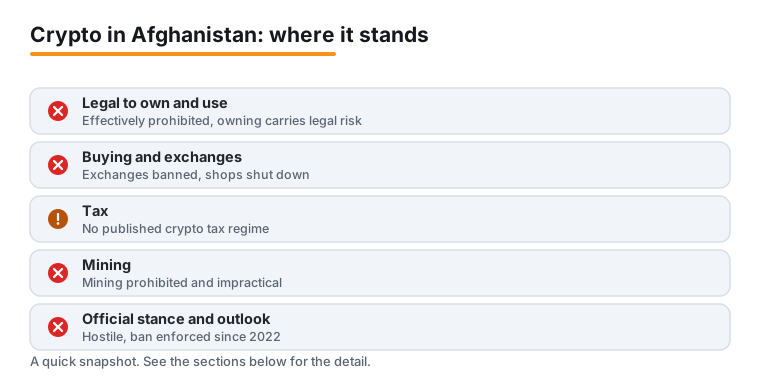
No. As of 2026, cryptocurrency is effectively prohibited in Afghanistan. In August 2022 the authorities declared crypto trading unlawful, and officials have described it as haram. The ban applies broadly to buying, selling and operating exchange services, and enforcement has included shutting down trading shops and detaining operators. Cryptocurrency is not recognised as legal tender, and there is no legal route to use it inside the country.
It is important to separate two ideas that templated articles often blur: the underlying technology may be usable, but the activity is banned. Holding, trading or facilitating cryptocurrency exposes individuals to confiscation of funds and potential detention. Some residents still transact privately or P2P, but doing so is unauthorised and carries genuine legal and safety risk. Statements that Afghanistan is becoming a hub for decentralised finance describe an aspiration, not the current legal reality. Verify the latest position with official notices and a qualified local lawyer before assuming anything.
Who regulates crypto in Afghanistan?
There is no dedicated crypto regulator in Afghanistan, because the activity is banned rather than licensed. Oversight sits with the existing financial and security institutions:
- Da Afghanistan Bank (DAB) is the central bank, responsible for monetary policy, currency, the banking system and money-service oversight. DAB has supported the ban and does not license crypto exchanges, custodians or wallets. Its official website is dab.gov.af, where it focuses on conventional banking, exchange rates and financial supervision; it publishes no crypto authorisation regime.
- FinTRACA (the Financial Transactions and Reports Analysis Center of Afghanistan) is the country's financial intelligence unit (FIU), established in 2006 and administratively housed within DAB. It handles anti-money-laundering (AML) and counter-terrorist-financing (CFT) monitoring. Its site is fintraca.gov.af.
- The de facto authorities carry out enforcement, including ordering closures of crypto trading businesses and detaining people involved in the market.
Because there is no authorisation regime, there are no virtual-asset service providers (VASPs) operating legally in Afghanistan, and no investor-protection or dispute-resolution mechanism for crypto.
Key laws and frameworks
Afghanistan does not have a modern, purpose-built crypto framework with licensing, consumer protection and disclosure rules. Instead, digital assets fall under a blanket prohibition combined with the country's general financial and anti-money-laundering controls.
The building blocks are named and published. FinTRACA lists four laws as the AML/CFT instruments currently applied: the Anti-Money Laundering and Proceeds of Crime Law, the Counter Financing of Terrorism Law, the Banking Law of Afghanistan and the Da Afghanistan Bank Law. FinTRACA itself is the Financial Intelligence Unit established within Da Afghanistan Bank by Article 25 of the Anti-Money Laundering and Proceeds of Crime Law; it receives suspicious transaction reports under Article 18 and draws its enforcement powers from Article 24, which cover written warnings, suspension or revocation of a business licence, fines of 50,000 to 500,000 afghani per infraction, and orders removing an administrator, officer or employee. That statute repealed the earlier anti-money-laundering law published in Official Gazette 840 dated 10/8/1383, and its published English text contains no reference to virtual assets or cryptocurrency. Internationally, virtual-asset risk is shaped by the Financial Action Task Force (FATF) standards (notably Recommendation 15 on virtual assets and VASPs); you can read the FATF's work on this at fatf-gafi.org. However, in Afghanistan these AML standards operate against a backdrop where crypto activity is prohibited outright rather than licensed, so there is no domestic VASP registration framework to comply with. Rules and enforcement can change with little notice and limited public documentation, so confirm the current status through official channels before relying on any of this.
Licensing and registration of exchanges
There is no licensing or registration regime for crypto exchanges or VASPs in Afghanistan, because the underlying activity is banned. Da Afghanistan Bank does not issue crypto-exchange or custody licences, and the register that does exist covers entirely different categories. Annex I of the AML/CFT Responsibilities and Preventative Measures Regulation enumerates the institution types Da Afghanistan Bank regulates as Banks, Money Service Providers, Foreign Exchange Dealers, Electronic Money Institutions, Depository Micro Finance Institutions, Brokers and Prepaid card issuing companies. There is no virtual asset service provider category, and the word virtual does not appear anywhere in the regulation.
Local exchange shops that previously offered crypto services have been targeted for closure; the reported shutdown of around 16 exchanges in Herat in 2022 is the clearest example, and operating such a business is treated as unlawful. As a result the formal on-ramps common elsewhere (regulated domestic exchanges, bank transfers to platforms, card purchases) are not available in any compliant form. What persists is informal: private P2P deals, cash trades, and use of foreign platforms accessed remotely, all of which are unauthorised and may also be blocked or restricted by the platforms themselves for users connecting from Afghanistan.
Crypto and Bitcoin tax in Afghanistan
Because crypto activity is prohibited rather than regulated, Afghanistan does not operate a clear, published tax regime specifically for cryptocurrency gains, trading or mining. There is no official guidance assigning capital-gains, income or VAT treatment to digital assets the way some countries have done.
That absence should not be read as "tax-free." When an asset class is banned, the more relevant exposure is usually legal rather than fiscal: funds can be treated as illicit and confiscated. General income, business and customs taxes administered by the state could in principle touch related cash flows, but there is no reliable, verified crypto-specific rate or threshold to cite. No rate is specific to crypto, but the general default is knowable. The Afghanistan Revenue Department still lists the Income Tax Law 2009 (Official Gazette number 976 dated 18 March 2009, consolidated version December 2016) on its tax laws page. Article 21 makes the gain from the sale or exchange of capital assets subject to income tax, Article 29 computes gains on property held eighteen months or more at an averaged rate that cannot fall below two percent, Article 4(1) sets income tax on legal persons at 20 percent, and Article 66(1) sets business receipts tax at four percent of income received before deductions, which catches a natural person once revenue reaches Afs 750,000 per quarter under Article 64(2). No Afghan authority has applied any of these to digital assets, and the Revenue Department states its English text is an unofficial translation. If your situation involves Afghan tax residency or income, get advice from a qualified Afghan tax professional and confirm against the latest official rules. For general background see our crypto taxes guide. This section is informational only and is not tax advice.
AML and KYC rules
Afghanistan's anti-money-laundering (AML) and counter-terrorist-financing (CFT) framework is overseen by FinTRACA, the financial intelligence unit housed within Da Afghanistan Bank. Banks, money-service businesses and other reporting entities are expected to apply customer due diligence (know-your-customer, or KYC) and to report suspicious and large transactions, broadly in line with international FATF standards.
For crypto specifically, the practical effect is different from most countries: rather than a regulated VASP sector applying the FATF "travel rule" and registration requirements, crypto is banned, so there is no licensed channel through which KYC/AML controls are applied to digital-asset trades. Crypto-linked funds that surface through the formal banking system can nonetheless attract AML scrutiny and be treated as suspicious. The reporting thresholds are published: under the AML/CFT Responsibilities and Preventative Measures Regulation banks must report deposits, withdrawals or transfers in excess of AFS 1,000,000 to FinTRACA under Article 20(1), must not carry out occasional transactions in excess of AFS 500,000 for customers who refuse to identify themselves or to document their source of funds under Article 5(3)(3), and must collect supporting documents on cross-border wire transfers at or above AFS 1,000,000 under Article 18(2), so verify current obligations directly with FinTRACA at fintraca.gov.af or with qualified counsel.
Buying and using crypto in practice
There is no legal way to buy or use crypto through a licensed domestic channel in Afghanistan. We are not providing a step-by-step buying guide, because purchasing crypto in the country is illegal and there is no compliant on-ramp; presenting a "how-to" would misrepresent the legal reality and could expose readers to harm.
What persists is informal and unauthorised, and each route carries layered risk:
- Legal risk: participation is illegal and can lead to seizure of funds or detention.
- Counterparty risk: P2P trades have no recourse if the other side defrauds you; there is no regulator to complain to.
- Access risk: international platforms may restrict or block users connecting from Afghanistan, and connectivity can be unreliable.
If your legal residence is elsewhere and you are simply researching from outside Afghanistan, follow the licensed-exchange and KYC rules of that country instead. For anyone inside Afghanistan, the responsible guidance is to confirm the current law and seek qualified local advice before considering any action.
Bitcoin mining in Afghanistan
Bitcoin mining is not a sanctioned activity in Afghanistan and falls under the same prohibition that covers trading. While some commentary highlights the country's potential renewable resources (hydroelectric capacity in mountainous regions, plus solar and wind potential), that potential is theoretical and does not change the legal status of mining.
Several practical barriers reinforce the legal one:
- Electricity supply: Afghanistan imports a large share of its power and faces grid-reliability problems, making sustained, large-scale mining difficult and expensive.
- Hardware and capital: importing mining equipment and financing operations is hard amid banking disruption and trade constraints.
- Enforcement: visible energy use and equipment can attract attention, and the activity remains unlawful.
Claims that Afghanistan could become a "green mining pioneer" describe a hypothetical, not a present-day industry. Until the legal stance changes and a proper framework exists, mining should be regarded as both illegal and impractical for residents. This is not a recommendation to mine.
Remittances and stablecoins
Remittances are central to Afghanistan's economy, and the breakdown of normal banking after 2021 made moving money in and out of the country much harder. Historically the informal hawala network has handled a large share of cross-border transfers, operating on trust between brokers rather than through banks.
In theory Bitcoin and stablecoins offer an alternative: fast, borderless transfers that do not depend on a functioning local banking relationship. There are reports of diaspora members and aid-linked flows using crypto, and dollar-pegged USDT (Tether) is reportedly used to preserve savings and settle remittances, sometimes via dealers in neighbouring countries who hand over cash in afghanis once a transfer clears. Part of the appeal is cost: users have described conventional channels such as bank wires, Western Union, MoneyGram and hawala as carrying high or hidden fees, with some reporting effective charges of up to around 20 percent, which pushes people toward informal crypto transfers despite the legal risk. This is the genuine kernel of truth behind the "game-changer" framing in some articles.
The reality, however, is heavily constrained: such transfers are illegal under the current ban; the recipient still faces the "last mile" problem of converting crypto into usable cash through informal channels; and volatility, fraud and lack of recourse make crypto remittances less safe than the marketing suggests. Crypto has not lawfully "reshaped money-transfer laws"; it sits alongside hawala as an informal workaround with added legal exposure.
Recent developments (2025 to 2026)
The headline position has not changed: the ban first imposed in 2022 remains in force, and the authorities have shown consistent intent to suppress crypto. Reporting through 2025 and into 2026 describes continued enforcement, including detentions of traders, alongside persistent underground demand that the prohibition has failed to eliminate.
In February 2024 the ban was restated at provincial level in Badghis, where the local Taliban-appointed governor, Abdul Samad Jawid, announced a prohibition on digital and online currency transactions within the province and warned that people defying it would face legal consequences, with officials again framing crypto as gambling and haram. The episode illustrates that the prohibition is being reasserted locally rather than relaxed.
Two notable trends stand out. First, dollar-pegged stablecoins, especially USDT, have reportedly grown as a savings and remittance tool, precisely because they hold value against the dollar and route around the banking system. Second, there are reports that the authorities have tested monitoring and detection tools, including efforts to flag devices repeatedly connecting to known crypto-wallet infrastructure, signalling an intent to police the underground market more actively. These developments are drawn from media reporting rather than published official policy, so treat them as indicative and verify against official sources. A formal, regulated crypto market is not on the visible horizon.
Consumer risks and protection
The defining features of Afghanistan's crypto landscape are prohibition, enforcement and opacity, and there is essentially no consumer protection for digital assets. Because crypto is banned rather than licensed, there is no local regulator to complain to, no deposit insurance, no dispute-resolution process and no recourse if a platform fails or a counterparty defrauds you.
The main risks are:
- Legal exposure: banned activity, with possible confiscation of funds and detention.
- Fraud and counterparty loss: informal P2P deals offer no protection against scams.
- Volatility and exit risk: prices can swing sharply, and converting back to usable local cash relies on informal channels that can disappear or be shut down.
- Custody risk: self-custody mistakes such as lost keys or scams are irreversible.
- Data scarcity: reliable official information is limited, so even careful summaries can lag reality.
We make no price predictions. Any potential upside has to be weighed against a banned legal status, severe practical friction and the real possibility of losing the entire amount.
Official sources and how to verify
Because this is a fast-moving, under-documented area, do not rely on any single article, including this one, as the final word. Check the position directly with the official bodies:
- Da Afghanistan Bank (central bank): dab.gov.af for monetary policy, financial supervision and any official notices.
- FinTRACA (Financial Intelligence Unit): fintraca.gov.af for AML/CFT guidance, public notices and reports.
- Financial Action Task Force (FATF): fatf-gafi.org for the international virtual-asset and VASP standards that frame AML expectations.
For broader context, see our crypto regulation guide and our country regulation hub. This page is general information as of 2026 and is NOT legal, tax or financial advice. Crypto activity in Afghanistan can carry serious legal and personal risk; verify the current legal status with Da Afghanistan Bank and consult a qualified local lawyer before acting.
What is changing: Afghanistan in August 2026
Nothing in Afghanistan's crypto position changed between 30 June and 3 August 2026. The prohibition imposed in August 2022 still stands, and there is still no crypto law, no licensing regime and no published central bank notice on digital assets. What moved in the background is anti-money-laundering supervision, and it moved away from virtual assets rather than toward them.
Three checks establish the position on 3 August 2026. Da Afghanistan Bank is publishing daily, with its exchange rate table dated 03 August 2026 and the US dollar quoted at 65.9608 afghani for cash sales. The bank's published laws, regulations and circulars contain no reference to cryptocurrency, virtual assets or digital currency, and the circulars list runs only to one Islamic banking supervisory circular and a long series of accounting circulars for electronic money institutions. The same is true of every instrument published by FinTRACA, which publishes four laws, four regulations, five circulars and a single guideline.
The one area with fresh dated activity is AML enforcement. FinTRACA's enforcement record, last updated April 2026, shows 2025 as the heaviest year on record for licence suspensions against money service provider companies, which are the licensed hawala and exchange businesses through which informal value moves. The longer run matters, though: 2021 remains higher for account freezes and marginally higher for revocations.
| Enforcement action | 2021 | 2022 | 2023 | 2024 | 2025 |
|---|---|---|---|---|---|
| Suspended licences of MSPCOs | 43 | 19 | 3 | 3 | 104 |
| Revoked business licences of MSPCOs | 37 | 18 | 1 | 1 | 36 |
| Frozen bank accounts | 127 | 19 | 10 | 41 | 40 |
| Warnings, notifications and instructions to banking institutions | not stated | not stated | 2 | 26 | 28 |
| Value frozen | 34,913,197 AFN, 1,311,381 USD | 3,980,675 AFN, 5,440 USD | 20,223,526 AFN, 809 USD, 2,552 EUR | 64,555,825 AFN, 56,438 USD | 119,570,953 AFN, 2,924,848 USD, 127 EUR |
FinTRACA's published highlights for 2025 record 615,788 large cash transaction reports and 292 suspicious transaction reports received, along with 113 cases and 178 enforcement actions. Its suspicious transaction table and large cash transaction table both continue into the current year, with monthly figures published through May 2026. None of this material is crypto-specific, but it is the machinery a crypto-linked transfer runs into if it touches a bank or a licensed exchange house.
The named laws that actually govern crypto-related activity
There is no crypto statute in Afghanistan. That is worth saying once, precisely, and then moving on to what does apply. FinTRACA publishes four laws as the AML/CFT instruments currently applied, and none of them mentions virtual assets or cryptocurrency anywhere in the published English text. Da Afghanistan Bank's legislation page lists a wider set of eight, adding the Negotiable Instrument Law, the Secured Transaction of Movable Property Law, the Law of Mortgage on Immovable Property and the Financial Leasing Law, none of which touches digital assets either.
| Instrument | What it does | Relevance to crypto |
|---|---|---|
| Anti-Money Laundering and Proceeds of Crime Law | Criminalises money laundering. Article 25 establishes the Financial Intelligence Unit within Da Afghanistan Bank. Article 18 requires suspicious transaction reports within three days of forming the suspicion. Article 24 grants enforcement powers including written warnings, suspension or revocation of a business licence, fines of 50,000 to 500,000 afghani per infraction, and orders removing an administrator, officer or employee. It repealed the earlier AML law published in Official Gazette 840 dated 10/8/1383. | The statute a crypto holder is realistically exposed to. Its definition of funds or property reaches legal documents or instruments, including electronic or digital, evidencing title to or interest in assets, which is how crypto proceeds are treated as property in a laundering case. |
| Counter Financing of Terrorism Law and Regulations | Criminalises terrorist financing. Articles 2 and 11 of the Law with Articles 6 and 7 of the Regulation, together with Freezing Order number 2793 of 20 July 2016, implement UN Security Council Resolution 1267 and 1988 sanctions lists alongside the FinTRACA Watch-List. | The freezing mechanism, providing the legal basis on which accounts and funds are frozen. |
| Banking Law of Afghanistan and Da Afghanistan Bank Law | Constitute the central bank and set the perimeter of licensed banking and financial services. | Define what can be licensed. Crypto exchange and custody fall outside the perimeter entirely. |
| Income Tax Law 2009, Official Gazette number 976 of 18 March 2009 | General income and business taxation, consolidated version December 2016. | Supplies the tax default for asset disposals in the absence of any crypto rule. |
Sources: Da Afghanistan Bank's laws page, FinTRACA's laws page and regulations page, and the Afghanistan Revenue Department's tax laws page.
The reporting thresholds and cash limits that catch crypto-linked money
The thresholds are published. They come from the AML/CFT Responsibilities and Preventative Measures Regulation, issued by Da Afghanistan Bank's Financial Supervision Department in 2016 under Article 69 of the AML-PC Law and available from FinTRACA. They apply to any transaction that reaches the formal system, including a crypto cash-out routed through a bank or a licensed exchange house.
- Under Article 20(1), banks must report deposits, withdrawals or transfers in excess of AFS 1,000,000 or the equivalent in other currencies to FinTRACA, filed no earlier than the first business day and no later than the fifth business day of the month following the transaction.
- Under Article 5(3)(3), banks must not carry out occasional transactions in excess of AFS 500,000 for customers who refuse to identify themselves at all or refuse to disclose and document the source of their funds.
- Under Article 5(3)(2), non-bank financial institutions must run customer due diligence on an occasional or walk-in customer once a transaction reaches AFS 50,000 or above, whether single or several linked transactions.
- Under Article 18(2), cross-border wire transfers equal to or exceeding AFS 1,000,000 require supporting documents in addition to standard customer information.
- Under Article 18(3), cross-border transfers below AFS 50,000 must still carry the originator's name and account number or unique transaction number.
- Under Order number 4088 of the Prime Minister, published as a standing notice by FinTRACA, no individual may carry more than five thousand US dollars through an airport or more than five hundred US dollars across a land border in physical cash. Decorative jewelleries in normal quantity are excluded, with the quantity to be prescribed by a Ministry of Finance procedure.
That last limit matters for understanding why dollar stablecoins circulate informally despite the ban. Cash export is capped at five hundred US dollars by land, and the formal banking route is constrained, so informal transfer persists as the residual channel.
The same regulation settles the licensing question with a list rather than an assertion. Annex I enumerates the institution types that must comply with it: Banks, Money Service Providers, Foreign Exchange Dealers, Electronic Money Institutions, Depository Micro Finance Institutions, Brokers and Prepaid card issuing companies. There is no virtual asset service provider category, and the word virtual does not appear anywhere in the regulation's 32 pages.
What Afghan tax law says about disposing of an asset
No Afghan authority has issued crypto tax guidance, and no rate exists that is specific to digital assets. That does not mean nothing is knowable. The Afghanistan Revenue Department, part of the Ministry of Finance, still lists the Income Tax Law on its tax laws page alongside the Tax Administration Law and the Value Added Tax Law. The income tax text was published at Official Gazette number 976 dated 18 March 2009 and consolidated to a December 2016 version through amendments in Official Gazettes 1103, 1115, 1118, 01198, 1181, 1206 and 1209. Its default treatment of an asset disposal is the closest published answer to the question.
- Article 21 makes the gain from the sale or exchange of capital assets, or of investment in trade or business, subject to income tax.
- Article 29 sets the method for gains taxable under Article 23 on an asset owned eighteen months or more. The gain is divided by the number of years it was owned, averaged into other taxable income, taxed under the Article 4 schedule, and the resulting effective rate applied. The law then states that if the resulting rate is less than two percent, the applicable rate shall be two percent. This is a floor, not a headline rate.
- Article 4(1) sets income tax on legal persons at 20 percent of taxable income.
- Article 30 imposes one percent tax on the price receivable from the sale or transfer of movable or immovable property at the time ownership transfers.
- Article 66(1) sets business receipts tax at four percent of income received before any deductions. Article 64(2) brings a natural person into that charge once revenue reaches Afs 750,000 or more per quarter, while legal persons are chargeable under Article 64(1) without a threshold. Article 64(3) applies four percent to the cost price of imported goods including customs duty. Trading as a business, rather than a one-off disposal, would fall here.
| Monthly income of a natural person | Income tax under Article 4(3) |
|---|---|
| From Afs 0 to Afs 5,000 | 0 percent |
| From Afs 5,001 to Afs 12,500 | 2 percent |
| From Afs 12,501 to Afs 100,000 | 10 percent plus Afs 150 fixed amount |
| From Afs 100,000 and above | 20 percent plus Afs 8,900 fixed amount |
Treat these as the general law, not as crypto guidance. Because the activity is prohibited, the realistic exposure for a crypto holder in Afghanistan is confiscation and detention rather than a tax assessment, and no Afghan ruling applies these articles to digital assets. The Revenue Department also states on the document itself that its English text is an unofficial translation and that anyone needing certainty should rely on the Dari and Pashto versions published in the Official Gazettes. This section is informational and is not tax advice.
The legislative pipeline, and the crypto-shaped hole in it
There is no crypto bill in Afghanistan. No draft law, no consultation, no central bank framework and no announced timetable could be found in any official publication as of 3 August 2026. Rather than leave that as a bare assertion, it is worth showing what is moving, because the direction of travel is the answer.
- FinTRACA extended its supervisory coverage to designated non-financial businesses and professions, bringing tax accountants and external auditors into the reporting framework and training 137 staff from tax accountancy and external audit firms between 1 and 6 November 2025, working with the Ministry of Finance Revenue and Customs departments and CPA Afghanistan. The expansion is expressly aligned with FATF Recommendations 22 and 23 on non-financial professions. It makes no reference to Recommendation 15 on virtual assets and virtual asset service providers, which is the recommendation that would drive a crypto licensing regime. FinTRACA's circulars list separately carries Circular number 004 on Auditors and Chartered Accountants and Circular number 005 on Tax Accountants.
- On 30 December 2025 FinTRACA held the eleventh meeting of its Compliance Coordination Committee at the Supreme Council Hall of Da Afghanistan Bank, chaired by Director General Ahmad Rahimi, with the Afghanistan Banking Association and chief compliance officers of commercial banks. The agenda covered updating KYC forms, the quality of large cash transaction and suspicious transaction reports, fraud and forgery cases, and implementation of the UNSCR 1267 and 1988 sanctions lists with the FinTRACA Watch-List. Virtual assets were not on it.
- On 6 August 2025 the fourth meeting of the working committee of the High-Level Coordination Commission to Combat Money Laundering and Other Financial Crimes met with the ministries of foreign affairs, interior and justice, the General Directorate of Intelligence and the Supreme Court, focused on money laundering, drug trafficking and the smuggling of foreign currency, gold and precious stones at airports and land borders.
On the international side, Afghanistan became a member of the Asia/Pacific Group on Money Laundering in April 2006. FinTRACA publishes a sequence of FATF public statements about Afghanistan, and the most recent one listed is from 2017, when the FATF said Afghanistan had established the legal and regulatory framework to meet its action plan commitments and was no longer subject to the ongoing global AML/CFT compliance process. That page has not been extended since, and it predates the 2021 change of authorities, so it should not be read as a statement of Afghanistan's status today.
FinTRACA's published typologies point the same way. The four case studies cover a Telegram-promoted Ponzi-style investment scheme, trade-based money laundering through a shell company, and drug proceeds laundered through trade mis-invoicing. None of them involves digital assets.
Frequently asked questions
Is cryptocurrency legal in Afghanistan in 2026?
No. Crypto trading and exchange services have been banned since August 2022, with the central bank, Da Afghanistan Bank, supporting the prohibition and authorities shutting down exchanges and arresting traders. There is no lawful way to buy, sell or operate crypto services inside the country, and informal use carries legal and personal risk. This is general information, not legal advice; verify with the official regulator.
Who regulates crypto in Afghanistan?
There is no dedicated crypto regulator, because the activity is banned rather than licensed. Da Afghanistan Bank (the central bank, dab.gov.af) oversees the financial system and backs the ban, FinTRACA (the financial intelligence unit housed within DAB, fintraca.gov.af) handles anti-money-laundering monitoring, and the de facto authorities carry out enforcement such as closures and arrests.
Are crypto exchanges licensed in Afghanistan?
No. There is no licensing or registration regime for crypto exchanges or VASPs, because the underlying activity is banned. Da Afghanistan Bank does not issue crypto licences, and exchange shops have been closed by the authorities, with around 16 reportedly shut down in Herat in 2022. There are no legally operating crypto platforms in the country.
Can I use Bitcoin or USDT to send money to family in Afghanistan?
Technically crypto can route value across borders, and reporting suggests dollar-pegged stablecoins such as USDT are used for savings and remittances where banks have failed. But it is illegal under the current ban, and the recipient still has to convert it to cash through risky informal channels. The traditional hawala network handles most remittances. Using crypto this way is unauthorised; weigh the legal risk and seek qualified advice first.
Is Bitcoin mining allowed in Afghanistan?
No. Mining falls under the same prohibition as trading. Despite talk of renewable-energy potential, mining is illegal and impractical given unreliable electricity, hardware and import constraints, and enforcement risk. It should not be treated as a viable activity for residents.
Are there crypto taxes in Afghanistan?
There is no clear, published crypto-specific tax regime, because the activity is prohibited rather than regulated. That does not make it "tax-free" in a safe sense; the bigger exposure is legal, as funds can be treated as illicit and confiscated. We do not cite specific rates because no credible official source defines them. Consult a qualified Afghan tax professional. This is informational only and not tax advice.
Did the crypto ban change in 2024 or 2025?
No. The nationwide ban from August 2022 remained in force through 2024 and 2025, and the authorities restated it rather than relaxing it. In February 2024 the Taliban-appointed governor of Badghis, Abdul Samad Jawid, announced a provincial ban on digital and online currency transactions and warned of legal consequences for those who defied it. Reporting also describes continued enforcement and, in 2025, testing of tools to detect devices repeatedly connecting to known crypto-wallet infrastructure. These points come from media reporting; verify against official sources.
Why do some Afghans use crypto if it is banned?
Mainly because the formal banking system was badly disrupted after 2021 and conventional transfer channels can be slow or costly. Users have described bank wires, Western Union, MoneyGram and hawala as carrying high or hidden fees, in some reports up to around 20 percent, so dollar-pegged USDT and other crypto are used informally to move value and protect savings. This activity is still illegal under the current ban and carries legal, fraud and access risk, and the recipient must convert crypto to cash through informal channels.
What law bans crypto in Afghanistan?
None that has been published. As of 3 August 2026 there is no Afghan statute, regulation, circular or central bank notice that names cryptocurrency or virtual assets. Da Afghanistan Bank's published laws, regulations and circulars contain no such reference, and neither do FinTRACA's four laws, four regulations, five circulars or its single guideline. The prohibition dates from August 2022 and operates as an administrative and religious ruling by the de facto authorities, enforced through closures, arrests and confiscation rather than through a gazetted crypto law. What is published and does apply is the Anti-Money Laundering and Proceeds of Crime Law, the Counter Financing of Terrorism Law, the Banking Law of Afghanistan and the Da Afghanistan Bank Law.
Is a crypto law or licensing framework expected in Afghanistan in 2026 or 2027?
There is no evidence of one. No draft law, consultation, central bank framework or timetable appears in any official Afghan publication as of August 2026. The direction of AML policy points elsewhere: FinTRACA extended supervision to designated non-financial businesses and professions, bringing tax accountants and external auditors into scope under FATF Recommendations 22 and 23, and trained 137 staff from accountancy and audit firms between 1 and 6 November 2025. It made no reference to Recommendation 15 on virtual assets and virtual asset service providers, which is the standard that would drive a crypto licensing regime.
At what amount does a transfer get reported to FinTRACA?
Under Article 20(1) of the AML/CFT Responsibilities and Preventative Measures Regulation, banks must report deposits, withdrawals or transfers in excess of AFS 1,000,000 or the equivalent in other currencies, filed no earlier than the first and no later than the fifth business day of the following month. Under Article 5(3)(3) banks must not carry out occasional transactions in excess of AFS 500,000 for customers who refuse to identify themselves or to document the source of their funds. Under Article 18(2) cross-border wire transfers at or above AFS 1,000,000 require supporting documents, and under Article 18(3) transfers below AFS 50,000 must still carry the originator's name and account or unique transaction number. FinTRACA's published highlights record 615,788 large cash transaction reports and 292 suspicious transaction reports received in 2025.
How much cash can be carried out of Afghanistan legally?
Under Order number 4088 of the Prime Minister, published as a standing notice by FinTRACA, no individual may carry more than five thousand US dollars in physical cash through an airport, or more than five hundred US dollars across a land border. Decorative jewelleries, meaning gold and other precious metals and precious stones, in normal quantity are excluded from the threshold, with the quantity to be prescribed by a Ministry of Finance procedure. This limit is part of why dollar stablecoins circulate informally, though using them remains illegal under the crypto prohibition.
What tax would apply to a crypto gain in Afghanistan?
There is no crypto tax rule. The general default in the Income Tax Law 2009, which the Afghanistan Revenue Department still lists on its tax laws page, is that the gain from the sale or exchange of a capital asset is subject to income tax under Article 21. For property held eighteen months or more, Article 29 applies an averaged rate with a floor of two percent. Income tax on legal persons is 20 percent under Article 4(1), and business receipts tax is four percent of income received before deductions under Article 66(1), which catches a natural person once revenue reaches Afs 750,000 per quarter. No Afghan authority has applied these to digital assets, and because the activity is prohibited the realistic exposure is confiscation rather than assessment. The department's English text is an unofficial translation. This is informational only and not tax advice.
What is Afghanistan's status with the FATF and the APG?
Afghanistan became a member of the Asia/Pacific Group on Money Laundering in April 2006. FinTRACA publishes a sequence of FATF public statements about Afghanistan, and the most recent one listed is from 2017, when the FATF said Afghanistan had established the legal and regulatory framework to meet its action plan commitments and was no longer subject to the ongoing global AML/CFT compliance process. That page has not been updated since, and it predates the 2021 change of authorities, so it should be read as a record of the 2017 decision rather than as a statement of Afghanistan's listing status today. Anyone who needs the current position should check the FATF's own lists directly.
Facts reviewed: 3 August 2026. Page updated: 3 August 2026.