Home › Crypto Regulation › Maldives
Bitcoin & Cryptocurrency Regulation in Maldives
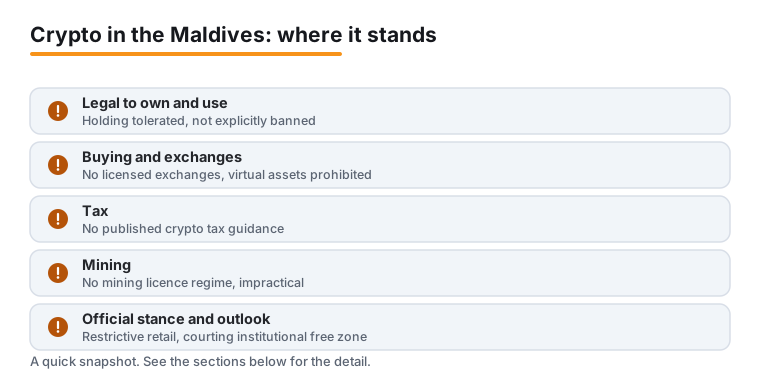
Quick answer — Maldives, 2026
- Legal: No crypto-specific law in force; not legal tender; no MMA permit granted for crypto transactions; holding is not an offence
- Tax: No crypto-specific rule; a disposal gain falls under the Income Tax Act 25/2019, individual rates 0% up to MVR 720,000 rising to 15%
- Buying: No licensed local exchange, via international platforms and P2P
Cryptocurrency policy in the Maldives is split in two directions. For ordinary residents and businesses, the picture is restrictive: the country's central bank, the Maldives Monetary Authority (MMA), has repeatedly stated that crypto is not legal tender and that no party has been granted permission to conduct financial transactions using cryptocurrencies or other virtual currencies under the Maldives Monetary Authority Act 1981. At the same time, in 2025 the government and a Dubai-based investment firm announced the Maldives International Financial Centre (MIFC), a large special-economic-zone project pitched as a fully regulated free zone for blockchain and digital-asset businesses. The result is a jurisdiction where everyday retail crypto sits in a restricted grey area while the state separately courts licensed institutional digital-asset activity inside a dedicated zone.
This guide explains, in plain terms, what is and is not allowed for individuals and businesses dealing with Bitcoin and other cryptocurrencies in the Maldives as of 2026, covering legal status, the regulators involved, the laws that apply, exchange and licensing rules, tax, AML and KYC, mining, recent developments, and consumer risk. This is general information as of 2026 and is NOT legal, tax or financial advice; crypto rules in the Maldives are evolving, so always verify the current position with the Maldives Monetary Authority and other named official bodies before acting. For background concepts see our guide to crypto regulation.
On this page: Legal status · Who regulates it · Taxes · How to buy · Mining
Is Bitcoin and crypto legal in the Maldives?
There is no statute that makes it a crime for an individual to own Bitcoin or other digital assets, so personal holding is not explicitly banned. But that is very different from saying crypto is legal or recognised. The Maldives Monetary Authority has stated publicly that cryptocurrency is not legal tender and that no party has been granted permission to conduct any financial transactions using cryptocurrencies or other virtual currencies in the country. The Maldivian rufiyaa (MVR) is the only recognised legal tender, and the MMA has stressed that issuing any other legal tender is against the law.
In its third round mutual evaluation of the Maldives, published in October 2025 after an on-site visit from 13 to 23 January 2025, the Asia/Pacific Group on Money Laundering recorded the opposite of a ban: there are no local Virtual Asset Service Providers in operation in the Maldives, there is some exposure to foreign VASPs providing services to people in the Maldives, and there are no prohibitions on the use of virtual assets. The same report states that the Maldives does not have a legal framework to regulate VASPs, nor has it issued any prohibitions relating to virtual asset or VASP activity, and it rates Recommendation 15 on new technologies non-compliant. So the honest summary for August 2026 is that no Maldivian law bans holding, buying or selling crypto, and no Maldivian law licenses or protects it either. The operative instrument is MMA notice IL-OFI/2018/66 of 11 October 2018, which states that no party has been granted permission to conduct any financial transactions using crypto currencies or other virtual currencies in the Maldives and cautions the general public on their use. That is a statement that no permits exist plus a warning, not a criminal prohibition on ownership. Treat the general environment as restricted and unregulated rather than sanctioned, and monitor MMA announcements closely.
Who regulates crypto in the Maldives?
Several official bodies are relevant, and it is important to keep them separate:
- Maldives Monetary Authority (MMA): the central bank and monetary regulator, established under the Maldives Monetary Authority Act 1981. It oversees legal tender, payment systems, licensing of money exchange and remittance businesses, and financial stability. It is the body that has declared crypto is not authorised for transactions. Official site: Maldives Monetary Authority.
- Financial Intelligence Unit (FIU): based within the MMA, it handles suspicious-transaction reporting and AML/CFT supervision and is working to enhance the country's virtual-asset AML framework.
- Maldives International Financial Services Authority (MIFSA): established by the President in January 2024 under the Special Economic Zones Act, MIFSA is the regulator for the new offshore/free-zone financial framework, including the MIFC and its planned licensing of digital-asset businesses. Official site: MIFSA.
- Maldives Inland Revenue Authority (MIRA): the national tax administrator.
For everyday retail crypto questions, the MMA is the authority that matters. For the new institutional zone, MIFSA is the relevant regulator.
Key laws and frameworks
The Maldives does not yet have a single, comprehensive virtual-asset statute governing retail crypto. Several existing frameworks shape how digital assets are treated:
- Maldives Monetary Authority Act 1981: underpins the MMA's mandate over currency and payments and is the legal basis for its position that crypto is not recognised money and that no transaction permits have been issued.
- Prevention of Money Laundering and Financing of Terrorism Act (PMLFT Act), Law No. 10/2014: the operative AML and CFT statute, named as such throughout the 2025 APG mutual evaluation and cited as Law No. 2014/10 in the CMDA sandbox draft. The evaluation records that preventive measures are set out in the PMLFT Act, that section 75 lets the MMA issue regulations for its execution, and that sectoral regulations exist for banks, insurance, securities business, money transfer and money changing businesses. It also found no provisions requiring VASPs to comply with the preventive measures in Recommendations 10 to 21, including the travel rule. The FIU has indicated it is enhancing the virtual-asset AML framework, with amendments under way to address risks such as the wider use of stablecoins as a means of payment.
- Special Economic Zones Act 2014: the legal basis used to establish MIFSA and the MIFC free zone, which is intended to have its own special legal, regulatory and tax regime for licensed entities operating inside it.
The MMA has also warned the public about fraudulent claims of official permits for crypto trading. If anyone presents a government licence to run a crypto exchange or investment scheme for the general public, treat it with strong scepticism and verify directly with the MMA. A special economic zone for licensed institutions is not the same as general legalisation of retail crypto across the country.
Exchange, VASP licensing and registration
For the general public, there is currently no framework for a licensed, locally regulated crypto exchange operating openly in the Maldives, and the MMA has not authorised crypto for transactions. As a result there are no domestic, MMA-supervised exchanges of the kind found in jurisdictions with formal virtual-asset licensing.
The picture is different inside the MIFC free zone. The MIFC is marketed as a fully regulated financial free zone for blockchain, digital assets and real-world-asset tokenisation, with MIFSA intended to license virtual-asset businesses such as exchanges, custody and settlement providers, alongside regulatory sandbox initiatives. As of 2026 this framework is still being built out, so prospective businesses should confirm the exact licensing categories, requirements and timelines directly with MIFSA rather than relying on summaries. See the official Maldives International Financial Centre site for current details.
In practice, residents who buy crypto today typically use international exchanges and peer-to-peer platforms, which carry banking friction, foreign-exchange limits and no local consumer protection if something goes wrong.
Crypto tax in the Maldives
The Maldives has historically relied on tourism-linked levies, import duties, a goods and services tax (GST) and business-profit and income taxation administered by the Maldives Inland Revenue Authority (MIRA), rather than a broad tax on every individual's investment gains. Because there is no dedicated crypto tax statute, there is no clearly published rule on how a capital gain from selling Bitcoin would be taxed for an individual.
This absence of specific guidance is exactly why caution is warranted:
- The fact that retail crypto is unregulated does NOT automatically mean profits are tax-free; businesses dealing in crypto could fall within general business-profit and income-tax rules.
- The MIFC free zone is being marketed with its own incentives, reported to include no corporate tax and tax-free inheritance, which would apply only to entities licensed inside the zone, not to ordinary residents.
- Authorities can issue interpretations that apply existing law to crypto, and your home-country tax obligations may also apply if you are a foreign national or resident.
There is no crypto-specific rate, but there is a statutory default. The Income Tax Act (Law Number 25/2019) charges tax under section 3(l) on gains derived from the disposal of movable, immovable, intellectual or intangible property, and individual rates in section 7 run 0% up to MVR 720,000 of taxable income, then 5.5%, 8%, 12% and 15% above MVR 2,400,000. Section 9 charges persons other than individuals and banks 0% up to MVR 500,000 and 15% above. Section 30(e)(1) disregards a gain in determining an individual's taxable income where the consideration from a disposal of a property or similar properties at any given time is not more than MVR 40,000 and the total from all such transactions stays within MVR 100,000 in an accounting period. These figures come from the Act as enacted; MIRA has published no crypto ruling, so treat this as the default that would apply rather than a confirmed crypto rule. Confirm your position with MIRA or a qualified Maldivian tax adviser. For general concepts see our crypto tax guide. This is informational only and not tax advice.
AML and KYC rules
Even though there is no retail crypto licensing regime, anti-money-laundering and know-your-customer obligations still reach crypto-related activity, particularly where banks or money-service businesses are involved. The Financial Intelligence Unit, housed within the MMA, receives suspicious-transaction reports and supervises AML/CFT compliance, and a National Coordination Committee chaired by the MMA Governor coordinates 17 domestic agencies on these issues.
The Maldives is a member of the Asia/Pacific Group on Money Laundering (APG), and its AML/CFT regime was assessed in a mutual evaluation, with an on-site visit in January 2025 and the report published later in 2025. That assessment recorded that the Maldives currently prohibits the use of virtual assets and that work is under way to develop a tailored virtual-asset AML framework, including amendments to the Financial Transaction Reporting Act and attention to the risks of stablecoins used as payment. As of the FATF listings in early 2026, the Maldives was not on the FATF list of jurisdictions under increased monitoring (the grey list), though it should continue to address the deficiencies identified in its evaluation. The practical takeaway: cross-border value transfers and exchange dealings can attract AML and KYC scrutiny regardless of the technology used, so expect identity checks and record-keeping requirements wherever the banking system touches your activity.
Buying and using crypto in practice
If you choose to buy crypto in the Maldives despite the restricted environment, the following reflects how most people approach it. None of this is encouragement to circumvent local rules; understand the legal and tax position first.
- Understand the legal context: no MMA permit has been granted for crypto-denominated financial transactions, there is no licensed local provider and no local consumer protection, and you carry the risk yourself.
- Use reputable international platforms: established global exchanges with strong security, transparent fees and proper KYC are generally safer than obscure local offers, and there are no MMA-licensed domestic exchanges.
- Expect banking and forex friction: the Maldives has faced foreign-currency pressures, and local banks may decline, delay or flag card payments and transfers connected to crypto platforms.
- Consider self-custody: moving holdings to a personal wallet (a hardware wallet for larger amounts) and protecting your seed phrase reduces exchange-failure risk.
- Keep records: retain transaction history in case tax authorities clarify or apply rules later.
Avoid anyone claiming to hold a special government permit to sell or trade crypto to the public, and be especially cautious with peer-to-peer trades and any local kiosk or ATM-style service, which have unclear legal standing and carry fraud and counterparty risk. There is no evidence of a public Bitcoin-ATM network in the Maldives.
Bitcoin mining in the Maldives
There is no specific Maldivian law that licenses commercial Bitcoin mining, and there is no recognised mining industry. Several structural factors make large-scale mining impractical:
- Energy constraints: the Maldives relies heavily on imported fuel for electricity, spread across many small islands, and energy-intensive mining would compete directly with residents' and the tourism sector's needs.
- Environmental sensitivity: as a low-lying island nation acutely exposed to climate change, the Maldives has strong incentives to limit high-consumption activities, and concerns about noise, heat, grid strain and carbon footprint are significant.
- Regulatory silence: without clear authorisation, anyone mining at scale would be operating in an undefined legal space, and current law restricts virtual-asset activity generally.
No Maldivian law licenses or bans mining, and the CMDA draft virtual asset rulebook does not mention it: the activities it defines are services related to security-type tokens, listed as exchange, transfer, custody and advisory services; the economics and infrastructure make the Maldives one of the least suitable places for serious mining. Confirm any plans with the MMA before proceeding.
Recent developments (2025 to 2026)
The defining feature of Maldivian crypto policy in 2026 is the tension between restriction and ambition. The MMA continues to maintain that crypto is not legal tender and not authorised for transactions, and the 2025 APG mutual evaluation recorded an existing prohibition on virtual-asset use. At the same time, the government formalised a joint venture for the Maldives International Financial Centre (MIFC) on 4 May 2025 under President Mohamed Muizzu. The project is backed by MBS Global Investments, a Dubai-based family office, with coverage citing a total value of around 8.8 billion US dollars and development targeted through about 2030.
The MIFC is pitched as a fully regulated free zone for blockchain, digital assets and real-world-asset tokenisation, governed by MIFSA (established in January 2024 under the Special Economic Zones Act), with promised tax incentives and licensing for virtual-asset businesses. Reported incentives for entities licensed inside the zone include no corporate tax and tax-free inheritance. Coverage has cited a planned area of roughly 830,000 square metres and ambitions to create around 16,000 jobs. One reported driver is the country's near-term external debt, with external debt-service costs reported at roughly 900 million US dollars in 2025 and projected higher for 2026, including a 500 million US dollar sukuk repayment, which the government hopes to offset by diversifying beyond tourism. Readers should note that figures, timelines and even the project's final shape are still evolving and come largely from announcements and press coverage rather than completed legislation. Crucially, a flagship institutional zone with its own regime is not the same as legalising everyday retail crypto across the country, and the FIU's virtual-asset AML framework was still being developed as of 2026.
Consumer risks and protection
For ordinary users, the Maldives offers little local protection. Key risks to keep in mind:
- No local safety net: retail crypto is unregulated, so there is no investor-protection scheme, ombudsman or local regulator to turn to if a platform fails or a scam occurs.
- Regulatory uncertainty: the CMDA draft Securities Virtual Asset Service Providers Regulation closed for comments on 15 December 2025 and has not appeared in the CMDA list of published regulations, and clause 43(b) says it comes into effect on the date it is published on the Gazette, so there is no built-in notice period.
- Access and exit friction: foreign-exchange limits and cautious banks can make it hard to move money in and out, which matters if you ever need to sell and repatriate funds quickly.
- Volatility: crypto prices can swing dramatically; only consider funds you can afford to lose entirely.
- Fraud and fake permits: the MMA has specifically warned about bogus claims of official permits. Be wary of social-media promotions, guaranteed-return schemes and anyone advertising a Maldives crypto licence.
The sensible posture is informed caution: follow MMA and MIFSA announcements, verify claims through official channels, and do not assume that the existence of a large state-backed blockchain project changes the rules that apply to your personal wallet today. This is informational only and not financial advice.
Official sources and how to verify
Crypto rules in the Maldives are evolving, so always confirm the current position with primary official sources rather than secondary summaries. Useful starting points:
- Maldives Monetary Authority (MMA): the central bank, for statements on legal tender, payments, licensing and crypto warnings.
- Maldives International Financial Services Authority (MIFSA): the regulator for the new free-zone financial framework and any digital-asset licensing inside it.
- Maldives International Financial Centre (MIFC): official information on the planned blockchain and digital-asset free zone.
- FATF country page for the Maldives: AML/CFT status, including the 2025 mutual evaluation.
For more general context, see our hub on crypto regulation by country and our introduction to crypto regulation. Remember: this article is general information as of 2026 and is NOT legal advice; verify your specific situation with the Maldives Monetary Authority and, where relevant, a qualified Maldivian legal or tax professional.
What is changing, as of August 2026
One thing has moved since this page was last reviewed, and it is at the securities regulator rather than the central bank. The Capital Market Development Authority put two drafts out for public consultation: a Securities Virtual Asset Service Providers Regulation and a Capital Market Sandbox Regulation. Comments were due before 15 December 2025.
Neither draft is law. As of 3 August 2026 neither appears in the CMDA list of published regulations, a list that is being kept current, with entries as recent as the Third Amendment to the Regulation on Continuing Disclosures and Obligations of Issuers, reference 2026/R-23 of 19 April 2026, and a consolidated version of regulation 2019/R-1050 dated 28 April 2026. Clause 43(b) of the virtual asset draft says it comes into effect on the date it is published on the Gazette of Government of Maldives, and section 25 of the sandbox draft says the same, so neither carries a phase-in period. Anyone tracking this should watch the Gazette and the CMDA regulations page rather than press announcements.
- The central bank position is unchanged. The operative document is still MMA notice IL-OFI/2018/66 of 11 October 2018, which states that no party has been granted permission to conduct any financial transactions using crypto currencies or other virtual currencies in the Maldives, and cautions the general public on their use. The MMA news feed lists no later press release on crypto or digital assets. It is a caution and a statement that no permits exist, not a criminal ban on holding.
- The MMA has a separate workstream of its own. In December 2024 it published request for proposals IL/2024/9453 to develop a framework for establishing an Islamic Digital Asset Centre, with a scope of work covering feasibility, economic impact, risk management, a regulatory framework, licensing frameworks and operational guidelines, AML and CFT compliance and Shariah governance. A separate procurement to conduct research on the same subject, IL-2024-9941, was invited on 19 December 2024 and its award recorded on 5 February 2025 under reference IL-2025-9941. No framework has been published since.
- The MIFC free zone has no verifiable licensing milestone. The APG mutual evaluation published in October 2025 records that no permits or licences had been issued for operations in the Special Economic Zone to date, with one application then under consideration. MIFSA was placed under the Ministry of Finance and Planning by Presidential Directive No. 5/2025, issued 13 March 2025. The MIFC site still describes intended activity, naming crypto exchanges, derivatives platforms, lending protocols and settlement solutions, without publishing a licence category, a capital requirement, a fee or a date.
The CMDA draft rulebook: what it would actually require
The draft Securities Virtual Asset Service Providers Regulation is the most concrete thing in the Maldivian pipeline, so it is worth knowing what it says. Clause 6(a) would bar any person from carrying out a Virtual Asset Activity in or from the Republic of Maldives without a licence from the Authority unless explicitly exempted. Clause 10 requires applicants to be companies incorporated under the Companies Act of the Maldives, maintaining a physical presence and principal place of business in the country, with client assets segregated from proprietary funds.
| Licence tier | Minimum paid-up capital | Who it is for | Key continuing conditions |
|---|---|---|---|
| Tier 1, Major S-VASP | MVR 2,000,000 | More than 500 active users, or client assets or monthly transaction volumes above the Tier 2 thresholds | Comprehensive AML and CFT programme, audited financial statements and capital adequacy reports annually, quarterly reports within 30 days of each calendar quarter, transaction records kept at least five years, professional indemnity insurance, at least one independent non-executive director |
| Tier 2, Limited-Scope S-VASP | MVR 500,000 | Fewer than 500 active users, aggregate client assets up to MVR 5,000,000 and monthly transaction volume up to MVR 2,000,000 | Monthly or quarterly compliance reporting, annual audited accounts, internal control and cybersecurity measures, and a mandatory transition where those thresholds are exceeded for three consecutive months |
| Tier 3, Sandbox S-VASP | No figure stated in either draft | Firms testing an innovative model | Operation governed exclusively by the CMDA Sandbox Regulation, authorisation limited to twelve months and extendable only under the sandbox rules, and a mandatory application to upgrade to Tier 1 or Tier 2 on successful testing |
The scope limit matters more than the tiers. Definition 2(a) covers a digital representation of value in token form that qualifies as a security under the Maldives Securities Act (Law number 2/2006), classified on economic reality and how the asset is offered and sold rather than on whether it is called a cryptocurrency or a token. It expressly excludes virtual assets that function purely as means of payment, legal tender in physical and digital form, stablecoins and central bank digital currencies. Bitcoin held or spent as a payment token, and stablecoins, would fall outside this rulebook, which means it would create no CMDA licensing route for them.
Other numbers in the draft worth noting: licences run five years and are renewable on application at least 60 days before expiry; appeals go to the CMDA Board within 30 days and must be decided within 60 days; material cybersecurity breaches must be reported to the Authority within 24 hours; providers already operating when the regulation commences must notify the Authority within 60 days or be deemed to be operating unlawfully; and sandbox participants transition to a Tier 1 or Tier 2 licence within six months. Applications are reviewed by a Virtual Assets Committee of five to seven members that includes one representative from the MMA and one from NCIT, and which makes binding determinations subject to appeal to the CMDA Board. Clause 41 requires a non-refundable application fee and a licensing fee payable before the licence takes effect, but sets no amounts and leaves the schedule to be published later.
The companion Capital Market Sandbox Regulation does carry fees. It is made under section 63(b)(12) of the Maldives Securities Act, sets a testing period of a minimum of six months and a maximum of twelve, charges a non-refundable application processing fee of MVR 5,000 and a non-refundable registration fee of MVR 35,000, and restricts investors during testing to sophisticated investors, defined as individuals with annual income of at least MVR 720,000 or entities with total assets of at least MVR 2,000,000. Participants file monthly progress reports and a final report within 30 days of the end of testing, and a rejected or withdrawn applicant waits three months before reapplying.
Crypto tax: the default rule that already applies
There is no crypto-specific tax rule in the Maldives and MIRA has published no crypto ruling. That is not the same as there being no rule at all. The Income Tax Act (Law Number 25/2019) charges income tax under section 3(l) on gains derived from the disposal of movable, immovable, intellectual or intangible property in respect of which a deduction for capital allowance is not allowed. A token is intangible property, so a disposal gain falls inside that charge as a matter of general law.
| Annual taxable income of an individual | Rate (section 7) |
|---|---|
| Not exceeding MVR 720,000 | 0% |
| More than MVR 720,000, not exceeding MVR 1,200,000 | 5.5% |
| More than MVR 1,200,000, not exceeding MVR 1,800,000 | 8% |
| More than MVR 1,800,000, not exceeding MVR 2,400,000 | 12% |
| More than MVR 2,400,000 | 15% |
For persons other than individuals and banks, section 9 sets 0% up to MVR 500,000 of taxable income and 15% above it. Banks are charged at 25% under section 8. Section 30 computes the gain as the consideration received on disposal less the cost base, which is acquisition and improvement expenditure plus expenditure incurred directly in connection with the disposal.
There is also a small-disposal carve-out for individuals. Section 30(e)(1) says no gain or loss is taken into account in determining an individual's taxable income where the total consideration received from the disposal of a property or similar properties at any given time is not more than MVR 40,000, and the total consideration from all such transactions does not exceed MVR 100,000 in an accounting period.
Two caveats, both real. First, this is the general default that would apply, not a published crypto rule: no Maldivian authority has confirmed in writing that a token is intangible property for section 3(l), and MIRA could publish an interpretation that differs. Second, the figures above are taken from the government hosted English translation of the Act as enacted in 2019, under which taxation commenced on 1 January 2020; MIRA's own website was unreachable, so any later amendment to the rate schedule has not been checked. Confirm your own position with MIRA or a qualified Maldivian tax adviser before relying on any of it.
What the 2025 mutual evaluation actually found
The Maldives was assessed by the Asia/Pacific Group on Money Laundering with an on-site visit from 13 to 23 January 2025. The report was adopted at the APG annual meeting in August 2025 and published as the third round mutual evaluation report in October 2025. Its virtual asset findings are the opposite of the ban that is often reported.
- There are no local Virtual Asset Service Providers in operation in the Maldives, there is some exposure to foreign VASPs providing services to people in the Maldives, and there are no prohibitions on the use of virtual assets in the Maldives.
- The Maldives does not have a legal framework to regulate VASPs, nor has it issued any prohibitions relating to virtual asset or VASP activity.
- Recommendation 15 on new technologies is rated non-compliant. The assessors found no requirements in place with respect to licensing, supervising, sanctioning, applying preventive measures, applying targeted financial sanctions or international cooperation with respect to VASPs, and no provisions requiring VASPs to comply with the travel rule.
- The report recommends that the Maldives adopt a clear framework for VASPs to either regulate or prohibit them, assess risks associated with VASPs and expedite rectifying technical gaps in compliance with Recommendation 15.
- On the free zone, it records that the Special Economic Zone Act (2014) allows offshore financial services with approvals from the SEZ Board of Investment and the MMA, that no permits or licences had been issued for SEZ operations to date with one application under consideration, and that no risk assessment has been done on the types of legal persons that could operate there.
The practical reading for an individual is that no Maldivian law makes owning, buying or selling crypto an offence, and no Maldivian law licenses or protects it either. The pressure to change that is coming from the mutual evaluation, and the CMDA draft is the first concrete response.
Frequently asked questions
Is cryptocurrency legal in the Maldives in 2026?
There is no specific law banning individuals from owning crypto, so private holding is broadly tolerated. However, the Maldives Monetary Authority has stated that cryptocurrency is not legal tender and that no party has permission to conduct financial transactions using virtual currencies, and the 2025 APG mutual evaluation recorded that the Maldives currently prohibits the use of virtual assets. In practice, retail crypto sits in a restricted, unregulated grey area outside the new financial free zone. Always confirm the current position with the MMA.
Who regulates cryptocurrency in the Maldives?
The Maldives Monetary Authority (MMA), the central bank, is the primary authority for everyday crypto matters and has issued the warnings that crypto is not authorised for transactions. AML oversight involves the Financial Intelligence Unit, tax falls under the Maldives Inland Revenue Authority (MIRA), and the new Maldives International Financial Services Authority (MIFSA) regulates the MIFC free-zone framework, including planned licensing of digital-asset businesses. There is no single comprehensive retail virtual-asset law yet.
Can I run a licensed crypto exchange in the Maldives?
Not for the general public: there is no MMA-licensed retail crypto exchange regime, and the MMA has granted no transaction permits. The Maldives International Financial Centre (MIFC), governed by MIFSA, is being built as a regulated free zone intended to license virtual-asset businesses such as exchanges and custodians, but as of 2026 that framework is still being developed. Confirm exact licensing categories and timelines directly with MIFSA before relying on it.
Do I have to pay tax on crypto in the Maldives?
There is no published crypto-specific tax rule, and the Maldives does not tax individual investment gains the way many countries do. That does not guarantee profits are tax-free: general business-profit and income-tax rules administered by MIRA could apply to crypto-related businesses, and authorities can clarify treatment over time. Because no reliable crypto tax rate is published, verify your obligations with MIRA or a qualified Maldivian tax adviser. This is not tax advice.
What is the Maldives International Financial Centre (MIFC)?
Announced in May 2025, the MIFC is a planned multi-billion-dollar special economic zone in Male, backed largely by the Dubai-based MBS Global Investments and the Maldivian government, marketed as a fully regulated free zone for blockchain, digital assets and tokenisation and governed by MIFSA. Development is targeted through around 2030, and many figures come from announcements rather than completed law. A special institutional zone is not the same as legalising everyday retail crypto across the country.
Are there Bitcoin ATMs or local exchanges in the Maldives?
There is no evidence of a public Bitcoin-ATM network, and there are no MMA-licensed retail crypto exchanges. Most people who buy crypto use international platforms or peer-to-peer trades, which come with banking friction, foreign-exchange limits and no local consumer protection. Be very cautious of any service claiming an official Maldivian permit, as the MMA has specifically warned about bogus permit claims.
Is the Maldives on the FATF grey list in 2026?
As of the FATF listings in early 2026, the Maldives was not on the FATF list of jurisdictions under increased monitoring, often called the grey list. Its AML/CFT regime was assessed in an APG mutual evaluation, with an on-site visit in January 2025 and the report published later that year, which identified areas to improve and recorded an existing prohibition on the use of virtual assets. Status can change, so check the current FATF and APG pages before relying on this.
What tax incentives does the Maldives MIFC offer crypto businesses?
Press coverage of the Maldives International Financial Centre describes incentives for entities licensed inside the free zone, reported to include no corporate tax and tax-free inheritance, along with digital-asset and multi-currency banking frameworks. These would apply only to businesses licensed within the zone by MIFSA, not to ordinary residents holding crypto. The framework is still being built out, and the figures come largely from announcements rather than completed legislation, so confirm current terms directly with MIFSA before relying on them.
Is crypto banned in the Maldives in August 2026?
No. There is no Maldivian law that bans holding, buying or selling crypto, and no law that licenses it either. The Asia/Pacific Group on Money Laundering mutual evaluation published in October 2025 records that there are no prohibitions on the use of virtual assets in the Maldives and no legal framework to regulate virtual asset service providers. The Maldives Monetary Authority notice IL-OFI/2018/66 of 11 October 2018 states that no party has been granted permission to conduct any financial transactions using crypto currencies or other virtual currencies, and cautions the public on their use. That is a warning and an absence of permits, not a criminal ban on ownership.
When will the Maldives have a crypto law?
No date has been announced. The Capital Market Development Authority's draft Securities Virtual Asset Service Providers Regulation closed for public comment on 15 December 2025 and had not appeared in the CMDA's list of published regulations as of 3 August 2026, even though that list carries entries as recent as April 2026. Clause 43(b) of the draft says it comes into effect on the date it is published on the Gazette of Government of Maldives, so there is no advance notice period. Watch the Gazette and the CMDA regulations page rather than press coverage.
How much capital would a Maldivian crypto exchange need under the draft rules?
Under the CMDA draft, MVR 2,000,000 in minimum paid-up capital for a Tier 1 Major S-VASP with more than 500 active users, and MVR 500,000 for a Tier 2 Limited-Scope S-VASP with fewer than 500 active users, client assets up to MVR 5,000,000 and monthly transaction volume up to MVR 2,000,000. Both must be companies incorporated under the Companies Act of the Maldives with a physical presence and principal place of business in the country, and must segregate client assets from proprietary funds. Licences would run five years. The draft requires an application fee and a licensing fee but sets no amounts, leaving the schedule to be published by the CMDA.
Would the CMDA draft rules cover Bitcoin?
Not on its face. The draft applies to a digital representation of value in token form that qualifies as a security under the Maldives Securities Act (Law number 2/2006), classified on economic reality rather than on what the asset is called. It expressly excludes virtual assets that function purely as means of payment, legal tender in physical and digital form, stablecoins and central bank digital currencies. Bitcoin used as a payment token, and stablecoins, would remain outside it, so the draft would create no CMDA licensing route for them.
What would the CMDA regulatory sandbox cost and how long would it run?
Under the draft Capital Market Sandbox Regulation, a non-refundable application processing fee of MVR 5,000 and a non-refundable registration fee of MVR 35,000. Testing runs for a minimum of six months and a maximum of twelve, extendable only by written request made at least fifteen working days before the end of the approved period. Investors during testing must be sophisticated investors, meaning individuals with annual income of at least MVR 720,000 or entities with total assets of at least MVR 2,000,000. This is a draft and is not in force.
Do I pay tax if I sell crypto at a profit in the Maldives?
There is no crypto-specific rule and MIRA has published no crypto ruling, but there is a default in the Income Tax Act (Law Number 25/2019). Section 3(l) charges gains from the disposal of movable, immovable, intellectual or intangible property. Individual rates under section 7 are 0% up to MVR 720,000 of taxable income, then 5.5%, 8%, 12% and 15% above MVR 2,400,000. Persons other than individuals and banks pay 0% up to MVR 500,000 and 15% above. Section 30(e)(1) disregards a gain in determining an individual's taxable income where the consideration from a disposal is not more than MVR 40,000 and the total from all such transactions stays within MVR 100,000 in an accounting period. These figures are from the Act as enacted, so confirm your position with MIRA or a qualified Maldivian tax adviser.
Is the Maldives Monetary Authority working on its own digital asset framework?
Separately from the CMDA, it commissioned work. In December 2024 the MMA published request for proposals IL/2024/9453 to develop a framework for establishing an Islamic Digital Asset Centre in the Maldives, with a scope covering feasibility, economic impact, risk management, a regulatory framework aligned with Shariah principles and international standards, AML and CFT compliance, licensing frameworks and operational guidelines, and Shariah governance. A separate procurement to conduct research on the same subject, IL-2024-9941, was invited on 19 December 2024 and its award recorded on 5 February 2025 under reference IL-2025-9941. No framework or draft regulation has been published since, and there is no announced timetable.
Can I get a crypto licence in the MIFC free zone yet?
There is no published route to one. The APG mutual evaluation published in October 2025 records that no permits or licences had been issued for operations in the Maldives Special Economic Zone to date, with one application then under consideration. MIFSA has published no licence categories, capital requirements, fee schedule or opening date, and was itself placed under the Ministry of Finance and Planning by Presidential Directive No. 5/2025 on 13 March 2025. Treat any offer of an MIFC crypto licence with strong scepticism and verify directly with MIFSA.
Facts reviewed: 13 August 2026. Page updated: 13 August 2026.