Home › Crypto Regulation › Bangladesh
Bitcoin & Cryptocurrency Regulation in Bangladesh
Quick answer — Bangladesh, 2026
- Legal: Not legal, unauthorised dealing breaches forex and AML law
- Tax: No dedicated crypto tax regime, income taxable in principle
- Buying: No licensed exchanges, informal P2P and offshore only
Bangladesh holds one of South Asia's strictest official positions on cryptocurrency. The central bank, Bangladesh Bank, has repeatedly stated that virtual currencies such as Bitcoin are not authorised, are not legal tender, and that dealing in them can breach the country's foreign-exchange and anti-money-laundering laws. As of 3 August 2026 there is still no licensed crypto exchange, no compliant local on-ramp, and no framework that recognises crypto as money or as a regulated investment product. The National Blockchain Policy of Bangladesh 2026, a version 1.0 document dated January 2026 and attributed to the ICT Division, is consistent with this: it places cryptocurrency trading, virtual asset service providers and any central bank digital currency outside its own scope and with Bangladesh Bank, and tokenised securities with the Bangladesh Securities and Exchange Commission, without creating a licensing route for either. Senior officials, including the central bank governor, reaffirmed this stance through 2025.
The picture is more nuanced than a blanket "banned" label suggests. Bangladesh Bank has clarified that simply holding crypto is not automatically treated as a crime; enforcement has focused on facilitation, exchange-like activity, and cross-border value transfer. Separately, the state encourages the underlying blockchain technology for public-sector use and has studied a central-bank digital currency (a digital taka). This guide explains the legal status, the regulators involved, the laws relied on, taxation, AML/KYC expectations, the practical reality of buying and using crypto, mining, recent developments, consumer risks, and how to verify the position with official sources. This is general information as of 2026 and is NOT legal, tax, or financial advice; always confirm the current rules with Bangladesh Bank and a qualified Bangladeshi professional before acting. See also our overview of crypto regulation.
On this page: Legal status · Who regulates it · Taxes · How to buy · Mining
Legal status: is Bitcoin and crypto legal in Bangladesh?
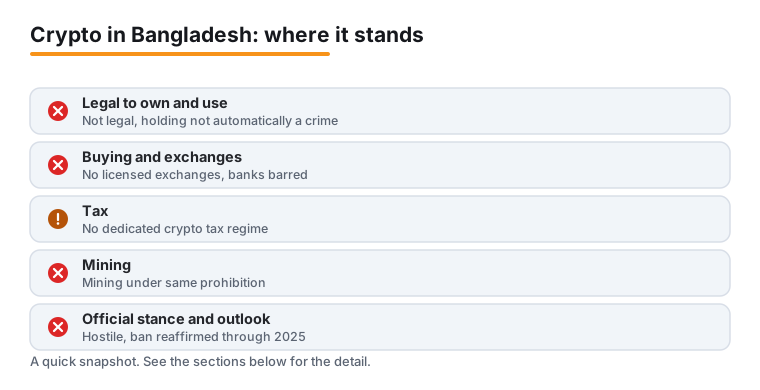
Cryptocurrency is not legal in Bangladesh. Only the Bangladeshi taka is recognised as legal tender, and there is no licensing regime that would let an exchange, broker, or custodian lawfully serve residents. Bangladesh Bank first issued a public warning against Bitcoin in 2014 and published a formal cautionary notice in December 2017, stating that no virtual currency is approved and that dealing in such currencies can be a punishable offence. The instrument that now carries the prohibition is FE Circular No. 24, dated 15 September 2022, issued by Bangladesh Bank's Foreign Exchange Policy Department and titled "Prohibition regarding virtual assets, virtual currencies and facilitating their exchange/transfer/trading". Paragraph 4 states that any transactions made in, from or to Bangladesh for obtaining virtual assets or virtual currencies are not permitted by Bangladesh Bank, and that providing any kind of facilitation in favour of doing business, activities and operations associated with the exchange, transfer or trading of virtual assets or virtual currencies is not permitted. Paragraph 5 treats a violation as a contravention of section 5(1)(e) of the Foreign Exchange Regulation Act, 1947, cognizable under section 23(1) of that Act per SRO No. 59-LAW/2021 dated 8 March 2021. The circular is issued under section 20(3) of the same Act and refers back to Bangladesh Bank public notice no. DCP(PR)1/2021-7/5 dated 29 July 2021.
That said, officials have publicly distinguished between facilitating or trading crypto and merely owning it. Statements reported in 2021 indicated that crypto trading was "neither legal nor a crime" in the sense that no statute names crypto by name, while the central bank's instructions still treat unauthorised dealing as unlawful under existing foreign-exchange and AML law. In practice this means there is no officially sanctioned, protected way to buy, sell, or settle crypto inside the country, and the safest reading is to treat participation as unlawful and unprotected. This is general information as of 2026, not legal advice; verify your situation with Bangladesh Bank and a Bangladeshi lawyer.
The regulators: who governs crypto in Bangladesh
There is no dedicated crypto regulator in Bangladesh, because there is no legal crypto market to regulate. Authority is spread across existing financial bodies:
- Bangladesh Bank is the central bank and the primary authority. It sets the policy that crypto is not permitted and instructs banks, payment providers, and money-transfer agents accordingly. Its official website is bb.org.bd.
- Bangladesh Financial Intelligence Unit (BFIU) handles anti-money-laundering and counter-terrorism-financing supervision, analyses suspicious-transaction reports, and has issued warnings and notices concerning crypto facilitation. Its official website is bfiu.org.bd.
- National Board of Revenue (NBR) is the apex tax authority, relevant to any taxable income. Its official website is nbr.gov.bd.
- Law-enforcement agencies investigate fraud, scams, and illicit transfers involving virtual currencies.
The central bank governor and other senior officials publicly reaffirmed opposition to legalising private crypto through 2025, while the institution continues to develop digital-finance and payment modernisation work separately. General information as of 2026, not legal advice.
Key laws and frameworks
Bangladesh has no dedicated cryptocurrency statute. The prohibition rests on existing financial laws as interpreted and enforced by the central bank and financial-intelligence authorities. The laws most often cited are:
- Foreign Exchange Regulation Act, 1947: Bangladesh operates strict capital controls. Because crypto can move value across borders outside the banking system, authorities treat unauthorised dealing as a foreign-exchange violation. Bangladesh Bank's cautionary notice stated that transacting in unauthorised virtual currencies, in defiance of its instructions, can be a punishable offence under this Act, with reported penalties of up to seven years' imprisonment, a fine, or both.
- Money Laundering Prevention Act, 2012: crypto is framed as a money-laundering risk, bringing it within AML enforcement supervised by the BFIU.
- Anti-Terrorism Act, 2009: cited alongside the AML framework in relation to terrorism-financing risk.
Separately, Bangladesh adopted a National Blockchain Strategy in 2020 and has explored innovation initiatives, including discussion of regulatory sandbox approaches for non-crypto blockchain use cases such as land records, trade documents, and government services. The state's clear distinction is between the underlying technology (encouraged) and decentralised cryptocurrencies (prohibited). General information as of 2026, not legal advice.
Licensing and registration of exchanges (VASPs)
There is no licensing or registration regime for crypto exchanges or virtual-asset service providers (VASPs) in Bangladesh. No domestic exchange is licensed, and there is no application path through which a platform could legally serve residents. Bangladesh Bank has instructed banks, mobile-financial-service providers, and payment intermediaries not to facilitate crypto transactions, which closes off compliant card and bank-transfer routes to offshore exchanges.
This contrasts with jurisdictions that have built registration or authorisation frameworks for VASPs. In Bangladesh, an exchange operating for local users would be doing so outside any legal framework, exposing it and its users to enforcement action. If the policy changes in future and a framework emerges, the safe approach would be a regulated, identity-verified provider; that does not exist for residents today. To compare how other regions handle licensing, see our broader guide to crypto regulation and our country regulation hub. General information as of 2026, not legal advice.
Crypto and Bitcoin taxation in Bangladesh
Because trading is officially prohibited, Bangladesh has no purpose-built crypto-tax regime, no specified capital-gains rate for digital assets, and no compliant reporting channel designed for crypto. This creates a gap: the activity is treated as unlawful, yet income remains, in principle, within the reach of general tax law administered by the National Board of Revenue.
Under Bangladesh's income-tax framework, income is generally taxable regardless of source, so a person who realises gains could face a tax claim while simultaneously exposing an underlying foreign-exchange or AML breach. There is no clean, legal way to declare crypto profits as one would in a regulated market.
Be very cautious about specific numbers. Articles that quote exact crypto tax "rates" or "thresholds" for Bangladesh are generally unreliable, because no dedicated crypto-tax rule exists to cite. There is no crypto-specific rate to state, because none exists. What does apply is the general regime under the Income-tax Act, 2023: individual income is taxed on a slab basis at 0, 10, 15, 20, 25 and 30 percent, so 30 percent is the top marginal rate for the 2025-26 and 2026-27 tax years, and the general tax-free threshold is BDT 400,000. A capital gain on an asset transferred more than five years after acquisition is taxed at 15 percent or the amount of tax deducted at the time of registration under section 125, whichever is higher. Gains on assets transferred within five years are taxed at the normal rates applicable to an individual. Those are the defaults a Bangladeshi tax adviser would reason from, not figures written for digital assets. For general background on how crypto can be taxed, see our guide to crypto taxes. General information as of 2026, not tax advice; consult a qualified Bangladeshi tax advisor and review official NBR guidance at nbr.gov.bd rather than relying on figures found online.
AML, KYC, and reporting rules
Bangladesh's anti-money-laundering and know-your-customer regime is built around the Money Laundering Prevention Act, 2012 and is supervised by the BFIU. Banks, mobile-financial-service operators, and other reporting institutions must perform customer due diligence and file suspicious-transaction and cash-transaction reports. Because crypto is treated as a money-laundering and terrorism-financing risk, crypto-linked activity falls within this reporting and monitoring framework.
In practice this means that crypto-related flows detected by banks or payment providers can trigger suspicious-transaction reporting, account scrutiny, or account closure, and that institutions are warned against facilitating crypto transfers. There is no licensed VASP layer applying KYC to retail crypto users, so the AML obligations sit on the regulated financial sector rather than on crypto platforms. Anyone whose banking activity intersects with crypto should expect heightened scrutiny under these rules. See the BFIU's official site at bfiu.org.bd. General information as of 2026, not legal advice.
Buying and using crypto in practice
The accurate answer is that there is no legal, regulated way to buy or use Bitcoin inside Bangladesh. No domestic exchange is licensed, there is no compliant local on-ramp, and there is no officially supported Bitcoin ATM network. Banks and payment providers are instructed not to process crypto purchases, so mainstream card and bank-transfer routes are restricted.
People who attempt it generally rely on informal means such as peer-to-peer arrangements, offshore platforms, or contacts abroad. Every one of those routes carries real risk:
- Legal exposure under foreign-exchange and anti-money-laundering law.
- Fraud and counterparty risk in peer-to-peer trades, with no regulator to complain to.
- Frozen funds or account closures if banks detect crypto-linked activity.
- No consumer protection: losses are typically unrecoverable.
This section is descriptive, not a how-to: it explains why there is no safe, sanctioned path, not how to circumvent the rules. The same constraints apply to using crypto for remittances; although remittances are economically vital to Bangladesh, the central bank has stated that crypto has no role in the country's remittance ecosystem for the foreseeable future, and the official preference is firmly for formal channels such as banks, licensed money-transfer operators, and mobile financial services. General information as of 2026, not legal or financial advice; confirm current rules with Bangladesh Bank.
Bitcoin mining in Bangladesh
Bitcoin mining sits under the same prohibition as trading. Because cryptocurrencies are not recognised and dealing in them is treated as unlawful, operating a mining business to acquire and sell crypto carries the same legal risk as exchange activity, and there is no licensing path that would make it compliant.
Even setting the law aside, the economics are difficult. Mining is electricity-intensive, and Bangladesh has historically faced power-supply constraints and periodic load-shedding; large, continuous industrial loads run counter to grid priorities, and electricity diverted to mining can attract scrutiny. Modern Bitcoin mining is also dominated by specialised hardware and very low-cost power, leaving small-scale miners uncompetitive in most settings.
The takeaway: mining is neither legal nor a practically viable sanctioned activity in Bangladesh today, and the legal exposure should be treated as the decisive factor. General information as of 2026, not legal advice.
Recent developments (2025-2026)
The official line hardened and was repeatedly reaffirmed through 2025. Senior Bangladesh Bank officials publicly stated the central bank was not considering legalising cryptocurrency, and the governor, Dr Ahsan H. Mansur, indicated that crypto has no place in the country's remittance ecosystem for the foreseeable future. Authorities also tightened warnings to banks, mobile-wallet providers, and fintech firms against facilitating crypto-based transfers; reporting through 2025 described an escalation in which Bangladesh Bank pressed banks, non-bank financial institutions, and mobile-financial-service providers such as bKash and Nagad to block crypto-linked flows, with facilitation framed as a punishable foreign-exchange and AML breach and the central bank retaining powers to freeze accounts, impose penalties, and act against licences. Treat the specifics cautiously and confirm any current notice directly with Bangladesh Bank and the BFIU rather than relying on third-party notice numbers.
On the modernisation side, Bangladesh has continued to study a central-bank digital currency, a digital taka. The idea was announced in a 2022 budget speech, a feasibility study was conducted, and a pilot was reported around 2024, but progress since then has been cautious, with little further public movement reported through 2025. The central bank's own analysis weighs the strong existing digital-payment ecosystem, and officials have signalled that near-term priorities include the digital taka work and cross-border payment links, including discussion of integration with India's UPI system, rather than legalising private crypto. Readers should treat CBDC timelines as evolving and verify the latest position with Bangladesh Bank.
Despite the ban, grassroots adoption has risen. Independent industry indices from firms such as Chainalysis and TRM Labs have placed Bangladesh among the higher-ranked countries for crypto usage. Chainalysis ranked Bangladesh 13th out of 151 countries in its 2025 Global Crypto Adoption Index, up from 17th the year before, and TRM Labs placed it around 14th; reporting attributes much of this to remittances, freelancing income, and capital controls rather than speculation. That tension, between firm prohibition and persistent informal usage, is the defining feature of the market. General information as of 2026, not legal advice.
A specific pattern behind these numbers is stablecoin use. Bangladesh has one of the world's larger freelancing populations, and reporting through 2025 described freelancers and overseas workers increasingly receiving dollar-pegged stablecoins such as Tether (USDT), then converting to taka through peer-to-peer trades settled via mobile financial services. This is faster and cheaper than some formal channels, which is part of why usage persists despite the prohibition; it also remains outside any legal or protected framework, so the legal and fraud risks described elsewhere on this page still apply. Estimates of the number of Bangladeshis holding crypto wallets circulate in the low millions, but these are industry estimates, not official figures, and should be treated as approximate. General information as of 2026, not legal advice.
Stablecoins, freelancing, and remittances
The most discussed real-world use of crypto in Bangladesh is not speculation but cross-border payments. Bangladesh has a very large freelancing workforce and depends heavily on remittances from workers abroad. Reporting through 2025 described a growing pattern in which freelancers receive payment in dollar-pegged stablecoins, chiefly Tether (USDT), and overseas workers send value home the same way, with the recipient converting to taka through peer-to-peer trades and cashing out via mobile financial services such as bKash or Nagad. The appeal is speed and lower cost compared with some formal channels.
This does not change the legal position. Bangladesh Bank's stance is that crypto has no role in the country's remittance ecosystem, and the official preference is firmly for formal channels: banks, licensed money-transfer operators, and mobile financial services, which now handle the large majority of recorded remittance inflows. Using stablecoins or peer-to-peer routes for remittances still sits outside any legal framework and carries the foreign-exchange, AML, fraud, and account-closure risks set out elsewhere on this page. Commentary arguing that Bangladesh should regulate rather than ban continues, and as of August 2026 no licensing framework has been adopted. The nearest thing to a forward plan is the National Blockchain Policy of Bangladesh 2026, which schedules implementing rules for the second and third quarters of 2026 and provides for a blockchain regulatory sandbox run by the National Data Governance Authority, with participation limited to 12 months and extendable by up to 6 additional months. That sandbox admits financial services and payment applications only with concurrent Bangladesh Bank or BSEC approval, its establishment is placed in the policy's Phase 2 covering 2027 to 2028, and the policy refers to guidelines on virtual asset service providers only conditionally, as something that may be promulgated rather than something that exists. Bangladesh Bank moved in the opposite direction on the same issue: paragraph 9 of FEPD-1 Circular No. 22, dated 22 July 2026, states that retention of export proceeds abroad in any form, including virtual assets, violates the Foreign Exchange Regulation Act, 1947. General information as of 2026, not legal or financial advice; confirm the current position with Bangladesh Bank.
Consumer risks and protection
For anyone in Bangladesh, the central risks are legal and financial. Dealing in crypto can breach foreign-exchange and AML laws; there is no licensed platform, no deposit protection, and no regulator to turn to if you are defrauded or a platform collapses. Because activity is pushed into informal channels, victims of fraud have little realistic ability to seek redress.
Layered on top are the ordinary risks of crypto everywhere: high price volatility, the risk of losing access to a self-custodied wallet, the irreversibility of transactions, and a high incidence of scams and fake "investment" schemes that specifically target markets where people cannot use mainstream, regulated platforms. Peer-to-peer trades are a common scam vector, and chargeback fraud is widespread.
There is no official consumer-protection scheme covering crypto in Bangladesh, precisely because the activity is not authorised. The prudent stance is to assume the prohibition remains in force, to treat any crypto exposure as high-risk and unprotected, and to weigh the legal position first. We do not make price predictions and nothing here is a recommendation to buy. General information as of 2026, not financial advice; consult a qualified professional.
Official sources and how to verify
Crypto policy in Bangladesh can evolve, and secondary websites often quote outdated or invented "rates", notice numbers, and rules. Always verify the current position directly with the authorities rather than relying on third-party summaries, including this one. The primary official sources are:
- Bangladesh Bank (central bank, primary authority and cautionary notices): bb.org.bd.
- Bangladesh Financial Intelligence Unit (BFIU) (AML/CFT supervision and notices): bfiu.org.bd.
- National Board of Revenue (NBR) (tax administration): nbr.gov.bd.
To verify, check the central bank's media room and circulars for the latest notices, and consult a licensed Bangladeshi lawyer or tax advisor for your specific situation. For wider context on how rules differ between countries, see our regulation hub and our general crypto regulation guide. This page is general information as of 2026 and is not legal, tax, or financial advice; the authoritative position is whatever Bangladesh Bank and the named authorities state at the time you act.
What is changing: Bangladesh crypto rules as of August 2026
Nothing in the prohibition has been relaxed. What moved between the last review and 3 August 2026 is that the rules became more specific, and Bangladesh Bank built a legal route for the cross-border payment demand that drives most crypto use in the country.
- The ban is carried by FE Circular No. 24, dated 15 September 2022, issued by Bangladesh Bank's Foreign Exchange Policy Department under section 20(3) of the Foreign Exchange Regulation Act, 1947 and titled "Prohibition regarding virtual assets, virtual currencies and facilitating their exchange/transfer/trading". Paragraph 4 states that any transactions made in, from or to Bangladesh for obtaining virtual assets or virtual currencies are not permitted by Bangladesh Bank, and that providing any kind of facilitation in favour of doing business associated with the exchange, transfer or trading of virtual assets is not permitted either. Paragraph 5 makes a breach a contravention of section 5(1)(e) of the Act, cognizable under section 23(1) per SRO No. 59-LAW/2021 of 8 March 2021.
- The same rule survived the 2025 consolidation. Paragraph 53 of FE Circular No. 31, dated 31 July 2025, states that apart from authorised notional or merchant accounts, retention of export proceeds abroad in any form, including purchase of virtual assets and maintenance of accounts in cryptocurrencies, contravenes section 5(1)(e)(i) of the Act.
- Bangladesh Bank applied it again in 2026. Paragraph 9 of FEPD-1 Circular No. 22, dated 22 July 2026, states that retention of export proceeds abroad in any form, "including foreign accounts, assets, or virtual assets", other than permitted notional or merchant accounts under approved arrangements, shall constitute a violation of the Foreign Exchange Regulation Act, 1947. That is the freelancer who leaves earnings in USDT, described in a circular issued twelve days before this review.
- On 29 July 2026 the same department issued FEPD-1 Circular No. 25, a bank-intermediated cross-border digital payment framework. It never mentions crypto. It builds a licensed alternative instead.
- Bangladesh Bank's Cyber Security Unit has an undated Bangla-language cautionary notice in the alert rotation on the bank's home page warning the public not to invest in, transact with or take part in member recruitment on Crossmarket.ai or any similar unauthorised crypto trading or MLM platform, stating that such platforms are not licensed or approved by Bangladesh Bank or the relevant regulatory authority, and warning of the risk of financial loss and fraud.
Current Bangladesh Bank circulars can be checked on the bank's circulars page.
The named instruments that actually apply
| Instrument | Issued by | Date | What it does |
|---|---|---|---|
| FE Circular No. 24 | Bangladesh Bank, Foreign Exchange Policy Department | 15 September 2022 | Prohibits transactions in, from or to Bangladesh for obtaining virtual assets or virtual currencies, and prohibits facilitating that business. Issued under section 20(3), Foreign Exchange Regulation Act, 1947. |
| Foreign Exchange Regulation Act, 1947 | Statute | 1947 | Sections 2(b)(i), 2(aa) and 2(bb) do not recognise virtual currencies as approved foreign exchange or an approved form of investment. Section 5(1)(e) is the breach provision and section 23(1) is the cognizance provision. |
| FE Circular No. 31 | Bangladesh Bank, Foreign Exchange Policy Department | 31 July 2025 | Consolidates export trade foreign exchange rules. Paragraph 53 keeps the prohibition on holding export proceeds abroad as virtual assets or in cryptocurrencies. |
| FEPD-1 Circular No. 22 | Bangladesh Bank, Foreign Exchange Policy Department-1 | 22 July 2026 | Restates at paragraph 9 that holding export proceeds abroad as virtual assets breaches the 1947 Act. Sets the freelancer thresholds: USD 20,000 without Form-C, USD 10,000 per OPGSP transaction, 50 percent ERQ retention for ICT services and 30 percent for other services. |
| FEPD-1 Circular No. 25 | Bangladesh Bank, Foreign Exchange Policy Department-1 | 29 July 2026 | Creates Digital Value Accounts through licensed banks for cross-border digital payments, capped at USD 300 per transaction. No crypto involvement. |
| National Blockchain Policy of Bangladesh 2026 | ICT Division, Ministry of Posts, Telecommunications and Information Technology | Version 1.0, January 2026 | Policy document, not law, and its formal adoption is not confirmed. Records that crypto, VASPs and CBDC sit with Bangladesh Bank and tokenised securities with BSEC. Creates no licence. |
| Income-tax Act, 2023 | Statute, administered by the National Board of Revenue | 2023 | The tax default. No crypto provision. Individual slab rates run 0, 10, 15, 20, 25 and 30 percent, and a gain on an asset held over five years is taxed at 15 percent or the section 125 amount deducted at registration, whichever is higher. |
The legislative pipeline and what it would mean
No crypto bill before parliament could be identified, and no virtual-asset licensing regime exists. The only document that sets out a future direction is the National Blockchain Policy of Bangladesh 2026, a version 1.0 document dated January 2026 and attributed to the ICT Division. It is a policy rather than a statute, it says it builds upon the earlier National Blockchain Strategy rather than replacing it, and readers should note that it is not listed on the ICT Division's own policies, publications or notices pages, so its formal adoption is unconfirmed.
- Who would regulate what. Sections 1.3.3 and 7.4 place crypto outside the policy's own scope and record where it already sits. Cryptocurrency exchanges, trading platforms and over-the-counter desks are assigned to Bangladesh Bank under the Bangladesh Bank Order, 1972, the Foreign Exchange Regulation Act, 1947 and the Anti-Money Laundering Act, 2012. Virtual Asset Service Providers, meaning entities doing exchange, transfer, custody or issuance of virtual assets, fall under Bangladesh Bank's AML and CFT frameworks and FATF recommendations. Stablecoins used for payment are subject to payment service regulations. Tokenised securities, security token offerings and digital asset investment schemes go to the Bangladesh Securities and Exchange Commission under the Securities and Exchange Ordinance, 1969.
- What has not happened. The policy refers to "Guidelines on Virtual Asset Service Providers, if promulgated", and section 7.4.1 refers to licensing requirements "as may be prescribed by" Bangladesh Bank. Both are conditional. No VASP guidelines have been issued, so recording jurisdiction is not the same as opening a licensing route.
- The dated milestones. The policy's Phase 1 Foundation roadmap covers 2026 to 2027: institutional setup in Q1 to Q2 2026, implementing rules and regulations in Q2 to Q3 2026, national blockchain infrastructure in Q3 to Q4 2026 and pilot applications from Q4 2026 to Q2 2027. The pilots named are digital identity, educational credential verification and land records, not payments. Phase 2 runs 2027 to 2028 and Phase 3 runs 2029 to 2030.
- The regulatory sandbox. Section 8.5 provides for a Blockchain Regulatory Sandbox administered by the National Data Governance Authority, running in cohorts, with participation limited to 12 months and extendable by up to 6 additional months. Applications involving financial services, payment systems or anything regulated by Bangladesh Bank or BSEC require concurrent approval from those regulators. The roadmap places establishing the sandbox in Phase 2, that is 2027 to 2028, not in 2026. No cohort or application window has been published.
For a holder or a would-be exchange in Bangladesh, none of this changes anything in 2026.
The legal cross-border payment route introduced in July 2026
The page correctly identifies that most crypto use in Bangladesh is freelancers and remittance recipients moving value, not speculation. Two circulars issued in the last fortnight of July 2026 address that demand directly, and a reader weighing a stablecoin workaround should know they exist.
- FEPD-1 Circular No. 25 of 29 July 2026 lets Authorized Dealers partner with foreign payment service providers, digital platforms and online payment gateway service providers and facilitate the opening of Digital Value Accounts for customers. Each Digital Value Account must sit as a sub-account under a Master DVA held by the bank, with real-time or near real-time system integration and a mirror ledger inside the bank. Cross-border online payments are capped at USD 300 or equivalent per transaction. Permitted uses include travel entitlement for private, medical and official travel, membership fees, IT related expenses, visa processing fees and online hotel booking. Banks must apply to Foreign Exchange Policy Department-1 for acknowledgement before commencing outward remittance services, so availability will arrive bank by bank. State news agency BSS reported the framework on 29 July 2026.
- FEPD-1 Circular No. 22 of 22 July 2026 consolidates the freelancer rules. Inward remittances up to USD 20,000 or equivalent may be credited without Form-C, with online Form-C required above that. Repatriation through an OPGSP is capped at USD 10,000 per transaction. Service exporters may retain up to 50 percent of net export earnings in foreign currency for software, data entry, processing and other ICT-related services, and up to 30 percent for other legitimate services, with the balance mandatorily converted to taka. ERQ balances may be spent on foreign travel, software registration, domain and hosting fees, server maintenance and import of equipment.
Neither circular mentions cryptocurrency. That is the point: the same circular that sets out the freelancer thresholds also states, at paragraph 9, that keeping proceeds abroad in virtual assets breaches the Foreign Exchange Regulation Act, 1947. Bangladesh is building the legal channel and closing the informal one at the same time. For context on how little formal architecture exists around digital assets, the Chambers Banking Regulation 2026 guide for Bangladesh, with law stated as at 9 December 2025, contains no crypto or virtual asset chapter.
Frequently asked questions
Is Bitcoin legal in Bangladesh in 2026?
No. Bangladesh Bank does not recognise Bitcoin or other cryptocurrencies as legal tender, and it treats unauthorised dealing as a breach of foreign-exchange and anti-money-laundering law. There are no licensed exchanges, and senior officials, including the central bank governor, reaffirmed opposition to legalising crypto through 2025. Officials have noted that merely holding crypto is not automatically a crime, but participation remains unlawful and unprotected. This is general information as of 2026, not legal advice; verify with Bangladesh Bank .
Who regulates cryptocurrency in Bangladesh?
Bangladesh Bank, the central bank, is the primary authority and sets the policy that crypto is not permitted. The Bangladesh Financial Intelligence Unit (BFIU) handles anti-money-laundering supervision and suspicious-transaction reporting, the National Board of Revenue (NBR) administers tax, and law-enforcement agencies investigate crypto-related fraud and illicit transfers. There is no dedicated crypto regulator because there is no legal crypto market.
What laws does Bangladesh use to restrict crypto?
There is no dedicated crypto statute. The restriction rests on existing laws, chiefly the Foreign Exchange Regulation Act, 1947 (used to treat unauthorised dealing as a foreign-exchange offence), the Money Laundering Prevention Act, 2012, and the Anti-Terrorism Act, 2009. Bangladesh Bank's cautionary notice stated that transacting in unauthorised virtual currencies can be a punishable offence with reported penalties of up to seven years' imprisonment, a fine, or both. This is general information, not legal advice.
Can I legally buy or sell crypto on an exchange in Bangladesh?
No. There is no licensing or registration regime for crypto exchanges or virtual-asset service providers, no licensed domestic platform, and no compliant on-ramp. Banks and payment providers are instructed not to process crypto transactions. Informal routes such as peer-to-peer trades or offshore platforms carry legal exposure, fraud risk, possible account closure, and no consumer protection. This is general information as of 2026, not financial advice.
Is there any tax on crypto profits in Bangladesh?
There is no dedicated crypto-tax regime, because trading is prohibited, so be wary of any source quoting a specific crypto tax rate for Bangladesh. In principle, income is taxable regardless of source under general tax law administered by the National Board of Revenue, but realising crypto gains could also expose an underlying legal breach. Speak to a qualified Bangladeshi tax advisor and check official guidance at nbr.gov.bd . This is general information, not tax advice.
Does Bangladesh support blockchain or a digital taka?
Yes, and this is separate from the crypto ban. Bangladesh adopted a National Blockchain Strategy in 2020 and encourages the technology for areas such as land records, trade documents, and government services. The central bank has also studied a digital taka (a central-bank digital currency), with a feasibility study and a reported limited pilot, but progress has been cautious and timelines are evolving. The state encourages the technology while continuing to prohibit decentralised cryptocurrencies. Verify the latest with Bangladesh Bank .
Why is crypto adoption in Bangladesh high despite the ban?
Independent industry indices put Bangladesh among the higher-ranked countries for grassroots crypto usage; Chainalysis ranked it 13th out of 151 countries in its 2025 index, up from 17th the year before. Reporting attributes this mainly to remittances, a large freelancing workforce receiving stablecoins such as USDT, and capital controls, rather than speculation. The usage sits outside any legal framework, so the legal, fraud, and account-closure risks still apply. This is general information as of 2026, not legal or financial advice.
Can I use stablecoins like USDT for remittances to Bangladesh?
In practice some people do, using peer-to-peer trades cashed out through mobile financial services, but it is not legal or protected. Bangladesh Bank's position is that crypto has no role in the country's remittance ecosystem, and the official preference is for formal channels such as banks, licensed money-transfer operators, and mobile financial services. Stablecoin and peer-to-peer routes carry foreign-exchange, anti-money-laundering, fraud, and account-closure risks. This is general information as of 2026, not legal or financial advice; confirm with Bangladesh Bank .
What law actually bans crypto in Bangladesh?
FE Circular No. 24, dated 15 September 2022, issued by Bangladesh Bank's Foreign Exchange Policy Department under section 20(3) of the Foreign Exchange Regulation Act, 1947. It is titled "Prohibition regarding virtual assets, virtual currencies and facilitating their exchange/transfer/trading". Paragraph 4 says any transaction in, from or to Bangladesh for obtaining virtual assets or virtual currencies is not permitted, and that facilitating that business is not permitted either. A breach is a contravention of section 5(1)(e) of the Act, cognizable under section 23(1) per SRO No. 59-LAW/2021 of 8 March 2021. There is no standalone crypto statute.
Has anything changed for crypto in Bangladesh in 2026?
The ban has not been relaxed. Two things did move. In January 2026 the ICT Division published the National Blockchain Policy of Bangladesh 2026, a policy document rather than a law, which records that cryptocurrency trading and virtual asset service providers sit with Bangladesh Bank and tokenised securities with BSEC, and which provides for a blockchain regulatory sandbox from 2027. It creates no crypto licence and refers to VASP guidelines only as something that may be promulgated. Then on 29 July 2026 Bangladesh Bank issued FEPD-1 Circular No. 25, a bank-intermediated cross-border digital payment framework that builds a legal payment route rather than legalising crypto.
Can freelancers in Bangladesh receive foreign payments legally without using stablecoins?
Yes, and the rules were consolidated in FEPD-1 Circular No. 22, dated 22 July 2026. Inward remittances up to USD 20,000 or equivalent can be credited without Form-C, with an online Form-C required above that. Repatriation through an Online Payment Gateway Service Provider is capped at USD 10,000 per transaction. Service exporters may retain up to 50 percent of net export earnings in foreign currency for software, data entry, processing and other ICT-related services, and up to 30 percent for other legitimate services, with the rest converted to taka. The same circular states at paragraph 9 that keeping export proceeds abroad in virtual assets violates the Foreign Exchange Regulation Act, 1947.
What tax rate would apply to a crypto gain in Bangladesh?
There is no crypto-specific rate, and any source quoting one is unreliable. The default regime is the Income-tax Act, 2023. Individual income is taxed on slabs of 0, 10, 15, 20, 25 and 30 percent, so 30 percent is the top marginal rate for the 2025-26 and 2026-27 tax years, and the general tax-free threshold is BDT 400,000. A capital gain on an asset transferred more than five years after acquisition is taxed at 15 percent or the amount deducted at registration under section 125, whichever is higher; gains on assets transferred within five years are taxed at normal individual rates. Realising a crypto gain would also expose the underlying foreign-exchange breach, so speak to a qualified Bangladeshi tax adviser.
Has Bangladesh Bank warned about any specific crypto platform?
Yes. An undated Bangla-language cautionary notice from Bangladesh Bank's Cyber Security Unit appears in the alert rotation on the bank's home page. It warns the public not to invest in, transact with, or take part in member recruitment on Crossmarket.ai or any similar unauthorised crypto trading or MLM platform, states that such platforms are not licensed or approved by Bangladesh Bank or the relevant regulatory authority, and warns of the risk of financial loss and fraud. The notice itself carries no date, so it should not be described as a 2026 warning.
What is a Digital Value Account and can it be used for crypto?
A Digital Value Account is a digital wallet or stored-value account created under FEPD-1 Circular No. 25 of 29 July 2026. It is opened through an Authorized Dealer bank in partnership with a foreign payment provider, must sit as a sub-account under a Master DVA held by the bank, and is capped at USD 300 or equivalent per cross-border online transaction. Permitted uses include travel, membership fees, IT related expenses, visa processing fees and hotel bookings. The circular does not mention crypto, virtual assets or stablecoins, and it does not create any route to buy them. Each bank must obtain acknowledgement from Bangladesh Bank before launching, so availability arrives bank by bank.
Facts reviewed: 3 August 2026. Page updated: 3 August 2026.