Home › Crypto Regulation › Nepal
Bitcoin & Cryptocurrency Regulation in Nepal
Quick answer — Nepal, 2026
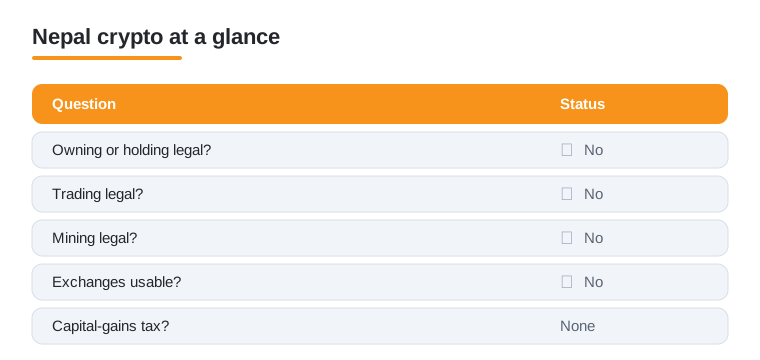
- Legal? No. Buying, selling, holding, trading, and mining crypto are all banned and actively enforced in 2026.
- Taxed? No tax framework exists, because the activity itself is prohibited.
- How residents buy: There is no legal route; exchanges are blocked and offenders face arrest.
Nepal is one of the strictest cryptocurrency jurisdictions in the world. Rather than the regulatory grey zone seen in many emerging markets, Nepal applies an outright prohibition: buying, selling, holding, trading, mining, and facilitating Bitcoin or any other virtual currency are all treated as illegal by the country's authorities. The central bank, Nepal Rastra Bank (NRB), first declared Bitcoin transactions illegal in a public notice in 2017 and broadened the ban to cover all virtual-currency activity in a January 2022 notice. The prohibition remains in force in 2026, and enforcement is active.
This guide explains where things stand for 2026: who regulates crypto in Nepal, which laws the ban rests on, why there are no licensed exchanges or Bitcoin ATMs, how the rules treat mining and remittances, what penalties have been reported, and how to verify the current position through official sources. It is written for residents, the Nepali diaspora, and visitors who need an accurate picture to avoid serious legal risk. This is general information as of 2026 and is not legal, tax, or financial advice; anyone with a specific situation should confirm the current rules directly with Nepal Rastra Bank or a qualified Nepali lawyer. For broader background, see our overview of crypto regulation and the country regulation hub.
On this page: Legal status · Who regulates it · Taxes · How to buy · Mining
Is Bitcoin and crypto legal in Nepal?
No. As of 2026, cryptocurrency is not legal in Nepal. Nepal Rastra Bank (NRB), the central bank, has repeatedly stated that all transactions involving Bitcoin and other virtual currencies are prohibited, and the police actively investigate and prosecute people who deal in them. Unlike countries that simply lack a framework, Nepal has chosen a clear, enforced prohibition.
There is no licensed way for an individual or business in Nepal to legally buy, sell, trade, mine, or accept payment in crypto. Operating or advertising a crypto exchange, running peer-to-peer trading, and acting as an intermediary are all treated as offences. The ban is broad: it is not limited to Bitcoin but extends to other coins, tokens, and related virtual-currency products. The NRB homepage carries a standing notice declaring that virtual-currency and cryptocurrency dealings, along with certain network-marketing schemes, are unlawful.
Because enforcement is real and ongoing, the practical takeaway is straightforward: engaging in crypto activity inside Nepal carries genuine legal exposure. Treat any service that claims to offer legal crypto access in Nepal with strong skepticism, and verify the current position directly with official sources.
Who regulates crypto in Nepal
The lead authority is Nepal Rastra Bank, the country's central bank. The NRB sets and communicates the policy, manages foreign exchange and the payment system, and has issued the public notices that declare virtual-currency activity illegal. Its official website is nrb.org.np, which is the authoritative place to check current notices.
Several other bodies support the prohibition in practice:
- Financial Information Unit (FIU-Nepal), hosted within the NRB, is Nepal's financial-intelligence agency. It collects suspicious-transaction reports from banks and other reporting entities and is the focal point for anti-money-laundering work, including activity linked to crypto.
- Nepal Police Cyber Bureau and the wider police investigate violations and make arrests in crypto and "hundi" (informal money-transfer) cases.
- Nepal Telecommunications Authority has blocked access to foreign crypto exchange and trading websites at the network level.
Crypto in Nepal is therefore governed not by a single dedicated regulator with a licensing desk, but by the central bank's prohibition backed by police and intelligence enforcement.
Key laws and frameworks
Nepal's prohibition does not rest on a single dedicated crypto statute. Instead, authorities apply existing laws and central-bank powers. The legal foundations most often cited are:
- Foreign Exchange (Regulation) Act, 2019 (1962) and its later consolidated version, under which crypto dealings are treated as unauthorised foreign-exchange transactions because the NRB controls cross-border value transfer. The 2017 Bitcoin notice was issued under this Act.
- Nepal Rastra Bank Act, 2058 (2002), which gives the central bank authority over the payment system and the Nepali rupee and underpins its notices declaring crypto activity illegal. The official English text is published by the Nepal Law Commission.
- Asset (Money) Laundering Prevention Act, 2064 (2008), which establishes the FIU and the suspicious-transaction reporting regime that captures crypto-linked flows. The Act is published on the NRB website.
The most concrete change came in 2024. Nepal amended the National Penal (Criminal) Code, 2074 (2017) to add a specific virtual-currency offence. Reported as Section 262A, it prohibits creating, selling, exchanging, transferring, holding, issuing, or giving any virtual currency other than currency issued by the NRB. Legal commentary dates the amendment to the Act to Amend the Prevention of Money Laundering and Some Other Acts, published in the Nepal Gazette on 12 April 2024. This moved the ban from central-bank notices alone into statutory criminal law, and reported maximum penalties under the provision reach up to five years of imprisonment plus forfeiture of the amount involved and a fine linked to the sum. See the published summary of the 2024 amendment and confirm the current text with a qualified Nepali lawyer.
Prosecutors have also drawn on provisions against informal cross-border money transfer ("hundi") and, in some reported cases, on the Electronic Transactions Act and penal-code provisions covering fraud and gambling. The precise combination of charges depends on the facts of each case.
The 2024 Penal Code amendment
For years Nepal's ban rested mainly on Nepal Rastra Bank notices issued under central-bank and foreign-exchange powers. In 2024 the prohibition was written directly into criminal law. Legal commentary reports that the National Penal (Criminal) Code, 2074 (2017) was amended to add a virtual-currency offence, described as Section 262A, through the Act to Amend the Prevention of Money Laundering and Some Other Acts, published in the Nepal Gazette on 12 April 2024.
As reported, the provision prohibits creating, selling, exchanging, transferring, holding, issuing, or giving any virtual currency other than currency issued by the NRB. "Virtual currency" is described broadly to cover data, code, tokens, or cryptocurrency-type assets created through cryptography that represent value electronically, so it is not limited to Bitcoin. Reported maximum penalties under the provision reach up to five years of imprisonment, together with forfeiture of the amount involved and any gain on it, plus a fine tied to the sum.
The practical significance is that crypto dealing is now framed as a defined criminal offence, not only a breach of a banking notice. This makes prosecution more direct and is one reason enforcement action has continued. Because summaries here rely on legal commentary rather than the primary Gazette text, confirm the exact wording and current penalties with a qualified Nepali lawyer or the Nepal Law Commission.
Licensing and registration of exchanges
There is no licensing or registration pathway for crypto exchanges or virtual-asset service providers (VASPs) in Nepal, because the underlying activity is banned. No body issues a crypto-exchange licence, and no compliant route exists for a domestic platform to onboard customers or accept rupee deposits for crypto.
This is the opposite of jurisdictions that register and supervise VASPs. In Nepal:
- Domestic crypto exchanges are not permitted to operate.
- Major international platforms have been blocked at the network level by the telecom regulator, and authorities have indicated that reaching them through a VPN does not make the activity lawful.
- Peer-to-peer and informal over-the-counter trading is illegal and has been the subject of police raids and arrests.
Operators of exchange-like services, including anyone facilitating trades for others, are treated as committing an offence rather than as unlicensed-but-tolerated businesses.
Crypto taxation in Nepal
Because crypto activity is prohibited, Nepal has no dedicated framework for taxing cryptocurrency gains, income, or transactions. There is no crypto capital-gains rule, no declared-income category for crypto trading, and no registration regime under which a Nepali resident could lawfully report and pay tax on crypto profits.
This absence is a direct consequence of the ban: the state does not tax an activity it treats as illegal. It also means crypto cannot be "legitimised" by paying tax on it, and that proceeds traced to crypto dealing may instead be treated as illicit and subject to confiscation. Diaspora Nepalis who hold or trade crypto lawfully in another country are subject to that country's tax rules, not Nepal's, but this does not legalise any activity carried out inside Nepal. For how taxation works where crypto is permitted, see our guide to crypto taxes, and confirm any Nepal-specific question with a qualified Nepali tax adviser or the relevant authority.
AML and KYC rules
Nepal has an established anti-money-laundering (AML) regime built around the Asset (Money) Laundering Prevention Act, 2008 and supervised through the Financial Information Unit at the NRB. Banks and other reporting entities must verify customer identity (KYC), monitor transactions, and file suspicious-transaction and threshold reports.
Crypto sits inside this regime as a red flag rather than as a regulated sector. Because there is no legal VASP framework, there is no crypto-specific licensing-plus-AML model of the kind seen elsewhere; instead, banks are expected to detect and report transactions linked to crypto, which raises the risk of frozen funds and investigation for anyone whose account activity is tied to virtual-currency dealing. The FIU and police have used these AML tools, alongside anti-hundi provisions, in crypto-related enforcement. Nepal's AML performance is assessed internationally and the current assessment is unfavourable: the FATF returned Nepal to its list of jurisdictions under increased monitoring, the grey list, at the plenary held in Paris from 17 to 21 February 2025, its second listing after a spell from 2008 to 2014, and an Asia/Pacific Group delegation warned in May 2026 that Nepal had fallen short on policy intervention, law implementation, investigative capacity, monitoring of high risk sectors and prosecutions, ahead of a decisive review in September 2026. Authorities cite money-laundering and terrorist-financing risk as a central reason for keeping crypto banned.
Buying and using crypto in practice
There is no legal route to buy or use cryptocurrency in Nepal, and this guide does not provide steps for circumventing the prohibition. In practice the usual on-ramps are closed:
- No licensed local exchange to register with or fund in rupees.
- Access to global exchanges is restricted, and using them is treated as a violation, not a workaround.
- Peer-to-peer and informal trading is illegal and has led to arrests.
- Banks watch for and report crypto-linked transactions, raising the risk of frozen accounts.
An underground market is widely reported to persist despite the ban, often using stablecoins such as USDT and offshore platforms reached via VPN. Participating in it is unlawful and exposes individuals to prosecution, scams, and total loss of funds with no legal recourse. The responsible options are to monitor official NRB notices for any change in policy, seek qualified legal advice about a specific situation, and recognise that diaspora Nepalis can use licensed platforms in countries where crypto is legal, subject to that country's rules, without that legalising any activity inside Nepal.
Bitcoin mining in Nepal
Bitcoin mining is explicitly prohibited in Nepal. When the NRB widened its stance in the January 2022 notice, mining was named alongside trading and investing as a banned activity. Running mining hardware to earn crypto is therefore neither a legal business nor a legal hobby in the country, regardless of the energy source used.
This is notable because Nepal has significant hydroelectric potential, and abundant low-cost renewable power is sometimes raised as a mining opportunity. Under the current prohibition that potential cannot be acted on lawfully, and seasonal variation in hydro output would be a further practical constraint even if the rules changed. Importing or operating mining rigs for crypto would expose an operator to enforcement. Any future shift would depend entirely on the government and central bank changing policy.
Recent developments (2025-2026)
The headline development is a state-controlled one: the NRB has been advancing work on a central bank digital currency (CBDC), a digital form of the Nepali rupee. The bank has described CBDC as a strategic priority and built a prototype, and in 2026 the legal step followed: the Ministry of Finance registered the Nepal Rastra Bank (Third Amendment) Bill, 2083 in the House of Representatives on 2083-02-11 in the Nepali calendar, reported as 26 May 2026, and the bill brings digital currency issued by the central bank into the definition of currency in Section 2 of the Nepal Rastra Bank Act, 2058. Parliament's record shows the bill reached committee discussion on 2083-03-24, with the committee report, House vote and authentication stages all still blank, and the Finance Committee was reading it clause by clause in early August 2026. The monetary policy for FY 2083/84 published in July 2026 sets no pilot or launch date. This is distinct from decentralised crypto and would not, by itself, legalise Bitcoin; the central bank has indicated that crypto and stablecoins remain excluded. If anything, the CBDC push reflects a preference for state-issued digital money over private virtual currencies.
On the law itself, the most concrete recent step was the April 2024 amendment to the National Penal (Criminal) Code adding a specific virtual-currency offence (reported as Section 262A), which put the ban into statutory criminal law rather than resting on NRB notices alone. On enforcement, 2025 saw continued and high-profile action. Nepali outlets reported multiple arrests for illegal crypto trading combined with hundi, including cases involving stablecoin (USDT) trading and large-value operations, with charges filed in district courts. One widely reported example was the March 2025 arrest of a Kathmandu trader, Sagar Giri, whose group was investigated over cryptocurrency transactions reported at around 4.34 billion rupees, with a charge sheet later filed in the Kathmandu District Court naming multiple defendants. Nepali legal commentary has referred to more than 50 crypto-related arrests across 2024 and 2025. The argument for rules rather than a blanket ban now has an institutional voice: the IMF's 2026 Article IV Consultation and seventh review under the Extended Credit Facility, reported by The Kathmandu Post on 9 June 2026, found that stablecoin and unbacked crypto flows grew markedly between 2019 and 2024 while adoption remained modest, and recommended a clear and well sequenced regulatory framework aligned with international standards. No legalisation has been enacted, and the central bank told parliament in 2026 that cryptocurrency does not need to be written into the Nepal Rastra Bank Act because it is already dealt with under anti money laundering law. Always confirm the latest position through the official NRB site before acting.
Consumer risks and protection
The dominant risk in Nepal is legal. Enforcement is active rather than theoretical: authorities monitor bank transactions, block exchange websites, and have carried out raids and arrests, including high-value cases. Because crypto is banned, there is no regulator to complain to and no legal remedy if a counterparty disappears with your money, which magnifies the universal hazards of crypto: sharp price volatility, fraud and scams, and irreversible transactions.
Reported penalties for crypto offences include fines, asset confiscation, and imprisonment. Under the 2024 virtual-currency amendment to the National Penal Code, legal commentary reports a maximum term of up to five years of imprisonment plus forfeiture and a fine tied to the amount involved, and reported court cases have also produced shorter custodial sentences depending on the charges. Public summaries still differ on exact prison terms and fine multiples across the different statutes that can be invoked, so this guide does not treat any single figure as definitive. The safest course is to assume the consequences are serious and to confirm specifics from official NRB notices or a qualified Nepali lawyer. For anyone weighing financial options, the legal reality, not the price outlook, is the first consideration: holding or trading crypto is currently illegal in Nepal, which makes it an unsuitable proposition for residents under the present rules. Nothing here is investment advice.
Official sources and how to verify
This guide is general information as of 2026 and is not legal, tax, or financial advice. Crypto policy in Nepal can evolve, so verify the current position with the named official regulator before taking any action. The authoritative sources are:
- Nepal Rastra Bank (central bank) for current notices, including the standing virtual-currency/cryptocurrency notice on its homepage.
- Financial Information Unit (FIU-Nepal) for AML reporting and guidance.
- Nepal Law Commission for the official English text of the Nepal Rastra Bank Act, 2058 (2002), and other laws.
- Asset (Money) Laundering Prevention Act, 2008 as published by the NRB.
- Nepal Law Commission for the National Penal (Criminal) Code, 2074 (2017) and its 2024 virtual-currency amendment (reported as Section 262A).
For broader context, see our crypto regulation overview and the country regulation hub. If you have a specific situation, consult a licensed Nepali lawyer rather than relying on informal guidance.
What is changing: the Nepal Rastra Bank (Third Amendment) Bill, 2083
The one piece of crypto relevant legislation actually moving in Nepal is not a crypto law. It is the Nepal Rastra Bank (Third Amendment) Bill, 2083, a government bill from the Ministry of Finance. The House of Representatives records it as registered bill number 3 of 2083, registered on 2083-02-11 in the Nepali calendar, with Hon. Dr. Swarnim Wagle named as the presenter. Nepali outlets reported the registration on 26 May 2026, and that report says the bill includes digital currency in the legal definition of currency for the first time.
The table below reproduces parliament's own stage record, including the stages that are still blank. Nepali calendar dates are given as parliament publishes them, with approximate Gregorian equivalents.
| Stage as parliament labels it | Date on the parliamentary record |
|---|---|
| Distribution to member | 2083-02-11, reported as 26 May 2026 |
| Present in house of Representative | 2083-02-27, about 10 June 2026 |
| General Discussion | 2083-02-28, about 11 June 2026 |
| Discussion in house | No date recorded |
| Discussion in Committee | 2083-03-24, about 8 July 2026 |
| Report Submitted by Committee | Blank |
| Passed by House | Blank |
| Passed or Returned by National Assembly | Blank |
| Authenticated | Blank |
What the bill would do:
- Amend the definition of currency in Section 2 of the Nepal Rastra Bank Act, 2058 (2002) so that currency covers banknotes in circulation, coins and digital currency issued by the central bank. That is the legal footing a Nepali central bank digital currency would need (ShareSansar, 4 August 2026).
- Reporting on the Finance Committee's clause by clause review states that privately issued digital assets such as cryptocurrencies and virtual currencies will not be recognised as official currency or legal money. Parliament's amendment paper shows that exclusion being proposed as a members' amendment to the bill's Section 2 clause, so it should be read as a proposal rather than as settled bill text.
What the bill would not do matters just as much. It creates no licence for a crypto exchange, no lawful route for a resident to buy or hold crypto, and it does not amend the Penal Code offence added in 2024. NRB Executive Director Dirgha Rawal told the committee that there is no need to incorporate cryptocurrencies and virtual currencies into the Nepal Rastra Bank Act, because such assets are already addressed under anti money laundering legislation (Nepal eKhabar, 3 August 2026). If the bill passes in its present form, the ban stays where it is and the change is that the NRB gains the power to issue a digital rupee.
No passage date has been set. Parliament's record shows no committee report, no House vote and no authentication. Until the committee reports and both houses vote, nothing in this bill is law.
The amendments MPs have filed, including a virtual asset licensing proposal
Parliament publishes a consolidated text of the amendments filed against each bill. Its amendment register records amendments to this bill from 18 members, and the consolidated amendment paper sets out what they say. Nepal Next reported on 20 July 2026 that those 18 members had registered 77 amendment proposals as of 19 July 2026.
The proposals relevant to crypto include:
- A definition of central bank digital currency as a digital rupee issued by the Bank carrying the status of legal money.
- An addition stating that virtual currency or crypto currency issued privately shall not be treated as currency or legal money for the purposes of the Act.
- Definitions of virtual currency and of a stable value digital payment instrument.
- A licensing and regulation clause for virtual asset service providers, filed against Section 7. Under it, nobody could operate as a virtual asset service provider without a licence from the Bank. Licensed providers would have to meet minimum capital, keep client assets segregated, maintain cyber security, audit, risk disclosure, transaction records and regulatory reporting, give clear risk disclosure in Nepali and English, and maintain tax and anti money laundering compliance systems. Misleading advertising and guaranteed profit claims would be prohibited, and the Bank could restrict high risk transactions.
If that licensing clause survived into the enacted text it would be the first time Nepali statute contemplated licensed crypto businesses. Two cautions belong with it. These are members' proposals, not government policy. And the central bank has told the committee that crypto does not belong in this Act at all, so the proposals face official resistance. Nothing here has been adopted.
What the IMF told Nepal in June 2026
In June 2026 the IMF published its 2026 Article IV Consultation and seventh review under the Extended Credit Facility for Nepal. Reporting on the staff findings says flows of stablecoins and unbacked crypto assets grew markedly between 2019 and 2024 despite the prohibition, although adoption remains modest, and that the Fund recommended a clear and well sequenced regulatory framework aligned with international standards rather than reliance on the ban alone (The Kathmandu Post, 9 June 2026, which reports the document as released that week).
This is the clearest external push for Nepal to move from prohibition to regulation, and it arrived while parliament was amending the central bank act. It is a recommendation, not a commitment. Neither the government nor the central bank has announced any plan to license crypto activity. The monetary policy for FY 2083/84 issued in July 2026 under Governor Biswo Nath Poudel carried no central bank digital currency launch date and no change of position on crypto (Kathmandu Post, 7 July 2026; the published document is Monetary Policy 2083/84, which contains no reference to crypto, virtual currency or digital currency). The bank's CBDC public consultation document, published in 2022, remains its fullest published statement of digital currency thinking.
The FATF grey list clock and what it means here
Nepal was returned to the FATF list of jurisdictions under increased monitoring, commonly called the grey list, at the plenary held in Paris from 17 to 21 February 2025. It is Nepal's second listing after a spell from 2008 to 2014, and the plenary approved an action plan for Nepal to exit (The Kathmandu Post, 22 February 2025).
In May 2026 an Asia/Pacific Group delegation visited Kathmandu and told officials that Nepal had fallen short across the board, on policy intervention, law implementation, building investigative capacity, monitoring high risk sectors and prosecuting offenders. Reporting on a confidential briefing note describes the visit as the final high level intervention before a decisive review in September 2026, records a 15 point set of directives with a 2027 deadline, and names placement on the black list as the downside risk (Kathmandu Post, 18 May 2026).
One caveat for readers: public reporting on Nepal's action plan does not identify virtual assets as one of the 15 items, so nobody should assume the grey list will force a crypto licensing regime. What it does is keep money laundering enforcement, and with it crypto enforcement through the police and the Financial Information Unit, at the top of the agenda through the September 2026 review.
Frequently asked questions
Is cryptocurrency legal in Nepal in 2026?
No. Nepal Rastra Bank prohibits all cryptocurrency activity, including buying, selling, holding, trading, and mining. The ban dates from a 2017 notice on Bitcoin and was widened to all virtual currencies in January 2022. Authorities enforce it and have made arrests, so engaging in crypto inside Nepal carries serious legal risk. This is general information, not legal advice; confirm with the official NRB site.
Who regulates cryptocurrency in Nepal?
Nepal Rastra Bank (NRB), the central bank, is the lead authority and the source of the notices declaring crypto illegal; its official site is nrb.org.np. The Financial Information Unit within the NRB handles money-laundering reporting, the Nepal Police Cyber Bureau investigates cases, and the Nepal Telecommunications Authority blocks foreign exchange websites. There is no body that licenses crypto exchanges, because the activity is banned.
Can I use international crypto exchanges from Nepal?
Access to major foreign crypto exchanges has been blocked by Nepal's telecom regulator, and authorities have indicated that reaching them through a VPN does not make the activity legal. Trading on these platforms from within Nepal is treated as a violation, and 2025 enforcement cases included people trading stablecoins such as USDT through offshore platforms.
Is crypto taxed in Nepal?
No. Because crypto activity is prohibited, Nepal has no framework to tax crypto gains, income, or transactions, and there is no way to legitimise crypto profits by paying tax on them. Diaspora Nepalis who trade crypto lawfully abroad are subject to that country's tax rules, not Nepal's, but that does not legalise any activity carried out inside Nepal.
What are the penalties for crypto in Nepal?
Reported penalties include fines, confiscation of assets, and imprisonment, with charges drawn from the Foreign Exchange (Regulation) Act, the Nepal Rastra Bank Act, anti-money-laundering law, and anti-hundi provisions. Public summaries differ on the exact maximum prison terms and fine multiples depending on the statute invoked, so treat the consequences as serious and confirm specifics with official NRB notices or a qualified Nepali lawyer.
Could crypto become legal in Nepal in the future?
Not on the current evidence. The bill before parliament in 2026, the Nepal Rastra Bank (Third Amendment) Bill, 2083, would give digital currency issued by the NRB the status of legal money, and amendments filed by 18 members would write into the same Act that privately issued virtual and crypto currencies are not currency or legal money. The central bank told the Finance Committee that crypto does not belong in this Act because anti money laundering law already covers it. The counterweight is the IMF, which in June 2026 recommended Nepal build a regulatory framework aligned with international standards instead of relying on the ban. Nothing has been enacted and no timetable exists. Watch the bill's page on the House of Representatives site and official NRB notices.
Did Nepal pass a specific crypto law recently?
Yes. In 2024 Nepal amended the National Penal (Criminal) Code, 2074 (2017) to add a specific virtual-currency offence, reported as Section 262A, through an amending Act published in the Nepal Gazette on 12 April 2024. It prohibits creating, selling, exchanging, transferring, holding, issuing, or giving any virtual currency other than currency issued by the NRB. This moved the ban from central-bank notices into statutory criminal law. Confirm the exact wording with a qualified Nepali lawyer, as summaries here rely on legal commentary.
Is USDT or stablecoin trading allowed in Nepal?
No. Stablecoins such as USDT fall under Nepal's virtual-currency ban, and recent enforcement has specifically targeted them. In a March 2025 case, a Kathmandu trader named Sagar Giri was arrested and his group was investigated over cryptocurrency transactions reported at around 4.34 billion rupees, with a charge sheet later filed in the Kathmandu District Court. Trading stablecoins from within Nepal is treated as a violation, not a workaround.
Is Nepal launching its own digital currency?
The NRB is working on a central bank digital currency, a state-issued digital form of the rupee, with technical support reported from the Bank for International Settlements and a Hyperledger-based prototype. The legal groundwork moved in 2026: a government bill under clause by clause reading in the House of Representatives Finance Committee in early August 2026 would recognise digital currency issued by the NRB as legal money. Parliament's record shows no committee report, no House vote and no authentication. No pilot or launch date has been announced, and the monetary policy for FY 2083/84 published in July 2026 sets none. This is separate from decentralised crypto; officials have said Bitcoin and stablecoins remain excluded from legalisation.
Is Nepal about to legalise crypto in 2026?
No. The only crypto relevant bill moving through parliament in 2026 is the Nepal Rastra Bank (Third Amendment) Bill, 2083, and it points the other way. It would give a digital rupee issued by the NRB the status of legal money, and amendments filed by members would add that privately issued virtual and crypto currencies are not currency or legal money. As of early August 2026 the bill was still in clause by clause reading in the House of Representatives Finance Committee. Parliament's stage record shows no committee report, no House vote and no authentication, and no passage date has been set.
Does the Nepal Rastra Bank (Third Amendment) Bill change anything for people who hold crypto?
Not directly. It creates no exchange licence, no lawful way to buy or hold crypto, and it does not amend the Penal Code virtual currency offence added in 2024. NRB Executive Director Dirgha Rawal told the Finance Committee that there is no need to incorporate cryptocurrencies and virtual currencies into the Nepal Rastra Bank Act, because they are already dealt with under anti money laundering legislation. The criminal exposure for holders and traders is unchanged.
Has anyone proposed licensing crypto businesses in Nepal?
Yes, as a members' amendment that has not been adopted. Parliament's consolidated amendment paper for the Nepal Rastra Bank (Third Amendment) Bill, 2083 includes a clause under which nobody could act as a virtual asset service provider without a licence from the central bank, with requirements covering minimum capital, segregation of client assets, cyber security, audit, risk disclosure in Nepali and English, transaction records, regulatory reporting and anti money laundering compliance. It is a proposal from members of parliament, not government policy, and the central bank has told the committee that crypto does not belong in this Act.
Has any official body argued for regulating crypto in Nepal instead of banning it?
Yes. The IMF, in its 2026 Article IV Consultation and seventh review under the Extended Credit Facility for Nepal, reported in June 2026, found that stablecoin and unbacked crypto flows grew markedly between 2019 and 2024 despite the ban while adoption remained modest, and recommended a clear and well sequenced regulatory framework aligned with international standards. That has not changed Nepali law, and the government has announced no licensing plan.
Is there a tax rate on crypto in Nepal?
No, and there is no rate to quote. Because dealing in virtual currency is a criminal offence rather than a regulated activity, no crypto capital gains rate, income category or filing route exists, and no authority has published one. What applies instead is forfeiture: the Penal Code provision allows seizure of the amount concerned and of any appreciation in those amounts or assets, plus a fine according to the amount in question and imprisonment of up to five years.
Where can I check the official Nepali documents myself?
The bill and its recorded stages are on the House of Representatives site at hr.parliament.gov.np under registered bills, listed as Nepal Rastra Bank (Third Amendment) Bill, 2083, alongside an amendment register that links the consolidated text of the members' amendments. Note that this government site currently serves an incomplete certificate chain, so some browsers show a security warning. Nepal Rastra Bank links its standing notice that virtual currency and cryptocurrency, network marketing and Hyper Fund transactions are unlawful from its homepage at nrb.org.np, though that notice is a scanned image. For the criminal provision, the instrument is the Act to Amend the Prevention of Money Laundering and some other Acts, 2080, published in the Nepal Gazette on 12 April 2024, which inserted Section 262A into Chapter 22 of the National Penal Code.
Facts reviewed: 13 August 2026. Page updated: 13 August 2026.