Home › Crypto Regulation › Mexico
Bitcoin & Cryptocurrency Regulation in Mexico
Quick answer — Mexico, 2026
- Legal: Legal for individuals, not legal tender, banks barred
- Tax: Taxed under general income tax, no dedicated crypto regime
- Buying: Via KYC exchanges and peer-to-peer, not banks
Mexico has one of Latin America's largest and most active cryptocurrency user bases, fueled by a young, mobile-first population and the world's busiest remittance corridor with the United States. The country's legal approach is best described as cautiously permissive, sometimes called a "gray zone": individuals and non-financial businesses are free to buy, hold, and trade crypto, while regulated banks and fintech firms are effectively barred from offering virtual-asset products to the public.
This guide explains how Bitcoin and other cryptocurrencies are treated under Mexican law as of 2026: who the regulators are, the key statutes, how exchanges and virtual-asset service providers must register, how crypto is taxed, the anti-money-laundering (AML) rules, and recent 2025 to 2026 developments. This is general information as of 2026 and is NOT legal, tax, or financial advice; because the rules are still evolving, always verify current requirements directly with the named official regulators, Banco de México (Banxico), the CNBV, and the tax authority (SAT), or with a licensed Mexican professional, before acting. For broader context see our guide to crypto regulation and the regulation hub.
On this page: Legal status · Who regulates it · Taxes · How to buy · Mining
Is Bitcoin and crypto legal in Mexico?
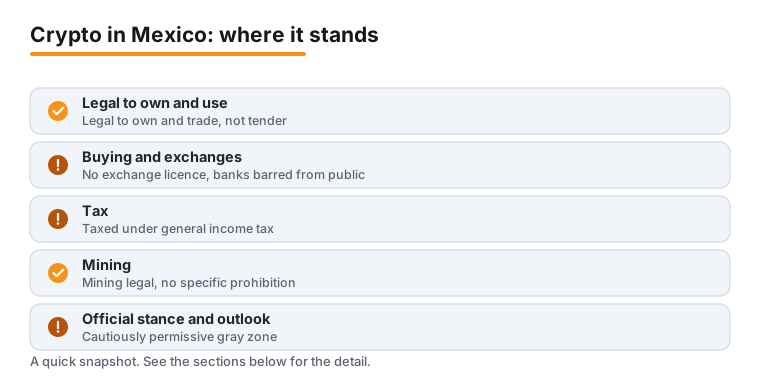
Yes. Owning, buying, selling, and trading Bitcoin and other cryptocurrencies is legal in Mexico for individuals and for non-financial businesses. No law prohibits private citizens from holding or transacting in digital assets, and a large retail and peer-to-peer market operates openly.
However, crypto is not legal tender. Under Article 30 of the Fintech Law, virtual assets are expressly not legal tender in Mexican territory, not foreign currency, and not backed by the government. Only the Mexican peso, issued by Banco de México, is legal tender, so no merchant is obliged to accept Bitcoin, although two parties may privately agree to settle in crypto if both consent.
The defining feature of Mexico's regime is the split between the open market and the regulated financial sector. Individuals enjoy broad freedom, but banks and licensed fintech institutions cannot offer crypto custody, exchange, or transfer services directly to customers. This "legal for people, off-limits for banks" structure pushes the consumer-facing market toward specialized exchanges rather than traditional banks.
Who regulates crypto in Mexico
Several authorities share oversight of digital assets, and no single agency controls the whole sector:
- Banco de México (Banxico): the central bank. It determines how virtual assets may be used within the financial system, must authorize any virtual asset before a regulated institution may operate with it, and issues the binding rules that banks and fintech firms must follow.
- Comisión Nacional Bancaria y de Valores (CNBV): the National Banking and Securities Commission, which licenses and supervises banks and fintech institutions (such as electronic payment and crowdfunding platforms) and monitors their compliance.
- Secretaría de Hacienda y Crédito Público (SHCP): the Ministry of Finance, responsible for overall financial policy and AML enforcement.
- Servicio de Administración Tributaria (SAT): the tax authority, which handles tax compliance for crypto-related activity.
- Unidad de Inteligencia Financiera (UIF): the Financial Intelligence Unit, which receives AML reports.
You can verify the central bank's role at the official Banco de México site.
Key laws and frameworks
Mexico does not have a single comprehensive crypto-asset statute comparable to the EU's MiCA. Instead, several instruments apply:
- The 2018 Fintech Law (Ley para Regular las Instituciones de Tecnología Financiera, often called the Ley Fintech). Enacted in March 2018, it was the first law in Latin America to formally define "virtual assets" (activos virtuales) and bring them under a legal framework. Article 30 establishes that virtual assets are not legal tender, and the law requires prior Banxico authorization before regulated institutions can operate with any virtual asset.
- Banxico Circular 4/2019, published in March 2019, set the rules for financial institutions and effectively limited their virtual-asset activity to internal operations subject to prior authorization, barring them from offering crypto services directly to the public.
- The Federal Anti-Money-Laundering Law (Ley Federal para la Prevención e Identificación de Operaciones con Recursos de Procedencia Ilícita, the LFPIORPI), which treats providing virtual-asset services as a regulated "vulnerable activity."
You can read the consolidated Fintech Law text on the official Chamber of Deputies (Diputados) law library, and the central bank's rules in Banxico Circular 4/2019. Because the rules are still developing, treat any specific rule as subject to change and confirm it against current official guidance.
Licensing and registration of exchanges and VASPs
Mexico does not currently offer a dedicated crypto-exchange license that would let an exchange operate as a regulated financial institution offering virtual assets to the public. Banxico Circular 4/2019 keeps regulated banks and fintech firms at a "healthy distance" from public-facing crypto activity. As a result, most consumer crypto platforms operate as ordinary businesses rather than as licensed financial entities.
The principal compliance gateway for exchanges and other virtual-asset service providers (VASPs) is the AML regime, not a financial license. Providing exchange services for virtual assets is a "vulnerable activity" under the LFPIORPI, which obliges providers to:
- Identify and verify customers (Know Your Customer, or KYC).
- Register with the authorities and maintain records.
- File reports on transactions and fees above defined thresholds.
Following the July 2025 AML reform, these obligations apply even to providers serving Mexican residents from abroad. The reform also added duties reported for obliged entities such as risk-based assessments, a designated compliance officer, staff vetting, periodic AML audits, and longer record-keeping. Several of these changes take effect through general rules that the Ministry of Finance (SHCP) is to issue within 12 months of the reform's publication, and that deadline fell in mid-July 2026. The Reglamento was reformed on 27 March 2026, but business chambers were still urging members to watch for the general rules in late June 2026 and no record of their publication could be found. Until they appear, the Article 18 duties on automated monitoring, risk-based evaluation, personnel selection, annual training and audit remain suspended, and the SAT's interim criteria are expressly non-binding.
A separate route exists for fintech institutions authorized under the Fintech Law (electronic payment and crowdfunding institutions), which are licensed and supervised by the CNBV, but their ability to deal in virtual assets remains tightly constrained by Banxico. Because Mexico still has no dedicated VASP license, crypto firms in practice either register as fintech entities with the CNBV or operate as ordinary businesses under the AML regime. This gap is one reason industry groups are pressing for a "Fintech Law 2.0" reform (see recent developments below).
How crypto is taxed in Mexico
Cryptocurrency is taxable in Mexico, but there is no dedicated crypto tax regime. Digital assets are treated under the general tax framework, generally as property rather than currency, so they fall under income tax (Impuesto Sobre la Renta, ISR) and, where applicable, value-added tax (Impuesto al Valor Agregado, IVA).
Key principles:
- Taxable events commonly include selling crypto for pesos, trading one crypto for another, and earning crypto as income (for example from work, mining, or certain rewards).
- Income tax applies to gains. Individuals are taxed under the personal ISR rules on progressive brackets (reported figures generally run from roughly 1.92 percent up to 35 percent depending on total annual income), while companies are taxed under the corporate ISR regime (commonly cited at 30 percent). Crypto profits are folded into your overall income rather than taxed under a separate capital-gains category.
- Record-keeping matters. You generally need to track acquisition cost, sale value, and dates in pesos to calculate any gain or loss, and report relevant amounts in your annual return (individuals typically file by April 30 for the prior tax year).
Rates, exemptions, and thresholds change and depend on individual facts, so confirm your obligations with the SAT or a qualified Mexican tax adviser. See also our general crypto taxes guide. This is not tax advice.
AML and KYC rules
Mexico applies a strict anti-money-laundering and counter-terrorism-financing regime to crypto. Under the LFPIORPI, providing virtual-asset services is a "vulnerable activity," which triggers customer identification, record-keeping, and reporting duties enforced by the SHCP and the UIF.
A landmark reform to the LFPIORPI was published in the Official Federal Gazette on July 16, 2025, strengthening the framework. Among the changes reported for virtual-asset activity:
- The scope now expressly covers virtual-asset operations performed from abroad with Mexican residents.
- The reporting threshold for a single operation was lowered to 210 UMA (Units of Measure and Update, on the order of 1,200 to 1,400 US dollars depending on the UMA value and exchange rate), down from the previous higher threshold.
- A new duty to report any operation where a service commission of 4 UMA or more (on the order of 25 US dollars) is charged, regardless of the operation's size.
- A risk-based approach across vulnerable activities and longer documentation-retention requirements.
In practice, expect to provide identification and proof of address when opening an account on a compliant platform, with enhanced checks for larger transactions. Exact UMA values and thresholds are updated periodically, so verify current figures with the official authorities.
Buying and using crypto in practice
Buying crypto in Mexico is straightforward and legal. Because banks generally do not offer crypto directly, residents rely on specialized cryptocurrency exchanges, peer-to-peer marketplaces, and payment apps that operate under the AML/KYC framework described above.
A typical path looks like this:
- Choose a compliant platform that applies KYC, discloses fees clearly, and has strong security practices.
- Complete verification by providing the identity documents the platform requires.
- Fund your account in pesos using supported methods such as a SPEI bank transfer or cash deposit.
- Place your order, watching spreads and fees.
- Secure your holdings with two-factor authentication, and consider a self-custody wallet for larger amounts.
- Keep records of every transaction for tax reporting.
Bitcoin ATMs exist in larger cities and tourist hubs and can be useful for quick cash conversions, but their fees are typically far higher than online exchanges, and operators are also subject to AML rules. Crypto is also widely used for remittances on the US-Mexico corridor, often via stablecoins to reduce volatility; the recipient still needs a compliant off-ramp (with KYC) to convert to pesos. Be cautious with informal or unverified sellers, as crypto fraud is a recurring risk in the region.
Bitcoin mining in Mexico
Bitcoin mining is legal in Mexico, and there is no specific prohibition on running mining hardware and no dedicated mining license. Miners operate as ordinary businesses or individuals and are subject to general rules on electricity use, taxation, and commercial activity.
The main considerations are economic and infrastructural rather than purely legal:
- Electricity cost and supply: profitability hinges on affordable, reliable power, which varies significantly by region.
- Energy mix: Mexico has notable solar, wind, and geothermal potential, and some operators emphasize renewable sourcing to cut costs. These are commercial choices, not mining-specific mandates.
- Taxation: income from mining is generally taxable, and mined coins are valued for tax purposes under the general ISR rules.
Anyone planning a sizeable operation should review local energy regulations, permitting, and tax treatment with professionals before investing.
Recent developments (2025 to 2026)
The clear trajectory is toward more oversight and transparency, not less:
- AML reform (July 2025): the LFPIORPI overhaul published on July 16, 2025 lowered reporting thresholds, added fee-based reporting, and extended VASP duties to providers serving Mexican residents from abroad.
- Tax transparency (2026): Mexico is among the jurisdictions committed to the OECD's Crypto-Asset Reporting Framework (CARF). Mexico sits in the second wave, with first international exchanges of crypto-asset data expected in 2028 rather than the 2027 first wave. Separately, Article 30-B of the Codigo Fiscal de la Federacion, introduced by the 2026 fiscal package and detailed in Regla 2.9.21 of the Resolucion Miscelanea Fiscal 2026, has given the SAT permanent online access to digital platform transaction records since 1 April 2026, though the published scope lists marketplaces, transport, delivery, accommodation, streaming and online education platforms and does not name virtual asset exchanges, which increases the importance of accurate self-reporting.
- Fintech Law 2.0 push: During 2026, fintech industry groups and the new head of the CNBV, Ángel Cabrera, began discussing a possible "Fintech Law 2.0" reform to clarify rules for crypto assets, add tiered or risk-based authorization, and cover open finance. That discussion now has a concrete vehicle. On 6 May 2026 Senator Alejandro Murat Hinojosa of the Morena caucus introduced an initiative in the Senate creating Activos Virtuales Estables Referenciados en Moneda Nacional, peso-referenced stablecoins issuable only by electronic payment fund institutions and credit institutions holding prior Banxico authorization, backed by liquid reserves equal to 100 percent of tokens in circulation. It was still in committee as of early August 2026, with no committee report or scheduled vote found, and it must clear both chambers. Speaking in June 2026, its sponsor estimated six to twelve months before the project could begin to be applied gradually.
- CBDC research: Banxico has discussed a potential central-bank digital currency (a digital peso), but the initiative remains at an early stage and has faced delays, and the 2025 target date passed without a launch. Reporting in March 2025 noted that the annual Banxico budget approved by its Governing Board for that year contained no plan related to the project.
The pacing item behind most of this is Mexico's FATF mutual evaluation. The on-site phase began on 11 March 2026, coordinated by the Treasury with Banxico, the SAT and the CNBV among the participating authorities. One compliance analysis expects the resulting report to be discussed and published between October 2026 and February 2027, with outcomes ranging from regular follow-up to enhanced follow-up or ICRG observation, the step before the grey list. That timetable is a commentator's expectation rather than an FATF announcement, so confirm the latest status with the official regulators before relying on any specific detail.
Consumer risks and protection
Because mainstream banks largely stay out of crypto, users in Mexico generally have fewer formal safeguards than in traditional finance. The main risks fall into several categories:
- Limited consumer protection: there is no comprehensive crypto-investor protection scheme, and platform failures or disputes may leave users with limited recourse.
- Fraud and security: scams, phishing, and theft are persistent, and crypto transactions are irreversible, so mistakes are costly.
- Regulatory uncertainty: the framework is still maturing, and the boundary between permitted activity and restricted financial-sector involvement can shift.
- Market volatility and tax exposure: sharp price swings and reporting obligations both require active management.
Sensible precautions include using compliant platforms with strong security and clear fee disclosure, investing only what you can afford to lose, securing your own keys for larger holdings, diversifying, keeping detailed records, and consulting a licensed adviser. This article is informational only and is not legal, tax, or financial advice.
Official sources and how to verify
Crypto rules in Mexico change, so always confirm current requirements with primary official sources rather than secondary summaries. The most authoritative starting points are:
- Banco de México (Banxico), the central bank, for rules on how virtual assets may be used in the financial system, including Circular 4/2019.
- The Fintech Law (LRITF) text on the Chamber of Deputies law library, for the statutory definition of virtual assets and Article 30.
- The SAT, the tax authority, for income-tax and reporting obligations.
- The CNBV (National Banking and Securities Commission) for fintech-institution licensing and supervision.
For our wider coverage, see the regulation hub and the crypto regulation explainer. Remember that this guide is general information as of 2026 and not legal advice; verify your specific situation with the named regulators or a licensed Mexican professional.
Where each rule stands in August 2026
Mexico has no single crypto statute, and none is in force. What exists is a set of separate instruments at different stages. This table is the short answer to what applies now and what is still only proposed.
| Measure | Stage in August 2026 | What happens next |
|---|---|---|
| Ley Fintech (2018) and Banxico Circular 4/2019 | In force | No repeal proposed. Banxico said in its Financial Stability Report of December 2025 that it will keep promoting a sana distancia between virtual assets and the traditional financial system. |
| AVE peso-stablecoin bill (Senate) | Introduced 6 May 2026, in committee, no dictamen found | Must pass committees and both chambers. Sponsor estimated six to twelve months to phased application. |
| LFPIORPI anti-money-laundering reform | In force since 17 July 2025 | Core identification and reporting duties already bind crypto exchanges. |
| Reglamento de la LFPIORPI reform | In force, published 27 March 2026 | Effects immediate, but full operability waits on the general rules below. |
| Reglas de Caracter General under the reformed LFPIORPI | Not published as of the latest available reporting | Statutory deadline fell in mid-July 2026. Several exchange duties stay suspended until they appear. |
| Article 30-B Codigo Fiscal de la Federacion | In force since 1 April 2026 | SAT online access to digital platform records. Crypto exchanges are not named in the published scope. |
| OECD CARF | Political commitment only | Mexico sits in the 2028 first-exchange group of 29 jurisdictions, on the OECD list updated 23 June 2026. |
| FATF mutual evaluation of Mexico | On-site phase held March 2026 | One compliance analysis expects plenary discussion and publication between October 2026 and February 2027. |
The stablecoin bill: what Activos Virtuales Estables would actually do
This is the most substantial crypto legislative proposal in Mexico since the 2018 Fintech Law. Senator Alejandro Murat Hinojosa of the Morena caucus introduced it in the Senate on 6 May 2026. It creates a category called Activo Virtual Estable Referenciado en Moneda Nacional, defined as a digital representation of value used as a means of payment or settlement instrument whose issuer must guarantee convertibility into pesos at nominal value, holding a stable 1:1 reference to the peso. The text is explicit that these tokens carry no legal tender status and do not displace the peso, and it is modelled on the United States GENIUS Act.
The concrete terms matter more than the label:
- Who could issue. Only Instituciones de Fondos de Pago Electronico (IFPE) and credit institutions with prior Banco de Mexico authorization could issue, administer and offer them to the public. Unlicensed fintech startups are excluded unless they obtain one of those licences.
- Reserves. Liquid reserves equal to 100 percent of tokens in circulation, with encumbrance, offsetting and reuse prohibited. If the issuer fails, the reserves stay outside the bankruptcy estate and go first to redeeming holders.
- Who supervises. Four bodies share it: Banxico for authorization, reserves and convertibility, CNBV for operations, technology and cybersecurity, the Treasury for anti-money-laundering, and Condusef for consumer protection, complaints and advertising.
- Scope. Three separate reports describe the bill as reforming ten ordenamientos of the Mexican financial system.
Two limits are worth being blunt about. The bill covers peso-referenced tokens, so it would not regulate USDT or USDC, which are the stablecoins Mexicans mostly hold. And it does not lift the general restriction on banks offering Bitcoin or other crypto to retail customers; it carves out one narrow permitted product rather than reopening Circular 4/2019. As of early August 2026 the initiative was still in committee, with no dictamen and no scheduled vote found.
The anti-money-laundering rulebook is half-written
Mexico tightened its AML law in July 2025 and its implementing Reglamento on 27 March 2026, but the technical rules that make several duties operable are late. The SHCP, with prior opinion from the SAT, had 12 months from 17 July 2025 to issue the Reglas de Caracter General, putting the deadline in mid-July 2026. In late June 2026 business chambers were still urging members to watch for publication, and no source located in this review records the rules actually appearing.
The practical consequence for a crypto exchange or professional dealer registered as a vulnerable activity is a split rulebook. Identification, record-keeping and reporting already apply, including the trigger where the fee charged for the service reaches 4 UMA. But the duties in Article 18 fractions VII to XI, covering automated monitoring mechanisms, risk-based evaluation, personnel selection, mandatory annual training, and internal and external audit, remain suspended until the rules set their start dates. The SAT has published only orientative criteria on its SPPLD portal, which are expressly not binding and do not substitute for the rules.
One change that does already bite is reach. The reform extends the regime to operations carried out with Mexicans from another jurisdiction, so offshore platforms serving Mexican residents are explicitly in scope.
The pressure behind all of this is external. The Financial Action Task Force began the on-site phase of its mutual evaluation of Mexico on 11 March 2026, coordinated by the Treasury with Banxico, the SAT and the CNBV among the participating authorities, per SHCP Comunicado No. 21. One compliance analysis expects the report to be discussed and published between October 2026 and February 2027, with outcomes ranging from regular follow-up to enhanced follow-up or ICRG observation, the step before the grey list. That timetable is a commentator's expectation, not an FATF announcement.
What the tax authority can actually see
Article 30-B of the Codigo Fiscal de la Federacion, introduced through the 2026 fiscal package, gives the SAT permanent online access to the systems of digital platforms operating in Mexico from 1 April 2026, with the detail in Regla 2.9.21 of the Resolucion Miscelanea Fiscal 2026. Access covers transaction records, billing and collection histories, data on service recipients and on sellers or service providers, and payment methods, and expressly excludes surveillance of individual user behaviour, private messages and consumed content.
It is widely described online as live SAT access to crypto exchange accounts. That overstates it. The published scope lists marketplaces and e-commerce, transport, mobility and delivery apps, accommodation intermediation, streaming and online education, and does not name virtual asset exchanges. Whether a particular crypto business is caught turns on whether it intermediates transactions between third parties. Platforms that refuse can face fines and ultimately temporary nationwide blocking through telecommunications operators.
Crypto-specific visibility reaches the SAT by two other routes instead. Today it comes through the anti-money-laundering vulnerable activity reports filed by registered exchanges. From 2028 it comes through the OECD Crypto-Asset Reporting Framework, where the OECD list updated 23 June 2026 places Mexico in the group of 29 jurisdictions making first exchanges by 2028, not the 46-jurisdiction 2027 group. Neither route changes what is taxable, only what the authorities can see.
Frequently asked questions
Is Bitcoin legal tender in Mexico?
No. Bitcoin and other cryptocurrencies are legal to own and trade, but they are not legal tender. Article 30 of the 2018 Fintech Law states that virtual assets are not legal tender in Mexico. Only the Mexican peso, issued by Banco de México, has that status, so merchants are not required to accept crypto, though two parties may agree privately to transact in it.
Can Mexican banks and fintech firms offer cryptocurrency services?
Generally no, not directly to the public. Under Banxico Circular 4/2019, regulated banks and fintech institutions may only operate with virtual assets for internal purposes and only with prior Banxico authorization. They are barred from offering crypto custody, exchange, or transfer services to retail customers, so the consumer market is served mainly by specialized exchanges.
Do crypto exchanges need a license in Mexico?
There is no dedicated crypto-exchange license that lets a platform offer virtual assets to the public as a regulated financial institution. Instead, exchanges and other virtual-asset service providers must comply with the anti-money-laundering law (LFPIORPI), which treats virtual-asset services as a "vulnerable activity" requiring customer identification (KYC), record-keeping, and transaction reporting to the authorities.
How is crypto taxed in Mexico?
Crypto is taxable but has no special regime; it is taxed under the general income-tax (ISR) rules and, where applicable, VAT (IVA). Digital assets are generally treated as property, so selling, trading, or earning crypto can create a taxable event. Individuals pay progressive rates folded into their overall income and file an annual return (typically by April 30). Confirm specifics with the SAT or a tax adviser; this is not tax advice.
What changed for crypto in Mexico in 2025 and 2026?
A major anti-money-laundering reform published on July 16, 2025 lowered the per-operation reporting threshold to 210 UMA, added reporting for service fees of 4 UMA or more, and extended obligations to providers serving Mexican residents from abroad. For 2026, Mexico has committed to the OECD's Crypto-Asset Reporting Framework (CARF), with first international data exchanges expected in 2028, and tax rules are expanding the SAT's access to digital-platform transaction data from around April 1, 2026.
Is there a dedicated crypto or VASP law coming to Mexico?
Not yet. As of mid-2026, Mexico still has no single comprehensive crypto statute and no dedicated VASP license; crypto firms usually register as fintech entities or comply through the anti-money-laundering regime. Fintech industry groups and the new CNBV head, Ángel Cabrera, have started discussing a possible "Fintech Law 2.0" reform to clarify crypto-asset rules and add tiered authorization, but this is at the discussion stage, not enacted law. Confirm the current status with official sources before relying on it.
When will the SAT get direct access to my exchange data?
Reporting rules are set to give Mexico's tax authority, the SAT, expanded near-real-time access to transaction data from digital platforms operating in Mexico from around April 1, 2026. Separately, Mexico has committed to the OECD CARF standard, under which platforms report users' crypto data for international exchange, with Mexico's first exchanges expected in 2028. Both trends make accurate record-keeping and self-reporting more important. This is not tax advice; verify specifics with the SAT.
Where can I verify the current rules?
Check primary official sources: Banco de México (banxico.org.mx) for central-bank rules including Circular 4/2019, the Chamber of Deputies law library (diputados.gob.mx) for the Fintech Law text, and the SAT (sat.gob.mx) for tax obligations. The CNBV supervises fintech-institution licensing. This guide is general information as of 2026 and not legal advice, so verify your situation with these regulators or a licensed Mexican professional.
Is Mexico about to regulate stablecoins?
A bill exists but is not law. On 6 May 2026 Senator Alejandro Murat introduced an initiative in the Senate creating Activos Virtuales Estables Referenciados en Moneda Nacional, peso-pegged tokens at 1:1 parity with full liquid reserve backing. Only electronic payment fund institutions (IFPE) and credit institutions with prior Banco de Mexico authorization could issue them. It was still in committee in early August 2026, with no committee report or scheduled vote found, and it must clear both chambers. The sponsor publicly estimated six to twelve months to phased application, so treat any earlier date as speculation.
Would the stablecoin bill let my Mexican bank sell me Bitcoin?
No. The initiative creates one narrow permitted product, a peso-referenced stablecoin issued under Banxico authorization with full reserve backing. It does not reopen Banxico Circular 4/2019, which is what keeps regulated institutions from offering crypto exchange, custody or transfer services to customers. In its December 2025 Financial Stability Report Banxico said it will keep promoting a sana distancia between virtual assets and the traditional financial system.
Does the bill cover USDT and USDC?
No. It applies to stable virtual assets referenced to the Mexican peso. Dollar-pegged stablecoins such as USDT and USDC fall outside that definition, so they would continue under the existing arrangement: not legal tender, not bank-distributed, and traded through platforms that comply as anti-money-laundering vulnerable activity providers.
Are the 2025 anti-money-laundering rules for exchanges fully in force?
Partly. The LFPIORPI reform took effect on 17 July 2025 and the Reglamento was reformed on 27 March 2026, so identification, record-keeping and reporting duties already apply. But the Reglas de Caracter General that operationalise the rest were due in mid-July 2026 and no record of their publication could be found. Until they appear, the Article 18 duties covering automated monitoring, risk-based evaluation, personnel selection, annual training and audit have no start date. Check the Diario Oficial de la Federacion for the current position.
Could Mexico end up on the FATF grey list?
It is a possible outcome, not a prediction. The FATF began the on-site phase of its mutual evaluation of Mexico on 11 March 2026, coordinated by the Treasury with Banxico, the SAT and the CNBV among the participating authorities. One compliance analysis expects the report to be discussed at plenary between October 2026 and February 2027, though the FATF itself has not published that timetable. Outcomes range from regular follow-up, the best case, through enhanced follow-up, to observation by the International Co-operation Review Group, which is the step before the grey list.
Does the SAT have live access to my crypto exchange account from April 2026?
Not on the basis usually cited. Article 30-B of the Codigo Fiscal de la Federacion has given the SAT permanent online access to digital platform records since 1 April 2026, with detail in Regla 2.9.21 of the Resolucion Miscelanea Fiscal 2026, but the published scope covers marketplaces, transport, delivery, accommodation, streaming and online education and does not name virtual asset exchanges. Crypto data reaches the SAT instead through vulnerable activity reports filed by registered exchanges now, and through the OECD CARF from 2028, the wave Mexico is in.
Facts reviewed: 3 August 2026. Page updated: 3 August 2026.
Related guides
More countries in the region
Practical guides