Home › Crypto Regulation › Portugal
Bitcoin & Cryptocurrency Regulation in Portugal
Quick answer — Portugal, 2026
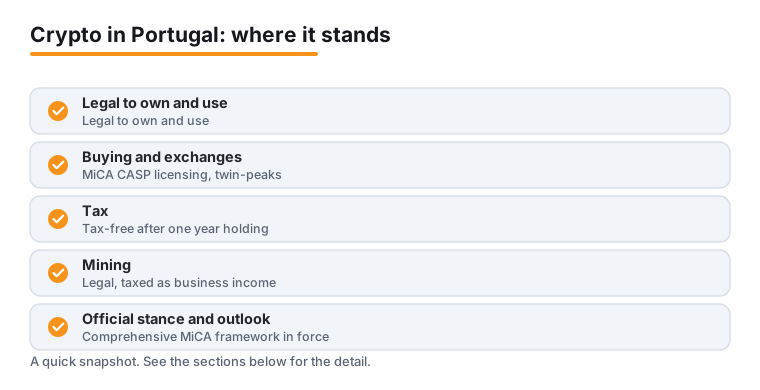
- Legal: Legal to own and trade, not legal tender; MiCA applies
- Tax: Gains under 365 days taxed at 28%, over one year broadly exempt; staking taxed
- Buying: Via EU-authorised CASPs, often passported in, funded by SEPA, after KYC
Portugal spent years with a reputation as one of Europe's most crypto-friendly countries, helped by a tax regime that left most individual gains untouched and by an active startup scene. That picture has matured. The European Union's Markets in Crypto-Assets Regulation (MiCA) is now in force across the bloc, and Portugal transposed it into national law at the end of 2025. The country has moved from a light-touch, anti-money-laundering-only approach toward a comprehensive licensing and supervision framework run jointly by the central bank and the securities regulator.
This page explains where things stand for 2026: whether Bitcoin and crypto are legal in Portugal, who regulates the sector, the key laws and frameworks, how exchanges are licensed, how crypto is taxed, the anti-money-laundering rules, what buying and using crypto looks like in practice, mining, recent developments, consumer risks, and how to verify everything against official sources. For broader context see our crypto regulation guide and our crypto taxes overview.
This is general information current as of 2026 and is not legal, tax, or financial advice. Crypto rules and tax treatment change frequently and depend on your personal circumstances. Always confirm the current position with the Banco de Portugal, the CMVM, or the Autoridade Tributaria before acting.
On this page: Legal status · Who regulates it · Taxes · How to buy · Mining
Is Bitcoin and crypto legal in Portugal?
Yes. Owning, buying, selling, holding, and transferring Bitcoin and other crypto-assets is legal for individuals and businesses in Portugal. There is no ban, and the country has long been viewed as one of the friendlier jurisdictions in Europe for crypto users and startups.
Crypto is not legal tender in Portugal. The euro is the only official currency, so no merchant is obliged to accept Bitcoin, although some choose to. What has changed is that the activity is no longer lightly regulated: as an EU member state, Portugal applies MiCA, the EU-wide framework that governs how crypto-assets are issued and how the firms that provide crypto services operate. Holding and using crypto remains legal, but the companies that serve you must increasingly be authorised and supervised.
Who regulates crypto in Portugal
Portugal uses a "twin peaks" model that splits supervision between two national competent authorities:
- Banco de Portugal (BdP), the central bank and prudential authority. It supervises asset-referenced tokens and e-money tokens (the MiCA categories that include most stablecoins), authorises crypto-asset service providers (CASPs), and oversees prudential requirements, governance, outsourcing, and the orderly wind-down of providers.
- CMVM (Comissao do Mercado de Valores Mobiliarios), the securities market commission. It supervises the public offering and admission to trading of crypto-assets other than stablecoins, market-abuse rules, and the conduct-of-business and investor-protection obligations that CASPs owe their clients.
Any entity wishing to provide crypto-asset services in Portugal must apply for authorisation from the Banco de Portugal, which notifies the CMVM whenever an application is submitted. The two authorities are required to cooperate. You can verify each authority's remit on the official Banco de Portugal site and the official CMVM site (linked in the official-sources section below).
Key laws and frameworks
Portugal's crypto rulebook now sits largely within the EU framework, complemented by national implementing legislation:
- MiCA, Regulation (EU) 2023/1114, the directly applicable EU regulation governing crypto-asset markets, issuers, and service providers.
- The Transfer of Funds Regulation, Regulation (EU) 2023/1113, often called the "travel rule," which extends anti-money-laundering tracing requirements to crypto transfers.
- Law No. 69/2025 (dated 1 December 2025, published 22 December 2025), the national law that implements MiCA in Portugal and assigns competence to the Banco de Portugal and the CMVM.
- Law No. 70/2025 (also late 2025), which gives national effect to the travel rule and revises Portugal's anti-money-laundering law.
- Law No. 83/2017 (of 18 August, as amended), Portugal's long-standing anti-money-laundering and counter-terrorist-financing law, under which crypto firms were originally registered and which continues to apply.
Lei n.º 69/2025 and Lei n.º 70/2025 were both published in the Diário da República on 22 December 2025. Lei n.º 70/2025 gives national effect to Article 38 of Regulation (EU) 2023/1113 and amends Lei n.º 83/2017. The tax rules come from a different law, Lei n.º 24-D/2022, de 30 de dezembro, the State Budget for 2023, which inserted crypto-assets into the IRS Code. Because effective dates can be technical, confirm the original texts with the regulators before acting.
Licensing and registration of exchanges and providers
Before MiCA, firms offering crypto services in Portugal had to register with the Banco de Portugal for anti-money-laundering purposes under Law No. 83/2017. Under MiCA, that registration is being replaced by a full CASP authorisation, which carries broader prudential, governance, and conduct requirements.
A key transitional rule applies. Entities that were already registered with the Banco de Portugal as of 30 December 2024 and had genuinely started and duly notified their activity may continue operating under the older regime until 1 July 2026, or until their MiCA authorisation is granted or refused, whichever comes first. Reporting also describes a related filing window: firms on the register had to lodge a CASP authorisation application during the period that ran from 30 December 2024 to 30 December 2025, and those that did not file by the end of that window lost the right to keep operating without a granted authorisation. After the transitional window closes, a firm without MiCA authorisation must stop providing services. On 29 June 2026 the Banco de Portugal confirmed that no authorisation had yet been granted under the full MiCA procedure. Eleven entities held Banco de Portugal registrations to provide virtual-asset services at the end of 2024, all but one of which had already begun activity. As of 3 August 2026, independent trackers of the ESMA register list a single authorised provider established in Portugal, Bison Bank, S.A., which operates as a credit institution under Article 60(1) of MiCA.
A major practical feature of MiCA is the EU "passport": a CASP authorised in one member state can offer services across the bloc. As a result, many platforms serving Portuguese users are authorised elsewhere in the EU rather than in Portugal. Always check a provider's stated authorisation status and home regulator. See also our country regulation hub for how other EU states apply the same framework.
Crypto and Bitcoin tax in Portugal
Portugal overhauled its crypto tax regime in 2023, and the core rules remain in place for 2026. The points below describe the general treatment for individual tax residents, but outcomes are highly fact-specific. Do not rely on these figures: verify your situation with the Autoridade Tributaria or a Portuguese tax adviser.
- Holding period matters. Gains on crypto-assets held for less than 365 days are generally treated as taxable capital gains. Gains on assets held for more than one year are, broadly, exempt from personal capital-gains tax, subject to exceptions (for example, assets that qualify as securities, or income linked to non-cooperative jurisdictions).
- Short-term gains are taxed at a flat autonomous IRS rate of 28%, with the option to aggregate the gain with your other income at progressive rates instead. Aggregation becomes compulsory where your taxable income reaches the top IRS bracket. Gains are computed on a FIFO basis. Income from a tax haven can face a higher rate (commonly cited at 35%).
- Crypto-to-crypto swaps are generally not treated as a taxable event at the moment of the trade; the original acquisition cost carries over and tax is typically deferred until you convert to fiat or spend the asset.
- Staking rewards and similar passive income are generally treated as investment income (category E capital income) and taxed at a flat rate widely cited at 28%, regardless of holding period. Mining, validation, and token issuance carried out as a professional or business activity are instead generally treated as category B business or professional income and may be taxed at progressive rates.
- Reporting still applies. Tax-free does not mean no reporting. Residents must declare relevant crypto activity in the annual IRS return (Modelo 3), even when long-term gains are exempt. Reporting cited for 2026 uses Anexo G, Quadro 18A for disposals of assets held under 365 days (taxed at 28%), Anexo G1 for long-term disposals that are exempt, and Anexo E for staking and similar capital income. The filing window generally runs from 1 April to 30 June of the following year.
The old "crypto is tax-free in Portugal" shorthand is outdated and was always an oversimplification. Treatment now depends on holding period, the type of activity, and your residency status. See our crypto taxes guide for general background, and confirm specifics with the tax authority.
AML, KYC, and the travel rule
Anti-money-laundering and counter-terrorist-financing rules are central to how crypto is regulated in Portugal. Under Law No. 83/2017 (as amended) and now the MiCA-era framework, crypto-asset service providers must comply with obligations that include risk management, transaction monitoring, customer identification (Know Your Customer, or KYC), customer due diligence, record-keeping, and the appointment of a money-laundering reporting officer.
With Law No. 70/2025, Portugal gave national effect to the EU travel rule (Regulation (EU) 2023/1113). In practice this means regulated providers must collect, transmit, screen, and retain information about the originator and the beneficiary of crypto transfers, aligning the regime with EU standards and FATF recommendations. For you as a user, expect identity verification when opening an account and additional information requirements when sending or receiving crypto through regulated platforms. Anonymous large-scale activity through regulated venues is not realistic.
Buying and using crypto in practice
Residents of Portugal can buy crypto through major EU-authorised exchanges, broker apps, and peer-to-peer platforms. Since 1 July 2026 any provider operating in or into Portugal must hold a MiCA CASP authorisation, be a financial entity that has notified under Article 60 of MiCA, or passport in an authorisation granted by another EU regulator. The prior-registration route no longer exists. Many platforms serving Portuguese users are authorised elsewhere in the EU and passport their licence into Portugal.
What to expect when opening an account and transacting:
- Identity verification (KYC). You will provide government ID and usually proof of address.
- Funding. Euro deposits via SEPA bank transfer, debit or credit card, and instant-payment methods are common. Bank transfers are typically cheaper than cards.
- Travel rule. When you send or receive crypto through regulated providers, sender and recipient information may be collected and shared.
- Self-custody. Holding your own keys remains legal and is common for longer-term holders, but it shifts full responsibility for security onto you.
- Spending crypto. Using crypto to pay for goods or services can have tax and invoicing consequences, especially if it forms part of a business activity. Keep clear records of dates, amounts, and cost basis.
Favour providers that clearly state their EU authorisation status, charge transparent fees, and offer strong account security such as two-factor authentication.
Bitcoin mining in Portugal
Bitcoin mining is legal in Portugal, and there is no dedicated ban on proof-of-work mining. There is also no special carve-out that makes mining unusually cheap or easy; the main constraints are economic and regulatory rather than prohibitive:
- Electricity cost and supply. Mining profitability is driven by power prices. Portugal has a growing share of renewable generation, which can be attractive, but retail and industrial electricity costs and grid-connection rules must be assessed carefully for any sizeable operation.
- Tax treatment. Income from mining is generally treated as business or professional activity rather than tax-exempt capital gains, which can mean registration and progressive taxation. Confirm the current treatment with a tax professional.
- Energy and environmental policy. EU and national climate goals increasingly shape energy-intensive activities, so large operations should expect scrutiny of energy use and evolving sustainability-related reporting expectations.
Small-scale or hobby mining is feasible, but anyone planning commercial-scale operations should model power costs, secure proper business registration, and seek legal and tax advice before committing capital.
Recent developments (2025 to 2026)
The defining development is the arrival of the MiCA era in Portugal. After a period of legal uncertainty in early 2025, when the Banco de Portugal noted that no competent authority had yet been formally designated to process MiCA authorisations, Portugal enacted Law No. 69/2025 (implementing MiCA) and Law No. 70/2025 (implementing the travel rule and revising the anti-money-laundering law) at the end of 2025.
These laws confirmed the twin-peaks split between the Banco de Portugal and the CMVM, opened the path for CASP authorisation applications, and set a transitional deadline of 1 July 2026 for previously registered firms to obtain a MiCA licence or cease activity.
A separate change affects tax transparency. The EU's DAC8 directive, which brings crypto-asset reporting into the EU's automatic exchange-of-information system and implements the OECD Crypto-Asset Reporting Framework, takes effect across the bloc from 1 January 2026. Member states were required to transpose it into national law by 31 December 2025, Portugal missed that deadline and, as of early August 2026, transposition still had not been completed. The European Commission opened an infringement procedure against Portugal and eleven other member states in January 2026, the Council of Ministers approved a transposition bill on 27 February 2026, and Proposta de Lei n.º 64/XVII went to Parliament in March 2026, drafted to apply retroactively from 1 January 2026 with the first provider reports due by 31 May 2027. In practice, crypto-asset service providers must collect and report data on EU-resident users' transactions from 1 January 2026, with the first exchanges between tax authorities generally expected by 30 September 2027. For Portuguese residents this means the Autoridade Tributaria is set to receive more information about crypto activity, including activity on platforms based elsewhere.
The transitional regime expired on 1 July 2026 and was not extended. Since that date, any firm serving Portuguese clients without a MiCA authorisation, an Article 60 notification, or an EU passport is committing a very serious administrative offence, and ESMA has called on such firms to stop onboarding clients and cease marketing while they wind down. Because the framework is still settling, monitor the official Banco de Portugal and CMVM pages for the latest position.
Consumer risks and protection
MiCA strengthens consumer protection by requiring authorised providers to meet disclosure, governance, conduct-of-business, complaints-handling, conflict-of-interest, and client-asset-safekeeping standards, supervised in Portugal by the CMVM for conduct and the Banco de Portugal for prudential matters. That said, regulation reduces but does not remove risk.
The main risks for crypto users in Portugal are common to the asset class:
- Price volatility. Crypto-assets can lose substantial value quickly, and this page makes no price predictions.
- Platform failure. An exchange or custodian can fail; assets held on a platform are not protected like bank deposits.
- Scams and phishing. Be sceptical of guaranteed or outsized returns and never share private keys or recovery phrases.
- Irreversible transactions. Crypto transfers generally cannot be undone, so verify addresses carefully.
- Self-custody risk. If you hold your own keys and lose them, the funds are gone.
Practical safeguards: use authorised providers, only commit money you can afford to lose, diversify, keep good records for tax, and consider independent professional advice. If you have a complaint about a regulated provider, the supervising authority's website explains the available channels.
Official sources and how to verify
Because crypto rules and tax treatment in Portugal are still settling under MiCA, always check the primary sources before acting. The most authoritative references are:
- Banco de Portugal for the registration and authorisation of crypto-asset and virtual-asset service providers, prudential rules, and stablecoin supervision.
- CMVM (Comissao do Mercado de Valores Mobiliarios) for market conduct, investor protection, non-stablecoin issuance, and market-abuse rules.
- EUR-Lex: MiCA Regulation (EU) 2023/1114 for the full text of the EU crypto-asset framework that applies in Portugal.
- Autoridade Tributaria (Portal das Financas) for crypto taxation, the IRS return, and filing deadlines.
For general background you can also read our crypto regulation guide. Remember that this page is general information current as of 2026 and is not legal advice; verify your specific situation with the named official regulators or a qualified Portuguese professional.
What changed on 1 July 2026
The MiCA transitional regime that allowed previously registered Portuguese virtual-asset service providers to keep operating expired on 1 July 2026. It was not extended. Providing crypto-asset services without the required authorisation, or outside the scope of an authorisation granted, is a contraordenação muito grave under the crypto-asset market regime approved by Lei n.º 69/2025, according to this CMS Portugal analysis of the end of the transitional regime. Very serious offences under the new crypto laws carry reported fines of 25,000 to 5 million euros where the offender is a legal person.
Portugal reached that deadline with almost nothing licensed. On 29 June 2026, two days before the cut-off, the Banco de Portugal stated that "até à presente data não foi ainda concedida qualquer autorização para o exercício da atividade", meaning no authorisation had been granted under the full MiCA procedure. The one entity able to operate was Bison Bank, which provides crypto-asset services as an already-regulated credit institution under Article 60(1) of MiCA rather than through a fresh authorisation, per this 29 June 2026 report. Bison Bank itself announced in June 2026 that it had become the first bank in Portugal to operate directly as a CASP under MiCA, after the Banco de Portugal approved the merger of its wholly owned subsidiary Bison Digital Assets.
That is still the position, and two independent trackers of the ESMA register agree on it. As of 3 August 2026 one tracker lists 321 authorised providers across the EU and EEA and exactly one established in Portugal, Bison Bank, S.A., supervised by the Banco de Portugal for custody, crypto-to-fiat and crypto-to-crypto exchange, execution of orders, placing, reception and transmission of orders, advice and transfer services. A second tracker, also dated 3 August 2026, puts the EU total at 323 and does not list Portugal among the nine largest licensing jurisdictions.
For a Portuguese resident the practical effect is straightforward. Almost every platform you can lawfully use is authorised in another EU member state and passported into Portugal rather than licensed here. ESMA published a public statement on 23 June 2026 calling on unauthorised providers to stop onboarding new EU clients, refrain from opening new client relationships or accounts, and cease marketing and solicitation, and telling investors to check that a firm is listed as authorised before investing or transferring funds. If a platform you use has gone quiet, restricted deposits or asked you to migrate to a different legal entity, that is why. Check the exact legal entity your account is with rather than the brand name.
Crypto legislation in Portugal: what is adopted and what is still coming
Portugal has a crypto law and it is in force. What is still missing is the tax-reporting half of the framework.
| Measure | Stage | Timing | What it means for you |
|---|---|---|---|
| MiCA, Regulation (EU) 2023/1114 | In force, directly applicable | Transitional period ended 1 July 2026 | Your provider must be authorised, notified under Article 60, or passported in |
| Lei n.º 69/2025, de 22 de dezembro | In force | Published 22 December 2025 | Splits supervision between the Banco de Portugal and the CMVM and sets the sanctions |
| Lei n.º 70/2025, de 22 de dezembro | In force | Published 22 December 2025 | Applies the travel rule and amends Lei n.º 83/2017; expect sender and recipient data collection |
| Proposta de Lei n.º 64/XVII, transposing DAC8 | In parliament | Approved in Council of Ministers 27 February 2026, before Parliament from March 2026 | Drafted to apply retroactively from 1 January 2026; first provider reports on 2026 activity due 31 May 2027 |
| AMLA takeover of EU-level AML tasks from the EBA | In force | 1 January 2026 | The EU-level AML rulebook for crypto firms now sits with AMLA; day-to-day supervision stays national |
The DAC8 file is the one still moving. Portugal missed the 31 December 2025 transposition deadline, the European Commission opened an infringement procedure against Portugal and eleven other member states in January 2026, and the Government responded by approving a transposition bill in Council of Ministers on 27 February 2026. The bill reached Parliament as Proposta de Lei n.º 64/XVII, recorded in the Ordem dos Advogados legislative bulletin for the week of 16 to 22 March 2026 as transposing Directive (EU) 2023/2226 and Directive (EU) 2025/872 and amending the Global Minimum Tax Regime. Vida Económica describes it as still em fase de discussão parlamentar, in an article bylined 17 April 2026 and carried in its edition of 31 July 2026. No source reviewed for this update indicates the bill had been approved by early August 2026.
What it will require, once passed: crypto-asset service providers must report to the Autoridade Tributária data on the operations of Portuguese-resident users. Jornal de Negócios reports that the regime is drafted to take retroactive effect from 1 January 2026, that the first report covering 2026 is due by 31 May 2027, and that fines can reach 22,000 euros with possible revocation of the operator's registration. Vida Económica gives the penalty band as 500 to 22,500 euros depending on whether the failure is an omission or error, a reporting failure or delay, or a control deficiency. No new tax on holders is proposed. The change is enforcement, not rates.
One caution on headlines. A 27 February 2026 report headlined a 15% tax on these dealings. On reading, that 15% is the OECD global minimum rate on the effective profits of large multinational groups, carried in the same bill, not a 15% tax on your crypto transactions.
No proposal to alter the 365-day exclusion or the 28% rate was found in any source reviewed for this update.
The Portuguese crypto taxes people miss: stamp duty and the right annex
The 28% rate and the 365-day rule are only part of the bill. Two stamp duty charges (Imposto do Selo) apply independently of the IRS return.
- 4% on commissions. A 4% stamp duty applies to commissions and consideration charged by, or through the intermediation of, crypto-asset service providers. It is normally declared and settled by the 20th of the following month through the DMIS declaration, which is a separate obligation from the annual IRS return.
- 10% on gratuitous transfers. Crypto received for free, including gifts, inheritances and certain airdrops without consideration, is taxed at 10% where the value of the operation exceeds 500 euros and the beneficiary is resident in Portugal, with the usual stamp duty exemption for direct family members.
The 4% charge is stated in the analysis of the regime created by Lei n.º 24-D/2022; both rates and the 500 euro threshold are set out in this Portuguese crypto tax guide, and the 10% charge on gifts and inheritances is also stated by Vida Económica.
On the IRS return itself, the annex depends on the activity, not just the holding period. Portuguese accounting guidance for the 2026 filing uses Anexo G where the gain is taxed, Anexo G1 where the operation is reportable but excluded from taxation, Anexo B for organised economic activity including mining carried on with structure and regularity, and Anexo J where the operation has a foreign source or international relevance. Anexo J matters in practice, because most platforms serving Portuguese residents are established elsewhere in the EU. ECO confirms that Quadro 18A of Anexo G is for onerous disposals of crypto-assets, with fields for valor de realização, valor de aquisição, despesas e encargos, and that gains on holdings of a year or more are not taxed.
Two further details worth knowing: gains are calculated on a FIFO basis, and the treatment for holdings of 365 days or more is conditional, since it does not apply where the counterparty resides in a privileged tax regime jurisdiction, the so-called blacklist.
Frequently asked questions
Is cryptocurrency legal in Portugal in 2026?
Yes. Buying, holding, selling, and transferring crypto is legal for individuals and businesses. Crypto is not legal tender, so the euro remains the only official currency, and the firms that provide crypto services must be authorised and supervised under the EU's MiCA framework, which Portugal transposed through Law No. 69/2025.
Who regulates crypto in Portugal?
Two authorities under a twin-peaks model. The Banco de Portugal handles prudential supervision, stablecoin issuance, and the authorisation of crypto-asset service providers, while the CMVM oversees market conduct, investor protection, and the public offering of crypto-assets other than stablecoins. Anti-money-laundering rules apply throughout. You can verify each role on the official Banco de Portugal and CMVM websites.
How is crypto taxed in Portugal?
In general, gains on crypto held for less than 365 days are taxable (commonly cited at a flat 28% capital-gains rate), while gains on assets held for more than one year are broadly exempt for individuals, subject to exceptions. Crypto-to-crypto swaps are generally not taxed at the time of the trade, and mining or staking income can be taxed as business or professional income. You must still report relevant activity in the annual IRS (Modelo 3) return. Tax depends on your circumstances, so confirm with the Autoridade Tributaria or a tax professional before filing.
Do crypto exchanges need a licence in Portugal?
Yes. Under MiCA, providers must hold a crypto-asset service provider (CASP) authorisation, which in Portugal is granted by the Banco de Portugal with CMVM involvement. Firms previously registered for anti-money-laundering purposes may continue operating during a transitional period that ends on 1 July 2026, or until their MiCA authorisation is granted or refused, whichever comes first. A CASP authorised elsewhere in the EU can passport its licence into Portugal.
What KYC and AML rules apply to crypto in Portugal?
Regulated providers must verify customer identity (KYC), perform due diligence, monitor transactions, keep records, and appoint a money-laundering reporting officer, under Law No. 83/2017 as amended. Portugal also applies the EU travel rule via Law No. 70/2025, so providers must collect and transmit information about the sender and recipient of crypto transfers. Expect identity checks when you open an account and when you move crypto through regulated platforms.
Is staking income taxed in Portugal?
Generally yes. Staking rewards and similar passive returns are typically treated as investment income (category E capital income) and taxed at a flat rate widely cited at 28%, regardless of how long you hold the asset, so the 365-day exemption that applies to capital gains on disposals does not apply to this income. Mining or validation run as a professional or business activity is instead generally treated as category B business income and may be taxed at progressive rates. Confirm your situation with the Autoridade Tributaria or a tax professional.
Which IRS annex do I use to declare crypto in Portugal?
Reporting cited for 2026 uses Anexo G, Quadro 18A for disposals of crypto held for less than 365 days (taxed at 28%), Anexo G1 for disposals of assets held for more than a year that are broadly exempt, and Anexo E for staking and similar capital income. You must declare relevant activity in the annual IRS (Modelo 3) return even when long-term gains are exempt, generally between 1 April and 30 June of the following year. Rules are detailed and change, so confirm the current forms and codes with the Autoridade Tributaria.
Will Portuguese tax authorities see my crypto activity under DAC8?
Increasingly yes. The EU's DAC8 directive brings crypto-asset reporting into the EU's automatic exchange-of-information system and applies from 1 January 2026. Crypto-asset service providers must collect and report data on EU-resident users' transactions, with the first cross-border exchanges between tax authorities generally expected by 30 September 2027, so the Autoridade Tributaria is set to receive more information about crypto activity, including activity on platforms based elsewhere in the EU. Accurate record-keeping and reporting matter more as a result.
Where can I verify Portugal's crypto rules officially?
Check the primary sources directly: the Banco de Portugal site for provider authorisation and prudential rules, the CMVM site for market conduct and investor protection, EUR-Lex for the full text of MiCA Regulation (EU) 2023/1114, and the Autoridade Tributaria (Portal das Financas) for taxation. This page is general information current as of 2026 and is not legal advice; confirm your specific situation with these regulators or a qualified Portuguese professional.
Can I still use my old crypto exchange in Portugal after 1 July 2026?
Only if it is authorised. The MiCA transitional regime that let previously registered Portuguese providers keep operating ended on 1 July 2026 and was not extended. A platform can serve you lawfully only if it holds a MiCA CASP authorisation, is a financial entity that notified under Article 60 of MiCA, or passports in an authorisation granted by another EU regulator. In a public statement on 23 June 2026, ESMA called on unauthorised firms to stop onboarding new EU clients, refrain from opening new client relationships or accounts, and cease marketing and solicitation, and told investors to check that a firm is listed as authorised before investing or transferring funds. Check the exact legal entity your account is with rather than the brand name, because many platforms serve Portuguese users through an entity licensed in another member state.
How many crypto firms are actually licensed in Portugal?
One. As of 3 August 2026, two independent trackers of the ESMA register each list a single authorised crypto-asset service provider established in Portugal, Bison Bank, S.A., supervised by the Banco de Portugal, against an EU and EEA total of 321 to 323 depending on the tracker. Bison Bank operates as an already-regulated credit institution under Article 60(1) of MiCA rather than through a new authorisation. On 29 June 2026 the Banco de Portugal confirmed it had not yet granted any authorisation under the full MiCA procedure. In practice, most platforms available to Portuguese residents are licensed elsewhere in the EU and passported in.
Has Portugal passed the DAC8 crypto reporting law yet?
Not as of early August 2026. Portugal missed the 31 December 2025 EU transposition deadline and the European Commission opened an infringement procedure against Portugal and eleven other member states in January 2026. The Council of Ministers approved a transposition bill on 27 February 2026 and it reached Parliament as Proposta de Lei n.º 64/XVII in March 2026, where Vida Economica still described it as under parliamentary discussion in an article carried in its 31 July 2026 edition. The bill is drafted to apply retroactively from 1 January 2026, with the first annual reports on 2026 activity due by 31 May 2027 and reported provider penalties running from 500 to 22,500 euros. It creates no new tax, only reporting. Confirm the current status with the Autoridade Tributaria.
Do I pay stamp duty on crypto in Portugal?
Sometimes, and it is separate from IRS. A 4% stamp duty applies to commissions and consideration charged by, or through the intermediation of, crypto-asset service providers, normally declared and settled by the 20th of the following month through the DMIS declaration. A 10% stamp duty applies to gratuitous transfers of crypto, such as gifts, inheritances and certain airdrops without consideration, where the value of the operation exceeds 500 euros and the beneficiary is resident in Portugal, with the usual exemption for direct family members.
Which IRS annex do I use if my exchange is not Portuguese?
Anexo J. Portuguese accounting guidance for the 2026 filing uses Anexo J where the operation has a foreign source or international relevance, which covers disposals through a platform established outside Portugal. Anexo G is used where the gain is taxed, Anexo G1 where the operation is reportable but excluded from taxation, and Anexo B for organised economic activity such as mining carried on with structure and regularity. Because most platforms serving Portuguese residents are established in another EU state, Anexo J applies more often than people expect. Confirm the current forms and codes with the Autoridade Tributaria.
Facts reviewed: 3 August 2026. Page updated: 3 August 2026.