Home › Crypto Regulation › Italy
Bitcoin & Cryptocurrency Regulation in Italy
Quick answer — Italy, 2026
- Legal: Legal to own and trade, not legal tender
- Tax: Gains taxed at 33 percent from 2026, plus 0.2 percent annual charge
- Buying: Via MiCA-authorised or EU-passported exchanges
In Italy, owning, buying, selling and using Bitcoin and other crypto-assets is legal, but crypto is not legal tender: only the euro must be accepted to settle debts. As a member of the European Union, Italy regulates crypto mainly through the EU Markets in Crypto-Assets Regulation (MiCA / MiCAR, Regulation (EU) 2023/1114), which was brought into Italian law by Legislative Decree no. 129 of 5 September 2024. Supervision is shared between CONSOB (the securities and markets authority) and the Banca d'Italia (Bank of Italy), while the Agenzia delle Entrate handles taxation. On top of MiCA sit anti-money-laundering obligations and a tax regime that was tightened from 1 January 2026.
This page is general information as of 2026 and is NOT legal, tax or financial advice. Crypto rules in Italy are changing quickly and depend on your personal circumstances. Always verify the current position with the named official regulators, CONSOB, the Banca d'Italia and the Agenzia delle Entrate, or consult a qualified Italian professional, before acting. For broader background see our guides on crypto regulation and crypto taxes.
On this page: Legal status · Who regulates it · Taxes · How to buy · Mining
Is Bitcoin and crypto legal in Italy?
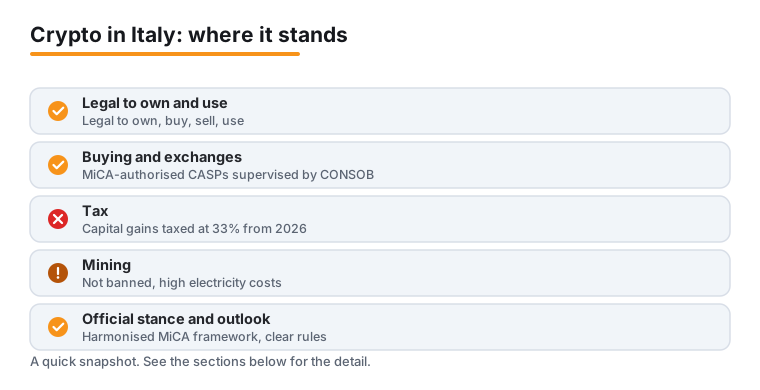
Yes. Buying, holding, selling and using Bitcoin and other crypto-assets is legal in Italy. There is no ban on individuals owning crypto, and authorised businesses may offer custody, trading, exchange and related services. What crypto is not is legal tender: under EU and Italian law only the euro must be accepted for the settlement of debts, so merchants are free to accept or refuse crypto as they choose.
Italy has moved from a fragmented, case-by-case stance to a harmonised European framework. Because Italy is part of the EU, the bloc-wide MiCA regulation now sets the baseline rules for crypto firms, while CONSOB and the Banca d'Italia handle authorisation, supervision and enforcement on Italian territory. The Banca d'Italia has noted that unbacked crypto-assets are not well suited to a payment function, and that regulated e-money tokens are the more reliable category for payments. For a resident, the practical effect is that crypto is treated as a legitimate but regulated and taxable asset, not a grey-area instrument.
Who regulates crypto in Italy?
Italy designated two competent authorities under MiCA, with responsibilities split largely by the type of operator and crypto-asset:
- CONSOB (Commissione Nazionale per le Societa e la Borsa): the securities and markets authority. It leads authorisation and supervision of crypto-asset service providers (CASPs), such as exchanges, brokers and custodians, generally in consultation with the Banca d'Italia, and has the main inspection and conduct-supervision powers. CONSOB also adopted the European Securities and Markets Authority (ESMA) guidelines on classifying tokens that qualify as financial instruments.
- Banca d'Italia (Bank of Italy): the central bank and prudential supervisor. It leads on issuers of asset-referenced tokens (ARTs) and on the stablecoin / e-money side, focuses on financial stability and the payments dimension, and acts in agreement with CONSOB where their remits overlap.
- Agenzia delle Entrate (Italian Revenue Agency): handles the taxation of crypto for residents.
- OAM (Organismo Agenti e Mediatori): maintained the national register used under the previous virtual-asset operator regime, which is being superseded by MiCA authorisation.
For background on how regulators around the world approach this, see our crypto regulation guide. Official CONSOB and Banca d'Italia links are listed at the end of this page.
Crypto laws and frameworks in Italy
Several layers of rules apply at once. The most important are the EU regulation, the Italian implementing decree, and anti-money-laundering obligations.
- MiCA / MiCAR (Regulation (EU) 2023/1114): the headline EU framework for crypto-asset service providers and for issuers of asset-referenced tokens and e-money tokens. It sets EU-wide rules on licensing, governance, custody, market conduct and consumer protection, and lets authorised firms passport their services across the EU. Rules on ARTs and e-money tokens began applying from 30 June 2024, with the full CASP regime from 30 December 2024.
- Legislative Decree no. 129/2024: Italy's national implementing law, published in September 2024. It designates CONSOB and the Banca d'Italia as competent authorities, sets out their powers, and amends provisions of the Italian Banking Act and Consolidated Finance Act to fit MiCA.
- Anti-money-laundering (AML): crypto businesses must apply customer due diligence, identity verification (KYC) and suspicious-activity reporting, in line with EU AML rules and Financial Action Task Force (FATF) standards.
- Tax transparency (DAC8): EU Directive 2023/2226 was brought into Italian law by Legislative Decree no. 194 of 10 December 2025, and the Agenzia delle Entrate set the operational rules by provvedimento of 22 June 2026. Crypto-asset service providers must collect client identification data, including Italian tax codes, and report exchange and transfer transactions. Obligations run from 1 January 2026, the first report is due to the Agenzia delle Entrate by 30 June 2027 for calendar year 2026, and the first international exchange of the data is due by 30 September 2027.
These instruments are now all in force. The remaining moving parts are at EU level, namely the proposal of 4 December 2025 to move CASP supervision from CONSOB to ESMA, and the digital euro Regulation, which entered trilogue on 13 July 2026.
Licensing and registration of exchanges (CASPs)
Under MiCA, platforms serving Italian customers must be authorised as crypto-asset service providers (CASPs) and supervised by CONSOB, or hold an equivalent authorisation in another EU member state and passport in. Italy ran a transitional regime for firms that were already registered as virtual-asset operators in the OAM register:
- Providers that applied for MiCA / CASP authorisation by 30 December 2025 could continue operating while their application was assessed, under article 45 of Legislative Decree 129/2024 as amended by Decree-Law 95/2025.
- That transitional window closed on 30 June 2026. Since 1 July 2026, only authorised CASPs, and already-supervised intermediaries that have notified their supervisor, may serve clients in the EU. In their joint press release of 30 June 2026, CONSOB and the Banca d'Italia said firms without authorisation in at least one EU country must cease activity and limit themselves to what is needed to close existing relationships, letting clients transfer or liquidate their positions.
- CONSOB introduced a supervisory contribution for entities operating in crypto-asset markets by resolution (delibera) no. 23799 of 2025, published in the Gazzetta Ufficiale no. 21 of 27 January 2026.
- Full CASP authorisation in Italy arrived only in 2026. By 30 June 2026, CONSOB, working closely with the Banca d'Italia, had authorised eight CASPs: CheckSig S.r.l., Conio S.r.l., CryptoSmart S.p.A., Hercle S.r.l., Hodlie S.r.l., Olliv Italia S.r.l., Riv Digital S.r.l. and Young Platform S.p.A. Banca Sella S.p.A., already a supervised bank, notified the Banca d'Italia that it would provide crypto-asset services, bringing the total to nine enabled entities. This means many users relied on EU-passported firms authorised elsewhere while local approvals caught up.
Exact deadlines, fee amounts and the list of authorised firms have shifted during the rollout, so anyone using or running a platform in Italy should verify a provider's current authorisation status directly with CONSOB and the Banca d'Italia before relying on it.
Crypto and Bitcoin tax in Italy
Italy taxes crypto, and the regime became stricter from the start of 2026. The broad principles below are widely reported, but exact rates, thresholds and options can change and depend on your situation, so treat specific figures as indicative and confirm them with the Agenzia delle Entrate or a tax adviser. See also our general crypto taxes guide.
- Capital gains: profits from disposing of crypto are subject to a substitute tax. The rate rose from 26% to 33% for gains realised from 1 January 2026, under article 1, comma 24 of Law no. 207 of 30 December 2024 (the 2025 Budget Law). Gains realised during 2025 are still taxed at 26%. An earlier proposal to raise the rate to 42% was withdrawn during the 2025 budget debate.
- Removal of the small-gains exemption: a previous allowance that exempted modest annual gains (commonly cited as a 2,000 euro threshold) has been abolished, so gains are generally taxable from the first euro.
- Euro stablecoins: article 1, comma 28 of Law no. 199 of 30 December 2025 (the 2026 Budget Law) taxes gains and other income from holding, transferring or using euro-denominated e-money tokens at 26% rather than 33%, from 1 January 2026. A euro-denominated e-money token is one whose value is stably anchored to the euro and whose reserve funds are held entirely in euro-denominated assets with entities authorised in the EU. Simply converting between euro and a euro-denominated e-money token, or redeeming one for its nominal value in euro, does not create a taxable gain or loss. That carve-out is drafted narrowly and does not extend to swaps involving other crypto-assets, so check your own case before assuming it applies.
- Optional step-up (revaluation): Italy has repeatedly offered an option to reset the cost basis of crypto holdings to their value on a set date (for example 1 January) in exchange for paying an 18% substitute tax on that value, replacing the historical purchase cost for future gain calculations. This step-up was set out in the 2025 Budget Law (Law no. 207 of 30 December 2024) and can be paid in one sum or in installments. With the headline rate now higher, this election can reduce future tax for long-held positions, but it is a planning choice, not a tax that applies automatically, so model it and confirm the current terms before using it.
- Holdings charge (stamp duty / IVAFE): an annual charge of 0.2% (two per thousand) of year-end value applies, levied as a stamp duty where crypto is held with Italian intermediaries and as IVAFE (the tax on financial assets held abroad) for assets held with foreign intermediaries or in self-custody.
- Reporting (Quadro RW): residents are generally expected to declare crypto holdings in the RW section of the annual return, with no de minimis threshold for crypto, and to report taxable events even where no tax is ultimately due.
Record every transaction with dates and euro values. Italian treatment of activities such as staking and airdrops is still developing, so professional advice is worthwhile if your activity is more than occasional.
AML and KYC rules
Crypto firms in Italy are treated as obliged entities under EU and Italian anti-money-laundering law. In practice this means:
- Identity verification (KYC): you must verify your identity with documents, and sometimes proof of address, before trading, depositing or withdrawing. This is a legal requirement, not an optional step.
- Customer due diligence: providers monitor activity, may request information on source of funds, and apply enhanced checks for higher-risk situations.
- Suspicious-activity reporting: firms must report suspicious transactions to the relevant Italian financial-intelligence authorities.
- Record-keeping and the travel rule: providers keep transaction records and, for transfers, collect and transmit originator and beneficiary information in line with EU rules.
From 2026, DAC8 also brings automatic reporting of crypto-asset data to tax authorities, so expect both your platform and the tax system to have visibility over your activity. The clear takeaway: use only authorised platforms, complete KYC honestly and keep your own records.
Buying and using crypto in practice
Italians can buy crypto through EU-authorised exchanges, local brokers, and some fintech and banking apps. Local providers are now becoming authorised under MiCA (CheckSig was reported as the first Italian CASP in 2026, with others such as Conio, RIV-Digital and Olliv Italia following), and firms authorised in other EU countries can also passport in to serve Italian residents. A typical, compliant path looks like this:
- Choose an authorised platform. Favour an exchange or broker clearly licensed to serve Italian residents under MiCA, and check its stated regulatory status.
- Verify your identity. Complete KYC by submitting an ID document and any required proof of address. This is mandatory.
- Fund your account. Deposit euros via SEPA bank transfer, card or a supported payment method, noting the fees.
- Place your order and compare total cost. Look beyond headline trading fees to spreads and conversion charges; zero-fee offers often recover costs in the spread.
- Secure your holdings. For larger or longer-term amounts, consider moving crypto to a wallet you control. Self-custody removes counterparty risk but makes you fully responsible for your keys; back up your recovery phrase offline and never share it.
- Keep records. Export your transaction history for your annual tax return.
Crypto ATMs exist in some Italian cities, usually with higher fees and identity checks for anything beyond small amounts. Merchants may accept crypto voluntarily, but are never obliged to. Be alert to scams: no legitimate service will ask for your seed phrase or guarantee profits.
Bitcoin mining in Italy
Bitcoin mining is not prohibited in Italy, but it is rarely cost-effective at scale. The main obstacle is electricity: Italian power prices are among the higher ones in Europe, which squeezes margins for proof-of-work mining that competes globally on energy cost. As a result, large-scale industrial mining is limited compared with countries that have cheaper or surplus power.
Where mining does occur, the emphasis is increasingly on efficiency and renewable energy, alongside modern hardware and better cooling, reflecting both economics and the EU's focus on the environmental footprint of crypto. Anyone considering mining should account for hardware and electricity costs, noise and heat, grid-connection rules, and the tax treatment of any rewards, which may be taxable. Profitability is highly sensitive to the Bitcoin price, network difficulty and your power tariff, so model the economics and verify the tax position with the Agenzia delle Entrate before starting.
Recent developments (2025 to 2026)
The dominant theme is consolidation under MiCA:
- Hard authorisation deadlines. CONSOB set firm dates for crypto platforms to obtain MiCA / CASP authorisation or exit the Italian market, with the transitional period reported to end no later than 30 June 2026.
- Supervisory fees. CONSOB introduced annual supervisory fees for crypto firms, scaling with the number of crypto-assets listed, with the first installment reported as due in mid-April 2026.
- First Italian CASP authorisations. Local approvals arrived only in 2026. CheckSig is reported as the first firm authorised in Italy (around May 2026), with Conio, RIV-Digital and Olliv Italia among those authorised in June 2026, shortly before the transitional deadline.
- Token classification. CONSOB adopted ESMA guidelines that sharpen when a token counts as a regulated financial instrument rather than a generic crypto-asset.
- Tax tightening. The rise to 33% for gains realised from 1 January 2026 was set by the 2025 Budget Law (Law no. 207 of 30 December 2024), not by the 2026 Budget Law, and the 2,000 euro exemption was removed by that same law from 1 January 2025. The 2026 Budget Law (Law no. 199 of 30 December 2025) then added the 26% rate for euro-denominated e-money tokens and brought crypto holdings into the ISEE means test. DAC8 reporting obligations started on 1 January 2026. The optional 18% step-up applied only to holdings at 1 January 2025, with the substitute tax due by 30 November 2025 in up to three annual instalments; the 2026 Budget Law did not open a new window.
For users this should, over time, mean better-supervised platforms, but in the short run some services may change terms, restrict features or leave the market. Confirm your provider's status and have a plan if it ceases Italian operations. The dates and law numbers above come from the Gazzetta Ufficiale, the Agenzia delle Entrate and the joint CONSOB and Banca d'Italia press release of 30 June 2026. The list of authorised firms changes as new authorisations are granted, so check the ESMA interim MiCA register for the current position.
Consumer risks and protection
MiCA aims to improve transparency, disclosures, custody standards and complaint handling, but it does not make crypto safe or guarantee returns. Key risks to weigh:
- Volatility: crypto markets can fall heavily and quickly, and there are no price guarantees.
- No deposit guarantee: crypto is not covered by deposit-protection schemes the way bank deposits are. If a platform fails or is hacked, recovery may be limited.
- Scams and phishing: fake exchanges, impersonation, romance and investment scams, and seed-phrase theft are common. Verify recipient details carefully, because crypto transactions are irreversible.
- Self-custody risk: holding your own keys removes counterparty risk but means a lost recovery phrase can mean lost funds.
- Provider exit risk: during the MiCA transition, some platforms may stop serving Italian customers.
A common principle is to invest only what you can afford to lose and to avoid over-concentration. If you are unsure, speak with an independent, qualified financial adviser who understands Italian tax and your circumstances. This page does not give investment advice or price forecasts.
Official sources and how to verify
Because rules and deadlines are changing in 2026, always confirm specifics with the official authorities rather than third-party summaries. The primary Italian and EU sources are:
- CONSOB MiCAR section, the securities and markets authority that authorises and supervises crypto-asset service providers.
- Banca d'Italia, MiCAR crypto-asset operators, the central bank and prudential supervisor.
- Agenzia delle Entrate, the Italian Revenue Agency, for taxation and reporting.
- ESMA, Markets in Crypto-Assets Regulation (MiCA), the EU-level framework and guidelines.
For more general background, see our regulation hub. Remember: this article is general information as of 2026 and not legal, tax or financial advice. Verify your specific situation with the named regulators or a qualified Italian professional before acting.
Status in August 2026: what changed on 1 July
The Italian transitional regime is over. Article 45 of Legislative Decree 129/2024, as amended by Decree-Law 95/2025, let firms already in the OAM register keep operating while their MiCA application was assessed, provided they applied by 30 December 2025, and in no case beyond 30 June 2026 (Banca d'Italia, CASP FAQ). Since 1 July 2026, crypto-asset services may be provided to clients in the EU only by firms authorised as CASPs under MiCA, and by already-supervised intermediaries that have notified their supervisor.
In a joint press release dated 30 June 2026, CONSOB and the Banca d'Italia confirmed nine enabled entities in Italy (joint CONSOB and Banca d'Italia press release, 30 June 2026):
- Eight authorised crypto-asset service providers: CheckSig S.r.l., Conio S.r.l., CryptoSmart S.p.A., Hercle S.r.l., Hodlie S.r.l., Olliv Italia S.r.l., Riv Digital S.r.l. and Young Platform S.p.A.
- Banca Sella S.p.A., an already-supervised bank, which notified the Banca d'Italia that it will provide crypto-asset services.
All eight authorised providers are entered in the ESMA register and can offer their services across the EU under the passport regime.
Firms that did not obtain CASP authorisation in at least one EU country must stop, limiting themselves to what is needed to close existing client relationships and to let clients transfer or liquidate their positions, while still observing conduct and anti-money-laundering rules. ESMA has asked such operators to prepare orderly wind-down plans providing for the transfer of client assets to authorised operators or to self-hosted wallets (Teleborsa, 30 June 2026). The two authorities tell savers to consult the ESMA register, and to check carefully which legal entity is actually providing the service, because MiCA protections apply only where that provider is authorised in the EU and not where other entities of the same group, including non-EU ones, are the ones serving the client.
Tax moved at the same time but under different laws. Gains realised from 1 January 2026 are taxed at 33%, while gains realised during 2025 are still taxed at 26%. Euro-denominated e-money tokens are taxed at 26% from 1 January 2026. DAC8 reporting obligations for crypto platforms started on 1 January 2026, with the first data due to the Agenzia delle Entrate by 30 June 2027.
Crypto legislation in Italy: adopted and in progress
Italy has no single crypto statute. What applies is a stack of EU regulations, Italian implementing decrees and budget law provisions. This is the state of that stack in August 2026, separating what already binds you from what is only proposed.
| Measure | Stage | What it means in practice | Timing |
|---|---|---|---|
| Legislative Decree 129/2024, article 45, as amended by Decree-Law 95/2025 | In force, window closed | Only authorised CASPs and notified supervised intermediaries may serve EU clients | Applications were due 30 December 2025; transitional operation ended 30 June 2026 |
| Law no. 207 of 30 December 2024, article 1, comma 24 | In force | Substitute tax on crypto gains rises from 26% to 33%; the 2,000 euro exemption was removed from 1 January 2025 | 33% applies to gains realised from 1 January 2026, first declared in 2027 |
| Law no. 199 of 30 December 2025, article 1, comma 28 | In force | 26% instead of 33% on euro-denominated e-money tokens; euro to euro-stablecoin conversion is not a taxable event | From 1 January 2026 |
| Law no. 199 of 30 December 2025, crypto in the ISEE means test | Adopted, not yet operative | Crypto would count as household movable assets for welfare, university fee and bonus eligibility | Requires an amendment to DPCM 159/2013, which had not been made as of March 2026 and has no published start date |
| Legislative Decree no. 194 of 10 December 2025 (DAC8), with Agenzia delle Entrate provvedimento of 22 June 2026 | In force | Platforms report your identity, tax code and transactions to the Agenzia delle Entrate automatically | Obligations from 1 January 2026; first report due 30 June 2027 for 2026; first international exchange by 30 September 2027 |
| Transfer of CASP supervision to ESMA (Commission package of 4 December 2025) | Proposed, with the co-legislators | ESMA rather than CONSOB would license and supervise crypto firms EU-wide | No adoption date. Application staggered at roughly 12 and 24 months after entry into force |
| Digital euro Regulation | Proposed, in trilogue | A central bank digital euro alongside cash. Not a crypto-asset and no change to MiCA | Parliament position 9 July 2026, first trilogue 13 July 2026, agreement targeted by end 2026; ECB pilot from the second half of 2027 for 12 months, potential first issuance during 2029 |
| Senate bill S. 1689-bis, permanent oversight table on crypto-assets | Proposed, in the Senate | A standing coordination body of MEF, CONSOB, Banca d'Italia, Guardia di Finanza and others. No new obligations by itself | Extracted from the 2026 budget bill on 30 October 2025. No further progress confirmed |
| Ministry of Economy and Finance working group on households' crypto investments | Announced only | Examining Italian households' exposure to crypto-assets and how such products are placed with savers | Reported to the macroprudential committee on 18 June 2026. No draft text or date published |
Sources for the table: Banca d'Italia CASP FAQ, Agenzia delle Entrate on the 2025 Budget Law, Agenzia delle Entrate on the 2026 Budget Law, Agenzia delle Entrate on DAC8, Coinlex on crypto and the ISEE, the Commission's Market Integration and Supervision Package, the ECB digital euro pilot and the Ministry of Economy and Finance.
Which tax rate applies to what, and when you actually file
Two rates coexist from 2026, and which one applies depends on the asset, not on the platform.
- 33% on gains realised from 1 January 2026 on Bitcoin, Ether, other crypto-assets and non-euro stablecoins, under article 1, comma 24 of Law no. 207 of 30 December 2024.
- 26% on gains and other income from holding, transferring or using euro-denominated e-money tokens, under article 1, comma 28 of Law no. 199 of 30 December 2025. A euro-denominated e-money token is one whose value is stably anchored to the euro and whose reserve funds are held entirely in euro-denominated assets with entities authorised in the EU.
- No taxable event on simply converting between euro and a euro-denominated e-money token, or redeeming one for its nominal value in euro. That carve-out is written narrowly, so it does not extend to swaps involving other crypto-assets.
- 26% on gains realised during calendar year 2025, which are the gains most Italian residents are declaring during 2026. The 33% rate is not retrospective.
- 0.2% a year on holdings, as stamp duty where crypto is held with an Italian intermediary and as the tax on the value of crypto-assets, which follows the IVAFE rules, where it is held abroad or in self-custody. The interpretive reference remains Agenzia delle Entrate Circolare no. 30/E of 27 October 2023.
The 18% step-up is no longer available. It applied only to holdings at 1 January 2025, and the substitute tax had to be paid by 30 November 2025, in one sum or in up to three annual instalments with 3% interest on the instalments falling after 2025. The 2026 Budget Law did not reopen it, so anyone who did not elect it keeps their original purchase cost.
For the 2026 filing season covering tax year 2025, the Modello 730 is due by 30 September 2026 and the Modello Redditi PF by 31 October 2026, which falls on a Saturday, so in practice the deadline moves to 2 November 2026. On payments, the balance and first instalment of advance tax fell due on 30 June 2026, deferrable to 30 July 2026 with a 0.40% surcharge, and the second instalment is due on 30 November 2026. Confirm your own dates with the Agenzia delle Entrate, since they depend on which form and regime you use.
How to check a platform is authorised
Since 1 July 2026 the authorisation check is the most useful thing an Italian resident can do before depositing.
- Check the ESMA interim MiCA register. ESMA publishes a file of authorised crypto-asset service providers and a separate file of non-compliant entities providing crypto-asset services, and republishes the register weekly.
- Check the exact legal entity name, not the brand. CONSOB and the Banca d'Italia warn that MiCA protections apply only where the entity actually serving you is authorised in the EU, and not where another group company, including a non-EU one, provides the service under the same brand.
- For Italian firms, the CONSOB MiCAR section and the Banca d'Italia crypto-asset market pages carry the two authorities' own communications and guidance.
Enforcement is active rather than theoretical. On 7 May 2026 CONSOB ordered Italian internet providers to block 23 websites offering unauthorised crypto-asset services, taking the running total of sites blocked since July 2019 to 1,704, of which 201 concerned crypto (Teleborsa, 7 May 2026). If a site you used has stopped resolving, that is a plausible reason.
If your provider did not get authorised by 30 June 2026, your holdings are not confiscated. The provider must let you transfer your crypto to an authorised provider or to a wallet you control, or close out your positions. Do not leave assets sitting with a firm that has been told to wind down.
Frequently asked questions
Is Bitcoin legal in Italy?
Yes. Owning, buying, selling and using crypto is legal in Italy, and authorised firms can offer crypto services. However, Bitcoin is not legal tender, so merchants are not obliged to accept it, and crypto activity is regulated and taxable.
Who regulates cryptocurrency in Italy?
Crypto is governed mainly by the EU's MiCA regulation, implemented in Italy by Legislative Decree no. 129/2024. CONSOB (the securities and markets authority) leads authorisation and supervision of crypto-asset service providers, the Banca d'Italia oversees the stablecoin and prudential side, and the Agenzia delle Entrate handles tax. Verify details at consob.it and bancaditalia.it.
How is crypto taxed in Italy in 2026?
Gains realised from 1 January 2026 are taxed at 33%, up from 26%, under article 1, comma 24 of Law no. 207 of 30 December 2024. Gains realised during 2025 are still taxed at 26%. Euro-denominated e-money tokens are taxed at 26% instead of 33% under article 1, comma 28 of Law no. 199 of 30 December 2025, and simply converting between euro and a euro-denominated e-money token is not a taxable event. The 2,000 euro exemption was removed from 1 January 2025. An annual 0.2% charge, stamp duty or the tax on the value of crypto-assets depending on where the assets are held, applies to holdings, which must be declared in the RW section of the return. Verify your own position with the Agenzia delle Entrate or a tax professional.
Can I still use crypto exchanges in Italy?
Yes, but exchanges serving Italian residents must be authorised as crypto-asset service providers under MiCA, or passport in from another EU country. The transitional period for previously registered Italian firms ended on 30 June 2026. Since 1 July 2026, providing crypto-asset services to clients in the EU without CASP authorisation breaches EU law, and unauthorised firms must limit themselves to closing existing relationships and letting clients transfer or liquidate their positions. Check the ESMA interim MiCA register before you deposit.
Do I have to complete KYC to use crypto in Italy?
Yes. Authorised platforms are obliged entities under EU and Italian anti-money-laundering law, so you must verify your identity (and sometimes your address) before trading, depositing or withdrawing. Providers also monitor activity and report suspicious transactions, and from 2026 DAC8 adds automatic reporting of crypto data to tax authorities.
Is Bitcoin mining allowed in Italy?
Mining is not banned, but high electricity prices make large-scale, profitable mining difficult, so activity tends to focus on energy-efficient hardware and renewable power. Mining rewards may be taxable, so check the current treatment with the Agenzia delle Entrate before starting.
Can I reduce my crypto tax with the 18% step-up option in Italy?
No. That window has closed. The 2025 Budget Law (Law no. 207 of 30 December 2024) let holders substitute the value of crypto held at 1 January 2025 for their original cost by paying an 18% substitute tax, but the tax had to be paid by 30 November 2025, in one sum or in up to three annual instalments with 3% interest on the instalments falling after 2025. The 2026 Budget Law (Law no. 199 of 30 December 2025) did not reopen it, so anyone who did not elect by that deadline keeps their original purchase cost and pays 33% on gains realised from 2026. Check with the Agenzia delle Entrate or a tax professional whether any new window has since been opened.
Which crypto platforms are authorised in Italy under MiCA?
As at 30 June 2026, CONSOB and the Banca d'Italia listed nine enabled entities in Italy: eight authorised CASPs, being CheckSig S.r.l., Conio S.r.l., CryptoSmart S.p.A., Hercle S.r.l., Hodlie S.r.l., Olliv Italia S.r.l., Riv Digital S.r.l. and Young Platform S.p.A., plus Banca Sella S.p.A., which notified the Banca d'Italia that it will provide crypto-asset services. All eight authorised providers are entered in the ESMA register and can passport across the EU, and firms authorised in another EU country can passport into Italy. The list changes, so check the ESMA interim MiCA register, which is republished weekly, rather than relying on any summary.
What happened to crypto exchanges in Italy on 1 July 2026?
The MiCA transitional period ended. From 1 July 2026, crypto-asset services can be provided to clients in the EU only by firms authorised as crypto-asset service providers under MiCA, and by already-supervised intermediaries such as banks that have notified their supervisor. CONSOB and the Banca d'Italia confirmed nine enabled entities in Italy on 30 June 2026: eight authorised CASPs (CheckSig, Conio, CryptoSmart, Hercle, Hodlie, Olliv Italia, Riv Digital and Young Platform) plus Banca Sella. Firms without authorisation in at least one EU country must stop and may only do what is needed to close existing client relationships.
My exchange was not authorised in Italy. Do I lose my crypto?
No. A provider that did not obtain authorisation must let you transfer your crypto to an authorised provider or to a wallet you control, or close out your positions, and it still has to observe conduct and anti-money-laundering rules while doing so. ESMA has asked such operators to prepare orderly wind-down plans. You should not leave assets sitting with a firm that has been told to wind down.
Is the Italian crypto tax rate 33% or 26% in 2026?
Both, depending on the asset. Gains realised from 1 January 2026 on Bitcoin, Ether, other crypto-assets and non-euro stablecoins are taxed at 33%, under article 1, comma 24 of Law no. 207 of 30 December 2024. Gains and other income from euro-denominated e-money tokens are taxed at 26%, under article 1, comma 28 of Law no. 199 of 30 December 2025. Gains realised during 2025, which most people are declaring in 2026, are still taxed at 26% because the increase is not retrospective.
Can I still use the 18% step-up to reset my cost basis?
No. The step-up applied only to crypto held at 1 January 2025 and the 18% substitute tax had to be paid by 30 November 2025, either in one sum or in up to three annual instalments with 3% interest on the instalments falling after 2025. The 2026 Budget Law did not reopen the window, so anyone who did not elect it keeps their original purchase cost.
Will the Italian tax authority see my crypto transactions?
Yes, for activity on reporting platforms from the 2026 tax year. Legislative Decree no. 194 of 10 December 2025 implements DAC8 in Italy, and the Agenzia delle Entrate set the operational rules by provvedimento of 22 June 2026. Providers must collect client identification data including Italian tax codes and report exchange and transfer transactions. The first report is due to the Agenzia delle Entrate by 30 June 2027 for calendar year 2026, and the first international exchange of that data is due by 30 September 2027.
Does crypto affect my ISEE in Italy?
Not yet in practice. The 2026 Budget Law delegates the Government to amend the Prime Ministerial Decree of 5 December 2013 no. 159 so that holdings in currencies and crypto-assets count in the movable assets component of the ISEE. As of March 2026 that amendment had not been made and no first application period had been published, so the provision is adopted but not operative.
How do I check that a crypto platform is legally allowed to serve me in Italy?
Check the ESMA interim MiCA register, which lists authorised crypto-asset service providers and, separately, non-compliant entities providing crypto-asset services, and is republished weekly. Check the exact legal entity serving you rather than the brand, because MiCA protections apply only where that entity is authorised in the EU and not where another group company, including a non-EU one, provides the service under the same name. CONSOB is also actively blocking unauthorised sites: on 7 May 2026 it ordered 23 more crypto sites blocked, bringing the total blocked since July 2019 to 1,704, of which 201 concerned crypto.
Facts reviewed: 5 August 2026. Page updated: 5 August 2026.