Home › Crypto Regulation › Andorra
Bitcoin & Cryptocurrency Regulation in Andorra
Quick answer — Andorra, 2026
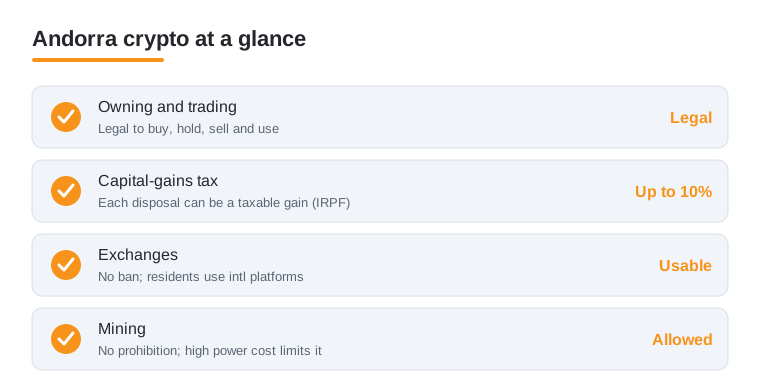
- Yes, owning, buying, and selling crypto is legal in Andorra under Law 24/2022; it is not legal tender (the euro is).
- It is taxed: residents pay personal income tax (IRPF) or corporate tax on gains, with a maximum personal rate widely reported at 10 percent.
- Residents buy via reputable international exchanges or AFA-authorised providers, funding in euros after KYC checks.
Andorra, the small principality in the Pyrenees between France and Spain, has become one of Europe's more deliberate crypto jurisdictions. Rather than leaving digital assets in a legal grey zone, in 2022 it enacted a dedicated statute that gives blockchain-based assets a clear legal footing and places the businesses that issue or handle them under formal supervision. Bitcoin and other cryptocurrencies are legal to buy, hold, and sell in Andorra, and the country has openly positioned itself as a destination for blockchain entrepreneurs and digital-asset investors.
This guide explains how digital assets are treated as of 2026: the legal status of crypto, the regulator, the key laws, how exchanges and other service providers are licensed, taxation, anti-money-laundering rules, the practicalities of buying and using crypto, mining, recent developments, consumer risks, and how to verify the rules at the official sources. It is general information as of 2026 and is NOT legal, tax, or financial advice. Andorran rules are detailed and still being developed through implementing regulation, so confirm specifics with the named official regulator, the Andorran Financial Authority (Autoritat Financera Andorrana, AFA), or a qualified Andorran lawyer or tax adviser. See also our introduction to crypto regulation and our wider country regulation hub.
On this page: Legal status · Who regulates it · Taxes · How to buy · Mining
Legal status of Bitcoin and crypto in Andorra
Owning, buying, selling, and using Bitcoin and other cryptocurrencies is legal in Andorra. Crypto is not legal tender; the euro is Andorra's official currency under a monetary agreement with the European Union. Digital assets are instead explicitly recognised in law as a category of asset that can be issued, held, transferred, and traded.
Andorra took an unusually clear position by passing a specific statute for digital assets in 2022 (covered below). The practical effect is that crypto has a defined legal status rather than sitting in ambiguity: individuals can hold and transact freely, merchants may choose to accept it, and businesses that provide crypto services operate under a licensing and anti-money-laundering regime supervised by the AFA. For ordinary users, the safest route is to use a properly authorised provider and to keep good records of every transaction.
The regulator: the Andorran Financial Authority (AFA)
The financial supervisor for digital assets in Andorra is the Andorran Financial Authority (Autoritat Financera Andorrana, AFA). The AFA is the public body responsible for regulating and supervising Andorra's financial system. It was known as the Andorran National Institute of Finance (INAF) until it was renamed in 2018, and it operates under its own governing law, Law 10/2013 on the Andorran Financial Authority.
For crypto specifically, the AFA examines and grants the authorisations required to operate in the digital-asset sector, maintains the public registers of authorised entities and of the actors related to digital assets, and supervises ongoing compliance. Its official register of authorised entities and digital-asset participants is published online and can be searched by anyone. There is no separate central bank in Andorra; because the country uses the euro rather than issuing its own currency, monetary policy is effectively set in the euro area, while domestic financial supervision sits with the AFA.
You can verify the regulator and check authorised entities directly at the AFA register of authorised entities.
Key laws and frameworks
Andorra's framework rests on a dedicated national law and is supported by AML/CFT and tax legislation, set against the backdrop of the country's relationship with the European Union.
Law 24/2022 on the digital representation of assets
The cornerstone is Law 24/2022, of 30 June, on the digital representation of assets through the use of cryptography and distributed-ledger and blockchain technology (Llei 24/2022, del 30 de juny, de la representacio digital d'actius mitjancant l'us de la criptografia i de la tecnologia de llibre registre distribuit i blockchain). It was approved by the Consell General on 30 June 2022, published in the official gazette (Butlleti Oficial del Principat d'Andorra) in July 2022, and entered into force in October 2022.
The law defines a taxonomy of digital assets, sets rules for the public and private issuance of tokens, and covers categories such as utility tokens, security-type tokens, and stablecoins, as well as custody, exchange, and trading on authorised platforms. It also describes a category of programmable sovereign digital money (a potential central-bank-style digital currency) as a government concept, though Andorra had not issued such an instrument as of 2026.
The EU dimension and MiCA
Andorra is not an EU member state, so the EU's Markets in Crypto-Assets Regulation (MiCA) does not apply as domestic law. MiCA can still reach Andorran firms that serve EU-based clients, and Andorra has been negotiating a broader Association Agreement with the EU that is expected to push closer alignment with European financial standards over time. Negotiations on that agreement were reported as concluded at the end of 2023, with ratification steps including a referendum in Andorra anticipated in the 2025 to 2026 period. As part of aligning its financial rules, Andorra also advanced legislation from 2023 to incorporate the EU's MiFID II investment-services standards into domestic law. This is general information, not legal advice; the framework is detailed and still being developed through implementing rules, so verify current requirements with the AFA.
Licensing and registration of exchanges and service providers
Under Law 24/2022, providing digital-asset services on a professional and regular basis from within Andorra requires prior authorisation from the AFA. This covers token issuers and operators such as exchange platforms, custodians, and related service providers.
Reported requirements for authorisation include a viable business model, suitable and fit administrators, demonstrated financial capacity and minimum capital, professional civil-liability insurance, and the appointment of a registered "digital overseer" (veedor digital registrat). The digital overseer is a mandatory representative (an individual professional such as a lawyer or economist, or a qualifying legal entity) who acts as the point of contact and guarantor of compliance with the AFA and handles regulatory liaison, supervision, and incident reporting. The detail of this role was further set out in implementing regulation.
Crucially for ordinary users: there is no Andorra-specific ban on using cryptocurrency exchanges, and residents commonly access well-known international platforms to buy and sell. The licensing obligation falls on the providers operating from Andorra, not on individuals using them. Before depositing funds with any firm that claims to be locally authorised, confirm its status in the AFA register. See our explainer on how crypto is regulated for more on licensing concepts.
Crypto and Bitcoin taxation in Andorra
Andorra is well known for a comparatively low tax burden, which is a large part of why it attracts crypto investors and entrepreneurs. "Low tax" is not "no tax," however, and treatment depends on residency status and the nature of the activity.
For Andorran tax residents, gains and income connected to cryptocurrency are generally dealt with under the personal income tax (Impost sobre la Renda de les Persones Fisiques, IRPF), established by Law 5/2014 and subsequently amended, or under corporate tax for businesses. Andorra's headline personal and corporate rates are modest by European standards, with a maximum personal rate widely reported at 10 percent. Under the IRPF, capital gains are commonly reported with an annual exemption of the first 3,000 euros of net gains, so only gains above that threshold fall to be taxed, at a rate reported up to 10 percent; treat that figure as something to confirm for your own facts. Each disposal of a digital asset (for example exchanging one token for another, or selling into euros) can produce a capital gain or loss, calculated as the difference between acquisition and disposal value in euros.
Because exact rates, allowances, exemption thresholds, and the classification of activities (occasional investing, professional trading, mining, or business income) change over time and depend on the facts, this guide does not treat any figure as definitive. This is not tax advice. Confirm the current numbers with the Government of Andorra's tax department or a qualified Andorran adviser, keep dates, amounts, euro values, fees, and counterparties for every transaction, and see our general guide to crypto taxes.
AML, KYC, and the role of UIFAND
Andorra's anti-money-laundering and counter-terrorist-financing (AML/CFT) regime is built on Law 14/2017, of 22 June, on the prevention and fight against money laundering and terrorist financing. This law was amended by Law 37/2021, of 16 December, which expressly brought virtual-asset service providers (VASPs) into scope as obliged entities, including exchange platforms, custodians, transfer services, and issuers of virtual assets.
The supervisory and reporting body is the Financial Intelligence Unit of Andorra (Unitat d'Intel-ligencia Financera d'Andorra, UIFAND), which receives, analyses, and transmits information on suspected money laundering and terrorist financing. Crypto service providers acting as obliged subjects must apply customer due diligence (KYC), identify beneficial owners, carry out risk management and staff training, and report suspicious transactions directly to UIFAND. In practice this means anyone using a reputable provider should expect identity verification and, for transfers, travel-rule-style information sharing.
You can verify this authority and its guidance at UIFAND, the Financial Intelligence Unit of Andorra.
Buying and using crypto in practice
For most residents the on-ramp is a reputable international exchange that serves Andorra and supports euro funding, or a provider authorised by the AFA. Expect to complete KYC identity checks, enable strong security (a unique password and two-factor authentication), and confirm that your Andorran bank permits transfers to and from crypto platforms, as the country has a small and conservative banking sector that can make payment rails a practical hurdle.
A sensible path is: choose a regulated platform and check its fees and security history; verify your identity; fund the account in euros once your bank is confirmed; buy a small amount first while you learn the interface; move meaningful holdings to self-custody (ideally a hardware wallet) and safeguard the recovery phrase offline; and keep transaction records with euro values for tax. Bitcoin ATMs exist in limited numbers, mostly around Andorra la Vella, but charge well above online-exchange rates and still apply identity checks for larger amounts; treat any specific ATM count as something to verify with a live locator. Crypto can also be useful for cross-border payments given Andorra's large foreign-resident population, but weigh volatility, on- and off-ramp costs, and compliance checks against conventional money-transfer services. None of this is financial advice; assess any platform yourself.
Bitcoin mining in Andorra
There is no specific prohibition on Bitcoin mining in Andorra, but the country is not a natural mining hub. Electricity is the key constraint: Andorra imports a large share of its power, and energy costs together with limited grid capacity make large-scale proof-of-work mining far less attractive than in regions with cheap, abundant electricity. The mountainous climate can assist with cooling, but that does not offset the underlying cost and supply limits.
For most people, mining in Andorra is best understood as a marginal or hobbyist activity rather than an industrial opportunity, and the country's innovation focus leans toward blockchain services, tokenisation, and digital-asset business rather than mining farms. Anyone considering a meaningful operation should weigh electricity contracts and capacity, the tax treatment of mined coins and any business income (verify with an Andorran adviser), and any permitting or registration that applies to a commercial activity. General information only.
Recent developments (2025-2026)
Andorra's framework has continued to mature since Law 24/2022 came into force. The AFA has built out its authorisation and supervision functions for digital assets, including the public registers of authorised entities, overseers, and digital-asset participants. On the AML/CFT side, UIFAND has issued technical communications addressing virtual assets and the digital-overseer role, and the regime has seen further refinement through decrees and guidance into 2025, including measures around audit and reporting obligations for obliged entities.
Reports from 2025 pointed to meaningful growth in crypto activity in Andorra since the law took effect, and the country has continued to position itself as a blockchain-friendly destination. The most significant medium-term variable is Andorra's Association Agreement with the EU. Negotiations concluded in 2023 between Andorra, San Marino and the EU, and the European Parliament gave the text a strong political endorsement in plenary on 11 February 2026, with the Council of the EU having almost reached consensus that the agreement is a mixed one requiring unanimous ratification by all member states, and the ratification process, expected to include a referendum in Andorra in the 2025 to 2026 window, could over time push the regime toward closer alignment with European standards such as the spirit of MiCA. Andorra's move to incorporate MiFID II investment-services rules is part of that broader alignment. Because this area is evolving, treat dated figures and announcements with caution and confirm the current position at the official sources below.
Consumer risks and protection
The headline risks are the same as anywhere: price volatility, scams and phishing, exchange or custody failures, and lost private keys. Andorra-specific points add to these. The regulatory framework is relatively new and still being fleshed out through implementing rules, so requirements change through AFA technical communications. Those listed for digital asset participants include CT 1/2023-AD of 21 February 2023 on liability insurance guarantees, CT 2/2023-AD of 21 April 2023 on activity monitoring submission deadlines, CT 1/2024-PAD and CT 2/2024-PAD of 20 March 2024 covering the licence application to act as a participant and the assessment of the suitability of senior management and the integrity of beneficial owners, and CT 1/2026-AFA of 28 January 2026, which updated AFA fees in line with 2025 inflation. Banking access for crypto activity can be limited in a small, conservative financial sector. And while authorised providers are subject to AFA supervision and AML/CFT obligations, those rules reduce but do not eliminate the risk of loss.
Practical protection: use a provider you can confirm in the AFA register or a reputable, well-established international exchange; be sceptical of guaranteed-return schemes and unregulated "advisers"; enable strong security and use hardware self-custody for larger holdings; and keep thorough records. Bitcoin and other cryptocurrencies are highly volatile and can lose value rapidly, so invest only what you can afford to lose. This guide makes no price predictions and is not financial advice.
Official sources and how to verify
Because crypto rules are detailed and changing, always confirm the current position against primary sources rather than secondary summaries. The most authoritative references for Andorra are:
- Andorran Financial Authority (AFA) register for authorised entities, overseers, and digital-asset participants, plus the AFA's published laws and regulations.
- UIFAND (Financial Intelligence Unit of Andorra) for AML/CFT obligations, technical communications, and guidance for virtual-asset service providers.
- Consell General (Parliament of Andorra) for the official text of Law 24/2022 on the digital representation of assets.
This page is general information as of 2026 and is NOT legal, tax, or financial advice. Verify your specific situation with the Andorran Financial Authority (AFA) or a qualified Andorran professional before acting, and see our broader crypto regulation by country resources.
What is changing in Andorra as of August 2026
Checks of the Andorran Financial Authority (AFA), the Financial Intelligence Unit (UIFAND) and the Consell General public legislative register on 4 August 2026 give a clear answer: Andorra's crypto statute book has not changed. Law 24/2022 of 30 June is still the only crypto law, and the only crypto-specific regulations the AFA lists for digital asset participants and overseers are Decree 478/2022 and Decree 335/2022, both from 2022. Those regulation pages also list two later instruments of general application, Decree 71/2023 on restrictive measures and Decree 223/2026 on audit, neither of which is about crypto.
What has changed is that the framework is now being used rather than merely written. What has not happened is the EU step this page previously anticipated for 2025 or 2026.
- No new crypto law, decree or bill. The register of government bills before the Consell General, whose most recent entry is dated 1 August 2026, contains nothing on digital assets, crypto-assets, cryptography or blockchain.
- Five firms now hold an Andorran digital asset authorisation, the most recent granted on 17 June 2025, per the AFA public register.
- No referendum has been held on the EU Association Agreement and no date has been set for one, according to the IMF 2026 Article IV staff report (Country Report 26/88, completed 9 April 2026).
- The AFA issued no press release on crypto, digital assets or MiCA in 2025 or 2026. Its press room for that period covers sovereign credit ratings, IMF consultations, its own 2024 activity report and a financial education agreement with the Banque de France.
- The most recent crypto-facing consumer warning is against QuantumAI, dated 2 October 2025, which the AFA states is "neither authorised nor registered to provide investment services or any other activity reserved for supervised entities in Andorra" (AFA alert). The AFA alerts list also carries older crypto warnings, against Bit2me in May 2021 and against virtual platforms offering cryptocurrency investments in March 2018.
The EU Association Agreement: where it actually stands and what it would change
This agreement is the only realistic route by which MiCA-style rules would reach Andorra, so its timing matters more than any domestic proposal. The IMF 2026 Article IV staff report on Andorra (Country Report 26/88, completed 9 April 2026, published by the AFA on 4 May 2026) sets out the position step by step. Note that nothing has yet been passed by any legislature and the text has not been signed.
| Step | Status |
|---|---|
| Negotiations concluded between Andorra, San Marino and the EU | Done, 2023 |
| Council EFTA Working Party proposes treating the agreement as mixed; Commission presents a counter-proposal adapted to a mixed nature | Done, 15 December 2025 |
| European Parliament plenary political endorsement, confirming an earlier positive Foreign Affairs Committee vote | Done, 11 February 2026 |
| Council decision authorising signature, via COREPER then the General Affairs Council | Pending. The IMF gives an average expected time of 8 weeks once consensus on the mixed nature is reached |
| Signature by Andorra, San Marino, the EU Commission and the 27 member states, then publication in EUR-Lex | Pending |
| Formal European Parliament approval by simple majority | Pending. The IMF gives an average expected time of three months after EUR-Lex publication, and notes the initial vote had overwhelming support at 552 of 651 in favour |
| Referendum in Andorra, a political commitment of the government, held before parliamentary ratification | Not scheduled. No date set as of April 2026; elections planned in 2027 |
| Unanimous ratification by all 27 member states, involving national parliaments and in some countries judicial review | Pending |
For crypto specifically, the report states that integration of financial services will require adoption of EU financial services regulation and supervision practices, that the financial sector has a 15-year transition period, and that the adoption process will begin after the EUAA is ratified. So even on the most favourable path, EU crypto rules would reach Andorra gradually over years, not on a single switchover date.
Two further points matter to holders and firms. Provisional application, if it happens, would cover most of the agreement but not two mixed competencies: good governance rules and some specific operations included in the free movement of capital. And if the referendum is unsuccessful, the IMF states that existing relations with the EU will remain unchanged and Andorra will be treated as a third country, as it is now.
Who is actually licensed: the AFA digital asset registers in full
Andorra's framework stopped being theoretical in 2024. The AFA keeps two public registers and both are short enough to reproduce in full, which makes them a usable check against any firm claiming to be "licensed in Andorra" for crypto.
| Entity | Register code | Authorised |
|---|---|---|
| Mora Banc Grup, SA | PAD-001/24 | 23/02/2024 |
| Prosegur, Custodia d'Actius Digitals, SLU | PAD-002/24 | 13/12/2024 |
| Fimarge, Societat Financera d'Inversió, SA | PAD-003/24 | 13/12/2024 |
| Crèdit Andorrà, SA | PAD-004/25 | 16/05/2025 |
| Onyze Assets, SLU | PAD-005/25 | 17/06/2025 |
All five are classified in the same single category, participant in the digital representation of assets. Four are authorised for custody and administration, reception and transmission of orders, and execution of orders for digital assets on behalf of third parties; Fimarge is authorised for custody and administration and for reception and transmission of orders, without execution. No entity on the register is authorised to operate a trading platform. Source: the AFA register of participants.
The second register lists digital overseers. Four were active in August 2026: Abast Global, SL (VDR-002, 29/03/2023), Giraffe Strategy, SL (VDR-005, 17/02/2023), Tax & Legal Consulting, SL (VDR-008, 17/02/2023) and Cases&Lacambra, SL (VDR-009, 24/05/2023). Two further overseer registrations, both individuals, ended on 29 February 2024. Source: the AFA register of overseers.
On cost, AFA fees are specified in Law 10/2013 of 23 May. Articles 50 to 54 cover the application fee for admission to trading of digital assets, the application fee for trading of digital assets, the application fee for prior verification before initiating activities, the annual fee for continuation of the activity and the annual fee for supervision of the activity. The AFA does not publish the euro amounts on that page; it states they are updated according to the evolution of the CPI, most recently by technical communication CT 1/2026-AFA of 28 January 2026.
The digital overseer requirement, and what Law 24/2022 does not cover
The most distinctive feature of Andorra's framework, and the one most often missed, is that every licence applicant must go through a gatekeeper. The AFA states that a participant seeking authorisation must designate a digital overseer from among those registered with the AFA, which will carry out the administrative dialogue with the AFA.
- The AFA states the registered digital overseer must be a lawyer or an economist, must be affiliated, and must have the nationality or the tax residence in the Principality of Andorra, among others.
- Only four overseers were active on the AFA register in August 2026, which is a real constraint on how quickly applications can proceed.
On scope, the AFA states that although the issuance of non-fungible tokens is excluded from Law 24/2022, other services linked to them are not, and in those cases the applicant must still designate a registered digital overseer. Source: the AFA innovation and fintech page.
What is in the legislative pipeline, and what is not
The claim that Andorra is "working on crypto rules" is common and the public record does not support it in August 2026. It is worth separating the two.
Not in progress. A check on 4 August 2026 of the Consell General registers of government bills, parliamentary bills, qualified bills, emergency legislation and international treaties found no measure on digital assets, crypto-assets, cryptography or blockchain. The EU Association Agreement is not among the 66 items in the register of international treaties before the Andorran parliament.
In progress, and relevant to crypto holders and firms:
- National money laundering and terrorist financing risk assessment. The IMF reports that the authorities intend to conclude the update, including the assessment of risks of misuse of legal persons and arrangements and virtual assets, by end 2026, and that preliminary results are already informing draft legal amendments on entity transparency and on monitoring foreign investment through legal entities. Those amendments had not been introduced as bills. This is the most likely source of the next rule change touching crypto.
- An IMF Financial Sector Assessment Programme in 2026, Andorra's first since it joined the IMF, with preparations under way and early AFA capacity building.
- Accession to the Council of Europe Warsaw Convention on laundering, search, seizure and confiscation of the proceeds from crime and on the financing of terrorism, published in the treaties register on 3 June 2026. It is not crypto-specific but sits in the AML regime that binds crypto firms.
- AML instruments already binding on crypto firms as obliged entities: the UIFAND technical communiqué on high-risk countries and jurisdictions of 22 June 2026, and Resolution 1/2026 of 22 May 2026 on restrictive measures (UIFAND).
- Audit obligations. The AFA lists Law 30/2025 of 15 December, the consolidated audit law published 22 January 2026, and its development regulation Decree 223/2026 of 10 June 2026, as applying to digital asset participants. Neither is crypto-specific.
One measure is easily misread as crypto regulation. Decree 288/2026 of 22 July 2026 approves the regulation adopting EU complementary technical standards on solvency, liquidity and prudential supervision, but by its own title it applies to banking entities and investment firms, not to digital asset participants. It signals the AFA moving towards EU standards ahead of any association agreement rather than a new crypto rule.
Frequently asked questions
Is cryptocurrency legal in Andorra?
Yes. Buying, holding, selling, and using Bitcoin and other cryptocurrencies is legal in Andorra. Digital assets are recognised in law under Law 24/2022, though they are not legal tender; only the euro holds that status. Businesses that provide crypto services from within Andorra must be authorised by the Andorran Financial Authority (AFA) and follow anti-money-laundering rules. This is general information, not legal advice.
Who regulates crypto in Andorra?
The Andorran Financial Authority (Autoritat Financera Andorrana, AFA) is the financial supervisor for digital assets. Under Law 24/2022, firms that issue tokens or provide digital-asset services need AFA authorisation, must meet capital and insurance requirements, and appoint a registered "digital overseer" as their liaison with the regulator. AML/CFT supervision and suspicious-transaction reporting run through UIFAND, the Financial Intelligence Unit of Andorra. You can verify authorised entities at the AFA register on afa.ad.
How is crypto taxed in Andorra?
Andorra's tax burden is comparatively low, but crypto is not automatically tax-free. For tax residents, gains and income are generally handled under personal income tax (IRPF, from Law 5/2014 as amended) or corporate tax depending on the activity, with a maximum personal rate widely reported at 10 percent. Capital gains are commonly reported with an annual exemption of the first 3,000 euros of net gains, so only gains above that threshold are taxed. Each disposal can generate a capital gain or loss measured in euros. Exact rates, allowances, and thresholds change and depend on classification, so verify the current figures with the Government of Andorra's tax department or a qualified adviser. This is not tax advice.
Does Andorra follow the EU's MiCA regulation?
Not directly. Andorra is not an EU member state, so MiCA does not apply as domestic law; the country regulates crypto through its own Law 24/2022 and AML legislation. However, MiCA can still affect Andorran firms that serve EU-based clients, and Andorra has been negotiating an Association Agreement with the EU that may bring closer alignment with European financial standards over time.
Do crypto exchanges need a licence in Andorra?
Yes, if they operate from Andorra on a professional, regular basis. Under Law 24/2022, token issuers and service providers such as exchanges and custodians need prior authorisation from the AFA, with requirements including suitable management, minimum capital, civil-liability insurance, and a registered digital overseer. Individuals using exchanges are not licensed themselves, and there is no ban on residents using reputable international platforms; the obligation falls on the providers based in Andorra.
Where can I verify Andorra's crypto rules officially?
Use primary sources. The Andorran Financial Authority (afa.ad) publishes its register of authorised entities and the relevant laws and regulations. UIFAND (uifand.ad) covers AML/CFT obligations and guidance for virtual-asset service providers. The Consell General (consellgeneral.ad) hosts the official text of Law 24/2022. Because the framework is evolving, confirm the current position there or with a qualified Andorran professional rather than relying on secondary summaries.
Is there a tax-free amount for crypto gains in Andorra?
For Andorran tax residents, capital gains are commonly reported with an annual exemption covering the first 3,000 euros of net gains, so gains up to that amount are generally not taxed and only the excess is subject to personal income tax at a rate reported up to 10 percent. Rates, thresholds, and how a given activity is classified can change and depend on your facts, so confirm the current figures with the Government of Andorra's tax department or a qualified Andorran adviser. This is not tax advice.
Will the EU Association Agreement change Andorra's crypto rules?
Possibly, over time. Andorra concluded negotiations on an Association Agreement with the EU at the end of 2023, and the ratification process, expected to include a referendum in Andorra in the 2025 to 2026 period, could bring closer alignment with European financial standards. Andorra also advanced legislation to incorporate the EU's MiFID II investment-services rules. Andorra is not an EU member, so MiCA does not currently apply as domestic law, and the country continues to regulate crypto through Law 24/2022. Check the official sources for the current position.
Has Andorra passed a new crypto law in 2026?
No. Law 24/2022 of 30 June remains the only Andorran crypto statute, and the only crypto-specific regulations the AFA lists alongside it are Decree 478/2022 and Decree 335/2022, both from 2022. A check of the Consell General public registers of government bills, parliamentary bills, qualified bills, emergency legislation and international treaties on 4 August 2026 found no measure on digital assets, crypto-assets, cryptography or blockchain.
When would MiCA apply in Andorra?
Not for years, and only if the EU Association Agreement is ratified. MiCA is EU law and Andorra is not an EU member. The IMF's 2026 Article IV staff report states that integration of financial services will require Andorra to adopt EU financial services regulation and supervision practices, that the financial sector has a 15-year transition period, and that the adoption process begins only after the agreement is ratified. The agreement had not been signed as of August 2026.
How many crypto firms are licensed in Andorra?
Five. The AFA register of participants in the digital representation of assets lists Mora Banc Grup (PAD-001/24, February 2024), Prosegur Custodia d'Actius Digitals (PAD-002/24, December 2024), Fimarge (PAD-003/24, December 2024), Credit Andorra (PAD-004/25, May 2025) and Onyze Assets (PAD-005/25, June 2025). All are in the same category. Four cover custody and administration, reception and transmission of orders, and execution of orders on behalf of third parties; Fimarge covers custody and administration and reception and transmission of orders. No entity on the register is authorised to operate a trading platform.
What is a digital overseer and do I need one?
A veedor digital is a registered adviser that every licence applicant must designate from among those registered with the AFA, and who carries out the administrative dialogue with the AFA. The AFA states the overseer must be a lawyer or an economist, must be affiliated, and must have the nationality or the tax residence in Andorra, among other requirements. Only four overseers were active on the AFA register in August 2026, which is a practical bottleneck for new applications.
Is there a date for the Andorran referendum on the EU Association Agreement?
No. The IMF's 2026 Article IV staff report, completed 9 April 2026, states that no date has been set, that the process is still pending at EU level, and that elections are planned in 2027. If the referendum is unsuccessful, the IMF states that existing relations with the EU will remain unchanged and Andorra will be treated as a third country, as it is now.
Is crypto mining regulated in Andorra?
Yes, but on the electricity side rather than the financial side. Decree 335/2022 of 17 August 2022 approves the regulation on the requirements for crypto-asset mining installations as regards their impact on the electrical system. The AFA still lists it as applicable regulation in 2026. There is no separate Andorran mining licence and no mining-specific tax created by that decree.
Facts reviewed: 4 August 2026. Page updated: 4 August 2026.