Home › Crypto Regulation › Malta
Bitcoin & Cryptocurrency Regulation in Malta
Quick answer — Malta, 2026
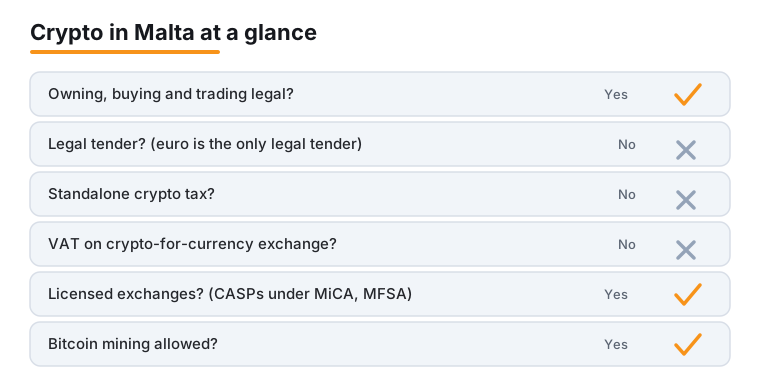
- Yes, owning, buying, selling, and trading crypto is legal in Malta; the euro stays the only legal tender.
- There is no standalone crypto tax; it falls under existing income-tax, stamp-duty, and VAT rules, depending on use and your residence.
- Residents buy through MFSA-regulated exchanges authorised under the EU's MiCA framework, after completing KYC and funding in euro.
Malta was one of the first countries in the world to build a dedicated legal framework for crypto-assets, earning the nickname "Blockchain Island" after it passed its Virtual Financial Assets (VFA) regime in 2018. That early head start has now merged into the European Union's single rulebook, the Markets in Crypto-Assets Regulation (MiCA), which applies directly in Malta as an EU member state. In 2026 the practical picture is one of a regulated, EU-aligned market in which crypto-asset service providers are licensed and supervised by the Malta Financial Services Authority (MFSA).
This page explains, in plain language, whether crypto is legal in Malta, who regulates it, the main laws and frameworks, how exchanges are licensed, how crypto is generally taxed, the anti-money-laundering rules, and how to buy and use crypto in practice. This is general information as of 2026 and is NOT legal, tax, or financial advice. Crypto rules change frequently and depend on your circumstances, so always verify the current position with the named official regulator, the MFSA, or a qualified Maltese professional before acting. See also our wider guides to crypto regulation and country regulation.
On this page: Legal status · Who regulates it · Taxes · How to buy · Mining
Legal status: is Bitcoin and crypto legal in Malta?
Yes. Owning, buying, selling, and trading Bitcoin and other crypto-assets is legal in Malta. There is no ban on individuals holding crypto or on businesses dealing in it, provided they comply with applicable licensing, anti-money-laundering (AML), and consumer-protection rules. Malta is a regulated, crypto-friendly jurisdiction rather than an unregulated one.
Legal is not the same as legal tender. Like the rest of the euro area, Malta's only legal tender is the euro. Bitcoin is treated as a private crypto-asset, not as official money, so no merchant is obliged to accept it and any acceptance is a matter of private agreement. The regulated activity is providing services around crypto-assets to others; using crypto for your own account is generally not itself a licensed activity.
Who regulates crypto in Malta (the regulators)
Three bodies matter most for crypto in Malta.
- Malta Financial Services Authority (MFSA) is the single national financial regulator and the competent authority for crypto-assets under MiCA and Malta's Markets in Crypto-Assets Act. It licenses and supervises crypto-asset service providers (CASPs) and issuers, and enforces rules on governance, client-asset protection, and market integrity. Its dedicated crypto page is the primary reference for status and procedures.
- Financial Intelligence Analysis Unit (FIAU) is Malta's national AML and counter-terrorist-financing (CFT) agency. It supervises crypto businesses for AML/CFT compliance, receives suspicious-transaction reports, and can impose administrative penalties.
- European Securities and Markets Authority (ESMA) is the EU-level body that coordinates how MiCA is applied across member states. In July 2025 ESMA published a peer review of how the MFSA authorised a CASP under MiCA (see Recent developments below).
You can read the regulator's own material on the MFSA Crypto-Assets page and the AML supervisor's material on the FIAU website.
Key laws and frameworks
Malta's crypto regulation now operates on two layers that fit together.
- EU layer (MiCA): The Markets in Crypto-Assets Regulation applies directly in Malta. It sets harmonised rules for crypto-asset service providers, such as exchanges, custodians, and brokers, and for issuers of asset-referenced tokens and e-money tokens. A firm authorised as a CASP in one EU country can passport its services across the bloc.
- National layer: Malta enacted a Markets in Crypto-Assets Act (Chapter 647 of the Laws of Malta), which designates the MFSA as competent authority and lets the responsible minister and the MFSA issue subsidiary legislation and rules supplementing MiCA. Malta's earlier 2018 framework, the Virtual Financial Assets Act, the Innovative Technology Arrangements and Services Act, and the Malta Digital Innovation Authority Act remain part of the broader blockchain-governance framework, with the VFA Act being phased out (see below).
Because Malta's original VFA framework was already close to MiCA, the transition required modest changes for many firms, and a VFA service provider submitting a CASP application between 30 December 2024 and 1 July 2026 received a 50% reduction in application fees under the Markets in Crypto-Assets Act (Fees) Regulations. AML and CFT obligations apply on top of all of this and are supervised by the FIAU.
Licensing and registration of exchanges and VASPs
Exchanges, brokers, custodians, and similar providers serving EU customers must be authorised as crypto-asset service providers (CASPs) under MiCA, with the MFSA acting as the competent authority in Malta. A person wishing to provide one or more crypto-asset services applies to the MFSA, and beneficial owners, qualifying holders, and senior managers must pass fitness-and-properness checks before authorisation.
The transition is now complete. Providers that already held a Maltese VFA licence before 30 December 2024 (sometimes called Category A entities) could continue operating under transitional, or grandfathering, arrangements until 1 July 2026, or until they were granted or refused a CASP authorisation, whichever came first. That window has closed. The Virtual Financial Assets Act, Chapter 590 of the Laws of Malta, was repealed on 3 July 2026 by Act XXXVI of 2024, and the national legislation register now records Chapter 590 as not in force. Under the Markets in Crypto-Assets Act (Fees) Regulations, a VFA service provider submitting a CASP application between 30 December 2024 and 1 July 2026 received a 50% reduction in application fees. Firms that did not hold a VFA licence by that date must apply afresh under MiCA. Because exact deadlines and procedures are set by MiCA and Maltese rules and can change, providers should confirm their own status directly with the MFSA. You can also check whether a platform is authorised on the MFSA's public registers and the relevant EU and ESMA listings.
Independent trackers of ESMA's interim CASP register, synced on 31 July 2026, recorded 22 crypto-asset service providers authorised in Malta out of 321 across the EEA, which places Malta fifth by number of authorisations behind Germany, France, the Netherlands and Cyprus. Those listed against Malta include OKX Europe Limited, Foris DAX MT Limited (Crypto.com), Gemini Intergalactic EU Ltd, Gate Technology Limited, Blue Cube Malta Limited (Blockchain.com), System Pay Services Malta Limited (BVNK), BP23 CA Limited (Bitpanda), Bequant Pro Limited, Damex Digital Ltd, Payhound Limited and Calamatta Cuschieri Investment Services Limited, along with a small number of e-money-token issuers. Trackers count slightly differently and one other put Malta at 25 on the same date. Because a CASP authorised in Malta can passport its services across the EU, some large platforms chose Malta as their EU base. The exact list changes as applications are decided, so always confirm a provider's current status on the MFSA and ESMA registers rather than relying on any fixed list.
Crypto and Bitcoin taxation in Malta
Malta has no single, standalone "crypto tax." Crypto-assets are taxed under existing income-tax, stamp-duty, and VAT rules, and the treatment depends heavily on the facts. In 2018 the tax authority (then the Commissioner for Revenue, now the Malta Tax and Customs Administration) issued guidelines on the treatment of distributed-ledger-technology (DLT) assets for income tax, stamp duty, and VAT. The guidance follows a few core principles:
- Use, not label, drives treatment. DLT assets are grouped into coins and tokens (with tokens split into financial and utility tokens), but the guidelines stress that tax treatment depends on the purpose for which an asset is used, not just its category.
- Activity matters. Profits from frequent, business-like trading can be treated as income, while one-off disposals may be treated differently. Coins used purely as a means of payment are broadly treated like other currency.
- Residence and domicile matter. Malta operates a remittance basis for individuals who are resident but not domiciled, which can change how foreign-source income and gains are taxed. This is a complex area with conditions and minimum-tax rules.
- VAT. Following the EU Court's Hedqvist decision, exchanging crypto for traditional currency is generally treated like other currency transactions for VAT purposes.
The rates that apply are Malta's ordinary income tax rates. For basis year 2026 the single computation charges 0% on the first 12,000 euro, 15% from 12,001 to 16,000 euro, 25% from 16,001 to 60,000 euro and 35% above 60,000 euro. Coins held as capital assets fall outside the capital gains charge altogether. Resident non-domiciled individuals pay on the remittance basis, with a minimum tax of 5,000 euro a year where foreign income of at least 35,000 euro was not received in Malta in full. For your actual liability, check current guidance from the Malta Tax and Customs Administration and our general crypto taxes guide, and speak to a Malta-qualified tax adviser. This section is informational only and is not tax advice.
Crypto tax reporting (DAC8 and CARF)
A separate development from how crypto is taxed is how it is reported to tax authorities. Malta has transposed the EU's DAC8 directive, which extends automatic exchange of information to crypto-assets and builds on the OECD's Crypto-Asset Reporting Framework (CARF). Malta gave DAC8 effect through Legal Notice 162 of 2026, amending its regulations on cooperation with other jurisdictions on tax matters.
- Who reports. Reporting crypto-asset service providers must collect and report information about their reportable users and transactions to the Maltese tax authority (the Malta Tax and Customs Administration), which then exchanges it with other jurisdictions.
- When it starts. The first reporting period is the calendar year beginning 1 January 2026, with the first reports due to the Commissioner for Tax and Customs within nine months of the year end, that is by 30 September 2027.
- Due diligence. Providers must run CARF-style due diligence on new customers from 1 January 2026, and complete checks on pre-existing customers by the end of 2026.
For ordinary users, the practical effect is that details of your crypto holdings and transactions held by a regulated provider can be shared with tax authorities, so accurate personal record-keeping matters more than before. Legal Notice 162 of 2026 was published in the Government Gazette on 22 May 2026 and is deemed to have come into force on 1 January 2026. MiCA-authorised CASPs do not register separately because the MFSA communicates a list of authorised CASPs to the tax authority; other crypto-asset operators must register with the Commissioner for Tax and Customs. Penalties include 500 euro for a registration failure, 2,500 euro for a record-retention failure, up to 50,000 euro for significant reporting non-compliance, and 10,000 to 30,000 euro personally for senior officials who submit false or misleading information.
AML and KYC rules
Anti-money-laundering and counter-terrorist-financing rules are central to crypto activity in Malta. Licensed providers are subject to obligations supervised by the FIAU, working alongside the MFSA. In practice this means:
- Identity verification (KYC). Expect full identity checks when you open an account with a regulated provider, and source-of-funds checks for larger transactions.
- Customer due diligence and monitoring. Providers must risk-assess customers, monitor transactions on an ongoing basis, and report suspicious activity to the FIAU.
- The travel rule. Under EU transfer-of-funds rules, providers must collect and pass on originator and beneficiary information when crypto moves between providers.
- Enforcement is real. The FIAU has imposed penalties on crypto firms for failures in risk assessment, due diligence, and monitoring, so compliance is not just paperwork.
For ordinary users, the main effect is that you will need to verify your identity and may be asked for documents; this is a legal requirement, not an optional step.
Buying and using crypto in practice
Buying crypto in Malta is straightforward and is done mainly through online exchanges and brokers. The key regulatory point is that the platform should be authorised to serve EU customers as a CASP under MiCA, or be operating under the relevant transitional arrangements. A typical, compliant path looks like this:
- Choose a regulated platform that is authorised to serve Malta and supports euro funding, and verify its status on the MFSA registers and EU/ESMA listings.
- Verify your identity by completing KYC with ID and any requested documents.
- Fund your account in euro, typically by SEPA transfer or card, noting fees and limits.
- Place your order after reviewing the price, spread, and fees.
- Secure your holdings with two-factor authentication, and for larger or longer-term amounts consider a wallet you control, including a hardware wallet, with your recovery phrase backed up offline.
- Keep records of dates, amounts, and cost basis for tax reporting.
There are no old-fashioned exchange-control restrictions on ordinary crypto purchases; the constraints that matter are AML/KYC compliance and using a regulated venue. Bitcoin ATMs exist in some EU markets but have historically been very scarce in Malta, and any cash-for-crypto operator would still be subject to AML rules; for most people a regulated online exchange is cheaper and simpler.
Bitcoin mining in Malta
There is no specific law banning Bitcoin mining in Malta, and individuals are generally free to run mining hardware. In practice, Malta is not a meaningful mining hub. Relatively high electricity costs, a warm climate that raises cooling demand, and limited industrial space make proof-of-work mining economically unattractive compared with regions that have cheap or surplus energy.
Anyone considering mining should weigh electricity costs, hardware and cooling, noise and heat, and the tax treatment of mined coins, which may be treated as income when received. MiCA also introduced sustainability-related disclosure expectations for service providers and issuers regarding the environmental impact of crypto-assets. Malta's policy emphasis has been on regulated financial services and blockchain businesses rather than on attracting large-scale mining.
Recent developments (2025 to 2026)
The defining trend is consolidation under MiCA. In July 2025 ESMA published a peer review of how the MFSA had authorised a CASP under MiCA. The review recognised the MFSA's good level of resources and supervisory engagement and its expertise, but it also found that, in the case examined, the authorisation process should have been more thorough and that some material issues, such as aspects of ICT infrastructure, custody, and business-model assessment, were unresolved or pending at the time of authorisation. The MFSA publicly welcomed the review. ESMA also issued recommendations to all EU supervisors on forward-looking assessment, governance and third-party arrangements, ICT resilience under DORA, exposure to DeFi, and consistency of consumer-facing disclosures.
The other major development is the closing of the VFA-to-MiCA transition. Grandfathering for existing VFA licence holders ran until 1 July 2026 and the VFA Act was repealed on 3 July 2026. ESMA confirmed in a statement of 17 April 2026 that from 1 July 2026 any entity providing crypto-asset services to EU clients without MiCA authorisation would be in breach of EU law and must cease operations, with credible wind-down plans in place. A MiCA CASP authorisation is now the only basis on which a provider can serve EU clients from Malta. A further 2026 change is on tax reporting: Malta transposed the EU's DAC8 directive through Legal Notice 162 of 2026, bringing crypto-assets into automatic exchange of information between tax authorities, with the first reporting period starting on 1 January 2026 (see the tax-reporting section above). Four dated items sit in the pipeline. The MFSA closed a consultation on tokenisation of financial instruments and real-world assets (Ref. 02-2026) on 30 June 2026 and a discussion paper on decentralised finance (Ref. 03-2026) on 31 July 2026, and has not yet published draft rules from either. The European Commission's review of MiCA is open from 20 May 2026 to 30 September 2026 and feeds a report under MiCA Articles 140 and 142 that may carry a legislative proposal. Regulation (EU) 2024/1624, the EU Anti-Money Laundering Regulation, applies from 10 July 2027 and will require regulated providers to close anonymous crypto-asset accounts and stop supporting anonymity-enhancing coins. The Commission's December 2025 proposal to move CASP supervision from national regulators to ESMA is still under negotiation, and Malta is among the member states resisting it. Because details are evolving, treat this page as a starting point and verify specifics with the official sources below.
Consumer risks and protection
EU rules such as MiCA aim to raise standards for crypto-asset service providers, including disclosure, governance, and custody requirements, and they give users of authorised firms clearer protections than dealing with unregulated platforms. But regulation cannot remove market risk or protect you from your own security mistakes.
The main risks for crypto users in Malta are the same as elsewhere: sharp price volatility, scams and phishing, loss of access if you lose your keys, and counterparty risk if a platform fails. Sensible precautions include using only regulated and reputable providers, verifying a platform's authorisation on the MFSA registers, being wary of guaranteed-return promises and unsolicited offers, never investing more than you can afford to lose, enabling two-factor authentication, and keeping your own records. This is general information, not investment advice; we make no price predictions and past performance does not indicate future results. If you are unsure, consult a licensed financial adviser in Malta.
Official sources and how to verify
Because crypto rules in Malta are EU-aligned and still evolving, always confirm the current position with the primary official sources rather than relying on summaries. The most authoritative starting points are:
- MFSA Crypto-Assets for licensing, CASP authorisation, registers, and the Markets in Crypto-Assets Act.
- FIAU (Financial Intelligence Analysis Unit) for AML and CFT obligations and supervision.
- Malta Tax and Customs Administration for tax treatment of DLT assets and filing obligations.
- ESMA for EU-level MiCA implementation, registers of authorised CASPs, and peer-review findings.
To verify that a platform is allowed to serve you, check that it is authorised on the MFSA registers and the relevant EU/ESMA listings before depositing funds. To reiterate: this page is general information as of 2026 and is NOT legal, tax, or financial advice, and you should confirm your specific situation with the MFSA or a qualified Maltese professional. For more context, see our crypto regulation guide.
What is changing: Malta crypto status in August 2026
Two dates this page describes as upcoming have now passed. The MiCA transition window for Maltese Virtual Financial Assets licence holders closed on 1 July 2026, and the Virtual Financial Assets Act, Chapter 590 of the Laws of Malta, was repealed on 3 July 2026 by Act XXXVI of 2024. Malta's national legislation register now records Chapter 590 as not in force, naming Act XXXVI of 2024 as the repealing act and 3 July 2026 as the date. Malta's crypto rulebook is MiCA plus the Markets in Crypto-Assets Act, Chapter 647, and there is no separate domestic Maltese crypto-asset service licence.
For a reader in Malta the practical consequence is narrow but real. A platform still marketing crypto services on the strength of an old Maltese VFA licence has no valid basis to do so. In a statement of 17 April 2026 ESMA confirmed that from 1 July 2026 any entity providing crypto-asset services to EU clients without MiCA authorisation would be in breach of EU law and must cease operations, with robust and immediately executable wind-down plans in place. Check the provider against the registers before you deposit anything.
Malta remains one of the larger MiCA licensing hubs by firm count. Independent trackers of ESMA's interim CASP register, synced on 31 July 2026, recorded 22 authorised providers in Malta out of 321 across the EEA, placing Malta fifth by number of authorisations behind Germany, France, the Netherlands and Cyprus. Names listed against Malta include OKX Europe Limited, Foris DAX MT Limited (Crypto.com), Gemini Intergalactic EU Ltd, Gate Technology Limited, Blue Cube Malta Limited (Blockchain.com), System Pay Services Malta Limited (BVNK), BP23 CA Limited (Bitpanda), Bequant Pro Limited, Damex Digital Ltd, Payhound Limited and Calamatta Cuschieri Investment Services Limited. Trackers count slightly differently, and one other put Malta at 25 on the same date, so treat any figure as a snapshot and confirm on the MFSA and ESMA listings. See the tracker for the current position.
One supervisory development landed after the transition closed. On 8 July 2026 ESMA launched a Common Supervisory Action on the digital operational resilience of CASPs with a specific emphasis on custody, covering governance, key and storage management, transaction controls, incident detection and response, smart contract risks and third-party dependencies. National regulators including the MFSA run the exercise on a risk-based sample of authorised firms from the second half of 2026 to the first half of 2027, with findings consolidated into a report to ESMA's Board of Supervisors in the second half of 2027.
Crypto legislation in Malta: adopted, pending and proposed
No crypto-specific bill was before the Maltese Parliament as of August 2026. What is moving is EU-level legislation that applies in Malta directly, plus two MFSA consultations that could produce Maltese rules. Here is the pipeline with dates.
| Measure | Stage | What it does | Timing |
|---|---|---|---|
| MiCA and the Markets in Crypto-Assets Act, Chapter 647 | In force | Sole licensing route for crypto-asset services in Malta; MFSA is competent authority | Fully applicable with no transitional carve-out since 1 July 2026 |
| Repeal of the Virtual Financial Assets Act, Chapter 590 | Done | Ends Malta's 2018 domestic crypto licence | Repealed 3 July 2026 |
| Legal Notice 162 of 2026 (DAC8) | In force | Automatic exchange of crypto-asset account information between tax authorities | Gazetted 22 May 2026, deemed in force from 1 January 2026; first reports due 30 September 2027 |
| Legal Notices 82 and 83 of 2026 (PMLFTR and CBAR) | In force | FIAU enforcement notice letters and periodic penalty payments for unremedied AML deficiencies | Applying now |
| MFSA Consultation 02-2026, tokenisation of financial instruments and real-world assets | Consultation closed | Tests whether Malta needs bespoke tokenisation rules | Launched 18 May 2026, closed 30 June 2026; no draft rules published |
| MFSA Discussion Paper 03-2026, decentralised finance | Consultation closed | Explores the MiCA perimeter, Segregated Cell Companies, Guardian Agents and Account Abstraction | Dated 12 June 2026, closing date 10 July 2026 later extended to 31 July 2026; no draft rules published |
| European Commission review of MiCA | Consultation open | Tests whether MiCA remains fit for purpose; feeds a report under MiCA Articles 140 and 142 | Opened 20 May 2026, closes 30 September 2026 |
| Commission proposal to move CASP supervision to ESMA | In negotiation | Would transfer supervision of significant CASPs from the MFSA to ESMA | Proposed December 2025, ECB opinion 9 April 2026; no adoption date |
| Regulation (EU) 2024/1624, the EU AML Regulation | Adopted, not yet applying | CASPs become obliged entities; anonymous crypto accounts and anonymity-enhancing coins prohibited at regulated firms; full due diligence on occasional transactions of 1,000 euro or more | Applies from 10 July 2027 |
| AMLA direct supervision | Preparatory | EU-level supervisor takes over a first group of high-risk cross-border groups | Data collection to 15 August 2026, provisional list end September 2026, selection during 2027, supervision from 2028 |
| Statutory framework for prediction markets | Announced only | Ministerial statement that Malta is exploring a legislative framework | Announced 26 March 2026; no bill, no timetable |
What this means concretely. Holders face no new Maltese obligation before 10 July 2027, when the EU AML Regulation forces regulated venues to close anonymous crypto-asset accounts and stop supporting anonymity-enhancing coins, and pushes full due diligence down to occasional transactions of 1,000 euro. Exchanges face the ESMA custody resilience review through mid-2027, possible AMLA selection during 2027, and a live political question over whether their supervisor stays the MFSA or becomes ESMA. Banks are affected by the same Article 79 prohibition and by the FIAU's new periodic penalty payments. Taxpayers have a fixed date already: 2026 account data reported by their provider reaches the Maltese tax authority by 30 September 2027 and is exchanged onward from there.
Malta crypto tax rates: the actual numbers
Malta has no crypto-specific rate. Which existing rate applies turns on whether a disposal is trading income, a gain on a security, or neither. The 2018 Commissioner for Revenue guidelines on distributed ledger technology assets remain the operative guidance.
- Coins held as an investment. The guidelines state that capital gains derived on the disposal of coins held as capital assets fall outside the scope of capital gains taxation. Malta charges capital gains only on specified categories of asset, and a coin used as a means of payment, medium of exchange or store of value is not one of them.
- Financial tokens. A token that meets the definition of a security can produce a chargeable capital gain, and returns such as interest, premiums or dividend-equivalent payments are taxed as income whether paid in crypto or in kind.
- Trading. Frequent, organised, profit-motivated dealing is business income taxed at ordinary rates, with badges of trade applied where needed. For basis year 2026 the single computation is 0% on the first 12,000 euro, 15% from 12,001 to 16,000 euro, 25% from 16,001 to 60,000 euro and 35% above 60,000 euro. Married and parent computations use wider lower bands, with the 35% rate starting above 60,000 euro in every case.
- Resident but not domiciled. The remittance basis applies: foreign income is taxed only when received in Malta, and foreign capital gains stay outside the charge whether remitted or not. A minimum tax of 5,000 euro a year applies where foreign income of at least 35,000 euro was not received in Malta in full.
- Global Residence Programme. Foreign income remitted to Malta is taxed at a flat 15%, subject to a minimum annual tax of 15,000 euro covering the applicant and dependants.
- Stamp duty. A DLT asset with the characteristics of a marketable security under the Duty on Documents and Transfers Act is dutiable in the same way as any other marketable security.
- VAT. Following the EU Court's Hedqvist judgment, exchanging crypto for traditional currency is treated like other currency transactions.
Malta's Budget 2026, presented on 27 October 2025 by Finance Minister Clyde Caruana, contained no crypto-specific tax measure. It widened the lower income tax bands for parents and married taxpayers in stages across 2026 to 2028, which affects crypto trading income like any other business income. The next budget is normally presented in October. These figures change annually, so confirm them with the Malta Tax and Customs Administration or a Malta-qualified adviser before filing. This is not tax advice.
Frequently asked questions
Is Bitcoin legal in Malta?
Yes. Owning, buying, selling, and trading Bitcoin and other crypto-assets is legal in Malta, subject to licensing, AML/KYC, and consumer-protection rules. However, Bitcoin is not legal tender; the euro is Malta's only legal tender, so no business is obliged to accept crypto as payment. This is general information, not legal advice.
Who regulates crypto in Malta?
The Malta Financial Services Authority (MFSA) is the competent authority for crypto-asset service providers under the EU's MiCA framework and Malta's Markets in Crypto-Assets Act (Chapter 647). AML and CFT supervision is handled by the Financial Intelligence Analysis Unit (FIAU), and the EU body ESMA coordinates how MiCA is applied across member states. You can verify status directly on the MFSA website.
Do crypto exchanges need a licence in Malta?
Yes. Exchanges, brokers, and custodians serving EU customers must be authorised as crypto-asset service providers (CASPs) under MiCA, with the MFSA as competent authority. Firms that held a Maltese VFA licence before 30 December 2024 could continue under transitional arrangements until 1 July 2026 or until their CASP application was decided, and that window closed on 1 July 2026. Confirm any provider's status on the MFSA and EU/ESMA registers.
How is crypto taxed in Malta?
Malta has no standalone crypto tax. Crypto is taxed under existing income-tax, stamp-duty, and VAT rules, following 2018 guidelines on DLT assets that base treatment on how an asset is used rather than just its category. Your residence and domicile status also affect the outcome. Rates and rules change, so confirm your position with the Malta Tax and Customs Administration or a qualified Maltese tax adviser. This is not tax advice.
What happens to Malta's old VFA crypto licences in 2026?
Malta's Virtual Financial Assets (VFA) regime is being phased out in favour of MiCA. They are gone. Existing VFA licence holders could continue under transitional, grandfathering arrangements until 1 July 2026, or until their CASP authorisation was granted or refused. The Virtual Financial Assets Act, Chapter 590 of the Laws of Malta, was repealed on 3 July 2026. Since then a MiCA CASP authorisation has been the only basis on which a provider can serve EU clients from Malta.
Are crypto users in Malta protected by regulation?
To a degree. MiCA sets standards for authorised crypto-asset service providers, including disclosure, governance, and custody requirements, which gives users clearer protections than unregulated platforms. But regulation does not eliminate price volatility, scams, key-loss, or the risk of a platform failing. Use only authorised providers, verify them on the MFSA and ESMA registers, secure your accounts, and never invest more than you can afford to lose.
Which crypto exchanges are licensed in Malta?
Independent trackers of ESMA's interim CASP register, synced on 31 July 2026, recorded 22 crypto-asset service providers authorised in Malta out of 321 across the EEA, including OKX Europe Limited, Foris DAX MT Limited (Crypto.com), Gemini Intergalactic EU Ltd, Gate Technology Limited, Blue Cube Malta Limited (Blockchain.com), System Pay Services Malta Limited (BVNK) and BP23 CA Limited (Bitpanda), plus a small number of e-money-token issuers. A CASP authorised in Malta can passport across the EU. The list changes as applications are decided, so always confirm a provider's current status on the MFSA and ESMA registers before depositing funds.
Will my Malta crypto account be reported to tax authorities?
It can be. Malta has transposed the EU's DAC8 directive through Legal Notice 162 of 2026, which brings crypto-assets into automatic exchange of information between tax authorities and follows the OECD's Crypto-Asset Reporting Framework. Regulated crypto-asset service providers must collect and report information on reportable users and transactions to the Malta Tax and Customs Administration, with the first reporting period starting 1 January 2026. Keep accurate personal records and confirm current rules with the tax authority.
Is a Malta VFA licence still valid in 2026?
No. The transitional period for Maltese Virtual Financial Assets licence holders ended on 1 July 2026, and the Virtual Financial Assets Act, Chapter 590 of the Laws of Malta, was repealed on 3 July 2026 by Act XXXVI of 2024. Malta no longer has a domestic crypto-asset service licence. The only route to provide crypto-asset services from Malta is a MiCA CASP authorisation from the MFSA. If a platform still advertises a Maltese VFA licence, treat that as a red flag and check the MFSA and ESMA CASP registers before depositing.
What crypto laws are coming next in Malta and the EU?
Four dated items. The MFSA closed a consultation on tokenisation of financial instruments and real-world assets on 30 June 2026 and a discussion paper on decentralised finance on 31 July 2026, and has published no draft rules from either. The European Commission's review of MiCA closes on 30 September 2026 and feeds a report under MiCA Articles 140 and 142 that may carry a legislative proposal. The EU Anti-Money Laundering Regulation, Regulation (EU) 2024/1624, applies from 10 July 2027 and will require regulated providers to close anonymous crypto-asset accounts and stop supporting anonymity-enhancing coins. The Commission's proposal to move CASP supervision from the MFSA to ESMA is still under negotiation, and Malta is among the member states resisting it. No crypto-specific bill was before the Maltese Parliament as of August 2026.
What rate of tax do I pay on crypto profits in Malta?
It depends on whether you are trading or investing. Frequent, organised, profit-motivated dealing is business income charged at Malta's ordinary income tax rates. For basis year 2026 the single computation is 0% on the first 12,000 euro, 15% from 12,001 to 16,000 euro, 25% from 16,001 to 60,000 euro and 35% above 60,000 euro. A disposal of coins held as capital assets falls outside Malta's capital gains charge, because that charge applies only to specified categories of asset and a coin used as a means of payment or store of value is not one of them. A financial token that meets the definition of a security can produce a chargeable gain. Resident non-domiciled individuals pay on the remittance basis, with a minimum tax of 5,000 euro a year where foreign income of at least 35,000 euro was not received in Malta in full. Confirm your own position with the Malta Tax and Customs Administration or a Malta-qualified adviser. This is not tax advice.
When will my Maltese crypto account first be reported to the tax authority?
The first DAC8 reporting period is calendar year 2026, and reports are due to the Commissioner for Tax and Customs within nine months of the year end, that is by 30 September 2027. Malta gave DAC8 effect through Legal Notice 162 of 2026, published in the Government Gazette on 22 May 2026 and deemed in force from 1 January 2026. MiCA-authorised CASPs are notified to the tax authority by the MFSA and do not register separately. Penalties for providers start at 500 euro for a registration failure and run to 50,000 euro for significant reporting non-compliance.
Will privacy coins be banned in Malta?
At regulated providers, effectively yes, from 10 July 2027. Article 79 of Regulation (EU) 2024/1624 prohibits credit institutions, financial institutions and crypto-asset service providers from keeping anonymous crypto-asset accounts, or any account otherwise allowing anonymisation of the account holder, and expressly covers anonymity-enhancing coins. The prohibition binds those firms, not individuals, so it is a rule about what regulated venues may offer rather than a rule about what you may hold. The same regulation requires crypto-asset service providers to apply full customer due diligence to occasional transactions of 1,000 euro or more.
Who supervises crypto exchanges in Malta, and could that change?
The MFSA is the competent authority under MiCA and the Markets in Crypto-Assets Act, Chapter 647, with the FIAU supervising anti-money-laundering compliance. That could change. The European Commission proposed in December 2025 to move direct supervision of significant crypto-asset service providers to ESMA in Paris, and the European Central Bank published an opinion on 9 April 2026 backing the plan while warning that ESMA would need significantly more resources and recommending a gradual transition. Malta, Ireland and Luxembourg have resisted the proposal. It is still in negotiation between the member states and the European Parliament and no adoption date has been set.
Facts reviewed: 5 August 2026. Page updated: 5 August 2026.