Home › Crypto Regulation › Greece
Bitcoin & Cryptocurrency Regulation in Greece
Quick answer — Greece, 2026
- Legal: Legal to own and trade, not legal tender; MiCA and Law 5193/2025 apply
- Tax: 15% flat crypto tax still a draft bill; treatment otherwise unsettled
- Buying: Via MiCA-authorised exchanges serving Greece, funded by SEPA, after KYC
Greece treats Bitcoin and other crypto-assets as legal-to-own digital assets rather than legal tender, and it has become one of the more clearly regulated markets in the European Union. In 2025 the Greek Parliament passed Law 5193/2025, which supplements and gives domestic effect to the EU's Markets in Crypto-Assets Regulation (MiCA), designating the national supervisory authorities and their powers. MiCA itself has applied directly across the EU, including Greece, since 30 December 2024. This guide explains where things stand for 2026: the legal status of crypto, who regulates it, how exchanges are licensed, how crypto is taxed (including a 15% capital-gains tax that, as of mid-2026, is still a draft bill rather than enacted law), new tax-reporting rules, AML and KYC duties, mining, and what to weigh before investing.
This article is general information as of 2026 and is not legal, tax, or financial advice. Greek crypto rules changed substantially in 2024-2025 and parts of the tax framework are still being finalised, so always verify the current position with the official regulators named below, the regulation hub, or a qualified Greek professional before acting.
On this page: Legal status · Who regulates it · Taxes · How to buy · Mining
Legal status of Bitcoin and crypto in Greece
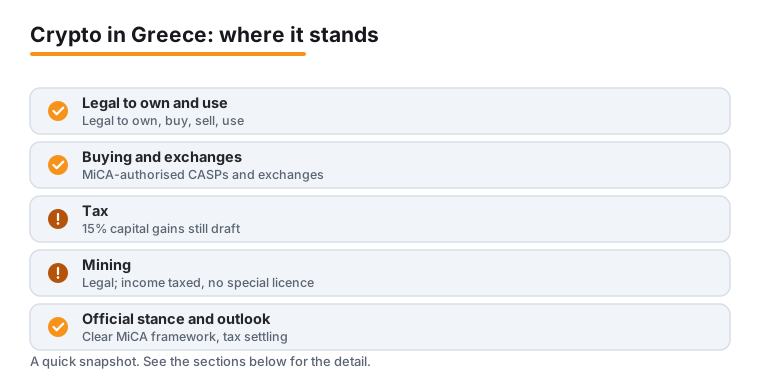
Yes, crypto is legal in Greece. Buying, holding, selling, and using Bitcoin and other crypto-assets is permitted for individuals and businesses, and there is no ban on ownership or trading.
What crypto is not is legal tender. Under EU rules the euro is the only legal tender in Greece, so no merchant is obliged to accept Bitcoin, and crypto is not issued or guaranteed by any central bank. Parties may, however, agree between themselves to use crypto as a means of exchange. The firms that provide crypto services to the public (exchanges, brokers, custodians) are now regulated as crypto-asset service providers under MiCA and Greek law. The practical takeaway: ownership is unrestricted, but the providers you deal with operate under licensing and anti-money-laundering rules. For background on how this fits the wider EU picture, see our crypto regulation overview.
Who regulates crypto in Greece
Oversight is shared among three bodies, each with a defined role:
- Hellenic Capital Market Commission (HCMC) is the lead authority that authorises and supervises most crypto-asset service providers (CASPs) under MiCA and oversees market abuse. It also handled Greece's earlier anti-money-laundering registry of virtual asset service providers.
- Bank of Greece is competent for crypto-assets that function like electronic money or are issued by entities already under its prudential supervision, such as banks and payment or e-money institutions, and for issuers of asset-referenced tokens and e-money tokens.
- Independent Authority for Public Revenue (AADE) handles taxation and the new crypto-asset tax-reporting regime.
Because a provider's authorisation status changes as it moves through licensing, always confirm a firm's standing on the HCMC's published registers before trusting it with funds. You can verify the regulators directly at Hellenic Capital Market Commission, Bank of Greece, and AADE.
Key laws and frameworks
The crypto rulebook in Greece rests on EU regulation plus national implementing law:
- MiCA (Regulation (EU) 2023/1114) is directly applicable across the EU. Its rules for crypto-asset service providers have applied since 30 December 2024, so the core requirements are the same in Greece as in other member states.
- Law 5193/2025, in force since April 2025, is the Greek law that supplements MiCA. It designates the HCMC and the Bank of Greece as competent authorities, sets out their supervisory and sanctioning powers, and provides for administrative penalties. It also amended the Greek anti-money-laundering Law 4557/2018 to bring CASPs within scope.
- Law 5301/2026, published in the Official Gazette on 15 May 2026, transposes the EU DAC8 directive (and DAC9) into Greek law and aligns with the OECD Crypto-Asset Reporting Framework (CARF). It brings in crypto-asset tax-reporting obligations for service providers, alongside a new binding tax rulings regime and penalty changes. Greece was late on this step: the EU DAC8 rules entered into force across the bloc on 1 January 2026, but Greece had not notified transposing measures by the 31 December 2025 deadline, and the European Commission opened an infringement procedure against Greece and eleven other member states on 30 January 2026 before Greece passed the law in May 2026.
Greece follows MiCA's categories (asset-referenced tokens, e-money tokens, and other crypto-assets) rather than a bespoke national definition. Because some of these provisions are recent and still being operationalised, check the official source for the current text before relying on a specific detail.
Licensing and registration of exchanges (CASPs)
Under MiCA, firms offering services such as operating a trading platform, exchanging crypto for fiat or for other crypto, custody and administration, order execution, or advice generally need authorisation as a crypto-asset service provider. In Greece the applicant must typically be incorporated as a societe anonyme and obtain authorisation from the HCMC (or from the Bank of Greece where the entity is already under its supervision).
By a decision published in August 2025, the HCMC set out the application procedure: a preliminary assessment phase followed by a substantive evaluation, with a final decision targeted within roughly 40 business days of a complete application. The EU built in a transition (grandfathering) period for firms that already operated under prior national regimes. In Greece, previously registered virtual asset service providers could keep operating only if they applied for a MiCA CASP licence by 31 December 2025; after that date a MiCA authorisation is required. Authorised CASPs benefit from passporting, meaning a licence in one EU state allows services across the bloc. Always confirm a provider's current authorisation status on the HCMC register.
Crypto and Bitcoin tax in Greece
Greek crypto taxation is in transition, and it is important to be precise about what is and is not yet law.
- As of 3 August 2026 the dedicated 15% capital gains tax on crypto profits is still a draft bill and not enacted law. The Ministry of National Economy and Finance has been preparing legislation expected to apply a flat 15% rate to gains from selling or disposing of crypto, with the first 500 euros of profit reported as exempt to spare small retail investors. Reports in June 2026 also indicated that individual miners would be exempt from the levy (though companies engaged in mining would not), that capital losses could be carried forward for up to five years to offset future gains, and that the filing deadline for crypto income would be 30 June of the year following the tax period. Powergame published the draft text on 2 June 2026, reporting that it had recently been presented to the Cabinet and would soon go to public consultation. Reporting on 20 June 2026 said the Ministry was expected to submit it to Parliament by the end of July, and reporting on 12 July 2026 said it was in the final stage of processing and expected to be ready within July. As of 3 August 2026 no tabling in Parliament and no live consultation on the ministry's opengov.gr page could be confirmed. Until it passes and takes effect, treat these as proposals: a flat 15% rate, a 500 euro annual tax-free threshold, tax triggered on conversion to euro or another currency or on paying for goods and services, no tax on crypto-to-crypto swaps, direct acquisition and transfer costs taken into account, losses carried forward for up to five years, crypto brought inside the inheritance, gift and parental provision regimes, staking and lending returns taxed as interest at 15%, and application from 1 January 2025. On mining, note that the draft text is narrower than early reports suggested: coins mined outside a business activity are not income when they are created or acquired, but they are taxed on disposal with the acquisition price treated as zero, so an individual miner is deferred rather than exempt.
- Until a dedicated regime is in force there is no crypto-specific article in Greek tax law: Global Legal Insights records that Greek law does not include specific provisions on the taxation of cryptocurrencies, with income from mining generally considered business income and income from trading considered capital gain taxed at the applicable rate, currently 15%. It also notes that AADE's Dispute Resolution Department has refused to treat profits from crypto sales as taxable, on the grounds that such income does not fall within the scope of Law 4172/2013, so practice has been inconsistent. In practice, trading profits have generally been viewed as capital gains and mining or staking income as ordinary or business income on the progressive personal income tax scale (which runs from 9% up to 44%). However, AADE dispute rulings have at times declined to treat crypto sales as taxable income under the existing Income Tax Code (Law 4172/2013), and VAT treatment has not been fully settled, which is exactly why new legislation is being prepared.
- Reporting is tightening regardless. Under Law 5301/2026 (DAC8/CARF), published on 15 May 2026, crypto-asset service providers must collect and report user transaction data to AADE. The first reporting period is 2026, and providers' first reports are expected in 2027 (DAC8 sets a filing window of up to nine months after the fiscal year, so reports covering 2026 fall due by 30 September 2027). Even for foreign-based platforms, this reduces the visibility gap over time.
Because rates, thresholds, exemptions, and the precise treatment of specific transactions depend on whether and how the draft law is enacted and on your own circumstances (resident vs non-resident, individual vs business), this guide does not present any figure as definitive. Confirm the current rules and deadlines with AADE or a Greek accountant, and see our general crypto taxes guide. This section is informational only and is not tax advice.
AML and KYC rules
Anti-money-laundering and counter-terrorist-financing duties apply across the board. Law 5193/2025 amended Greece's AML Law 4557/2018 so that crypto-asset service providers are treated as obliged financial institutions. That means CASPs must verify customer identity (KYC), monitor activity, keep records, and report suspicious transactions, and regulators can access those records to trace funds.
MiCA and the EU framework also effectively prohibit anonymous crypto accounts for regulated providers. The EU Transfer of Funds Regulation (Regulation (EU) 2023/1113), which extends the FATF travel rule to crypto, applies directly: providers must collect and transmit information on the originator and beneficiary of crypto transfers, and apply enhanced scrutiny to transfers involving self-hosted (unhosted) wallets and to cross-border relationships. The HCMC and Bank of Greece have strengthened investigative and sanctioning powers to enforce these rules. In short, expect identity verification before you can trade or withdraw, and expect larger or cross-border transfers to attract additional checks.
Buying and using crypto in practice
Most people in Greece buy crypto through international and EU-based exchanges that serve the country. Because Greece uses the euro and sits in the Single Euro Payments Area (SEPA), funding an account by SEPA bank transfer is usually cheap and straightforward; cards work too but typically cost more.
A typical path for a resident looks like this:
- Choose a provider that is MiCA-authorised (or progressing through licensing) and serves Greece. Favour firms visible on the HCMC registers and compare fees, supported coins, payment methods, and security.
- Verify your identity by completing KYC with ID and any required proof of address. This is mandatory under AML rules.
- Fund the account with a SEPA transfer in euros for low cost, or a card for speed at higher fees. Greek banks may apply extra scrutiny to crypto-related transfers, so a payment can occasionally be queried or delayed.
- Place an order at market or with a limit, mindful of the spread and trading fee.
- Secure your coins by moving long-term holdings to a personal wallet (a hardware wallet offers the strongest self-custody) and keeping the recovery phrase offline.
- Keep records of buy and sell dates and amounts, which you will need to calculate and report any taxable gains.
Crypto ATMs (kiosks) also exist in Athens, Thessaloniki, and tourist areas, run by private operators, letting you buy and sometimes sell coins for cash via a wallet QR code. They are fast and convenient but fees and spreads are usually far higher than online exchanges, and identity checks often apply above small amounts.
Bitcoin mining in Greece
Bitcoin mining is not prohibited in Greece, but there is no special mining licence regime that makes it uniquely easy. Miners operate as ordinary individuals or businesses and must observe general rules on company registration, electricity-supply contracts, taxation of the income produced, and any environmental or zoning requirements.
The dominant practical factor is electricity. Greek retail power prices sit among the higher tier in the EU, which squeezes mining margins versus low-cost jurisdictions and pushes serious operators toward cheaper or surplus energy. Greece's strong solar and wind resources are sometimes cited as an opportunity for sustainability-minded mining, but energy use and carbon footprint face growing scrutiny across the EU. On tax, mining income is generally treated as ordinary or business income rather than capital gains, with the value of mined coins typically recognised when received and a separate gain or loss when later sold. Anyone setting up an operation should get tailored advice on business registration, VAT, electricity contracts, and local permits, because these vary by scale and location.
Recent developments (2025-2026)
The pace of change has been rapid:
- April 2025: Law 5193/2025 supplemented MiCA in Greek law, designating the HCMC and Bank of Greece as competent authorities. Greece was among the first EU states, and the first in Southern Europe, to complete this domestic transposition.
- July to August 2025: the HCMC published its decision setting out the CASP authorisation procedure, opening the formal licensing process.
- 31 December 2025: end of the grandfathering window. Pre-MiCA virtual asset service providers had to have applied for a CASP licence to keep operating.
- 30 January 2026: the European Commission opened an infringement procedure against Greece and eleven other member states for not transposing the EU DAC8 crypto tax-reporting directive by the 31 December 2025 deadline.
- 15 May 2026: Greece published Law 5301/2026, transposing DAC8 (and DAC9) and bringing in crypto-asset reporting obligations for service providers, with the first reports to AADE expected in 2027 (by 30 September 2027 for the 2026 period).
- June 2026: the Ministry of Finance was reported to be drafting a dedicated 15% crypto capital-gains tax with a 500-euro exemption on gains. Reports indicated individual miners would be exempt (but not mining companies), that capital losses could be carried forward for five years, and that the filing deadline would be 30 June of the following year. The bill was expected to go to Parliament in the coming months and was not yet enacted at the time of writing.
The direction of travel is toward consolidation and clarity: clearer supervisors, a formal licensing process, tighter reporting, and a tax regime moving from a grey zone toward defined rules.
Consumer risks and protection
Clearer rules reduce legal uncertainty but do not remove investment risk. The main risks for crypto users in Greece are:
- Market risk. Prices are volatile and can fall steeply; crypto is not covered by deposit-guarantee schemes.
- Platform and custody risk. Exchanges can be hacked, fail, or freeze withdrawals; self-custody shifts the risk to you losing your keys.
- Scams and fraud. Fake exchanges, impersonation, romance and investment scams, and guaranteed-return schemes are common; regulators warn consumers to be cautious.
- Regulatory and tax change. Rules, rates, and reporting duties are still settling under MiCA and the pending tax bill, so what is true this year may shift.
On the protection side, MiCA brings disclosure, governance, custody-segregation, and conduct requirements for authorised providers, and the HCMC and Bank of Greece can supervise and sanction firms. The strongest single safeguard you control is dealing only with authorised providers and treating crypto as a small, speculative slice of a diversified portfolio. Invest only what you can afford to lose.
Official sources and how to verify
Because this area is evolving, verify any specific point directly with the responsible authority rather than relying on summaries:
- Hellenic Capital Market Commission (HCMC) for CASP authorisation, registers, and MiCA supervision.
- Bank of Greece for e-money and asset-referenced tokens and supervised institutions.
- Independent Authority for Public Revenue (AADE) for taxation and crypto tax-reporting rules.
- ESMA: Markets in Crypto-Assets Regulation (MiCA) for the EU-level rulebook and the list of national competent authorities.
You can also compare jurisdictions on our regulation hub. To repeat the key caveat: this article is general information as of 2026 and is not legal, tax, or financial advice; the dedicated 15% crypto tax was still a draft bill at the time of writing, so confirm the current legal and tax position with the HCMC, the Bank of Greece, or AADE, and seek professional advice before acting.
What is changing: Greece in August 2026
Two dates matter more than anything else on this page. The first is 1 July 2026, when the MiCA transitional period closed across the EU. ESMA states that entities providing crypto-asset services under national law before 30 December 2024 could continue only until 1 July 2026 or until they were granted or refused a MiCA authorisation. Greece closed its own national window earlier: under the transitional rule in Law 5193/2025, providers registered with the Hellenic Capital Market Commission VASP registry until 27 December 2024 could operate under the previous AML regime only until 31 December 2025, as summarised by Zepos and Yannopoulos. Greek CASP authorisations have started to appear: a company press release dated 27 July 2026 described Capital Wallet Greece as holding one of the country's first CASP authorisations, covering six of the ten crypto-asset services defined by MiCA. That is the firm's own announcement, not an HCMC statement, and no official count of authorised Greek providers could be confirmed.
The second date is the one that has not arrived. As of 3 August 2026, the dedicated 15% crypto capital gains tax is still a draft bill. Greek reporting on 12 July 2026 said the Ministry of National Economy and Finance had the bill in the final stage of processing and expected to be ready within July, after reporting on 20 June 2026 said the Ministry was expected to submit it to Parliament by the end of July. Neither a tabled bill nor a live consultation on the ministry's opengov.gr page could be confirmed at the time of this update.
So the honest August 2026 position is: licensing is settled and now strictly MiCA-only, tax reporting is settled and already running, and the tax rate itself is still pending.
Greek crypto legislation: what is adopted and what is pending
| Measure | Stage | What it does | Timing |
|---|---|---|---|
| Law 5193/2025, Part C (MiCA implementing law) | In force | Names the HCMC as competent authority for crypto-asset service providers, with sole responsibility for the market abuse provisions, and the Bank of Greece competent in specific cases. Amends AML Law 4557/2018. A person who intentionally provides crypto-asset services professionally without a licence faces imprisonment of at least one year, alongside administrative sanctions under MiCA Article 94. | Voted 10 April 2025. National grandfathering ended 31 December 2025. |
| HCMC Board Decision 8/1059/30.7.2025 | In force | The licensing procedure itself: a dossier meeting MiCA Article 62 and the EU technical standards, acknowledgement in 5 working days, completeness check in 25 working days, decision in 40 working days once the file is complete. | In force from 30 July 2025. |
| Law 5273/2026, Gazette 13/A, 30 January 2026 | In force | Ratifies the OECD Crypto-Asset Reporting Framework agreement. Article 2 makes AADE the competent authority. Article 4 covers providers tax resident, incorporated, managed or usually operating in Greece, and providers acting through a Greek branch. Article 5 requires reporting of user name, address, jurisdictions of residence, tax identification number and date and place of birth, and the same for controlling persons. Article 6 requires self-certification due diligence. | Applies from 1 January 2026. First submission due by 31 March 2027. |
| Law 5301/2026, Gazette A 74, 15 May 2026 | In force | Transposes DAC8 (Directive (EU) 2023/2226) and DAC9 (Directive (EU) 2025/872). Article 8 inserts Article 9AD on automatic exchange covering reporting crypto-asset service providers. Article 28 amends Article 35 of the Tax Procedure Code on auditing those providers. Article 29 adds the penalty regime at Article 59 of the Tax Procedure Code. Separately, Article 38 amends Article 57 on accepting cash payments of more than 500 euros. | Published 15 May 2026, feeding the same 2027 exchange cycle as the CARF rules. |
| Draft bill on crypto taxation and transfers (15%) | Drafted, not tabled | Would tax crypto capital gains at a flat 15% with a 500 euro annual tax-free threshold, tax only on conversion to currency or on paying for goods and services, no tax on crypto-to-crypto swaps, direct acquisition and transfer costs taken into account, losses carried forward five years, and crypto brought into the inheritance, gift and parental provision regimes. Mining outside a business activity is not income when the coins are created, but is taxed on disposal at a zero acquisition price. Staking and lending returns are treated as interest income taxed at 15%. | Presented to the Cabinet by early June 2026 and reported as final-stage drafting in July 2026. Drafted to apply from 1 January 2025. No parliamentary tabling confirmed as of 3 August 2026. |
Sources for the two 2026 laws: Law 5273/2026 text, plus Law 5301/2026 and its article list. For the licensing procedure, see this summary of HCMC Decision 8/1059/30.7.2025. For the draft tax bill, see Powergame's publication of the draft text.
What the reporting rules already mean for your exchange account
The tax rate is unsettled, but the visibility is not. Two instruments already in force put Greek crypto activity in front of AADE.
- Data collected from 2026. Under Law 5273/2026, reporting crypto-asset service providers that are tax resident, incorporated, managed or usually operating in Greece, or acting through a Greek branch, must apply self-certification due diligence and report each reportable user's name, address, jurisdictions of residence, tax identification number and date and place of birth. The obligation applies from 1 January 2026.
- First filing due 31 March 2027. The same law requires submission by 31 March of the calendar year following the year the information relates to. Your 2026 activity therefore reaches AADE in early 2027, whether or not any 15% tax has been enacted by then.
- Cross-border exchange. Law 5301/2026 transposes DAC8, inserting Article 9AD to extend mandatory automatic exchange of information to reporting crypto-asset service providers, so the data does not stop at the Greek border.
- Penalties fall on the provider, not the user. The scale added by Article 29 of Law 5301/2026 runs from 100 euros for late submission, to 300 euros for omitted, incomplete or inaccurate information, 1,000 euros for failing to respond to a request, 2,500 euros for non-cooperation, and 5,000 euros for continued non-compliance, with a cap of 500,000 euros per audit and 10,000 euros per reporting year for late filing, as set out in this summary of the law. The pressure is on exchanges to gather accurate identity data from you.
The practical reading: keep a record of acquisition dates, acquisition costs and disposal proceeds for every position now, because the draft bill is written to apply from 1 January 2025 and the reporting stream starts from 2026 either way.
Checking that a provider is actually authorised
Since 1 July 2026 there is no transitional cover left, which makes the authorisation check meaningful rather than cosmetic. The EU supervisory authorities issued a joint warning on crypto-assets on 6 October 2025 stating that firms already providing crypto-asset services under national law before 30 December 2024 could continue until 1 July 2026 or until authorisation was granted or refused, and that consumers do not benefit from any MiCA protections when using such providers until the transitional period expires. That period has now expired, so any firm still serving Greek clients without authorisation is operating outside the law.
ESMA maintains the register of authorised crypto-asset service providers, and states the interim register remains a set of csv files until mid-2026, when it is folded into ESMA's own IT systems. Check a provider there, and check the HCMC's own list, before funding an account. Under Law 5193/2025, intentionally providing crypto-asset services professionally in Greece without a licence carries imprisonment of at least one year, which is a reasonable signal of how the state now treats unlicensed operators.
Frequently asked questions
Is Bitcoin legal in Greece?
Yes. Owning, buying, selling, and using Bitcoin and other crypto-assets is legal in Greece for individuals and businesses. However, crypto is not legal tender, only the euro is, so no business is required to accept it. Providers that offer crypto services are regulated as crypto-asset service providers under the EU's MiCA regulation and Law 5193/2025.
Who regulates cryptocurrency in Greece?
Oversight is shared. The Hellenic Capital Market Commission (HCMC) is the lead authority that authorises and supervises most crypto-asset service providers under MiCA, while the Bank of Greece is competent for e-money and asset-referenced tokens and for entities already under its supervision. The Independent Authority for Public Revenue (AADE) handles taxation. Law 5193/2025, in force since April 2025, supplements MiCA and designates these authorities.
Do I have to pay tax on crypto in Greece?
The position is in transition. As of mid-2026, a dedicated 15% flat capital-gains tax on crypto profits (with the first 500 euros reported as exempt) was a draft bill being prepared by the Ministry of Finance, not yet enacted law. Until it passes, the treatment of gains has been unsettled, with trading profits generally viewed as capital gains and mining or staking as ordinary income. Separately, providers must report user transactions to AADE under Law 5301/2026 from 2026. Confirm the current rules with AADE or a Greek accountant. This is not tax advice.
Will my crypto exchange report my activity to Greek tax authorities?
Increasingly, yes. Greece transposed the EU DAC8 directive through Law 5301/2026, published on 15 May 2026, which aligns with the OECD Crypto-Asset Reporting Framework (CARF). Under it, crypto-asset service providers must collect and report user transaction data to the Independent Authority for Public Revenue (AADE). The first reporting period is 2026, with providers' first reports expected in 2027 (by 30 September 2027 for the 2026 period). Greece was actually late to adopt these rules, which is why the European Commission opened an infringement procedure in January 2026 before the law passed in May. Over time this narrows the visibility gap, including for accounts held with foreign platforms that fall within scope.
When would the planned 15% crypto tax apply, and to whom?
As of mid-2026 the 15% flat rate on crypto gains is a draft bill, not enacted law, so no start date is fixed. As reported in June 2026, the draft would tax gains from selling or disposing of crypto at 15%, exempt the first 500 euros of profit, exempt individual miners (but not mining companies), allow capital losses to be carried forward for up to five years, and set a filing deadline of 30 June of the following year. These figures could change during the parliamentary process, so confirm the final text with AADE or a Greek accountant before relying on any number. This is not tax advice.
Do crypto exchanges need a licence in Greece?
Yes. Under MiCA, firms providing services such as running a trading platform, exchanging crypto, custody, or order execution generally need authorisation as a crypto-asset service provider from the HCMC (or the Bank of Greece for entities it already supervises). Existing virtual asset service providers had to apply for a MiCA licence by 31 December 2025 to keep operating. Always check a provider's status on the HCMC register before depositing funds.
What is the best way to buy Bitcoin in Greece?
Most people use a MiCA-authorised exchange funded by a SEPA bank transfer in euros, which keeps fees low; cards are faster but cost more. You complete identity verification (KYC), place your order, and ideally move long-term holdings to a personal wallet. Crypto ATMs exist across Greek cities for cash purchases but usually charge much higher fees and spreads, so treat them as a convenience option.
How can I verify the current crypto rules in Greece?
Check the official authorities directly: the Hellenic Capital Market Commission (hcmc.gr) for licensing and registers, the Bank of Greece (bankofgreece.gr) for e-money and token issuers, and AADE (aade.gr) for tax. For the EU-level MiCA rulebook, see ESMA. Because the tax framework in particular is still being finalised, do not rely on third-party summaries for a specific decision; confirm with the regulator or a qualified Greek professional.
Has Greece passed the 15% crypto tax yet, as of August 2026?
No. As of 3 August 2026 it is still a draft bill. The draft was presented to the Cabinet and published in early June 2026, reporting on 20 June 2026 said the Ministry was expected to submit it to Parliament by the end of July, and reporting on 12 July 2026 said it was in the final stage of processing and expected to be ready within July. No tabled bill and no live opengov.gr consultation could be confirmed. Because the draft is written to apply from 1 January 2025, enactment later in 2026 would still reach 2025 gains.
Can my old exchange still serve me in Greece after 1 July 2026?
Only if it now holds a MiCA authorisation. The EU-wide MiCA transitional period ended on 1 July 2026, and Greece closed its own national window earlier, on 31 December 2025, for providers registered with the HCMC VASP registry until 27 December 2024. Under Law 5193/2025, intentionally providing crypto-asset services professionally without a licence carries imprisonment of at least one year alongside administrative fines. Check the provider against the ESMA register and the HCMC list before funding an account.
When does my exchange first report my Greek crypto activity to AADE?
Law 5273/2026, published in Government Gazette 13/A on 30 January 2026, ratifies the OECD Crypto-Asset Reporting Framework agreement and names AADE as the competent authority. The reporting obligations apply from 1 January 2026, with information due by 31 March of the calendar year following the year it relates to. That means your 2026 activity is reported by 31 March 2027. Law 5301/2026, published in Gazette A 74 on 15 May 2026, transposes DAC8 so the data can also be exchanged with other EU tax authorities.
What information will a Greek exchange have to hand over?
Under Article 5 of Law 5273/2026, a reporting crypto-asset service provider must report the user's name, address, jurisdictions of residence, tax identification number and date and place of birth, and the same details for controlling persons of a reportable entity. Article 6 requires the provider to obtain a self-certification allowing it to establish your tax residence. Expect to be asked for your AFM and a tax residence declaration if you have not already given them.
How long does an HCMC crypto licence take?
HCMC Board Decision 8/1059/30.7.2025 sets the timetable: acknowledgement of the application within 5 working days of submission, a check of whether the file is complete within 25 working days of receipt, and a decision within 40 working days from the date the application is complete. The application must contain the information and documents required by Article 62 of MiCA and the accompanying EU technical standards.
Would mining be taxed under the proposed Greek rules?
Early reporting said individual miners would be exempt, but the draft text as published is narrower. Coins mined outside a business activity do not count as income at the moment they are created or acquired, so nothing is due when you mine. Tax arises when you dispose of them, and the acquisition price is treated as zero, so the whole disposal proceeds count as gain at 15%. Mining carried on commercially takes its acquisition cost from accounting records instead. Staking, yield farming and lending returns are treated as interest income taxed at 15%. None of this is law yet. Under the current rules, Global Legal Insights records that mining income in Greece is generally considered business income.
Facts reviewed: 3 August 2026. Page updated: 3 August 2026.