Home › Crypto Regulation › Spain
Bitcoin & Cryptocurrency Regulation in Spain
Quick answer — Spain, 2026
- Legal: Legal to own and trade, not legal tender
- Tax: Gains taxed as savings income, mining and staking as general income
- Buying: Via MiCA-authorised or EU-passported exchanges
Spain is one of Europe's more active cryptocurrency markets, with broad retail adoption and a dense network of Bitcoin ATMs. Owning, buying, selling and using Bitcoin and other crypto-assets is legal in Spain, but the sector is supervised, taxed and increasingly transparent. As an EU member state, Spain's crypto framework is anchored to European Union law, and the defining change for 2025 and 2026 is the full application of the EU Markets in Crypto-Assets Regulation (MiCA), which replaces Spain's earlier national anti-money-laundering registry with a single European licensing regime.
This page explains, in plain terms, who regulates crypto in Spain, its legal status, the key laws, how exchanges are licensed, how crypto is taxed, the anti-money-laundering rules, and the practical steps to buy and use it. This is general information as of 2026 and is NOT legal, tax or financial advice. Crypto rules and tax thresholds change frequently, so verify any specific detail with the named official regulators, principally the CNMV, or with a qualified professional, before acting. For more background see our guide to crypto regulation.
On this page: Legal status · Who regulates it · Taxes · How to buy · Mining
Legal status of Bitcoin and crypto in Spain
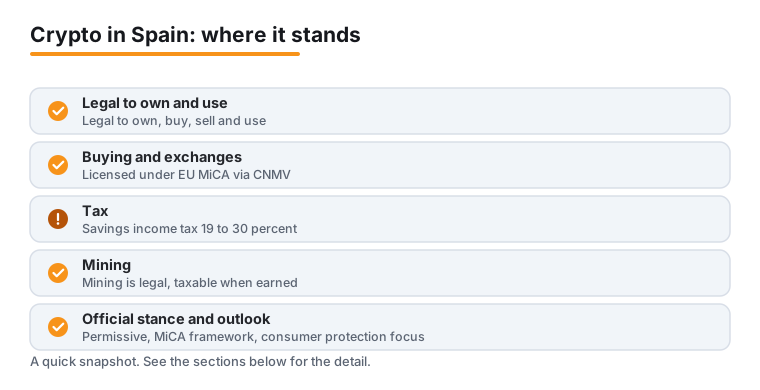
Buying, holding, selling and transacting with Bitcoin and other crypto-assets is legal in Spain. There is no ban on private ownership or use, and individuals and businesses may trade through registered or licensed platforms. Crypto is regulated, not prohibited.
Crypto is not, however, legal tender. The euro is Spain's only official currency, so no merchant is obliged to accept Bitcoin, and accepting it is a voluntary commercial decision. Spanish authorities classify crypto-assets as a regulated asset class subject to investor-protection, anti-money-laundering and tax rules, rather than as a parallel form of money. In short, Spain's stance is permissive but cautious, with a strong emphasis on consumer protection and transparency.
Who regulates crypto in Spain
Supervision is shared between several authorities, with responsibilities divided by the type of activity:
- CNMV (Comision Nacional del Mercado de Valores), Spain's securities regulator, is the competent authority for authorising and supervising crypto-asset service providers (CASPs) under MiCA, and for conduct, disclosure and advertising rules. See CNMV: MiCA regulation for crypto-assets.
- Banco de Espana (Bank of Spain) previously operated the national anti-money-laundering registry of virtual asset service providers (VASPs). Under MiCA it supervises issuers of electronic money tokens (EMTs) and asset-referenced tokens (ARTs). See the Banco de Espana.
- SEPBLAC, Spain's financial intelligence unit, oversees anti-money-laundering and counter-terrorist-financing obligations, including customer identification and suspicious-activity reporting.
- Agencia Tributaria (AEAT), the tax authority, administers crypto reporting obligations and the collection of any tax due. See the Agencia Tributaria.
At the European level, ESMA and the EBA coordinate the application of MiCA across member states.
Key laws and frameworks
The central framework for 2026 is MiCA, the EU's harmonised Regulation on Markets in Crypto-Assets (Regulation (EU) 2023/1114). MiCA entered into force in 2023, and its rules for crypto-asset service providers became applicable across the EU on 30 December 2024. Spain's transitional period for firms that were already operating ran until 1 July 2026. Since that date, the CNMV states that only providers authorised by the CNMV or by another European authority may operate in Spain. Spain used the maximum 18-month transition allowed under MiCA, measured from the 30 December 2024 application date; in its communication to the sector of 19 December 2024 the CNMV said Spain had decided to shorten the transition to 12 months, ending 30 December 2025, and had told ESMA formally; Spain subsequently reverted to the full period allowed by MiCA Article 143.3. That deadline has now passed, so the question for a Spanish user is no longer when the transition ends but whether a given platform appears in the CNMV or ESMA register.
Alongside MiCA, two other strands matter. First, the Banco de Espana kept a register of virtual currency exchange and wallet custody providers from May 2021 under Ley 10/2010. The CNMV states that this register stopped making new entries when MiCA became applicable on 30 December 2024, and that it continues to exist so that firms previously entered in it can be verified. Second, DAC8 is Council Directive (EU) 2023/2226, which extends the automatic exchange of tax information to crypto-assets. Member states had to transpose it by 31 December 2025 and must apply its rules from 1 January 2026, with information on the first reporting year exchanged between member states by 30 September 2027. Spain has not yet transposed it; the enabling bill is expediente 121/000060 in the Congreso de los Diputados. Spain's national advertising rule for crypto, CNMV Circular 1/2022, was repealed by Circular 1/2024, de 17 de diciembre, in force from 28 December 2024, on the reasoning that MiCA is directly applicable and leaves member states no discretionary margin on the matter. The bill tabled in July 2026 would give the CNMV supervision of crypto-asset advertising again as a matter of Spanish law.
Licensing and registration of exchanges (CASPs)
Before MiCA, crypto exchange and wallet-custody providers had to enrol in the Banco de Espana's anti-money-laundering registry (its full name being the Registro de proveedores de servicios de cambio de moneda virtual por moneda fiduciaria y de custodia de monederos electronicos). Crucially, that registration was an anti-money-laundering formality only: the Bank of Spain has stated that being on the register does not mean it has approved or verified the provider's activity or solvency.
Under MiCA, that national registry is being replaced by a single authorisation regime. The CNMV authorises and supervises CASPs offering services such as exchange, trading and custody, and a Spanish licence can be passported across the EU. The application window for CASP authorisation opened on 30 December 2024. The CNMV granted Spain's first MiCA CASP authorisation to BBVA on 5 March 2025, and the bank began offering buy, sell and custody services for Bitcoin and Ether to retail customers inside its mobile app on 4 July 2025. The number authorised in Spain itself has stayed small. On the CNMV list consulted on 3 August 2026, nine providers are typed as authorised in Spain: Basque Pay, Bitcoinforme (Bit2Me), Criptan Trade, Crossmint Europe, Due Network, Fintech Payments PSC, Iqana Technologies, Minos Global and Prosegur Custodia de Activos Digitales. Six Spanish credit institutions appear separately, one firm serves Spain through a branch, and 149 more are passported in from other member states. Existing VASPs registered before 30 December 2024 may continue operating during the transition until they are authorised, refused, or the transition period ends. After the transition closes, providers without MiCA authorisation must exit the Spanish market. When choosing a platform, check its regulatory status with the CNMV.
Crypto and Bitcoin taxation in Spain
Crypto is taxable in Spain, and the AEAT treats it as a capital asset rather than as currency. How a transaction is taxed depends on what you did:
- Selling, swapping or spending crypto generally realises a capital gain or loss, taxed as savings income (renta del ahorro) on the difference between acquisition and disposal value. For 2025 the savings-income scale runs in bands, reported at 19 percent up to 6,000 euros, 21 percent from 6,000 to 50,000 euros, 23 percent from 50,000 to 200,000 euros, 27 percent from 200,000 to 300,000 euros, and 30 percent above 300,000 euros. These are the bands the AEAT applies to the 2025 savings tax base, the return that was filed between 8 April and 30 June 2026 under Orden HAC/277/2026, de 25 de marzo.
- Mining, staking rewards, airdrops, crypto received as salary and certain DeFi yield are generally treated as ordinary (general) income when received, which can be taxed at higher progressive rates.
- Simply holding crypto is not a taxable event, though Spain's wealth tax (Impuesto sobre el Patrimonio) may apply to large net worth, with thresholds and regional reliefs that vary by autonomous community.
Relevant declarations include Modelo 100 (the annual IRPF income-tax return), Modelo 721, approved by Orden HFP/886/2023, de 26 de julio, an informational declaration for crypto held on platforms outside Spain, filed between 1 January and 31 March of the year after the one reported, with the AEAT stating there is no obligation where the 31 December balances of each type of virtual currency held abroad do not jointly exceed 50,000 euros, and Modelo 172 and Modelo 173 (information returns filed by Spanish crypto companies). Because rates, thresholds and deadlines change, verify current figures on the Agencia Tributaria website or with a Spanish tax adviser. See also our guide to crypto taxes. This is general information, not tax advice.
AML and KYC rules
Crypto service providers in Spain are obliged entities under anti-money-laundering (AML) and counter-terrorist-financing law. In practice this means you should expect full identity verification (KYC) when opening an account or transacting above low limits, including providing official identification and, in some cases, proof of the source of funds. Platforms must monitor transactions and report suspicious activity to SEPBLAC, Spain's financial intelligence unit.
These obligations originate in Ley 10/2010 (which transposed the EU anti-money-laundering directives) and continue under MiCA and the EU's wider AML package. From 2026, DAC8 further requires crypto platforms to collect and automatically report customer account and transaction data to tax authorities. Users should therefore assume that their crypto activity is identifiable and reportable, and that anonymous trading through regulated platforms is no longer realistic.
Buying and using crypto in practice
Spanish residents can buy crypto through international and domestic exchanges, broker apps and some banks' platforms. The practical rule for 2026 is to use a provider that is MiCA-authorised, either licensed by the CNMV in Spain or passported from another EU member state. A typical compliant route is: choose a licensed platform, complete identity verification (KYC), fund the account in euros (commonly by SEPA bank transfer or card), place your order while reviewing the spread and fees, and, for larger amounts, move holdings to a wallet you control such as a hardware wallet while safeguarding the recovery phrase.
Keep detailed records of the dates, amounts and euro values of every transaction, as you will need them for your annual tax return and any informational declarations. Crypto is not legal tender, so merchant acceptance is voluntary; where it is accepted, spending crypto is generally a taxable disposal. Bitcoin and stablecoins are also sometimes used for cross-border remittances because transfers can settle quickly, but volatility, conversion fees and the need for compliant on- and off-ramps at both ends should be weighed against established remittance services.
Bitcoin ATMs and mining in Spain
Spain hosts one of Europe's larger Bitcoin ATM networks; industry trackers placed the country at roughly 300 machines in late 2025, ahead of other European countries by machine count and among the largest networks worldwide. The kiosks are concentrated in cities such as Madrid and Barcelona. These kiosks let users buy crypto with cash or card, and some support selling back to euros, but they generally charge noticeably higher fees and worse rates than online exchanges. ATM operators are service providers subject to AML obligations and the same MiCA-era licensing expectations as other CASPs, so expect identity checks, particularly above low transaction limits.
Bitcoin mining is legal in Spain. There is no crypto-specific mining ban; the activity is shaped mainly by economics and energy policy. Spain's relatively high electricity costs make large-scale proof-of-work mining challenging compared with cheaper-energy jurisdictions, though there is interest in pairing mining with surplus solar and wind power. Income from mining is generally taxable when earned, and operating commercially brings business-registration, accounting and energy-contract considerations. Anyone planning a commercial operation should seek advice on tax treatment, permitting and electricity arrangements.
Recent developments (2025 and 2026)
The period from 2025 into 2026 has been defined by the rollout of MiCA. The CNMV opened CASP authorisation applications on 30 December 2024 and issued Spain's first MiCA CASP authorisation to BBVA on 5 March 2025. Through 2025 the CNMV published implementation guidelines, including fit-and-proper criteria for board members and shareholders and guidance for financial entities notifying their intention to provide crypto services.
For 2026, two changes stand out. First, the MiCA transition for existing Spanish providers is ending (the CNMV's official page cites 1 July 2026), after which unauthorised providers must leave the market, with some late-2025 reports indicating Spain aimed to accelerate this. Second, DAC8 begins to take effect: EU member states are to apply its rules from 1 January 2026, so crypto platforms must collect reportable data on EU-resident users from that date, with the first reports covering 2026 due to national tax authorities in early 2027. Transposition has not been uniform; in January 2026 the European Commission opened an infringement procedure against Spain over the late implementation of DAC8, which points to the direction of travel even as the domestic detail is finalised. A possible future digital euro continues to be explored at the EU level, but that is a central-bank initiative separate from private crypto-assets. For the current position, always rely on the CNMV, the Banco de Espana and the AEAT.
Consumer risks and protection
The main risks for Spanish users are familiar: market volatility, scams and fraudulent schemes, platform or custody failure, loss of private keys, and the burden of accurate tax reporting. Spanish authorities have repeatedly warned about high-risk crypto products and misleading promotions, which is why advertising rules require clear risk warnings, including in influencer marketing. Crypto-assets are generally not covered by deposit-guarantee or investor-compensation schemes, so funds held on a failed platform may not be recoverable.
MiCA strengthens consumer protection by standardising authorisation, disclosure (such as crypto-asset white papers) and conduct rules across the EU, but it does not remove market risk: prices can move sharply in either direction, and past performance does not predict future results. To reduce risk, use a CNMV-authorised or EU-passported provider, be sceptical of guaranteed-return offers, use reputable custody, keep records, and only commit capital you can afford to lose. None of this is financial advice; consider consulting a regulated adviser before investing.
Official sources and how to verify
Because crypto rules and tax thresholds in Spain change frequently, always confirm the current position with the official authorities rather than relying on third-party summaries. The primary sources are:
- CNMV: MiCA, new regulation for crypto-assets, the regulator's hub for CASP authorisation, supervision and the transition timeline.
- Banco de Espana, for the former VASP registry and for oversight of electronic money tokens and asset-referenced tokens.
- Agencia Tributaria (AEAT), for tax obligations and forms such as Modelo 100, Modelo 721, Modelo 172 and Modelo 173.
You can also compare jurisdictions through our regulation overview. This page is general information as of 2026 and is NOT legal, tax or financial advice; verify specifics with the CNMV, the Banco de Espana, the AEAT, or a qualified professional before acting.
Status in August 2026: the transition is over
Spain's MiCA transitional regime ran until 1 July 2026. The CNMV states that since that date a platform may only serve Spanish residents if it holds a crypto-asset service provider authorisation from the CNMV or has been passported into Spain by another European authority. Nothing else in the framework changed on that date. Spain still has no separate national crypto statute, so what applies is MiCA, the anti-money-laundering law Ley 10/2010, and ordinary income tax on disposals.
- Spain first told ESMA it would shorten the transition to 12 months, ending 30 December 2025. The CNMV set that choice out in its communication to the sector of 19 December 2024, which reproduces MiCA Article 143.3. Spain later reverted to the full period that article allows, and the CNMV now cites 1 July 2026.
- The Banco de Espana register of virtual currency exchange and wallet custody providers, kept since May 2021 under Ley 10/2010, stopped making new entries when MiCA became applicable on 30 December 2024. Per the same CNMV communication, it continues to exist so that firms previously entered in it can be verified.
- Competence is fixed by article 251 of Ley 6/2023, de 17 de marzo, which designates the CNMV as competent authority for supervising compliance with the EU crypto-asset markets regulation, without prejudice to the Banco de Espana over issuers of electronic money tokens and over asset-referenced tokens. The article refers to MiCA by description rather than by number, because the law was passed before MiCA was numbered.
- The CNMV has been reorganising around the work. An agreement of its Council dated 25 June 2026, published in the BOE on 7 July 2026, delegates authorisation decisions on crypto-asset service providers to the Executive Committee while reserving revocation and sanctioning, and a resolution of the same date, published on 3 July 2026, amended its internal rules to absorb new supervisory functions under MiCA, the distributed ledger pilot regime and DORA.
If a platform you used closed its Spanish accounts around July 2026, check any replacement in the CNMV or ESMA register before moving assets, and keep the transaction records you will need for your tax return.
Legislation in progress: two bills in the Cortes
No crypto-specific Spanish law has been enacted since the page was last reviewed. Two bills are live in the Congreso de los Diputados, and a third strand of tax implementing rules is in draft at the Ministry of Finance.
| Measure | Stage on 3 August 2026 | Next fixed date | What it would change |
|---|---|---|---|
| Proyecto de Ley por la que se modifican diversas leyes para la digitalizacion y modernizacion del sector financiero, expediente 121/000105 | Approved by the Council of Ministers on 14 July 2026, presented on 17 July 2026, qualified on 23 July 2026. In the amendment phase in the Comision de Economia, Comercio y Transformacion Digital, by urgent procedure with full legislative competence. | Amendment deadline 9 September 2026 | The bill text published in the BOCG states that crypto-asset service providers become obliged entities under anti-money-laundering law like any financial institution, that the CNMV will authorise them and hold the Spanish register, and it rewrites article 247 of Ley 6/2023 on CNMV powers over crypto-asset advertising. It also carries the funds transfer regulation, the DORA penalty regime and a modernised sandbox. See also the Council of Ministers reference. |
| Proyecto de Ley modifying the Ley 58/2003 General Tributaria and the income and inheritance tax laws (DAC8), expediente 121/000060 | Presented 5 June 2025. The plenary rejected the amendment to return it on 16 October 2025 and agreed avocacion on 27 November 2025. Recorded situation is Comision de Hacienda y Funcion Publica, Informe, since 30 October 2025. No tramitation event recorded in 2026. | None published | Per the Ministry of Finance, it transposes Directive (EU) 2023/2226, tightens reporting and due diligence duties on crypto providers for residents and non-residents, and recognises cryptocurrencies as assets that can be seized for unpaid tax. |
| Draft ministerial order on crypto tax forms, and the draft royal decree behind it | The order was put to public hearing on 10 March 2026. The draft royal decree completing the DAC8 transposition went to public hearing on 28 July 2025. | Not stated | Per the published executive summary, it creates form 042 for entry in a Register of crypto-asset operators and form 175 for reporting providers, renames forms 172 and 721 from virtual currencies to crypto-assets, and amends the order governing form 289. It states that form 175 replaces the obligations of form 173, and that the new forms would apply first to the 2026 tax year, filed from 2027. |
Spain missed the DAC8 transposition deadline of 31 December 2025. On 30 January 2026 the European Commission sent letters of formal notice to twelve member states over it, Spain among them, with two months to reply and complete transposition. As at 3 August 2026 the enabling bill was still in committee. The directive itself applies from 1 January 2026, and information on the first reporting year is exchanged between member states by 30 September 2027.
Who is actually authorised to serve Spain
The CNMV publishes a list of crypto-asset service providers that may operate in Spain, downloadable as a PDF. It is not the official MiCA register: the CNMV points to the ESMA register kept under Article 109.5 of Regulation (EU) 2023/1114 for that. On the version consulted on 3 August 2026 the list held 165 entries, and the split matters more than the total.
- Nine providers are typed as authorised in Spain, with the date from which each may provide MiCA services: Bitcoinforme S.L. trading as Bit2Me from 31 October 2025, Due Network S.L. from 12 June 2026, Criptan Trade S.L. and Crossmint Europe S.L. from 26 June 2026, Minos Global S.L. and Prosegur Custodia de Activos Digitales S.L. from 30 June 2026, Iqana Technologies S.L. from 10 July 2026, and Basque Pay S.L. and Fintech Payments PSC S.L. from 31 July 2026.
- Six Spanish credit institutions appear separately, providing crypto services on the basis of their banking licence after notifying the CNMV: Banco Bilbao Vizcaya Argentaria from 5 March 2025, Cecabank and Open Bank from 24 July 2025, Renta 4 Banco from 21 November 2025, and CaixaBank and Kutxabank from 27 March 2026.
- The large majority of entries, 149 of them, are firms authorised elsewhere in the EU or EEA serving Spain under freedom of services, most commonly from France, the Netherlands, Malta, Germany, Cyprus, Luxembourg and Ireland. One further firm, from Germany, serves Spain through a Spanish branch.
So the market is legal and well supplied, but very little of it is licensed in Spain itself, and most of the Spanish authorisations were granted only in mid-2026. If a provider is not on the CNMV list and not on the ESMA register, it should not be taking Spanish clients, and using it means going without MiCA protections. The CNMV set out its supervisory criteria in a new MiCA question and answer block published on 15 December 2025, with the document itself kept at FAQ MiCA.
Tax: what applies now, and what changes when DAC8 lands
Crypto tax in Spain is still handled under general rules and the 2023 reporting forms, because the DAC8 bill has not passed. The concrete position for the current filing cycle:
- Disposals go in the savings tax base. The AEAT manual for the 2025 tax year sets the scale at 19 percent up to 6,000 euros, 21 percent from 6,000 to 50,000, 23 percent from 50,000 to 200,000, 27 percent from 200,000 to 300,000 and 30 percent above 300,000. See the AEAT scale for the savings tax base.
- The 2025 return was filed between 8 April and 30 June 2026, under Orden HAC/277/2026, de 25 de marzo, which approved the IRPF and wealth tax forms for that year. That window has closed.
- Form 721 covers crypto held on platforms outside Spain and is filed between 1 January and 31 March of the year after the one reported, under Orden HFP/886/2023, de 26 de julio. The AEAT states there is no obligation to report where the balances at 31 December of each type of virtual currency held abroad, valued in euros, do not jointly exceed 50,000 euros.
- Forms 172 on balances and 173 on transactions are filed by Spanish providers, under Orden HFP/887/2023, de 26 de julio.
- The AEAT has told taxpayers what it intends to do with that data. Its 2026 tax and customs control plan, approved on 11 March 2026 and published in the BOE on 12 March 2026, says it will push control actions in 2026 against taxpayers who operated with these assets and did not declare the income or capital gains from holding and transferring them.
When DAC8 is transposed, form 173 is replaced by form 175, forms 172 and 721 are renamed to refer to crypto-assets rather than virtual currencies, and a new census form 042 registers crypto-asset operators. The draft order says the new forms would apply first to the 2026 tax year and be filed from 2027. Until it is approved, the older forms remain the ones in force.
Frequently asked questions
Is Bitcoin legal in Spain in 2026?
Yes. Owning, buying, selling and using Bitcoin and other crypto-assets is legal in Spain. It is not legal tender, so merchants are not obliged to accept it, and service providers must be authorised under the EU MiCA framework (or operating during the transition period) to serve Spanish users.
Who regulates cryptocurrency in Spain?
The CNMV (Comision Nacional del Mercado de Valores) is the competent authority for authorising and supervising crypto-asset service providers under MiCA, and for conduct and advertising rules. The Banco de Espana previously ran the anti-money-laundering VASP registry and now oversees electronic money tokens and asset-referenced tokens, SEPBLAC handles anti-money-laundering supervision, and the Agencia Tributaria (AEAT) handles tax. Verify with the CNMV.
Do I have to pay tax on crypto in Spain?
Generally yes. Gains from selling, swapping or spending crypto are usually taxed as savings income (reported in 2025 at rates from 19 percent up to 30 percent depending on the amount), while mining, staking and similar rewards are typically taxed as general income when received. Crypto held on foreign platforms above 50,000 euros must be reported on the informational Modelo 721, usually by 31 March. Rates and thresholds change, so verify current figures with the Agencia Tributaria or a tax adviser. This is not tax advice.
Do crypto exchanges need a licence in Spain?
Yes. Under MiCA, crypto-asset service providers must be authorised by the CNMV (or passported from another EU member state) to offer services such as exchange, trading and custody. Before MiCA, providers had to enrol in the Banco de Espana anti-money-laundering registry, but that was only an AML formality and did not amount to approval of the business. The CNMV issued Spain's first MiCA CASP authorisation to BBVA on 5 March 2025.
What is MiCA and when does it fully apply in Spain?
MiCA is the EU Markets in Crypto-Assets Regulation, which harmonises crypto licensing and consumer-protection rules across the EU. Its provider rules became applicable on 30 December 2024, and the CNMV's official page cites 1 July 2026 as the end of Spain's transition for firms already operating, after which only authorised providers may serve Spanish users. Because timing can change, confirm the current deadline with the CNMV.
Are crypto transactions anonymous in Spain?
No. Regulated platforms must verify your identity (KYC) and report suspicious activity to SEPBLAC under anti-money-laundering law. From 2026, the EU's DAC8 directive also requires crypto platforms to automatically report customer account and transaction data to tax authorities, so you should assume your activity is identifiable and reportable.
Can I use my bank to buy crypto in Spain?
Some banks now offer it. BBVA received Spain's first MiCA authorisation from the CNMV on 5 March 2025 and started letting retail customers buy, sell and hold Bitcoin and Ether directly in its mobile app on 4 July 2025. Other providers may follow, but availability varies by institution, so check whether your bank is CNMV-authorised or is passporting a licence from another EU country before relying on it.
How many crypto exchanges are licensed in Spain?
Few so far. Reporting around mid-2026 put the number of fully CNMV-authorised crypto-asset service providers at roughly three, a small figure next to Spain's market size and the roughly two hundred CASPs authorised across the EU by then. Many providers were still operating under the transition period, which the CNMV cites as ending on 1 July 2026, after which unauthorised firms must leave the market. Check any platform's status with the CNMV.
When does DAC8 crypto tax reporting start in Spain?
EU member states are to apply DAC8 from 1 January 2026, so crypto platforms must collect reportable data on EU-resident users from that date, with the first reports covering 2026 due to tax authorities in early 2027. On 30 January 2026 the European Commission sent letters of formal notice to twelve member states, Spain included, for failing to notify DAC8 transposition measures, giving two months to reply and complete transposition. As at 3 August 2026 the Spanish bill was still in committee in the Congreso de los Diputados with no tramitation step recorded in 2026, so the domestic reporting rules have not yet changed. Confirm current obligations with the Agencia Tributaria.
Can I still use my usual crypto exchange in Spain after 1 July 2026?
Only if it is authorised. Spain's MiCA transitional regime ran until 1 July 2026, and the CNMV says that since that date only providers authorised by the CNMV or by another European authority may operate in Spain. Check the CNMV list of crypto-asset service providers and the ESMA register kept under Article 109.5 of Regulation (EU) 2023/1114. If a platform is on neither, it should not be taking Spanish clients and you would have no MiCA protection.
How many crypto firms are actually licensed in Spain?
On the CNMV list consulted on 3 August 2026, nine providers were typed as authorised in Spain: Basque Pay, Bitcoinforme (Bit2Me), Criptan Trade, Crossmint Europe, Due Network, Fintech Payments PSC, Iqana Technologies, Minos Global and Prosegur Custodia de Activos Digitales. Six Spanish banks appear separately, one firm serves Spain through a branch, and 149 further entries are firms authorised in other member states serving Spain under a passport, making 165 entries in total.
Which Spanish banks can sell me crypto?
Six Spanish credit institutions appear on the CNMV list as able to provide crypto-asset services, with effect from these dates: BBVA from 5 March 2025, Cecabank and Open Bank from 24 July 2025, Renta 4 Banco from 21 November 2025, and CaixaBank and Kutxabank from 27 March 2026. They provide the services on the basis of their banking licence after notifying the CNMV. What each one actually offers to retail customers varies, so check with the bank.
Is a new Spanish crypto law coming?
Yes, one is in parliament. The Council of Ministers approved the Proyecto de Ley por la que se modifican diversas leyes para la digitalizacion y modernizacion del sector financiero on 14 July 2026 and it was presented to Congress on 17 July 2026 as expediente 121/000105, handled by urgent procedure with an amendment deadline of 9 September 2026. It would make crypto-asset service providers obliged entities under anti-money-laundering law, give the CNMV the register of authorised entities, and restore its powers over crypto advertising. No approval date has been published.
Has Spain transposed the DAC8 crypto tax reporting rules?
Not yet. DAC8 is Council Directive (EU) 2023/2226 and had to be transposed by 31 December 2025. Spain missed that deadline and the European Commission sent it a letter of formal notice on 30 January 2026. The Spanish bill, expediente 121/000060, was still in committee in the Congreso de los Diputados as at 3 August 2026 with no step recorded during 2026. Until it passes, Spanish crypto reporting continues through forms 172, 173 and 721.
Which tax forms will change once DAC8 is transposed in Spain?
A draft ministerial order put to public hearing on 10 March 2026 would create form 042, a census declaration for entry in a Register of crypto-asset operators, and form 175 for reporting crypto-asset service providers in place of form 173. It would also rename form 172 on balances and form 721 on assets held abroad so they refer to crypto-assets rather than virtual currencies, and amend the order governing form 289. The draft says the new forms would apply first to the 2026 tax year and be filed from 2027. None of it is in force yet.
Is the CNMV checking crypto advertising in Spain?
Not under a Spanish circular at the moment. CNMV Circular 1/2022 on crypto advertising was repealed by Circular 1/2024, de 17 de diciembre, in force from 28 December 2024, because MiCA is directly applicable and leaves member states no discretionary margin on the point. Marketing communications are therefore governed by MiCA. The bill tabled in July 2026 would rewrite article 247 of Ley 6/2023 to give the CNMV powers over crypto-asset advertising as a matter of Spanish law.
Facts reviewed: 5 August 2026. Page updated: 5 August 2026.