The 5 Biggest Crypto Stories of 2026, Explained
For most of its history, crypto news has been noise - a token you'd never heard of up 4,000%, a celebrity coin, another exchange imploding. 2026 feels different. The stories that matter this year aren't about getting rich by Friday; they're about crypto quietly, and sometimes awkwardly, wiring itself into the actual financial system. Below are the five developments that genuinely define the year - and what each really means once you look past the price ticker.
Bitcoin ETFs grew up - and showed their teeth
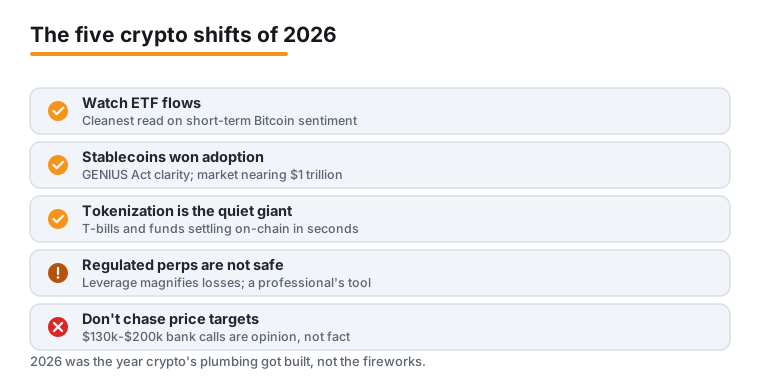
When US spot Bitcoin ETFs launched in early 2024, they did something simple but profound: they let anyone buy Bitcoin through an ordinary brokerage account - no wallet, no seed phrase, no exchange sign-up. By 2026 that convenience has revealed its flip side.
This spring those same funds posted some of the largest outflows in their short history - on the order of $1.6 billion in a single week and close to $3 billion across ten trading sessions - dragging total ETF assets from roughly $104 billion down toward $94 billion. Bitcoin spent weeks pinned in a $73,000-$74,000 range as a direct result.
The deeper story isn't the red number; it's what the number reveals. Bitcoin used to trade like an island, moved mostly by its own true believers. Now that large institutions hold a meaningful slice of it through ETFs, Bitcoin increasingly behaves like any other risk asset: when fund managers de-risk, BTC gets sold right alongside tech stocks. The ETF made Bitcoin both more accessible and more ordinary - and "ordinary" cuts both ways.
What it means for you: daily ETF flow data is now one of the cleanest reads on short-term sentiment. The era of Bitcoin happily ignoring the wider economy is, for the moment, over.
Stablecoins quietly won the use-case war
While the headlines chased Bitcoin's price, the most consequential thing in crypto turned out to be the least glamorous: the stablecoin - a token engineered to always be worth one dollar.
In 2025 the United States passed the GENIUS Act, its first federal framework for stablecoins, setting rules on reserves, audits and who is even allowed to issue one. With that legal clarity, stablecoins have cemented themselves as crypto's number-one real-world use case, and analysts now project the total market pushing toward the $1 trillion mark this cycle.
What are people actually doing with them? Sending money across borders in seconds for cents instead of days and double-digit fees; holding dollars in countries where the local currency is sliding; settling trades; parking cash between positions; and increasingly earning yield. A stablecoin is, in effect, a programmable dollar that moves at internet speed and never closes for the weekend.
The risks are real and deserve respect - a stablecoin is only as sound as the reserves behind it, and history has examples of coins that lost their peg. But as a story about genuine adoption, with real people using crypto for real money, nothing else comes close.
Wall Street is moving real assets on-chain
The flashy version of crypto is meme coins. The version that has bank executives paying attention is tokenization: representing traditional assets - Treasury bills, money-market funds, bonds, even real estate - as tokens on a blockchain.
The chair of the US securities regulator has repeatedly called tokenization central to modernizing markets, and the world's largest asset managers now run tokenized funds holding billions of dollars. Why bother? Because a tokenized Treasury can settle in seconds instead of two days, trade around the clock, be split into tiny fractions, and carry its compliance rules baked directly into the asset itself.
Quietly, this erases the line between "crypto" and "finance." Here, institutions aren't betting on coins - they're adopting the underlying technology to make their existing business faster and cheaper. If stablecoins put the dollar on-chain, tokenization is putting everything else there too. It is the least hyped and arguably most structurally important trend of the year.
Crypto derivatives went legit in America
For years, the way most of the world actually traded crypto - perpetual futures - was effectively off-limits to Americans, living on offshore venues. A perpetual ("perp") is a futures contract with no expiry date, kept in line with the spot price by a periodic "funding" payment between buyers and sellers. Globally, it is the dominant instrument in crypto trading.
In 2026 that changed. The US derivatives regulator cleared Coinbase to list digital-commodity perpetual-style contracts for major tokens including Bitcoin, Ethereum and Solana, and authorized the prediction-market platform Kalshi to launch the first American-born Bitcoin perpetual futures. In plain terms: regulated, onshore leverage and price discovery, instead of nudging US traders toward offshore platforms with little oversight.
That is a hallmark of a maturing market - deeper liquidity, clearer rules. It also arrives with a warning label: leverage magnifies losses just as easily as gains, and "regulated" is not a synonym for "safe." For most people, perps are a professional's tool, not a beginner's product.
The great rotation: crypto vs. the AI trade
Step back and a bigger pattern explains much of 2026's choppiness. A large share of investor money has rotated into a narrow band of US stocks - artificial intelligence, semiconductors, defense and energy - and crypto has, for now, ceded the spotlight. With Bitcoin trading more like a macro risk asset than "digital gold," it has been competing with the AI trade for the same pool of speculative capital.
And yet the institutions placing long-term bets are unusually upbeat. Research desks describe 2026 as the dawn of an institutional era for digital assets, and several banks have floated Bitcoin targets in the $130,000-$200,000 range for this cycle. The tension is the whole point: in the short term, crypto fights AI for attention and dollars; in the long term, the plumbing being installed right now - ETFs, regulated stablecoins, tokenization, onshore derivatives - is the foundation for whatever the next cycle becomes.
How to read it: zoom out. A quiet price does not mean a quiet industry. This was the year the infrastructure got built; the fireworks, when they come, tend to follow.
What it all means for you
Five stories, one through-line: in 2026 crypto stopped being a casino in the corner and started becoming part of the financial system's wiring. A few practical takeaways:
- Watch flows, not just price. ETF inflows and outflows now tell you more about near-term direction than any chart pattern.
- Stablecoins are the real adoption metric. If you want to know whether crypto is being used, follow stablecoin volumes, not Bitcoin's headline price.
- Tokenization and regulated derivatives mean institutions are committing - slowly, with lawyers, but committing.
- Don't confuse a calm market with a dead one. The boring stretches are exactly when the foundations get poured.
None of this is financial advice, and nobody - not even the banks with the big price targets - actually knows what next quarter holds. But if you understand these five shifts, you understand more about where crypto is heading than most of the noise will ever tell you.
Frequently asked questions
Is 2026 a good time to buy crypto?
No one can answer that for you, and anyone promising a confident yes or no is guessing. Crypto remains highly volatile, and 2026 prices have swung hard on fund flows and macro news. If you do invest, risk only what you can afford to lose and learn the basics first - our guide to buying and selling crypto is a sensible starting point. This is information, not financial advice.
Are Bitcoin ETFs safe?
A spot Bitcoin ETF is a regulated wrapper that holds Bitcoin for you, which removes the risk of losing your own keys. It does not remove price risk - Bitcoin's value can fall sharply, and 2026 has shown ETF flows can be volatile in both directions.
What is a stablecoin, in one sentence?
A stablecoin is a crypto token designed to always be worth about one US dollar, used mainly for payments, saving and moving money quickly - see our explainer on Tether and stablecoins.
Will Bitcoin really hit $200,000?
Some banks have published targets in that range, but price predictions have a poor track record and should be treated as opinion, not fact. Focus on understanding the technology and managing risk rather than chasing a number.
Do I owe tax on any of this?
In most countries, yes - selling, swapping or earning crypto can be taxable events, and rules vary widely. See our overview of how crypto is taxed and confirm with a qualified local professional.
Last updated: 2026-06.
Related guides
- Bitcoin Price Predictions & 2026 Outlook
- Crypto in Your 401(k): The New 2026 Rules Explained
- Form 1099-DA Explained: The New Crypto Tax Form (2026)
- How to Cash Out Crypto to Your Bank Account (2026)
- Tokenized Real World Assets: How to Buy RWAs in 2026
- Bitcoin (BTC): the Complete Guide
- Crypto Regulation by Country