Tokenized Real World Assets: What RWAs Are and How Regular Investors Buy Them
Tokenized real world assets, or RWAs, are ordinary financial assets, Treasury bills, gold bars, rental houses, private loans, wrapped in a blockchain token you can hold in a crypto wallet. The market crossed $31 billion in tracked on-chain value in May 2026, up from around $6 billion at the start of 2025, and the names behind the biggest products are BlackRock, Franklin Templeton, and Paxos, not anonymous teams. The pitch to a regular investor is real: you can buy a slice of a rental property for $50 or a share of a Treasury fund for $20. The catch is that what you legally own varies wildly between products, and the space has already attracted fakes. This guide covers both.
What a tokenized real world asset actually is
An RWA token is a blockchain entry that represents a legal claim on something that exists off-chain. Three parties make that claim real: an issuer who creates the token and holds the legal obligation, a custodian who holds the underlying asset (a vault, a bank, a property manager), and usually a transfer agent or registrar who keeps the official record of who owns what. The token is the interface; the legal wrapper underneath is the product.
This is the opposite of a crypto-native asset like bitcoin, where the token is the asset. With an RWA, the blockchain gives you 24/7 transferability and fractional sizing, but you inherit every off-chain dependency: the issuer's solvency, the custodian's honesty, the enforceability of the paperwork. If tokens and chains are new to you, start with our blockchain basics explainer, because everything below assumes you can hold a token in a wallet.
The $31 billion market, mapped
Trackers like rwa.xyz split the market into a few buckets, and the exact totals differ depending on what each tracker counts, but the shape is consistent in 2026:
- Tokenized US Treasuries are the anchor of the market. These are funds holding T-bills, sold as tokens.
- Private credit is the largest non-Treasury segment, dominated by Figure's home equity lines, with Maple and Centrifuge running on-chain lending pools. Some trackers count Figure's multi-billion dollar loan book here; some do not, which is why headline market sizes disagree.
- Tokenized gold had a breakout 2026: Q1 spot volume in gold tokens passed what all of 2025 did combined.
- Tokenized real estate is the smallest bucket by value but the most retail-friendly, with $50 minimums.
Notice what that list is: bonds, loans, metal, property. RWAs are boring assets with a new distribution channel, and pricing them like moonshot tokens is the first mistake people make.
Tokenized Treasuries: three access tiers
Tokenized Treasury funds sort neatly by who is allowed in:
- BlackRock BUIDL (via Securitize): the flagship institutional product and the largest tokenized Treasury fund, around $3 billion across multiple chains. Minimum investment is $5 million and you must be a qualified purchaser. You will read about it constantly; you will almost certainly never buy it directly, and that is fine.
- Ondo OUSG and similar: $100,000 minimums, accredited investors, KYC with the issuer.
- Franklin Templeton BENJI: the retail door. BENJI is the on-chain share class of FOBXX, an SEC-registered 1940 Act money market fund. Minimum is $20 through the Benji app, with standard brokerage-style KYC, and the management fee is 0.15%, among the lowest in the category.
Ondo USDY deserves a special flag: it is a bearer-style yield note open to retail with no formal minimum, but it is restricted to non-US persons. If you are in the US, USDY is not for you, whatever a YouTube video says. Gas costs and transfer minimums make a few hundred dollars the practical floor there anyway.
Tokenized gold: PAXG and XAUT
The two dominant gold tokens both peg one token to one troy ounce of allocated, LBMA-accredited gold in London vaults, but the fine print differs:
- PAXG (Paxos): issued by a New York regulated trust company. You can buy fractions on major exchanges for a few dollars, or from Paxos directly with a minimum around 0.03 PAXG. No storage fee; a small 0.02% fee applies to on-chain transfers. Physical redemption exists but only makes sense for whales: you need roughly 430 PAXG, a full London Good Delivery bar, and per-request redemption fees run into five figures.
- XAUT (Tether Gold): minimum 50 XAUT (about 50 troy ounces) to buy directly from the issuer, and physical redemption requires roughly a full 430-ounce bar, with a 0.25% fee each way, so retail buyers get it on exchanges only.
For a small holder, the honest framing is: you are buying exchange-traded exposure to vaulted gold with no annual storage fee, and the physical redemption option is mostly theoretical. Verify the token contract address against the issuer's official site before buying on a DEX; gold tokens are a favorite target for copycat contracts.
Tokenized real estate: how the $50 entry works
Platforms like RealT and Lofty take a single US rental property, put it inside its own LLC (usually Wyoming or Delaware), and sell the LLC's membership units as tokens, often at $50 each. You are not on the deed. You own shares of a company that owns the house. Rent, minus taxes, insurance, and a management fee that typically runs 8 to 15%, is distributed to token holders in stablecoins, daily on some platforms, weekly on others. Token holders vote on decisions like selling the property or replacing the property manager.
The edge cases matter more than the brochure. A vacancy or a major repair can zero out distributions for months. Liquidity is thin: these platforms run their own marketplaces, and selling an unpopular property's tokens can take days or a discount. Because each property is its own LLC, a platform failure does not automatically wipe you out, but untangling ownership without the platform's interface would be painful.
Private credit: the high-yield end
On-chain private credit means lending pools where your stablecoins fund real loans: Figure's home equity lines dominate by volume, while Maple Finance runs KYC-gated pools lending to trading firms and fintechs, and Centrifuge finances things like invoices and consumer credit. Advertised yields in 2026 run from high single digits to the mid-teens.
Access is the most gated of any RWA class. Maple's core institutional pools require KYC and accreditation checks; its Syrup product is open to retail DeFi users without accreditation, though some jurisdictions are blocked, and some Centrifuge pools take retail with KYC. The rule that never changes: the extra yield over a Treasury fund is default risk, priced. Pools have taken real losses in past cycles when borrowers blew up. If you lend here, read who the borrowers are, whether loans are overcollateralized, and what the withdrawal queue looks like under stress. This corner overlaps heavily with DeFi lending mechanics, which we cover in our DeFi explainer.
What you legally own, product by product
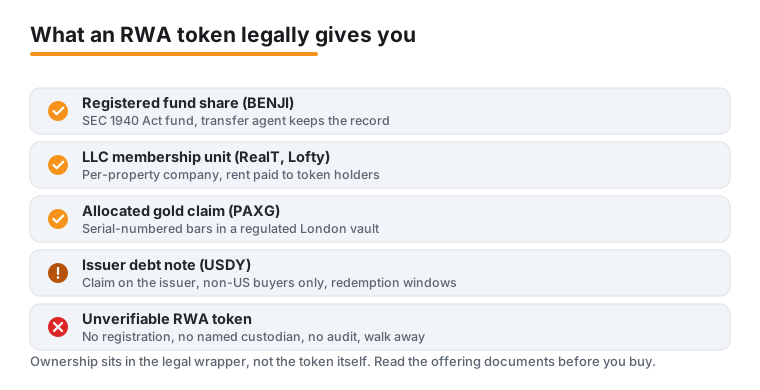
This is the question that separates informed buyers from token collectors. With BENJI you own shares of an SEC-registered fund, and the transfer agent's books, not the blockchain, are the final legal record. With RealT or Lofty you own LLC membership units governed by an operating agreement. With PAXG you own a claim on specific serial-numbered gold bars held by a regulated trust. With USDY you own a debt obligation of the issuer.
Almost all of these are securities under US law, which is why the good ones come with offering documents, KYC, and transfer restrictions, the same machinery we explain in our guide to crypto securities and ICOs. Regulation is catching up in real time: the GENIUS Act now governs stablecoin issuers, and the CLARITY Act, which creates explicit registration paths for tokenized securities, cleared the Senate Banking Committee in May 2026 and is headed to the full Senate. The SEC's stated position is blunt: tokenizing a security does not stop it from being a security.
How the yield compares to a money market fund
A tokenized Treasury fund holds the same T-bills your brokerage money market fund holds, so gross yield is essentially identical. What differs is fees and frictions. BENJI's 0.15% fee undercuts many retail money market funds; other tokenized products charge more. Then add the crypto-side costs a brokerage never charges: on-ramp and off-ramp fees moving dollars to stablecoins and back, gas fees, and bid-ask spreads if you exit on a secondary market instead of redeeming.
What you give up: SIPC coverage, and a broker who can reset your password; lose your keys and recovery depends on the issuer's reissuance process. What you gain: 24/7 transfers, the option to post the token as collateral in DeFi protocols that accept it, and access for people outside the US brokerage system. If you have a brokerage account and just want T-bill yield, the token adds convenience only if you already live on-chain.
The risk checklist before you buy anything
Run every RWA product through this list, in order:
- Issuer risk. Who legally owes you the asset? Check their registration in the regulator's own database (SEC EDGAR, state trust charters), not their website's badges.
- Redemption terms. Can you redeem with the issuer, at what minimum, on what timeline, and does it survive a stressed market? Secondary market liquidity is not redemption.
- Custody and proof of reserves. A named custodian and independent attestations, not self-reported dashboards. For gold, bar lists; for funds, a transfer agent.
- Contract verification. Get the token contract address from the issuer's official documentation and check it on rwa.xyz or a block explorer. Copycat tokens with identical names are one of the most common RWA scams.
- Yield sanity. Treasury-level yield is Treasury-level. Anything advertising double the T-bill rate as risk-free is lying about one of those two words.
Fraudsters now build entire fake RWA sites claiming BlackRock partnerships, complete with forged audits. The tell is always the same: no verifiable registration, no named custodian, pressure to buy through their own portal only.
A first purchase, step by step
A sane starter path for a US retail investor: Step 1, pick the asset class that matches a portfolio need you already have, cash yield (Treasuries), inflation hedge (gold), or income real estate, not the highest APY on a leaderboard. Step 2, choose the route: issuer-direct with KYC (Benji app, Lofty, RealT) gives you the legal wrapper and redemption rights; exchange-listed tokens like PAXG are faster but you verify the contract yourself. Step 3, complete KYC; expect a day or two, not minutes. Step 4, buy a small test amount, $20 to $100, and watch one full distribution cycle land before sizing up. Step 5, keep records from day one, because distributions are taxable income in most jurisdictions and platform tax reporting varies. Non-US readers have a wider menu (USDY, some Centrifuge pools) but should check local rules first.
Frequently asked questions
Do I actually own the house or the gold bar?
Not directly. With real estate tokens you own membership units in an LLC that owns the property; your name is not on the deed. With PAXG you own a legal claim on allocated gold bars held by a regulated custodian. The claims are real and enforceable, but they run through the issuer's legal structure, so read the operating agreement or terms before buying.
Can US investors buy Ondo USDY?
No. USDY is offered to non-US persons only, and Ondo enforces this at KYC. US retail investors wanting tokenized Treasury exposure should look at Franklin Templeton's BENJI, which is an SEC-registered fund with a $20 minimum, or simply hold a regular money market fund at a broker.
Is a tokenized Treasury fund as safe as a regular money market fund?
The underlying T-bills are the same, so credit risk is comparable for a registered product like BENJI. The differences are operational: no SIPC coverage, wallet and key management risk if self-custodied, smart contract risk, and slower recovery processes if something goes wrong. You are swapping brokerage-side protections for on-chain flexibility.
What happens to my tokens if the issuer goes bankrupt?
It depends entirely on the structure. Registered funds and per-property LLCs hold assets bankruptcy-remote from the platform, so your claim survives, though accessing it may take time and lawyers. Bearer-style notes like yield tokens make you a creditor of the issuer, which is a weaker position. This is exactly why the legal wrapper matters more than the token.
Can I sell an RWA token anytime, like a normal crypto token?
Sometimes. PAXG trades on major exchanges around the clock with deep liquidity. Real estate tokens trade on thin platform marketplaces where selling can take days. Fund tokens like BENJI move through the issuer's app and redemption process. Always distinguish secondary market liquidity, which can vanish, from issuer redemption, which is contractual but has minimums and timelines.
How do I spot a fake RWA token?
Check three things independently of the project's website: the issuer's registration in an official regulator database, the token contract address against the issuer's own documentation, and the existence of a named custodian with third-party attestations. Fake RWA projects in 2026 routinely forge audits and claim partnerships with BlackRock or major banks. If any of the three checks fails, walk away.
How are RWA token earnings taxed?
In the US, distributions from tokenized Treasury funds are generally interest-like income, rental token distributions are income from the LLC (often with a K-1 or 1099 depending on structure), and selling any token triggers capital gains rules. Platforms vary widely in reporting quality, so keep your own records and talk to a tax professional before the amounts get serious.
Last updated: 2026-06-30.
Related guides
- Bitcoin Price Predictions & 2026 Outlook
- Can Quantum Computers Break Bitcoin? Real Timeline
- Crypto in Your 401(k): The New 2026 Rules Explained
- Form 1099-DA Explained: The New Crypto Tax Form (2026)
- How to Cash Out Crypto to Your Bank Account (2026)
- Bitcoin (BTC): the Complete Guide
- Crypto Regulation by Country