Home › Crypto Regulation › Gambia
Bitcoin & Cryptocurrency Regulation in Gambia
Quick answer — Gambia, 2026
- Legal: Not illegal to own or trade, not legal tender, unregulated grey zone
- Tax: No crypto-specific tax, general income or business rules may apply
- Buying: No licensed local exchange, use international platforms, P2P, mobile money
The Gambia, one of West Africa's smallest economies, has not built a dedicated legal framework for Bitcoin and other cryptocurrencies. As of 2026 there is no statute that specifically authorises crypto and no statute that specifically bans it. Digital assets sit in a regulatory grey zone: people can and do buy, hold and transfer crypto, but they do so without the licensing regime, tax clarity or consumer protections that a formal framework would provide. The only legal tender for settling debts is the Gambian dalasi (GMD), issued by the Central Bank of The Gambia.
This guide explains, in plain language, where things stand for 2026: the legal status of crypto, which authorities have a say, how buying and exchanges work in practice, taxation, anti-money-laundering rules, and the realities around mining and remittances. Crypto policy across West Africa is moving quickly, so always confirm the current rules with the official Gambian sources named below before acting. This article is general information as of 2026 and is not legal, tax or financial advice; verify your position with the Central Bank of The Gambia or a qualified professional. For wider context, see our crypto regulation overview and our country regulation hub.
On this page: Legal status · Who regulates it · Taxes · How to buy · Mining
Legal status: is Bitcoin and crypto legal in Gambia?
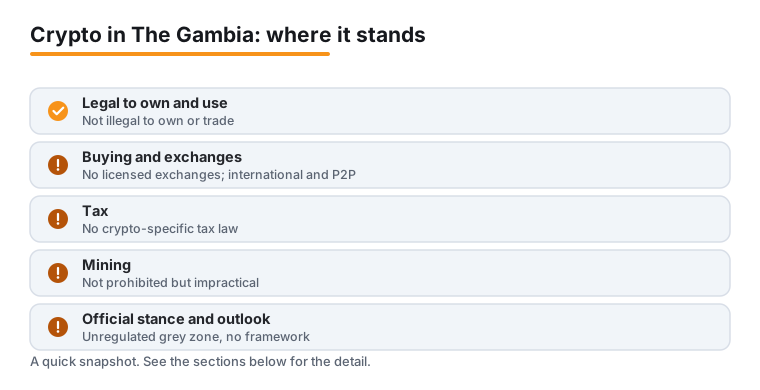
Owning, buying and selling Bitcoin and other cryptocurrencies is not illegal in The Gambia. No law prohibits individuals from holding digital assets, and no law makes them legal tender. The only money recognised by law for settling debts is the Gambian dalasi (GMD), issued by the Central Bank of The Gambia.
In practical terms, crypto is tolerated rather than formally regulated. The absence of specific legislation is a double-edged sword: you are generally free to participate, but if something goes wrong (a hacked exchange, a scam, a failed peer-to-peer trade) there is little dedicated legal recourse and no deposit-insurance-style safety net for crypto holdings. General laws still apply, so using crypto in connection with fraud, money laundering or other financial crime can carry the same consequences as any other illicit financial activity. Because no Gambian authority has issued a definitive public ruling that crypto is either "fully legal" or "banned", treat any such claim with caution and verify the latest position with the Central Bank of The Gambia.
Who regulates crypto in Gambia? The main authorities
No single body has been given an explicit mandate over cryptocurrency, but several institutions are relevant because their existing powers can touch crypto-related activity:
- Central Bank of The Gambia (CBG) is the monetary authority. It issues the dalasi, sets monetary policy, and through its Financial Supervision Department is responsible for licensing, regulation and supervision of the banking sector, foreign-exchange dealers, payment systems and mobile-money operations. Crypto firms that touch the formal banking or FX system can fall within its remit.
- Gambia Financial Intelligence Unit (FIU) is the national anti-money-laundering body. It receives suspicious-transaction reports and supervises reporting entities for AML/CFT compliance.
- Gambia Revenue Authority (GRA) administers taxation. Although there are no crypto-specific tax rules, general income and business-tax law is its responsibility.
There is, as of 2026, no dedicated crypto or virtual-asset regulator and no published register of licensed exchanges or virtual-asset service providers (VASPs). For official contact details, the Central Bank is at 1-2 ECOWAS Avenue, Banjul (see cbg.gm).
Key laws and frameworks
As of 2026, The Gambia has no bespoke cryptocurrency or virtual-asset statute. Crypto businesses are not licensed under a dedicated regime. That does not mean crypto activity is entirely outside the law, because several existing legal regimes can apply:
- Anti-Money Laundering and Combating Terrorist Financing (AML/CFT) law. The Anti-Money Laundering and Combating of Terrorist Financing Act 2012 established the Financial Intelligence Unit and extended AML/CFT obligations to a wide range of reporting entities. A strengthened Anti-Money Laundering, Combating Terrorist Financing and Proliferation Financing (AML/CFT/PF) Bill was validated at a stakeholder workshop on 20 June 2024 to close technical-compliance gaps identified in the country's 2022 Mutual Evaluation. At that workshop the FIU stated the Bill is intended to address risks from Money or Value Transfer Services and emerging technologies, including virtual assets, in line with FATF Recommendations 14 and 15. This is the clearest official signal to date that Gambian authorities plan to bring crypto-related value transfer within AML supervision. As at August 2026 there is no public record that the Bill has been enacted. It does not appear on the National Assembly's bill tracker, which listed 15 bills when last updated in July 2026, and a search of the Assembly's document repository for money laundering returns only the 2012 Act.
- Banking and payments law. The Central Bank of The Gambia supervises banks, FX dealers and payment activity under its enabling legislation.
- Securities, investment and consumer-protection rules. The named statute here is the Capital Market and Securities Act 2021, described at the capital market's launch on 29 September 2023 as the principal regulatory document for the capital and securities markets, under which the Central Bank of The Gambia was appointed to establish and oversee a Securities and Exchange Commission and the Gambia Stock Exchange. Neither the Act nor its launch coverage refers to digital assets or tokenised securities, and no ruling classifying a crypto asset as a security in The Gambia has been published, so a token sold to Gambians as an investment sits in an untested space. If a token or scheme is marketed as an investment, general rules against fraudulent or unauthorised offerings, and ordinary contract and consumer law, can be relevant, although enforcement around novel digital assets is largely untested.
The Gambia is a member of GIABA, the West African regional anti-money-laundering body, and was assessed in a FATF/GIABA Mutual Evaluation. GIABA's published calendar puts The Gambia's next mutual evaluation on-site visit in March 2030, with plenary discussion in November 2030, assessed against the FATF revised assessment methodology adopted in 2022, which covers Recommendation 15 on new technologies and virtual assets. GIABA states that all dates indicated are subject to change, and these are assessment dates rather than a deadline for any Gambian crypto law. Until something changes, the practical rulebook remains the Anti-Money Laundering and Combating of Terrorist Financing Act 2012, which does not mention crypto anywhere.
Licensing and registration of exchanges and VASPs
There is no Gambia-specific licensing or registration regime for cryptocurrency exchanges or virtual-asset service providers as of 2026, and no official register of authorised crypto businesses. The Central Bank of The Gambia does publish a fintech page, but it lists payment service providers only, 15 of them, including Qmoney, Afrimoney, Wave Transfer and Yonna Wallet, and no crypto or virtual asset business appears on it. This contrasts with several other African jurisdictions that have recently introduced VASP licensing or mandatory registration.
Because there is no domestic licensing framework, there are no Gambia-specific exchange rules to comply with beyond a platform's own terms and any identity (KYC) checks it imposes. Where a crypto business interacts with the banking or foreign-exchange system, the Central Bank of The Gambia's banking, FX and payments supervision can still apply, and AML/CFT obligations administered by the FIU may be engaged for activities that amount to value transfer. Anyone planning to operate a crypto business in The Gambia should seek direct guidance from the Central Bank and the FIU, since the absence of a published regime does not mean an absence of obligations.
Crypto taxation in Gambia
The Gambia has no crypto-specific tax law as of 2026, and no published rates or thresholds for cryptocurrency gains or income. Because the tax statutes were not written with digital assets in mind, the treatment of crypto profits is uncertain rather than zero. The default the Gambia Revenue Authority publishes for asset disposals is capital gains tax, which it says applies to any person who disposes a capital asset in The Gambia and to any Gambian resident who sells a capital asset outside The Gambia, at the higher of 15 percent of the gains or 5 percent of the consideration for individuals, and the higher of 25 percent of the gains or 10 percent of the consideration for companies, partnerships and trustees. Trading run as a business would instead meet personal income tax, at the higher of the first schedule rates or 1 percent of turnover on audited accounts, or corporation tax at the higher of 27 percent of net profit or 1 percent of turnover on audited accounts. The GRA has published no ruling on whether a crypto token is a capital asset, so none of these is confirmed to apply to crypto.
The prudent approach is not to assume crypto is tax-free. Keep clear records of your transactions (dates, amounts, counterparties and dalasi values), and confirm your obligations directly with the Gambia Revenue Authority or a qualified Gambian tax adviser before relying on any treatment. For general background on how crypto is taxed elsewhere, see our crypto taxes guide.
AML and KYC rules
Anti-money-laundering and know-your-customer requirements are the part of Gambian law most likely to touch crypto. The Anti-Money Laundering and Combating of Terrorist Financing Act 2012 created the Financial Intelligence Unit and imposed AML/CFT obligations (customer due diligence, record-keeping and suspicious-transaction reporting) on reporting entities, including financial and designated non-financial businesses. A reformed AML/CFT/PF Bill, validated at an FIU stakeholder workshop on 20 June 2024, aims to broaden administrative sanctions and let the FIU enforce compliance without first securing a court order. At that workshop the FIU said the Bill would address emerging technologies including virtual assets under FATF Recommendations 14 and 15, so once enacted it is the most likely route by which crypto-related value transfer is drawn into formal AML supervision.
Although the current rules do not yet name crypto exchanges as a regulated category in the way a dedicated VASP regime would, a business that transmits or converts value can fall within their scope. In practice, the KYC you will most often encounter is that imposed by the international exchanges and peer-to-peer platforms Gambians use, which apply their own identity checks regardless of where you live. You can review the national framework and the list of reporting entities on the Gambia Financial Intelligence Unit website.
Buying and using crypto in practice
There are no Gambia-licensed domestic crypto exchanges, so most users rely on international platforms and peer-to-peer (P2P) trading. Common routes include:
- Global exchanges that accept Gambian users and support card or bank deposits where available.
- Peer-to-peer marketplaces, where buyers and sellers are matched and settle via mobile money or bank transfer, often using an escrow feature.
- Mobile-money rails, which are widely used in The Gambia and frequently bridge the gap between dalasi and crypto in P2P trades.
A careful approach: choose a reputable platform; complete its KYC checks; fund via mobile money or bank transfer; for P2P trades, only release funds once escrow conditions are met; and move coins you are not actively trading into a wallet you control. Start with a small test amount, double-check wallet addresses before sending, and never act on unsolicited "investment" offers. Foreign-exchange controls and individual bank policies can affect how easily you move dalasi in and out, so confirm with your bank or mobile-money provider. Because the sector is unregulated locally, your own diligence is the main line of defence.
Bitcoin mining in Gambia
Bitcoin mining is not specifically prohibited in The Gambia, but the country is not a natural fit for it. Large-scale mining is energy-intensive and needs cheap, abundant and reliable electricity. The Gambia's grid is small and supply can be constrained, with both reliability and cost working against profitable mining at scale.
Off-grid solar is sometimes raised as an eco-friendly angle for a sunny country, and small solar installations could in theory power modest mining setups without straining the public grid. In practice, the upfront cost of solar capacity, batteries and modern mining hardware, plus import and maintenance challenges, makes this a niche, experimental activity rather than a realistic income strategy for most people. Anyone considering it should factor in electricity tariffs, any import duties on equipment, and the lack of a clear regulatory or tax framework for mining revenue, and should verify the current position with the relevant utility and the Gambia Revenue Authority before committing capital.
Crypto remittances to Gambia
Remittances matter enormously to The Gambia: money sent home by Gambians living abroad is a major source of household income and foreign exchange. Traditional channels can be slow or expensive, which is why some people look to Bitcoin and stablecoins as a cheaper, faster alternative for cross-border transfers. Crypto can move value across borders in minutes, and a recipient can convert to dalasi through a P2P trade or mobile money.
Important caveats apply: Bitcoin's price can swing sharply (stablecoins reduce but do not eliminate this); the recipient still needs a reliable off-ramp to spendable dalasi, which adds fees and counterparty risk; cross-border transfers can engage AML rules and foreign-exchange regulations, and informal channels that bypass licensed operators may create legal exposure; and remittance corridors are a frequent target for fraud. Crypto remittances are technically possible and used by some, but they are not a regulated, guaranteed service. Compare the all-in cost and risk against established, licensed money-transfer operators before relying on them.
Recent developments (2025-2026)
The Gambia entered 2026 without a dedicated crypto or virtual-asset law, but the surrounding environment is shifting. The most concrete domestic step has been on the AML side: the strengthened AML/CFT/PF Bill validated in 2024 is intended to bring the country's financial-crime framework closer to FATF standards, which over time tend to draw virtual-asset activity into supervision under Recommendation 15.
Regionally, several African neighbours moved decisively in 2025. Nigeria signed the Investments and Securities Act 2025 in March 2025, which classifies digital assets as securities and requires virtual-asset service providers to register with the Securities and Exchange Commission. Kenya signed its Virtual Asset Service Providers Act into law in October 2025, and Ghana's parliament passed a Virtual Asset Service Providers Bill in December 2025 that places crypto trading under Bank of Ghana oversight with phased licensing during 2026. The Gambia has not followed. Its 2026 Budget Speech, delivered on 5 December 2025 and setting out the year's legislative and revenue measures in detail, contains no mention of cryptocurrency, virtual assets, digital assets or blockchain, and no virtual asset bill appears on the National Assembly's bill tracker. The nearest thing to movement is anti-money-laundering groundwork: a national money laundering and terrorist financing risk assessment was validated in December 2025, and a national AML/CFT/CPF strategy for 2026 to 2030 was commissioned in early 2026. Neither document has been published. None of this has yet produced binding Gambian crypto legislation, so treat the position as evolving and watch the Central Bank of The Gambia and the FIU for official announcements.
Consumer risks and protection
The defining risk in The Gambia is the absence of a clear legal and supervisory framework for crypto. That gap means limited consumer protection, no dedicated dispute-resolution path for crypto disputes, and uncertainty over taxation and the future treatment of crypto businesses. Layered on top are the universal crypto risks: price volatility, fraud and "get-rich-quick" schemes, security threats to wallets and exchanges, and the irreversibility of mistaken or scam transactions.
To protect yourself: treat crypto as a high-risk, speculative asset and never invest money you cannot afford to lose; be sceptical of any guaranteed-return promise, which is a hallmark of fraud; use platforms with strong security records and self-custody for holdings you are not actively trading; use escrow on P2P deals; and keep records of every transaction. Because there is no local investor-protection regime or compensation scheme, recovering funds after a scam or platform failure is extremely difficult, so prevention matters more than it would in a regulated market.
Official sources and how to verify
Crypto rules and tax treatment can change quickly, and this page consolidates the public position as of 2026. Always confirm the current rules with the primary Gambian authorities rather than relying on secondary summaries:
- Central Bank of The Gambia for monetary policy, banking, FX, payments and any official notices on digital assets: cbg.gm.
- Gambia Financial Intelligence Unit for AML/CFT obligations and reporting requirements: fiu.gov.gm.
- Gambia Revenue Authority for tax questions: gra.gm.
- FATF for The Gambia's mutual-evaluation findings on AML/CFT and virtual assets: FATF Mutual Evaluation of The Gambia.
This article is general information as of 2026 and is not legal, tax or financial advice. Verify your specific situation with the Central Bank of The Gambia or a qualified professional before making decisions. For more background, see our crypto regulation guide and the wider regulation hub.
Crypto legislation in The Gambia: what is adopted, what is pending, August 2026
The Gambia has no crypto or virtual asset statute, and as at August 2026 none is before parliament. Rather than leave it there, here is every document that could plausibly become one, with the stage each has actually reached.
| Instrument | Stage | Timing | What it means in practice |
|---|---|---|---|
| Anti-Money Laundering and Combating of Terrorist Financing Act 2012 | In force | Since 2012, and still the only anti-money-laundering statute returned by the National Assembly document repository, where it carries a publication date of 29 June 2026 | Banks, mobile money operators and forex bureaux run identity checks and file suspicious transaction reports. Crypto is never named, but a dalasi cash out through a bank or wallet passes through this regime. |
| Reformed AML/CFT/PF Bill, validated 20 June 2024 | Draft, not introduced | No introduction date published. Absent from the Assembly bill tracker, which listed 15 bills when last updated in July 2026 | The FIU said at validation it would cover money or value transfer services and emerging technologies including virtual assets. If enacted as described, crypto cash out businesses would face FIU registration, due diligence and reporting duties. |
| National money laundering and terrorist financing risk assessment | Validated, not published | Validated December 2025 | Sets the evidence base for what comes next. Whether it treats virtual assets as a risk is not public, and the FIU's risk assessment page still lists only a 2020 report. |
| National AML/CFT/CPF strategy 2026 to 2030 | Commissioned, not drafted in public | Expert support scoped as a three month assignment across the first half of 2026, per the recruitment notice, which closed on 18 February 2026. No publication date announced | Policy, not law, and binding on nobody. It is nevertheless the document that would normally decide whether The Gambia writes virtual asset rules at all. The notice itself does not mention virtual assets. |
| GIABA third round mutual evaluation of The Gambia | Scheduled | On-site visit March 2030, plenary discussion November 2030, per the GIABA consolidated calendar, which states that all dates indicated are subject to change | Assessed against the FATF revised assessment methodology adopted in 2022, which covers the FATF Recommendations as a whole, including Recommendation 15 on new technologies and virtual assets. This is an assessment date, not a deadline for any Gambian crypto law, and GIABA has published no crypto timetable for The Gambia. |
The government's own programme is the strongest evidence that nothing is imminent. The 2026 Budget Speech, delivered on 5 December 2025, names the year's legislative and revenue measures in unusual detail, including a National PPP Bill, a revised GIEPA Act whose draft Bill has been submitted to the National Assembly, electronic VAT invoicing, a Carbon Based Excise Duty on Fuel Products and an increase in the tax on betting, gaming, lottery and gambling winnings from 40 percent to 50 percent. It contains no mention of cryptocurrency, virtual assets, digital assets or blockchain.
One recent enactment on the Assembly bill tracker touches crypto only indirectly. The Data Protection and Privacy Bill 2024 is shown as assented, last updated on 15 July 2026. It governs the lawful processing of data, the rights of data subjects, the legal obligations of controllers and processors, and trans-border data flows. It does not address crypto, though it is the framework that would govern how a platform handles the identity data of Gambian users.
The named laws that already apply to crypto activity
There is no crypto law in The Gambia, so the useful question is which existing instruments bite. These are the ones that do, by name.
| Instrument | Administered by | How it touches crypto |
|---|---|---|
| Anti-Money Laundering and Combating of Terrorist Financing Act 2012 | Gambia Financial Intelligence Unit | Customer due diligence, record keeping and suspicious transaction reporting for reporting entities. Virtual asset service providers are not a named category. |
| Capital Market and Securities Act 2021 | Securities and Exchange Commission, which the Central Bank of The Gambia was appointed to establish and oversee alongside the Gambia Stock Exchange, launched 29 September 2023 | The route by which a token sold as an investment could be treated as a security. No published ruling classifies any crypto asset as a security in The Gambia. |
| Payment Systems Act 2016 | Central Bank of The Gambia | Governs the payment infrastructure a crypto trade settles across. Its payment service provider definition predates crypto and current fintech business models. |
| Regulation for the Provision of Mobile Money Services | Central Bank of The Gambia | Defines retail transfers, facilitates electronic payment services without compromising the safety and efficiency of the national payment system, and sets minimum standards for consumer protection and risk management. It defines no virtual asset. Most peer to peer crypto trades in The Gambia settle on these rails. |
| Banking Act 2009, Consumer Protection Act 2014, Non-Bank Financial Institutions Act 2016 | Central Bank of The Gambia | The rest of the supervision framework a crypto business would collide with if it took deposits, offered credit or held client funds. |
| Income and Value Added Tax Act 2012 | Gambia Revenue Authority | The capital gains, income, corporation and VAT defaults that a crypto disposal or crypto business income would be measured against. |
The World Bank's June 2022 Financial Sector Assessment enumerated exactly this framework and recommended that the Payment Systems Act 2016 and the mobile money regulation be updated to include emerging business models and fintech, expanding the payment service and infrastructure provider definition to cover fintechs and paytechs such as payment initiators, payment gateways and merchant aggregators. That update has not been published as at August 2026. In February 2026 the Central Bank launched a National Payment Systems Advisory Committee with an initial three year term, meeting at least quarterly, to advise on payment system policy, risk management, consumer protection and interoperability, following the launch of BANTABA 2.0, described as the country's first real time, fully interoperable payment system. Neither the committee's stated mandate nor the payment system extends to virtual assets.
Crypto tax in The Gambia: the default rates you would be measured against
The Gambia has no crypto tax rule and the Gambia Revenue Authority has published no ruling on how crypto is classified. It does publish the rates for the general regimes a crypto disposal would be argued under, and those are what you would be measured against.
| Tax | Published rate |
|---|---|
| Capital gains tax, individuals | The higher of 15 percent of the gains or 5 percent of the consideration |
| Capital gains tax, companies, partnerships and trustees | The higher of 25 percent of the gains or 10 percent of the consideration |
| Corporation tax | The higher of 27 percent of net profit, or 1 percent of turnover on audited accounts (2 percent of turnover for unaudited accounts) |
| Personal income tax on business income | The higher of the applicable rates in the first schedule or 1 percent of turnover for audited accounts (2 percent of turnover in any other case). If business turnover is under D500,000 per annum, 3 percent of turnover |
| Value added tax | 15 percent standard rate |
The GRA states that any person who disposes a capital asset in The Gambia is liable to pay capital gains tax, and that any Gambian resident who sells a capital asset outside The Gambia is liable too, giving land, machinery and shares as its examples. Whether a crypto token counts as a capital asset for this purpose has not been publicly determined, and the 2026 Budget Speech announced no crypto tax measure. Treat these as the rates you would argue about rather than rates confirmed to apply, keep dated records of every acquisition and disposal in dalasi terms, and put the question to the Gambia Revenue Authority in writing before relying on any treatment.
Frequently asked questions
Is cryptocurrency legal in The Gambia?
There is no law that bans owning or trading crypto in The Gambia, and no law that makes it legal tender. It sits in an unregulated grey zone: generally permitted, but without dedicated consumer protections. The only legal currency is the Gambian dalasi. Verify the current position with the Central Bank of The Gambia.
Who regulates cryptocurrency in The Gambia?
No single body has an explicit crypto mandate. The Central Bank of The Gambia supervises banking, foreign exchange, payments and mobile money; the Financial Intelligence Unit handles anti-money-laundering oversight; and the Gambia Revenue Authority handles tax. There is no dedicated crypto or VASP regulator as of 2026.
Does The Gambia have a crypto law or licensing regime?
Not as of 2026. The Gambia has not enacted a dedicated virtual-asset statute, and there is no published licensing regime or register for crypto exchanges or VASPs. General laws, especially the Anti-Money Laundering and Combating of Terrorist Financing Act 2012 and financial-crime rules, can still apply to crypto-related activity.
How are crypto gains taxed in The Gambia?
There is no crypto-specific tax framework for The Gambia and no Gambia Revenue Authority ruling on how crypto is classified. The general rates you would be measured against are published: capital gains tax at the higher of 15 percent of the gains or 5 percent of the consideration for individuals, and the higher of 25 percent of the gains or 10 percent of the consideration for companies, partnerships and trustees; corporation tax at the higher of 27 percent of net profit or 1 percent of turnover on audited accounts; and VAT at 15 percent. Crypto profits are not automatically tax-free, however: depending on the activity, general income or business-tax rules could apply. Confirm your obligations with the Gambia Revenue Authority or a qualified tax adviser before relying on any treatment.
Are there KYC or AML rules for crypto in The Gambia?
The Anti-Money Laundering and Combating of Terrorist Financing Act 2012 created the Financial Intelligence Unit and imposes customer due diligence, record-keeping and suspicious-transaction reporting on reporting entities. A strengthened AML/CFT/PF Bill was validated in 2024. While crypto exchanges are not named as a separate licensed category, value-transfer businesses can fall within these rules, and international platforms apply their own KYC checks to Gambian users.
Can I use Bitcoin to send remittances to The Gambia?
It is technically possible to send value via Bitcoin or stablecoins and convert to dalasi through peer-to-peer trades or mobile money. But this is not a regulated, guaranteed service, and it carries volatility, off-ramp and compliance risks. Compare the full cost and risk against licensed money-transfer operators first.
Has the Central Bank of The Gambia banned or endorsed cryptocurrency?
No. The Central Bank of The Gambia has not issued a public ruling that either bans crypto or recognises it as legal tender, and the only legal currency remains the dalasi. Treat any claim that Gambia has "legalised" or "banned" crypto with caution and check the Central Bank and the FIU for official notices.
Does the reformed AML bill cover crypto in The Gambia?
At the validation workshop on 20 June 2024, the Financial Intelligence Unit said the reformed AML/CFT/PF Bill is intended to address emerging technologies including virtual assets, in line with FATF Recommendations 14 and 15. This is the clearest signal that crypto-related value transfer will be drawn into AML supervision, but you should confirm the Bill's enactment status with the FIU.
Is a crypto law coming in The Gambia, and when?
No crypto or virtual asset bill is before the National Assembly as at August 2026. Its public bill tracker listed 15 bills when last updated in July 2026 and none concerns virtual assets or anti-money laundering, and the 2026 Budget Speech of 5 December 2025 names no crypto measure. The next scheduled milestone is GIABA's third round mutual evaluation of The Gambia, with an on-site visit set for March 2030 and plenary discussion in November 2030, assessed against the FATF revised methodology adopted in 2022 that covers virtual assets under Recommendation 15. GIABA marks all those dates as subject to change, and they are assessment dates rather than a deadline for legislation. Before that, the document to watch is the national AML/CFT/CPF strategy for 2026 to 2030, commissioned in early 2026 and not yet published.
What tax rate would apply if I sell crypto at a profit in The Gambia?
There is no crypto-specific rate. The Gambia Revenue Authority's published default for disposing of a capital asset is capital gains tax at the higher of 15 percent of the gains or 5 percent of the consideration for individuals, and the higher of 25 percent of the gains or 10 percent of the consideration for companies, partnerships and trustees. Corporation tax is the higher of 27 percent of net profit or 1 percent of turnover on audited accounts, and VAT is 15 percent. The GRA has published no ruling on whether a crypto token is a capital asset, so confirm your position with the GRA in writing before relying on any of these figures.
Is any crypto exchange licensed in The Gambia?
No. The Central Bank of The Gambia publishes a fintech page and it lists payment service providers only, 15 of them, including Qmoney, Afrimoney, Wave Transfer and Yonna Wallet. No crypto or virtual asset business appears on it, and there is no virtual asset service provider licence in The Gambia to apply for. Anyone claiming to hold a Gambian crypto licence is misrepresenting the position.
Was the reformed anti-money-laundering bill validated in 2024 ever passed?
There is no public record that it was. It does not appear on the National Assembly's bill tracker, and a search of the Assembly's document repository for money laundering returns only the Anti-Money Laundering and Combating of Terrorist Financing Act 2012. Both Assembly archives are visibly incomplete and still being digitised, so this is an absence of public evidence rather than proof that no replacement was enacted. Treat the 2012 Act as the law in force until an enacted replacement is published.
Does The Gambia have a securities regulator that could rule on crypto tokens?
The Capital Market and Securities Act 2021 is the principal regulatory document for the capital and securities markets, and under it the Central Bank of The Gambia was appointed to establish and oversee a Securities and Exchange Commission alongside the Gambia Stock Exchange, launched on 29 September 2023. Neither the Act nor the launch coverage mentions digital assets, no ruling classifying a crypto asset as a security has been published, and the Commission's current operating status and rulebook are not public. A token sold to Gambians as an investment therefore sits in an untested space rather than a permitted or prohibited one.
Facts reviewed: 13 August 2026. Page updated: 13 August 2026.