Home › Crypto Regulation › Ghana
Bitcoin & Cryptocurrency Regulation in Ghana
Quick answer — Ghana, 2026
- Legal: Legal to own and trade under Act 1154, not legal tender
- Tax: No standalone crypto tax; existing income and capital gains rules apply
- Buying: Via mobile money, exchanges and P2P, providers must be licensed
Ghana has moved from cautious warnings to an active, written rulebook for digital assets. After years in which the Bank of Ghana treated cryptocurrencies as unregulated and risky, Parliament passed the Virtual Asset Service Providers Act, 2025 (Act 1154) in December 2025, and President John Mahama assented to it on 30 December 2025. The Act creates a formal framework to register, license and supervise crypto businesses. Implementation is phased through 2026, led by the Bank of Ghana (through a dedicated virtual assets office) alongside the Securities and Exchange Commission (SEC) and the Financial Intelligence Centre (FIC). This guide explains what is and is not legal, who regulates the sector, how tax, licensing and AML rules work, and the practical steps for buying and holding Bitcoin in Ghana. This is general information as of 2026 and is NOT legal, tax or financial advice; verify current rules with the Bank of Ghana, the SEC and the Ghana Revenue Authority before acting. See also our broader guide to crypto regulation.
On this page: Legal status · Who regulates it · Taxes · How to buy · Mining
Is Bitcoin and crypto legal in Ghana?
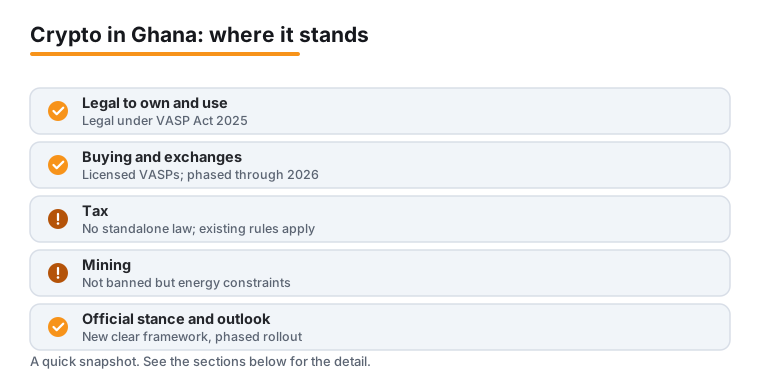
Yes. Owning, buying, selling and trading Bitcoin and other cryptocurrencies is legal in Ghana under the Virtual Asset Service Providers Act, 2025 (Act 1154). The law explicitly recognises virtual assets and the businesses that handle them, replacing the earlier position in which the Bank of Ghana had not authorised any institution to deal in crypto and had warned the public against it.
One important limit remains: cryptocurrencies are not legal tender. The Ghanaian cedi (GHS) is the sole official currency, and no business is obliged to accept Bitcoin for payment. Crypto is treated as a digital asset you can hold, invest in and transfer, not as official money. Separately, the Bank of Ghana has been developing a central bank digital currency (the eCedi); a CBDC is government-issued and is a different thing from decentralised crypto such as Bitcoin.
In short: holding and trading crypto is permitted, businesses that serve the public must be licensed, and the cedi keeps its exclusive status as national currency.
Who regulates crypto in Ghana?
Oversight is shared, with the central bank in the lead:
- Bank of Ghana (BoG) is the primary regulator and lead licensing authority for virtual asset service providers (VASPs). The central bank has stood up a dedicated virtual assets office to oversee the sector and operationalise the Act.
- Securities and Exchange Commission (SEC) handles activities that involve securities or investment-type products, and runs the regulatory sandbox through which crypto firms are being tested before full licensing.
- Financial Intelligence Centre (FIC) oversees anti-money-laundering reporting and financial-crime monitoring.
- Ghana Revenue Authority (GRA) administers taxation.
You can confirm the current status of the framework on the Bank of Ghana's dedicated page at bog.gov.gh/virtual-assets and on the SEC at sec.gov.gh.
Key laws and frameworks
The cornerstone is the Virtual Asset Service Providers Act, 2025 (Act 1154), passed by Parliament in December 2025 and assented to by the President on 30 December 2025. It brings a previously informal market into a supervised perimeter. A Bank of Ghana registration exercise in July 2025 had identified over 100 firms offering exchange, wallet, brokerage and advisory services to a user base put at more than three million Ghanaians, with the local market often cited in the region of US$3 billion in annual flows. Ghana is consistently ranked among the leading crypto markets in Africa in industry adoption studies. The Act sets out who may offer crypto services and on what terms.
To operationalise the Act, regulators began issuing instruments in early 2026. The SEC issued its Securities Industry (Regulatory Sandbox Licensing) Guidelines 2026 on 9 March 2026, under section 71 of Act 1154, creating a dedicated virtual asset sandbox track for firms dealing in crypto, tokenisation, distributed-ledger technology and related innovations. The Bank of Ghana and SEC signalled that further directives, capital and risk-management standards, and AML/CFT rules would follow during 2026.
As at August 2026 the licence categories, fees, capital thresholds and application deadlines have not been published at all. The Bank of Ghana register of regulatory directives lists 70 instruments and none concerns virtual assets, and the SEC register lists only the March 2026 sandbox guidelines. The Bank of Ghana roadmap scheduled commencement of licensing and registration to begin from March 2026, and that has not happened; no revised date has been published. The design principles are already fixed in Ghana's published policy position: no ban, activity-based licensing, risk-based tiering so higher-risk services face more stringent requirements, enforcement of FATF Recommendation 16 (the Travel Rule) on VASPs operating in and from Ghana, and criminal sanctions for severe violations. The Bank of Ghana covers payments, custody and financial stability, the SEC covers offering, trading and investment, and the Financial Intelligence Centre covers AML and CFT compliance.
Licensing and registration of exchanges and VASPs
Under Act 1154, exchanges, brokers, wallet and custody providers, and crypto payment platforms must register and obtain a licence before operating in Ghana, with the Bank of Ghana as the primary licensing authority. The regime is activity-based by design, not entity-based. Ghana's published policy position states that licensing and registration should depend on the activity performed, and not the specific technology used, and the SEC has confirmed eleven separate virtual asset service categories it will license under the Act, from exchanges and trading platforms through tokenisation, brokerage and advocacy on securities. A firm is authorised for named services rather than given a blanket licence.
Typical obligations under the framework include:
- Know-Your-Customer (KYC) and customer due diligence;
- Anti-Money-Laundering and Counter-Terrorism-Financing (AML/CFT) controls aligned with Financial Action Task Force (FATF) standards;
- compliance with the FATF "Travel Rule" (sharing originator and beneficiary data on transfers between providers);
- minimum capital, cybersecurity, audit and ongoing reporting requirements.
Rollout is phased across 2026. Two parallel sandboxes are running. In March 2026 the SEC admitted 11 firms (Africoin, Blu Penguin, Goldbod, Hanypay, Hyro Exchange, HSB Global, Koinkoin, Whitebits, Vaulta, Xchain and Bsystem) to a 12-month sandbox covering capital-markets and investment-type products, while the Bank of Ghana had earlier admitted a separate group of 6 firms to its own sandbox covering payments, custody, exchange and issuance. Separately, the Bank of Ghana had already required registration a year earlier. Notice No. BG/GOV/SEC/2025/18, dated 10 July 2025, required all VASPs offering services to persons resident in Ghana, whether through physical presence or digital platforms, to register with the central bank by 15 August 2025. Registration was compulsory but, in the notice's own words, does not constitute a licence to operate, nor does it imply legal recognition or approval. Existing operators are expected to register and demonstrate compliance to keep serving customers. By March 2026 the Bank of Ghana reported that more than 100 crypto firms had registered, and it set up a dedicated office to oversee the sector. Always check a platform's current regulatory standing before depositing funds.
Crypto and Bitcoin tax in Ghana
Ghana does not yet have a standalone crypto tax statute, but that does not make crypto tax-free. The Ghana Revenue Authority (GRA) applies existing income-tax and capital-gains rules to crypto activity, and the new VASP framework gives regulators scope to require licensed platforms to report user transactions, partly to capture revenue from a market that was previously informal.
As a general guide to how the existing rules tend to apply:
- Trading as a business or profession recurring profits from active trading are generally treated as taxable income.
- Disposing of an investment gains on selling crypto held as an asset may fall under the GRA's capital-gains rules; residents are required to report gains on chargeable assets.
- Receiving crypto as payment the cedi value at the time of receipt is typically relevant for income purposes.
The Ghana Revenue Authority has published no crypto practice note, so no official guidance confirms how a crypto disposal is characterised. The default rule it does publish is capital gains tax: for an individual, gains on realising an investment asset are charged at 15 percent of the net gains realised, treated as an isolated transaction, under section 35 of the Income Tax Act, 2015 (Act 896), while businesses instead include capital gains in their annual returns and are taxed accordingly. The GRA capital gains page does not mention crypto, and the treatment of staking rewards, mining income and airdrops remains unstated. Confirm your exact liability, applicable rates and filing obligations with the GRA at gra.gov.gh or a qualified Ghanaian tax adviser. Keep clear records of every buy, sell, swap and transfer (dates, cedi values and fees). See our general crypto taxes overview. This section is general information, not tax advice.
AML, KYC and the Travel Rule
Anti-money-laundering and counter-terrorism-financing rules are central to Ghana's framework. Licensed VASPs must run identity verification (KYC) and customer due diligence, monitor and report suspicious activity to the Financial Intelligence Centre, and apply controls consistent with FATF standards. The framework also adopts the FATF Travel Rule, which requires providers to collect and share originator and beneficiary information when virtual assets move between regulated platforms.
For everyday users this means you should expect to verify your identity when opening accounts and when sending or receiving larger amounts, and to have your transactions recorded. These requirements sit alongside Ghana's existing foreign-exchange rules, which continue to apply to cross-border value transfers. The practical effect is greater traceability and stronger consumer protection, at the cost of more documentation than the previously informal market required.
Buying and using crypto in practice
Most Ghanaians buy crypto online rather than through physical outlets. The dominant on-ramp is mobile money (MTN Mobile Money / MoMo and AirtelTigo Money), followed by bank transfers and cards. Common routes include:
- Global exchanges that serve Ghana (for example Binance, OKX, Kraken and Crypto.com), usually funded by card or bank transfer;
- Africa-focused platforms that support cedi mobile-money deposits and peer-to-peer trades;
- Peer-to-peer (P2P) marketplaces, where buyers and sellers transact directly with escrow protection.
Under the VASP Act, providers serving Ghanaian customers are expected to be licensed (or operating within the sandbox) and to run KYC checks, so be prepared to verify your identity. One funding-route pitfall to note: in June 2026 the Bank of Ghana ordered banks, e-money issuers and payment providers to stop supporting unauthorised foreign-currency (for example US dollar) crypto wallet services linked to local payment channels, so dollar-wallet top-ups through a Ghanaian bank or card may not work. Practical tips: prefer regulated or well-established platforms, compare the all-in price (spread plus fees) across routes, enable two-factor authentication, withdraw long-term holdings to a wallet you control, and watch for impersonation scams on social media and messaging apps. As licensing takes effect during 2026, the list of authorised providers will firm up, so check a platform's regulatory standing before depositing funds.
Bitcoin ATMs and mining in Ghana
Bitcoin ATMs are scarce. A handful of machines have appeared in Accra over time, but coverage is thin and availability changes frequently. ATM spreads and fees are typically far higher than buying on an exchange, and a licensed ATM operator will still apply identity checks under the new rules. For most users, mobile money and online exchanges are more practical and cheaper.
Mining is not banned, but it is not a mainstream activity and faces real practical hurdles. The biggest is electricity: grid power can be costly and supply is not always reliable, and mining is energy-hungry, so margins are sensitive to tariffs and uptime. Miners also operate within Ghana's general rules on business registration, equipment import, energy use and taxation, and the VASP framework may touch operators who also provide custody or exchange-type services. Ghana's strong solar potential makes renewable or hybrid setups worth exploring, but anyone considering mining at scale should model power costs carefully and confirm the licensing, energy and tax position with the relevant authorities before investing.
Recent developments (2025-2026)
The pace of change has been rapid:
- December 2025 Parliament passed the Virtual Asset Service Providers Act, 2025 (Act 1154), and the President assented to it on 30 December 2025, formally legalising and bringing crypto businesses under supervision.
- Early 2026 the Bank of Ghana established a dedicated virtual assets office and signalled phased licensing rules through the year; the BoG and SEC committed to issuing operational directives within the early part of 2026.
- 20 February 2026 the Bank of Ghana and SEC issued a joint directive ordering VASPs to stop public advertising of crypto and stablecoin products and to take down billboards within 48 hours, warning of sanctions; the order applies even to firms in the sandbox.
- 5 March 2026 the Bank of Ghana issued a notice making registration mandatory for all VASPs operating in or serving Ghana, while noting that registration is not a licence or approval to operate. The central bank reported that more than 100 firms had registered.
- 9 March 2026 the SEC issued the Securities Industry (Regulatory Sandbox Licensing) Guidelines 2026 under section 71 of Act 1154, creating a virtual asset sandbox track.
- March 2026 the SEC admitted 11 firms to a 12-month sandbox for capital-markets and investment products; the Bank of Ghana had earlier admitted a separate group of 6 firms to its own sandbox covering payments, custody, exchange and issuance.
- June 2026 the Bank of Ghana ordered banks, e-money issuers and payment providers to stop supporting unauthorised foreign-currency (for example US dollar) crypto wallet services, citing the Payment Systems and Services Act 2019 and the Foreign Exchange Act 2006.
Officials have also signalled interest in broader digital-money initiatives, including the eCedi CBDC and discussion of gold-backed stablecoin concepts. The Bank of Ghana has published an eCedi design paper and related material but no launch date, and no gold-backed stablecoin instrument appears in its regulatory directives register, its virtual asset publications or its notices through early August 2026. Treat both as policy interest rather than a scheduled product.
Consumer risks and protection
Crypto in Ghana now sits inside a clearer legal structure, which is positive, but key risks remain. Market risk is unavoidable: Bitcoin and other cryptocurrencies are highly volatile and can lose value quickly, so never invest money you cannot afford to lose. Fraud and security risk is significant: scams, phishing, fake support accounts, "guaranteed returns" schemes, hacking and lost keys cause real losses. Transition risk is specific to this moment: the licensing regime is being rolled out in phases through 2026, so the roster of authorised providers, the precise compliance obligations and the tax treatment are still settling.
The new framework is designed to improve protection over time by legalising and supervising the sector, deterring money laundering and allowing regulated innovation through pilots and a sandbox. But regulation does not remove market risk. Sensible principles: invest only surplus funds, diversify, use reputable and (where required) licensed or sandbox-approved platforms, secure your accounts and keys, keep records, and consult a licensed financial adviser in Ghana if in doubt. None of this is investment advice.
Official sources and how to verify
Because the rules are evolving, the most reliable course is to check primary, official sources rather than third-party summaries. Start here:
- Bank of Ghana virtual assets page for the framework, licensing status and notices.
- SEC Ghana Regulatory Sandbox Licensing Guidelines 2026 for the sandbox track and participant announcements.
- Ghana Revenue Authority capital gains tax for tax treatment and filing.
This guide is general information as of 2026 and is NOT legal, tax or financial advice. Verify any specific legal or tax question with the named official regulators (the Bank of Ghana, the SEC, the FIC and the GRA) or a qualified Ghanaian professional before acting. For more context, see our crypto regulation guide and our country regulation hub.
What is changing: Ghana crypto status in August 2026
Ghana's Virtual Asset Service Providers Act, 2025 (Act 1154) is law, but the licensing regime it creates has still not opened. The Bank of Ghana confirms Parliament passed the Act on 19 December 2025 in its official FAQ on the law (Bank of Ghana, Frequently Asked Questions: The Virtual Asset Service Providers Act, dated February 2026). As of early August 2026 no VASP licence has been issued in Ghana, because neither regulator has published the licensing directives and guidelines needed to operationalise the Act.
For a reader in Ghana today, that translates into five concrete points, each stated by the regulator rather than inferred:
- Owning and trading crypto for yourself is lawful and needs no licence. The Bank of Ghana states the law targets service providers, not individuals trading on their own behalf, and that neither the regulatory authorities nor the government will control private wallets or individual transactions (VASP Act FAQs, questions 8 and 11).
- The cedi remains sole legal tender. The Bank of Ghana adds that it is not permissible, under the law, to issue invoices, set prices or pay wages in virtual assets (question 14).
- No exchange serving Ghana is licensed yet. The 2025 registration exercise expressly does not confer authorisation: it states that registration does not constitute a licence to operate, nor does it imply legal recognition or approval (Notice No. BG/GOV/SEC/2025/18).
- Crypto has no deposit protection. Virtual assets are not covered by Ghana's deposit protection scheme or any statutory compensation fund (question 20).
- Banks may work with crypto firms, but only with approval. The law allows regulated partnerships between banks or dedicated electronic money issuers and VASPs, subject to risk management, compliance requirements and supervisory approval (question 15).
The Bank of Ghana supervises this through a dedicated Virtual Asset Department, contactable at [email protected], and the SEC through a Virtual Asset Committee. Registration enquiries go to [email protected].
One date already on this page needs correcting against the primary source. The Bank of Ghana's mandatory VASP registration exercise was ordered by Notice No. BG/GOV/SEC/2025/18 dated 10 July 2025, with a deadline of 15 August 2025. There is no Bank of Ghana VASP registration notice dated March 2026.
The VASP licensing pipeline and when it is expected to move
The Bank of Ghana published a dated implementation roadmap for the virtual asset regime. It is the clearest public statement of what is coming and roughly when, so it is worth setting the roadmap's own timings against what had actually happened by August 2026 (Bank of Ghana Roadmap for Virtual Asset Service Providers Regulatory Development).
| Roadmap timing | Milestone as published | Position in August 2026 |
|---|---|---|
| Jul to Aug 2025 | Engagement with industry and relevant state agencies on the draft VASP Bill and framework | Done |
| Jul to Aug 2025 | Launch of mandatory registration for VASPs operating in and from Ghana, with SEC and FIC | Done. Notice BG/GOV/SEC/2025/18, deadline 15 August 2025, over 100 VASPs recorded |
| Aug to Sep 2025 | Consultations on the draft VASP Bill with the Attorney General's Office, Parliament and Cabinet | Done |
| Aug to Sep 2025 | Deployment of a dedicated webpage or portal for VASP registration and information | Done. The Bank of Ghana virtual assets and VASP resources pages are live |
| Sep to Oct 2025 | Passage of the draft VASP Bill into Act | Slipped. Parliament passed it on 19 December 2025 |
| Oct 2025 to Mar 2026 | Limited sandboxing of VASP business models | Done. Six entities admitted 22 January 2026 for one year |
| Nov to Dec 2025 | Public consultation on draft VASP directives, guidelines and stakeholder validation workshop | No published output as at August 2026 |
| Oct 2025 to Feb 2026 | Nationwide public awareness campaign on virtual assets | Done. Four National Virtual Assets Education Manuals published 16 April 2026 |
| From Mar 2026 | Phased operationalisation of the VASP Act, meaning commencement of licensing and registration | Not yet visible. No licensing instrument published by either regulator |
| Mar to Apr 2026 | Update of the webpage with FAQs, compliance materials and guidance notes | Partly done. The VASP Act FAQs are dated February 2026 |
The one milestone that matters most to exchanges, banks and holders is the last substantive one: phased operationalisation of the VASP Act, commencement of licensing and registration, scheduled to begin from March 2026. It has not visibly begun. The Bank of Ghana's published register of regulatory directives lists 70 instruments and none concerns virtual assets, and its notices up to 3 August 2026 announce none. The SEC's published register of directives and guidelines likewise contains only one virtual asset instrument, the March 2026 sandbox guidelines (SEC directives and guidelines register).
What is therefore still unpublished, and what a prospective operator is waiting for: licence categories in operational form, application windows, licence fees, minimum capital thresholds, cybersecurity standards and Travel Rule mechanics. The SEC said on 29 December 2025 that it and the Bank of Ghana would issue guidelines and other regulatory instruments to operationalise the Act (SEC press release, Passage of the Virtual Asset Service Providers Bill). No revised date has been published. The Bank of Ghana's VASP resources page carries a section heading for Guidelines for Whitepapers with no document published under it.
The Act does provide for transitional arrangements letting existing operators apply for licensing or registration once the regime becomes operational, confirmed in the February 2026 joint notice, and the Bank of Ghana warns that operating without authorisation after this period will attract sanctions. The length of the transition window has not been published.
The June 2026 directive that changed how Ghanaians fund crypto accounts
On 12 June 2026 the Bank of Ghana issued Notice No. BG/GOV/SEC/2026/14, a supervisory directive regarding support for fiat USD wallet services in Ghana. It is the most practically significant development for ordinary Ghanaian crypto users in 2026 (read the directive).
The Bank said it had noted with concern the operation of fiat currency wallet arrangements, denominated in foreign currencies, mainly United States dollars, by certain crypto platforms for users in Ghana, supported through bank transfers, payment cards and other payment channels provided by some regulated financial institutions. It found that these arrangements typically involve activities that require authorisation under the Payment Systems and Services Act, 2019 (Act 987) and the Foreign Exchange Act, 2006 (Act 723), and that the relevant crypto platforms have not been authorised by the Bank of Ghana to undertake such activities.
Banks, specialised deposit-taking institutions, electronic money issuers, payment service providers and other regulated financial institutions were directed to refrain from establishing or maintaining arrangements that facilitate the funding, operation, settlement or customer access to unauthorised fiat currency wallet services offered to users in Ghana. Institutions that currently provide banking, payment, card acquiring, settlement or related services in support of such arrangements were told to take immediate steps to discontinue that support. Failure to comply may result in supervisory or enforcement actions.
The practical effect for a retail user is that funding a US dollar balance on an unauthorised crypto platform using a Ghanaian bank transfer or card is being closed off at the bank end. Note what the directive is not: it is an instruction to regulated financial institutions, not a ban on owning or trading crypto, and it does not make holding virtual assets unlawful.
Crypto tax in Ghana: what is actually published
Ghana has no crypto-specific tax statute, and the Ghana Revenue Authority has published no crypto practice note. Its register of practice notes lists none covering virtual or digital assets (GRA practice notes). That is not the same as crypto being untaxed, but it does mean no official Ghanaian guidance confirms how a crypto disposal is characterised.
What is officially published is the general capital gains rule for realising an investment asset (GRA, Capital Gains Tax). The GRA page does not mention crypto anywhere, so treat the following as the default rule a Ghanaian adviser would start from, not as a ruling on virtual assets:
- 15 percent for individuals, charged on the net gains realised, with the gain treated as an isolated transaction, under section 35 of the Income Tax Act, 2015 (Act 896).
- For businesses, the GRA states capital gains are not charged at that isolated rate but are included in the business annual returns and taxed accordingly.
- Frequent or professional trading is more likely to be treated as business income than an isolated capital gain, which moves it out of isolated-transaction treatment and into the ordinary income regime.
- Reporting is self-assessed. The GRA requires a Capital Gains Tax Return summarising chargeable assets disposed of. Because no VASP is licensed in Ghana yet, no local exchange operates a statutory withholding or reporting channel for crypto, so the obligation sits with the taxpayer.
The GRA has published nothing on staking rewards, mining income, airdrops or crypto-to-crypto swaps, and nothing confirming that crypto is a chargeable investment asset for section 35 purposes. Treat those as open questions and seek a ruling rather than assuming a treatment.
Who is actually inside Ghana's crypto sandboxes
Two separate sandboxes are running, and neither is a licence.
Bank of Ghana sandbox. On 22 January 2026 the Bank of Ghana admitted six entities into its Regulatory Sandbox for one year, to assist in validating proposed regulatory frameworks around the exchange, custody, administration and issuance of virtual assets (Bank of Ghana press release, List of Participants, Regulatory Sandbox):
- Transika Ltd.
- One Africa Securities Ltd.
- Mansu Technologies Ltd.
- Payafrione Gh Ltd
- Akuna Wallet Ltd.
- Afrix Paycoin Ltd.
The Bank reserves the right to withdraw its approval of any entity at any time for non-performance or non-compliance. That one year term runs to around 22 January 2027.
SEC sandbox. On 9 March 2026 the SEC issued the Securities Industry (Regulatory Sandbox Licensing) Guidelines 2026, number SEC/GUI/001/03/2026, under sections 3 and 209 of the Securities Industry Act, 2016 (Act 929) as amended by the Securities Industry (Amendment) Act, 2021 (Act 1062), and pursuant to section 71 of Act 1154. They replace the 2020 sandbox guidelines and create a designated Virtual Asset Sandbox Track (read the guidelines). Concrete requirements include:
- A foreign applicant must demonstrate not less than 30 percent local participation, satisfied either by Ghanaian citizens or Ghanaian-owned companies holding at least 30 percent of the issued equity, or by binding commercial arrangements giving Ghanaian entities at least 30 percent of the net economic benefit.
- Every foreign applicant admitted must establish and maintain a physical operational office in Ghana for the duration of the testing period and appoint at least one Ghana-resident senior officer or compliance officer. The guidelines state that a registered address without substantive operational capacity does not satisfy this requirement.
- The approval process shall not exceed 90 days, and if it extends beyond 90 days the SEC shall inform the applicant. Lapse of the 90 day period is not automatic approval.
- Fees are not fixed in the guidelines. The applicable fee structure is to be communicated separately by the SEC, is non-refundable, and may be varied.
- An extension must be applied for at least one month before the sandbox period expires.
- On exit, an entity must obtain all required licences before deploying to the investing public, transitioning to a licensed virtual asset service under the Schedule to Act 1154.
The SEC has confirmed it will license eleven categories of virtual asset service under the Act: virtual asset exchanges, trading platforms, issuance, tokenisation, exchange traded funds, managers, investment advisors, brokerage, advocacy on securities, mining and validation on securities, and sandbox on securities (SEC press release, 29 December 2025). The SEC has not published a list of sandbox participants on its public notices and press releases page, and its guidelines say participant details may, rather than shall, be posted (SEC public notices and press releases).
Frequently asked questions
Is cryptocurrency legal in Ghana in 2026?
Yes. Buying, holding and trading crypto is legal under the Virtual Asset Service Providers Act, 2025 (Act 1154), passed in December 2025 and assented to on 30 December 2025. However, crypto is not legal tender (only the cedi is), and businesses that offer crypto services to the public must be licensed, primarily by the Bank of Ghana.
Who regulates crypto in Ghana?
The Bank of Ghana is the primary regulator and lead licensing authority, working through a dedicated virtual assets office, alongside the Securities and Exchange Commission (SEC) for securities-related activity and the regulatory sandbox, and the Financial Intelligence Centre (FIC) for anti-money-laundering oversight. The Ghana Revenue Authority handles tax. Verify current details at bog.gov.gh.
Do I need a licence to run a crypto exchange in Ghana?
Yes. Under Act 1154, exchanges, brokers, wallet and custody providers, and crypto payment platforms must register and be licensed before operating, with the Bank of Ghana as lead authority. The regime is being rolled out in phases through 2026, and in March 2026 the SEC admitted an initial group of firms to a 12-month regulatory sandbox to test services under supervision. Check official BoG and SEC notices for current licence categories, capital requirements and deadlines.
Do I have to pay tax on crypto in Ghana?
Generally yes. Ghana has no dedicated crypto tax law, but the Ghana Revenue Authority applies existing income-tax and capital-gains rules to crypto profits, and licensed platforms may be required to report transactions. Rates quoted online vary and are not always official, so confirm your exact liability with the GRA or a qualified tax adviser. This is not tax advice.
What is the best way to buy Bitcoin in Ghana?
Most people buy online using mobile money (MTN MoMo or AirtelTigo Money), a bank transfer or a card, through a reputable exchange or a P2P marketplace with escrow. Compare the total cost (spread plus fees), complete identity verification, and move long-term holdings to a wallet you control. Physical Bitcoin ATMs exist but are rare and usually more expensive.
Can I send Bitcoin abroad from Ghana?
Yes, sending crypto internationally is allowed, but expect identity checks, record-keeping and the FATF Travel Rule to apply through licensed providers, alongside Ghana's existing foreign-exchange rules. Use reputable platforms, keep records, and check current requirements with the Bank of Ghana before sending large amounts. This is general information, not legal advice.
Why have crypto ads and billboards disappeared in Ghana?
On 20 February 2026 the Bank of Ghana and the SEC issued a joint directive ordering virtual asset service providers to stop public advertising of crypto and stablecoin products and to take down billboards within 48 hours, warning of sanctions for non-compliance. The order applies even to firms inside the regulatory sandbox, and the transitional grace period for licensing does not cover promotional activity. The aim is to limit mass marketing until full licensing is operational.
How big is crypto use in Ghana?
Crypto use is widespread. A Bank of Ghana registration exercise in July 2025 identified over 100 firms serving a user base put at more than three million Ghanaians, with the market often cited in the region of US$3 billion in annual flows. Ghana is regularly ranked among the leading crypto markets in Africa in industry adoption studies. Adoption is driven mainly by remittances, saving against cedi inflation and financial inclusion, and is strongest among younger, digitally active users.
Can Ghanaian banks trade or hold crypto for customers?
No. Under the framework the Bank of Ghana has kept banks out of direct crypto dealing, and in June 2026 it ordered banks, e-money issuers and payment providers to stop supporting unauthorised foreign-currency crypto wallet services linked to local payment channels. Crypto services are meant to run through licensed or sandbox-approved VASPs, not through banks holding crypto on your behalf. Confirm current rules with the Bank of Ghana before relying on any bank-linked funding route.
Is crypto legal in Ghana right now, in August 2026?
Yes. Buying, holding, selling and transferring crypto for yourself is lawful in Ghana and requires no licence. The Virtual Asset Service Providers Act, 2025 (Act 1154), which Parliament passed on 19 December 2025, regulates service providers rather than individuals. The Bank of Ghana states that the law targets service providers, not individuals trading on their own behalf, and that neither the regulatory authorities nor the government will control private wallets or individual transactions. Crypto is not legal tender; the cedi remains Ghana's sole legal tender, and it is not permissible under the law to issue invoices, set prices or pay wages in virtual assets.
Can I get a crypto exchange licence in Ghana today?
No. As of early August 2026 the licensing regime under Act 1154 has not opened. Neither the Bank of Ghana nor the SEC has published the VASP licensing directives, application windows, fees or capital thresholds needed to operationalise the Act. The Bank of Ghana's published roadmap scheduled commencement of licensing and registration from March 2026, but no licensing instrument had appeared by August 2026, and the Bank's register of regulatory directives contains no virtual asset instrument. The only published route currently open to a virtual asset business under SEC oversight is the Virtual Asset Sandbox Track in the Securities Industry (Regulatory Sandbox Licensing) Guidelines 2026, issued 9 March 2026.
When will crypto licensing actually start in Ghana?
No date has been published. The Bank of Ghana roadmap put phased operationalisation of the VASP Act, meaning commencement of licensing and registration, at from March 2026. That timing passed without any licensing instrument being issued, and neither regulator has published a revised timetable. The one year term of the six entities admitted to the Bank of Ghana sandbox on 22 January 2026 expires around 22 January 2027. Act 1154 does provide transitional arrangements letting existing operators apply for licensing or registration once the regime becomes operational, but the length of that transition window has not been published.
Why did my Ghanaian bank stop letting me fund my crypto account in US dollars?
Because of Bank of Ghana Notice No. BG/GOV/SEC/2026/14, dated 12 June 2026. The Bank found that foreign currency fiat wallet arrangements, mainly in US dollars, run by certain crypto platforms for users in Ghana typically involve activities requiring authorisation under the Payment Systems and Services Act, 2019 (Act 987) and the Foreign Exchange Act, 2006 (Act 723), and that the platforms concerned are not authorised. It directed banks, specialised deposit-taking institutions, electronic money issuers, payment service providers and other regulated financial institutions to refrain from facilitating the funding, operation, settlement or customer access to those services, and to discontinue existing support immediately. It is a directive to financial institutions, not a ban on owning crypto.
How much tax do I pay on crypto gains in Ghana?
Ghana has no crypto-specific tax law and the Ghana Revenue Authority has published no crypto practice note, so no official guidance confirms how a crypto disposal is characterised. The general rule the GRA publishes is that for an individual, capital gains on realising an investment asset are charged at 15 percent of the net gains realised, treated as an isolated transaction, under section 35 of the Income Tax Act, 2015 (Act 896). For a business, capital gains are not charged at that isolated rate but are included in the annual returns and taxed accordingly. Frequent or professional trading is more likely to be treated as business income than an isolated capital gain. Reporting is self-assessed through the Capital Gains Tax Return. The GRA has published nothing on staking, mining, airdrops or crypto-to-crypto swaps, so confirm your position with the GRA or a qualified Ghanaian adviser.
Is my crypto protected if a Ghanaian platform collapses?
No. The Bank of Ghana states plainly that virtual assets are not covered by Ghana's deposit protection scheme or any statutory compensation fund, unlike bank deposits held in licensed financial institutions, and that users are responsible for safeguarding their holdings. Because no VASP has been licensed under Act 1154 yet, there is also no licensed provider subject to conduct and custody supervision. Registration with the Bank of Ghana in 2025 does not constitute a licence to operate and does not imply legal recognition or approval, so a firm describing itself as registered is not an authorised firm.
Which firms are in Ghana's crypto regulatory sandbox?
The Bank of Ghana admitted six entities into its Regulatory Sandbox on 22 January 2026 for one year: Transika Ltd., One Africa Securities Ltd., Mansu Technologies Ltd., Payafrione Gh Ltd, Akuna Wallet Ltd. and Afrix Paycoin Ltd. They are helping validate proposed regulatory frameworks around the exchange, custody, administration and issuance of virtual assets, and the Bank reserves the right to withdraw approval at any time. Sandbox admission is not a licence. Separately, the SEC operates a Virtual Asset Sandbox Track under guidelines issued on 9 March 2026, which require foreign applicants to show not less than 30 percent local participation and to maintain a physical operational office in Ghana; the SEC has not published a participant list on its public notices page.
Facts reviewed: 4 August 2026. Page updated: 4 August 2026.