Home › Crypto Regulation › Cape Verde
Bitcoin & Cryptocurrency Regulation in Cape Verde
Quick answer — Cape Verde, 2026
- Legal: Legal to own and trade, not legal tender
- Tax: No crypto-specific tax; general income tax applies, company profits at 20 percent
- Buying: Via international exchanges with KYC, local services must register
Cape Verde (Cabo Verde) is an island nation off the West African coast with a tourism-driven, services-led economy, a currency (the Cape Verdean escudo, CVE) pegged to the euro at a fixed rate of 110.265 CVE per euro since 1 January 1999 and backed by a credit facility from Portugal, and a large diaspora that sends money home from Portugal, the United States, and elsewhere. Those features make digital money and cross-border transfers more than a niche interest here. After several years of legal ambiguity, the country adopted a dedicated framework for virtual assets in 2023, moving from an unregulated grey zone toward supervised, registration-based activity overseen by the central bank.
This guide explains where Cape Verde stands on Bitcoin and cryptocurrency as of 2026: whether crypto is legal, who regulates it, the laws that apply, how exchanges must register, taxation, AML and KYC duties, and the practical situation for buying, mining, and protecting yourself. Cape Verde is not a member of the European Union, so the EU Markets in Crypto-Assets Regulation (MiCA) does not apply here; the rules are domestic. This is general information as of 2026 and is NOT legal, tax, or financial advice. Crypto rules and tax treatment change and a lot depends on your circumstances, so verify anything that affects you with the Banco de Cabo Verde, the national tax authority, and a qualified local professional before acting. See also our overview of crypto regulation and our country-by-country regulation hub.
On this page: Legal status · Who regulates it · Taxes · How to buy · Mining
Is Bitcoin and crypto legal in Cape Verde?
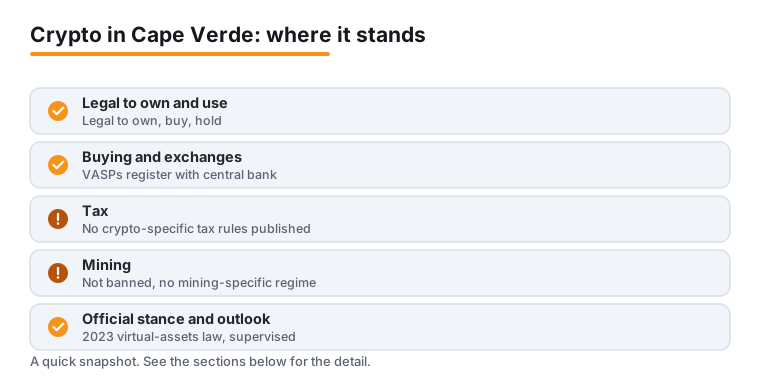
Yes. Owning, buying, selling, and holding Bitcoin and other cryptocurrencies is legal in Cape Verde. Crypto is not, however, legal tender. The Cape Verdean escudo remains the only official currency, and no business is obliged to accept Bitcoin as payment. Virtual assets are treated as a distinct category of digital value rather than as money issued by the state.
The important shift is that Cape Verde now has a specific law for the sector. In 2023 it adopted legislation regulating the provision of services with virtual assets and the establishment of digital banks. The practical effect is that individuals can use crypto freely, while businesses that provide crypto services to the public must register with the central bank and operate within a supervised framework rather than in an unregulated vacuum. If you are simply buying and holding crypto for yourself, you are on solid legal ground; if you intend to run an exchange, custody, or transfer service, the registration and compliance rules described below apply.
Who regulates crypto in Cape Verde?
The Banco de Cabo Verde (the central bank, commonly abbreviated BCV) is the competent authority for virtual assets. Founded in 1975 and operating as the country's central bank since 1993, the BCV issues the escudo, runs monetary and exchange-rate policy, and supervises the banking and financial system. Under the 2023 virtual-assets law it is responsible for the prior registration of entities that provide virtual-asset services and for verifying their compliance with anti-money-laundering and counter-terrorist-financing duties. It also authorizes and supervises banks, including the internet-based digital banks the same law allows.
There is no separate, standalone crypto agency in Cape Verde: oversight sits with the central bank, working alongside the country's financial-intelligence and tax authorities on AML and revenue matters. The BCV's public interest in the sector predates the 2023 law: as far back as 29 March 2018 it issued a public alert on virtual currencies, warning that they were not issued or guaranteed by the central bank and that holders bore the risks. You can confirm the regulator and its current guidance on the official site of the Banco de Cabo Verde.
Key laws and frameworks
The cornerstone of Cape Verde's framework is Law no. 30/X/2023, published in the official gazette on 21 June 2023 and in force from the following day. It does two main things: it regulates services involving virtual assets, and it provides for the establishment of digital banks. Implementing detail is set out in Aviso n.º 2/2024, de 28 de maio, published in Boletim Oficial n.º 94, 1.º Suplemento, II Série. The BCV consulted on the draft between 19 January and 29 March 2024, held a clarification session on 1 March 2024, and announced the final notice on 7 June 2024. The notice regulates Article 3(3) of Law no. 30/X/2023 and sets the terms on which entities apply to the central bank to register virtual-asset activities.
Key points to understand:
- Definition of virtual assets. The law treats a virtual asset as a digital representation of value that is not necessarily linked to an official currency, does not have the legal status of fiat money, but can be accepted as a means of exchange or investment and can be transferred, stored, and traded electronically. This follows the international (FATF) approach.
- Prior registration. Entities that intend to carry out virtual-asset activities on a professional basis in Cape Verde must register in advance with the Banco de Cabo Verde. Providing crypto services to the public is permitted but supervised.
- AML and CFT duties. Virtual-asset service providers are bound by the legal obligations to prevent and combat money laundering and the financing of terrorism, including customer identification, record-keeping, monitoring, and suspicious-activity reporting.
- Digital banks. The same law allows internet-based retail banks but holds them to broadly the same authorization, capital, risk-management, and supervisory standards as conventional banks.
Because Cape Verde is outside the EU, MiCA does not govern it; the framework is national and still maturing, so expect the regulator's expectations and implementing guidance to keep evolving. The text of the law is published by the official gazette, the Boletim Oficial Eletronico de Cabo Verde. For more on how frameworks differ between countries, see our crypto regulation guide.
Licensing and registration of exchanges (VASPs)
Any entity that wants to provide virtual-asset services to the public on a professional basis in Cape Verde, including exchanges that swap crypto for fiat or for other crypto, custody or wallet providers, and transfer services, must register in advance with the Banco de Cabo Verde before operating. This is a registration regime tied to fitness, governance, and AML compliance rather than a light-touch notification.
In practice, applicants should expect to:
- incorporate a local company and obtain the usual business prerequisites (tax number and municipal licence);
- document ownership, management, and source of funds, and provide criminal-record certificates and disclosure of any relevant legal or administrative proceedings;
- put in place AML and KYC policies, internal controls, and risk-management procedures before approval;
- keep the registration updated when the scope of activities changes, for example expanding into new types of virtual-asset services or operating in another jurisdiction with a higher money-laundering or terrorist-financing risk.
The detailed documentation and procedure are set by Aviso n.º 2/2024 of 28 May 2024. GIABA records that its Article 3 makes the granting and maintenance of registration conditional on a fitness and propriety assessment of owners and managers carried out under Lei n.º 62/VIII/2014. The full text of the notice is not published openly, so confirm the current documentation with the Banco de Cabo Verde. You can review the BCV's draft notice on registering virtual-asset service providers (PDF), issued for public consultation. Note that figures often quoted by company-formation agents (for example a specific minimum share capital) are not a substitute for the current official requirements, which you should confirm directly with the central bank.
Crypto and Bitcoin tax in Cape Verde
Cape Verde has no crypto-specific tax rule and no crypto guidance from the tax authority could be found, so the general income tax rules apply. Under the declarative method, individual rates are 16.5 percent up to CVE 960,000, 23.1 percent from CVE 960,000 to CVE 1,800,000, and 27.5 percent above CVE 1,800,000, with net income up to CVE 220,000 a year exempt. Investment income is taxed at a flat 20 percent, with dividends and interest on bonds at 10 percent. Capital gains of individuals are taxed at 1 percent on disposals of immovable property, intellectual property or shareholdings, and 20 percent on gambling and prize winnings. None of those categories names virtual assets, so the open question is which heading a personal crypto disposal falls under, not the rate. The safest assumption is that general tax principles can reach crypto activity the same way they reach other income, gains, or business revenue.
The questions that usually drive the outcome are:
- Are you an occasional individual investor, or are you trading or providing services as a business? The treatment can differ substantially.
- Is the activity a one-off disposal, recurring trading, mining income, or payment received for goods and services?
- Are you a tax resident of Cape Verde, and where did the activity take place?
For companies the position is clearer. Corporate income tax is 20 percent, rising to an effective 20.40 percent in the municipalities of Praia and Mindelo because of a 2 percent fire brigade surcharge on the tax due. There is no separate capital gains tax: gains are taxed as ordinary business income, and only 50 percent of a gain counts if the sale proceeds are reinvested in tangible fixed, intangible or non-consumable biological assets within the allowed window. Micro and small companies pay a single special tax of 4 percent on gross annual sales in place of corporate income tax, the fire brigade surtax, VAT and the company's social security contribution. These are general corporate rules, not a crypto carve-out. Keep clear records of every purchase, sale, transfer, and the fiat value at the time, and confirm your obligations with the national tax authority and a qualified local accountant. This is not tax advice. For background, see our guide to crypto taxes.
AML and KYC rules
Anti-money-laundering and counter-terrorist-financing compliance is the core of Cape Verde's virtual-asset regime. Law no. 30/X/2023 applies the country's AML and CFT duties to entities carrying out virtual-asset activities, and the Banco de Cabo Verde is the authority that verifies compliance among the providers it supervises.
For a registered provider this means, in line with FATF standards:
- Customer due diligence (KYC). Identify and verify customers, and in higher-risk cases establish the source of funds and apply enhanced checks.
- Record-keeping. Retain identity and transaction records for the period required by law.
- Monitoring and reporting. Monitor transactions for suspicious patterns and report suspicious activity to the competent authorities.
- Internal controls. Maintain written AML and CFT policies, designate responsible officers, and train staff.
For ordinary users the most visible effect is identity verification: any reputable platform, and any locally registered service, will ask you to confirm who you are and sometimes the origin of your funds before you can trade or withdraw beyond small amounts.
Buying and using crypto in practice
For an ordinary resident, buying crypto in Cape Verde is straightforward in practice. There is no national ban on accessing well-known international exchanges, and platforms such as Coinbase, Kraken, and Bitget are generally reachable by Cape Verdean users. You can typically fund an account by card or bank transfer and convert escudos, often via euro rails given the EUR peg, into Bitcoin and other assets.
A few things to keep in mind:
- Identity verification. Expect to complete KYC on any reputable platform. AML rules mean you will usually need to confirm your identity and sometimes the source of funds.
- Local versus offshore providers. A business providing crypto services to the public within Cape Verde is expected to register with the central bank. Many residents instead use large offshore exchanges; that is common, but it means your consumer protections, dispute options, and recourse depend on the platform's home jurisdiction, not on Cape Verdean oversight.
- Banking and currency. Because the escudo is pegged to the euro and capital movement is regulated, conversions and transfers may route through euro accounts or payment processors. Watch fees and exchange spreads.
- Local infrastructure is thin. Bitcoin ATM coverage is minimal and best treated as emerging rather than established across the islands; a listing on an ATM-locator site does not guarantee a working, compliant machine. For most people a reputable online exchange or a mobile wallet is the cheaper and more reliable route.
To buy safely: choose an established exchange that supports Cape Verdean users and euro funding, complete identity verification, fund with a card or bank transfer (minding conversion fees), start with a small order, enable two-factor authentication, and consider moving larger holdings to a private or hardware wallet. Never share your recovery phrase, and treat any promise of guaranteed profits as a red flag.
Remittances and stablecoins
Remittances are economically important to Cape Verde. A large diaspora sends money home, and traditional transfers can be slow and costly. Bitcoin and stablecoins are attractive here because they can move value across borders quickly and, in some corridors, more cheaply than legacy money-transfer services, while reaching people who are comfortable with mobile wallets.
The caveats matter for ordinary families: Bitcoin's price can move sharply between sending and cashing out, so some users prefer euro- or dollar-pegged stablecoins to reduce volatility, though stablecoins carry their own issuer and platform risks. The value of a transfer also depends on being able to convert back to escudos at a fair rate, and limited local on and off ramps can make the last step harder than the transfer itself. Any business that converts crypto to local currency or runs transfer services for the public is expected to register with the central bank and meet KYC and AML obligations. For person-to-person help among family, crypto can work well if both sides are comfortable with wallets and fees; for larger or business flows, use providers that are transparent about registration and compliance.
Bitcoin mining in Cape Verde
There is no specific prohibition on Bitcoin mining in Cape Verde, but there is also no detailed, mining-specific regulatory regime that singles it out for special licensing. Anyone considering mining should think first about the physical and economic constraints rather than assume a tailored framework exists.
The practical realities are significant:
- Energy. Cape Verde is an island system that imports most of its fossil fuel and has historically faced relatively high electricity costs. The country is investing heavily in wind and solar with ambitious renewable targets, which in theory could support sustainable mining, but grid capacity and reliability are real limits for energy-intensive operations.
- Climate and logistics. A warm climate raises cooling costs, and importing and servicing specialized hardware on remote islands adds expense and lead time.
- Compliance. A mining operation that also exchanges or sells crypto to others could fall within the virtual-asset services framework and its registration and AML duties.
Small-scale or hobby mining is unlikely to be a problem in itself, but a commercially viable, large-scale operation faces meaningful cost and infrastructure hurdles. Anyone planning a serious project should confirm energy, import, business-licensing, and any virtual-asset obligations with the relevant authorities first.
Recent developments and outlook
The most consequential development remains the 2023 adoption of Law no. 30/X/2023, which moved Cape Verde from an unregulated grey zone to a supervised, registration-based framework, followed by central-bank implementing notices that set out the PSAV registration process. Since then the picture has been one of incremental clarification rather than dramatic change.
In the broader policy context, the World Bank reclassified Cape Verde as an Upper-Middle-Income Country with effect from 1 July 2025, driven by a rise in gross national income per capita, and the country continued to modernize its financial-sector legislation, including central-bank reforms tied to its programme with the International Monetary Fund. On monetary policy the BCV raised its policy rate from 1.50 percent in November 2024 to 2.50 percent by February 2025 to contain inflation, a reminder that the escudo's euro peg constrains independent rate-setting. Separately, the enabling legislation for a digital escudo is now in place. Lei n.º 70/X/2026, de 26 de janeiro approved a new BCV Organic Law, published in Boletim Oficial n.º 8, I Série and in force since 27 January 2026, which revoked the 2002 organic law. Article 10 of the new Organic Law gives the Bank the exclusive right to issue notes and coins in physical, digital or other format, gives them legal tender status, and makes the issue of digital currency subject to a regulation to be made by the Bank. That regulation has not been published and no digital escudo has been issued. Governor Óscar Santos said in October 2025 that a working group was studying implementation and that the Bank would put a viable payment system in place before moving to digital currency. A CBDC would be state-issued money and is a different thing from Bitcoin or private stablecoins. For crypto specifically, the trend is consistent with the wider African pattern of operationalizing FATF-aligned AML and CFT requirements for virtual-asset providers and tightening supervision. Expect continued refinement of registration and compliance expectations rather than sudden bans or sweeping liberalization. Because the framework is still young, always check the current position with the Banco de Cabo Verde before relying on any specific rule.
Consumer risks and protection
The main risks for crypto users in Cape Verde are familiar ones, sharpened by the country's small size. Market volatility can erase value quickly. Because most activity relies on offshore platforms, your protection depends on those providers rather than on local supervision, and recourse in a dispute follows the platform's home jurisdiction. Thin local infrastructure makes cashing out less reliable, and scams that target retail investors, from fake investment schemes to phishing for wallet keys, are a persistent threat everywhere.
To protect yourself: prefer platforms that are transparent about registration and compliance, complete and keep records of your KYC, enable two-factor authentication, store significant holdings in a private or hardware wallet, never share your recovery phrase, and be skeptical of any guaranteed-return offer. Treat crypto, if you hold it at all, as a small and speculative part of a diversified plan rather than savings you cannot afford to lose. Registration of a provider with the central bank is an AML-supervision measure; it is not a guarantee against loss, fraud, or market falls.
Official sources and how to verify
Crypto rules evolve, and second-hand summaries (including this page) can lag behind the law. Always confirm the current position with primary sources before acting:
- Banco de Cabo Verde (central bank and competent regulator) for registration of virtual-asset service providers, AML supervision, and official guidance: www.bcv.cv, with its sector legislation page and its notice on PSAV registration (PDF).
- Boletim Oficial Eletronico de Cabo Verde (official gazette) for the authentic text of Law no. 30/X/2023 and any amendments or new notices: boe.incv.cv.
- The national tax authority and a qualified local accountant or lawyer for how a transaction will be taxed in your specific situation.
This article is general information as of 2026 and is NOT legal, tax, or financial advice. Verify anything that affects you with the Banco de Cabo Verde and a qualified professional. For related reading, see our crypto regulation guide and our regulation hub.
What is changing: the August 2026 position
Two statements on this page are out of date, and both corrections are settled.
- The registration notice is final, not a draft. The Banco de Cabo Verde put a draft notice out for public consultation on 19 January 2024 and published the final text as Aviso n.º 2/2024, de 28 de maio, in Boletim Oficial n.º 94, 1.º Suplemento, II Série, where the gazette summary describes it as regulating the registration of entities intending to carry out activities with virtual assets. The BCV's communiqué of 7 June 2024 records that the consultation ran from 19 January to 29 March 2024, with a clarification session on 1 March 2024, that the notice implements Article 3(3) of Law no. 30/X/2023, and that it could help the country reach better technical compliance with FATF Recommendation 15. The notice is listed on the BCV legislation index.
- A digital escudo no longer needs new enabling legislation. Lei n.º 70/X/2026, de 26 de janeiro approved a new Organic Law for the central bank and revoked the 2002 one. Article 5 sets entry into force on the day after publication, so it has applied since 27 January 2026. Article 10 of the annexed Organic Law gives the Bank the exclusive right to issue notes and coins in physical, digital or other format, states that they have legal tender and discharging power, and provides that the issue of digital currency is subject to a regulation to be made by the Bank. The full text is published by the BCV.
What has not changed: crypto is legal to buy, hold and sell, it is not legal tender, and there is no crypto-specific tax rule. No digital escudo has been issued and no regulation for one has been published. A full text search of the Boletim Oficial for "ativos virtuais" returns no instrument later than the 2024 notice, and the BCV news archive, which runs to the end of July 2026, announces no further virtual-asset measure.
The pipeline, and what is actually scheduled
Digital escudo. The power exists, the rules do not.
- Status: Article 10(4) of the 2026 Organic Law leaves the issue of digital currency to a regulation to be made by the Bank. No draft, consultation or pilot has been published.
- Sequencing: Governor Óscar Santos said on 3 October 2025 that digital currency was already foreseen in the new Organic Law proposal, that a working group was studying the process, that adoption would be gradual and would begin by strengthening the existing payment system, and that Cape Verde wanted to avoid the setbacks of countries that moved too early. His words were that the country wants a payment system that is viable and works first, and only then to take the leap to digital currency (Balai, reporting Inforpress, 3 October 2025).
- Timing: none stated. The law sets no date, and neither the BCV nor the government has announced one. The governor had told RTC in May 2023 that issuing a digital escudo was waiting only on the new Organic Law, which he then expected that year; it arrived two and a half years later, which is a fair guide to how firm any timetable here is.
- Activity since: the BCV took part in a conference on central bank digital currencies and cross-border payments in Macau from 1 to 5 June 2026, reported in its news archive. That is the only digital currency item the Bank has published in 2026.
- Criticism: A Nação reported on 2 February 2026 an unnamed specialist's view that the digital currency reference is a generic clause with no conceptual framework, no statement of objectives and no explicit risk assessment, and that introducing one without clear limits could become an instrument of bank disintermediation, erosion of the deposit base and, at the extreme, indirect monetary financing of the State.
- What it would mean for you: a digital escudo would be state money with legal tender status. It would not legalise, restrict or tax Bitcoin or stablecoins any differently than today.
Payment and fintech rules. On 13 February 2026 the BCV published its Estudo de Caracterização das Iniciativas Fintech em Cabo Verde, based on a questionnaire to payment service providers and fintech entities run between December 2024 and May 2025. It concludes that entry conditions are not equitable for non-bank payment providers and identifies actions including revising the legal framework for proportionate prudential requirements, coordination between regulators, and developing regulatory sandboxes and innovation hubs. That is a study recommendation, not a bill, no draft has followed it, and the report rests on 17 valid responses from payment providers and 5 from fintech entities.
AML remediation. Cape Verde was required to report to GIABA in May 2026 on progress in improving its AML and CFT measures. That process is the most likely driver of the next change to the virtual-asset rules. GIABA has published no seventh follow-up report for Cape Verde, so the outcome is not public.
FATF Recommendation 15: what the assessors actually found
Cape Verde's virtual-asset framework has been assessed against the FATF standard and it did not pass. GIABA, the FATF-style regional body for West Africa, adopted Cape Verde's sixth enhanced follow-up report by written procedure at its May 2025 plenary. It re-rated Recommendation 15, on new technologies and virtual assets, from Partially Compliant down to Non-Compliant. The report states that Cape Verde has 15 Recommendations rated Non-Compliant or Partially Compliant, remains under the enhanced follow-up regime, and was to report to GIABA in May 2026 on progress.
The report itself is specific about the gap between the law and supervision in practice:
- Cape Verde has not identified or assessed the money laundering and terrorist financing risks arising from virtual assets and VASP activity. The BCV fintech questionnaire exercise was treated as information gathering, not risk assessment, and VASPs were not covered in the 2017 national risk assessment (criterion 15.3(a), Not Met).
- The BCV is responsible for regulating VASPs under Article 3(2) of the VASPs Law, but is not empowered by law to conduct risk-based supervision or monitoring of them, and lacks the powers to inspect, compel production of information, or withdraw, restrict or suspend a registration (criterion 15.6, Not Met).
- There is no range of proportionate and dissuasive sanctions, criminal, civil or administrative, for VASPs that fail to comply, and none applying to their directors and senior management (criterion 15.8, Not Met).
- No guidelines or feedback have been issued to help VASPs apply national measures and detect and report suspicious transactions (criterion 15.7, Not Met).
- Customer due diligence on occasional transactions is only triggered at CVE 1,000,000, equivalent to EUR 10,000, under Article 12 of Law no. 120/VIII/2016 as applied by Law no. 30/X/2023 (criterion 15.9(a), Not Met). GIABA said it placed more weight on this threshold, together with risk identification and risk-based supervision, in reaching its conclusion.
- Cape Verde did not demonstrate that it identifies people or companies carrying on VASP activity without the required registration, or sanctions them (criterion 15.5, Not Met).
One thing the assessors did credit: registration itself is in place, and the BCV is required to assess the fitness and propriety of owners and managers under Law no. 62/VIII/2014 as a condition of granting and keeping a registration (criterion 15.4, Met). The practical reading is that registration with the Banco de Cabo Verde is an entry gate rather than ongoing supervision. If a platform advertises that it is registered in Cape Verde, treat that as a statement about paperwork, not about consumer protection.
Tax: the rates that apply when there is no crypto rule
There is no crypto-specific tax rule in Cape Verde, and no crypto guidance from the national tax authority, the Direção Nacional das Receitas de Estado, could be found. What applies instead is the ordinary income tax code. The rates below are as published in PwC's Cabo Verde tax summaries, last reviewed 29 May 2026, not as read from the tax codes themselves.
| Who or what | Rate |
|---|---|
| Individual income, declarative method (and unjustified increases in net wealth) | 16.5 percent up to CVE 960,000; 23.1 percent from CVE 960,000 to CVE 1,800,000; 27.5 percent above CVE 1,800,000. Net income up to CVE 220,000 a year is exempt (source) |
| Investment income of individuals (Category D) | 20 percent as a general flat rate, with dividends at 10 percent and interest on bonds at 10 percent (source) |
| Capital gains of individuals (Category E) | 1 percent on disposals of immovable property, intellectual property or shareholdings; 20 percent on gambling, lottery, betting and prizes (source) |
| Company profits (IRPC) | 20 percent, or an effective 20.40 percent in the municipalities of Praia and Mindelo, where a 2 percent fire brigade surcharge applies to the tax due (source) |
| Company capital gains | No separate capital gains tax; taxed as ordinary business income. Only 50 percent of the gain counts if the sale proceeds are reinvested in tangible fixed, intangible or non-consumable biological assets within the allowed window (source) |
| Micro and small companies | A single special tax of 4 percent on the gross amount of annual sales replaces corporate income tax, the fire brigade surtax, VAT and the company's social security contribution (source) |
Note what is missing. No statutory category names virtual assets. The individual capital gains heading covers immovable property, intellectual property and shareholdings, and crypto is none of those, so it is not obvious which heading a personal disposal of Bitcoin falls under. A business that trades crypto or provides crypto services is on firmer ground, because that is ordinary business income under IRPC. If you hold a large or recurring position, ask the tax authority for a written position rather than assume a rate.
Unauthorised operators and how to check a provider
The BCV maintains a public Atividade Financeira Ilícita page naming entities it has found operating without authorisation, and one carries a crypto-styled name. In a communiqué dated 29 September 2025 the BCV stated that an alleged company called OPTCOIN, with premises on rua Miguel Bombarda in Praia, Santiago, was offering the public a service of receiving repayable funds without having sought or obtained prior authorisation, and that it is not authorised to carry on any financial activity and holds no registration with the central bank. Read the communiqué precisely: the BCV describes unauthorised deposit taking, not virtual-asset services, so this is a warning about an entity with a crypto-styled name rather than a finding about a crypto business.
Checking a provider is harder than it should be. The BCV publishes a list of authorised institutions by category, covering banks, other credit institutions, insurers, payment and electronic money institutions, financial companies, exchange bureaux and financial system auxiliaries. There is no virtual-asset category, and no public register of registered virtual-asset service providers, so a claim to be registered under the 2024 notice cannot be verified from the BCV website. Ask the Bank directly.
Two older positions still stand. The BCV's alert of 29 March 2018 on the risks of virtual currencies remains published, relaying warnings from the European Banking Authority, ESMA and EIOPA that operations in virtual currencies carry high risk and offer no consumer protection, because they are not guaranteed by a central bank or national authority, are not legal tender and are very insufficiently regulated. And carrying on financial activity without authorisation is punishable by imprisonment under Article 228 of the Lei das Atividades e das Instituições Financeiras, Lei n.º 62/VIII/2014, de 23 de abril. That offence covers unauthorised financial activity generally; it is not the VASP registration duty, and as GIABA found, no sanctions regime specific to VASPs exists yet.
Frequently asked questions
Is cryptocurrency legal in Cape Verde?
Yes. Buying, holding, selling, and using cryptocurrency is legal in Cape Verde, but crypto is not legal tender and no one is required to accept it as payment. Since 2023 the country has a specific law (Law no. 30/X/2023) regulating virtual-asset services, and businesses that provide crypto services to the public must register with the Banco de Cabo Verde and follow anti-money-laundering rules.
Who regulates crypto in Cape Verde?
The Banco de Cabo Verde (the central bank) is the competent authority. It oversees the prior registration of virtual-asset service providers and verifies their compliance with obligations to prevent money laundering and terrorist financing. It also authorizes and supervises banks, including digital banks. Cape Verde is not in the EU, so MiCA does not apply; the rules are domestic.
What law governs crypto in Cape Verde?
Law no. 30/X/2023, published on 21 June 2023 and in force from the following day, regulates services involving virtual assets and the establishment of digital banks. It requires prior registration with the central bank for anyone providing virtual-asset services professionally and applies the country's anti-money-laundering and counter-terrorist-financing duties. Implementing detail is set out in Aviso n.º 2/2024 of 28 May 2024, published in Boletim Oficial n.º 94, 1.º Suplemento, II Série.
Do crypto exchanges need a licence in Cape Verde?
Any entity providing virtual-asset services to the public on a professional basis, including exchanges, custody, and transfer services, must register in advance with the Banco de Cabo Verde before operating. Applicants typically incorporate locally, obtain a tax number and municipal licence, disclose ownership and source of funds, and put AML and KYC controls in place. Confirm the exact current documentation and requirements directly with the central bank.
How is crypto taxed in Cape Verde?
There is no crypto-specific tax rule, so the general income tax code applies. Individual rates under the declarative method are 16.5 percent, 23.1 percent and 27.5 percent by band, with net income up to CVE 220,000 a year exempt. Company profits are taxed at 20 percent, or an effective 20.40 percent in Praia and Mindelo. Crypto is not named in any statutory category, so how a personal disposal is classified is the unresolved question. General tax principles may reach crypto income, gains, or business revenue depending on your circumstances and residency. Keep detailed records and confirm your obligations with the national tax authority and a qualified local accountant. This is not tax advice.
Can I buy Bitcoin in Cape Verde, and how?
Yes. There is no national ban on accessing major international exchanges, and platforms that support Cape Verdean users let you verify your identity, fund an account (often via euro rails given the escudo's euro peg), and buy Bitcoin. Use reputable platforms, complete the required identity checks, enable strong security, and consider moving larger holdings to a private or hardware wallet. Local Bitcoin ATM coverage is minimal, so an online exchange is usually the most practical route.
Is Bitcoin legal tender in Cape Verde?
No. The Cape Verdean escudo (CVE) is the only official currency, pegged to the euro at 110.265 CVE per euro since 1999. Bitcoin and other cryptocurrencies are legal to own and trade but are not legal tender, and no business is required to accept them as payment. Crypto is treated as a distinct category of digital value, not as money issued by the state.
Does Cape Verde have a central bank digital currency (digital escudo)?
Not as of 2026. No digital escudo has been issued, but the legal power to issue one now exists. Lei n.º 70/X/2026, in force since 27 January 2026, lets the Banco de Cabo Verde issue notes and coins in physical, digital or other format and leaves the issue of digital currency to a regulation the Bank has not yet made. No date, pilot or draft regulation has been announced. A CBDC, if introduced, would be state-issued money and is separate from Bitcoin or private stablecoins.
When will Cape Verde launch a digital escudo?
No date has been announced. The legal power now exists: Lei n.º 70/X/2026 of 26 January 2026, the new Banco de Cabo Verde Organic Law, entered into force on 27 January 2026, and Article 10 of that Organic Law lets the Bank issue notes and coins in physical, digital or other format and makes the issue of digital currency subject to a regulation to be made by the Bank. No such regulation has been drafted publicly or put to consultation. Governor Óscar Santos said in October 2025 that a working group was studying implementation and that the Bank intends to have a viable, working payment system in place before moving to digital currency. A digital escudo would be central bank money with legal tender status and would not change how Bitcoin or stablecoins are treated.
Is the Banco de Cabo Verde notice on crypto registration still a draft?
No. The draft went out for public consultation on 19 January 2024, the consultation closed on 29 March 2024, and the final text was published as Aviso n.º 2/2024, de 28 de maio, in Boletim Oficial n.º 94, 1.º Suplemento, II Série. The BCV announced the publication on 7 June 2024. It implements Article 3(3) of Law no. 30/X/2023 and sets the terms for applying to register virtual-asset activities with the central bank, including a fitness and propriety assessment of owners and managers. The full text of the notice is not published openly, so confirm the exact requirements with the Bank.
How strong is supervision of crypto firms in Cape Verde in practice?
Weaker than the law suggests. GIABA, the FATF-style regional body for West Africa, adopted Cape Verde's sixth enhanced follow-up report by written procedure at its May 2025 plenary and re-rated FATF Recommendation 15 on virtual assets from Partially Compliant down to Non-Compliant. It found that Cape Verde has not assessed the money laundering risks of virtual assets, that the BCV is not empowered by law to conduct risk-based supervision of virtual-asset service providers or to inspect, compel information or suspend a registration, that there is no proportionate sanctions regime for them, and that no guidance has been issued to help them detect suspicious transactions. It did credit the registration requirement and the fitness and propriety test. Cape Verde remains under enhanced follow-up and was to report progress to GIABA in May 2026. Registration is an entry gate, not ongoing supervision.
Can I check whether a crypto firm is registered with the Banco de Cabo Verde?
Not from the website. The BCV publishes a list of authorised institutions by category, covering banks, other credit institutions, insurers, payment and electronic money institutions, financial companies, exchange bureaux and financial system auxiliaries. There is no virtual-asset category and no public register of registered virtual-asset service providers, so a claim to hold a registration under Aviso n.º 2/2024 cannot be verified there. Ask the central bank directly, and check the BCV's Atividade Financeira Ilícita page, which names entities it has found operating without authorisation.
Has the Banco de Cabo Verde named any crypto-branded company as unauthorised?
Yes, with a caveat about what it actually said. On 29 September 2025 the BCV published a communiqué stating that an alleged company called OPTCOIN, with premises on rua Miguel Bombarda in Praia, Santiago, was offering the public a service of receiving repayable funds without having sought or obtained prior authorisation, and that it is not authorised to carry on any financial activity and holds no registration with the central bank. The communiqué describes unauthorised deposit taking rather than virtual-asset services, so it is a warning about an entity with a crypto-styled name, not a finding about a crypto business. Carrying on financial activity without authorisation is punishable by imprisonment under Article 228 of Lei n.º 62/VIII/2014.
Facts reviewed: 12 August 2026. Page updated: 12 August 2026.