Home › Crypto Regulation › Guinea
Bitcoin & Cryptocurrency Regulation in Guinea
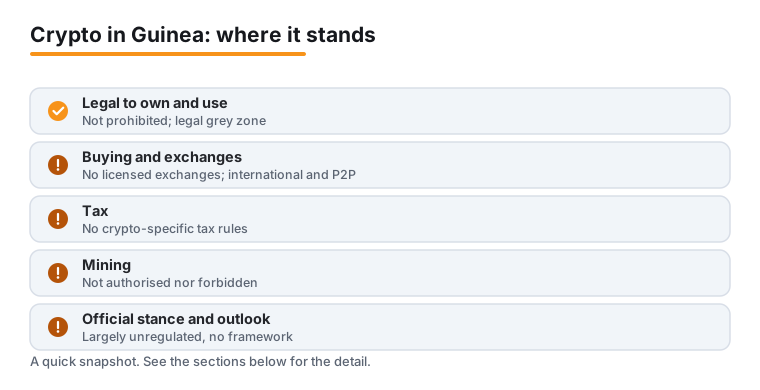
Quick answer — Guinea, 2026
- Legal: Legal grey zone, not banned, not legal tender
- Tax: No crypto-specific tax; general tax code may apply
- Buying: Via international platforms and P2P; no licensed local exchanges
Guinea (officially the Republic of Guinea, capital Conakry) is a West African country with its own currency, the Guinean franc (GNF), and its own central bank. Unlike its neighbours Senegal, Mali or Ivory Coast, Guinea is not part of the West African Economic and Monetary Union (WAEMU) and does not use the CFA franc, so its rules are set nationally rather than by a regional central bank. Interest in Bitcoin, stablecoins and other crypto-assets has grown alongside mobile money, remittances and currency pressure, but Guinea has not passed a dedicated cryptocurrency law. The result is that crypto is largely unregulated rather than clearly authorised or banned.
This guide explains what is known about the legal status of crypto in Guinea as of 2026, who the relevant authorities are, how existing laws on anti-money laundering and tax may apply, and the practical realities of buying, using, sending and mining Bitcoin. It is general information only and is NOT legal, tax or financial advice. Crypto rules can change quickly, so always confirm the current position with the named official Guinean authorities, in particular the central bank (BCRG), or with a qualified local professional before you act. For wider background, see our overviews of crypto regulation and crypto regulation by country.
On this page: Legal status · Who regulates it · Taxes · How to buy · Mining
Is Bitcoin and crypto legal in Guinea?
There is no public evidence that Guinea has banned Bitcoin or other cryptocurrencies, and Guinean statute has recognised and defined virtual assets and their service providers since 2021, and Article 101 of that law requires central bank approval to operate, but the central bank has never published how to obtain it. In practice, owning, buying, selling and holding crypto is not prohibited, but it is not formally regulated. Crypto sits in a legal grey zone: tolerated in everyday use, but without the licensing regimes, dispute mechanisms and consumer protections that apply to banks and licensed payment institutions.
Two points matter for residents and visitors:
- Not legal tender. The only legal tender in Guinea is the Guinean franc (GNF), which is issued by the central bank. Bitcoin is not money issued or backed by the state, and no merchant is obliged to accept it.
- A licence is required but cannot be obtained. Article 97 of the 2021 AML law makes the Central Bank of the Republic of Guinea responsible for regulating and supervising virtual asset service providers, Chapter VII imposes duties on them directly, and Article 101 bars anyone from carrying on the activity professionally without the central bank's approval. The gap is that the central bank has never issued the terms and conditions that would let a provider apply. Their activities can still fall under general laws on anti-money laundering, fraud, foreign exchange and consumer protection.
The absence of clear rules cuts both ways: individuals are free to experiment, but they have little official recourse if a platform collapses or a counterparty disappears. Treat any claim that crypto is officially approved in Guinea with caution and verify the current stance with the central bank or a local lawyer.
Who regulates crypto in Guinea? The BCRG
Guinea's financial system is overseen by the Central Bank of the Republic of Guinea (Banque Centrale de la Republique de Guinee, BCRG). The BCRG issues the Guinean franc, sets monetary and exchange-rate policy, and supervises banks, microfinance and payment institutions. Its official website is bcrg.gn.
As of 2026, the BCRG has not published a standalone regulatory regime for crypto-assets. Its public work on the digital side has focused on modernising conventional payments rather than on cryptocurrencies. In January 2025 the BCRG launched a national monetary and digital switch, run through a subsidiary called Guineenne de Monetique (GuiM), to link banks, mobile money and other payment providers, and the bank has moved to strengthen digital and electronic payments through these formal channels. None of this brings Bitcoin or other crypto-assets under a dedicated supervisory licence.
In short, the BCRG is not merely the closest available reference, it is the statutory regulator: Article 97 of the 2021 AML law makes it responsible for regulating and supervising virtual asset service providers, and Article 101 makes its approval a precondition of carrying on the activity. It has not, to date, issued the licensing or registration procedures that would give that mandate practical effect, and it has published no crypto-specific framework, circular or public warning. If you need an authoritative answer for your situation, the BCRG (or a qualified Guinean lawyer) is where to confirm it.
Key laws and frameworks that touch crypto
There is no crypto-specific statute in Guinea, but several general legal frameworks can apply to crypto activity:
- Anti-money laundering and counter-terrorist financing (AML/CFT). Guinea's main AML/CFT law is Loi L/2021/0024/AN of 17 August 2021, which combats money laundering and the financing of terrorism. It repealed and replaced the earlier 2007 law (L/2007/010/AN) and introduced a stricter, broader regime. The 2021 law obliges financial and many non-financial entities to apply customer due diligence and to report suspicious transactions.
- Financial intelligence. The same framework underpins Guinea's financial intelligence unit, CENTIF (see the next section).
- Foreign exchange rules. Because crypto is often used to move value across borders, the central bank's foreign-exchange regulations may be relevant, especially for businesses converting between GNF, foreign currency and digital assets.
- General criminal, tax and consumer law. Fraud, scams and misappropriation remain illegal whether or not crypto is involved, and general tax rules can apply to crypto income or gains.
Internationally, Guinea is a member of GIABA, the Inter-Governmental Action Group against Money Laundering in West Africa, and is subject to the standards of the Financial Action Task Force (FATF). FATF Recommendation 15 asks countries to apply AML/CFT measures to virtual assets and virtual asset service providers (VASPs). Guinea's most recent GIABA mutual evaluation report was adopted in November 2023. The 2021 AML law does set out a dedicated virtual asset regime, in Chapter VII, Articles 58 to 60, with customer due diligence triggered at 10,000,000 Guinean francs on occasional transactions under Article 59(2). Article 101 goes further and prohibits carrying on virtual asset services professionally without the approval or authorisation of the central bank. What the law does not do is set out how to obtain that approval, and GIABA's assessment is that Guinea has no regulatory texts on the issuance of licences or registration, nor on supervising the sector.
AML, KYC and the role of CENTIF
Guinea's financial intelligence unit is CENTIF (Cellule Nationale de Traitement des Informations Financieres). It collects and analyses reports of suspicious transactions and shares its findings with the competent authorities. CENTIF operates within Guinea's AML/CFT framework and is an interministerial administrative authority placed under the supervision of the Minister of Economy and Finance, with members drawn from several ministries and the central bank. Its official website is centifgn.org.
In practice this means:
- Reporting entities such as banks, microfinance institutions, money-transfer operators and a range of non-financial businesses must run know-your-customer (KYC) checks and file suspicious-transaction reports with CENTIF.
- Crypto is separately named. Article 5(4) of the 2021 AML law lists virtual asset service providers as category 4 of Guinea's reporting entities, and CENTIF publishes that list on its own site. What does not yet exist is the registration machinery: the central bank has never published licensing or registration procedures, and GIABA records that no provider has ever applied. However, where crypto activity intersects with a regulated institution, for example when funds pass through a bank account or a licensed money operator, AML/KYC obligations can still bite.
- Expect identity verification. Reputable international platforms that serve Guinean users generally require KYC, and larger or frequent transfers can attract additional scrutiny.
The direction of travel across West Africa, encouraged by GIABA and FATF, is toward bringing virtual assets explicitly within AML/CFT supervision. Anyone running a crypto-related business in Guinea should take legal advice on how the 2021 law and CENTIF reporting duties apply to them.
Crypto and Bitcoin tax in Guinea
Guinea has no tax regime written for cryptocurrencies, and the 2026 finance law confirmed it: Loi Ordinaire L/2026/010/CNT amended VAT credit refunds, the apprenticeship tax, invoicing rules, property tax rates and audit duration, and introduced nothing on crypto-assets or digital assets. Without dedicated rules, crypto-related income and gains are generally assessed under the existing General Tax Code (Code General des Impots) as interpreted by the tax authorities, and treatment can depend on whether a transaction looks like personal investment, business activity or income for services.
General principles that often apply where there is no bespoke crypto tax law:
- Trading or business activity (such as running an exchange desk or accepting crypto in a business) may be treated as taxable business income.
- Investment gains may fall under capital-gains or general income provisions, depending on local interpretation.
- Crypto received as payment for work or goods may be treated like other income, valued in Guinean francs when received.
There are no crypto-specific rates to state, and the 2026 finance law, Loi Ordinaire L/2026/010/CNT, introduced none. The General Tax Code defaults that would apply are concrete: 25 percent on business profits under the BIC and corporate tax rules, 5 percent of turnover under the taxe professionnelle unique below 1,000,000,000 Guinean francs of turnover, 15 percent on movable capital income, and 18 percent VAT on underlying supplies. The Code's non-professional capital gains charge is written for immovable property, so an occasional private disposal of crypto has no clear charging provision. Do not rely on numbers quoted on unofficial sites. Keep clear records of purchases, sales, dates and GNF values, and consult Guinea's tax administration, the Direction Nationale des Impots, or a qualified accountant. For general background see our guide to crypto taxes. This is informational only and not tax advice.
Licensing and registration of exchanges and VASPs
As of 2026 there is no licensed domestic crypto exchange or VASP registration regime in Guinea. The BCRG has not created a dedicated authorisation category for crypto businesses, and the 2021 AML law does establish an approval requirement. Article 101 provides that no one may carry on virtual asset services professionally without the central bank's approval or authorisation, and requires the central bank to identify and sanction those who do. But GIABA's 2023 evaluation records that the central bank never mapped out the terms and conditions for licensing, that no provider operating in Guinea has been identified, and that no application has ever been received. So an exchange cannot in practice obtain a Guinean crypto licence, while operating without one is prohibited rather than merely unregulated.
The practical consequences:
- No registered local exchanges. Most Guinean users rely on international platforms or peer-to-peer (P2P) marketplaces rather than a licensed domestic venue.
- General rules still apply. A business that touches crypto may still need to comply with company law, foreign-exchange rules, and AML/KYC and CENTIF reporting duties where it interacts with the regulated financial system.
- Regulatory uncertainty. If Guinea introduces a VASP framework in future, in line with FATF Recommendation 15 and GIABA encouragement, registration or licensing requirements could appear quickly. Operators should monitor BCRG announcements.
If you intend to run any crypto-related service in or into Guinea, do not assume the absence of a licence means the absence of obligations. Confirm the current position with the BCRG and take local legal advice.
Buying and using crypto in practice
Because there is no licensed domestic exchange regime, most people in Guinea buy and sell Bitcoin through international platforms or peer-to-peer marketplaces. Common routes include:
- Global exchanges, sometimes accessible to Guinean users, though availability, payment methods and verification requirements vary and can change without notice.
- Peer-to-peer (P2P) marketplaces, which let users trade directly, often settling via mobile money or bank transfer. Popular where card access is limited, but they carry higher counterparty risk.
- Mobile money bridges, widely used in Guinea to fund or cash out trades through mobile-wallet transfers.
Practical cautions for buyers:
- Expect identity verification (KYC) on reputable platforms; treat services that ask for none as higher risk.
- On P2P, use escrow, check counterparty ratings, communicate within the platform, and never release funds before confirming receipt.
- Watch fees and spreads, as thin local liquidity can push the effective price away from global quotes.
- Start with a small test transaction, withdraw to a wallet you control, and keep records.
As for Bitcoin ATMs, as of 2026 there is no reliable confirmation of working, maintained crypto ATMs in Guinea. Some directories list Conakry as a possible location, but a listing is not the same as an operational machine. In practice, people rely on P2P trades and mobile money rather than ATMs. Because the sector is unregulated, there is little official recourse if a platform or counterparty fails.
Sending remittances with crypto
Remittances from the diaspora are an important income source for many Guinean families, and high fees on traditional transfer services have led some senders to explore Bitcoin and stablecoins. Crypto can, in principle, move value across borders quickly, but there are practical and risk considerations.
A typical crypto remittance flow: the sender buys Bitcoin or a stablecoin abroad on a reputable platform, transfers it to the recipient's wallet or to a platform the recipient can access, and the recipient in Guinea converts it to Guinean francs, often via a P2P marketplace or local trader, frequently cashing out through mobile money.
Things to keep in mind:
- Volatility. Bitcoin's value can move sharply between sending and cashing out. Some senders prefer well-known stablecoins to reduce this, though those carry their own counterparty risks.
- The cash-out step is the bottleneck. Converting crypto into spendable GNF reliably is usually the hardest part; local liquidity, fees and counterparty trust all matter.
- Compliance. Larger or frequent transfers may attract AML/KYC scrutiny under the 2021 law, so use legitimate platforms and keep records.
- Irreversibility. Crypto transactions cannot be reversed; a wrong address means lost funds.
Regional data helps explain the interest. In its 2025 reporting on Sub-Saharan Africa, Chainalysis found that stablecoins made up roughly 43 percent of the region's crypto transaction volume, and estimated that sending a 200 US dollar remittance could cost about 60 percent less using stablecoins than with some traditional methods. These are regional figures, not Guinea-specific ones, and the real saving depends heavily on the cash-out step and local fees, but they show why senders across the region test stablecoin transfers.
For many households, regulated money-transfer operators and mobile-money corridors remain simpler and more predictable. Crypto can complement them, but it is not automatically cheaper or safer once conversion costs and risks are counted.
Bitcoin mining in Guinea
Guinea is not a recognised centre for Bitcoin mining, and there is no specific legal framework that either authorises or forbids it. Anyone considering mining should weigh several country-specific factors:
- Electricity supply and cost. Mining is energy-intensive and only viable where power is cheap, abundant and reliable. Guinea has significant hydropower potential and has invested in large hydroelectric projects, but grid reliability and access vary, and industrial-scale power is not guaranteed. Mining could compete with households for limited supply.
- Hardware and climate. Specialised mining hardware is hard to source locally and usually must be imported, while heat and dust raise cooling and maintenance costs.
- Regulatory uncertainty. With no clear rules, future regulation, energy policy or import controls could change the economics or legality of operations.
Promotional material often frames mining around sustainability ideals such as renewable energy and community benefit. Those goals are reasonable, but they do not change the practical reality: without cheap, dependable electricity and a clear legal footing, small-scale mining in Guinea is unlikely to be profitable, and larger operations would need major infrastructure and regulatory clarity. Treat promises of easy mining profits with scepticism.
Recent developments (2025-2026)
The most concrete recent moves in Guinea's financial sector have been about modernising conventional payments rather than regulating crypto:
- National monetary and digital switch (January 2025). On 15 January 2025 the BCRG launched its Switch Monetique et Digital, operated through a subsidiary company, Guineenne de Monetique (GuiM). The switch is meant to connect banks, electronic-money institutions, microfinance bodies, payment operators and fintechs so that transfers between bank accounts and mobile wallets can settle across providers. Its stated goals are to modernise electronic payments, widen financial inclusion for unbanked and rural users, cut cash use and reduce fraud. This is a fiat-payment modernisation effort, not a crypto framework, and its official announcement does not mention cryptocurrencies or digital assets.
- AML/CFT consolidation. The 2021 AML/CFT law and Guinea's November 2023 GIABA mutual evaluation keep pressure on the country to align with FATF standards, including Recommendation 15 on virtual assets. This makes a future, more explicit treatment of crypto plausible over time.
As of August 2026 there is no crypto-specific statute and no licence a provider can actually obtain, but there is a statutory virtual asset regime in Chapter VII of the 2021 AML law, with the central bank as named supervisor under Article 97 and its approval required under Article 101. Guinea's FATF Recommendation 15 rating remains Partially Compliant, it stays under GIABA enhanced follow-up, and its next follow-up report is scheduled for November 2026. Anyone relying on the legal position should check the BCRG and CENTIF sites for new announcements, because the picture is evolving.
Consumer risks and protection
The defining feature of crypto in Guinea is uncertainty. There is no dedicated law granting protections or imposing clear obligations, which leaves users exposed and businesses without a compliance roadmap. The main risks to keep front of mind:
- No local protection. Because the sector is unregulated, there is little official recourse against fraud, platform failure or theft. Deposit-insurance and banking-style safeguards do not apply to crypto holdings.
- Fraud and scams. Unregulated markets attract bad actors; offers of guaranteed or unusually high returns are a classic warning sign. If it sounds too good to be true, it usually is.
- Market risk. Prices are volatile and can decline rapidly; you could lose a large part of your capital.
- Operational and custody risk. Lost keys, phishing, hacked accounts and failed platforms can mean permanent loss. Never share your recovery phrase.
- Liquidity risk. Turning crypto back into usable Guinean francs is not always quick or cheap.
Sensible precautions: never invest more than you can afford to lose, prefer reputable platforms with KYC and escrow, move funds to self-custody where practical, keep good records, and be sceptical of pressure to act fast. None of this is financial advice; consider speaking with a qualified adviser about your circumstances.
Official sources and how to verify
Crypto rules in Guinea are evolving and not collected in a single crypto statute, so always verify the current position against primary official sources rather than third-party summaries (including this one). The most relevant authorities and references are:
- Central Bank of the Republic of Guinea (BCRG), the monetary and financial-supervision authority: bcrg.gn.
- CENTIF, Guinea's financial intelligence unit under the 2021 AML/CFT law: centifgn.org.
- Direction Nationale des Impots (DNI), the national tax administration: dgi.gov.gn.
- GIABA, the West African AML/CFT body that evaluates Guinea: giaba.org.
For wider context, see our overviews of crypto regulation and crypto regulation by country. This article is general information as of 2026 and is NOT legal, tax or financial advice. The legal and tax position can change; before acting, verify the current rules with the named official regulator, in particular the BCRG, or with a qualified Guinean professional.
Crypto in Guinea: status at August 2026
Nothing between 30 June and 3 August 2026 changed the headline position: crypto is not banned in Guinea, it is not legal tender, and there is no crypto tax rule. The Guinean franc remains the only legal tender.
The more useful correction is that Guinea is not a blank slate. Virtual assets and virtual asset service providers have been defined in Guinean law since 2021, the central bank is their named supervisor, and the law already requires them to hold its approval. What is missing is the machinery beneath that requirement, not the requirement itself. Three facts fix the current position.
- The central bank has issued no crypto-specific framework, circular or public warning. Its news page covers a SWIFT infrastructure deployment, an IMF Article IV mission and Extended Credit Facility negotiations, the Governor's address at the presentation of the 2026 finance law, and the Monetary Policy Committee meeting of 30 March 2026 (BCRG news). Its general anti-money laundering instructions numbered 109, 110 and 111/DGSIF/DSB of 11 January 2023 do apply to reporting entities and are cited by assessors when measuring Guinea against the virtual assets standard, but none of them is written for crypto.
- Guinea's rating on FATF Recommendation 15, which covers new technologies and virtual assets, remains Partially Compliant. It was not re-rated in the Second Enhanced Follow-Up Report adopted at the GIABA plenary of November 2025, which examined only Recommendations 28 and 34 and concluded that progress was not sufficient to justify re-rating either. Guinea has 26 Recommendations rated Compliant or Largely Compliant and remains under enhanced follow-up (GIABA follow-up report).
- Guinea is not on the FATF grey list. The statement of 19 June 2026 lists 22 jurisdictions under increased monitoring and the Republic of Guinea is not among them. Readers sometimes confuse this with Papua New Guinea, which is listed (FATF, 19 June 2026).
What Guinea's 2021 AML law actually says about crypto
The page currently treats the 2021 AML law as a general statute that might incidentally touch crypto. It does considerably more. Loi L/2021/0024/AN of 17 August 2021 contains an express virtual asset regime, and the text is published by the central bank itself (full text, BCRG). Guinea's financial intelligence unit lists virtual asset service providers as category 4 of its reporting entities on its own site (CENTIF, assujettis).
| Provision | What it does |
|---|---|
| Article 6(2) | Defines a virtual asset as a digital representation of value that can be exchanged or transferred digitally and used for payment or investment. Excludes digital representations of fiat currency, securities and other financial assets already covered by other rules. |
| Article 6(63) | Defines a virtual asset service provider by five commercial activities carried on for or on behalf of a client: exchange between virtual assets and fiat currency, exchange between one or more forms of virtual assets, transfer of virtual assets, custody or administration of virtual assets or of instruments enabling their control, and participation in financial services linked to an issuer's offer of virtual assets. |
| Article 5(4) | Makes virtual asset service providers reporting entities, alongside the Public Treasury, the central bank, financial institutions, real estate agents, gaming operators and dealers in precious stones and metals. |
| Article 3 | Removes professional secrecy as a ground for a virtual asset service provider to refuse to meet its obligations under the law. |
| Chapter VII, Articles 58 to 60 | Sets duties specific to virtual asset service providers: identifying, assessing, managing and mitigating money laundering and terrorist financing risk, applying customer due diligence, and complying with further obligations by cross-reference to other articles of the law. |
| Article 59(2) | Triggers customer due diligence on occasional transactions equal to or above 10,000,000 Guinean francs, or a threshold set by the central bank. |
| Article 42 | Extends the wire transfer rules in Article 41 to financial institutions when they send or receive a transfer of virtual assets for a client. |
| Article 97 | Names the Central Bank of the Republic of Guinea as the authority responsible for regulating and supervising virtual asset service providers' compliance with the law. |
| Article 101 | Provides that no one may carry on the professional activity of virtual asset services without having obtained the approval or authorisation of the central bank, and requires the central bank to identify those operating without it and apply the sanctions set out in Articles 104, 105, 107 and 108. |
The practical consequence is the opposite of a grey zone for businesses. Anyone running an exchange, a transfer service, a custody service or a commercial P2P desk in Guinea is a reporting entity by operation of law and needs central bank approval to operate at all. Because the central bank has never set out how to apply for that approval, the activity is in practice unlicensable rather than merely unlicensed. Individuals who simply buy and hold are not reporting entities, are not carrying on a professional activity, and have no filing duty of their own.
What is coming, and roughly when
Guinea has the primary legislation, including a licensing requirement, and lacks the implementing texts that would make it usable. That gap is documented, dated and has a deadline attached to it, which is the closest thing to a legislative pipeline the country currently has.
- The missing texts. GIABA's 2023 mutual evaluation records that although virtual asset service providers are subject to the AML law, Guinea has no regulatory texts on the issuance of licences or registration, nor for the supervision or monitoring of the sector, and has conducted no study to understand the money laundering risks linked to their operations. It records that the central bank had not taken measures to inform the public that providers operating or wishing to operate in Guinea must be licensed or registered with it, nor mapped out the terms and conditions for licensing, that no virtual asset service provider operating in Guinea has been identified, and that no licence or registration application has ever been received (mutual evaluation report). The evaluators' recommendation is to establish a mechanism for identifying, licensing or registering and monitoring these providers, and to supervise them on a risk basis.
- The deadline. Countries are expected to have addressed most technical compliance gaps by the end of the third year following adoption of their mutual evaluation report. Guinea's was adopted in November 2023, which puts that point at November 2026, and Guinea's next enhanced follow-up report is scheduled for November 2026 (second enhanced follow-up report). That is the date to watch. It is a reporting deadline, not a commencement date, and it does not guarantee that any text will be issued.
- Who would pass it. The 2026 finance law was adopted as Loi Ordinaire L/2026/010/CNT by the transitional National Council. Guinea has since held a parliamentary election on 31 May 2026, in which the Generation for Modernity and Development won 94 of 147 National Assembly seats, under the bicameral legislature approved in the 2025 constitutional referendum (election result). Any future crypto statute, and the 2027 finance law, would go through that new assembly rather than the transitional council.
- Enforcement capacity is being built first. In June 2026 the Presidency's Secretariat General for Special Services and the fight against organised crime ran a four day training workshop on money laundering through crypto-assets, supported by Expertise France, for magistrates, judicial police officers, central bank staff and other actors in the criminal justice chain, including a deputy special prosecutor at the CRIEF and the deputy director general of the asset recovery agency AGRASC. Participants described the sessions as their introduction to the field, and the Expertise France expert said a second phase on investigation techniques would follow (Guinee7, 26 June 2026).
No bill on virtual assets has been published or laid before the legislature. The honest reading is that Guinea is building investigative capacity and is under an external reporting deadline in November 2026, but has not yet drafted the licensing procedures its own law presupposes.
Guinea's 2026 digital decrees, and what they do not cover
In May and June 2026 Guinea issued a group of presidential decrees building a digital regulation stack. None is a crypto measure, and the page should not be updated to imply otherwise, but they are the most concrete regulatory activity touching online services in years and readers will encounter them.
- Decret D/2026/0158/PRG/SGG, made public on 21 May 2026, creates the Redevance de Conformite Numerique, a levy on foreign digital platforms whose consumption is treated as localised in Guinea by reference to IP address, payment method, phone number or billing address. The rate is set between 1.5 and 7 percent by category by the ARPT regulatory council and revised at least every two years, with a uniform 3 percent rate in the first twelve months. Reported categories are streaming and interactive content, digital advertising, cloud and SaaS, app distribution, and e-commerce and marketplace intermediation. Providers with a Guinean taxable base below 250,000,000 Guinean francs a year are exempt, as are educational and non-profit services. Providers have 90 days to designate a representative with the ARPT. Collection runs through banks, mobile money operators and approved payment gateways. The decree also creates a Digital Analysis and Regulation Platform and a Digital Sovereignty Fund (ARPT, Guineenews).
- Decret D/2026/0159/PRG/SGG requires enterprises and public or private establishments operating in electronic transactions, including foreign providers serving Guinea, to undergo security audit and certification supervised by the ARPT, with an audit every three years plus intermediate and post-incident controls. Reported penalties run to daily fines of 50,000,000 Guinean francs reaching up to 4,500,000,000, and monetary sanctions up to 3,000,000,000, doubled for repeat breaches, with suspension or withdrawal of the conformity certificate needed to keep operating (ARPT, Mosaique Guinee).
- Decrets D/2026/0160 and D/2026/0161, posted by the ARPT on the same day, adopt a certification framework for networks and information systems relating to electronic transactions, and provide for a national platform certifying the identity of SIM card holders and telecom service users.
Crypto-assets, virtual assets and exchanges are not named in any of these. Two points still matter for a crypto reader. Guinea has shown it will assert taxing and audit jurisdiction over foreign online platforms using an IP address and payment method residence test. And the reported scope of the audit decree, which reaches operators of electronic transaction systems including foreign providers, is wide enough that a platform with Guinean operations should take local advice rather than assume it is out of scope. The ARPT publishes only the titles of these decrees, so the rates, thresholds and penalties above come from Guinean press reporting rather than from the decree texts.
What tax would actually apply to a crypto disposal in Guinea
Guinea has no crypto tax rule, and the 2026 finance law did not create one. That is worth stating once and then answering properly, because a reader still needs to know which existing category their transaction falls into. The rates below are General Tax Code defaults taken from a published third-party digest, not crypto rates, and none has been confirmed by the tax administration as applying to crypto (Code General des Impots, Ministry of Budget; rate summary in this published digest).
| Situation | Likely category | Rate |
|---|---|---|
| Trading as a habitual business, running an exchange desk, accepting crypto in a business | Benefices industriels et commerciaux for individuals; impot sur les societes for companies | 25 percent of taxable profit. Companies distributing petroleum products are taxed at 35 percent and holders of a mining title at 30 percent. |
| Small trader with annual turnover under 1,000,000,000 Guinean francs | Taxe professionnelle unique, which replaces the patente, business profits tax, corporate tax and minimum tax | 5 percent of the previous year's turnover, declared and paid by 15 February. |
| Crypto received as pay for work | Salary withholding (retenue sur traitements et salaires), valued in Guinean francs when received | Progressive: nil up to 1,000,000 Guinean francs, then 5, 8, 10 and 15 percent by band, and 20 percent above 20,000,000. |
| Interest or dividend-style income from financial instruments | Impot sur le revenu des valeurs mobilieres | 15 percent. |
| Occasional private sale at a gain by someone not trading as a business | No clear charging provision. The Code's non-professional capital gains charge is written for immovable property, taxed at 15 percent with a 10 percent abatement reflecting years of ownership and exempt where the sale price does not exceed 20,000,000 Guinean francs. Published sources do not describe an equivalent general charge on private disposals of movable or intangible assets. | Not established. |
| Selling goods or services for crypto | VAT applies to the underlying supply in the normal way | 18 percent standard rate, 0 percent on exports. |
The line that matters is the last but one. Guinea's tax code taxes profits from an activity carried on as a business, and taxes non-professional gains on real property, but published sources do not describe a general capital gains charge on private disposals of movable or intangible assets. That is why the frequency and organisation of your activity, rather than the size of the gain, is the question that decides your exposure. Keep records of purchases, sales, dates and Guinean franc values, and confirm the position with the Direction Nationale des Impots or a qualified Guinean accountant before filing.
Frequently asked questions
Is Bitcoin legal in Guinea?
There is no known ban on Bitcoin in Guinea and no specific law authorising it either, so it sits in a legal grey zone. Buying, holding and selling crypto is not prohibited, but it is largely unregulated, and Bitcoin is not legal tender. The Guinean franc remains the only official currency. Always confirm the current position with the central bank (BCRG) at bcrg.gn or a local lawyer.
Who regulates cryptocurrency in Guinea?
There is no dedicated crypto regulator. The Central Bank of the Republic of Guinea (BCRG) is the main financial authority and the primary point of reference, but it has not issued a specific crypto licensing framework as of 2026. Guinea's financial intelligence unit, CENTIF, oversees anti-money-laundering reporting under the 2021 AML/CFT law (L/2021/0024/AN). Verify any specifics directly with the BCRG.
Do I have to pay tax on crypto in Guinea?
Guinea does not appear to have crypto-specific tax rules, so gains or income from crypto would generally be assessed under the existing General Tax Code as interpreted by the authorities. We do not quote specific rates or thresholds because reliable figures are not verifiable and the tax code can change. Keep detailed records and consult the national tax administration (Direction Nationale des Impots, dni.gov.gn) or a qualified accountant. This is not tax advice.
Are crypto exchanges licensed in Guinea?
No. As of 2026 there is no licensed domestic crypto exchange or VASP registration regime in Guinea, and the BCRG has not created a dedicated crypto authorisation. Most users rely on international platforms or peer-to-peer marketplaces. Businesses touching crypto may still face AML/KYC, foreign-exchange and CENTIF reporting obligations, so local legal advice is recommended.
Can I use Bitcoin to send remittances to Guinea?
Yes, in principle. Senders abroad can buy Bitcoin or a stablecoin and transfer it to a recipient who converts it to Guinean francs, often via a P2P platform and mobile money. The main challenges are price volatility, the cost and reliability of cashing out into local currency, and AML/KYC checks on larger transfers under the 2021 law. Compare carefully against regulated money-transfer services, which can sometimes be simpler.
Did Guinea launch a digital currency or crypto system in 2025?
No. In January 2025 the central bank (BCRG) launched a national monetary and digital switch, operated through a subsidiary called Guineenne de Monetique (GuiM). It connects banks, mobile money and other payment providers so transfers can settle across the formal financial system. This is a fiat-payment and financial-inclusion project, not a cryptocurrency, a central-bank digital currency or a crypto licensing framework. The official announcement does not mention crypto-assets.
Does Guinea use stablecoins for remittances?
There is no official Guinea programme for this, but some senders across the region use stablecoins to reduce transfer costs. Chainalysis reported in 2025 that stablecoins made up roughly 43 percent of crypto transaction volume in Sub-Saharan Africa and that stablecoin remittances could be markedly cheaper than some traditional methods. Those are regional figures, not Guinea-specific, and the saving depends on the cash-out into Guinean francs, local fees and counterparty trust. Compare carefully with regulated money-transfer services.
Where can I check the official rules?
Use primary official sources rather than third-party summaries. The central bank (BCRG) at bcrg.gn is the main reference for monetary and financial-supervision matters; CENTIF at centifgn.org handles anti-money-laundering reporting; and the Direction Nationale des Impots at dni.gov.gn covers tax. Guinea is also assessed by the regional body GIABA at giaba.org. Because the position is evolving, verify before you act and seek qualified local advice.
Does any Guinean law actually mention cryptocurrency?
Yes. Loi L/2021/0024/AN of 17 August 2021 defines a virtual asset in Article 6(2) and a virtual asset service provider in Article 6(63), lists those providers as reporting entities in Article 5(4), imposes obligations on them in Chapter VII (Articles 58 to 60), extends wire transfer rules to virtual asset transfers in Article 42, makes the Central Bank of the Republic of Guinea their regulator and supervisor in Article 97, and requires its approval to carry on the activity in Article 101. The central bank publishes the full text of the law on its own website.
Who regulates crypto businesses in Guinea, and can they get a licence?
The Central Bank of the Republic of Guinea is the statutory supervisor under Article 97 of the 2021 AML law, and Article 101 says no one may carry on virtual asset services professionally without its approval or authorisation. But it has never published licensing or registration procedures, and GIABA's 2023 evaluation records that it never mapped out the terms and conditions, that no virtual asset service provider operating in Guinea has been identified, and that no application has ever been received. So there is a named regulator, a legal duty to be approved, and no way to apply.
Is it legal to run a crypto exchange in Guinea?
Not without central bank approval. Article 101 of the 2021 AML law prohibits carrying on the professional activity of virtual asset services without the approval or authorisation of the Central Bank of the Republic of Guinea, and directs it to identify those operating without approval and apply the sanctions in Articles 104, 105, 107 and 108. Because no application route has ever been published, an operator cannot regularise its position. This is a legal exposure rather than a grey zone. Simply buying and holding crypto as an individual is not a professional activity and is not covered.
Is there a KYC threshold for crypto transactions in Guinea?
Yes. Article 59(2) of the 2021 AML law requires virtual asset service providers to apply customer due diligence to occasional transactions equal to or above 10,000,000 Guinean francs, or a threshold set by the central bank. This is a legal duty on the provider, not on the individual customer.
Did Guinea's 2026 budget introduce a crypto tax?
No. Loi Ordinaire L/2026/010/CNT, the 2026 initial finance law, widened eligibility for VAT credit refunds, moved the apprenticeship tax to monthly declaration and payment, tightened invoicing requirements, revised Contribution Fonciere Unique property tax rates and capped targeted or partial tax audits at three months. It contains no provision on crypto-assets, virtual assets or digital assets.
Is the 3 percent Guinean digital tax a crypto tax?
No. Decret D/2026/0158/PRG/SGG, made public on 21 May 2026, created the Redevance de Conformite Numerique on foreign digital platforms, at 1.5 to 7 percent by category with a uniform 3 percent in the first twelve months. The reported categories are streaming and interactive content, digital advertising, cloud and SaaS, app distribution, and e-commerce and marketplace intermediation. Crypto-assets and exchanges are not among them. Providers with a Guinean taxable base below 250,000,000 Guinean francs a year are exempt.
Is Guinea on the FATF grey list?
No. The FATF statement of 19 June 2026 lists 22 jurisdictions under increased monitoring and the Republic of Guinea is not among them. Papua New Guinea is listed, which is a different country and a common source of confusion. Guinea is, however, under GIABA enhanced follow-up, with its next follow-up report scheduled for November 2026.
When is Guinea likely to get a proper crypto framework?
No bill on virtual assets has been published or laid before the legislature, so no date can be given honestly. The nearest fixed marker is November 2026, when Guinea's next GIABA enhanced follow-up report is due and when the three year point after its November 2023 evaluation falls. That is a reporting deadline, not a commencement date. Any statute would now pass through the National Assembly elected on 31 May 2026 rather than the transitional council that passed the 2026 finance law.
What tax would I pay on a crypto gain in Guinea?
There is no crypto-specific rule. If you trade as a habitual business you fall under the industrial and commercial profits rules or corporate tax at 25 percent, or the taxe professionnelle unique at 5 percent of turnover if turnover is below 1,000,000,000 Guinean francs. Crypto received as pay is taxed under the progressive salary withholding scale, up to 20 percent. For an occasional private sale there is no clear charging provision, because the Code's non-professional capital gains charge is written for immovable property. Confirm your own position with the Direction Nationale des Impots or a qualified accountant.
Facts reviewed: 5 August 2026. Page updated: 12 August 2026.