Home › Crypto Regulation › Benin
Bitcoin & Cryptocurrency Regulation in Benin
Quick answer — Benin, 2026
- Legal: Not banned for individuals, not legal tender; sits in a tolerated grey area
- Tax: No dedicated crypto tax; gains assessed under existing tax rules
- Buying: Via international exchanges and P2P, funded mainly through mobile money
Benin is a member of the West African Economic and Monetary Union (WAEMU, known locally as UEMOA), shares the West African CFA franc (XOF) with seven neighbouring countries, and is supervised by a single regional central bank and regulator: the Central Bank of West African States (BCEAO). This regional context is the most important thing to understand about cryptocurrency in Benin. The country does not set its own monetary policy or foreign-exchange rules in isolation, and much of the framework that touches Bitcoin and crypto is decided at the WAEMU level and applied across the bloc.
As of 2026, cryptocurrency in Benin sits in a grey zone. It is neither recognised as legal tender nor specifically banned for individuals, and there are no dedicated crypto-trading rules in national law. At the same time, Benin has begun building the foundations of oversight: a 2024 anti-money-laundering law introduces the idea of licensed virtual-asset businesses, and a 2024 WAEMU foreign-exchange reform tightened cross-border controls. This page is general information as of 2026 and is NOT legal, tax or financial advice; verify the current position with the BCEAO and Benin's authorities, and consult a qualified local professional before acting. For background, see our guide to crypto regulation.
On this page: Legal status · Who regulates it · Taxes · How to buy · Mining
Is Bitcoin and crypto legal in Benin?
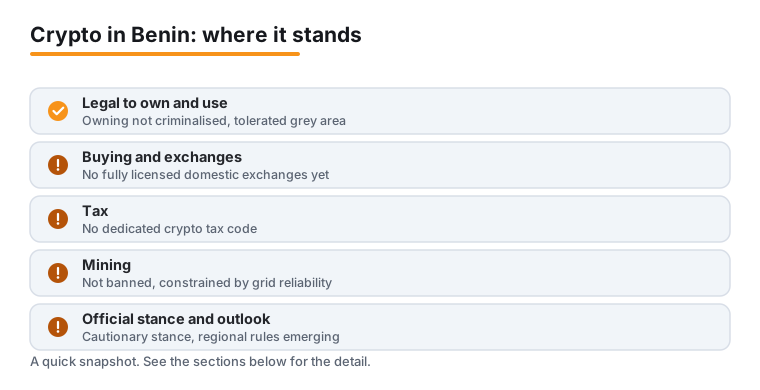
Owning, buying and selling Bitcoin and other cryptocurrencies is not a criminal offence for private individuals in Benin. No law criminalises simply holding crypto, and many Beninese already use mobile-first apps and peer-to-peer platforms to trade. At the same time, no cryptocurrency is legal tender. The only legal tender is the West African CFA franc (XOF), issued by the BCEAO. Merchants are not obliged to accept Bitcoin, and crypto holdings do not carry the legal protections attached to bank deposits or regulated financial products.
The accurate description for 2026 is a tolerated grey area rather than a clearly licensed market. Independent legal reviews of Benin's exchange-control regime confirm that, as a practical matter, there are no specific national rules dedicated to cryptocurrencies, and no dedicated crypto-trading statute had been enacted at the time of writing. What does apply is a growing layer of anti-money-laundering and foreign-exchange obligations set at the WAEMU level. Treat any blanket claim that crypto is fully "legal and regulated" or outright "banned" with caution, and verify the current position against official BCEAO and Beninese government sources.
Who regulates crypto in Benin: the BCEAO and WAEMU
The central authority is the Central Bank of West African States (BCEAO), the shared central bank and financial regulator for the eight WAEMU/UEMOA members, of which Benin is one. The BCEAO issues the CFA franc, oversees banks and electronic-money issuers, sets foreign-exchange rules and is the body driving the region's emerging approach to crypto-assets.
At the national level, Benin's Ministry of Economy and Finance and its agencies apply WAEMU rules locally, and the tax administration, the Direction Generale des Impots, handles taxation. The BCEAO has created an internal committee (often referred to as C-CRYPTO) to study crypto-asset regulation for the union, signalling that future rules are likely to be designed regionally and then transposed into Benin's law rather than written from scratch in Benin alone. For now, the BCEAO's public stance has been cautionary: senior officials have repeatedly described crypto-assets as highly volatile and speculative and urged the public across the union to exercise caution.
Key laws and frameworks
Benin's crypto-relevant rules come from two layers: national legislation and the WAEMU regional framework administered by the BCEAO. The main instruments to know are:
- Law No. 2024-01 of 20 February 2024 on anti-money-laundering and counter-terrorist-financing (AML/CFT), which transposes the UEMOA uniform directive into Benin's law. This comprehensive text (more than 200 articles) introduces the concept of Virtual Asset Service Providers (in French, prestataires de services sur actifs virtuels, PSAV) and provides that their activities are subject to prior approval or authorisation (agrement ou autorisation prealable). Crucially, the law leaves it to additional texts to designate the competent authorities and to set the detailed conditions for operating, which means that as at August 2026 no implementing text had been published, so no application route exists even though Article 58 makes prior authorisation a legal precondition. Payment providers, by contrast, do have a working regime: 30 payment institutions were licensed across the WAEMU as at 15 September 2025 under BCEAO Instruction No. 001-01-2024 of 23 January 2024, two of them established in Benin.
- WAEMU Foreign Exchange Regulation No. 06/2024/CM/UEMOA, adopted on 20 December 2024, which replaced the older 2010 regime and tightened controls on cross-border financial flows, repatriation of income and the domiciliation of transactions through approved local intermediaries, expanding the BCEAO's oversight.
- BCEAO Instruction No. 008-05-2015, which governs electronic-money issuers across WAEMU and forms part of the toolkit authorities can apply to crypto-adjacent payment activity.
The clear trend is regional convergence around AML/CFT and know-your-customer (KYC) standards. Anyone running a crypto business in Benin should assume authorisation requirements and reporting obligations will keep expanding, and should take local legal advice.
Licensing and registration of exchanges and VASPs
Benin's 2024 AML/CFT law brings Virtual Asset Service Providers (PSAV) into scope and states that their activities require prior approval or authorisation. In principle, that means crypto exchanges, custodians and similar businesses serving Benin are expected to be authorised and to meet AML/CFT, customer due-diligence and reporting standards.
In practice, however, the implementing texts that would name the competent licensing authority and define the application process and operating conditions had not been fully rolled out as of 2026. The result is a gap between the law's direction and an operational licensing regime. There were no Benin-based, fully licensed domestic crypto exchanges operating under a clear, dedicated framework at the time of writing. Businesses considering entering the market should monitor BCEAO and government publications closely, engage local counsel, and be ready to comply with WAEMU-wide standards once the detailed framework is published. The wider regional picture reinforces this direction: the BCEAO began licensing fintechs in 2025 and is actively studying a harmonised crypto framework for the union.
Crypto and Bitcoin tax in Benin
Benin does not have a dedicated, clearly published crypto-tax code, so cryptocurrency gains are generally assessed under existing tax principles rather than a bespoke regime. Depending on the facts, profits from disposing of crypto could be treated as taxable income or as a gain, and activity carried on as a business may be taxed differently from occasional personal investment. Crypto received as payment for goods, services or work can also have tax consequences.
No Beninese text sets a crypto-specific rate or threshold for individuals. What exists are the ordinary rates that crypto activity falls into: corporate income tax at 30 percent, personal income tax on a progressive scale running from 0 percent below XOF 60,000 to 30 percent above XOF 500,000, VAT at a standard rate of 18 percent, and 15 percent withholding on interest. You may see third-party sites cite precise percentages; treat those as unverified unless they point to an official Beninese source. The responsible approach is to keep detailed records of every transaction (dates, amounts, counter-party and the XOF value at the time) and to confirm your obligations with the Direction Generale des Impots or a qualified local tax adviser before filing. See our general crypto taxes guide for context. This section is informational only and is not tax advice.
AML, KYC and anti-money-laundering rules
Anti-money-laundering and counter-terrorist-financing rules are the most developed part of Benin's crypto-relevant framework. Law No. 2024-01 of 2024 transposes the UEMOA AML/CFT directive and imposes obligations on regulated entities, including risk assessment, customer and transaction due diligence, beneficial-ownership transparency, rules on electronic transfers and compliance with targeted financial sanctions. Virtual Asset Service Providers are explicitly brought within these obligations.
For ordinary users, the practical effect is that reputable platforms serving the region apply increasingly strict identity checks. Expect to provide official ID and, often, proof of address, and to have larger or unusual transactions scrutinised. Anonymous cash-to-crypto channels attract heightened suspicion. These KYC expectations sit alongside the WAEMU foreign-exchange controls described below, and the two together mean that crypto activity in Benin is far from anonymous in practice when conducted through compliant services.
Benin's AML/CFT system is monitored by GIABA, the regional FATF-style body for West Africa. In a follow-up report adopted at GIABA's May 2025 plenary, Benin was assessed as having moderate remaining shortcomings and was kept under an enhanced follow-up regime, with noted gaps including measures on new technologies (FATF Recommendation 15, which covers virtual assets) for some non-financial businesses. The report also recorded progress, with several ratings improved. This external scrutiny is one reason authorities are expected to keep tightening virtual-asset supervision.
Buying and using crypto in practice
With no fully licensed domestic exchange operating under a clear regime, most users in Benin reach crypto through three routes: global centralised exchanges that accept African customers, peer-to-peer (P2P) marketplaces, and fintech apps focused on Francophone Africa that bridge mobile money and crypto. Funding typically flows through popular mobile-money services and, less often, bank cards or transfers. As a concrete example, Binance added mobile-money purchases in West African CFA francs for several Francophone African countries, including Benin, and in an October 2025 expansion widened local payment access across more of the continent; at launch this mobile-money channel supported buy transactions. This shows how residents in practice fund crypto through mobile money rather than a licensed local exchange.
Two compliance realities shape the experience. First, KYC is unavoidable on reputable platforms, as WAEMU's AML/CFT rules push services toward stricter identity checks. Second, foreign-exchange rules matter: under Regulation No. 06/2024/CM/UEMOA, cross-border flows and dealings with non-residents are tightly controlled and must generally pass through approved local intermediaries with the required reporting. Converting crypto to or from foreign currency outside authorised channels can therefore carry regulatory exposure. Practical guidance: choose established platforms with a strong track record, complete KYC honestly, withdraw to a wallet where you control the private keys, keep records of how funds entered and left the system, and be wary of informal off-platform "agents" offering attractive rates.
Bitcoin mining in Benin
There is no specific Beninese law that bans or expressly authorises cryptocurrency mining. In principle, mining is not prohibited, but it is not actively encouraged by a dedicated policy either, and miners would have to work within ordinary rules covering business registration, electricity supply and taxation.
The bigger constraints are practical. Reliable, low-cost electricity is the single most important input for profitable mining, and Benin's grid has historically faced capacity and reliability challenges, with the country importing a share of its power. That makes large-scale, energy-hungry mining difficult to run economically compared with regions that have cheap surplus power, while hot ambient temperatures add cooling costs and imported hardware is expensive. Sources promoting Benin as a future mining hub tend to emphasise potential rather than an established industry, so treat such claims as aspirational. Anyone considering mining should assess real electricity tariffs, confirm the legal and tax treatment of mining income with local advisers, and factor in grid reliability and equipment import duties before committing capital.
Recent developments (2024-2026)
The pace of change has picked up at the regional level, which is where Benin's future rules are being shaped. The most relevant recent developments are:
- 2024: Benin enacted Law No. 2024-01 (20 February 2024), bringing Virtual Asset Service Providers into its AML/CFT framework, and the WAEMU adopted Foreign Exchange Regulation No. 06/2024/CM/UEMOA (20 December 2024), tightening cross-border controls union-wide.
- 2025: The BCEAO began formally licensing fintechs operating in the union, an early step toward bringing previously informal digital-finance activity under supervision. In the same year, a GIABA follow-up report on Benin (adopted May 2025) kept the country under an enhanced AML/CFT monitoring regime, and Binance added mobile-money purchases in CFA francs for Benin, later widened in an October 2025 expansion of local payment access across Africa.
- 2026: The BCEAO convened an international conference on crypto-assets and digital innovations in Dakar on 8 May 2026, aimed at shaping a harmonised regulatory framework for the WAEMU that balances innovation with financial stability. The central bank's dedicated crypto committee (C-CRYPTO) continues this work in liaison with AMF-UMOA, the regional securities regulator formerly known as the CREPMF. On 22 July 2026, presenting the BCEAO's 2025 annual report in Dakar, Governor Jean-Claude Kassi Brou confirmed that crypto-assets are neither a currency nor regulated, and that the framework remains in preparation with no announced deadline.
Detailed crypto rules for Benin are being drafted regionally by C-CRYPTO, the BCEAO committee announced around the central bank's Dakar conference of 8 May 2026, and would then be applied in Benin through national implementing texts. As at 22 July 2026 that committee had published no draft text and the BCEAO had communicated no publication deadline. Because the framework is genuinely evolving, check the BCEAO's official site for the latest position before relying on any summary, including this one.
Consumer risks and protection
Crypto users in Benin face the usual market risks plus a layer of regulatory uncertainty. Because no cryptocurrency is legal tender and there is no dedicated consumer-protection regime for crypto, there is limited legal recourse if a platform fails, a trade goes wrong or you fall victim to fraud. Prices are volatile, local liquidity to convert back into XOF can be thinner than in larger markets, and informal cross-border conversions can run into the WAEMU foreign-exchange controls.
The BCEAO itself has publicly described crypto-assets as highly volatile and speculative and urged the public to exercise caution, a signal that the official approach is cautionary rather than guaranteeing safety. To protect yourself: only commit money you can afford to lose, use established platforms, complete KYC honestly, secure holdings in self-custody where you control the private keys, never share your seed phrase, and avoid "guaranteed return" schemes and high-pressure tactics. When something feels rushed or too good to be true, slow down and verify with official sources.
Official sources and how to verify
Because this area is evolving, always confirm the current position with primary, official sources rather than relying on third-party summaries. The most useful starting points are:
- The Central Bank of West African States (BCEAO) for regional monetary policy, foreign-exchange regulation, electronic-money rules and the union's emerging crypto-asset framework.
- The Direction Generale des Impots du Benin for tax obligations and filing.
- The Direction Generale du Tresor et de la Comptabilite Publique (Tresor public du Benin), which handles public finance and republishes official notices relevant to the financial sector.
You can also compare Benin's position with the wider regional and global picture using our crypto regulation hub. This article is general information as of 2026 and is NOT legal, tax or financial advice; verify the current rules with the BCEAO and Benin's authorities, and consult a qualified local professional before making decisions.
What is changing: crypto in Benin as of August 2026
Benin's legal position on crypto has not changed since this page was last reviewed, and there is now a dated statement on the record rather than an assumption. On 22 July 2026 in Dakar, presenting the BCEAO's 2025 annual report, Governor Jean-Claude Kassi Brou restated the central bank's line on crypto-assets: it is not a currency, it is not regulated, so be cautious. The same briefing confirmed the BCEAO is still building the union's crypto framework with no publication deadline communicated.
Three things are true in Benin right now:
- No crypto-specific statute is in force. Buying, holding and selling crypto is not a criminal offence for an individual. No crypto is legal tender; the CFA franc is. Law No. 2024-01 does make prior authorisation a legal precondition for acting as a virtual asset service provider, but the texts that would set the conditions and name the competent authority have not been published, so there is no route to apply.
- The rules that do bite are AML/CFT, foreign exchange and payments rules. Your bank or mobile money provider applies identity and source of funds checks to crypto-linked flows because it is obliged to, not because crypto is licensed.
- Benin is not on the FATF grey list. The FATF plenary of 17 to 19 June 2026 left 22 jurisdictions under increased monitoring, adding Iraq and Bosnia and Herzegovina and removing Algeria and Namibia. Benin is not among the 22, though fellow WAEMU member Cote d'Ivoire is. Benin is instead in GIABA enhanced follow-up, a regional peer review process and a materially lower-stakes thing than FATF listing.
The crypto rulebook being drafted for Benin, and what it would mean
The detailed rules that will govern crypto in Benin are being written regionally, not in Cotonou. This is the pipeline and what is genuinely known about timing.
- C-CRYPTO, the BCEAO committee drafting the UMOA crypto-asset regulation. The BCEAO confirms it has established a committee to elaborate the regulatory framework for crypto-assets, announced around its international conference on crypto-assets and digital innovations held in Dakar on 8 May 2026, where the central bank called for a balanced approach between innovation, financial stability and security. As at 22 July 2026 the committee had produced no draft text, no public consultation and no adoption date. Concrete effect if adopted: licensing, capital and AML obligations for exchanges and brokers serving Beninese users; reporting duties for banks; likely marketing and disclosure restrictions. Holders would most plausibly face stricter identity and source of funds checks, not a ban.
- AMF-UMOA, the regional securities regulator. Formerly the Conseil Regional de l'Epargne Publique et des Marches Financiers (CREPMF), it is the body that would supervise any crypto product treated as a public offering or investment instrument across the eight WAEMU states, Benin included. The BCEAO's regulatory work on crypto is being conducted in liaison with AMF-UMOA.
- An e-CFA central bank digital currency: studies only. On 22 July 2026 the governor said a digital currency is not implemented overnight, that it must first be shown to answer a real need, and that no deployment decision has been taken. The bank has meanwhile created a financial innovation directorate and a regulatory sandbox so fintechs can test products under supervision. An e-CFA would be central bank money, not a crypto-asset, and would neither legalise nor prohibit private crypto.
The realistic sequence is a regional regulation first, then Beninese implementing texts. No official body has attached a year to either step, and this page will not invent one.
Which Benin taxes actually apply to crypto today
There is no crypto-specific tax in Benin and no crypto line on a Beninese return. That does not mean crypto is untaxed. It means a crypto gain falls into whichever ordinary head of tax fits the facts, at ordinary Benin rates. These are the rates that would apply, from a country tax profile updated in July 2026:
| Head of tax | Rate | When it plausibly reaches crypto |
|---|---|---|
| Corporate income tax (impot sur les societes) | 30 percent | Trading or mining through a company. |
| Personal income tax (IRPP), progressive | 0 percent below XOF 60,000; 10 percent from 60,001 to 150,000; 15 percent from 150,001 to 250,000; 19 percent from 250,001 to 500,000; 30 percent above XOF 500,000 | Crypto received as pay, or activity carried on habitually enough to count as a trade rather than occasional personal investment. |
| VAT (TVA) | 18 percent standard rate | Supplying goods or services in Benin. Invoicing in crypto does not remove a VAT liability. |
| Withholding on interest | 15 percent | Interest-bearing or lending arrangements. |
| Withholding on dividends | 15 percent standard; 10 percent on regularly distributed amounts; 5 percent on regularly distributed amounts to non-residents; 7 percent for companies listed on an approved WAEMU stock exchange | Distributions from a company used to hold or trade crypto. |
None of these is a crypto rule, and no Beninese text states that an occasional personal crypto disposal is taxed at a set rate. That gap is in the law, not in this page. The nearest movement is on the digital economy generally: the supplementary finance law adopted by the National Assembly on 19 June 2026 takes into account certain activities of non-resident operators and revenue generated by digital platforms. No provision names crypto-assets, so do not read it as a crypto tax. Keep dated records of every transaction with the XOF value at the time, and confirm your position with the Direction Generale des Impots or a qualified local adviser before filing. This is information, not tax advice.
Where to report a crypto scam in Benin
Benin has a named national body for digital fraud that most crypto guides omit: the Centre National d'Investigations Numeriques (CNIN). In July 2025 CNIN publicly warned that a fraudulent document circulating in Benin, usurping the identity of the Ministere de l'Economie et des Finances, was promoting a purported cryptocurrency investment opportunity. CNIN published two reporting routes: the email address [email protected] and the cnin.bj website. That alert dates from July 2025, not 2026, but the reporting channel remains the live one.
Note what this does and does not give you. CNIN is a criminal investigation route. It is not a financial ombudsman and it cannot recover funds. Because no crypto exchange is licensed in Benin, there is no domestic regulator with the power to compensate you if a platform collapses or freezes your account, and no deposit guarantee applies. That absence of recourse, rather than any risk of prosecution for holding crypto, is the practical legal risk in Benin today.
Frequently asked questions
Is cryptocurrency legal in Benin?
Holding, buying and selling crypto is not a criminal offence for individuals, and there is no law banning ownership. However, no cryptocurrency is legal tender; only the West African CFA franc (XOF), issued by the BCEAO, is. There are no specific national crypto-trading rules, so crypto sits in a tolerated grey area that is increasingly subject to WAEMU-wide anti-money-laundering and foreign-exchange controls. This is general information, not legal advice; verify with the BCEAO.
Who regulates crypto in Benin?
The main authority is the Central Bank of West African States (BCEAO), the shared central bank and regulator for the WAEMU/UEMOA bloc that Benin belongs to (official site bceao.int). Nationally, Benin's Ministry of Economy and Finance applies WAEMU rules and the Direction Generale des Impots handles tax. The BCEAO has set up a committee to study a harmonised crypto framework for the union, so future rules are likely to be designed regionally.
Do crypto exchanges need a licence in Benin?
Benin's Law No. 2024-01 of 20 February 2024 introduces Virtual Asset Service Providers (PSAV) and states their activities require prior approval or authorisation. However, the implementing texts that would name the competent authority and define the licensing process were not fully in place as of 2026, so there was no operational domestic licensing regime and no fully licensed Benin-based exchange. Check the BCEAO for the latest position.
Do I have to pay tax on crypto in Benin?
Benin has no dedicated crypto-tax code, so gains are generally assessed under existing tax rules and could be treated as income or a gain depending on the activity. No specific statutory crypto rate or threshold has been reliably confirmed, so do not rely on percentages quoted by third-party sites. Keep full records of every transaction in XOF terms and confirm your obligations with the Direction Generale des Impots (impots.bj) or a qualified adviser. This is not tax advice.
What are the main legal risks of using crypto in Benin?
The key risks are the lack of legal-tender status and dedicated consumer protection (limited recourse if a platform fails or a trade goes wrong), price volatility, scams , thin local liquidity, and the WAEMU foreign-exchange controls under Regulation No. 06/2024/CM/UEMOA, which restrict cross-border flows and require dealings to pass through approved local intermediaries. Converting crypto to or from foreign currency through informal channels can carry regulatory exposure.
How do people in Benin actually buy crypto?
With no fully licensed domestic exchange, most residents use global exchanges that accept African customers, peer-to-peer marketplaces, and fintech apps for Francophone Africa, funding purchases mainly through mobile money. As a concrete example, Binance added mobile-money purchases in West African CFA francs for several countries including Benin, later widened in an October 2025 expansion of local payment access across Africa. Reputable platforms require KYC identity checks, and cross-border conversions can run into WAEMU foreign-exchange controls. This is general information, not financial advice.
Is Benin on any international watch list for money laundering?
Benin's anti-money-laundering system is reviewed by GIABA, the FATF-style regional body for West Africa. In a follow-up report adopted at GIABA's May 2025 plenary, Benin was assessed as having moderate remaining shortcomings and was kept under an enhanced follow-up regime, while also recording progress on several ratings. Gaps noted included measures on new technologies (FATF Recommendation 15, which covers virtual assets) for some non-financial businesses. This scrutiny is one reason virtual-asset supervision is expected to keep tightening. Verify the current status with GIABA and the BCEAO.
Where can I check the official rules for crypto in Benin?
Start with the BCEAO (bceao.int) for regional monetary, foreign-exchange and crypto-asset policy, the Direction Generale des Impots (impots.bj) for tax, and the Tresor public du Benin (tresorbenin.bj), which handles public finance and republishes official notices relevant to the financial sector. Because the framework is evolving, always verify against these primary sources and take qualified local advice before acting.
Is a crypto law coming to Benin, and when?
Yes, but not from Benin and not on a published schedule. The BCEAO set up a committee called C-CRYPTO to draft a crypto-asset regulation for the whole West African Monetary Union, announced around its Dakar conference on 8 May 2026. As at 22 July 2026 there was no draft text, no consultation and no adoption date, and reporting of the governor's briefing that day states explicitly that no publication deadline has been communicated. Once a regional regulation is adopted, Benin would still need national implementing texts. Anyone quoting you a specific year is guessing.
What tax rate applies to crypto profits in Benin?
There is no crypto-specific rate. Depending on the facts, a crypto gain falls under an ordinary head of tax: corporate income tax at 30 percent if you trade through a company, personal income tax on a progressive scale from 0 percent below XOF 60,000 up to 30 percent above XOF 500,000 if the activity is a trade or the crypto is payment for work, VAT at a standard 18 percent on supplies of goods and services, and 15 percent withholding on interest. No Beninese text says an occasional personal crypto disposal is taxed at a set rate. Keep dated records with the XOF value at the time and confirm with the Direction Generale des Impots before filing.
Who is actually writing the crypto rules that will apply in Benin?
Two regional bodies rather than a Beninese one. The BCEAO, through its C-CRYPTO committee, is drafting the crypto-asset framework for the eight WAEMU states, and is doing so in liaison with AMF-UMOA, the regional securities regulator formerly called the CREPMF, which would supervise anything treated as a public offering or investment instrument. Benin's own contribution so far is Law No. 2024-01 of 20 February 2024, whose Article 58 requires prior approval to act as a virtual asset service provider but leaves the operating conditions to texts that have not been issued.
Where do I report a crypto scam in Benin?
To the Centre National d'Investigations Numeriques (CNIN), by email at [email protected] or through cnin.bj. CNIN warned publicly in July 2025 about a fraudulent document usurping the identity of the Ministere de l'Economie et des Finances to promote a purported crypto investment opportunity. Be realistic about what this achieves: CNIN is a criminal investigation body, not a financial ombudsman, and it cannot recover your funds. Because no crypto exchange is licensed in Benin, there is no domestic regulator that can compensate you if a platform fails.
Is Benin on the FATF grey list?
No. After the FATF plenary of 17 to 19 June 2026 there were 22 jurisdictions under increased monitoring, and Benin was not among them, although fellow WAEMU member Cote d'Ivoire was. Benin is in GIABA enhanced follow-up, a regional peer review process that tracks progress on technical compliance. The two are often confused. GIABA follow-up is not the FATF grey list and carries none of the same consequences for correspondent banking.
Facts reviewed: 8 August 2026. Page updated: 8 August 2026.