Home › Crypto Regulation › Nigeria
Bitcoin & Cryptocurrency Regulation in Nigeria
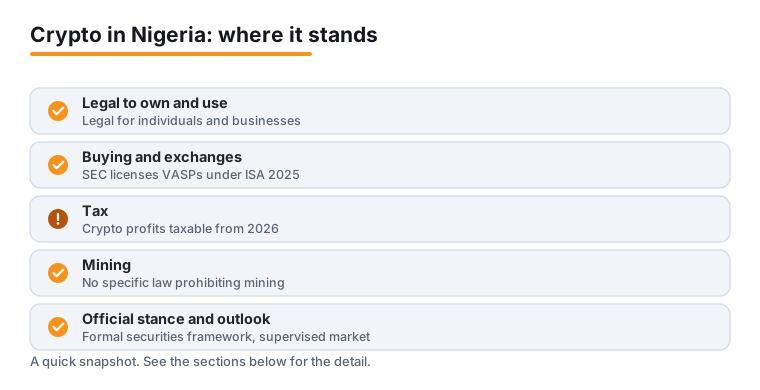
Quick answer — Nigeria, 2026
- Legal: Legal to own and trade, treated as securities, not legal tender
- Tax: Gains taxed on six bands, 0 percent up to 800,000 naira and 25 percent above 50 million naira
- Buying: Via SEC-engaged domestic platforms, major foreign exchanges blocked
Nigeria is one of the largest and most active cryptocurrency markets in Africa, driven by a young, tech-fluent population, repeated naira depreciation, and strong demand for cheaper cross-border payments. The country's stance has shifted sharply: from a February 2021 banking restriction that pushed activity into informal peer-to-peer (P2P) channels, to a formal framework that now treats digital assets as securities under the Investments and Securities Act 2025, licenses the businesses that handle them, and brings crypto profits into the tax net. This page explains the current state of Nigeria crypto regulation as of 2026: the legal status of Bitcoin, who regulates the sector, the key laws, how exchanges are licensed, how crypto is taxed, AML and KYC rules, and practical and consumer-protection points.
This is general information as of 2026 and is not legal, tax, or financial advice. Nigeria's crypto rules are changing quickly, so always verify the current position with the named official regulators (the Securities and Exchange Commission, the Central Bank of Nigeria, and the Nigeria Revenue Service / Federal Inland Revenue Service) or a qualified Nigerian professional before acting. See also our overviews of crypto regulation and crypto rules by country.
On this page: Legal status · Who regulates it · Taxes · How to buy · Mining
Is Bitcoin and crypto legal in Nigeria?
Yes. Owning, buying, selling, and trading Bitcoin and other cryptocurrencies is legal for individuals and businesses in Nigeria. Crypto is not legal tender; only the naira (and the Central Bank of Nigeria's eNaira digital currency) holds that status, and no merchant can be forced to accept crypto in place of naira. But there is no law that makes simply holding or transacting in crypto a criminal act.
The important change is that the sector is now formally regulated rather than merely tolerated. With the Investments and Securities Act 2025, digital assets are legally recognised as securities, businesses that offer crypto services to the public must be licensed or registered with the Securities and Exchange Commission (SEC), and banks may only serve crypto firms that meet regulatory conditions. So while personal use is legal, providing crypto services without authorisation is not. This is a significant move from the earlier period when banks were directed to stop facilitating crypto transactions altogether.
Because licensing and enforcement are still maturing, an ordinary user's practical experience can differ from the letter of the rules. Treat the framework as a clear direction of travel toward supervised, taxed activity, and verify the standing of any platform you use.
Who regulates crypto in Nigeria?
Three institutions now share responsibility for crypto oversight in Nigeria:
- Securities and Exchange Commission (SEC) is the lead market regulator for digital assets. Under the Investments and Securities Act 2025, the SEC sets the rules for token issuance, exchanges, custodians, and other Virtual Asset Service Providers (VASPs), and handles registration, licensing, supervision, and enforcement. Its official site is sec.gov.ng.
- Central Bank of Nigeria (CBN) is the monetary and banking authority. It governs how licensed banks and payment institutions may interact with crypto businesses, issued the 2023 guidelines on operating bank accounts for VASPs, and runs the eNaira central bank digital currency. Its official site is cbn.gov.ng.
- Nigeria Revenue Service (NRS), the renamed Federal Inland Revenue Service (FIRS), administers and enforces tax on crypto activity under the 2025 tax reform laws. Since the rename took effect on 1 January 2026, the NRS operates its own site at nrs.gov.ng (the former firs.gov.ng address may redirect or become stale).
State internal revenue services may also be relevant for personal income tax. For a broader primer on how regulators approach digital assets, see our guide to crypto regulation.
Key crypto laws and frameworks in Nigeria
Nigeria has no single "crypto act." Instead, the framework has been built up through a series of milestones and is anchored by the 2025 securities and tax reforms:
- February 2021: The CBN directed banks and financial institutions to stop facilitating crypto transactions, cutting off regulated banking rails. Activity continued largely through P2P channels.
- May 2022: The SEC issued rules on the issuance, offering, and custody of digital assets, signalling intent to regulate rather than prohibit.
- December 2023: The CBN issued Guidelines on Operations of Bank Accounts for Virtual Asset Service Providers, lifting the blanket banking restriction. Banks may now open designated accounts for crypto firms holding the relevant SEC licence, though banks themselves remain barred from trading or holding crypto on their own account, and VASP platform transactions are to be in naira.
- June 2024: The SEC launched the Accelerated Regulatory Incubation Programme (ARIP) to onboard exchanges and other VASPs in a sandbox-style environment.
- March 2025: President Bola Tinubu signed the Investments and Securities Act (ISA) 2025, which repealed the 2007 Act and expanded the legal definition of "securities" to include virtual and digital assets, placing crypto squarely under SEC oversight. The Act was gazetted on 2 May 2025.
- June 2025: The SEC's digital asset rules came into force, and the President signed the 2025 tax reform laws (see the taxation section below).
The published entry requirements are concrete: an ARIP application carries a non-refundable processing fee of 2,000,000 naira, evidence of shareholders' funds with a fidelity bond covering at least 25 percent of those funds, and at least four sponsored principal officers. The separate Regulatory Incubation track carries a 50,000 naira non-refundable assessment fee and runs for one year. Always check the SEC's official publications for the current detail rather than relying on summaries.
Licensing and registration of exchanges and VASPs
Under the ISA 2025, entities that deal in digital assets, including Digital Asset Exchanges, Digital Asset Offering Platforms, custodians, and other VASPs, must register with and obtain authorisation from the SEC. Applicants are expected to meet fit-and-proper criteria, satisfy capital-adequacy and risk-management standards, and apply AML and KYC controls.
The main on-ramp has been the SEC's Accelerated Regulatory Incubation Programme (ARIP), launched in June 2024. Two domestic operators, Busha and Quidax, received provisional approvals (approval-in-principle) on 29 August 2024 as Digital Asset Exchanges, with Quidax the first to be onboarded. A further group of firms was later admitted into ARIP to test their models, reported to include Trovotech, Wrapped CBDC, HousingExchange.NG, Dream City Capital, and Blockvault Custodian. ARIP was intended as a step toward full VASP licences, but as of 3 August 2026 no firm had progressed from ARIP to full registration, and the SEC's published register still listed only Busha and Quidax as ARIP participants: Busha and Quidax still held only their 2024 provisional approvals despite the promised 12-month transition, and operators have described ARIP as a sandbox rather than a licence. The SEC has also slowed new provisional approvals, citing the need for additional due diligence, so the authorised list has effectively stalled and is best checked directly with the regulator.
For users, the practical point is to favour platforms that are licensed, registered, or visibly working through the SEC's process, and to verify a platform's regulatory standing on the SEC site before depositing funds. Banking access for these licensed firms was restored by the CBN's 2023 VASP account guidelines, which over time should make naira on-ramps and off-ramps more transparent than the informal channels that filled the gap after 2021.
Crypto and Bitcoin tax in Nigeria
Crypto is now firmly inside Nigeria's tax net. The Nigeria Tax Act 2025 and accompanying reform laws were signed on 26 June 2025 and took effect on 1 January 2026. They explicitly recognise profits from digital and virtual assets as taxable, building on the Finance Act 2023, which had already listed digital assets as chargeable assets for capital gains purposes.
Broadly, gains and income from crypto are treated like gains and income from other assets and business activity. For individuals, crypto gains are generally treated as chargeable gains taxed under progressive personal income tax bands rather than the former flat 10 percent capital gains charge; reporting suggests a top marginal rate of 25 percent, which applies to taxable income above 50 million naira, while individuals with total annual income (including crypto profits) below the small-income threshold of about 800,000 naira (roughly 545 US dollars at 2026 rates) are exempt. Income-type receipts such as staking rewards, mining rewards, and airdrops are generally treated as ordinary income when received rather than as capital gains, and reporting suggests that losses may be carried forward to offset future chargeable gains. Businesses may face company income tax, and licensed VASPs are expected to report user transaction data to the tax authority. The 2025 reforms also rename the Federal Inland Revenue Service as the Nigeria Revenue Service and tie compliance to taxpayer identification (TIN) and national identity (NIN) linkage.
On the filing side, individuals are generally expected to declare crypto gains and income in their annual return, filed through the tax authority's TaxPro-Max portal, with an annual filing deadline of 31 March covering income earned in the previous calendar year. Licensed exchanges are expected to report transactions linked to a user's TIN automatically, so on-platform activity is increasingly visible to the authorities. Penalties for non-compliance under the reform laws can be significant. Because the mechanics are new and being bedded in, treat any specific deadline, penalty, or figure as provisional and confirm it with the Nigeria Revenue Service before filing.
Exact rates, thresholds, exemptions, and filing mechanics depend on your activity, residency, and the rules in force when a transaction occurs, and these figures are evolving. The personal income tax bands in force since 1 January 2026 are 0 percent on the first 800,000 naira, 15 percent from 800,001 to 3 million naira, 18 percent from 3 million to 12 million naira, 21 percent from 12 million to 25 million naira, 23 percent from 25 million to 50 million naira, and 25 percent above 50 million naira. The personal income tax and capital gains tax regimes have been merged, so chargeable gains for individuals, including gains on digital assets, are taxed at those same bands rather than at the former flat 10 percent rate. What you personally owe still depends on your total income and residency, so confirm your own position before filing. Keep clear records of every transaction (dates, amounts, naira values, counterparties, and purpose), file through the official channels, and confirm your obligations with the Nigeria Revenue Service / FIRS, your state revenue service, or a qualified adviser. See our general explainer on crypto taxes. This section is informational only and is not tax advice.
AML, KYC, and identity rules
Anti-money-laundering (AML), counter-terrorist-financing (CFT), and know-your-customer (KYC) controls are central to Nigeria's framework. Licensed VASPs must verify customer identities, monitor transactions on an ongoing basis, and apply controls consistent with the SEC's rules and the CBN's VASP account guidelines. Banks serving crypto firms are required to take reasonable measures to establish the beneficial ownership and source of funds behind designated accounts.
From the 2026 tax reforms, identity linkage is also tightening: users transacting through regulated platforms are expected to provide a Tax Identification Number and National Identification Number, and exchanges are not meant to facilitate transactions for users who have not supplied them. Licensed platforms are also expected to file regular reports on user activity to the tax authority. In practice this means you should expect full identity verification on any compliant Nigerian platform, and you should be wary of services that ask for none.
Buying and using crypto in practice
Nigerians buy crypto mainly through online exchanges and P2P marketplaces, and the licensing shift is steadily reshaping how that works. A careful approach looks like this:
- Choose a compliant platform. Favour exchanges that are licensed, registered, or visibly working through the SEC's ARIP process, with clear KYC and AML procedures.
- Verify your account. Expect to provide identity documents, proof of address, and (under the 2026 rules) your TIN and NIN.
- Fund your account. With banking access restored for licensed VASPs, naira bank transfers are becoming more workable; check funding methods, fees, and limits.
- Order and secure. Review fees and the exchange rate before confirming, enable two-factor authentication, use strong unique passwords, and consider moving longer-term holdings to a wallet you control, ideally a hardware wallet.
- Keep records for tax and personal tracking.
Note that the relationship between Nigeria and some large international exchanges has been turbulent: in early 2024 Binance delisted the naira from its P2P platform, two of its executives were detained, and the SEC moved to curb naira-denominated P2P trading over concerns it was being used to influence the exchange rate. Separately, in February 2024 the Nigerian Communications Commission directed telecom and internet providers to block access to several major foreign exchanges (Binance, Coinbase, Kraken, OKX, Luno, and Bybit); that block remained in force into 2026, so those platforms stay inaccessible to ordinary Nigerian users (short of a VPN) and have not sought local licences, even though crypto itself is now legal and regulated. In practice the realistic on-ramps are domestic SEC-engaged platforms such as Busha and Quidax. Availability and features of foreign platforms can change without notice, and informal P2P deals carry higher fraud and chargeback risk, so verify standing before sending money. For remittances, Bitcoin and dollar-pegged stablecoins are popular for moving value across borders quickly, but volatility, cash-out friction, and foreign-exchange and AML rules all apply; many users favour stablecoins to reduce price risk.
Bitcoin mining in Nigeria
There is no specific Nigerian law that prohibits cryptocurrency mining, and mining Bitcoin or other proof-of-work assets is generally permissible. It is not, however, governed by a dedicated mining regime; instead it sits within ordinary business, tax, and energy constraints:
- Electricity and cost: Mining is energy-intensive, and Nigeria's grid reliability and electricity costs, plus heavy reliance on generators in many areas, make large-scale mining economically challenging compared with regions that have cheaper, more stable power.
- Business and tax compliance: Operating a mining business can trigger company registration, tax, and reporting obligations, and mining income may be taxable under the 2025 tax laws.
- Equipment imports and forex: Sourcing hardware involves import procedures and foreign-exchange considerations that can be affected by currency controls.
Anyone planning to mine at scale should seek professional advice on the business, tax, and energy implications and watch for any mining-specific guidance from the SEC or other agencies.
Recent developments (2024 to 2026)
The pace of change has been rapid:
- 2024: The SEC launched ARIP and granted the first provisional approvals (Busha and Quidax); the Binance dispute and detention of executives unfolded; and the SEC moved to curb naira-denominated P2P trading.
- March 2025: The Investments and Securities Act 2025 was signed, classifying digital assets as securities.
- June 2025: The SEC's digital asset rules came into force, and the four 2025 tax reform laws were signed.
- 1 January 2026: The new tax regime took effect, taxing crypto profits, renaming FIRS as the Nigeria Revenue Service, and tying compliance to TIN/NIN identity linkage and platform reporting.
- Licence freeze: Despite the June 2025 rules and the 2026 tax regime, no firm had advanced from ARIP to a full VASP licence by late 2025; Busha and Quidax remained on their 2024 provisional approvals, so the regulated-platform list had stalled rather than expanded ("tax first, licence later").
- Foreign-exchange block: The February 2024 NCC order blocking telecom and internet access to Binance, Coinbase, Kraken, OKX, Luno, and Bybit remained in force into 2026, keeping those exchanges inaccessible to ordinary users even though crypto is now legal.
- eNaira: Adoption of the CBN's retail eNaira CBDC has remained limited; by late 2025 the CBN signalled a shift in emphasis toward wholesale CBDC use. Confirm its current status with the CBN.
The overall direction is clear: Nigeria is building a supervised, taxed market rather than shutting crypto out. Because details are still being refined, treat any specific figure or licence list as provisional and check the official sources.
Consumer risks and protection
Nigeria's crypto market carries the usual risks (price volatility, scams and Ponzi schemes, phishing and account theft, and platform insolvency), amplified by a framework that is still settling. Specific local risks worth noting:
- Regulatory change: Rules, licensing requirements, and the treatment of particular platforms can shift quickly; a service available today may change features or access tomorrow.
- Foreign-exchange policy: Authorities have shown concern about crypto's effect on the naira, including action against naira-denominated P2P trading, so off-ramp conditions can tighten.
- Informal channels: Deals outside licensed platforms offer little recourse if something goes wrong.
To protect yourself, use platforms that operate within Nigerian regulation, complete identity verification, fund through traceable methods, secure accounts with two-factor authentication, hold longer-term funds in a wallet you control, avoid anyone promising guaranteed or unusually high returns, and only commit money you can afford to lose. If a platform is regulated, the SEC's investor-protection and complaints channels may offer recourse; unregulated services generally do not. This page is informational only and is not legal, tax, or financial advice.
Official sources and how to verify
Crypto rules in Nigeria are evolving, so always confirm the current position directly with the responsible authorities rather than relying on third-party summaries. The primary official sources are:
- Securities and Exchange Commission (SEC), Nigeria for digital asset rules, VASP/exchange licensing, ARIP, and enforcement: sec.gov.ng.
- Central Bank of Nigeria (CBN) for the VASP bank-account guidelines, banking-sector rules, and the eNaira: cbn.gov.ng.
- Nigeria Revenue Service / Federal Inland Revenue Service (FIRS) for crypto taxation, filing, and identity-linkage requirements: nrs.gov.ng (the older firs.gov.ng link may redirect).
To verify a platform, check whether it appears on the SEC's published list of registered or ARIP-approved operators, and confirm any tax figure against current NRS/FIRS guidance, since rates and thresholds can change. This is general information as of 2026 and is not legal advice; verify your situation with the SEC, CBN, NRS/FIRS, or a qualified Nigerian professional. For more, see our hub on crypto regulation.
What changed in July 2026
Nigeria's framework moved again after this page was last reviewed on 30 June 2026. The main change is the Presidential Executive Order on Virtual Assets Coordination, 2026, signed by President Tinubu on Friday 17 July 2026. It was made pursuant to section 5 of the Constitution of the Federal Republic of Nigeria, 1999 (as altered), and took effect immediately.
The State House statement says the Order does not create a new regulator and does not transfer powers between agencies. What it changes is which agency a crypto business registers with, and how the agencies work together.
- Registration follows the activity and the asset. Virtual assets and activities that behave like securities are registered by the Securities and Exchange Commission. Payment, settlement, custody and related services involving non-security virtual assets are registered by the Central Bank of Nigeria.
- A Virtual Asset Council sets policy direction. It is chaired by the CBN, with the Nigeria Revenue Service and the SEC as vice-chairs, and the Nigerian Financial Intelligence Unit and the Office of the National Security Adviser as members. It works with the Attorney-General of the Federation on a harmonised legal and institutional framework.
- A Virtual Asset Office is the Council's operational body, with its secretariat domiciled at the CBN.
- The Council was directed to develop a Harmonised Implementation Framework within 30 days of the Order, which falls due in mid-August 2026.
Three further items were announced alongside the Order and none of them had been published as of 3 August 2026: a CBN regulatory sandbox for virtual asset and blockchain products, an NRS tax policy for the virtual assets sector, and a Federal Government Virtual Assets White Paper setting longer-term policy direction. Because this is an executive order rather than an Act, it coordinates the existing framework, including the Investments and Securities Act 2025 and the 2025 tax laws, rather than replacing it or creating new statutory offences (Banwo and Ighodalo, Crypto Times).
What is coming next, and roughly when
Nigeria still has no single crypto Act. This is what is adopted, what is before the National Assembly, and what has only been announced, as at 3 August 2026.
| Instrument | Stage | Timing |
|---|---|---|
| Presidential Executive Order on Virtual Assets Coordination, 2026 | In force | Effective on signing, 17 July 2026 |
| Harmonised Implementation Framework under the Order | Directed, not yet published | Due within 30 days of the Order, so mid-August 2026 |
| Virtual Asset Service Providers Regulation Bill, 2026 (SB 956) | Before the Senate | Second reading 9 June 2026, then referred to the Senate Committee on Capital Market with a four-week reporting mandate. No third reading, House passage or assent found as at 3 August 2026 |
| CBN regulatory sandbox for virtual assets | Announced only | No date stated |
| NRS tax policy for the virtual assets sector | Announced only | No date stated |
| Federal Government Virtual Assets White Paper | Being finalised | No date stated |
The Senate bill is sponsored by Deputy Senate President Barau Jibrin and was presented on the floor by Chief Whip Mohammed Tahir Monguno. It would require virtual asset service providers to be licensed and to meet anti-money-laundering, counter-terrorist-financing and investor-protection requirements. Second reading is an early stage. The bill must still clear committee, third reading in the Senate, passage by the House of Representatives and presidential assent before any of it binds anyone (Voice of Nigeria, The Nation, Leadership).
Which platforms actually hold SEC approval
Checked against the SEC's own register of FinTech operators on 3 August 2026, only two firms appear as Accelerated Regulatory Incubation Programme participants: Busha Digital Limited and Quidax Technologies Limited, both listed as Digital Assets Exchange. No digital asset exchange appears among the SEC's fully registered categories, which cover crowdfunding, robo advisers, digital sub-brokers and digital investment managers.
Reporting in early July 2026 said seven further firms had been admitted to ARIP: Bitbarter Technologies, Luno Fintech Nigeria, GetEquity, Koinkoin Global Network, Wrapped CBDC, Trovotech and Blockvault Custodian (Nairametrics, TechEconomy). Treat this as unconfirmed. TechEconomy records that the sole source was a statement by the industry association VASPA, and that neither the SEC nor the named firms had independently confirmed the admissions. Those names had still not appeared in the SEC's published ARIP table when it was checked on 3 August 2026, so the register remains the record.
What approval means in practice, from the SEC's own published programme rules:
- An Approval-in-Principle is conditional clearance to operate, not a full licence. The ARIP entries on the register carry no test period dates, unlike the Regulatory Incubation entries.
- An ARIP application requires a non-refundable processing fee of 2,000,000 naira, evidence of shareholders' funds with a fidelity bond covering at least 25 percent of those funds, at least four sponsored principal officers, and a No Objection letter from any sectoral regulator the applicant is already licensed by.
- The separate Regulatory Incubation track is a one-year sandbox with a 50,000 naira non-refundable assessment fee, quarterly progress reports to the Commission, regulatory guidance within 10 months and a decision at the 12-month mark. Wrapped CBDC Ltd, which issues the cNGN stablecoin, along with Trovotech, HousingExchange.NG, DreamCity Capital and Blockvault Custodian, are listed on this track with test periods running 29 August 2024 to 28 August 2025.
- The ARIP description on the SEC's page still refers to the Investments and Securities Act 2007, even though a banner on the same page notes that the Investments and Securities Act 2025 has been assented to. The page carries a publication date of 24 May 2025. That mismatch is a reason to confirm status directly rather than infer it from the site's wording.
To check a platform yourself, use the SEC register linked above, or email [email protected], which the SEC gives as the contact for its innovation programmes.
The 2026 tax rules in actual numbers
Four Acts signed on 26 June 2025 took effect on 1 January 2026: the Nigeria Tax Act 2025, the Nigeria Tax Administration Act 2025, the Nigeria Revenue Service (Establishment) Act and the Joint Revenue Board (Establishment) Act (Forbes). These are the operative figures.
| Annual taxable income | Rate |
|---|---|
| First 800,000 naira | 0 percent |
| 800,001 to 3,000,000 naira | 15 percent |
| 3,000,001 to 12,000,000 naira | 18 percent |
| 12,000,001 to 25,000,000 naira | 21 percent |
| 25,000,001 to 50,000,000 naira | 23 percent |
| Above 50,000,000 naira | 25 percent |
- The personal income tax and capital gains tax regimes have been merged, so chargeable gains for individuals, including gains on digital and virtual assets, are taxed at the bands above rather than at the former flat 10 percent capital gains rate (KPMG, EY).
- Companies income tax is 30 percent for companies that are not small companies, and that is the rate that reaches VASP profits, which come mainly from transaction fees (Mariblock).
- VASPs must hold a Tax Identification Number, register with the Nigeria Revenue Service and file monthly returns disclosing transaction details, types and amounts together with customer information, including Tax Identification Numbers and National Identification Numbers.
- Failure to comply attracts penalties of up to 10 million naira for the first month of default and 1 million naira for each subsequent month, with potential suspension or revocation of the provider's licence.
- Individuals file an annual return by 31 March covering income earned in the previous calendar year. Personal income tax is administered by the State Internal Revenue Service in the state where an individual resides, so the filing channel is not always the federal portal (Punch).
The tax is charged on profit, not on gross transaction value. The NRS has said it will publish a dedicated tax policy for the virtual assets sector, which is the document expected to settle the points that remain unclear, including how staking, mining and airdrop receipts are characterised.
AML rules: the law that applies and Nigeria's FATF status
Nigeria was removed from the Financial Action Task Force grey list at the FATF plenary held between 22 and 24 October 2025, alongside Burkina Faso, Mozambique and South Africa. Nigeria had been placed under increased monitoring on 24 February 2023. The Federal Ministry of Finance described the removal as the outcome of two years of sustained reforms (Federal Ministry of Finance, Aluko and Oyebode). Removal ends increased monitoring. It does not reduce the compliance burden on regulated firms.
The general statute that catches crypto businesses, whether or not the Senate bill ever passes, is the Money Laundering (Prevention and Prohibition) Act 2022. Virtual asset service providers are regarded as financial institutions under the Act, which makes them reporting entities with customer due diligence, record keeping and reporting duties. The same Act sets cash transaction thresholds of 5,000,000 naira for individuals and 10,000,000 naira for bodies corporate, above which transactions must pass through a financial institution (Pavestones Legal). This is why any compliant Nigerian platform will insist on full identity verification.
Frequently asked questions
Is cryptocurrency legal in Nigeria in 2026?
Yes. Buying, holding, and trading cryptocurrency is legal for individuals and businesses in Nigeria, though crypto is not legal tender. Since the Investments and Securities Act 2025, digital assets are legally recognised as securities, the sector is regulated, and businesses offering crypto services to the public must be licensed or registered with the Securities and Exchange Commission (SEC). This is general information, not legal advice; verify with the SEC.
Who regulates crypto in Nigeria?
The Securities and Exchange Commission (SEC) is the lead regulator for digital assets and Virtual Asset Service Providers, handling registration, licensing, market rules, and enforcement. The Central Bank of Nigeria (CBN) oversees how banks interact with crypto firms and runs the eNaira. Tax falls to the Nigeria Revenue Service (the renamed Federal Inland Revenue Service / FIRS) and state revenue authorities.
Did Nigeria ban crypto, and is the ban still in place?
In February 2021 the CBN directed banks to stop facilitating crypto transactions, which restricted banking access but did not make personal crypto use illegal. In December 2023 the CBN issued guidelines allowing banks to operate accounts for SEC-licensed crypto businesses, lifting that blanket restriction. Banks still cannot trade or hold crypto on their own account. Separately, authorities moved in 2024 to curb naira-denominated peer-to-peer trading.
Do I have to pay tax on crypto in Nigeria?
Yes, crypto profits and income are taxable. The Nigeria Tax Act 2025 took effect on 1 January 2026 and explicitly treats gains from digital assets as taxable, generally under progressive personal income tax for individuals (with a small-income exemption around 800,000 naira) and company income tax for businesses. Rates and thresholds are evolving, so keep detailed records and confirm with the Nigeria Revenue Service / FIRS or a qualified adviser. This is not tax advice.
Which crypto exchanges are licensed in Nigeria?
Exchanges and other VASPs must register with and be authorised by the SEC. Under the SEC's Accelerated Regulatory Incubation Programme (ARIP), launched in June 2024, Busha and Quidax received provisional approvals as Digital Asset Exchanges, with further approvals assessed on a due-diligence basis. The authorised list is short and changes over time, so confirm a platform's standing directly on the SEC website before depositing funds.
What is the safest way to buy Bitcoin in Nigeria?
Use a platform that is licensed, registered, or visibly working within SEC regulation, complete full identity verification (including your TIN and NIN under the 2026 rules), and fund through traceable methods. Secure your account with two-factor authentication and move longer-term holdings to a wallet you control. Be cautious with informal peer-to-peer deals, avoid anyone promising guaranteed returns, and verify a platform's regulatory standing before sending money.
Does Binance or Coinbase still work in Nigeria?
Not normally. In February 2024 the Nigerian Communications Commission directed telecom and internet providers to block access to several major foreign exchanges, including Binance, Coinbase, Kraken, OKX, Luno, and Bybit, to curb naira speculation. That block remained in force into 2026, so these platforms stay inaccessible to ordinary Nigerian users without a VPN, and they have not obtained local SEC licences. Crypto itself is legal and regulated in Nigeria, but the practical on-ramps are domestic SEC-engaged platforms such as Busha and Quidax rather than the blocked foreign exchanges.
How and when do I file crypto tax in Nigeria?
Individuals are generally expected to declare crypto gains and income in their annual tax return, filed through the tax authority's TaxPro-Max portal, with an annual filing deadline of 31 March covering income earned in the previous calendar year. You will normally need a Tax Identification Number (TIN) and National Identification Number (NIN) linked to your exchange accounts, and licensed exchanges are expected to report TIN-linked transactions automatically. Rates run on six progressive bands from 0 percent to 25 percent, with the first 800,000 naira of annual taxable income charged at 0 percent and the 25 percent rate applying above 50 million naira. Deadlines and figures are new and can change, so confirm with the Nigeria Revenue Service or a qualified adviser. This is not tax advice.
Are staking, mining, and airdrop rewards taxed in Nigeria?
Reporting on the 2026 tax regime indicates that receipts such as staking rewards, mining rewards, and airdrops are generally treated as ordinary income when received, rather than as capital gains, and are taxable accordingly. A later disposal of those coins can then create a separate chargeable gain or loss. The exact treatment can depend on your circumstances and is still settling, so keep detailed records of what you received, when, and its naira value, and confirm your position with the Nigeria Revenue Service or a qualified adviser.
What is the Presidential Executive Order on Virtual Assets Coordination, 2026?
It is an executive order signed by President Bola Tinubu on Friday 17 July 2026, made pursuant to section 5 of the 1999 Constitution as altered, and effective immediately. The State House says it does not create a new regulator or transfer powers between agencies. It allocates registration by activity: virtual assets and activities that behave like securities are registered by the SEC, while payment, settlement, custody and other non-security virtual asset services are registered by the Central Bank of Nigeria. It also creates a Virtual Asset Council chaired by the CBN, with the Nigeria Revenue Service and the SEC as vice-chairs and the NFIU and the Office of the National Security Adviser as members, plus a Virtual Asset Office with its secretariat at the CBN. The Council was directed to develop a Harmonised Implementation Framework within 30 days, which falls due in mid-August 2026.
Is a crypto law going through the Nigerian parliament right now?
Yes. The Virtual Asset Service Providers Regulation Bill, 2026, numbered SB 956 and sponsored by Deputy Senate President Barau Jibrin, passed second reading in the Senate on 9 June 2026 and was referred to the Senate Committee on Capital Market with a mandate to report within four weeks. It would put VASP licensing, anti-money-laundering and counter-terrorist-financing duties and investor protection on a statutory footing. As of 3 August 2026 no third reading, House of Representatives passage or presidential assent could be found, so it is not law and binds no one yet.
Do I register a crypto business with the SEC or the CBN in Nigeria now?
It depends on what the business does. Under the July 2026 Executive Order, activities involving virtual assets that behave like securities are registered by the Securities and Exchange Commission, while payment, settlement, custody and related services involving non-security virtual assets are registered by the Central Bank of Nigeria. The Harmonised Implementation Framework due in mid-August 2026 is the document expected to set out how the split is applied in practice. It had not been published as of 3 August 2026.
Is Nigeria still on the FATF grey list?
No. Nigeria was removed from the Financial Action Task Force grey list at the plenary held between 22 and 24 October 2025, having been placed under increased monitoring on 24 February 2023. Removal ends increased monitoring but does not lower compliance obligations. Crypto businesses remain caught by the Money Laundering (Prevention and Prohibition) Act 2022, which regards virtual asset service providers as financial institutions and therefore as reporting entities.
What penalties do Nigerian crypto exchanges face for not reporting to the tax authority?
Under the 2025 tax laws in force since 1 January 2026, virtual asset service providers must obtain a Tax Identification Number, register with the Nigeria Revenue Service and file monthly returns disclosing transaction details, types and amounts together with customer information including Tax Identification Numbers and National Identification Numbers. Non-compliance attracts penalties of up to 10 million naira for the first month of default and 1 million naira for every subsequent month, with the potential for suspension or revocation of the licence.
Facts reviewed: 5 August 2026. Page updated: 5 August 2026.